Ruminations

Blog dedicated primarily to randomly selected news items; comments reflecting personal perceptions

Wednesday, July 20, 2022

Coffee: Clean Bill of Health

"Based on this study, clinicians can tell their patients that there is no need for most coffee drinkers to eliminate the beverage from their diet but to be cautious about higher calorie specialty coffees."
Lead study author Dr. Dan Liu, department of epidemiology, Southern Medical University, Guangzhou, China
 
"Researchers from Southern Medical University in Guangzhou, China used data from the U.K. Biobank study health behavior questionnaire to evaluate the associations of consumption of sugar-sweetened, artificially sweetened, and unsweetened coffee with all-cause and cause-specific mortality. More than 171,000 participants from the U.K. without known heart disease or cancer were asked several dietary and health behavior questions to determine coffee consumption habits. The authors found that during the 7-year follow up period, participants who drank any amount of unsweetened coffee were 16 to 21 percent less likely to die than participants who did not drink coffee. They also found that participants who drank 1.5 to 3.5 daily cups of coffee sweetened with sugar were 29 to 31 percent less likely to die than participants who did not drink coffee. The authors noted that adults who drank sugar-sweetened coffee added only about 1 teaspoon of sugar per cup of coffee on average. Results were inconclusive for participants who used artificial sweeteners in their coffee."
Summary, Annals of Internal Medicine
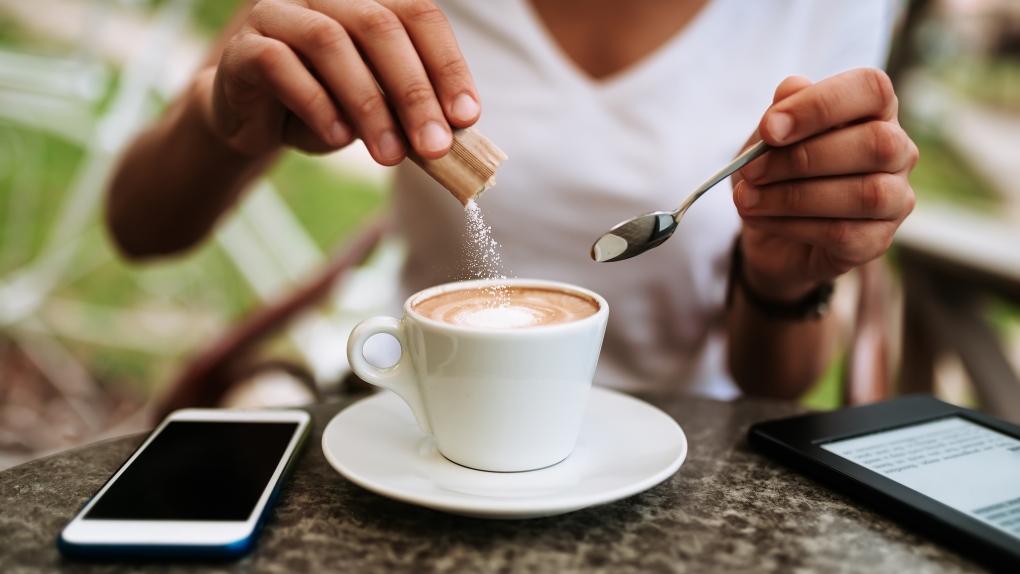
Results of a recent survey showed that for people who drank a moderate amount of coffee, had about a 30 per cent lower death risk compared with non-coffee drinkers. (Adobe Stock/CNN)

According to yet another published study on the health benefits of coffee consumption out of Guangzhou, China published in the Annals of Internal Medicine, people who consume moderate amounts of coffee -- up to three and a half cups daily -- might gain improved chances at achieving a longer life span. This, whether or not the coffee taken is lightly sweetened with sugar.
 
Study researhers tracked coffee consumption and health of 171,616 study participants for a period of seven years. The average age of the participants was around 56 years. All were free of cancer and cardiovascular disease a the beginning of the study. The researchers discovered that people who had a regular habit of drinking one and  a half to three and a half cups of coffee daily either plain or sweetened with a teaspoon of sugar were up to 30 percent less likely to die in the time frame studied from any cause, inclusive of cancer and cardiovascular disease, as opposed to those who drank no coffee at all. 

In addition it made no difference to the outcome, whether the type of coffee consumed was instant, ground or decaffeinated. The study results were noted to be inconclusive for the use of artificial sweeteners. The research does not prove coffee alone to be responsible for lowered mortality risk in participants, but over the years research revealed a variety of health benefits attributed to coffee consumption.

As for xample, a reduced risk for succumbing to Type 2 diabetes, or Parkinson's disease, depression and other chronic life-changing medical conditions. The benefits of coffee has often been attribued by nutritionists to the richness of antioxidants in coffee beans. Believed to help reduce internal inflammation and cell damage as well as protect against disease.

Consuming caffeinated coffee provides as well, an energy boast and is known to increase alertness. At the other end of the spectrum, caffeine is known to have a role in sleep disruption, as well as becoming a risky habit during pregnancy.

 
pouring coffee
Coffee drinkers who consumed 2.5 to 4.5 cups a day, without sugar, had a 29% lower risk of death than non-coffee drinkers, in a seven-year study. Photograph: Anthony Devlin/PA
"The observational nature of this new study means these conclusions are far from definitive."
"This is because coffee drinkers are in general more affluent and have healthier lives than non-drinkers and I remain unconvinced whether these factors can be overcome in observational studies."
"I would suggest people stick to coffee or tea, preferably without sugar, which most people can adapt to, and try to do all the other things we know keep you healthy – move more, eat and sleep better."
Dr. Naveed Sattar, professor of metabolic medicine, University of Glasgow

Labels: , , ,

Friday, October 09, 2020

The Great Barrington Declaration

"We had a taste of freedom as the summer wore on [and now] a pretty dismal [winter is in the wings]."
"Obviously, the Great Barrington fix will excite the minimizers who pretend COVID-19 is not much worse than the flu and enliven the libertarians who object to public health measures on principle."
"So be it: they've been offside all along."
"[There is hope a vaccine may be available by March, and given the prospects] why on earth should we rush to embrace a reckless prescription for a demographically-selective national 'chicken-pox party' involving a dangerous pathogen?"
Dr.David Naylor, co-chair, Canada's COVID-19 immunity task force

"[The most] compassionate approach [leading to herd immunity] is to allow those who are at minimal risk of death to live their lives normally to build up immunity to the virus through natural infection, while protecting those who are at highest risk."
"People who are more at risk may participate [in normal activities] if they wish, while society as a whole enjoys the protection conferred upon the vulnerable by those who have built up herd immunity." 
Declaration authors
Supporters of the Great Barrington Declaration believe young and non-vulnerable people should be allowed to ‘resume life as normal’ to build up herd immunity
Supporters of the Great Barrington Declaration believe young and non-vulnerable people should be allowed to ‘resume life as normal’ to build up herd immunity  (PA)
The Great Barrington Declaration is a 510-word opus written by academics from Harvard, Stanford and Oxford universities whose prestige obviously lends credence to the three academics who put the composition together as a learned trio offering a wise solution to a global public dilemma. They have sufficient clout to have gained an audience with U.S.Health and Human Services Secretary Alex Azar and White House pandemic adviser Scott Atlas himself under scrutiny for his views on herd immunity -- the view of "controlled spread" of the young and healthy who are less likely to perish from COVID in the interests of gaining immunity once recovered, effectively halting the spread of the disease.

Thousands of people have signed on to the declaration, obviously accepting its argument as a sensible solution to the spread of the pathogen. "By way of example, nursing homes should use staff with acquired immunity and perform frequent PCR testing of other staff and all victims", reads the document. Food and essential goods should be delivered to retirees living at home, and those not vulnerable "should immediately be allowed to resume life as normal". In-person teaching at schools and universities should proceed, as well as the resumption of extracurricular activities such as sports as "low risk" adults work normally, and arts, music and cultural events resume. 

The authors point out that lockdowns have resulted in collateral damage on public health, including lower childhood vaccination rates, fewer screenings for cancer and a deterioration in mental health, not to mention domestic violence "leading to greater excess mortality in years to come, with the working class and younger members of society carrying the heaviest burden". "We all feel that the scientific and public discussion has excluded pertinent evidence [about the harms of the lockdown, for instance], and the possibility of a superior approach to the epidemic that would save lives relative to the current approach", pointed out Jayanta Bhattacharya, physician, epidemiologist and health economist at Stanford University Medical School.

Hospitalizations are steeply rising in the United States, with confirmed case numbers in lock-step in Ontario and Quebec while across Canada, average daily case counts leaped upward 40 percent in one week alone. Collateral damage can be seen in the fed-up attitude of  young people tired of restraints to their social lives, while those working in small businesses see their livelihoods evaporating. These are conditions under which the herd-immunity movement can gain public traction.

"I mean, honestly, if a medical student submitted this as a paper they would get a failing grade", Dr.Irfan Dhalla, general internist and vice-presdent at Unity Health which operates two Toronto hospitals said in exasperation, of the declaration she considers reflective of a fringe element within society and the medical community. "It's not as much as a fringe view as I would like it to be. But it's the wrong view. We cannot reach herd immunity without a massive loss of life or a vaccine. It's that simple. Honestly, it boggles my mind that intelligent people are signing on to this statement."
 
London protest
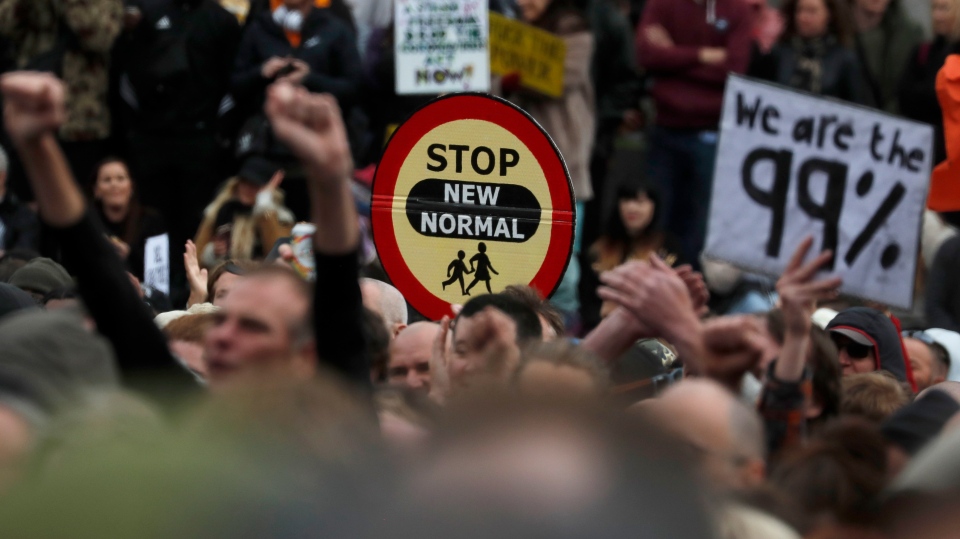
 'We Do Not Consent' rally London, Sept. 26, 2020. (AP Photo/Frank Augstein)

Professor Martin Kulldorff of Harvard Medical School, co-author of the declaration, feels society should focus on shielding people over 60, but those under 40 "should live their normal lives unless they have some known risk factor. Anybody above 60, whether teacher or bus driver or janitor I think should not be working -- if those in their 60s can't work from home they should be able to take a sabbatical [supported by social security] for three, four or whatever months it takes before there is immunity in the community that will protect everybody."

Co-author Oxford University epidemiologist Dr.Sunetra Gupta feels that it's entirely possible to shield those in the high-risk category while allowing others "to get out there and get infected and build up herd immunity" as a temporary measure and not a "permanent state of affairs. We're saying, let's just do this for the three months that it takes for the pathogen to sweep through the population." 

Critics of this school of thought don't hesitate to point out that those countries succeeding in managing    COVID including South Korea, have strategies that don't rely on "letting the virus run wild while hoping that the asthmatic community and the elderly can find somewhere to hide for 12 months", pointed out Dr.Michael Head, senior research fellow in global health at the University of Southampton. Britain too had briefly considered herd immunity and then retreated as the COVID toll rapidly rose.

Dr. Naylor noted Sweden's gamble with herd immunity which saw them with the highest rates of hospitalization and deaths in comparison to their neighbours, and where in any event, their no-lockdown policy failed to create herd immunity, according to a paper published in the Journal of the Royal Society of Medicine. No herd immunity strategy that focuses on the young and healthy is ever going to result in the "controlled demographic burn that some zealots imagine", concluded Dr. Naylor.

"Case growth will be exponential, with masses of people sick in their 40s and 50s, hospitals will be overrun and deaths will skyrocket as they did in Italy and New York", pointed out Dr.Naylor. And nor are younger people immune to severe COVID-19, as highlighted by a new study by researchers at Brigham and Women's Hospital that found of 3,222 people aged 18 to 35 admitted to U.S. hospitals in April and June, 21 percent required intensive care, ten percent needed mechanical ventilation, and 2.7 percent died, a rather sobering reality.
"There is no current evidence about COVID-19 to suggest that a long-term passive approach has any merit.  Despite the huge advances in our understand of the coronavirus and resulting infection, we don’t know that herd immunity is even possible.  Natural, lasting, protective immunity to the disease would be needed and we don’t know how effective or long-lasting people’s post-infection immunity will be. Just to find out whether this is possible, would be to consign a great many more thousands of people to their deaths, and many more would be left suffering from the effects of long COVID, which even less is well understood."
"There is also the fact that we haven’t properly got to grips with how to shield vulnerable populations adequately and neither do we have the capacity in the UK to test for asymptomatic infections.  Furthermore, we’re also still only scratching the surface of how the virus is transmitted."
Dr Simon Clarke, Associate Professor of Cellular Microbiology, University of Reading, U.K.

Labels: , , ,

 
()() Follow @rheytah Tweet