Blog dedicated primarily to randomly selected news items; comments reflecting personal perceptions
Monday, January 03, 2022
Israel's Tight Race Against Omicron
"The [infection] numbers will have to be very high in order to reach herd immunity."
"This is possible but we don't want to reach it by means of infections, we want it to happen as a result of many people vaccinating."
Nachman Ash, Director-General, Health Ministry, State of Israel
Sheba Medical Centre, Israel
In its ongoing battle to fend off the SARS-CoV-2 virus, Israeli government authorities and the country's top health official and medical authorizing body approved use of Merck & Co.'s antiviral pill for COVID-19 patients -- molnupiravir -- as yet another arrow in its quiver of pharmaceuticals meant to counter the predatory effects of the coronavirus devastating the country.
The latest iteration of a COVID mutant has sent world health authorities into a scramble as the Omicron variant lives up to its early reputation as a potentially more transmissible virus than its predecessors. Infections keep hitting new world records, currently seeing an average of over a million cases each day between December 24 and December 30, as revealed by Reuters data.
The only bright spark in an otherwise endless dance of evasion with this often-deadly virus is that despite rising numbers of cases everywhere in the world, deaths have not risen proportionate to the infection numbers, reflecting a change in both the virus's modus operandi and final effects. Great relief, tempered by a 'wait-and-see' caution has resulted in a exhalation of bated breath with the realization of coping with a less lethal adversary.
And in Israel, which in the early months of the original COVID-19 sweep through the world community became a leader in swift remedial action in hopes of taming the untamable, daily cases with Omicron are anticipated in the coming three weeks to reach record high infection rates. Like other nations, Israel celebrated, congratulating the efficacy of its swift action in the first wave, thinking the virus was tamed only to learn soon afterward this was wishful thinking.
Salman Zarka, head of the Israeli health ministry's coronavirus task force, expressed his belief that herd immunity was far from guaranteed, given experience in the past two years that demonstrated some COVID-19 patients who had recovered from their intimate acquaintance with COVID had nonetheless later been reinfected.
Conventionally, herd immunity represents a population peaking at the top majority number of infections rendering its capacity to further infect those still vulnerable, less likely to occur. The population becomes protected either through vaccination or by individuals developing antibodies by contracting the disease, in large enough numbers to qualify as a situation of having achieved herd immunity.
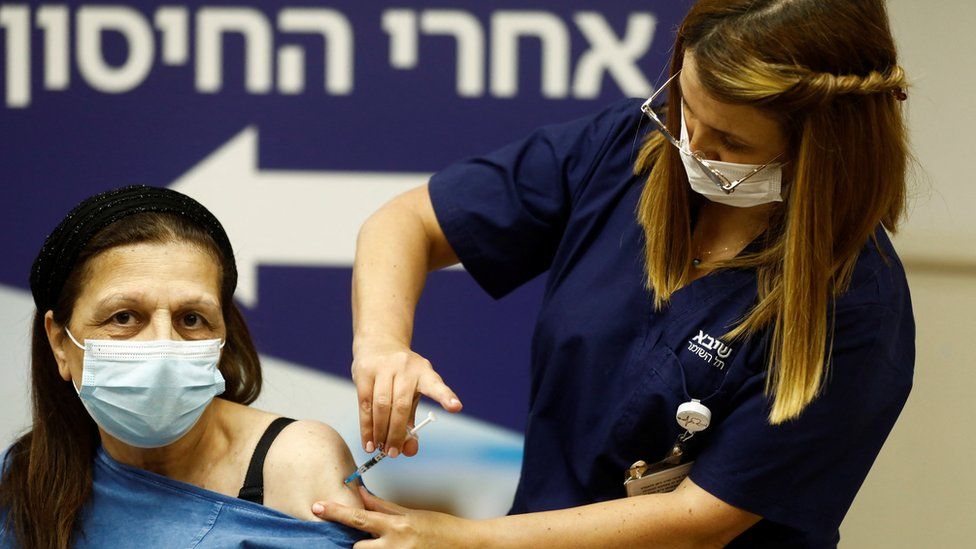
Of Israel's 9.4 million population, approximately 60 percent have been fully vaccinated, mostly with the use of the Pfizer/BioNTech vaccine, meaning they have either received three doses or have recently secured their second dose. Yet a remaining hundreds of thousands eligible in the population for a third inoculation appear to have hesitated.
Director-General Ash of the Health Ministry is considering a fourth vaccine dose for those over 60, with severe morbidity avoidance in mind, following its approval a week earlier for those who are immune-compromised and for elderly people in congregate-care homes. The use of molnupiravir for COVID-19 patients over the age of 18 has been authorized by the country's Health Ministry which had signed a supply contract with Merck.
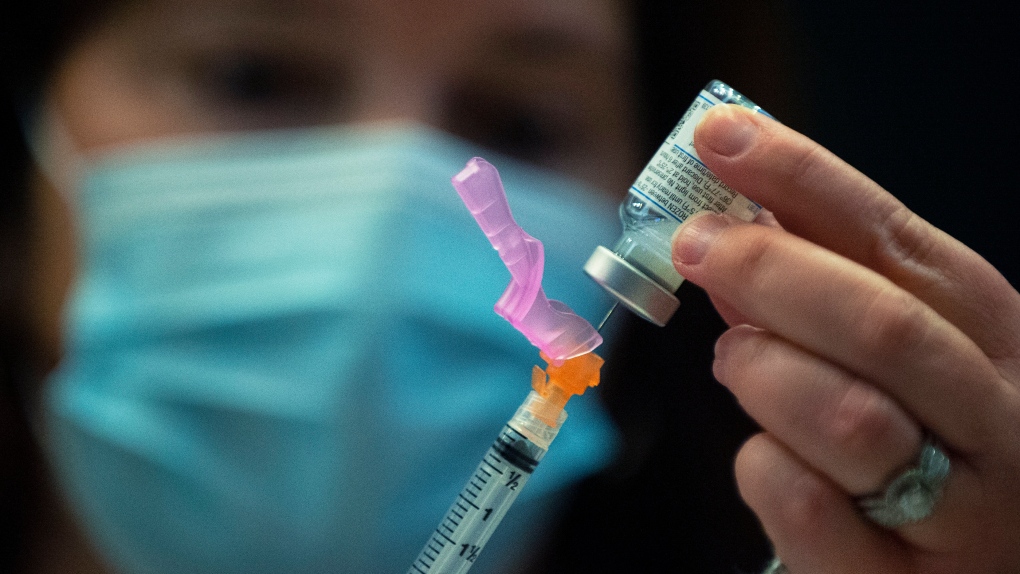
The pharmaceutical pill has been shown to reduce hospitalization and death by around 30 percent in a clinical trial, authorized in the U.S. last month for high-risk adult patients. Statistics that convinced Israel to order 100,000 units as well of Pfizer's Paxlovid antiviral pill for those aged 12 and older who are at risk of serious disease.
Israel has approved a fourth vaccine dose for the immunocompromized and the elderly in care homes Reuters
"Certainly, I think if it is a very low cost, very safe, very effective way to prevent the spread of COVID-19, then I don't see why we wouldn't vaccinate children purely for that reason."
"If it came to pass that we weren't able to achieve herd immunity without some kind of mandate, and in particular a mandate for children, it's something we should definitely consider."
"It's not forcing people to be vaccinated; it's not forcibly injecting them or anything like that, of course."
Anthony Skelton, associate professor of philosophy, Western University
"There are two ethical questions when it comes to vaccination. Do the benefits outweigh the risks for this individual -- is it in their interest to have a vaccine? And, secondly, is there somebody else who needs it more?"
"For children, at this point in time, I think the answer to the first question is uncertain; for younger children it's more uncertain, simply as a function of the fact that there has been very little experience in them."
"Even if the vaccine is highly effective in children, it can only eliminate an already tiny risk."
Dominic Wilkinson, professor of medical ethics, University of Oxford
"Realistically, if we want to reach herd immunity in the short term it's likely that we're going to have to vaccinate kids."
"Because the vaccines aren't perfect at preventing transmission, you're talking about vaccinating all of the eligible population age 12 and older, which we know we're not going to hit."
Ashleigh Tuite, University of Toronto infectious disease epidemiologist
A
dilemma has arisen over whether it’s right to vaccinate young children —
not so much for their own good, but to help achieve herd immunity.Photo by Getty Images
There are several reasons why children should be vaccinated, posits philosopher Anthony Skelton. If vaccines prove to be safe and effective in younger children the option is less risky than trusting that if they become infected everything will turn out well. Science still has not established many things about COVID-19 outcomes following infection, and researchers have much yet to learn about long COVID in children. Although Pfizer's vaccine used to inoculate older children see some reactions that are "pretty small and manageable", concerns are raised over unnecessarily vaccinating them.
According to Dr.Skelton, children are part of the 'herd' in a population and there are concerns that Canada will be unable to reach effective herd immunity with the boost that vaccinating only over-12-year-old children will give, and bypassing all younger children in the drive for herd immunity. The 0-to-11-age group account for 12.5 percent of the country's population, at a 4,783,562 total, according to Statistics Canada.
In Canada some 271,000 COVID infections were reported in children under age 19 and of those roughly 1,400 children were hospitalized, and thirteen of the total perished due to COVID. Most children infected withCOVID experience mild or no symptoms whatever. Rare, occasionally life-threatening conditions, such as multisystem inflammatory syndrome can occur, a hyper immune reaction to being infected with COVID causing coronary aneurysms. But overall, children seem spared from COVID's serious conditions.
Pfizer-BioNtech is preparing to approach U.S. regulators for an expansion of emergency authorization of its vaccine to be used with children aged five to 11, with younger children to follow, according to a senior Pfizer executive. Awaiting data to unequivocally demonstrate safety and immunogenicity (immune response in children), expectations are that Pfizer will pursue similar timelines to Health Canada in a similar submission. Canada, in May, became the first country globally to authorize Pfizer's vaccine for use with 12- to 15-year-olds.
Both Pfizer and Moderna have been undergoing tests with children to ensure efficacy and safety, and both tested a series of doses to discover safe minimum doses to ensure a immune response. "Kids do have a stronger immune response, so it's super important that we have the right dosing and we figure out the right schedule before to go ahead and do it", explained Dr. Fatima Kakkar, infectious disease pediatrician at Sainte-Justine hospital in Montreal.
A safe dose-to-age formula appears to have been settled by Pfizer, with a three-microgram dose each shot for children ages six months to five years, and 10 microgram doses for five to eleven-year-olds. Adult doses in comparison, have 30 micrograms.
“Even if the vaccine is highly effective in
children, it can only eliminate an already tiny risk,” says Oxford
professor of medical ethics Dominic Wilkinson.Photo by Getty Images
"[It's reasonable to ask children] to do something to help us all, including them, get back the world that we want them to live in and grow up in. I think we need to give children credit: They know what's going on. They worry. They're anxious. They're thinking about what they're seeing."
"This is not about, 'dig a moat around your house, make that safe and stay inside'. We've been through that stage."
"This is about, how can we make our family, our community, our town, our country, our world safe, so that it can be the place that we want children to have the chance to grow up in."
Perri Klass, professor of pediatrics and journalism, New York University
"Our findings highlight that vaccination does not only protect the individual who receives it, but is likely to reduce viral shedding and therefore transmission to the population."
Israeli Analysis
(Kenneth Ferriera/Lincoln Journal Star via AP)
"Herd immunity can also be reached when a sufficient number of people
in the population have recovered from a disease and have developed
antibodies against future infection. For example, those who survived the
1918 flu (influenza) pandemic were later immune to infection with the
H1N1 flu, a subtype of influenza A. During the 2009-10 flu season, H1N1
caused the respiratory infection in humans that was commonly referred to
as swine flu.
"However, there are some major problems with relying on community infection to create herd immunity to the virus that causes COVID-19. First, it isn't yet clear if infection with the COVID-19 virus makes a person immune to future infection.
"Research suggests that after infection with some coronaviruses,
reinfection with the same virus — though usually mild and only happening
in a fraction of people — is possible after a period of months or
years. Further research is needed to determine the protective effect of
antibodies to the virus in those who have been infected.
"Even if infection with the COVID-19
virus creates long-lasting immunity, a large number of people would
have to become infected to reach the herd immunity threshold. Experts
estimate that in the U.S., 70% of the population — more than 200 million
people — would have to recover from COVID-19 to halt the epidemic. If many people become sick with COVID-19
at once, the health care system could quickly become overwhelmed. This
amount of infection could also lead to serious complications and
millions of deaths, especially among older people and those who have
chronic conditions."
Mayo Clinic
"Surrendering to the virus [by allowing it to run through a community unchecked to infect the population to achieve herd immunity is not a defensible plan]."
"[Such an approach would lead to a catastrophic loss of human
lives without necessarily speeding up society’s return to normal]. We have never successfully been able to do it before, and it will
lead to unacceptable and unnecessary untold human death and suffering."
Kristian
Andersen, immunologist, Scripps Research Institute, La Jolla,
California
ICU health-care worker Jannikka Navaratnam cares for a patient inside a
negative pressure room at the Humber River Hospital during the COVID-19
pandemic in Toronto. (Nathan Denette/The Canadian Press)
Infectious diseases are difficult to eradicate, and it has been this way throughout human history where one type of virus after another has run amok through human populations, devastating communities whenever a new virus emerges. Hundreds of years ago during the colonial era, European colonial powers brought new pathogens with them when they invaded and colonized populations on other continents, in some instances seeing 90 percent of the population that had never before encountered such viruses wiped out; it happened in Peru when the Spanish conquistadors arrived.
In our current, modern era, science enables human populations to rely on research to produce vaccines so that mass inoculation will either (rarely) eradicate a virus entirely or succeed in keeping it under control. From measles to polio to mumps these deadly diseases still can lethally infect, but vaccines have them under control. Once a certain proportion of a population becomes immune to a disease, the herd effect takes over, protecting those members of that population that for one reason or another cannot be vaccinated.
Herd immunity thresholds differ with each disease; measles as an example is so infectious that a 90 percent vaccination rate is required to dampen its enthusiasm in attacking a vulnerable population. Mumps is able to be contained at a 75 percent herd immunity. COVID-19 was initially and erroneously estimated to be not very contagious so that estimates as low as ten percent to achieve herd immunity were theorized. Medical science has since learned quite a bit more about the SARS-CoV-2 virus causing COVID.
The assumption now among public health agencies was that the figure of 66 percent herd immunity may be the magic number to be achieved. Until a study from the Brazilian city of Manaus showed upward of 76 percent of the population had contracted and survived COVID-19, easily surpassing that 66 estimate. Israel's first-place status in inoculating the largest proportion of its population of any other country in the world has the attention of the medical world fixated on its progress. Given restrictions on vaccinating children set aside, the Israeli experience may give a fixed fugyre to the number of vaccinations to be achieved to see hospitalization and death go into free-fall.
COVID-19 lockdowns have overwhelmingly impacted the world economy, its production, its employment, its health care systems, its patience. There were proposals to allow the disease to run its course while protecting vulnerable populations, which was what Sweden chose to do. It managed to preserve its economy to an extent its neighbours who instituted full lockdowns were unable to achieve, but in the end, the country experienced a death rate found to be ten times greater than its neighbours.
New York City's experience in the spring of 2020 was quite different, when it became the worst-hit epicentre in the world. It was thought that the catastrophe in the spring at the very least rendered the city resistant to any future outbreaks. However, when a second wave swept through the city it turned out to be a repeat of the first. Since then studies discovered that up to 90percent of New Yorkers may yet be susceptible to infection by COVID-19.
Should countries decide to pursue a strategy of "natural herd immunity", a team of researchers warned in a widely circulated letter published in The Lancet, the result could well be that thousands of unnecessary deaths would occur; no notable gains in resilience would result. The frantic rush by scientists with pharmaceutical companies to succeed in designing a successful vaccine led to a formula to stop people from experiencing the worst impacts of COVID infection. On the other hand, it remains unknown whether those same people could still 'shed' the virus and infect others.
Also unknown is how long the vaccine effects might last; whether it could confer (unlikely) lifetime immunity, last for years, or have to be re-administered annually with a new formulation like the seasonal flu. Science does have a hint of an answer to that critical question, in that people who have recovered naturally from having been infected have been re-infected with COVID. There is much yet to be known about COVID-19, including the potential rate of reinfection, particularly post-vaccination.
And then too, there is the reality that the current vaccines now in circulation have efficacy rates from 70 percent to 95 percent. Which leaves 30 and 5 percent respectively of people for whom vaccination does nothing to avert either contracting the pathogen or experiencing milder reactions from its onset. And non-symptomatic cases famously go on to infect others in an endless cycle ... until such time as all the pieces of the puzzle fall into place ... if ever.
In a troubling sign, COVID-19 is already reinfecting people who have recovered naturally from the disease.Photo by Ryan Remiorz/The Canadian Press
Publi8c Rebellion, Herd Immunity and Prioritizing Super-Spreaders for Vaccines
"Hot-spotting is dramatically more efficient than uniform allocation."
"We conclude that hot-spotting could enable public health authorities to greatly reduce the social and economic costs of COVID-19 until vaccine supply catches up with demand."
New scientific paper
"Let's assume the vaccines do nothing to stop the spread. Removing high-risk individuals doesn't really change anything."
"The optics are not that great: ‘You can get vaccinated because of your bad behaviour' [people taking advantage of an incentive to violate social-distancing rules so they can jump the vaccine queue]."
Mahesh Nagarajan, applied mathematician, business professor, University of British Columbia
Unmasked people take part in a protest against COVID-19 restrictions in Toronto on December 20, 2020.Photo by Chris Helgren/Reuters/File
Not yet published in a peer-reviewed journal, a new research paper recently posted on a 'pre-print' online site lacking independent scrutiny posits that the strategy of 'hot-spotting', essentially recognizing people who present as super-spreaders, with the use of smartphone contact-tracing apps to identify those super-spreaders, and then using the still-scarce supply of vaccines to focus on seeing them as a priority for inoculation, would have the effect of reaching herd immunity levels far faster than with the equal spread of inoculation distribution.
In theory, this would mimic the work of forest firefighters who see a wide-ranging fire and target it for immediate attention for the purpose of stopping its raging spread. In Canada, as elsewhere in an anxious world where the first doses of the recently-approved vaccines produced by Pfizer and Moderna are being circulated, it will take quite a long time -- perhaps into next year's fall season -- before sufficient vaccines will have been produced to facilitate inoculating entire populations against COVID-19.
Until that occurs, society must grapple with the need to self-isolate, to remain vigilant against contagion, to properly mask and attend to hygiene methods in a universal bid to cope with the infectious spread of the coronavirus that has succeeded in short order in upending the global social order in country after country, while threatening food security and taking the world economy into a veritable down-spiralling head-spin. Those doses of precious vaccine are in short order and will be for some time, taxing authorities to dole them out carefully among prioritized groups.
Hundreds of people gathered in Montreal Sunday and marched through
the city protesting municipal and provincial government restrictions put
in place to stop the spread of COVID-19.
Montreal police (SPVM) handed out 269 infractions to protesters who weren't wearing masks CTV News
The recommendations out of this paper appear feasible in identifying potential super-spreaders, to then prioritize those who infect the greatest number of other people, for the purpose of vaccinating them and thus removing the threat they represent in the ever-widening arc of infections. Herd immunity would theoretically be accomplished using less than half as much vaccine as opposed to it being distributed more evenly across a population.
Scientists from the Universities of Waterloo and Guelph, working in conjunction with the Perimeter Institute for Theoretical Physics alongside drugmaker Samofi Pasteur were jointly responsible for the content and premise of the paper. Considered an excellent paper by one outside expert, to be seriously considered by Canadian authorities, that expert nonetheless cautioned the protocol would work only should the vaccines be proven to prevent infection with COVID, not merely prevent symptoms of the virus from occurring.
Queen's University infectious-disease specialist Dr.Gerald Evans also commented on the fact that it remains uncertain whether the apps would succeed in identifying possible virus transmitters, or would inadvertently catch "highly mobile persons". The paper was produced through a collaboration between mathematicians and physicists addressing the reality that the vaccine rollout will take considerable time and effort to achieve its ultimate goal. The authors cite theoretical research previously published suggesting targeting potential super-spreaders would have the effect of increasing the effectiveness of a vaccine.
Tracing apps harnessing the Bluetooth function on cellphones warning whether someone has been in close proximity to an individual who has tested positive for COVID to pinpoint those who have an exceptional number and duration of contacts is a vital part of the concept. Mathematical modelling was used to test the possible impact in prioritizing such people as opposed to the effect of uniformly administering vaccine.
Up to 2,000 people marched through the streets of Aylmer,
Ont., angry about masks and physical distancing rules put in place by
the provincial and federal governments. (Kate Dubinski/CBC)
They were able to conclude with a degree of confidence that half as many would require shots to reach herd immunity, the point where sufficient numbers of people are vaccinated to make certain the spread has been significantly reduced. Dr. Nagarajan from University of British Columbia points out a possible glitch; while the Pfizer and Moderna vaccines were seen to be 95 percent effective, that effectiveness was based on preventing symptoms; 'protective immunity'.
The studies failed to collect data on sterilizing immunity, which is to say, whether the vaccines actually act to prevent infection from the virus occurring. Should this not be the case, the method of singling out super-spreaders would fail to be of much help, since they could continue passing on the pathogen to others, Dr.Nagarajan noted. Another issue is the potential unintended consequences of the strategy, with people seeing an incentive to violate social distancing rules manipulatively to jump the vaccine queue.
On Sunday, hundreds of Calgarians marched down Stephen Avenue to protest
public health restrictions intended to slow the spread of the
coronavirus. (CBC)
"We had a taste of freedom as the summer wore on [and now] a pretty dismal [winter is in the wings]."
"Obviously, the Great Barrington fix will excite the minimizers who pretend COVID-19 is not much worse than the flu and enliven the libertarians who object to public health measures on principle."
"So be it: they've been offside all along."
"[There is hope a vaccine may be available by March, and given the prospects] why on earth should we rush to embrace a reckless prescription for a demographically-selective national 'chicken-pox party' involving a dangerous pathogen?"
Dr.David Naylor, co-chair, Canada's COVID-19 immunity task force
"[The most] compassionate approach [leading to herd immunity] is to allow those who are at minimal risk of death to live their lives normally to build up immunity to the virus through natural infection, while protecting those who are at highest risk."
"People who are more at risk may participate [in normal activities] if they wish, while society as a whole enjoys the protection conferred upon the vulnerable by those who have built up herd immunity."
Declaration authors
Supporters of the
Great Barrington Declaration believe young and non-vulnerable people
should be allowed to ‘resume life as normal’ to build up herd immunity (PA)
The Great Barrington Declaration is a 510-word opus written by academics from Harvard, Stanford and Oxford universities whose prestige obviously lends credence to the three academics who put the composition together as a learned trio offering a wise solution to a global public dilemma. They have sufficient clout to have gained an audience with U.S.Health and Human Services Secretary Alex Azar and White House pandemic adviser Scott Atlas himself under scrutiny for his views on herd immunity -- the view of "controlled spread" of the young and healthy who are less likely to perish from COVID in the interests of gaining immunity once recovered, effectively halting the spread of the disease.
Thousands of people have signed on to the declaration, obviously accepting its argument as a sensible solution to the spread of the pathogen. "By way of example, nursing homes should use staff with acquired immunity and perform frequent PCR testing of other staff and all victims", reads the document. Food and essential goods should be delivered to retirees living at home, and those not vulnerable "should immediately be allowed to resume life as normal". In-person teaching at schools and universities should proceed, as well as the resumption of extracurricular activities such as sports as "low risk" adults work normally, and arts, music and cultural events resume.
The authors point out that lockdowns have resulted in collateral damage on public health, including lower childhood vaccination rates, fewer screenings for cancer and a deterioration in mental health, not to mention domestic violence "leading to greater excess mortality in years to come, with the working class and younger members of society carrying the heaviest burden". "We all feel that the scientific and public discussion has excluded pertinent evidence [about the harms of the lockdown, for instance], and the possibility of a superior approach to the epidemic that would save lives relative to the current approach", pointed out Jayanta Bhattacharya, physician, epidemiologist and health economist at Stanford University Medical School.
Hospitalizations are steeply rising in the United States, with confirmed case numbers in lock-step in Ontario and Quebec while across Canada, average daily case counts leaped upward 40 percent in one week alone. Collateral damage can be seen in the fed-up attitude of young people tired of restraints to their social lives, while those working in small businesses see their livelihoods evaporating. These are conditions under which the herd-immunity movement can gain public traction.
"I mean, honestly, if a medical student submitted this as a paper they would get a failing grade", Dr.Irfan Dhalla, general internist and vice-presdent at Unity Health which operates two Toronto hospitals said in exasperation, of the declaration she considers reflective of a fringe element within society and the medical community. "It's not as much as a fringe view as I would like it to be. But it's the wrong view. We cannot reach herd immunity without a massive loss of life or a vaccine. It's that simple. Honestly, it boggles my mind that intelligent people are signing on to this statement."
'We Do Not Consent' rally London, Sept. 26,
2020. (AP Photo/Frank Augstein)
Professor Martin Kulldorff of Harvard Medical School, co-author of the declaration, feels society should focus on shielding people over 60, but those under 40 "should live their normal lives unless they have some known risk factor. Anybody above 60, whether teacher or bus driver or janitor I think should not be working -- if those in their 60s can't work from home they should be able to take a sabbatical [supported by social security] for three, four or whatever months it takes before there is immunity in the community that will protect everybody."
Co-author Oxford University epidemiologist Dr.Sunetra Gupta feels that it's entirely possible to shield those in the high-risk category while allowing others "to get out there and get infected and build up herd immunity" as a temporary measure and not a "permanent state of affairs. We're saying, let's just do this for the three months that it takes for the pathogen to sweep through the population."
Critics of this school of thought don't hesitate to point out that those countries succeeding in managing COVID including South Korea, have strategies that don't rely on "letting the virus run wild while hoping that the asthmatic community and the elderly can find somewhere to hide for 12 months", pointed out Dr.Michael Head, senior research fellow in global health at the University of Southampton. Britain too had briefly considered herd immunity and then retreated as the COVID toll rapidly rose.
Dr. Naylor noted Sweden's gamble with herd immunity which saw them with the highest rates of hospitalization and deaths in comparison to their neighbours, and where in any event, their no-lockdown policy failed to create herd immunity, according to a paper published in the Journal of the Royal Society of Medicine. No herd immunity strategy that focuses on the young and healthy is ever going to result in the "controlled demographic burn that some zealots imagine", concluded Dr. Naylor.
"Case growth will be exponential, with masses of people sick in their 40s and 50s, hospitals will be overrun and deaths will skyrocket as they did in Italy and New York", pointed out Dr.Naylor. And nor are younger people immune to severe COVID-19, as highlighted by a new study by researchers at Brigham and Women's Hospital that found of 3,222 people aged 18 to 35 admitted to U.S. hospitals in April and June, 21 percent required intensive care, ten percent needed mechanical ventilation, and 2.7 percent died, a rather sobering reality.
"There is no current evidence about COVID-19 to suggest that a
long-term passive approach has any merit. Despite the huge advances in
our understand of the coronavirus and resulting infection, we don’t know
that herd immunity is even possible. Natural, lasting, protective
immunity to the disease would be needed and we don’t know how effective
or long-lasting people’s post-infection immunity will be. Just to find
out whether this is possible, would be to consign a great many more
thousands of people to their deaths, and many more would be left
suffering from the effects of long COVID, which even less is well
understood."
"There is also the fact that we haven’t properly got to grips with
how to shield vulnerable populations adequately and neither do we have
the capacity in the UK to test for asymptomatic infections. Furthermore, we’re also still only scratching the surface of how the
virus is transmitted."
Dr Simon Clarke, Associate Professor of Cellular Microbiology, University of Reading, U.K.
The
Great Barrington Declaration’s authors argue that the most
“compassionate approach” to reaching herd immunity “is to allow those
who are at minimal risk of death to live their lives normally to build
up immunity to the virus through natural infection, while protecting
those who are at highest risk.”Photo by Peter J. Thompson/National Post
"We found that test positivity rates were higher in lower income areas [and] among the Black population." "Further studies are needed to understand how populations are at risk of
becoming infected [and to better understand the socioeconomic
determinants of infection]." "[We hope the] information out of New York can help our colleagues to
identify populations that are at risk in this country [as rates of
infection climb in several areas of the country]." "[We at Northwell Health hope to better understand the] genetic
predispositions of patients and characteristics of the virus, in order
to identify better ways to tailor treatment." "The story is still being written in terms of the COVID contagion. Time is of the essence in trying to stay ahead of the
virus." Dr. Jim Crawford, chair, Department of
Pathology, Long Island Jewish Medical Center and North Shore
University Hospital
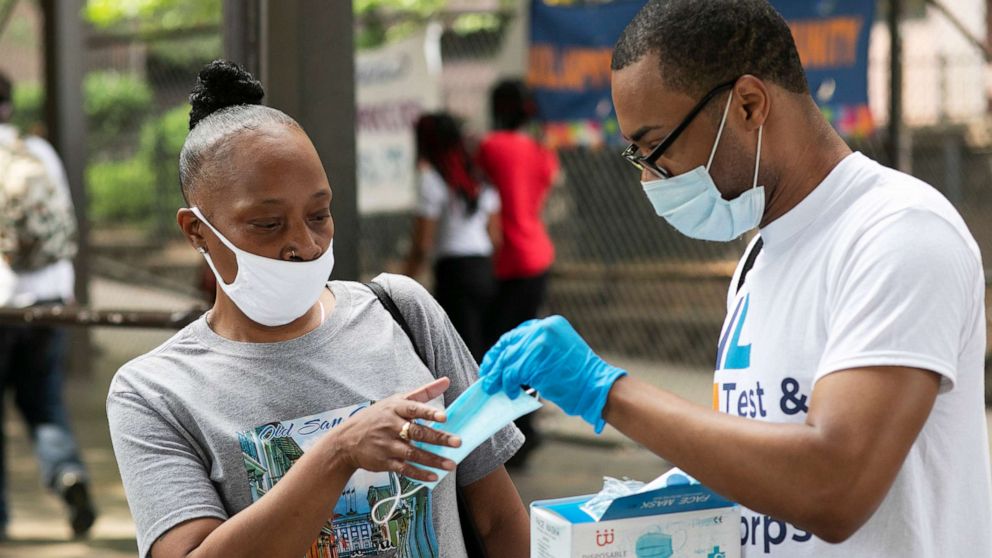
Stephane
Labossiere, right, with the Mayor's Office of Immigrant Affairs, hands
out masks and printed information about free COVID-19 testing in
Brooklyn being offered by NYC Health + Hospitals, Wednesday, July 8,
2020, in New York.Mark Lennihan/AP
New findings arising out of a study that Dr.Crawford and his research colleagues undertook based on antibody tests at a clinic in the Corona neighbourhood of Queens suggest that specific areas of New York have achieved close to a 70 percent immunity rate to COVID-19; a "stunning" revelation leading to the belief that the residents involved may very well be in a protected state from a second wave of the novel coronavirus.
Health care company City-MD made the results available to local media, that a higher antibody rate than anywhere else in the world has been established, the data released publicly. The Italian province of Bergamo, also hard hit by the global pandemic had a 57 percent immunity to COVID, and the site of Austria's largest coronavirus outbreak at the Alpine ski resort Ischgl, reported a 47 percent rate.
But it is in some boroughs of New York city, emergency doctors related, that the rates reflect what the clinical presentations have informed, with an emphasis on areas of the city of lower income and high minority populations. Those very areas where experts theorized would be hardest hit, due not only to the density of the population, but because of poverty and the limitations imposed on people in such circumstances.
An earlier study, however, seemed to indicate that such dense areas of inner cities were able to manage surprisingly well, the lockdown ensuring that people stayed where they were, in a limited geographic range, venturing out when absolutely required, and realizing in the end, a lower infection rate than parts of the outer city where populations are unable to walk short distances to a destination, must drive and drive further to access shopping and appointments becoming more susceptible to infection.
The figures of 68 percent antibodies at Queens and 56 at another clinic in Jackson Heights of positive tests affirm an approach to the high antibody rate required to establish herd immunity. And it seems clear to some from New York City's testing program that herd immunity has been achieved by some such communities, raising the prospect that other jurisdictions abroad that have been hard hit with COVID, may also experience herd immunity, where a 70 percent infection rate arming people with antibodies passes the test.
Not everyone is in agreement however. Virologists feel the results may not be representative of the general population since testing had taken place at urgent care centres; warning insufficient data exists to definitively conclude that herd immunity has been achieved, given that little is known as well how rigorously testing was carried out, and whether false positives occurred.
Just five percent of the population tested positive in Spain where the largest and most meticulous antibody study had been carried out in a survey of 60,000 people across the nation, and not with a focus on any single area. Among the hardest-hit cities in the world, New York recorded 222,000 cases and close to 23,000 deaths up to the present.
About 314,000 tests were administered by CityMD, up to June 26, with 26 percent of the tests positive. A study using antibody tests to determine what proportion of the population was infected from early March to the present woould require a study with a different focus. Antibody research found roughly 20% of the New York City population acquired infections, nowhere near the 60% experts agree would confer herd immunity.
Some
neighborhoods, like Corona in Queens, were so hard hit during the peak
of the coronavirus epidemic that they might now have herd immunity. Credit...Victor J. Blue for The New York Times