Ruminations

Blog dedicated primarily to randomly selected news items; comments reflecting personal perceptions

Wednesday, February 09, 2022

Walking Again

"The first few steps were incredible -- a dream come true. It was very emotional to see my legs moving. I've been through some pretty intense training in the past few months, and I've set myself a series of goals."
"For instance, I can now go up and down stairs, and I hope to be able to walk one kilometre by this spring."
"Every day I work around two hours. I try to improve the quality of the step and the speed. Just by taking a simple shower, I can now stand up."
"I am free and I can go and walk wherever I want. I was living with my parents, and now I have an apartment and I can do everything alone, no problem."
Michel Roccati, 30, Italy
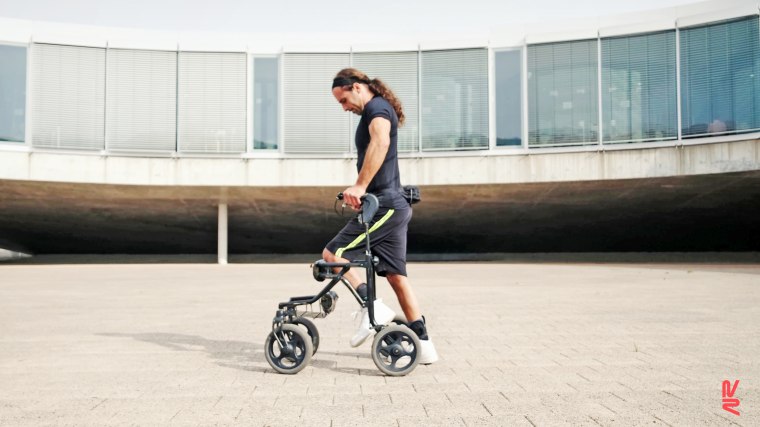
Michel Roccati, one of the three men to test a prototype of a new spinal cord stimulator, walks at Lausanne University Hospital in Switzerland.
Michel Roccati, one of the three men to test a prototype of a new spinal cord stimulator, walks at Lausanne University Hospital in Switzerland.  NeuroRestore

"When you first turn it on you can stand and step but you still need support, and the gait pattern is poor, but it allows you to start training all this activity immediately, and over the course of several months we can decrease the support."
"All three patients were able to stand, walk, pedal, swim and control their torso movements in just one day, after their implants were activated. That's thanks to the specific stimulation programs we wrote for each type of activity."
"We are not yet at the stage where it's a commercially available technology that you can use with your smartphone, but that's our next objective."
"Our stimulation algorithms are based on imitating nature and work exactly in the way that the spinal cord is stimulated by the brain."
Gregoire Courtine, neuroscientist, Swiss Federal Institute of Technology, Lausanne, Switzerland
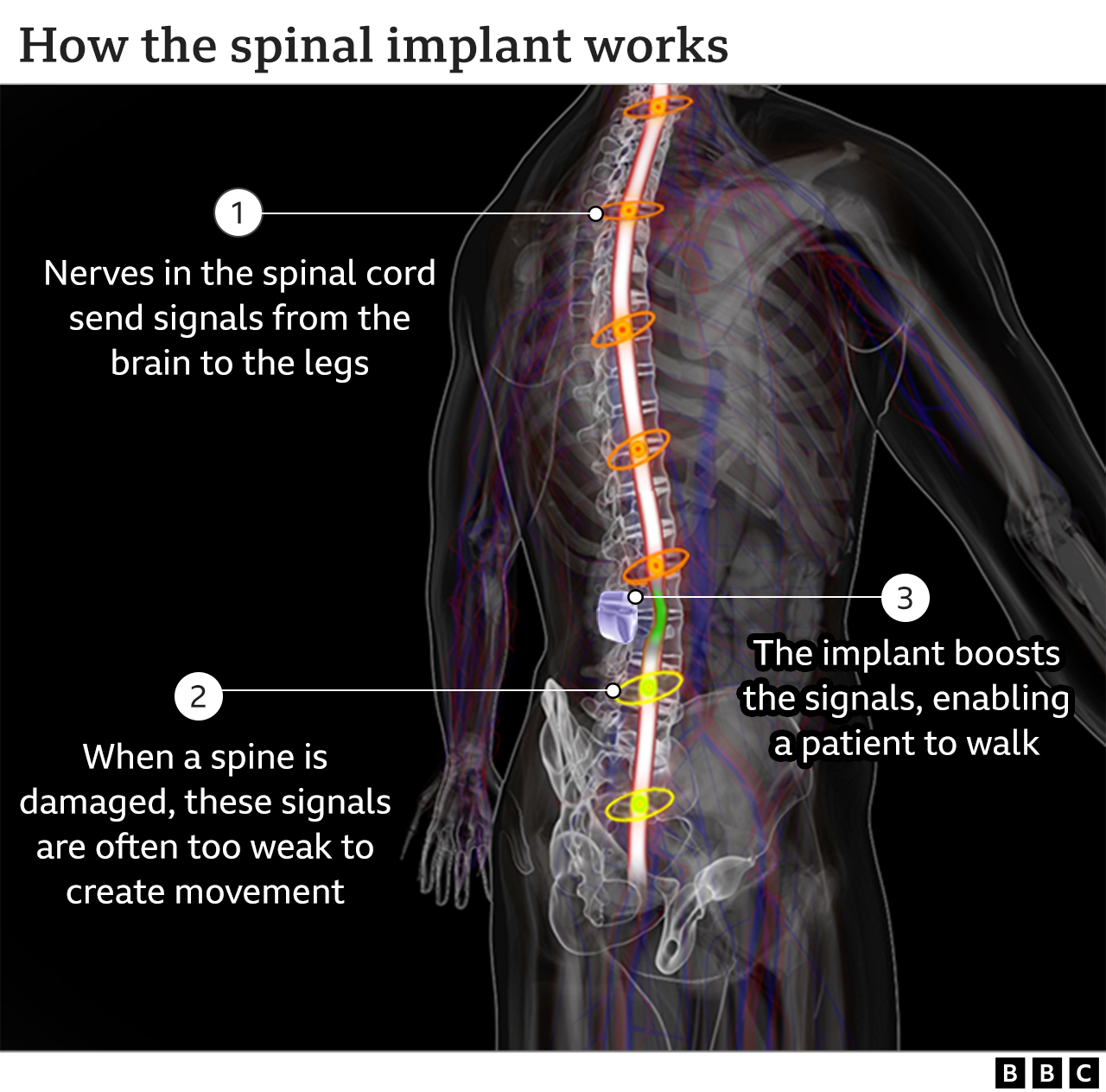
Two small remote controls were attached to a walker to help Michel Roccati support himself, a reflection of his years of enforced bodily inactivity caused by the severing of his spinal cord nerves leaving him with a wasted musculature. Attached wirelessly to a tablet to forward the appropriate signals to a pacemaker installed in his abdomen, the pacemaker relays signals to the implant, in turn stimulating specific neurons in a particular sequence which allow the muscles to fire up in correct order, enabling his movement.
 
modified spinal cord stimulator
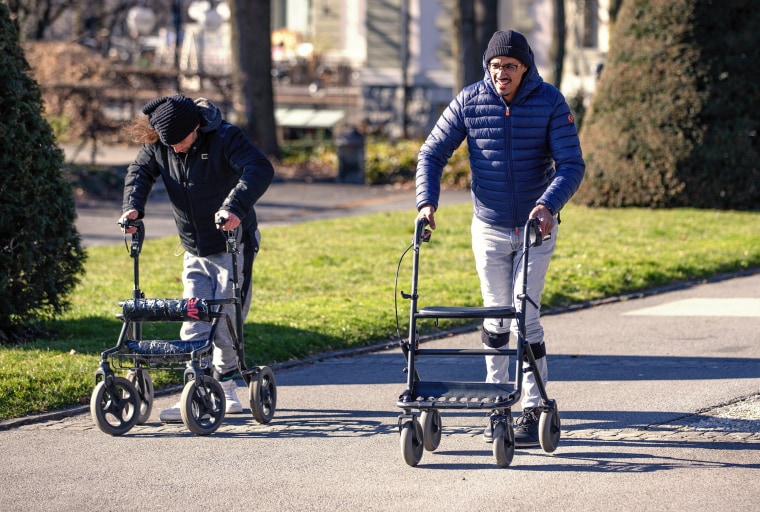
Two men with spinal cord injuries that left them paralyzed walk in Lausanne, Switzerland, with the help of a modified spinal cord stimulator.   NeuroRestore
A new day is on the cusp of dawning for people with injured spinal cords, bringing them the hope finally of mobility. Michel Roccati was the perfect candidate for this experimental new electronic implant due to his completely paralyzed condition. The electronic implant surgically placed in his spine is renewing his life. Following the implantation of the electronic array to stimulate nerves below his spinal injury, he was able to stand and walk. He can now also cycle and swim.

Partially paralyzed patients were advantaged previously with similar technology, but the work of the Swiss researchers represents the first time this technology has shown itself workable for people whose spinal cord injuries are so severe they have no movement ability whatever. Developed by scientists at the Swiss Federal Institute of Technology and Lausanne University Hospital, the implant is operated through the stimulation of the region of the spinal cord activating specific muscle groups in the trunk and legs.

The principle requirement for the implant to work is six centimetres at the very least, of healthy spinal cord below the site of the injury, to enable the implant to stimulate certain nerves; the implant fitted underneath the vertebrae, within the spinal column. Artificial intelligence is made use of to analyze the sequence of neurons firing in individuals when they intend to carry out activities such as walking, cycling and canoeing.

To stimulate the nerves, the implant uses 15 electrodes, but the researchers aspire to move to 32 or 64 electrodes with the intention of gaining greater control as they expand the effectiveness of their invention. Following the implant surgery, patients recover for roughly ten days prior to the device being switched on. 
 
The technology has been trialled successfully with three other patients whose condition is similar to Mr. Roccati's. Larger clinical trials are planned to take place in the United States and Europe. The Swiss researchers bear hope that their device will become available within the next two to three years. Their research success details were published in Nature Medicine.
Graphic

Labels: , , ,

Wednesday, January 27, 2021

Hope for Spinal Cord-Injured Patients

A hand picking up a tiny bead
Marcus Donner/Center for Neurotechnology
"As a rehabilitation physician, my experience was that there was always a limit to how much people would recover."
"But now it looks like that's changing. It's so rewarding to see these results."
Dr.Fatma Inanici, lead author, research, University of Washington 

"Both people [in the study] who had no hand movement at the beginning of the study started moving their hands again during stimulation, and were able to produce a measurable force between their fingers and thumb."
We're seeing a common theme across universities -- stimulating the spinal cord electrically is making people better."
Chet Moritz, associate professor of electrical and computer engineering, rehabilitation medicine and physiology and biophysics, University of Washington
A timeline blocking out the treatment plan for each month of the study
 
Participants in a new study out of the University of Washington have seen significant improvements in their mobility with a five-month exposure to physical therapy and spinal cord electrical stimulation. The complete mobility impairment that results from spinal cord injury devastates lives; victims are unable to engage in simple taken-for-granted tasks like eating or drinking on their own; they become completely dependent physically on vital daily assistance to aid in ordinary life-tasks.

Spinal Cord Injury B.C. estimates there are 85,556 people in Canada whose physical decline has resulted from spinal cord injury, with no cure for the condition. Typically, patients take part in exercise therapy in hopes of improving motor function, while previous research has indicated that implanting a stimulator to deliver electric current to a damaged spinal cord could offer help to paralyzed patients in their goal to recover mobility.
 
Two researchers watch as a participant squeezes a device to test his grip strength
Chet Moritz (left) and Fatma Inanici (center) observe as a participant (right) measures grip strength (by squeezing the device in his hand). The participant has sensors on his arms (black cases) to measure his arm muscle activity during the task. Note: This photo was taken in 2019.  Marcus Donner/Center for Neurotechnology
 
Researchers at University of Washington have gone one step further in a bid to accelerate the drive toward success in restoration of a measure of mobility for those with spinal cord injuries. A non-surgical therapy with the use of patches to stick to the skin like a Band-Aid delivers electrical pulses to the injured area. Their study, operational for five months, recruited six people with spinal cord injuries among whom some were able to move fingers and thumbs, and others possessed no mobility at all.

Researchers monitored baseline limb movement in the first four weeks of the study, moving on to include intensive physical therapy for the second month, training three times weekly for two hours. In the third month physical therapy was combined with Transcutaneous Electrical Spinal Cord Stimulation. The last two months of the study saw participants grouped in the severity of injuries where those with less severe injuries received an additional month of training followed by a month of training in combination with stimulation.
 
The participants with more severe injuries saw their training combined with stimulation followed by training alone, and while some participants regained some level of hand function during training alone, all six participants realized improvements when stimulation was combined with training. Participants moreover, maintained improvements, able to resume hobbies some three to six months following treatment. 

What turned out to be equally if not more encouraging was that some participants saw improvements in other health areas including achieving normal heart rate, improved body temperature regulation and in bladder function.

A researcher attaches small round patches to the back of a participant's neck
Fatma Inanici applies small patches that will deliver electrical currents to the injured area on a participant’s neck.    Marcus Donner/Center for Neurotechnology

Labels: , , , , ,

 
()() Follow @rheytah Tweet