Ruminations

Blog dedicated primarily to randomly selected news items; comments reflecting personal perceptions

Friday, July 02, 2021

Lytton, B.C.: Hell on Earth: Fire and Brimstone


"I am crying really ... sometimes I just pinch my skin to make sure it's not a dream, it's really happening ... 30 years working in this job, never seen anything like this madness ..."
Maximiliano Herrera, world weather records expert

"Sydney [Australia] sits at 33 latitude, Lytton [British Columbia, Canada] at 50."
"Temperatures this high should not be occurring here!"
Sarah Perkins-Kirkpatrick, climate scientist, University of New South Wales
Located about 250 km northeast of Vancouver, Lytton broke previous all-time temperature records on three consecutive days, soaring to 46.6C on Sunday, 47.7C Monday and 49.6C on Tuesday. In 1937 it had hit a high temperature of 45C. And then the following day as the heat dome began to move and Lytton experienced brief relief from the searing heat its one thousand residents were forced to evacuate as a wildfire swept into the town and completely obliterated it.

The heat record that Lytton reached is hotter even than the all-time high of 47.2C experienced by Las Vegas, California and 48.3C in Phoenix Arizona, states considerably south of Canada, across the southern border into the United States. According to Mr. Herrera, only 26 countries have been as hot or hotter, ever. Nowhere in Europe or South America has the temperature ever registered that extremely hot, the most extreme high temperature north of 45 degrees latitude.
"I am incredibly overwhelmed by the news of the fire. It happened so fast and is completely devastating almost everyone I've ever known."
"The town itself and surrounding reserves have been severely hit. Fire continues up towards other surrounding reserves between Lytton and Lillooet and Lytton and Shackan."
"Many people in the community expressed concerns that the railways were still up to their usual traffic when the temperatures in Lytton were reaching the high forties [Celsius] this week."
Shianna McAllister, a Nlaka'pamux from the Lytton First Nation
A building in Lytton, B.C., is engulfed in flames on Wednesday. (2 Rivers Remix Society)
 
The province's Coroners Service received reports of 486 sudden deaths -- according to chief coroner Lisa Lapointe -- between June 25 and the afternoon of June 28, over double their usual number of such reports. When the fire struck, its spread was so rapid that people were forced to sprint off within 15 minutes of having been ordered to leave, taking nothing with them but what they were wearing. In minutes buildings were erupting in flames.

Residents aimed for the nearest towns, in their anxiety to find shelter; Lillooet or Merritt, finding emergency shelters awaiting them. Not quite everyone left, some decided to try to save their homes. Some residents are unaccounted for, the RCMP investigating. A small convoy of vehicles was videoed leaving the area, two separate fires behind them, one a wildfire on the mountain slope above the town, burning the last two weeks, the second in the valley, swiftly consuming the town.

The convoy had to drive a curving road, past burnt-out and still-burning buildings, cars, trucks, recreation vehicles and huge old trees enveloped in flame. Blowing smoke and ash buffeted the vehicles and visibility became so dark with billowing smoke at times it was reduced completely. Apart from the extreme heat and the dry condition of the surrounding forest where electrical storms easily ignite wildfires. there are two railways intersecting either side of Lytton.
 
The fire is seen burning in the Lytton, B.C., area on Wednesday. Conditions in the area were dangerously dry and windy after the record-breaking heatwave. (Facebook/Edith Loring Kuhanga)
 
That proximity of crossing railway lines is a danger of itself -- occasionally in hot atmospheres setting fires by sparks set off from the metal wheels of passing trains grinding on the metal rail lines and then lighting dry areas of brush. Meteorologists explained as well, that the unusual weather contributed to thousands of lightning strikes in the interior elevating the risk of wildfires. And dozens spontaneously erupted.

"This is so devastating -- we are all in shock", said Edith Lorin-Kuhanga, administrator at the Stein Valley Nlakapamux School. "Our community members have lost everything. I understand our band office is also gone", she lamented of the carnage brought to the Lytton First Nation reservation. An area spanning about 80 square kilometres in the interior beyond Lytton is raging out of control, according to the B.C. wildfire Service.

Around what is left of Lytton, ("The town has sustained structural damage and 90 percent of the village is burned, including the centre of town", Brad Vis, MP for Mission-Matsqui-Fraser Canyon), electrical, cellphone, rail and  highway infrastructure are all badly damaged, hampering both travel and communication. The town's main intersection is littered with burnt building debris; gutted vehicles stand where a village was once located.
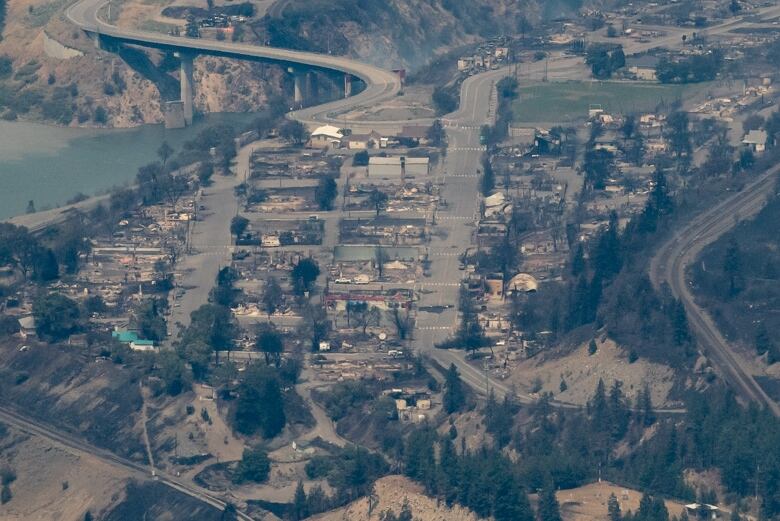
Structures destroyed by fire in the heart of Lytton, B.C., are seen from a helicopter on Thursday. (Darryl Dyck/The Canadian Press)

Labels: , , , , , ,

Thursday, July 01, 2021

Killing Heat Waves, Electrical Wildfires : Western Canada

"[The number of deaths recorded since Friday -- 486 sudden deaths -- is] unprecedented [in the province; officials will be reviewing what happened in the hopes of preventing such a tragic outcome in future heat waves]."
"On the coast, we're not used to the extreme weather events. There are many things, I think, that many of us can learn in terms of response, in terms of informing the public about the risk."
"Please arrange regular check-ins with those who live alone, and encourage everyone you know to drink water, stay in the shade as much as possible and visit cooler environments whenever they can." 
"The Coroners Service would normally receive approximately 130 reports of death over a four-day period. From Friday, June 25 through 3 p.m. on Monday, June 28, at least 233 deaths were reported. This number will increase as data continues to be updated."
Chief coroner Lisa Lapointe, British Columbia
 
"The reality is we've never seen anything like this in B.C., and in fact the country, but especially in the Lower Mainland."
"After we are past this, we will have to take a hard look at what we need to change for the future."
B.C. Public Safety Minister Mike Farnworth
Sun
 
"[Police received a flurry of calls Tuesday morning] as people are showing up in their parents’ house or relatives’ house and finding them deceased."
"It’s changing [numbers of calls coming in to police] as people are discovering their loved-ones dead. [Police usually respond to three or four sudden deaths on a typical day]."
"We have more reports that have been made to us that we have not been able to send officers to because they are currently at other scenes waiting for the coroner to take over the investigation."
"I’ve been a police officer for 15 years and I’ve never experienced the volume of sudden deaths that have come in in such a short period of time. This has been an extreme sudden spike in sudden deaths throughout the city all over the city."
Sgt.Steve Addison, Vancouver Police Department
 
"This was an unprecedented heat wave, with records being broken day after day. The public was acutely aware that we had a heat problem. And we were doing our best to break through all the other noise to encourage people to take steps to protect themselves. But it was apparent to anybody who walked outdoors that we were in an unprecedented heat wave and again there’s a level of personal responsibility."
"This is a tragedy upon a whole host of others we’ve had to address over a number of months but I believe we did what we could to get the information out and we rely also on the public press and media outlets who’ve done a really good job in my mind, of making the case, telling people to be wary and we have our internet presence and social media doing that as well."
British Columbia Premier John Horgan
A view of the city after the scorching weather triggered an Air Quality Advisory in Vancouver, British Columbia, Canada June 28, 2021.
The sweltering heat wave settling over Western Canada is widely viewed as being responsible as a contributing factor to the majority of hundreds of sudden-death calls to the RCMP since Monday in the greater Vancouver area, where Burnaby residents were treated to extremely high temperatures. The spike in calls to police has been astonishing in sheer numbers, while the deaths remain under investigation.

Temperatures in the Vancouver area reached just under 32C Monday but according to Environment Canada, the high humidity accompanying the heat made it actually feel close to 40C in those areas furthest from the water in the coastal city. Residents were urgently requested by authorities to check on  members of their family, and their neighbours, particularly those in the older age bracket.

"We are seeing this weather can be deadly for vulnerable members of our community, especially the elderly and those with underlying health issues", said Cpl.Mike Kalanj of the RCMP, of the countless calls being received of sudden deaths. No fewer than 103 heat records across British Columbia, Alberta, Yukon and the Northwest Territories were broken in the historic weather system.

A new Canadian high temperature of 47.9C was set in Lytton, B.C. leaving the previous record of 46.6 from the same village a day earlier, in the dust. In the Alberta communities of Jasper, Grande Prairie and Hendrickson Creek, temperature records continue to be broken as the mercury spiralled upward to the mid- to high-30s.

The Nahanni Bute region of N.W.T. went up to 38.1 C, the highest temperature ever recorded in the territory, Environment Canada reported. Four heat warnings have also been issued for regions along Manitoba's western boundary with forecasters warning of extreme conditions persisting across the Prairies for the remainder of the week and perhaps into next week.
 
Wildfire in Lytton
A wildfire burns in the mountains north of Lytton, B.C., on Thursday, July 1, 2021. THE CANADIAN PRESS/Darryl Dyck
 
As the extreme heat recedes, another potential emergency rises. Even as  temperatures are expected to slide back to more seasonal values, the chance of lightning has been enhanced inside the parched southern Interior; the very same area where evacuation alerts were issued as a wildfire grew close to two square kilometres on Monday. Sixty-two wildfires and 29,000 lightning strikes have now been reported in just 24 hours.

Residents of Lytton in the B.C. Interior have been told to evacuate after wildfires swept in following a record-breaking heat wave.   CBC


Labels: , , , , , ,

 
()() Follow @rheytah Tweet