Ruminations

Blog dedicated primarily to randomly selected news items; comments reflecting personal perceptions

Friday, December 07, 2018

Bewildering Absent Digits

"By cutting off a piece of your finger, everyone around you can see that you've done something to this severity that shows how committed you are to the god or to the group."
"It's just costly enough without being an infringement to your survival."
"You're in a dark cave, where images are said to appear suddenly out of the darkness. Individuals have argued that people might be using mind-altering substances."
"We thought that within the context of this ritualized environment, sacrifice would make the most sense out of all of these different [reasons to amputate a finger]."
"Previously, if a skeleton was missing their finger bones, we wouldn't really think too much of it, because the archaeological record is so patchy and small finger bones can deteriorate quite easily."
"But now, if we're finding a lot of skeletons that are missing fingers, it might mean something different."
Brea McCauley, researcher, Simon Fraser University, Vancouver, B.C.
Hand stencils are seen in the Grotte de Gargas. Wikimedia Commons

Researchers began to notice in the 1950s, that images appeared at Grotte de Gargas, Cosquer Cave and other prehistoric caves sites discovered in various parts of France and Spain, the images drawn on the interior walls often depicted incomplete complements of digits on drawn hands. Those images of hands with severed digits gave birth to a number of competing theories respecting their origins and possible meaning.

Recently, Australian archaeologist Ian Gilligan informed New Scientist, a British magazine, that many of those hands appear to be faithful replications of frostbite since the thumbs appear intact while middle, ring and pinky fingers are abbreviated. Out of Britain's Durham University in 2012 came convincing arguments by researchers there that Paleolithic societies were capable of producing mittens and their considered opinion was that the images likelier are proof of the existence of a sign language where hand gestures were used for interaction.

And now the latest research out of Simon Fraser University indicates that researchers there are confident in theorizing that the disfigured human hands can be attributed to amputated fingers linked to sacrifice to a deity. The studied artwork dating from the Upper Palaeolithic era (22,000 to 27,000 years ago) found in France and Spain appear to reflect sound guesswork on the part of archaeologists, but the research team of Brea McCauley, David Maxwell and Mark Collard see a bonding exercise, not frostbite or sign language as the cause.

The B.C. researchers concluded their hypothesis through studying an online ethnographic database labelled the Human Relations Area Files and there they discovered that cultures world-wide have engaged in systematic finger amputation. No fewer than 121 societies undertook this sacrificial practice throughout history, ostensibly for one of ten possible reasons including mourning the death of a relative, punishment for crimes, and ritualizing a group's distinct identity.

In the end, sacrifice appeared the most likely and common motivation in their sample, supporting the researchers' initial view. The hands of several dozen people, among them adults, adolescents and infants were the subjects of images at Grotte de Gargas and it is Ms. McCauley's studied opinion that it is entirely conceivable that a finger or up to three would be cut away in a ritual of "negatively arousing" religious experiences.

Other evidence, they feel, negates possibilities that steer away from amputation; were the images those of frostbitten hands it would seem more likely they would be seen across a much larger area wherever icy temperatures were common during the Palaeolithic age, but they are distributed erratically within a small group of caves in varying regions of France and Spain, leading her to doubt they represent an ancient sign language since no discernible pattern of bent thumbs exist, though they are the easiest finger to contort.

Ancient images of disfigured hands are shown at the Cosquer Cave near Marseille, France.    Courtesy of Jean Clottes

Labels: , , ,

Monday, July 09, 2018

Giving Harbour to Potential Brain-Killers : Child to Adult

"These viruses are probably significant players in driving the immune system in Alzheimer's. I think they're like gas on the flames of some pathology that may be immune-driven."
"The viruses have a direct sort of push-pull with lots of known Alzheimer's genes."
"I don't think we can answer whether herpes viruses are a primary cause of Alzheimer's disease. But what's clear is that they're perturbing networks and participating in networks that directly accelerate the brain towards the Alzheimer's topology,"
"It's very unpopular [the viral link to Alzheimer's theory]. I'm sure there's a lot of people who are secretly unhappy about it." 
"[Alzheimer's researchers] come up to me at conferences and say in hushed tones, 'Oh, I also have a data set that shows viruses but I'm afraid to publish it."
Joel Dudley, professor, Icahn School of Medicine, Mount Sinai, New York

"This definitely brings up the potential role of infection or infectious particles in the pathology of Alzheimer's."
"It's a very complex disease, and the answer's [to its onset and possible treatment] not going to be one thing."
Dr. John Morris, Alzheimer's expert, Washington University School of Medicine, St.Louis, Missouri
Credit: Shutterstock
The hypothesis that a virus may be implicated in the onset of Alzheimer's is a hoary old one that many if not most scientists specializing in the treatment of Alzheimer's dismiss out of hand. The authors of a new research paper published in the journal Neuron were among those doubters and obviously no longer are since they've given their professional imprimatur to that theory through their research conclusions and the paper that arose from them.

Compelling evidence that viruses may be involved in Alzheimer's -- in particular two types of herpes infections known to infect infants and then to lie dormant for years.

Through their research, the scientists discovered the viruses interact with Alzheimer's linked genes; that fact alone serves to support the idea that they may indeed play a significant role in how that dread brain disease develops and steadily progresses in severity, leading to death. The study's authors took pains to point out that no firm evidence yet exists that these viruses do cause Alzheimer's; theirs is a scientifically educated thesis.

Another study soon to see publication supports their initial conclusion by suggesting the role viruses may play in kick-starting an immune response whose purpose might result in increasing an accumulation of amyloid, a protein present in human brains which has a tendency to clump into Alzheimer's plaques. If these theories are ultimately proven by further research to be correct, there is hope they may lead toward treatments and possibly even new methods of screening for Alzheimer's.

The study presented the most authoritative evidence yet for a viral role in the onset of Alzheimer's. To reach their conclusion, close to 950 human brain samples located in four different brain banks were analyzed, resulting in links discovered to the genetic, molecular and clinical symptoms of Alzheimer's. Those rejecting the theory outright raise questions of their own, such as the possibility that the viruses discovered in significant numbers in Alzheimer's brains might be 'innocent bystanders'.

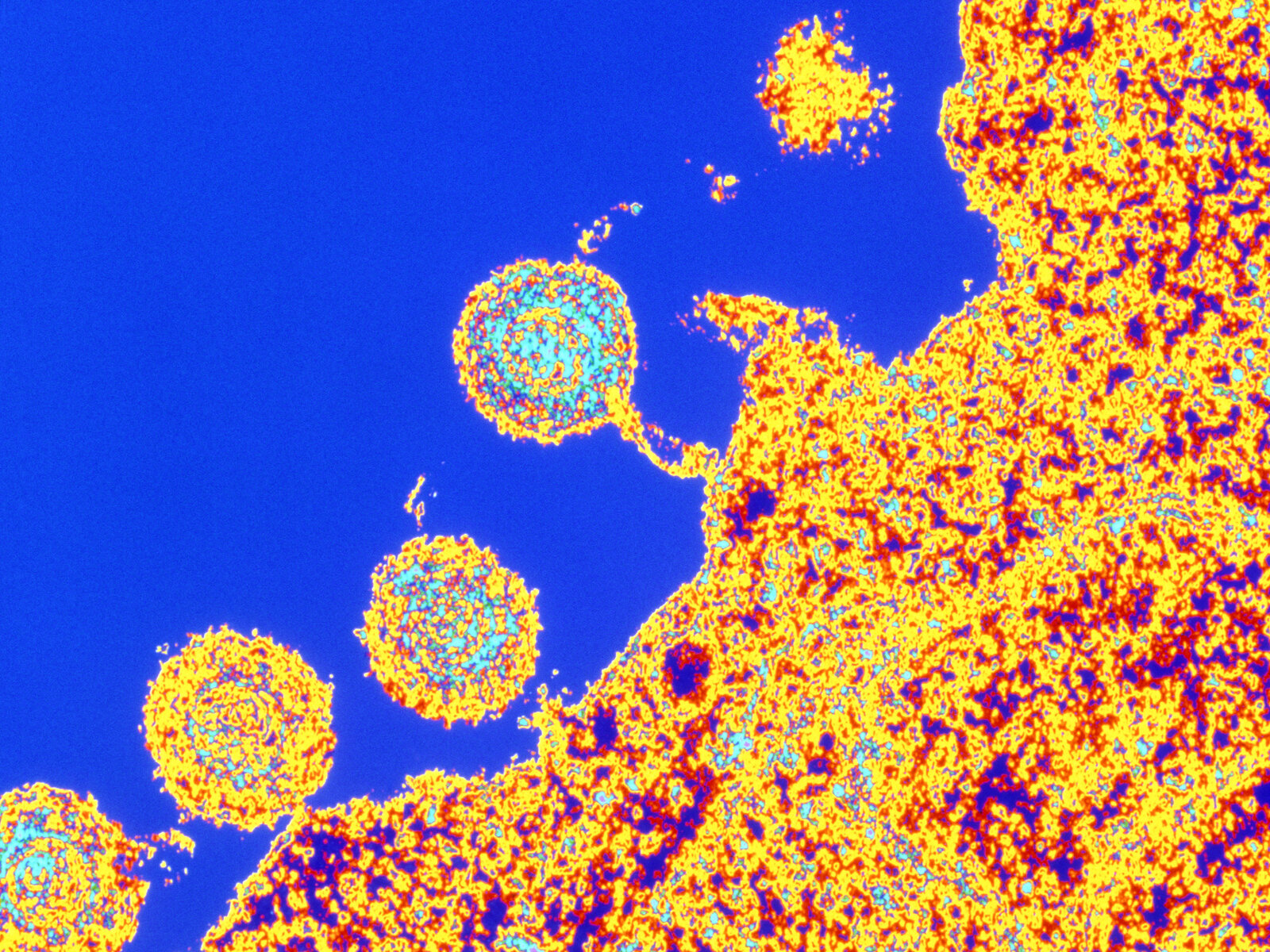
Several circular herpes virus particles are seen near a cell membrane. Roseola herpes virus causes a childhood illness marked by skin rashes and now has been found in brains with Alzheimer's disease.  NCI/Science Source

Two neuroscientists at Massachusetts General Hospital and Harvard University have been responsible for advancing the viral/Alzheimer's links for years, and Drs. Rudolph Tanzi and Robert Moir are preparing to issue new findings of their own. New experiments of theirs performed in mice and three-dimensional brain cells in a petri dish discovered the same herpes species to ignite a protective reaction in amyloid which Dr. Tanzi describes as "seeding" the amyloid, leading it to ensnare the virus in fibrous nets, forming plaques.

According to these findings, viruses and other microbes represent the advance to the theory that Alzheimer's is caused by amyloid accumulation which the brain is helpless to clear away. Alzheimer's which increasingly afflicts greater numbers of mostly elderly people, has up to the present resisted all drugs tested in hundreds of clinical trials.

Dr. Dudley and his colleagues created computer models to map the molecular and genetic networks to disrupt the progress of Alzheimer's.

Simply put, these particular herpes species are able to enter brain cells. Two areas of the brain particularly damaged in Alzheimer's demonstrate the process of genes susceptible to harm from herpes viruses invading their precincts. The same genes found to be active in Alzheimer's pathology evidently become active also in fighting viruses.

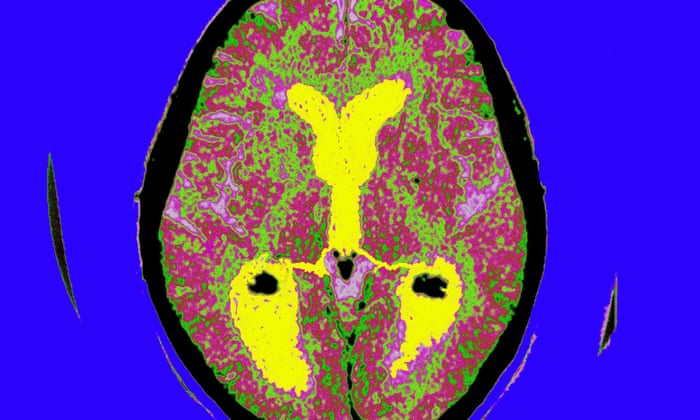
Brain scan of a patient with Alzheimer’s disease. Photograph: BSIP/UIG via Getty Images

Labels: , , , , ,

 
()() Follow @rheytah Tweet