Ruminations

Blog dedicated primarily to randomly selected news items; comments reflecting personal perceptions

Saturday, May 25, 2019

Seeking Solutions to Obesity

"This proves that [the gene] MC4R is an important, if not the most important, controller of weight." "[And the new pathway provides an obvious target for drugs to protect against obesity]."

Sadaf Farooqi, MBChB, PhD, professor of metabolism and medicine, University of Cambridge

"We think regulation of hunger and satiety is the key."
"There is food everywhere. If you are a little bit hungry and someone puts out a big plate of doughnuts at your meeting, who’s going to reach for the doughnuts?”
Cecilia Lindgren, professor of genomic endocrinology and metabolism, University of Oxford
Two studies published April 18 in the journal Cell have shone new light on the role genetics can play in developing obesity—or protecting against it.  CardiovascularBusiness

Those among us who always seem to be able to eat whatever they like and never gain weight are both admired and resented by the infinitely greater number of people who crave food constantly and frequently overdo it, ending up gaining weight that then threatens to impair their health and longevity, New research has revealed that the people who always look so trim have a faulty gene responsible for their unusual metabolism.

That genetic alteration in that relatively small number of people who don't seem to ever gain weight actually mutes their appetite so they are in fact not all that enthusiastic about eating. On the more positive end of the spectrum, not only do they remain physiologically spare but these people who never consume much food or think constantly about their next meal, have a reduced chance of becoming diabetic or struggling with heart disease.

The U.K. Biobank which has data on a half million people aged 40 to 60, formed the basis of the study published in the journal Cell, while a second study also published in the same journal made use of data from the same population to develop a genetic risk score for obesity which can help predict as early as childhood who would be at high risk for obesity.

The findings from both studies, when taken together, confirm that there are biological reasons for the reality that some people struggle with their weight and others have no need to. The biological impacts are recognized to focus on appetite, not on metabolism, where people who gain too much weight or struggle to retain normal weight feel hunger on a frequency scale not reflected by their naturally thin counterparts.

The appetite-dulling mutation, led by Dr. Farooqi and Nick Wareham, an epidemiologist at the University of Cambridge, drew on Dr. Farooqi's research into the gene MC4R which she has studied for the past two decades. Her study of the gene was primarily in an effort to parse why it is that some people are overweight, not the opposite; why some people are not.

Endowed with MC4R mutations people tend toward obesity. As many as 300 mutations are located in this gene; the most common single gene cause of obesity. Six percent of children suffering from severe obesity can trace the cause to this gene mutation.

Satiety -- the feeling of fullness following a meal -- is destroyed by the mutations. When people eat a meal, the gene is automatically switched on to signal people that they have consumed their nutritional needs for that meal. When people consequently feel that 'full' signal they stop eating, and the signal turns off.

Those people carrying a mutation in MC4R preventing the gene from doing its work are absent the signal of satiety. Consequently they always feel the need to eat, and as a result become overweight, with a risk of diabetes and heart disease 50 percent more elevated than those lacking the mutation.

In some people, according to the new study, the MC4R gene is always turned to 'on'; they feel full always. And 6 percent of the population is affected by that mutant gene.

As for the related study, Dr. Amit V. Khera, a cardiologist at Massachusetts General Hospital and fellow researchers were looking for a method to predict out of a huge collection of minuscule variations in DNA, who might be destined to struggle with weight gain. As a result, the scientists designed an obesity risk score based on DNA alternations, such that people with the highest score weighed 13 kilograms more on average than those with the lowest scores.

The very obese saw 60 percent scoring high. And since the  U.K. Biobank population data consisted of adults, the scientists made use of other genetic studies where at birth, babies with high scores weighed the same as babies with low scores. But by three-and-a-half, they were heavier and by age eight, they were obese. Late adolescence saw them weighing on average 13 kilograms more than children with low risk scores.

"Those eight years might be magical and give you a unique opportunity to make a difference", observed Dr. Joel Hirschhorn, a geneticist at Boston Children's Hospital.


food, hunger
Business Standard

Labels: , , , ,

Monday, July 09, 2018

Giving Harbour to Potential Brain-Killers : Child to Adult

"These viruses are probably significant players in driving the immune system in Alzheimer's. I think they're like gas on the flames of some pathology that may be immune-driven."
"The viruses have a direct sort of push-pull with lots of known Alzheimer's genes."
"I don't think we can answer whether herpes viruses are a primary cause of Alzheimer's disease. But what's clear is that they're perturbing networks and participating in networks that directly accelerate the brain towards the Alzheimer's topology,"
"It's very unpopular [the viral link to Alzheimer's theory]. I'm sure there's a lot of people who are secretly unhappy about it." 
"[Alzheimer's researchers] come up to me at conferences and say in hushed tones, 'Oh, I also have a data set that shows viruses but I'm afraid to publish it."
Joel Dudley, professor, Icahn School of Medicine, Mount Sinai, New York

"This definitely brings up the potential role of infection or infectious particles in the pathology of Alzheimer's."
"It's a very complex disease, and the answer's [to its onset and possible treatment] not going to be one thing."
Dr. John Morris, Alzheimer's expert, Washington University School of Medicine, St.Louis, Missouri
Credit: Shutterstock
The hypothesis that a virus may be implicated in the onset of Alzheimer's is a hoary old one that many if not most scientists specializing in the treatment of Alzheimer's dismiss out of hand. The authors of a new research paper published in the journal Neuron were among those doubters and obviously no longer are since they've given their professional imprimatur to that theory through their research conclusions and the paper that arose from them.

Compelling evidence that viruses may be involved in Alzheimer's -- in particular two types of herpes infections known to infect infants and then to lie dormant for years.

Through their research, the scientists discovered the viruses interact with Alzheimer's linked genes; that fact alone serves to support the idea that they may indeed play a significant role in how that dread brain disease develops and steadily progresses in severity, leading to death. The study's authors took pains to point out that no firm evidence yet exists that these viruses do cause Alzheimer's; theirs is a scientifically educated thesis.

Another study soon to see publication supports their initial conclusion by suggesting the role viruses may play in kick-starting an immune response whose purpose might result in increasing an accumulation of amyloid, a protein present in human brains which has a tendency to clump into Alzheimer's plaques. If these theories are ultimately proven by further research to be correct, there is hope they may lead toward treatments and possibly even new methods of screening for Alzheimer's.

The study presented the most authoritative evidence yet for a viral role in the onset of Alzheimer's. To reach their conclusion, close to 950 human brain samples located in four different brain banks were analyzed, resulting in links discovered to the genetic, molecular and clinical symptoms of Alzheimer's. Those rejecting the theory outright raise questions of their own, such as the possibility that the viruses discovered in significant numbers in Alzheimer's brains might be 'innocent bystanders'.

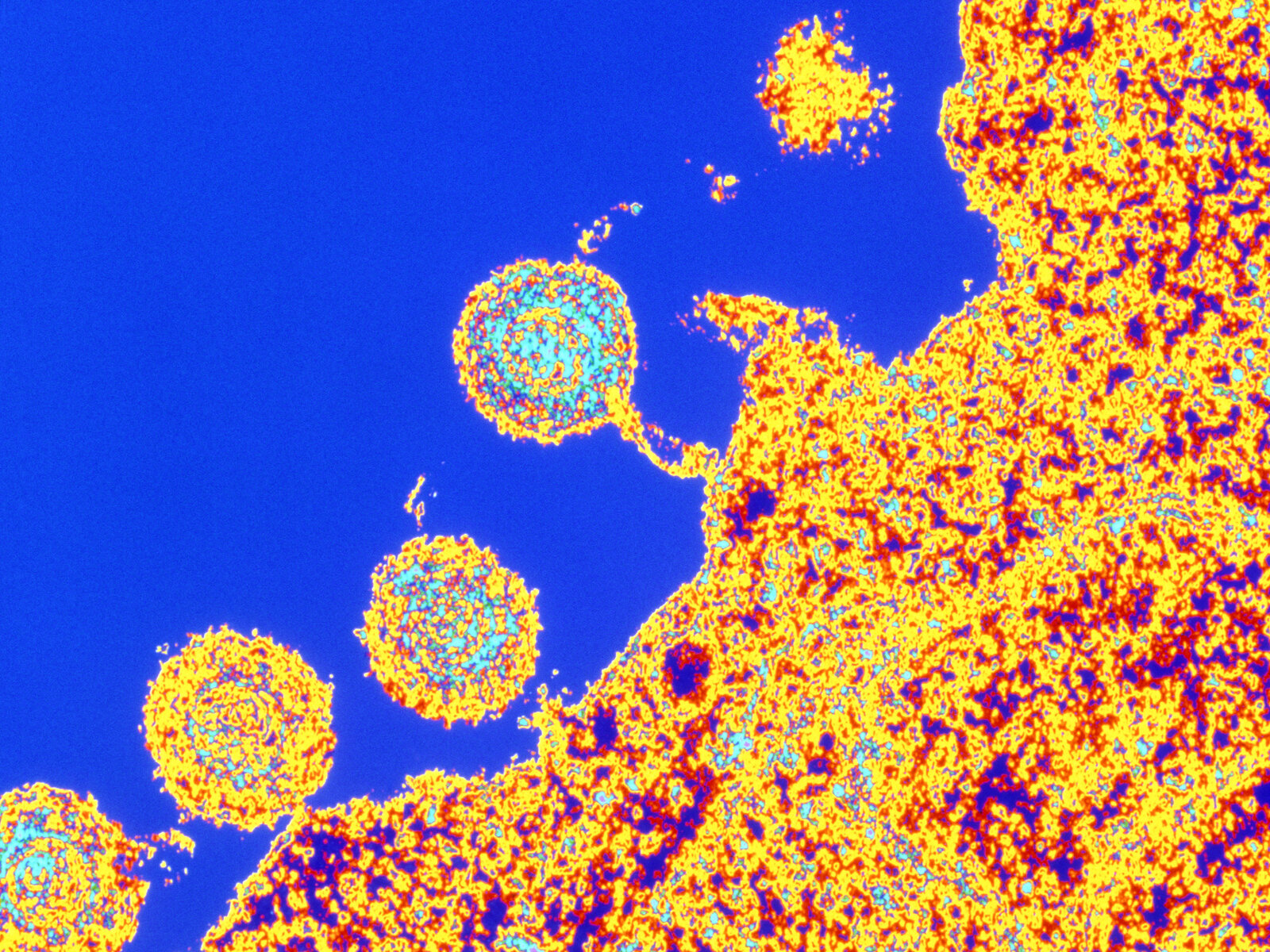
Several circular herpes virus particles are seen near a cell membrane. Roseola herpes virus causes a childhood illness marked by skin rashes and now has been found in brains with Alzheimer's disease.  NCI/Science Source

Two neuroscientists at Massachusetts General Hospital and Harvard University have been responsible for advancing the viral/Alzheimer's links for years, and Drs. Rudolph Tanzi and Robert Moir are preparing to issue new findings of their own. New experiments of theirs performed in mice and three-dimensional brain cells in a petri dish discovered the same herpes species to ignite a protective reaction in amyloid which Dr. Tanzi describes as "seeding" the amyloid, leading it to ensnare the virus in fibrous nets, forming plaques.

According to these findings, viruses and other microbes represent the advance to the theory that Alzheimer's is caused by amyloid accumulation which the brain is helpless to clear away. Alzheimer's which increasingly afflicts greater numbers of mostly elderly people, has up to the present resisted all drugs tested in hundreds of clinical trials.

Dr. Dudley and his colleagues created computer models to map the molecular and genetic networks to disrupt the progress of Alzheimer's.

Simply put, these particular herpes species are able to enter brain cells. Two areas of the brain particularly damaged in Alzheimer's demonstrate the process of genes susceptible to harm from herpes viruses invading their precincts. The same genes found to be active in Alzheimer's pathology evidently become active also in fighting viruses.

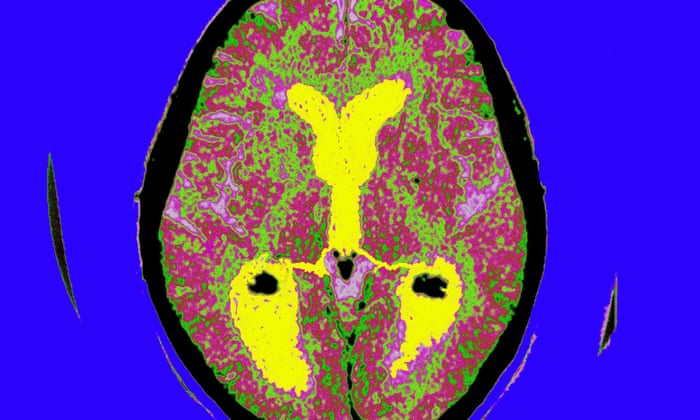
Brain scan of a patient with Alzheimer’s disease. Photograph: BSIP/UIG via Getty Images

Labels: , , , , ,

 
()() Follow @rheytah Tweet