Forgotten Baby Syndrome
"Never leave a child unattended in a motor vehicle, even for a minute. That should be a rule that you make for yourself; even if I forgot something in the house, I need to run back in the house with the child."
"You have to get your cellphone at some point, usually, so that's a good way to remember [the child's presence in the back seat by placing your cellphone beside the child's seat]."
If the child is in distress, we've talked to the police about this and they recommend that you do whatever you can to get the child out of that car."
"Regardless of the exact mechanisms and circumstances that lead to these
tragic incidents, experts believe that under the right circumstances,
forgetting an infant or child in the back seat could happen to anyone.
It’s important to be aware of potential pitfalls and set strategies and
habits in place as reminders that can help prevent attention shifts and
lapses in memory."
"On a sunny day, the interior temperature of a vehicle can rise to
dangerous levels within a short period of time. For example, an outside
temperature of 22.2°C can result in an interior temperature above 40°C
in just an hour. These
temperatures are extremely dangerous and can lead to hyperthermia – a
condition where the body temperature is elevated beyond normal. Young
children are particularly susceptible to this and in developing a
heatstroke as their bodies heat up quicker."
Dr. Joelene Huber, Hospital for Sick Children, Toronto, Assistant Professor, Pediatrics, University of Toronto

"You know, I think we all know that, especially working parents, when
you're under stress, when you're sleep deprived, your memory might not
be functioning the way you wish it were. And that is exacerbated when
you're doing something habitual, like driving to work every day in the
same route. When there's a change in routine, sometimes the parent will
forget to do the change and go back to the original autopilot routine
that they're used to. In a lot of these cases - and this is what's
shocking about it - in more than 200 cases in the last two decades or
so, parents have literally forgotten about their younger child and gone
and brought their older child to a day care setting and forgotten the
younger one is in the car. They sort of reverted to the old pattern that
they remember from years ago."
"Sometimes you have prosecutors who look at this situation and realize it
was just this horrible, tragic mistake. Sometimes you have prosecutors
who look at the situation and say, wait a minute, is there something
wrong here? Could the parent have been on drugs? Was there some
extenuating circumstances that led to this parent's forgetting? And, you
know, the people who study this do recommend that prosecutors look into
the circumstances of the death. There is always that small chance that
the parent somehow was negligent or the parent had even intended to kill
the child. But it is a small subset of the number of children that have
died in this way, according to the people who study this."
Sharon Otterman, The New York Times
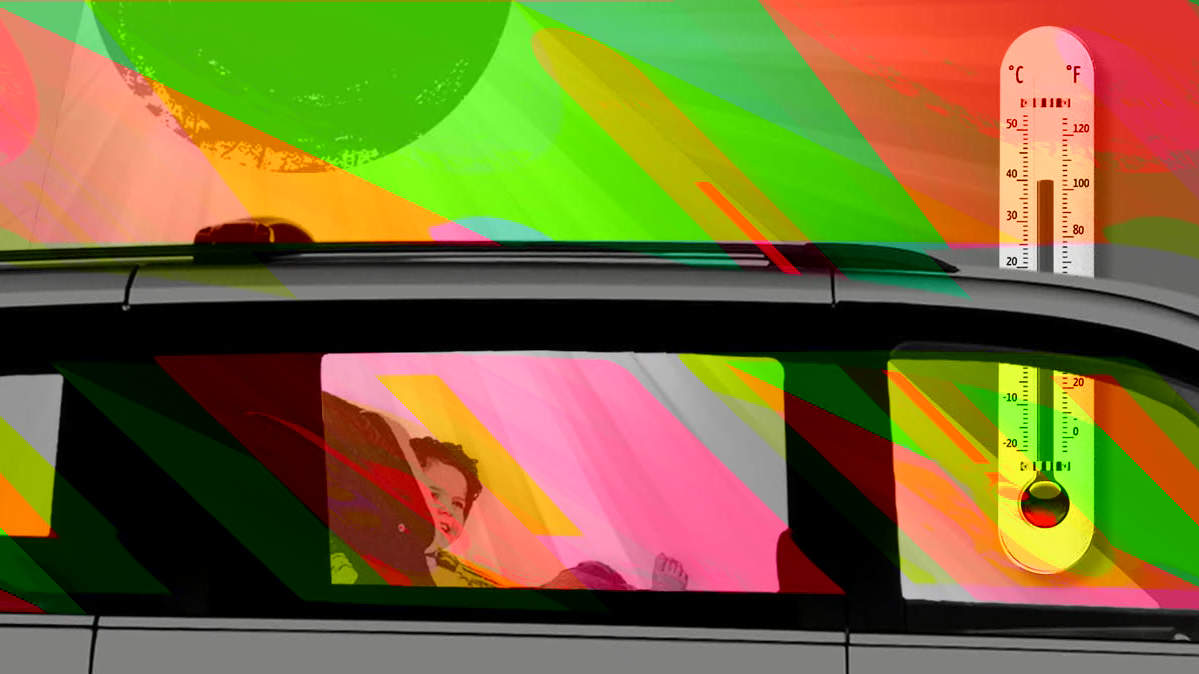 |
| Illustration: John Ritter |
In the United States, thirty babies, infants or very young children, die yearly from being left in a closed vehicle on a hot, sunny day. In Canada, with one-tenth the population of the United States, one child a year is lost to what many refer to as
"Forgotten Baby Syndrome". Accidents, where children are stranded alone in hot cars, leading to a child's agonizing death. A new study out of the Hospital for Sick Children in Toronto points to habits that parents could absorb into their routine that would help them to always bear in mind that their child is with them.
To never lock the car, for example, without first performing a routine, thorough scrutiny of the back seat. The back seat is where the baby seat is located. And in that baby seat may be a child who has fallen asleep. A quiet child can be overlooked, its presence automatically discounted because a parent's brain happens to be elsewhere at the time; to get to work on time, an important meeting you're late for, concerns over just about anything, family- or work-related. We're pressed for time, with none to be wasted.
On the other hand, the issue of forgetting a child's presence, while it can certainly happen to anyone who is distracted, should make all of us metaphorically sit up and take notice. Take notice in particular about something we rarely forget; our indispensable cellphones. Now, that's automatic, to take possession of it, always have it with us in easy grasp. So, placing that item so indispensable to our day beside the child in the back seat will help to recall the presence of the child. Something there doesn't quite compute necessarily, but it could work.
In the study, the authors pointed out that simple forgetfulness was integrally involved in four of six deaths recorded between the years 2013 and 2018 in Canada, according to their research recently published in
Pediatrics and Child Health. Most of the deaths that came under study related to adults forgetting their most immediate mission -- on the way to another destination for the day; to drop a child off at daycare; speeding directly on to that second, important destination and failing to recall that the child wasn't placed securely at daycare for the day.
In 2013 a child just shy of two years of age was picked up by his grandmother at her daughter's home after working a nightshift. With the child in her car, she simply forgot to drive him to the daycare and he was left in the car, and he perished in that car. The grandmother pleaded guilty to failing to provide the necessities of life, receiving a suspended sentence and two years of probation. Hers, however, is really a life sentence; she will never outlive the fact that she was responsible quite directly for the death of her grandson.
Dr. Huber recommends that parents arrange for their child-care providers to call, sound an alarm should one of their charges be absent without prior notice. Another recommendation is to place a stuffed toy in the infant car seat, and that the stuffed toy be placed on the front seat of the car when a child is put in the car seat, as a reminder to the parent or the driver that the plush toy will be placed back in the car seat when the child is taken out of it. Above all, emphasizes Dr. Huber, remember the mantra
"Look before you lock".
As for anyone who happens to notice a child alone in a car in hot weather, they should immediately dial 911 for assistance. A
"greenhouse effect" occurs inside cars, sending the interior temperature to deadly heights, even when the outside temperature is a moderate 21 or 22C.

Labels: Accidents, Children, Death, Hot Days, Vehicles, Warning