Ruminations

Blog dedicated primarily to randomly selected news items; comments reflecting personal perceptions

Wednesday, August 12, 2020

Anti-COVID-Contagion Mask Efficacy

"We confirmed that when people speak, small droplets get expelled, so disease can be spread by talking, without coughing or sneezing."                                      "We could also see that some face coverings performed much better than others in blocking expelled particles."                                                                                  "We certainly encourage everyone to wear a mask, but we want to make sure that when you wear a mask and you go to the trouble of making a mask, you make one, or wear one that actually helps not just you, but helps everyone."                             Martin Fischer, associate research professor, Duke University, North Carolina  

"If everyone wore a mask, we could stop up to 99 percent of these droplets before they reach someone else."                                                                                 "About half of infections are from people who don't show symptoms, and often don't know they're infected. they can unknowingly spread the virus when they cough, sneeze and just talk."                                                                              "They [some types of masks tested] were no good. The notion that 'anything is better than nothing' didn't hold true."                                                                             Eric Westman, associate professor of medicine, Duke University

Different types of face masks
Shutterstock/Golden Shrimp

It was when Dr.Westman began an association with a local non-profit to obtain masks from them to enable him to provide free masks to people who need them, that the idea for a study, published online this month in the journal Science Advances, came about. He was curious about which masks would be the most effective, wanting to be certain he wouldn't be providing people with masks that were inefficient, giving them a false sense of security.

To that end he decided he would test their efficacy, and asked colleagues to think up a basic, cost-effective method to test common masks. Dr.Fischer answered the call -- as director of the Advanced Light Imaging and Spectroscopy facility -- he put together a cardboard box, a laser, a lens and a cellphone camera to produce an inexpensive method of testing face masks. With the result that it was revealed that the masks Dr.Westman planned to acquire were relatively ineffective in reducing COVID-19's spread.

The study found that many masks made at home do work quite well to reduce the spread of COVID-19. The comparison led by researchers at Duke University of effectiveness of 14 different types and manufacture of masks and face coverings, useful in shielding from droplets people expel while merely talking, produced useful results. Each type of mask was tested ten times by one speaker, while three coverings were tested by four other speakers, with test subjects led to repeat the phrase "Stay healthy, people".

N95 masks were confirmed to represent the most effective coverings in shielding from the spread of COVID-19, where the masks without valves succeeded in allowing only 0.3 percent of droplets to escape, in comparison to the same speaker wearing no mask. Second in effectiveness was surgical masks, permitting one percent of spattered droplets to escape. These masks are not available to the general public however; they are part of the personal protective equipment meant for the use and protection of health care professionals.

Researchers then turned their attention to a variety of homemade masks, along with other commonly-used face coverings, finding that many homemade masks perform perfectly well. Just five percent of droplets were released by a polypropylene/cotton blend mask, while most pleated cotton masks tested released fewer than 20 percent of droplets. There were varying results, with the takeaway that a need exists for more testing of commonly-worn face masks, according to the researchers.
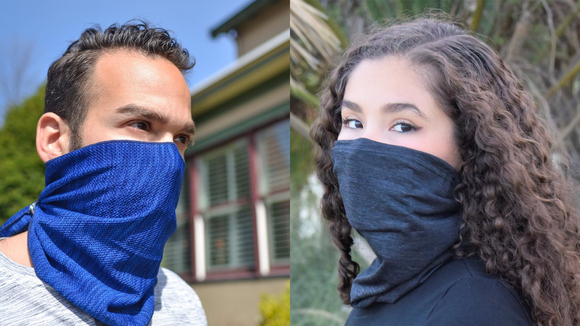
People are using gaiters as face masks—but are they as effective? (Photo: Mission/Etsy)
Aerial view of gray cotton neck fleece isolated on white background
iStock

Knitted masks were seen to provide substantially less protection than any of the cotton types, while a bandana cut the number of droplets only by half. And then, there is the fleece neck gaiter which, when tested, was seen to increase the number of expelled droplets to 110 percent. "We attribute this to the fleece, the textile, breaking up those big particles into many little particles. They tend to hang around longer in the air, they can get carried away easier in the air, so this might actually be counterproductive to wear such a mask", cautioned Dr.Fischer.

Labels: , , ,

Tuesday, July 07, 2020

Recognizing All Aspects of Viral Transmission

"The debate over whether the airborne transmission route occurs is over. Many of us have claimed its relevance from very early in this pandemic."
"It was real then. It is real now. Period."
Dr.Richard L. Corsi, dean, engineering and computer science, Portland State University

"Hand-washing and social distancing are appropriate, but in our view, insufficient to provide protection from virus-carrying respiratory microdroplets released into the air by infected people."
"[The problem is a matter of] heightened significance now, when countries are re-opening following lockdowns -- bringing people back to workplaces and students back to schools, colleges and universities."
"All routes of transmission must be interrupted [to await the arrival of a vaccine]."
Joint commentary, Journal of Clinical Infectious Diseases

"Simple things can make a big difference."
"Wear masks whenever you are not at home. Even simple homemade masks can have a major impact."
"Open windows. Don't gather in large groups inside with singing and loud talking."
Dr.Donald Milton, professor of environmental health, University of Maryland

"[Some public health officials have dismissed airborne transmission] which does not strike me as being very cautious when  you are dealing with a virus which is still new and is causing a very severe pandemic."
"[Under the precautionary principle] you don't have to await scientific certainty to take extra precautions."
"It's very inconvenient to acknowledge aerosol transmission because it takes a lot more work to deal with it. Certainly not everyone who has worked with COVID patients has been infected. But there have been a very high number of health-care workers worldwide that have been."
"This is something that needs to be re-examined very carefully."
"In poorly ventilated settings you would expect aerosol transmission to increase."
"[Wearing masks is] something that vigorously should be encouraged, absolutely."
Dr.Raymond Tellier, medical microbiologist, McGill University Health Centre
The logo and building of the World Health Organization (WHO) headquarters in Geneva, Switzerland, 15 April 2020. US President Donald Trump announced that he has instructed his administration to halt funding to the WHO. The American president criticizes the World Health Organization for its mismanagement of the Coronavirus pandemic Covid-19. (Martial Trezzini/Keystone via AP)
The World Health Organization is preparing a scientific brief on modes of transmission that will be released in the coming days, according to Maria Van Kerkhove, technical lead on the COVID-19 pandemic at WHO  (Martial

In a shocked and traumatized world it's just as well that some concensus occurs between health scientists to advise and inform the general public, left confused by persuasive counter-arguments emanating from the authority of experts in the field of virology and infectious diseases. As has occurred most recently when a group of 239 think-alike scientists messaged an appeal to the World Health Organization along with other national health authorities to grant formal recognition to the potential for the airborne contagion of COVID-19.

Published yesterday in the Journal of Clinical Infectious Diseases, there is a warning under the signatures of an international group of scientists that every reason exists to anticipate that SARS=CoV-2 may be spread through microscopic repository droplets sufficiently small to remain aloft and capable of travelling through a room-like space, just like any other coronavirus.

Airborne transmission of COVID-19 micro particles is generally not recognized by most public health bodies, the World Health Organization included. Certain aerosol-generating medical procedures known to cause airborne transmission present as the exception. The preferred messaging is that close contact and larger respiratory droplets seen when people sneeze or cough represent the primary vector for infection, despite the limited range of one or two metres before the droplets fall.

The hundreds of agreed scientists support the explanation that there is a "real risk" in airborne transmission of COVID-19, but it does not represent the only "real risk", referring to a plausible explanation for a number of superspreading events. The possibility of airborne transmission is not under consideration by a number of public health officials. The reason for this reluctance is debatable, yet there is the very fact that not enough is yet known about the SARS-CoV-2 virus to feel confident in predicting any route it takes, now and in t he future.

However, measures have been recommended to retard airborne transmission which could include effective ventilation to ensure more clean air enters premises from the outdoors and less circulating air in public buildings, workplaces schools, hospitals and nursing homes. And that remedies can be suggested such as airborne infection controls such as germicidal UV lights and avoidance of overcrowded conditions, paying particular attention to public transport and public buildings.

Studies have noted that "beyond any reasonable doubt" tiny virus-heavy aerosolized droplets released as people exhale, talk and cough, are capable of floating in the air and drifting long distances carried by currents; possibly as wide-ranging as tens of metres in distance, according to the message from the combined opinion piece.

"Currently, health experts believe that coronavirus cannot be transmitted through airborne transmission", according tot he B.C.Centre for Disease control. Unravelling which transmission route -- droplets via close contact -- airborne?  contaminated hands? represent the most important  theory is difficult to support. Breathing and speaking helps to emit and transmit minuscule aerosols as a response to why it is that asymptomatic people not coughing or sneezing are able to transmit the virus.

Of primary importance it remains well understood that "In poorly ventilated settings aerosol transmissions are expected to increase." Asymptomatic individuals aren't coughing or sneezing yet are able to transmit the virus. Physical distancing and washing hands and self-isolating should someone recognize the symptoms of disease, emphasized Dr.Tellier.
"We wanted them to acknowledge the evidence."
"This is definitely not an attack on the WHO. It's a scientific debate, but we felt we needed to go public because they were refusing to hear the evidence after many conversations with them,"Jose Jimenez, chemist, University of Colorado, paper co-signer
A woman sits in a bench while walking her dogs in Mexico City
Scientists have accused the WHO of underestimating the possibility of airborne transmission AFP

Labels: , , ,

 
()() Follow @rheytah Tweet