Ruminations

Blog dedicated primarily to randomly selected news items; comments reflecting personal perceptions

Thursday, June 18, 2020

Could There Conceivably Be A More Contentious Issue?

"It has never been 100 percent safe to send children to school. There's always been a risk of contracting some infectious disease, whether it's the flu, the Norovirus or other viruses."
"Children are at risk of being injured ... and suffering mental and physical harm from bullying."
"But of course we can manage these risks and put mitigating factors in place to deal with them. This is exactly the kind of approach we have to take now."
Dr.Ronald Cohn, CEO, Sick Children's Hospital, Toronto
Experts say recent data shows children are not the super-spreaders of COVID-19 they initially believed they would be. (Erik White/CBC)
The conundrum of all the most difficult choices any society could possibly face; how best to safeguard the nation's children from the opportunistic clutches of a new, mysterious disease that has wrought havoc the world over, and still allow those children to experience as normal a childhood and education opportunities as possible? There is never any complete agreement on any issue; there are always supporters and detractors of perceived solutions, and in this instance there are both, as might be expected.

Canada's largest and most prestigious hospital specializing in care for children has issued a new report, one that the country will look upon as an instruction manual on how to proceed in re-opening classrooms at every level of education, and at the same time exercise due caution in the interests of protecting one of the most vulnerable demographics in any society. The report emphasizes the need to return children to the classroom if for no other reason, aside from attaining an age-appropriate education, than to continue their socialization and ensure sound mental health ensues.

The advice contained in the report will of necessity be a surprise to some and disturbing to others, while being greeted as a welcome solution by yet others. Greater incidents of infection could be a result of requiring students to wear face masks; separating children while they socialize outside the classroom would result in negative psychological effects, although maintaining a discreet distance between student desks is advanced, along with the cancellation of assemblies.

Jurisdictions in East Asia, as an example, the first to be confronted with the SARS-CoV-2 virus causing COVID-19, took an entirely different, infinitely more rigidly protective view on how to manage the safety of children returning to school following the first wave of the global pandemic. Hospital experts in Toronto informed a virtual news conference with the release of the report that children have suffered anxiety, depression and loneliness, facing a heightened risk of family discord and abuse throughout the lockdown period.

OTTAWA, ONTARIO - TUESDAY SEPTEMBER 2, 2008 - Today was the first day back to school for many youngsters at Orleans new Avalon Public School.  Photo by Ashley Fraser, The Ottawa Citizen - City - 91386 -

Those same experts stressed that the psychological benefits of resuming in-person classes in the coming usual school fall resumption period outweigh COVID-19 risks, particularly in alignment with frequent handwashing and ensuring that ill children remain at home. According to an Australian report on the experience of reopening schools, few cases of the coronavirus were found among students, with no evidence of students being a vector for adult infection: "Children are not the primary drivers of COVID-19 spread".
"That seems like the easiest of wins, especially for older kids; [urging public health authorities to decree mask use in certain public places mandatory as a key practise in curbing the spread of the virus]."
"My nieces are 11 and 13. They live in Massachusetts. They are required to mask. It's not a big deal."
"This whole document reeks of the kind of laissez-faire approach that got us into trouble with long-term care facilities and which now has Sweden in so much trouble."
"The complete lack of thought given to the role schools may play in amplifying disease that kills adults is just astounding."
"If you wanted to create super-spreader events, the way to do it would be to gather large groups indoors and have them sing, as this document appears to countenance."
Dr.David Fisman, head, epidemiology division, school of public health, University of Toronto
 Virtual learning could be offered for immunosuppressed. (Juliya Shangarey/Shutterstock)

"In young children in particular, masks can be irritating and may lead to increased touching of the face and eyes which could increase the risk of infection."
"Strict physical distancing should not be emphasized to children in the school setting as it is not practical and could cause significant psychological harm."
"Close interaction, such as playing and socializing, is central to child development and should not be discouraged."
Sick Children's Hospital Report

Children, emphasizes Dr.Cohn, despite earlier indications, do not seem to be "super-spreaders" of COVID-19. It seems more evident on the other hand that it is adults who tend to infect young people. Schools, in his considered opinion, are not at all likely to become a significant amplifier of COVID-19. Recent research appears to downplay the potential of children being major vectors for the coronavirus. British scientists produced a paper citing family clusters of cases indicating children to rarely be recognized as the instigator: "At the current time, children do not appear to be super-spreaders".
"[Keeping children out of school has already caused] significant adverse consequences."
"Parents are telling me their children are struggling with the lack of routine and structure."
"Children are sad, irritable, clingy and lonely."
Dr.Catherine Birken, pediatrician

"We are working closely with the best medical and scientific leaders in Canada -- including the Hospital for Sick Children and the COVID-19 Command Table -- to develop health protocols that keep our schools safe."
"We will take a cautious approach that underscores our complete commitment to safety."
Ontario Education Minister Stephen Lecce
Dr. Michelle Science says steps should be taken to ensure some physical distancing in schools, but trying to enforce safe distances among kids is impractical. (Ben Nelms/CBC)


Labels: , , , ,

Tuesday, December 04, 2018

COPD Evaluations

"The dilemma in the Canadian health-care system is that we can't admit them [chronic obstructive pulmonary disorder patients] all. We don't have enough beds."
"We [his research team] were trying to come up with a risk score to predict who was at risk of doing poorly so we could be more accurate in identifying those who needed [hospital] admission."
"That's sort of a trade-off [increased hospital admissions] we'll have to deal with if we want the best outcomes for our patients." 
"You have to put it together [social factors], discuss it with the patient and family, and make a recommendation as to whether or not to go home. It's a tool that makes our care safer for people."
"An emergency department is a crazy place to work [within]. You have huge numbers of people coming in the door 24/7, and they all have different problems. But some of these problems we see time after time after time, and it's now possible to systematize and standardize assessments in a way that wasn't done before."
Dr. Ian Stiell, Emergency Room physician, senior scientist, The Ottawa Hospital
iStock_000011190593LargeCOPD, an umbrella term for a number of diseases including chronic bronchitis and emphysema, is a chronic disease caused largely by smoking and characterized by shortness of breath, cough and sputum production. It progresses slowly over many years. As it advances, shortness of breath limits the activity levels of individuals and reduces their quality of life. It can also lead to premature death.                          Council of Academic Hospitals of Ontario
 
Dr. Stiell is recognized across the global medical community for his work in producing data to drive rule-making within hospital settings. Guidelines to assist emergencv room doctors have been developed by him, so ER physicians are enabled logically to determine when medical tests should be prescribed for knee injuries, concussions and spinal injuries, as well as a risk scale for heart failure. More recently he has been instrumental in producing a new study to demonstrate how an assessment tool can be of immeasurable help to emergency-room doctors required to make critical decisions about how to respond to patients with breathing difficulties.

Patients experiencing difficulties breathing as a result of chronic obstructive pulmonary disorder (COPD) are frequent visitors to hospital emergency rooms, presenting doctors with a dilemma. COPD is a serious disease of the lungs that is often attributed to smoking. The condition can be severely aggravated with the onset of a simple cold or flu, leaving COPD patients struggling for air with their compromised lungs. Faced with such patients, doctors on duty must arrive at a decision whether to admit patients to hospital or to send them back home after treatment, based on their assessment.

Dr. Stiell, with his immense experience as a seasoned ER physician emphasizes the importance for patients and hospitals that the correct COPD patients -- those most likely to develop dangerous complications -- be admitted. Emergency doctors have relied on their experience and clinical judgment in the past, along with consultations on occasion, when they reach their informed determinations. But that decision-making can be fraught with the potential for deleterious results arising on occasion.

About 38 percent of COPD patients in Canada were admitted to hospital after arrival at an emergency department with shortness of breath, according to earlier research published by Dr. Stiell. Many of those presenting with such symptoms have been sent home following their assessment and treatment, and among them some patients suffered seriously compromising events, the result of which was that some of these patients died. This is an obviously critical issue requiring a solution.

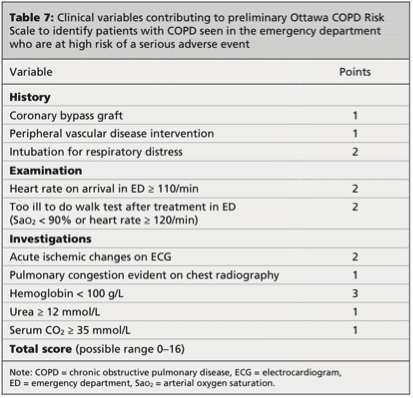
Ottawa-COPD-Risk-Scale

So together with his research team Dr. Stiell examined medical data arising out of 945 COPD cases to identify the common characteristics of high-risk patients which they then used to develop a ten-point "risk scale" to be used by ER doctors to more accurately identify those patients who are most likely to develop dangerous complications. The study tested the validity of the risk scale based on the experience of ER doctors from six Canadian hospitals, and it was published in the Canadian Medical Association Journal.

The finding was that through employment of the features identified in the scale, emergency-room physicians were enabled to improve their predictions significantly to identify which patients  were likely to suffer dangerous complications in the short term. A total of 1,415 COPD patient records were studied. Of that number, 135 had suffered serious setbacks in the month following their visit to an emergency room. Using conventional assessment methodology 52 percent of cases were correctly predicted for serious complications. With the use of the risk scale that number jumped to 79.3 percent correct predictions.

What resulted from that increased accuracy, predictably, was a modest hospital admission increase. Dr. Stiell is satisfied that the COPD scale presents doctors with an objective measure of the risk faced by patients with COPD, a score that is not considered in isolation of social factors, as, for example, whether the patient has access to a caregiver and family doctor.

Labels: , , , , ,

 
()() Follow @rheytah Tweet