Ruminations

Blog dedicated primarily to randomly selected news items; comments reflecting personal perceptions

Sunday, August 13, 2017

Fleecing The Sheep and Laughing All The Way To The Bank

"He's probably an artist who's in more demand today than any other."
"He's so good that he controls everything. He controls when galleries make shows, he controls who they sell a painting to -- he's on top."
Alberto Mugrabi, mesmerized 'art' collector

"Artists whose work is in great demand are in charge."
"They can call the shots and Mark figured that out pretty early."
"Who says he can't [break with tradition and sell directly out of his studio rather than through an agent]? It's an unwritten rule, but he's breaking the rules." 
Ann Philbin, director, Hammer Museum, Los Angeles

"He's the most important artist of his generation."
"I have bought works out of his studio; I've also bought works privately."
"I bought a sculpture of his for the Museum of Modern Art. He tries to sell them to people who are collectors rather than investors."
David Geffen, media mogul, owner of six paintings by Grotjahn

"There was always a conscious conversation about the importance of placing pictures in museums and in great collections."
"It becomes a pretty precise methodology."
"Artists like Mark -- they run their own show, as they should. They're the ones who've taken all this risk and stared into that void."
Timothy Blum, founder, Blum & Poe
Mark Grotjahn Credit Monica Almeida/The New York Times  The artist proudly stands before a sculpture of his that sold at auction for $16.8-million
Leonardo da Vinci, could he but foresee a time in the future when unscrupulous pretenders to art would successfully manipulate greedy acquisitors to believe that faux art reflects talent and original vision, would never have believed that intelligent human beings could stoop so low as to scrape the barrel of credulity and do it willingly, besides. Creating an atmosphere and a culture where the recognition of non-objective art bespeaks the genius of the few, and the challenge is to the viewer to admit that though the work is not visually or aesthetic leasing, it is original.

Its origins, needless to say, in the minds of flim-flam entrepreneurs who have recognized the cupidity and stupidity of a segment of the population that will believe anything that 'experts' in the field of art curation convincingly inform them. While beauty may be in the eye of the beholder, so is a natural inclination to recognize what it truly is. And nothing that this man produces, just like the 'art' produced by so many of his contemporaries in 'modern art' represents beauty or the originality of vision accomplished through a master's hand.

Create it, and they will come is his obvious mantra. But not without having first carefully set the stage. To convince the willingly gullible that what this man has produced (like, for example, Jackson Pollock) represents an authentic work of art, unequalled in bold design and execution by any of his contemporaries and as such a rare opportunity to acquire a colossal work of art whose value, both aesthetic and financial, can only increase in an art-hungry world.
"Untitled (Orange Butterfly Blue MG03) #1"  in his “Butterfly” series, 2003. Credit Douglas M. Parker

The gullible include art dealers whose discerning eye and bumph antennae distinguish them somewhat from enthusiastic art collectors only in that they instinctively know that any artist in their stable who gains the confidence of the art world and those who can afford the absurdly exorbitant prices to claim the prestige of ownership of such artistic nonentities as this respond to his clever pretense, inspiring their confidence and willingness to part with their expendable wealth.

Public and private art galleries succumb just as do those who style themselves connoisseurs of art; they have the academic papers to prove their studies resulted in moving to the head of the class. The prestigious vote of confidence in an artist such as this that results from his splendid art works being acquired to hang on the walls or grace the marble flooring of acclaimed galleries such as the Whitney Museum of American Art, the Museum of Contemporary Art in Los Angeles and the Los Angeles County Museum of Art, let alone New York's Museum of Modern Art and the Guggenheim Museum 'prove' the value of this execrable work.
Works in Mark Grotjahn's studio headed to the Nasher Sculpture Center. Credit Monica Almeida/The New York Times
The now-49-year-old Mr. Grotjahn has managed skilfully to influence the value of his works to an  unusual extent. Perhaps it was the psychological trauma he suffered when at an early show one painting only sold -- and for a miserly $1,750 -- that drove him to 'take charge' of his career in such a masterful manner as to create a legend about himself drawn from his own ego and masterfully parlayed into a general acknowledgement that his supremely gifted talent simply cannot be overlooked.

To those of a skeptical bent who fail to credit his 'art' with a simulacrum of rare artistic brilliance, they must understand the sad depth of their philistine ignorance.

That experience appeared to have soured  him indelibly with the convention that an artist was meant by unwritten rule to be faithful to a one-dealership representation. He has chosen instead to use the services of a number of recognized dealerships, all of whom boast well-heeled clients. And nor does he neglect the impact it can have on collectors to deal directly with the artist himself, a rare privilege he generously grants on occasion to various clients, even permitting them the privilege of buying art directly out of his studio, an unheard-of practise.

He had at one time himself, after earning his Master of Fine Arts degree from the University of California, operated an art gallery in Hollywood. He is intimately acquainted with the trade from both perspectives. The coincidental Hollywood conception of life in America, raucous, uninhibited, violent, sexy, criminal, addicted and wealthy, is a fitting metaphor for the claims that what this heralded artist produces represents the pinnacle of creative art.
"Untitled (Circus No. 1 Face 44.18)" in his “Circus” series, 2012. Credit Douglas M. Parker

Artists producing work of actual merit reflecting their special abilities in the creation of realistic renditions of landscapes, portraiture, allegorical and historical paintings whose artistic expertise speaks to the core of the aesthetic bestowed upon most discriminating viewers must wince if and when they become aware of such shameless charlatans perverting the very substance of art and authenticity in its production. It is this corruption of the beauty and meaning of art that speaks to the degeneration of its recognition and appreciation of its rightful place in our aesthetic.

"Untitled (African, Gated Front and Back Mask M34.b)" is a 2014 bronze based on a cardboard box and tubes. Credit Monica Almeida/The New York Times


Labels: , , , , , ,

Saturday, February 04, 2017

“You DON'T Gotta Eat Here...especially not twice!”

SOOO I convinced my family to give it a try for my sister's 18th birthday dinner. The 8 of us were seated and a highchair was provided for my 16-month-old son. The highchair was F-I-L-T-H-Y! We hadn't been greeted by our waitress yet so we asked a waiter from another section to come clean or replace the chair. He brought a new chair...that just as dirty lol. My mom politely asked that he wipe it down with a cloth. Thank you, kind sir, for doing so. We were greeted by our waitress, who was, yup...the same darn waitress my husband and I had a week prior! I thought, maybe she was just having a bad night last Friday as well....I thought wrong. Drink orders were taken...it was10 minutes before they made it to the table and she forgot 2 of them...another 5 minutes for those. Then we sat...and we waited....and glasses got empty and orders weren't taken. I'm not exaggerating when I say that there was a whole 1/2 hour period when our waitress didn't come by our table at all! When she was finally ready to take our food orders, we skipped the appetizers and went straight for main courses. Everyone ordered something different - pulled pork, ribs, brisket, chicken...classic Southern fare. My son has an allergy so I asked the waitress to consult with the chef about the chicken fingers. She proceeded to argue with me about whether or not there may be dairy in them. Rather than just ask the chef herself; very unprofessional. While most restaurants are not able to guarantee an allergen-free environment, all of them ar able to provide a list of ingredients. That is all I wanted...but I got attitude instead. I was not the only one to get attitude either, my dad asked for a pitcher of ice tea for the table and she replied (and I quote) "Just hold on a sec" as she waved her finger at him! The food finally came and 3 out of 8orders were wrong...either the wrong bbq sauce, wrong side dishes (like beans instead of cornbread). There was no butter or ketchup on the table, replacements for incorrect orders took WAY too long...and overall there were alot of LONG faces at the table. But atleast there was live entertainment - a drunk (yes DRUNK) woman wearing a D&S t-shirt, stumbling around the restaurant...O-M-G!
D_S_Southern_Comfort_BBQ-Ottawa_Ontario.html# Review by J_FoodLover_11
restaurant interior: Portrait of a happy male waiter with a tray in his hand at the restaurant
So really, after a rant like that, the second displeasured review written of the same food establishment, why on Earth would anyone return only to find themselves in the very same situation over again? Glutton for punishment? Willing to give an erring server and food establishment a second chance? Who knows! Spelling and syntax errors aside, it made for an amusing read, if somewhat puzzling for the stated reason that anyone who would return to a restaurant that so spectacularly failed their expectations first time around must either have a short memory or couldn't be bothered finding an alternative.

To that anyone sensible might respond indeed OMG!

But restaurateurs themselves appear to be in a state of revolt in response to customers' entitled expectations, it seems. Consider that dentists and doctors and other service providers of health aid will charge clients who fail to live up to their obligations to appear on schedule for appointments, but what recourse do restaurants have when, having booked a table well in advance, those scheduling the reservation fail to appear and the restaurant is left in the lurch? Which explains why many no longer take reservations. Patrons must appear and wait to be seated.

And those diners who think they can peruse a menu and, finding nothing they deem attractive enough to order on it, persuadingly convince the server and the chef to accommodate them by providing an alternative plate, while succeeding in the past, are no longer capable of doing so. It's not necessarily that the chef is rigidly immovable in declining to provide anything not advertised, but that this kind of accommodation transcends by a good degree the customary offering of a range of dishes appealing to diners yet expecting the chef to focus on their particular taste as a polite obligation to commerce.

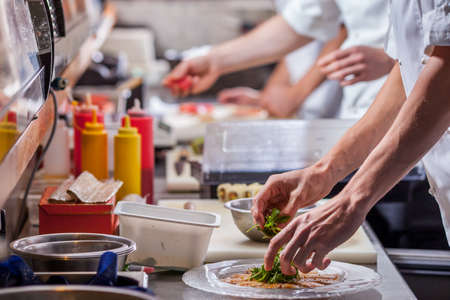
restaurant interior: male cooks preparing meals in restaurant kitchen Stock Photo
And is it not rather unreasonable when a customer, dining alone, finds the table they've been escorted to uncongenial to their seating preference, and insists instead in being seated at a customer-empty table set for eight? Where once a restaurant might graciously have opted to move that diner to the eight-seating table, they've now opted-out. It seems the profit margin is not that great to accommodate the need to change a tablecloth on a large table that has serviced one picky diner.

The moral of this story might lie in the morale that sagged with frustration over bending into pretzels to satisfy a clientele for whom no efforts at accommodation are quite sufficient. And now restaurateurs appear to be declaring by their unwillingness to continue being manipulated by fastidiously entitled diners whose wishes go beyond inconveniencing a business, that what you see is what you get. 

The food establishment is in the business to make a profit. And while servicing the customer's wishes can be performed to a degree, it has its limits. And if the restaurant now rejects payment by credit card that too obviously is a rejection of a taken-for-granted payment process that it deems inconvenient and costly to itself. That, and the assertive declaration that separate bills for friends sharing a table and ordering separately, is entirely too much trouble; one bill is to suffice, and use a little math to figure out who owes what. 

restaurant interior: SINGAPORE - NOVEMBER 08, 2015: food court in The Shoppes at Marina Bay Sands. The Shoppes at Marina Bay Sands is one of Singapores largest luxury shopping malls
Singapore, food court, Shoppers in Marina   123RF

Labels: , , , ,

Saturday, August 15, 2015

Corporate Conscience? Oxymoron

"Coca-Cola, the world's largest producers of sugary beverages, is backing a new 'science-based solution to the obesity crisis: To maintain a healthy weight, get more exercise and worry less about cutting calories ...."
"The beverage giant has teamed up with influential scientists who are advancing this message in medical journals, at conferences and through social media. to help the scientists get the word out, Coke has provided financial and logistical support to a new non-profit organization called the Global Energy Balance Network, which promotes the argument that weight-conscious Americans are overly fixated on how much they eat and drink while not paying enough attention to exercise."
The New York Times

"Most of the focus in the popular media and in the scientific press is, 'Oh they’re eating too much, eating too much, eating too much’ - blaming fast food, blaming sugary drinks and so on."
"And there’s really virtually no compelling evidence that that, in fact, is the cause."
Steven N. Blair, exercise scientist, vice president, Global Energy Balance Network

File Photo/The Associated Press
Coca-Cola is backing a new “science-based” solution to the obesity crisis: To maintain a healthy weight, get more exercise and worry less about cutting calories. Health experts say this message is misleading and part of an effort by Coke to deflect criticism about the role sugary drinks have played in the spread of obesity and Type 2 diabetes.

Kraft Foods, McDonald's, PepsiCo and Hershey's, along with Coca-Cola are all implicated as corporate malefactors capable of manipulating public opinion. Well, certainly people are hugely suggestible. And people love to eat, particularly food and drink that appeal to their taste buds, high in sugar, fat, salt, all of which in abundant amounts in any diet speak to excess. Moderation may be the key to the golden mean, but it isn't in most people's characters to cling to moderation.

We enjoy excess. If something seems like a good thing, tastes good, makes us feel good, we automatically think: why not more? And so, we indulge. And we super-indulge. Not just intermittently, but constantly. And manufacturers of quasi food that has been processed beyond its natural state to present as taste-pleasing products rife with sugar, fat and salt, see no reason why they have to restrain their acquisitive impulse in sales and profit.

After all, people are imbued with free will and people have the capacity to make discriminatory, intelligent choices in their lives. And as free individuals able to do as they wish when they wish, why should it be the responsibility of food processors to be concerned about health matters on the part of the public? Government agencies, on the other hand, are concerned, they're concerned about the growing menace of population obesity, because ill-health takes its toll on a health-care system.

So government-employed scientists study the issues, do their research, conduct their investigations and come to conclusions in line with government's concern; people are eating too much and too much of the wrong food. So the corporate food-processing interests are responding. They're hiring their own scientists and medical investigators to come up with academic conclusions that all would be well if only people used the energy they derive from questionable food sources, to balance intake with output.

In the annals of all's fair in public relations if it profits the bottom line, the food processing giants have taken to hiring scientists to come up with findings that match the interests of processors. Now, the question might be a standoff between ethical corruption versus personal restraint. Consider this: the president of the Global Energy Balance Network is none other than University of Colorado School of Medicine Professor James O. Hill, a past chair of the National Institute of Health Nutrition Study Section.

Reputation, global respect as a nutrition scientist and medical researcher? The man has it all. He was a member of the Expert Panel on Obesity of the National Institutes of Health, developing American guidelines for the treatment and prevention of obesity. Dr Hill is thought of as "a leader in the fight against the global obesity epidemic", celebrated by the American Society for Nutrition. He is also Director of the Center for Human Nutrition, co-founder of the National Weight Control Registry.

That this man of great repute in nutritional science has chosen employment with corporate food interests to aid them in advancing the theory that it doesn't matter what you eat or drink as long as you correspondingly exercise to match the energy consumed and thus stave off excess weight gain is breathtakingly puzzling. The simple reality being, needless to say, that sound nutritional intake itself is an imperative, one matched with a regime of bodily exercise for greatest health impact.

All else is commentary, and for the most part uninformed and untrustworthy evasion of reality.

Labels: , , ,

 
()() Follow @rheytah Tweet