Ruminations

Blog dedicated primarily to randomly selected news items; comments reflecting personal perceptions

Thursday, October 18, 2018

But Is It Art? The Joke's On You  Seriously

"A chapter in Phaidon’s upcoming Andy Warhol Catalogue Raisonné, Paintings 1976-1978-Volume 5 documents three closely related bodies of work—the Piss, Oxidation, and Cum paintings. The Piss paintings were made by urinating and pouring or dripping urine onto primed canvases; the Oxidation paintings were made by urinating and pouring or dripping urine onto canvases prepared with either copper or gold-colored paint; the Cum paintings were made with semen ejaculated, poured, or dripped onto primed canvases. Andy Warhol produced these paintings during the second half of 1977 and 1978. Chronologically, they directly follow and partially overlap with the Torso and Sex Parts paintings of late 1976 through early 1978. Thematically, both groups of work are concerned with the body: the Torsos and Sex Parts are figural representations of the body’s sexual attributes, whereas the Piss, Oxidation, and Cum paintings are process-based and abstract, relating to the body’s elemental functions."
The Phaidon Folio, Artspace editors
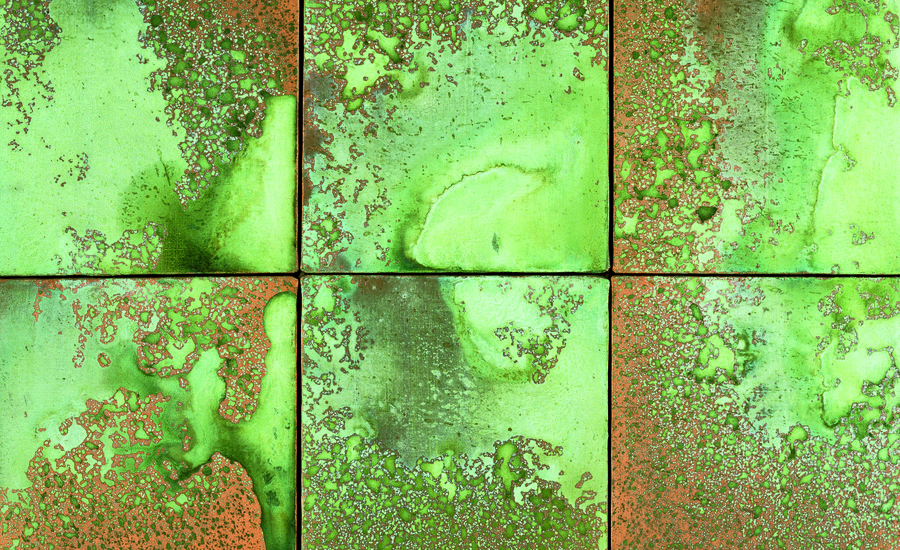
Andy Warhol Made Abstract Art? A Look at His "Piss, Oxidation, and Cum" Paintings
Andy Warhol, Oxidation, 1977–78, urine and metallic paint on canvas, six canvases. Collection Norman and Norah Stone, San Francisco © The Andy Warhol Foundation for the Visual Arts, Inc., NY, Photo by Phillips/Schwab.
Seriously? This is art. Well, the art community seems to feel it is. Not for ordinary art lovers to disagree, since if they do, they're art Philistines, people who are attracted to art for its aesthetic appeal to them personally. What do they know about art markets and auctions of the work that avant-garde 'artists' produce and which connoisseurs claim represents the highest order of art and art investors are prepared to divest themselves of huge sums of money to acquire, gaining prestige and planning to sell when the 'art' they've set aside to gain in value makes it worth their while.

Who might be interested in hanging on their walls, a piece of 'art' construed as meaningful, beyond abstract, and comprised of semen? Or urine? Take your pick. But you can't have them, either one -- or any of Andy Warhol's great masterpieces unless you're rolling in money and funding such a purchase represents no hardship. Think of the respect you'd acquire in the arts community for owning such an engaging piece of art representative of the human experience, after all....

Andy Warhol, Cum, 1977–78, semen on cotton. The Andy Warhol Museum, Pittsburgh; Founding Collection, Contribution The Andy Warhol Foundation for the Visual Arts, Inc. ©The Andy Warhol Foundation for the Visual Arts, Inc., NY, Photo by Phillips/Schwarb

As a Pop Art icon, Andy Warhol has few peers, unless perhaps one thinks of Banksy and his art meant to self-destruct as soon as it has been sold at auction for an unimaginable price, and the purchaser carries through his bid, despite that the piece of art he bought no longer exists in its original form, banking on the very real fact that this destroyed piece of 'art' will only gain in value because of the renowned name of its author and the spectacular trick of destroying its 'integrity' as it passed hands.

Warhol was born in the United States to parents who arrived there as immigrants from Slovakia, from a little town in the foothills of the Carpathian Mountains, a place called Mikova. The residents of that tiny hamlet were mostly unaware that one of their own was a celebrity in the United States and the international art world. "I thought he painted houses", Jan Zavacky, 73, said, at one time, though they all know better now. For they cannot be ignorant of the fact that Warhol's fame is such that his admirers will make pilgrimages to the place where his ancestors were born.
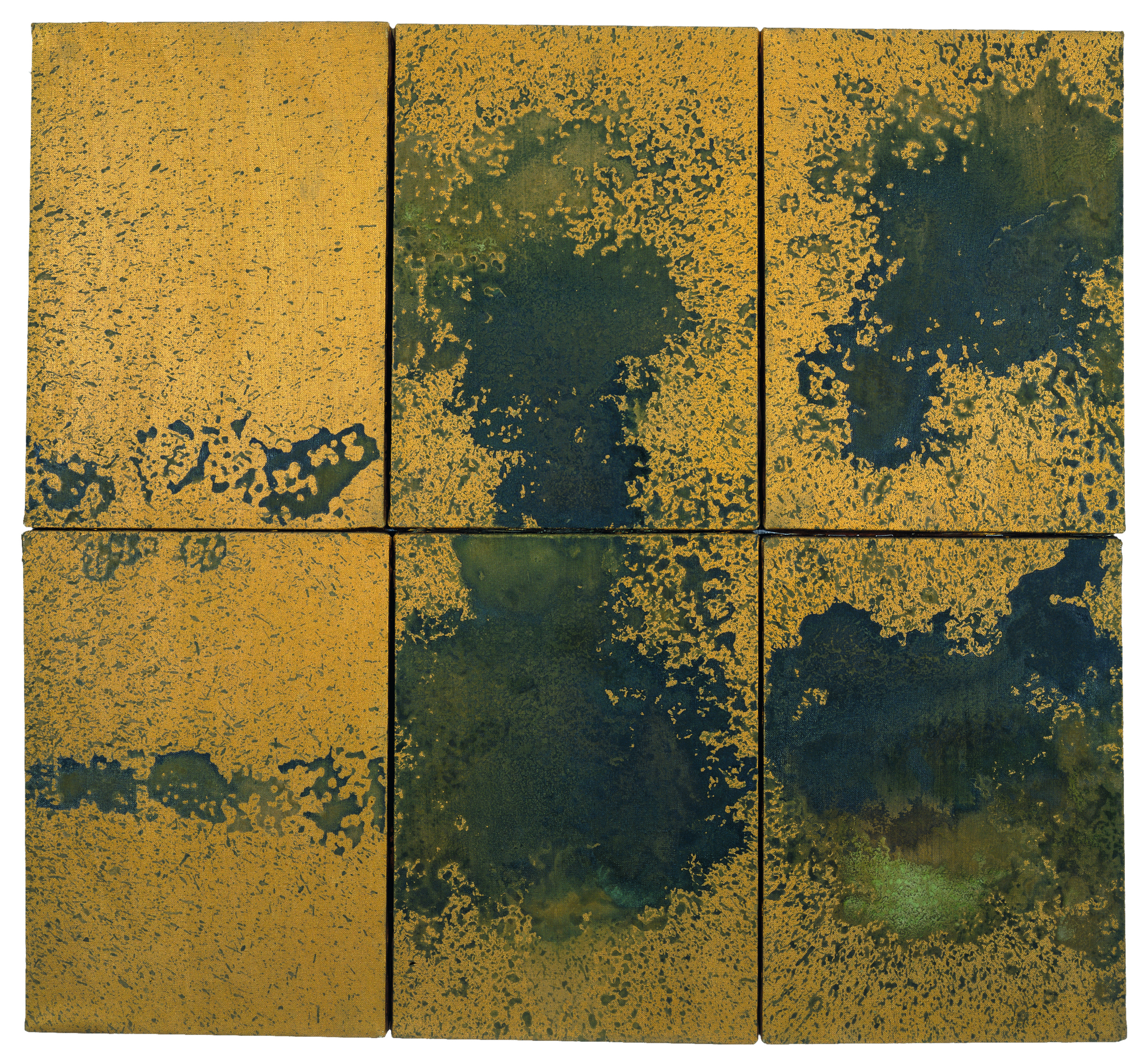
Andy Warhol, Oxidation, 1977–78, urine and metallic paint on linen, six canvases. Present location unknown © The Andy Warhol Foundation for the Visual Arts, Inc., NY, Photo by Phillips/Schwab

An old post office has been transformed into the Andy Warhol Museum of Modern Art, in the nearby town of Medzilaborce, and the main road in the town was been renamed Andy Warhol Street. But it is on the road leading to Mikova that a billboard sits with the visage of Warhol in his wig of wild hair, identifying the village as his family home, his ancestral home, though it is not that of an aristocrat. Few people remain in the town. But now they all recognize the name Andy Warhol, son of Andrej Varchola and Julia Zavacky-Varchola. Warhol simplified things by changing his name.

A cousin who lives in the tiny village of Mikova observed astutely that In America "You don't need to be very good at something. You just need to be different", something her cousin Andy figured out a long time ago, and made a prodigious effort to distinguish himself, doing it very successfully, by being wildly, outrageously 'different'. There was a time when Andy Warhol said, "I come from nowhere", and perhaps he meant the town of 100 residents is so insignificant it is actually nowhere.

As, for example, his art could be characterized by some who appreciate traditional art forms, as 'nothing'. Or even an assault on art, or an insult to the medium. The Medzilaborce museum was set up by Michal Bycko, an art expert, aided by Warhol's U.S. family. "They laughed in my face", were "outraged", when he showed a photograph of Warhol in his wild-haired wig to the locals and tried to convince them that the son of Andrej and Julia was famous for painting pictures of Campbell's soup cans.
What Was Warhol's Factory Really Like? See 10 Rare, Intimate Photos of Pop's Crucible by Stephen Shore
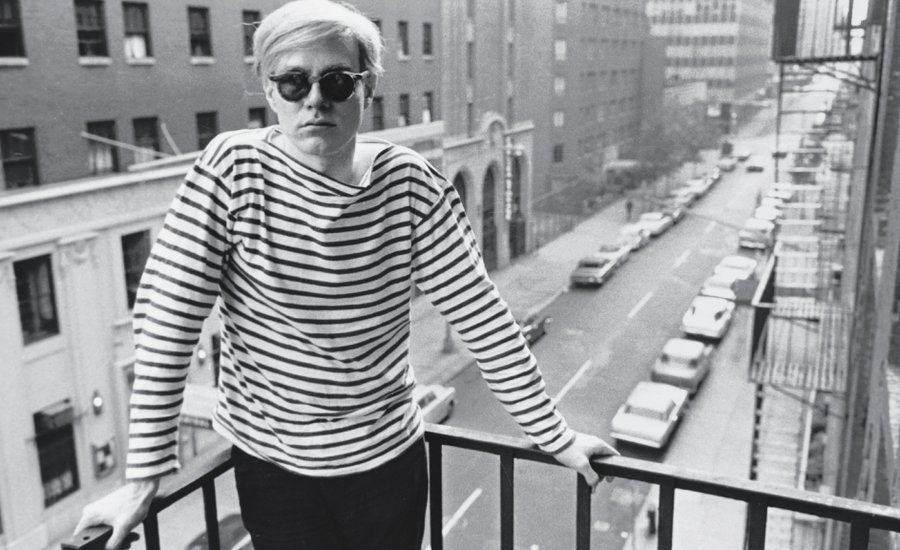
The artist Andy Warhol on fire escape of the Factory at 231 East 47th Street in the 1970s

Now, the Medzilaborce museum is where Europe's largest collection of Warhol art and artifacts can be found. There are no fewer than ten Campbell's Soup Can prints, a number of Marilyn Monroes, and a snakeskin jacket the artist once wore, along with a pair of his glasses. Warhol's parents both spoke Ruthenian, part of a culture and language bordering between Slovakia, Ukraine and Poland. He was able to understand it sufficiently so as to use it when he met Pope John Paul II, who as a Pole, knew the language.

Imagine, paint enough Campbell's soup cans and you get to meet the Pope! Andy Warhol did, and he laughed all the way to the bank....

Andy Warhol

Ladies and Gentlemen (II.129)
Print
Screen print on Arches paper
43" x 28"
Buy Now

Labels: , ,

Friday, August 18, 2017

Art, Quite Simply Art

http://img.theepochtimes.com/n3/eet-content/uploads/2017/07/17/7.Harvey-Dinnerstein_SundownTheCrossing_1999_OilonCanvas_74x84-1500x1362.jpg
"Sundown, The Crossing" 1999 by Harvey Dinnerstein. Oil on canvas.
"It was formative [the recognition that the tradition of 19th Century artists called his aesthetic to respond in kind]. The drawings that I did were mostly incidental and reportorial. I think they were effective, but at some point I started to realize that it wasn't enough just to record incidents. One had to reach beyond the narrative, beyond the moment, for something deeper, more transcendent ... to some other level of perception."
"It was the beginning of a way of thinking that affected many of the things that I would do later [as an artist]."
"The biggest challenge [is] to have a visual idea that's personal relevant to myself as I see the world around me."
"It is difficult to explain. It is being open and having an insatiable curiosity [for] anything that is happening. That's a small part of it."
"The vast diversity of humanity in the city, more so today than ever, seems to me especially focused underground."
"I've never planted a tree in my life. I do them in this space [committing his art to canvas in his studio]. It's kind of crazy with all this stuff in here."
Harvey Dinnerstein, visual artist, New York City, New York
Artist Harvey Dinnerstein in his studio in Brooklyn, New York, on May 31, 2017. (Samira Bouaou/The Epoch Times)

Just as a writer of novels makes use of his personal history and adds a healthy dose of fantasy to his/her novels to create a work of fiction that resonates with the personal and the whimsical to invite the reading public to a treat for their minds and imaginations to run free, so too did this artist who had 'never planted a tree in his life', place himself within the context of a painting showing a gardener at his task among flowers, busy with the planting of a tree, wheelbarrow holding garden soil beside him. It is an original vision, a painting of strength, unlimited talent and vibrant beauty.

Some viewers might recoil at the sight of an aged man, upper torso revealed, intent on his task, handling a tree, beside him bright and piquant colours of a floral display against a glowing backdrop. But this man has not shied away from the beauty of the human figure even in old age, for he is well into his eighties and has no intention of submitting to the years other than to make the most of all the opportunities the future years will afford him. He is a classical figurative painter. Many of whose paintings reflect family scenes, city life, the seasons and visual conceptions that artists before him focused on.

He is skilled and driven to paint life and his vision of eternity. Classical depictions of mythology are not beyond him; myths they may be, but they involve human nature and mankind interacting with the faith of a higher intelligence. The visual documentation of humankind's ventures in love and war, the emergence of cultural variants and the measures that humans employ to advance their interests and communicate with one another can all be depicted as they are envisioned in the past, and as they take place at the present.

Artist Harvey Dinnerstein in his studio in Brooklyn, New York, on May 31, 2017. (Samira Bouaou/The Epoch Times)
Artist Harvey Dinnerstein in his studio. Photo: Samira Bouaou
As a realist artist he moved in his youth among others whose love of art mirrored his own. While the art world became immersed and enthused with non-objective art and the theories of modernism, he and his peers clung to the classical tradition of depicting nature and the human form as they appear to us realistically. That type of art is classified by this man as the humanist traditions of the past. The art of the Renaissance with its lavish splendour and ebullience along with later naturalist and realist artists patterned his own version of rendering timeless art under his brush and his signature.

"Walking Together, Montgomery," 1956, by Harvey Dinnerstein. Charcoal on paper, 17 1/4 inches by 25 7/8 inches. (Courtesy of Harvey Dinnerstein)
“Walking Together, Montgomery,” 1956, by Harvey Dinnerstein. Charcoal on paper, 17 1/4 inches by 
25 7/8 inches. (Courtesy of Harvey Dinnerstein)
 
He took inspiration from the civil rights movement, from poetry, from everyday scenes of life he witnessed, and accustomed himself to carrying a notebook where he could jot down a 'cartoon' sketch that he might later, in his studio use as a guide to his memory to expand and detail into a painting. It is what many artists married to their work do, to jog memory and outline what they will at a later date elaborate upon in the commission of an artwork.

The quality of this man's depiction of landscape and figures speaks to his passion for his art. It is a passion that communicates itself to the eye of the beholder. Viewing his paintings, no explanation is required for they speak for themselves. It can be readily determined what Mr Dinnerstein meant to convey, and succeeded admirably in doing so. This is the kind of art that has its peers in the past, less so in the present, overshadowed in the world of art by the bogus productions in demand by buyers who believe the art 'experts' who claim abstract art represents fine art.

"In the Kitchen," 1960–61, by Harvey Dinnerstein. Oil on canvas, 20 inches by 16 inches. (Courtesy of Harvey Dinnerstein)
"In the Kitchen" 1960-61 by Harvey Dinnerstein, Oil on Canvass, Courtesy Harvey Dinnerstein

Labels: ,

Sunday, August 13, 2017

Fleecing The Sheep and Laughing All The Way To The Bank

"He's probably an artist who's in more demand today than any other."
"He's so good that he controls everything. He controls when galleries make shows, he controls who they sell a painting to -- he's on top."
Alberto Mugrabi, mesmerized 'art' collector

"Artists whose work is in great demand are in charge."
"They can call the shots and Mark figured that out pretty early."
"Who says he can't [break with tradition and sell directly out of his studio rather than through an agent]? It's an unwritten rule, but he's breaking the rules." 
Ann Philbin, director, Hammer Museum, Los Angeles

"He's the most important artist of his generation."
"I have bought works out of his studio; I've also bought works privately."
"I bought a sculpture of his for the Museum of Modern Art. He tries to sell them to people who are collectors rather than investors."
David Geffen, media mogul, owner of six paintings by Grotjahn

"There was always a conscious conversation about the importance of placing pictures in museums and in great collections."
"It becomes a pretty precise methodology."
"Artists like Mark -- they run their own show, as they should. They're the ones who've taken all this risk and stared into that void."
Timothy Blum, founder, Blum & Poe
Mark Grotjahn Credit Monica Almeida/The New York Times  The artist proudly stands before a sculpture of his that sold at auction for $16.8-million
Leonardo da Vinci, could he but foresee a time in the future when unscrupulous pretenders to art would successfully manipulate greedy acquisitors to believe that faux art reflects talent and original vision, would never have believed that intelligent human beings could stoop so low as to scrape the barrel of credulity and do it willingly, besides. Creating an atmosphere and a culture where the recognition of non-objective art bespeaks the genius of the few, and the challenge is to the viewer to admit that though the work is not visually or aesthetic leasing, it is original.

Its origins, needless to say, in the minds of flim-flam entrepreneurs who have recognized the cupidity and stupidity of a segment of the population that will believe anything that 'experts' in the field of art curation convincingly inform them. While beauty may be in the eye of the beholder, so is a natural inclination to recognize what it truly is. And nothing that this man produces, just like the 'art' produced by so many of his contemporaries in 'modern art' represents beauty or the originality of vision accomplished through a master's hand.

Create it, and they will come is his obvious mantra. But not without having first carefully set the stage. To convince the willingly gullible that what this man has produced (like, for example, Jackson Pollock) represents an authentic work of art, unequalled in bold design and execution by any of his contemporaries and as such a rare opportunity to acquire a colossal work of art whose value, both aesthetic and financial, can only increase in an art-hungry world.
"Untitled (Orange Butterfly Blue MG03) #1"  in his “Butterfly” series, 2003. Credit Douglas M. Parker

The gullible include art dealers whose discerning eye and bumph antennae distinguish them somewhat from enthusiastic art collectors only in that they instinctively know that any artist in their stable who gains the confidence of the art world and those who can afford the absurdly exorbitant prices to claim the prestige of ownership of such artistic nonentities as this respond to his clever pretense, inspiring their confidence and willingness to part with their expendable wealth.

Public and private art galleries succumb just as do those who style themselves connoisseurs of art; they have the academic papers to prove their studies resulted in moving to the head of the class. The prestigious vote of confidence in an artist such as this that results from his splendid art works being acquired to hang on the walls or grace the marble flooring of acclaimed galleries such as the Whitney Museum of American Art, the Museum of Contemporary Art in Los Angeles and the Los Angeles County Museum of Art, let alone New York's Museum of Modern Art and the Guggenheim Museum 'prove' the value of this execrable work.
Works in Mark Grotjahn's studio headed to the Nasher Sculpture Center. Credit Monica Almeida/The New York Times
The now-49-year-old Mr. Grotjahn has managed skilfully to influence the value of his works to an  unusual extent. Perhaps it was the psychological trauma he suffered when at an early show one painting only sold -- and for a miserly $1,750 -- that drove him to 'take charge' of his career in such a masterful manner as to create a legend about himself drawn from his own ego and masterfully parlayed into a general acknowledgement that his supremely gifted talent simply cannot be overlooked.

To those of a skeptical bent who fail to credit his 'art' with a simulacrum of rare artistic brilliance, they must understand the sad depth of their philistine ignorance.

That experience appeared to have soured  him indelibly with the convention that an artist was meant by unwritten rule to be faithful to a one-dealership representation. He has chosen instead to use the services of a number of recognized dealerships, all of whom boast well-heeled clients. And nor does he neglect the impact it can have on collectors to deal directly with the artist himself, a rare privilege he generously grants on occasion to various clients, even permitting them the privilege of buying art directly out of his studio, an unheard-of practise.

He had at one time himself, after earning his Master of Fine Arts degree from the University of California, operated an art gallery in Hollywood. He is intimately acquainted with the trade from both perspectives. The coincidental Hollywood conception of life in America, raucous, uninhibited, violent, sexy, criminal, addicted and wealthy, is a fitting metaphor for the claims that what this heralded artist produces represents the pinnacle of creative art.
"Untitled (Circus No. 1 Face 44.18)" in his “Circus” series, 2012. Credit Douglas M. Parker

Artists producing work of actual merit reflecting their special abilities in the creation of realistic renditions of landscapes, portraiture, allegorical and historical paintings whose artistic expertise speaks to the core of the aesthetic bestowed upon most discriminating viewers must wince if and when they become aware of such shameless charlatans perverting the very substance of art and authenticity in its production. It is this corruption of the beauty and meaning of art that speaks to the degeneration of its recognition and appreciation of its rightful place in our aesthetic.

"Untitled (African, Gated Front and Back Mask M34.b)" is a 2014 bronze based on a cardboard box and tubes. Credit Monica Almeida/The New York Times


Labels: , , , , , ,

Tuesday, July 07, 2015

Surviving Inspired Idiocy

"It was eerie because it didn't feel the same way you thought it would. It wasn't as bumpy as you'd expect, but when the balloons started blowing up the whole chair would shake like crazy. It was like a gun going off."
"About halfway through my descent, I knew I was getting pushed backwards and there was no way I was going to make it. I had to pick an emergency landing spot. I'm pretty sure I broke my foot. It's no big deal."
"We didn't think they'd take it as seriously as they are [police]. Things are a little more severe than we anticipated."
"The winds were so violent up there. It was aggressive. I was a little bit in shock it was so cold up there."
"If I were to do it again [the police] wouldn't be as easy on me. If I had the opportunity to it again legally, I would do it again."
Dan Boria, owner, All Clean Natural company
Dan Boria Balloon Man
"Obviously it's not a regulated device [agglomeration of helium balloons]. It's something that he concocted himself."
"I've been on this job for twenty years and this is the first time I've seen something like this. Usually you see it on the TV shows of things not to do."
Kyle Grant, acting inspector, District 1, Calgary Police Services

As public relations and advertising stunts go this was rather imaginative and pretty well simpleton-inspired. What could go wrong? Well, putting together one hundred helium-filled balloons and trusting that their airy loft would safeguard one's life while suspended beneath their aggregate lift in a plastic lawn chair, hovering above clouds while airplanes pass close by isn't most people's idea of brilliant inspiration. Perhaps they don't know how to spell: BOLD INNOVATION.

Balloon chair

And for this stunt, drawing attention to himself and his company through this incredible piece of showmanship one can only classified as demented derring-do and a disregard for one's safety, unless one is completely beyond recognizing the foolishness of such an enterprise, 26-year-old entrepreneur Dan Boria was charged with public mischief, leaving Calgary police, during the event known as the Calgary Stampede which draws thousands out to watch that spectacle, scratching their heads in bewilderment.

At the lengths people with imagination and insufficient common sense to accompany it, will go to, in an effort to be noticed, presumably admired, and feted for a new level of salesmanship. He was advertising his cleaning company, with the use of air currents enabling him to float above the Stampede. He meant to conclude his little adventure by skydiving into the chuckwagon races, flying his company logo by, on a banner hauled by a small airplane above his balloons.

He meant also, to arouse a spirit of celebration among those witnessing this idiocy, without a doubt. However, things went somewhat awry after 30 minutes aloft, when he was unable to parachute into the races and instead crash-landed "a mile or two" away from the Stampede. Making not quite the splash he had intended, but managing to survive his miscalculation nonetheless. For which most people would be grateful, but he appears inspired to give it another try.

Calgary Police were waiting for him as he landed and charged him with mischief causing danger to life; arresting him at the scene of his inglorious descent as he came down to earth, literally. He suffered "minor injuries" treated then and there, and transported to the court services program. The company owner, Dan Boria and his employees evidently thought of the idea together. Might it be possible his employees worked on the theory that their idiotic employer might learn a lesson in sobriety?
Calgary Sun

The $20 lawn chair, the six-foot balloons and helium that cost $12,000 could be reckoned an investment in opportunity to treat the public to really imaginative advertising; since television and radio adverts are so last-century, after all.

One can only imagine his long-suffering mother, raising this creatively imaginative child to become an irrationally imaginative semi-adult whose exploits must lead her from heart palpitations to the constant verge of total collapse.

Labels: , ,

Friday, April 10, 2015

Art and Artlessness

"Words of bile and hatred bullied [him into declining a longed-for engagement with the Toronto Symphony Orchestra]. The media frenzy [over Valentina Lisitsa's cancelled performance sucked him too into its vortex of hatred]."
"What started out as one of the happiest moments of my life turned into a shattering display of mob hysteria. Her words offended many people who perceived her as pro-violence and anti-love."
"Free speech has consequences, and one must own one's position ... Her attitude, and the mob-like behaviour of her devotees, censures Rachmaninoff's 2nd concerto."
Stewart Goodyear, pianist, Toronto
Stewart Goodyear, seen here in 2012, says he has pulled out of filling in for Valentina Lisitsa after facing a furore for doing so after the controversy surrounding her views on Ukraine.
RANDY RISLING / Toronto STAR Order this photo
Stewart Goodyear, seen here in 2012, says he has pulled out of filling in for Valentina Lisitsa after facing a furore for doing so after the controversy surrounding her views on Ukraine.

"It's hard to see the connection between what she said and what the duties of her job are and how it would affect it. I think there is a problem with the message that this sends to artists that they may have trouble getting jobs or keeping jobs if they express views that are unpopular or controversial."
Cara Zwibel, Canadian Civil Liberties Association

"This is not about free speech, this is not about a political perspective or persuasion, this is about very offensive, intolerant comments about people."
"As one of Canada's most important cultural institutions, our priority must remain on being a stage for the world's great works of music, and not for opinions that some believe to be deeply offensive."
Jeff Melanson, president, chief executive, TSO
Ukraine-born pianist Valentina Lisitsa says she has no intention to stop criticizing her native country.
Vince Talotta / Toronto Star   Ukraine-born pianist Valentina Lisitsa says she has no intention to stop criticizing her native country.

Unfortunately, it seems that Mr. Melanson dropped the ball on the Toronto Symphony Orchestra's primary function of presenting as a stage for the world's great works of music. Presumably, the obnoxious but hugely talented classical pianist Valentina Lisitsa whose popularity has soared for the precision and beauty of her rendering of great musical compositions is acclaimed by music lovers for her talented expression on the piano, and not for her tasteless and odious opinions.

Richard Wagner, hugely admired as a favourite of the Third Reich for his presentation of the ubermensch, the Aryan ideal, remains a controversial figure, but even his music with its sturm und drang that so inspired Adolf Hitler, remains popular as the quintessential dramatic musical storytelling panorama of legendary superhuman figures. The man and his philosophy were wretched, but his music extraordinarily listenable, though many consider it tainted irremediably.

Ukraine-born, ethnic Russian classical pianist Valentine Lisitsa has gained a huge following for whom her controversial statements remain irrelevant; her musical ability speaks for itself as far as they're concerned. She had been scheduled to play as a guest star with the Toronto Symphony Orchestra. Protests lodged with the orchestra administration, however, resulting from her strongly-held views on world affairs, convinced the TSO board that her presence on stage with the orchestra would burden their reputation.

Her popularity with classical music aficionados is one that transcends her politics, however. And the orchestra has been both congratulated and damned by its decision to honour their retaining fee for her performance, while absenting her from the stage. As a replacement for Ms. Lisitsa, a Toronto pianist, Stewart Goodyear, was invited to take her place, and he was pleased to accept what to him represented a mouth-watering opportunity to advance his career.

Unfortunately, Mr. Goodyear too will not be appearing with the TSO. In a Facebook entry, he complained bitterly that the controversy had dragged him into its vortex "before I could blink." Since the cancellation of Ms. Lisitsa's appearance, critics of the decision have protested the aura of censorship, and have accused the orchestral management of surrendering to Ukrainian demands.

Without a doubt Ms. Lisitsa has offended with her opinionated and canted view of politics and human relations. Her sharp-tongued cuts have lunged at a wide range of subjects, from accusations of "atrocities" committed on the part of the Ukrainian regime against ethnic Russian Ukrainians, to the skepticism she expresses about the Holocaust, to mockery of Down syndrome individuals, even expressing a threat against NATO troops.

Open-minded and pleasant she obviously is not. But she is 41 years of age, an adult whose experiences have formed her perspective on many matters relating to the human condition. She has been endowed with an especial musical talent to offset her repugnant willingness to offend. And while it might be satisfying to some to just tell her to shut up and play the keyboard, she does have a right to express her ignorant opinion in a society that values free speech.

Valentina Lisitsa
Ukraine-born classical pianist Valentina Lisitsa is shown performing live on stage at the Royal Albert Hall in London on June 19, 2012. (Andrew Cowie/AFP/Getty Images)

Dislike her, like her music. Or, as the TSO has it, if the talented Ms. Lisitsis feels entitled to air her random and insulting thoughts revealing her personality as a rather nasty person, she does so at the expense of her professional reputation of a pianist of great original ability, and she has made her choice, just as the Toronto Symphony made theirs.

Labels: , , , ,

Wednesday, December 24, 2014

Freeing The Mind With Movement

"It is only ideas gained from walking that have any worth."
"[Being able to] walk in the mountains for seven or eight hours without a trace of weariness [enables philosophical composition]."
"The suppleness of my muscles has always been greatest when my creative energies were flowing most abundantly."
Friedrich Nietzsche, In Twilight of the Idols (1889)

"If I couldn't walk fast and far, I should just explode and perish."
Charles Dickens letter from Boulogne, France, 1850

"The only friend to walk with is one who so exactly shares your taste for each mood of the countryside that a glance, a halt, or at most a nudge, is enough to assure us that the pleasure is shared."
C.S. Lewis, Author of  The Chronicles of Narnia

"There is something about the pace of walking and the pace of thinking that goes together. Walking requires a certain amount of attention but it leaves great parts of the time open to thinking. I do believe once you get the blood flowing through the brain it does start working more creatively."
"Your senses are sharpened. As a writer, I also use it as a form of problem solving. I'm far more likely to find a solution by going for a walk than sitting at my desk and 'thinking'."
Geoff Nicholson, The Lost Art of Walking


It was observed of Steve Jobs who used the mind-clearing exercise of walking to tease his mind toward clarity and inspiration, that "Taking a long walk was his preferred way to have a serious conversation", as stated in the biography of Apple's co-founder, written by Walter Isaacson. Taking inspiration from a man whose inventive genius was an example to many others in the field, Facebook's Mark Zuckerberg is also credited with adopting the walking-to-think example.

Charles Darwin is reputed to have walked constantly along what he termed his "thinking path", a road called Sandwalk Wood located close to his home in southeast England. He developed a habit of three-45-minute walks each day; before breakfast, lunch, and the third post-prandially, in the early evening. His son attested to his father's rarely straying from the routine. And it was that routine he relied upon to aid him in finalizing his theory of natural selection and random mutation.


Ludwig van Beethoven, deaf at 40, had his own regimented routine that included regular walking. He would intersperse his composition time with swift forays out of doors to refresh his mind. Once his working day was completed, he would take long, solitary walks carrying with him a pencil and notepad to stroll the Viennese woods. There to find inspiration, then recording them. His sixth symphony the "Pastoral" is complete with woodwind sounds of various birds he heard during his rambles.

Henry David Thoreau, George Orwell, Thomas De Quincy, Constantin Brancuso, Bruce Chatwin and Vladimir Nabokov all indulged in walking to release themselves from the stress of life and work, allowing their minds to roam creatively, indulging their natural creativity and in the process enriching their originality, unleashed through the serenity and mind-wandering that captivated their inner consciousness, gifting society with the results.

And now researchers with Stanford University have validated the process of unleashing creativity through the act and art of walking. The study results, conducted by Marily Oppezzo and Daniel L. Schwartz, published in the Journal of Experimental Psychology resulted from an experiment where participants were tasked with undertaking Guilford's Alternative Uses Test.

This is a timed activity meant to measure creative thinking; while sitting, and alternatively while walking on a treadmill. The two researchers discovered that walking did indeed increase creativity for 82% of the research participants, with increases of output averaging 60%. The test evaluates the quantity of ideas, but also their quality; the originality of ideas and specificity of those ideas. Additional ideas were generated while walking, of a high quality; innovative and practical.

The advice of those who engage in walking is simply to go out and do it. The benefits endowed by so doing are just too numerous to overlook, from the simple enjoyment of exercising limbs, to the freedom to look about and appreciate a landscape, to the freeing of the mind while taking in prevailing clues of light, distance, fragrances and activities taking place all about; whether in an urban streetscape or a woodland landscape ramble, the results are manifold.


Human beings were not designed to sit for interminable hours at desks staring at computer screens and exercising their cerebral matter through forced communication without some manner of inspirational motivation interrupting the stagnation of movement and boredom. Walking does that, the ingestion of the scene through fresh air to stimulate the brain along with the physical momentum of striding along and appreciating the sensations that surround and impress.

From those stimulations come the urge to indulge in performing some measure of expression, for we are creatures meant to communicate, whatever the tools we use at our disposal; words, paint, sculpture, music, or dance.  

Labels: , , , ,

 
()() Follow @rheytah Tweet