Ruminations

Blog dedicated primarily to randomly selected news items; comments reflecting personal perceptions

Tuesday, September 09, 2025

A Reckoning in Nepal

https://i.cbc.ca/1.7628692.1757407776!/fileImage/httpImage/image.jpg_gen/derivatives/original_1180/nepal-protests-sept-8-2025.jpg?im=Resize%3D1180
An aerial view shows demonstrators gathered outside Nepal's parliament during a protest in Kathmandu on Monday, condemning social media prohibitions and corruption by the government. Nepal police opened fire, killing at least 19 people, as thousands of young protesters took to the streets demanding the government lift a social media ban and tackle corruption. (Prabin Ranabhat/AFP/Getty Images)
 
"We were triggered by the social media ban but that is not the only reason we are gathered here."
"We are protesting against corruption that has been institutionalized in Nepal."
Yujan Rajbhandari, 24, Nepali student, Kathmandu 
 
"Violence is not the answer [urging Nepalese security forces to restraint as protests continued their third day]."
"I am appalled by escalating violence in #Nepal, which has left many young protesters dead or injured."
"Reports of the disproportionate use of force by the authorities need to be urgently investigated. Dialogue – not violence – is the way forward."
United Nations High Commissioner for Human Rights Volker Türk 
 
"In view of the adverse situation in the country, I have resigned effective today to facilitate the solution to the problem and to help resolve it politically in accordance with the constitution."
KP Oli, 73, four-time prime minister who leads the Communist Party  
https://d.newsweek.com/en/full/2718843/nepal-protests.webp?w=736&h=414&f=c64417cda331b4c5b6152131709aff80
Nepal PM Resigns Amid Deadly Anti-Corruption Protests   Still capture from video, Newsweek
 
Nepal has erupted in street protests led by its Gen X demographic in revolt against a government ban on social media, demanding its reversal, while also calling for an end to government institutionalized corruption. Those street protests began with singing of the national anthem and the flag of Nepal in full display. They speedily deteriorated in response to police attempting to restore order where the protesters were met with rubber bullets, tear gas, water cannon and police baton-wielding charges when demonstrators rushed through barbed wire fencing into a restricted area adjacent parliament.
 
"I have never seen such a disturbing situation at the hospital. Tear gas entered the hospital area as well, making it difficult for doctors to work", stated Ranjana Nepal, information officer at the facility where many of the wounded -- both demonstrators and police -- were taken for emergency treatment. Media in Nepal reported live fire was used by police against protesters. "Sixteen people have sadly died. About a hundred are under treatment, including police", reported Shekhar Khanal, spokesman for the Kathmandu valley police. 
 
A curfew was imposed by the district administration in a number of areas of the city, including the parliament, the president's residence and Singha Durbar, where the prime minister's office is housed. Some demonstrators climbed over the wall into the parliament premises, vandalizing the gate. Other districts across the country saw similar protests being organized. 
 
https://d.newsweek.com/en/full/2718798/kathmandu-protests-nepal.webp?w=790&f=cdc14c05142ce896776db854e1106e21
A protester carries a firearm as demonstrators gather outside the Singha Durbar palace complex during a protest to condemn the police's deadly crackdown on demonstrators in Kathmandu on September 9, 2025, a day after demonstrations over social media prohibitions and corruption by the government. PRABIN RANABHAT/AFP via Getty Images
 
Millions of Nepalis are users of popular platforms like Instagram, relying on them for news, entertainment, and business. A total of 26 social media platforms had been under the ban. One student said she was protesting against the "authoritarian attitude" of the government. "We want to see change. Others have endured this, but it has to end with our generation", 20-year-old Ikshama Tumrok said, while joining the chants against the ban on social media, and government corruption. 
 
CPN US office Kathmandu
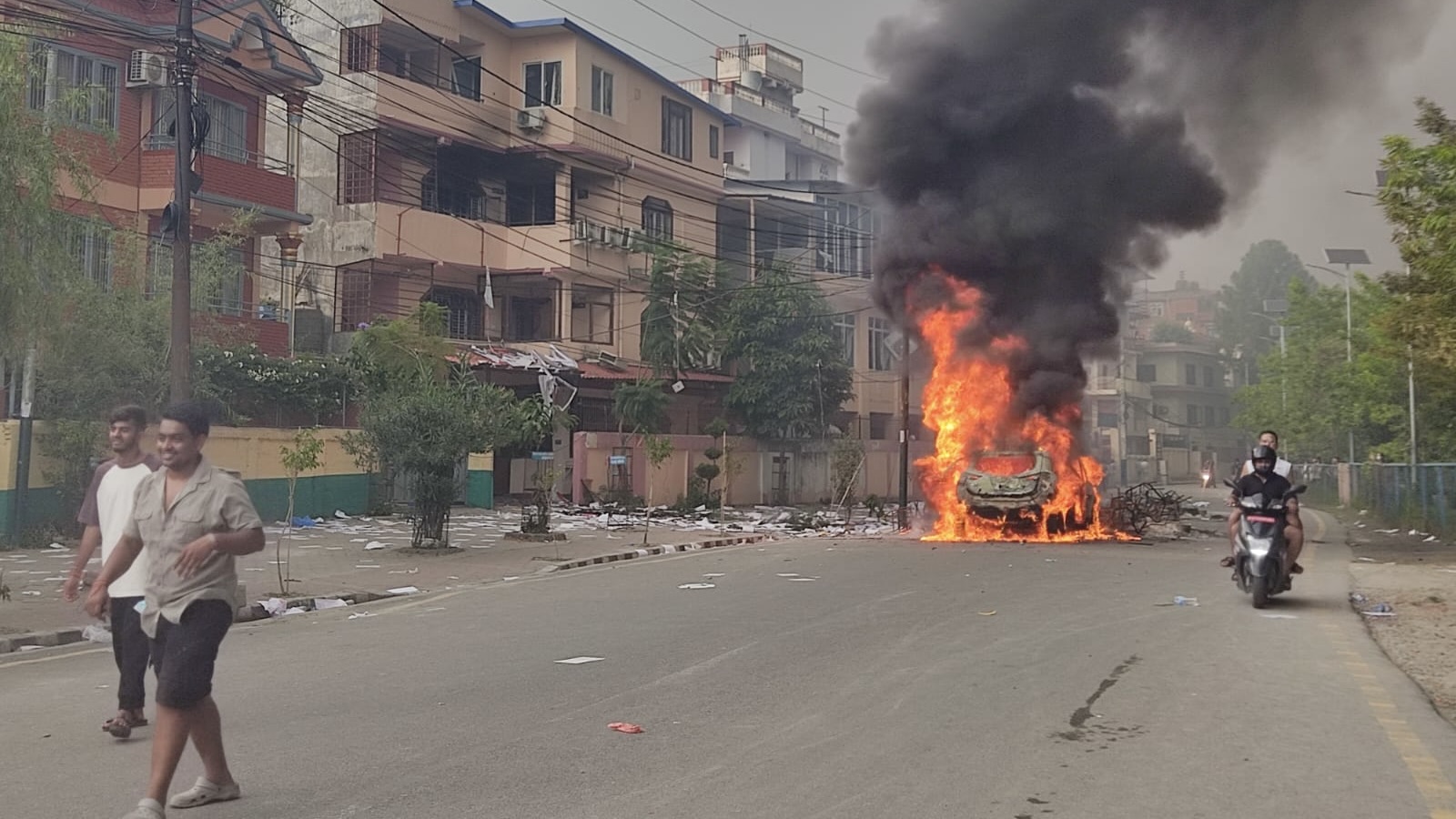
A vehicle was set on fire in front of the office of the CPN (Unified Socialist) in Kathmandu, Nepal on September 9. Photo: Surendra Kandel
 
Ministers, former ministers and high-profile officials have been involved in a number of reported corruption cases in the past several years. Since the ban came into effect, videos have surfaced and gone viral on TikTok, contrasting struggles of ordinary Nepalis, as opposed to the children of politicians flaunting luxury goods and costly vacation. "There have been movements abroad against corruption and they [government], are afraid that might happen here as well", observed protester Bhumika Bharati. 
 
On Tuesday the Nepalese parliament building as well as homes of political leaders were torched by more aggressive protesters, demanding the resignation of the entire government apparatus. Also on Tuesday, the wife of Jhala Nath Khanal, former prime minister of Nepal died, burned alive when her home was set on fire as the anti-government protests became more violent. 
 
 
https://www.tribuneindia.com/sortd-service/imaginary/v22-01/jpg/large/high?url=dGhldHJpYnVuZS1zb3J0ZC1wcm8tcHJvZC1zb3J0ZC9tZWRpYWYyNzU5YmMwLThkYmItMTFmMC04NDliLWQxMWMzZjNiMjVlNy5qcGc=
Smoke rises from Nepal’s Parliament after it was set on fire by demonstrators on the second day of anti-government protests in Kathmandu. PTI
 

Labels: , , , , ,

Tuesday, February 04, 2025

U.S. Agency for International Development Status

The agency’s funding was corrupted, with grants going to radical causes and organizations.
Perhaps the best illustration of how USAID has misused its funding is found in the Middle East.
In 2024, as the region reeled from the aftermath of the bestial atrocities committed by Hamas in Israel the previous year, the United States significantly boosted its financial support for projects in Gaza and the West Bank, spending more than $200 million of American taxpayers’ money in territories already rife with terrorist incitement and activity.
The respected Israeli research organization NGO Monitor pointed out that as the US government “dramatically increased funding” for these various projects, it “drastically decreased transparency.”
These grants were made to what USAID called “miscellaneous foreign awardees.” You wouldn’t know from the opaque accounting process that beneficiaries included local partners who praised the October 7 onslaught.
A “flash appeal” issued by the United Nations for assistance in Gaza attracted $114 million from Washington, feathering the nests of local non-governmental organizations like Al Awda, a “health and community center” with close ties to the Marxist Popular Front for the Liberation of Palestine, designated as a terrorist organization, and the Palestinian Medical Relief Society, whose president described the massacres in Israel as “a glorious day for the Palestinian resistance and people.” 
Foundation for Defense of Democracies
 
"With regards to the USAID stuff, I went over it with [the president] in detail and he agreed that we should shut it down."
"It became apparent that it's not an apple with a worm in it."
"What we have is just a ball of worms. You've got to basically get rid of the whole thing. It's beyond repair." 
"We're shutting it down."
Elon Musk, Department of Government Efficiency
https://ichef.bbci.co.uk/news/1024/cpsprodpb/3ed3/live/177687f0-e280-11ef-bf78-8ba219386e40.jpg.webp
Demonstrators outside the US Agency for International Development (USAID) headquarters in Washington, DC on Monday   Getty Images
 
When President John F. Kennedy established the U.S. Agency for International Development in 1961 its mandate was clear; "international development assistance opportunities", then a shift in focus occurred, to "basic human needs". USAID had been dedicated to extending assistance to countries in  recovery from disasters, countries working internally to escape poverty, countries dedicated to democratic reforms.
 
President Trump, on the other  hand, saw the agency as being run by "radical lunatics" and said as much on Sunday, agreeing with tech maestro Elon Musk that it was a "criminal organization" and he said as much the following day, when he posted just that. 

On Monday, staff of USAID were instructed not to enter the Washington headquarters of USAID. Police blocked the agency's lobby after President Trump took steps to shut the agency down. This follows the laying-off of thousands of USAID employees since Donald Trump took office two weeks ago. As an example of the Department of Government Efficiency (DOGE)'s powers in influencing government administration this is compelling.
 
Latterly USAID focused on "basic human needs" in the form of food availability, population planning, health, education and human resources development, along with sustainable development abroad. Sectors such as gender equality and female empowerment, as well as water availability and sanitation, along with issues relating to economic growth and trade. Billions in funding have been dispensed on an annual basis globally.
 
It is Mr. Musk's contention in his new quasi-governmental role influencing the Trump administration that in promoting liberal causes the organization mismanaged its funds. USAID  workers wee informed by way of a memo last week that they should cooperate with the new administration in Washington in recognition of Mr. Trump's "America First" policy.
 
Once Mr. Trump issued  his executive order re-evaluating and realigning U.S. foreign aid, Marco Rubio as Secretary of State "paused all U.S. foreign assistance funding by or through the State Department and USAID for review". By Wednesday the USAID website was no longer in evidence. Over 600 staffers were reportedly locked out of the agency's computer system. Those still able to access their computers received emails to the effect that "at the direction of Agency leadership" the headquarters building "will be closed to Agency personnel on February 3."
 
Two top security chiefs at USAID were placed on leave of  absence after refusing to turn classified material in restricted areas over to Mr. Musk's inspection teams. DOGE conducted a similar operation at Treasury Department, to gain access to sensitive information, leading to a resignation by a senior Treasury official. At the present time, USAID's future remains unknown. 

USAID-funded Palestinian NGOs: Introducing Children to Convicted Terrorists
A number of USAID sub-grantees ran programs that introduced children to convicted terrorists, presented convicted terrorists as role models, and publicly demonstrated support for terrorists and terrorist organizations
NGO Monitor
Norwegian People’s Aid Funding to Terror Affiliated NGOs
According to the US Department of Justice, NPA provided “material support” to Iran, Hamas, the Popular Front for the Liberation of Palestine (PFLP), and the Democratic Front for the Liberation of Palestine (DFLP) – designated terrorist organizations under US law. As a result of these partnerships, in March 2018, NPA settled a civil-fraud suit, paying a $2 million settlement to the US.
NGO Monitor
 
On Friday, February 7, 2025, at 11:59 pm (EST) all USAID direct hire personnel will be placed on administrative leave globally, with the exception of designated personnel responsible for mission-critical functions, core leadership and specially designated programs. Essential personnel expected to continue working will be informed by Agency leadership by Thursday, February 6, at 3:00pm (EST).
For USAID personnel currently posted outside the United States, the Agency, in coordination with missions and the Department of State, is currently preparing a plan, in accordance with all applicable requirements and laws, under which the Agency would arrange and pay for return travel to the United States within 30 days and provide for the termination of PSC and ISC contracts that are not determined to be essential. The Agency will consider case-by-case exceptions and return travel extensions based on personal or family hardship, mobility or safety concerns, or other reasons. For example, the Agency will consider exceptions based on the timing of dependents’ school term, personal or familial medical needs, pregnancy, and other reasons. Further guidance on how to request an exception will be forthcoming.
Thank you for your service
 

Labels: , , , ,

Sunday, August 13, 2017

Fleecing The Sheep and Laughing All The Way To The Bank

"He's probably an artist who's in more demand today than any other."
"He's so good that he controls everything. He controls when galleries make shows, he controls who they sell a painting to -- he's on top."
Alberto Mugrabi, mesmerized 'art' collector

"Artists whose work is in great demand are in charge."
"They can call the shots and Mark figured that out pretty early."
"Who says he can't [break with tradition and sell directly out of his studio rather than through an agent]? It's an unwritten rule, but he's breaking the rules." 
Ann Philbin, director, Hammer Museum, Los Angeles

"He's the most important artist of his generation."
"I have bought works out of his studio; I've also bought works privately."
"I bought a sculpture of his for the Museum of Modern Art. He tries to sell them to people who are collectors rather than investors."
David Geffen, media mogul, owner of six paintings by Grotjahn

"There was always a conscious conversation about the importance of placing pictures in museums and in great collections."
"It becomes a pretty precise methodology."
"Artists like Mark -- they run their own show, as they should. They're the ones who've taken all this risk and stared into that void."
Timothy Blum, founder, Blum & Poe
Mark Grotjahn Credit Monica Almeida/The New York Times  The artist proudly stands before a sculpture of his that sold at auction for $16.8-million
Leonardo da Vinci, could he but foresee a time in the future when unscrupulous pretenders to art would successfully manipulate greedy acquisitors to believe that faux art reflects talent and original vision, would never have believed that intelligent human beings could stoop so low as to scrape the barrel of credulity and do it willingly, besides. Creating an atmosphere and a culture where the recognition of non-objective art bespeaks the genius of the few, and the challenge is to the viewer to admit that though the work is not visually or aesthetic leasing, it is original.

Its origins, needless to say, in the minds of flim-flam entrepreneurs who have recognized the cupidity and stupidity of a segment of the population that will believe anything that 'experts' in the field of art curation convincingly inform them. While beauty may be in the eye of the beholder, so is a natural inclination to recognize what it truly is. And nothing that this man produces, just like the 'art' produced by so many of his contemporaries in 'modern art' represents beauty or the originality of vision accomplished through a master's hand.

Create it, and they will come is his obvious mantra. But not without having first carefully set the stage. To convince the willingly gullible that what this man has produced (like, for example, Jackson Pollock) represents an authentic work of art, unequalled in bold design and execution by any of his contemporaries and as such a rare opportunity to acquire a colossal work of art whose value, both aesthetic and financial, can only increase in an art-hungry world.
"Untitled (Orange Butterfly Blue MG03) #1"  in his “Butterfly” series, 2003. Credit Douglas M. Parker

The gullible include art dealers whose discerning eye and bumph antennae distinguish them somewhat from enthusiastic art collectors only in that they instinctively know that any artist in their stable who gains the confidence of the art world and those who can afford the absurdly exorbitant prices to claim the prestige of ownership of such artistic nonentities as this respond to his clever pretense, inspiring their confidence and willingness to part with their expendable wealth.

Public and private art galleries succumb just as do those who style themselves connoisseurs of art; they have the academic papers to prove their studies resulted in moving to the head of the class. The prestigious vote of confidence in an artist such as this that results from his splendid art works being acquired to hang on the walls or grace the marble flooring of acclaimed galleries such as the Whitney Museum of American Art, the Museum of Contemporary Art in Los Angeles and the Los Angeles County Museum of Art, let alone New York's Museum of Modern Art and the Guggenheim Museum 'prove' the value of this execrable work.
Works in Mark Grotjahn's studio headed to the Nasher Sculpture Center. Credit Monica Almeida/The New York Times
The now-49-year-old Mr. Grotjahn has managed skilfully to influence the value of his works to an  unusual extent. Perhaps it was the psychological trauma he suffered when at an early show one painting only sold -- and for a miserly $1,750 -- that drove him to 'take charge' of his career in such a masterful manner as to create a legend about himself drawn from his own ego and masterfully parlayed into a general acknowledgement that his supremely gifted talent simply cannot be overlooked.

To those of a skeptical bent who fail to credit his 'art' with a simulacrum of rare artistic brilliance, they must understand the sad depth of their philistine ignorance.

That experience appeared to have soured  him indelibly with the convention that an artist was meant by unwritten rule to be faithful to a one-dealership representation. He has chosen instead to use the services of a number of recognized dealerships, all of whom boast well-heeled clients. And nor does he neglect the impact it can have on collectors to deal directly with the artist himself, a rare privilege he generously grants on occasion to various clients, even permitting them the privilege of buying art directly out of his studio, an unheard-of practise.

He had at one time himself, after earning his Master of Fine Arts degree from the University of California, operated an art gallery in Hollywood. He is intimately acquainted with the trade from both perspectives. The coincidental Hollywood conception of life in America, raucous, uninhibited, violent, sexy, criminal, addicted and wealthy, is a fitting metaphor for the claims that what this heralded artist produces represents the pinnacle of creative art.
"Untitled (Circus No. 1 Face 44.18)" in his “Circus” series, 2012. Credit Douglas M. Parker

Artists producing work of actual merit reflecting their special abilities in the creation of realistic renditions of landscapes, portraiture, allegorical and historical paintings whose artistic expertise speaks to the core of the aesthetic bestowed upon most discriminating viewers must wince if and when they become aware of such shameless charlatans perverting the very substance of art and authenticity in its production. It is this corruption of the beauty and meaning of art that speaks to the degeneration of its recognition and appreciation of its rightful place in our aesthetic.

"Untitled (African, Gated Front and Back Mask M34.b)" is a 2014 bronze based on a cardboard box and tubes. Credit Monica Almeida/The New York Times


Labels: , , , , , ,

Friday, May 05, 2017

Food Fraud: Adulteration, Replacement, Mislabelling

"A good fraudster is someone who technically hides very well his game. We're not supposed to discover the issue, but when it turns badly and when the fraud is done by people that have no scruples in what they are doing, it can even lead to tragic consequences."
"An important measure is beefing up traceability measures. Food ingredients are sourced from all over the planet but that doesn't mean there shouldn't be the right traceability to prevent food fraud from occurring."
Samuel Godefroy, leading expert, food risk analysis, Laval University, Quebec

"I think essentially you're dealing with the future of food."
"If you don't have trust from the consumers, it becomes very difficult to add any value and grow the food business."
"Food categories that are more vulnerable to food fraud are fish, seafood, liquids, spices, fruits, vegetables and meat products. Canada has seen its share of cases in recent months, one of the most notable ones is Mucci Farms in Ontario. The company was fined $1.5 million for selling Mexican tomatoes as a product of Canada. The company denies the labelling was intentional and faults their computer system. Other cases have emerged, mostly whistleblowers trying to give food fraud more attention. Cericola Farms, one of the largest poultry processors in the country, was in court over organic mislabelling allegations, but the case has gone quiet since October. The number of cases is adding up. The Canadian Food Inspection Agency received more than 40 complaints in 2016 and many expect that number to increase in 2017."
Sylvain Charlebois, researcher of food fraud, Dalhousie University, Halifax 

"We have to remember the people conducting the fraud are interested in making money." 
"But sometimes it's in ways that we haven't anticipated, so it's important to exchange information and make sure all the players in the system have open channels of communication in order to address this critical issue."
Aline Dimitri, deputy chief food safety officer, Canadian Food Inspection Agency
In this photo, lobsters are processed at a seafood plant in Maine. Sylvain Charlebois argues that seafood is one of the products vulnerable to 'food fraud.' Robert F. Bukaty / AP

Research undertaken by Michigan State university concluded that food fraud reached $40-billion worldwide; fraud that is inclusive of mislabelling country of origin, using 'organic' labels falsely, altering expiry dates, producing counterfeit products -- as well as adulterating or substituting ingredients. The 2008 scheme to adulterate milk powder with a chemical that produces plastic in China, caused the death of four children and made 300,000 people ill.

Instances of wood pulp discovered to be used as a 'filler' in Parmesan cheese, garlic powder 'filled' with talc, misrepresented pure virgin olive oil, the widespread problem of food fraud by unscrupulous purveyors seeking to use inferior products, adulterating pure food with inedible and sometimes dangerous ingredients represents a problem that just doesn't want to go away. And it will not, as long as those seeking to gain profit from short-cuts or the production of dangerous and inferior products go undetected.

The mislabelling of seafood with inferior, more plentiful substitutes is a common problem, occurring in Canada and the United States. A CBC Marketplace study discovered that 34 of 153 fish samples taken from grocery stores had been mislabelled, when lower-priced fish was given a higher-priced fish labelling, for obvious reasons of illicit profit to the detriment of the consumer. The Canadian Food Inspection Agency randomly checks food samples and cites non-compliance with labelling laws by food suppliers.

Some 70 instances of non-compliance with labelling laws annually over the past five years have been published on the (CFIA) Food Inspection Agency's website. And no one researching the ubiquity of food fraud feels this to be an accurate number of fraudsters; merely the number that random checks have ferreted out. Food items like olive oil, honey and maple syrup all have been found adulterated by the CFIA. Mr. Godefroy, in his capacity as a food fraud expert, recommends increased resources for those random checks.

Barcoding technology can be used in the identification of food fraud through testing the precise molecular level production of a food item, determining whether it is organic and what its geographical origin is. DNA analysis technology remains costly and slow, but Mr. Charlebois of Dalhousie University, sees a future where people could access affordable hand-held DNA analysis devices to use while in the supermarket or at home to themselves detect the existence of food fraud.

The University of Guelph, in fact, is working with the CFIA on a goal to simplify DNA analysis technology, making it more cost-effective and accessible in the near future to the general public. A good proportion of Canadians are concerned that the basic foods they purchase are not really reflected on the labels identifying their ingredients. People with specific health conditions in particular are alert to the problems inherent in food fraud, according to a survey a Dalhousie research team conduced on line.

CTV Toronto: Consumers worried about food fraud

Labels: , , ,

Monday, January 23, 2017

Educating Afghanistan's Children : Or So We Think

"Canada is currently undertaking the necessary due diligence to ensure that in the event that Canada's funds have been misappropriated, that such funds are recovered and that the guilty parties are held to account."
"Canadian funds provided to EQUIP are administered by the World Bank through the Afghanistan Reconstruction Trust Fund." 
"Canada's longstanding support to education in Afghanistan has contributed, along with other donors, to more than 8.4 million Afghan children being enrolled in formal and community-based schools, 39 percent of whom are girls."
Jessica Seguin, spokeswoman, Global Affairs Canada

"Earlier this month, the Minister of Education Assadullah Hanif Balkhi said that a recent study found that only six million Afghan children are in fact at school -- contrary to the 11 million as previously stated by the former government [of previous Prime Minister Hamid Karzai]."
Report, TOLOnews, Afghanistan

"[Allegations of nonexistent] ghost students, teachers and schools [in Afghanistan are not new, in a country swept by corruption]. [A report issued in January by the U.S. Special Inspector General for Afghanistan Reconstruction (SIGAR), points to a] high risk list [vulnerable to] significant waste, fraud and abuse."
"Corruption continues to be one of the most serious  threats to the U.S.-funded Afghanistan reconstruction effort."
"SIGAR has launched a new ARTF performance audit to assess the extent to which the World Bank and the Afghan government monitor and account for U.S. contributions to the ARTF, evaluate whether ARTF-funded projects have achieved their stated goals and objectives, and utilize and enforce any conditionality on ARTF funding."
"There may be problems with student and teacher absenteeism that warrant further investigation by the Afghan government."
U.S. Special Inspector General for Afghanistan Reconstruction


Yasamina, 14  "I fetch water every day - it takes about an hour. But, I also go to my school. I walk with my 
friends for four kilometres every day but I like walking to my school with my friends. I want to be a nurse when 
I finish my school here." BBC News

At one time the ruling Taliban issued an edict that Afghan girls had no need of education, and only boys were permitted to attend schools. Neither were women permitted to be seen outside their homes without wearing an all-enveloping burqa that also covered their faces, allowing eyes to peer out from behind a netting on the top half of the niqab, or veil. Women were not permitted to work, even if there was no one else to support them financially, even if they had dependent children. Men were expected not to shave their facial hair. Music was not permitted, nor was celebratory gatherings.

After the ouster of the Taliban, when the U.S.-led NATO mission to find Osama bin Laden and disperse both al-Qaeda and their supporters the Taliban from Afghanistan, the international mission undertook a transformation of Afghan society. Schools were built and medical clinics were established; where previously girls were not permitted to study, schools were built solely for girls to attend, and no longer would male physicians be restricted from treating female patients, nor female physicians forced to wear burqas themselves, while undertaking surgical procedures.


Humanitarian aid organizations flooded into Afghanistan with the intention of serving its people. Afghan women, now permitted to work, did just that, priding themselves on their new freedom and determined to move forward. And the international community, preparing to leave Afghanistan, invested in training Afghan police and the military to Western standards to enable them to meet conflict situations in self-defense. In the process, discovering how deeply-engrained corruption in Afghanistan was, permeating the entire society.

Current President Ashraf Ghani had campaigned for the presidency several years back, with one of his primary promises being to sweep endemic corruption out of Afghanistan. Had the U.S. agency not delved deeply into the problem of unaccountability and corruption in the education ministry, in preparation for a presentation of an updated report for the new American administration, the depth to which the ministry was corrupted might never have been fully revealed, even though the Afghan government had arrested workers in the ministry for embezzlement at an earlier date.


Mohammad Zaman, 13, studies in Sherzad high school. He says most
of his schoolmates study in the open 
air because there are not many 
rooms in his school which is over-crowded. "I want to study wherever I can, I wish we had rooms but I learn a lot of things every day. I want to be an engineer in the future." BBC News

Half the number of children that the previous government of Afghanistan under former president Hamid Karzai, reported to be attending school, actually did. International aid for that specific purpose has been set aside, purloined and found its way into the pockets and bank accounts of various Afghan officials, to the detriment of Afghanistan's children. What the Taliban did in depriving the children of Afghanistan, particularly the girls, of an education, as an institutional edict, the trusted and legally, democratically elected government has carried forward through inattention to the funding dispersal and the actual implementation of what the funding was meant to accomplish.


Billions of dollars representing international aid are unaccounted for. The issue of "widespread corruption", now front and centre again will have consequences in the international community which had expectations that its dedicated efforts and its treasury meant to fund an impoverished and embattled nation would have positive results for the future, not enrich corrupt officials. The result of which will be felt on future investments in the country.

These boys walk to Kodi Khel village from a nearby mountain. They say they walk in a group and rest on the way every day. They cross rivers and mountainous valleys before they arrive at Sherzad high school. BBC News

Labels: , ,

Sunday, October 23, 2016

Breathtakingly Audacious Corruption

"Mr. Martin has hundreds of thousands of dollars to spend on his campaign and to woo the very small Shuswap electorate. It's unlikely any of his opponents have those kind of resources. Hopefully, voters get access to the full information about how their council has been run and change things."
"Corruption in our political system -- whether on or off reserve -- can never be tolerated or overlooked, as integrity is foundational to democracy."
"[Shuswap members] deserve to know exactly what has gone on with their band leadership and millions of their dollars."
Jordan Bateman, spokesman, Canadian Taxpayers Federation
Bethany Lindsay/Postmedia/File
Bethany Lindsay/Postmedia/File   The Shuswap First Nation has an on-reserve population of about 100 people, and is located on the outskirts of Invermere near the B.C.-Alberta border
 
When the previous Conservative-led government in Canada enacted the First Nations Financial Transparency Act, to ensure that band members on and off reserve were kept informed of what their band councils were engaged in, and how they used the funding available to them through Aboriginal Affairs and Northern Development Canada, it was revealed by investigative reporters that the Shuswap First Nation, a tiny British Columbia band, had been manipulated to transfer $4.2 million of band funding over a period of 3-1/2 years to a single family.

This is a one-hundred member band, whose members live on their reserve located on the outskirts of Invermere close to the British Columbia-Alberta border. A forensic audit carried out by Ernst & Young authorized and funded by the federal government after revelations in the news media pointed out this gross mismanagement of band funds, was verified when the auditors produced a thirteen-page report made available to band members and handed over as well to the RCMP for investigation.

Incumbent Shuswap First Nation Chief Barbara Cote helped wrest control of the band from the family of former chief Paul Sam.
Postmedia/File   Incumbent Shuswap First Nation Chief Barbara Cote helped wrest control of the band from the family of former chief Paul Sam.

Current Chief Barbara Cote, along with the band's two councillors advised band members through a written statement that "It [the matter of the abuse of band funds] is under RCMP investigation." A "general and widespread lack of supporting documentation" was highlighted in the Ernst & Young report, noted in their completed audit. Which made note of a lack of proof that expenditures existed related to transactions undertaken by the band, which had a disconcerting habit of advancing the financial affairs of the Sam and Martin family.

In his 80s and confined to a wheelchair, the band chief was paid, tax-free, $741,262 to administer the band affairs, representing one hundred individuals of the band; that would be the equivalent of $1.3 million had taxes have had to be paid on that salary. Paul Sam's wife Alice Sam, in her capacity as the band's bookkeeper received $690,481 as her salary, equivalent to $1.2 million. While their son, Dean Martin was paid slightly below $1.4 million between April 2011 and November 2014.

Alice Sam (left) and then-Shuswap First Nation Chief Paul Sam in 2014. Dan Walton / Columbia Valley Pioneer files
And it is former Chief Sam's son Dean Martin who is now casting himself as an incoming chief should the band choose to vote him into office, and usher out the three incumbents, Chief Barbara Cote and councillors Tim Eugene and Rosalita Pascal who have represented the interests of the band ever since the Sam family was locked out and ousted when it was revealed through the media how they had manipulated band funds to service their personal craving for wealth.This, despite the police probe into the illegality of the transactions the Sam family had engaged in to enrich themselves, preying on the band's trust.

Moreover, two private companies: Shuswap Woodlands Restoration and KDC Sand & Gravel benefited by an additional $1.36 million in undocumented funds from the band's financial reserves. Two of Dean Martin's sons own each of these companies. As well, an additional $66,481 was used during that three-year period "on flights to destinations such as Las Vegas, Chicago and Varadero, Cuba for travel of an apparent personal nature", concluded the Ernst & Young audit.
Dean Martin, candidate for election in the Shuswap First Nation, and son of former chief Paul Sam and former councillor Alice Sam.
Dean Martin, candidate for election in the Shuswap First Nation, and son of former chief Paul Sam and former councillor Alice Sam. Greg Amos / Columbia Valley Pioneer Files

Yet, there's more that the audit discovered which they revealed in their report. Two amounts of $15,000 had been "diverted" for the purpose of clearing the credit card debts of Dean and his son Richard Martin, with another $20,000 going to pay down Dean Martin's former wife Pam's line of credit. Another $28,000 was used to pay for travel and accommodation for a softball team. These revelations are a shocking example of what some First Nations reserves are labouring under, under the guidance and direction of conscienceless leaders.

According to its 2015-16 financial statements, there is a $211,333 loan listed as an outstanding liability, taken out by KDC Sand & Gravel. Another drag on band expenses is the litigation launched against some ex-employees, including Dean Martin. In view of this egregious example of criminal malfeasance on the part of the elected chief and councillors of the Shuswap First Nation until they were removed once news of their skullduggery became public knowledge, it seems peculiar indeed that the current Trudeau government is prepared to revoke the First Nations Financial Transparency Act, citing their view that insufficient consultation with First Nations took place before the act was brought into law.

Labels: , , ,

Saturday, March 19, 2016

All Is Not Necessarily Fair in Sport-League Corruption

"Whenever I see the words 'commitment fees', 'commitment bonuses', 'access fees', 'access bonuses', that for me raises a red flag. It's language used to dress up bribes traditionally.
John Githongo, Kenya anti-corruption leader

"Because of Nike's secretive meetings with the top three A.K. [Athletics Kenya] officials, it is my opinion that Nike officials have always been aware that the payments in question are improper."
Affidavit, former Nike administrative assistant

"[Bribery, embezzlement and] unsavoury, improper business practices [are common in sports federations]."
"I hear it all the time from sporting officials. To survive in this world, these are the rules of the game."
Roger Pielke Jr., University of Colorado
David Rudisha (photo: EPA/IAN LANGSDON)
Current 800m world record holder Rudisha

Blowing the whistle on malpractice is always fraught with controversy, denials on the one hand, accusations on the other with each side having its share of champions. And the one who blows the whistle is never very popular with either. A disaffected former employee of Athletics Kenya, a 10-year administrative assistant, has unleashed a storm of offence and defence in a major sport scandal in Kenya, a country well mired in corruption, like most African countries.

It is generally agreed that Kenya produces the world's best competitive runners, although Jamaica claims that place for its runners. Champions of any sport irresistibly draw the attention of commercial interests. What greater impressive public relations advertising could make for a happy marriage between a celebrity and a seller of a product than having a world-renowned sport-footwear producer sign a contract with a country's sport federation whose runners are recognized as the best?
Wilson Kipsang of Kenya hoisted his country's flag after winning the New York City Marathon on Sunday. Kipsang won in an unofficial time of 2 hours, 10 minutes, 59 seconds.
Wilson Kipsang of Kenya hoisted his country's flag after winning the New York City Marathon in 2014.  Kipsang won in an unofficial time of 2 hours, 10 minutes, 59 seconds.   Craig Ruttle/AP

Nike Inc. that had privilege. And when a Chinese clothing company offered sponsorship of Kenya's runners Nike blanched considerably. Leading to a 2009 contract where an agreement to pay hundreds of thousands in honorariums and a 'commitment bonus' of a half-million to sweeten the deal led Kenyan federation officials to view Nike most favourably again. The whistle-blower was blunt; this was a bribe, unsurprisingly.

The Chinese Li-Ning Company had offered only $200,000 as a bribe, and Nike proved it could do so much better. The new contract with Nike was negotiated where the agreement to pay Athletics Kenya an annual sponsorship fee of $1.3-million to $1.5-million, along with an additional $100,000 honorarium annually and the 'commitment bonus', balanced the scale of corruption completely in Nike's favour, and incidentally avoided a lawsuit where Nike could have claimed no grounds existed for termination.

The pot-sweetener ostensibly to be in support of training and the support of Kenyan athletes who required a financial leg up ended landing in private bank accounts owned by officials, swiftly withdrawn from Athletics Kenya's bank account. As an investigation unfolds and investigators peruse letters, bank records and invoices, all courtesy of the whistle-blower, Nike protests its innocence; pure altruism on its part, those payments meant to benefit Kenyan athletes.

Investigators with Kenya's Directorate of Criminal Investigations repeatedly asked for Nike to provide additional information, but evidently what they ask for is being construed as confidential, therefore a reluctance to divulge based on client-provider confidentiality. "Why was such a huge sum of money paid as commitment? It's only Nike who can tell us", commented one detective.

Nike's twenty year involvement with the national runners' association has meant that millions of dollars have passed hands to ensure that Kenyan runners wear Nike's swoosh-brand. And since Kenyans hold world records in the 800 meters, 1,000 meters, 3,000 meters, 20,000 meters, 25,000 meters, 30,000 meters, half-marathon, marathon, it naturally follows that without Nike's signature product they would be incapable of producing such sterling results.

It hasn't sat well with Kenyan athletes to learn that hundreds of thousands of dollars that could and should have been disposed honestly and fairly to give needed financial aid to impoverished Kenyan athletes were taken instead by the privileged authorities in Kenya's sport federation. Which led to a Nairobi protest at Athletics Kenya headquarters.

The investigation revealed that the organization's chairman, Isaiah Kiplagat had requested that Nike wire the bonus to his personal account, but was refused. Regardless, within days the $500,000 had been withdrawn by top officials with Athletics Kenya, as revealed by bank records. Mr. Kiplagat and two other officials deny that did anything that could be construed as ethically questionable, let alone criminal.

Labels: , ,

Monday, March 16, 2015

Cheap, Unreliable Generic Drugs

"The numbers here are so large -- in terms of the facilities and types of drugs being made and ingested -- and it's just a drop in the bucket how many are getting inspected."
"And yet you look at the inspections that have occurred now, and you see dozens of warning letters over the last several years for these facilities in India."
Andrew Beato, Washington lawyer

"When we talk about generic substitution, we always talk about cost, not quality. The way that this manifests itself on the other side -- when you do not have proper regulatory oversight -- is that people try to cut corners."
Dinesh Thakur, chemical engineer, former executive Ranbaxy Laboratories

"These guys are not keeping records, are fudging records, are systematically deleting records."
"It [IPCA report] is managing to do things no company should be able to do on the production line."
Amir Attaran, health policy expert, University of Ottawa
Health Canada has barred drug imports from Dr. Reddy's plant in India after a U.S. Food and Drug Administration inspection found questionable conditions.
Dhiraj Singh/Bloomberg   Health Canada has barred drug imports from Dr. Reddy's plant in India after a U.S. Food and Drug Administration inspection found questionable conditions.

Generic-produced drugs are less expensive variants of drugs having the same properties as those pharmaceuticals whose patent protection has expired, allowing the industry to use the formulae of the original drugs without penalty. They are quite a bit less expensive, and represent a boon to humanitarian groups working in under-developed countries who rely on them to produce the same effects as the patented and more expensive drugs.

They are also much cheaper for health insurance companies and provincial health benefit regulators in Canada and government agencies elsewhere to access, to help keep the steeply rising costs of drugs to manageable levels. But reliance on their effectiveness and sterility when they are sourced in some questionable venues means that their use can be a gamble if the generic manufacturers fail to test the effectiveness of their drugs, and fail to ensure that their manufacture is without contaminants.

Take for example Dr. Reddy's Laboratories Ltd. in India where American inspectors found that the water used to produce ingredients in part of medications produced is free of biological contamination in a country whose unsafe drinking water is notorious. Tests showed that unknown impurities were to be found in some of the drugs produced by the plant. Worse, samples had bacteria and mould whose presence appeared "TNTC": too numerous to count.

It was noted as well that factory workers' washrooms had no hot water, no soap, neither air dryers or single-service towels. After the U.S. Food and Drug Administration inspection results were made known, Health Canada barred imports from this producer. India's pharmaceutical manufacturing is a booming business where generic drugs can be sourced cheaper than the cost of their production elsewhere, however, and this is a lure.

Unfortunately, foreign regulators are discovering questionable manufacturing standards to be the norm in India, as well as manipulated records, and the manufacture of defective drugs. An industry that was once concentrated in Europe and North America, pharmaceuticals have increasingly depended on the developing world for production where lower production costs feed into the thrust for less expensive acquisition of patent-expired products in the West.

Governments and insurers have looked increasingly to achieve lower prices through generic drug production. And those generic drugs become the choice for patient prescriptions. The generic pharmaceutical industry that has developed in India has a value of $15-billion, achieved through labour costs roughly one-tenth of those in the West. The result is that one in 20 of Canada's finished drugs are produced in India.

About ten percent of the factories supplying active ingredients or finished products to Canada come from India, according to Health Canada. Indian facilities have been investigated then charged with sloppy practices including fraud. Leading Health Canada to launch a website listing concerns relating to standards at pharmaceutical factories, and of the new "Inspection Tracker" website focuses, eleven of the 15 plants listed were located in India.

Ten drugs were recalled from the active market due to quality defects in the last five months, and four of those were produced in Indian factories, including lots of antibiotic generics, removed due to fears that the intravenous solution was contaminated with foreign particles. Imports from both Dr. Reddy's Indian plant and another owned by IPCA Laboratories were shut off from entry into Canada by Health Canada. "Data integrity" issues; testing for the presence of active ingredients or impurities cited as the issues.

In 2004, Dinesh Thakur, a former executive with Ranbaxy Laboratories noticed that a generic antibiotic produced by the company he worked for designated for the home market in India did nothing to solve his son's severe ear infection. He switched his son's medication to the brand-name version of the drug and his son's high fever was down to normal overnight. That episode convinced him to reveal his findings.

Amit Bhargava/Bloomberg/Files
Amit Bhargava/Bloomberg/Files   A researcher works in a Ranbaxy Laboratories Ltd. lab in Gurgaon, India.

And that led to a half-billion penalty imposed by the American government against Ranbaxy Laboratories in 2013 for selling adulterated drugs, for hiding incriminating data, and for misleading regulators. According to experts the outstanding problem with the Indian industry appears the regulatory system itself. Where the national regulator employs fewer than four hundred people to investigate over 1,300 factories.

State level regulators tasked with overseeing drugs exported abroad have a reputation for corruption. And nor are they trained sufficiently to do their job, even with corruption discounted. An Indian parliamentary committee three years earlier examining the drug-approval process, reached the conclusion that regulators conspired with the companies they governed rather than placing the interests of safe consumer products first.

"If parliament says that about their own regulators, you can imagine how bad things are", Mr. Thakur stated. "If you're only focused on costs, you don't know what the long-term outcomes are. I don't think there's enough science ... to say that mandatory generic substitution is always the right thing."

Scott Eells/Bloomberg
Scott Eells/Bloomberg   India's chief drug regulator has said he plans to add hundreds more staff and promised greater oversight.

Labels: , , , , , ,

Monday, December 29, 2014

The Arab Heritage of Jesus' Divinity

"Palestine is here, exactly where it always was. It has been lived in for 4000 years, by Arabs, Christians, Jews and anyone else who showed up. The Roman Emperor Augustus called it Iudaea. Later, in 135 CE, the Romans renamed it Syria Palaestina in an attempt to sever all connection to it by the Jews.  It was part of the Ottoman Empire until its dissolution in 1918, then called Palestine again under the British Mandate. After Israel's war of Independence in 1948, it was and still is called Israel."
"There never has been a Palestinian state. Ever. The West Bank was Jordanian, the Golan Heights were Syrian and the Gaza Strip was Egyptian."
Bassam Tawil, Palestinian Journalist, The Gatestone Institute, 28 December 2014

Mahmoud Abbas, Pope Francis
Atta Jaber/Flash 90

A re-writing of history, however, has Palestinians living since forever in "Palestine". It's true that they did live there, only they weren't then Palestinian Arabs, they were Jews living in "Palestine". There never has been a time when Jews didn't live there. The Palestinian Arabs who now claim to have their heritage firmly lodged in Palestine are relatively recent migrants, having moved from Egypt and Jordan into the area that once was Judea. The ancient place names are familiar to anyone reading the Old Testament, as a geography familiar for its Jewish presence.

But now, not only did those Palestinian Arabs originate from the area, they are also responsible for the presence of Jesus of Nazareth, the God's tender gift to humankind. How in error the world has been from antiquity to the present to attribute the birth of Jesus the Christ to a Jewish mother, Mary, and a Jewish father, Joseph. Mary and Joseph may have been Jewish, and even that must be questioned, according to the new Palestinian narrative, but their son was most certainly of Palestinian Arab origin.

The Palestinian Authority has authorized a "Christmas tradition"  to enrich the Palestinian claim to exceptionalism in the geography, to be honoured by the international community and Christianity in particular. Jesus was no Jew; he was an Arab Palestinian. Senior figures of the Palestinian Authority, along with PA Chairman Mahmoud Abbas declare it thus, and so it must be; Jesus was "Palestinian". A new art exhibit demonstrates these claims through artistic license and the examples below are testament to their sincerity.
 
Here’s the original by Raphael:
18-raphael-paintings.preview
Raphael The Deposition (1507)
In what has become a "Christmas tradition" for the Palestinian Authority (PA), PA Chairman Mahmoud Abbas and other senior figures of the group once again made the ahistorical claim that Jesus was "Palestinian." This is a historical truth dating back to the year before which was the first time that claim was made; at the time the Israeli Foreign Ministry responded by declaring: "We forgive him because he knows not what he does."

But, again, a week ago the official PA newspaper WAFA was informed by Mahmoud Abbas officially that: "We celebrate the birth of Jesus, a Palestinian messenger of love, justice and peace"; decoded by Palestinian Media Watch. Poor History; it has the parentage and ethnic roots of the most influential prophet in religious history all wrong; how utterly incongruously ignominious. Christianity itself must now look to somehow making amends by recognizing Christ as an Arab, not an accursed Jew.

Ignoring at the same time the inconvenient other bit of history that it was hundreds of years after the death of Jesus that the Roman Empire, still occupying the geography of the Middle East, thought to alter the name of that particular region from Judea to "Palestina". The name itself resurrected thousands of year afterward during the British mandate when after World War I the name change from Israel to "Palestine" took place.

Another update to history and looking forward into the future had the Palestinian Authority Supreme Sharia Judge Mahmound Al-Habbash authoritatively announce the soon-to-occur disappearance of Israel, for a religious war, incited by Mahmoud Abbas is on the near horizon. "Christmas is also a Palestinian holiday because Jesus, peace be upon him, was Palestinian. He was born in Palestine; lived and was sent (as prophet) to Palestine. Therefore Christmas has a special Palestinian flavour."

As though all of this doesn't appear firm enough in validating the historical correction, District Governor of Ramallah and El-Bireh, Laila Ghannam, announced on official PA TV that "We are standing here, Muslims and Christians, in Yasser Arafat Square (named after) the symbol of our cause, to celebrate Christmas. So too we will stand united to celebrate victory, far off as it may be. Merry Christmas, let's celebrate and be merry; Jesus the Messiah is Palestinian, and we are Palestinians and will continue to hold our heads high."

To clinch this new version of religious historical transfiguration, Adnan Al-Damiri, official spokesman for the PA Security Forces celebrated on his December 25 Facebook entry: "The anniversary of love and peace, the birth day of Jesus the Palestinian", while PA chief negotiator Saeb Erekat of Fatah's Central Committee, spoke of "the first Martyr, the first Palestinian, Jesus." Not to be outdone, Tawfiq Tiraw, another Fatah Central Committee member wished the "united Palestinian people a new Christmas that will herald liberty as did Jesus, the first Palestinian."

Jesus -- who knew? -- ordained that the Palestinian Arabs had first place in God's love, and it was they who were chosen to be a light unto the world. We have it on the highest authority of the Palestinian Authority. And so, it is right and proper for Palestinian Arabs to host the world thronging as they do annually to Bethlehem, when tourism is at its height in adoration of a Palestinian Arab chosen by God Almighty as his only son to bring peace and tranquility to the world.

We can judge for ourselves how successful the Palestinian Arabs, anointed by God who sacrificed his only living son as a Palestinian Arab to the cause of world peace -- while the iniquitous Jews continue to claim what is not rightfully theirs; the State of Israel, somewhat truncated from its original, but if the Palestinian Authority has anything to say about it, and they do, soon to be no more -- have demonstrated by their brotherly forbearance that peace is preferable to slaughter..

Pope Francis appeared to keep his counsel to himself when during his visit to the Holy Land in May the Palestinian Authority entertained the pontiff with an extraordinary art exhibit presenting Jesus in his true historical persona as a "suffering Palestinian martyr."

Here’s the Palestinian version of the Rafael painting, from the current Palestine Museum exhibit:
988511_607500702698614_957813745928407508_n

"Jesus’ legs replaced by a photo of the wounded legs of a Palestinian, carried by a man as an Israeli soldier looks on".  The inference relating to 'violence committed by Israel against modern day Palestinians' by Israeli Jews; an historical line from Christ-the-Arab's divine agony to that of his present-day 'descendants'. Now that's artistic innovation for you, hugely aiding historical revisionism to sound success.

Labels: , , , , ,

 
()() Follow @rheytah Tweet