Ruminations

Blog dedicated primarily to randomly selected news items; comments reflecting personal perceptions

Monday, July 05, 2021

Beating the Indian Out of the Child

"I'm asking the provincial and federal governments to add those two schools [St.John's and St.Joseph's Training Schools] to where they're looking for bodies of First Nations children who were sent to residential schools]."
"There were threats from other kids that if you weren't good, the brothers would kill you and you'd be buried in a little corner of the graveyard. Like a bogeyman story."
"I think I can say with almost absolute certainty that every single one of them [First Nations children] was abused. Some of them were beaten senseless. They beat them to unconsciousness, black and blue. I saw grown men beat little frail 11- and 12-year-olds into a pulp."
"I wouldn't be surprised if they killed some of those kids."
"I applaud the OPP [Ontario Provincial Police] for the investigation [reports of students who had 'disappeared', in 1990s], but  know they didn't use ground-penetrating radar and they didn't go back to look at the historical records of kids who weren't alive."
David McCann, 75, former ward, St.Joseph's Training School for Boys
The St. Joseph’s Training School for Boys opened in Alfred in 1933, directly beside St. Joseph’s Catholic Church. This statue of St. Joseph with a child was erected outside the church in 1934 with the inscription “Protegez nous.”
The St. Joseph’s Training School for Boys opened in Alfred in 1933, directly beside St. Joseph’s Catholic Church. This statue of St. Joseph with a child was erected outside the church in 1934 with the inscription “Protegez nous.” Photo by Bruce Deachman /Postmedia
 
One man with a mission. A man who as a child was placed in a 'reform' school setting, like many other young people who acted out, misbehaved, were thought to be in need of segregation from their families and society at large, to be exposed to the stern treatment meted out at a 'school' whose purpose was to discipline them, teach them not to defy authority, to behave as they were ordered to, before they could be released back into society. These were reform schools meant to treat those in the general population whose behaviour fell into the category of juvenile delinquency, young people society felt unable to handle. Among the ward-inmatepopulation, one third was estimated to be of First Nations origins.

According to David McCann, these children of First Nations were placed in the reform school setting for the crimes of continuing to speak their aboriginal languages while at residential schools, of obdurate behaviour, of attempting to run away from the residential schools in a desperate bid to be reunited with their families and their tribes. He was involved several years back in formally approaching the Holy See to appeal to the pope for an apology "for the mental, physical and sexual abuse suffered by children, women and men at the hands of various Roman Catholic religious orders and clergy in the past".

In the 19th Century when the-then Government of Canada enacted legislation to make it law that all aboriginal children attend residential schools in an effort to integrate them into the general society, to make them fit to join society at large, leaving behind their original culture, heritage, language, family and clan, the plan was thought to represent a solution to the problem as it was then perceived, of First Nations resolutely insisting they would continue to respect their heritage by living on the land as they always had. Which meant living on government-supported reserve land, which made government responsible for providing housing, education, medical needs, potable water.

A situation that prevails to the present day, all of it inadequate for many reserves, while others have struck out independently to be self-supporting. But it is the residential school system that remains a living canker in the bitter memory of First Nations, many of whom never saw their children again, when childhood diseases took a dreadful toll and inadequate medical services were available at the residential schools, enacting a larger death count than within the general population. Recently at a number of residential school sites, ground-penetrating radar uncovered the presence of unmarked graves of child residential school inmates.

While the government mandated that children of aboriginal descent must attend the schools, the actual operation of the schools was handed over, along with government grants, to religious orders, most of which were of the Roman Catholic Church. Many children received good educations while at the schools and made successful lives for themselves, but many others suffered from poor and inadequate food allotted them, corporeal punishment meted out, loneliness and general emotional deprivation. Others were beaten, raped and others yet died of tuberculosis running rampant through First Nations communities.

With the discovery of graves of a thousand children uncovered at a number of provincial residential school sites, Canada has been shocked into facing the dire consequences of forcing children away from their families and their heritage, their language and culture, tearing them away from all that was familiar in an effort to prepare them to join a majority population unlike their own. Mr. McCann believes the investigations ongoing into residential school deaths should reach out to include the "disappeared" from reform schools.

He had himself been a ward at age 12 at the reform school 70 kilometres east of Ottawa for a two-year period in the late 1950s where, he said, he was raped and beaten routinely by members of the De La Salle Brothers of the Christian Schools, a lay order that operated both the St.Joseph's and St.John's reform schools. In 1989 Mr. McCann spoke publicly for the first time of what had occurred at St.Joseph's, leading hundreds of other former students to share their own stories of abuse. Criminal trials followed, with convictions of 20 of the order's brothers.

The children at the reform schools, he stresses, were five- to 15-year-old "castaways", sent on to the two reform schools for the crime of wanting to be who and what they were. He was at one point chairman of the Helpline organization representing over 1,600 former students at the two reformatories. It hadn't occurred to him at the time to think about those students who failed to survive their ordeal of reformatory life.  
 
David McCann as a boy.
David McCann as a boy
"I never focused on the kids who weren't alive. We didn't delver into that history. My focus was on helping those who were alive", he explains.

"But this is part of the residential schools story. There were between 2,000 and 3,000 First Nations kids at St.Joseph's over the years, and I know they didn't all go home. And whoever is looking into the residential schools should look into those kids and make sure they get their names back."
"They deserve nothing less, their families deserve nothing less and the First Nations deserve nothing less."
"When I die, my family will bury me alongside my parents." "Those kids don't deserve to lie in unmarked graves in Alfred, Ontario."
"They just don't."


Labels: , , ,

Saturday, May 29, 2021

Canada's First Nations Residential School System

"In many cases, school principals simply reported on the number of children who had died in a school, with few or no supporting details."
"[Despite this; many of the schools built so poorly they were virtual fire traps], for much of their history, Canadian residential schools operated beyond the reach of fire regulations."
Report, Truth and Reconciliation Commission
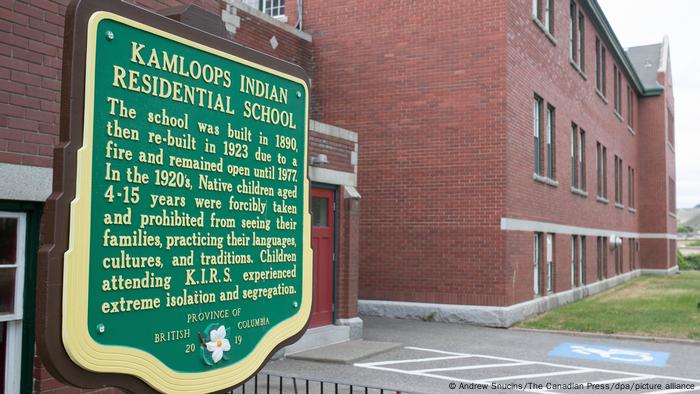
A sign tells the story of Kamloops school
A sign tells how Kamloops pupils were forbidden from seeing their families, practicing their languages or traditions

In the 19th Century, the then-government of Canada in consultation with religious groups put together a plan to gather aboriginal children from their tribes, take them from their families -- in their best interests to achieve a 'civilized' education which would enable them to take their place as model citizens, joining the rest of Canada, rather than have them remain on reservations learning traditional culture, language, way of life as a means by which these children would be 'westernized' and 'civilized', and learn how to look after themselves as they integrated into the broader society. 

This was accomplished by government fiat; no consultation with tribal authorities, much less seeking permission from the parents whose children would be scooped up and taken to the nearest residential school to be taught as the government saw would best fit their plans for future integration; to make 'Canadians' out of First Nations children. The children certainly weren't consulted, much less their parents and it's clear that neither the children nor their parents would have given consent.

Many of the children suffered through their years at the residential schools, many others learned skills that would serve them in later life, and they bore no ill-will toward the program. Many others, however, felt they were deprived of their First Nations childhood and many among them experienced harsh treatment while at the schools; punishment meted out to children who rebelled. Without doubt all the children involved missed their families and their tribal way of life.

When childhood diseases swept through the country in the late 1800s and mid-1900s, the toll among children was inevitable until vaccines and other therapies were produced to save lives. At the residential schools where children lived closely with one another the infection rate among the residents was higher and comparatively many more children died than in the broader community. There was little-to-no communication between the authorities at the residential schools and the parents of the children.
 
Delhia Nahanee lays roses on the steps of the Vancouver Art Gallery
Delhia Nahanee from the Nisga'a and Squamish First Nations lays a rose on one of 215 pairs of children's shoes on the steps of the Vancouver Art Gallery
 
The presence of fair-sized cemeteries on the property of the residential schools has always been a rallying point for First Nations activists and leaders demanding the end of the residential schools, compensation to past residents, and apologies for the heavy-handedness of depriving families of their children. Outside of Kamloops, British Columbia 215 unmarked graves belonging to children resident at the Kamloops Indian Residential School were discovered this week.

Chief Harvey McLeod of the Upper Nicola Band recalled his own experience at the school as a child. "I just remember that they were here one day and they were gone the next", he said of seeing his schoolmates disappearing and never being spoken of afterward. The government appointed a committee in 2008 to look into the simmering issue of the residential schools. The Truth and Reconciliation Commission produced a damning report detailing the ways in which thousands of First Nations children suffered hardship living away from their parents, many of them never to return.

The commission put the number of children who had died while attending a residential school at 3,200; one in every 40 students throughout the 120-year existence of the schools. Most of the schools had graveyards sitting adjacent the school buildings; many of the graves were unmarked, records never kept of children's names, tribes, ages; their parents obliquely notified but given no details, and never was the body of a child sent back to his/her parents for burial and the ritual of mourning.

"It's staggering to think that families would not have known what happened to a child that was sent off to the residential schools", noted Ontario;s Chief Coroner in 2012 when his office initiated an inquest into unrecorded residential school deaths. When a mother near Cornwall, Ontario heard of her son's death at residential school as a result of meningitis, she requested his body be returned home for burial. "It is not the practice of the Department to send bodies of Indians by rail excepting under very exceptional circumstances", the Department of Indian Affairs responded.

Tuberculosis was the most prolific killer of the children. Negligent health practices and cramped conditions made residential schools hotbeds of infection. The years 1870 to 1920 were the deadliest years at the Indian Residential Schools. Opened in 1884, the first six years of the Qu'Appelle Indian Residential School saw over 40 percent of its students die. In southern Alberta, the Sacred Heart Residential School had an annual student death toll of one in 20.

As late as the 1940s, the death rates at residential schools were up to five times greater than among Canadian children as a whole. Nearly one third of the students at the Kuper Island Residential School located in British Columbia died in the years following its 1889 opening. "The Indians are inclined to boycott this school on account of so many deaths", a school inspector wrote in 1922.

There was a marked absence of the most basic of medical care at the residential schools. James Gladstone who became the first Status Indian appointed to the Senate of Canada, wrote in his memoirs of a fellow student who died when no medical attention was given the boy after he stepped on a nail. "I looked after Joe for two days until he died. I was the only one he would listen to during his delirium", wrote Gladstone.

Poor construction and the lack of basic safety standards led to residential school fires with mass-casualty incidents. A fire in 1927 at the Beauval Indian Residential School in Saskatchewan  led to the death of 19 students. Three years after that 12 students died at Cross Lake Indian Residential School in Manitoba when a fire broke out there. 

And then there was the sad reality of children attempting to run away from the schools in hopes of reaching their homes. On these occasions when children ran away, the schools appeared to make little effort to recover the children by launching search parties. On New Year's Day, 1937 a group of four boys aged 7 to 9 ran away from Fraser Lake Indian Residential School with the intention of reaching their families at the Naldeh reserve seven miles' distance. 

When the school eventually assembled a search party, the boys were found frozen to death less than a mile from home, 24 hours after they had run off. With this latest discovery of 215 undocumented graves of children, Chief Rosanne Casimir of the Tk'emlups te Seewepeme First Nation revealed that a ground-penetrating radar specialist had aided in the location of the graves. Speaking of the discovery as an "unthinkable loss that was spoken about but never documented at the Kamloops Indian Residential School".
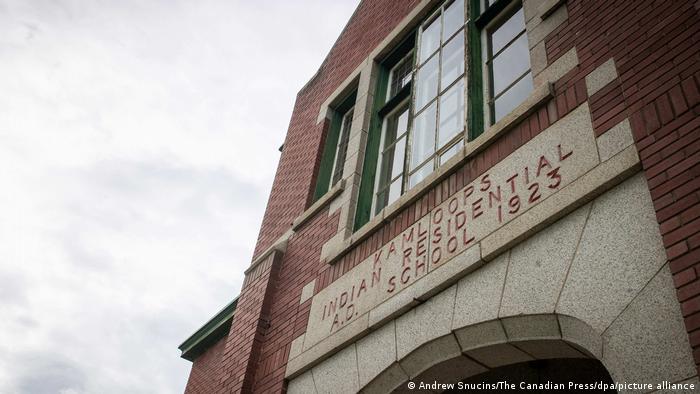
The entrance of the Kamloops Indian Residential School
Researchers found the remains of at least 215 Indigenous children on the property of the former Kamloops Residential School

Labels: , , ,

Friday, December 04, 2020

Acknowledging the Most COVID-Vulnerable

"There have been some deceitful and terrible things that have been done to our communities historically."
"As far as I'm involved, things of that sort are never going to happen [again]."
Arlen Dumas, grand chief, Assembly of Manitoba Chiefs

"The problem is trying to solve it [the history of medical experimentation imposed on First Nations by governments in Canada] in the middle of an emergency, in the middle of a pandemic, and trying to gain that trust."
"These solutions needed to start 20, 30, 50 years ago."
Ian Mosby, assistant professor, Ryerson University, Toronto

"It's not a game [trust of public health orders relating to vaccinations against COVID-19]."
"We need to take this serious[ly] and it is at a critical, critical junction."
Melanie MacKinnon, First Nations pandemic response team
Dr. James Makokis is a family physician in Kehewin First Nation. (Terry Reith/CBC)
 
The prairie provinces of Canada, Saskatchewan, Manitoba and Alberta are facing grim statistics in the number of COVID cases, hospitalizations and deaths. And hardest hit and most vulnerable among their population groups are First Nations people. In Manitoba to date, 45 First Nations people have died from COVID-19, mostly in the last few weeks with the average age of death 66, as opposed to age 83 for the overall population in Manitoba. An aboriginal boy under ten years of age died last weekend. 

There is an aura of distrust among Indigenous people in Canada for the sincerity of politicians, government leaders and the medical community, born of long association with those leaders having imposed on aboriginal groups medical experiments of questionable and often harmful proportions. Now Aboriginal leaders are facing a dilemma of their own, as are those of the medical community in persuading First Nations peoples that it is in their best interests to agree to being inoculated against COVID.
 
A gymnasium in Shamattawa First Nation has been set up with cots as the Red Cross helps the fly-in community amid surging COVID-19 numbers. As of Friday, there are 1,815 active COVID-19 cases among First Nations people in Manitoba. (Submitted by Eric Redhead)
 
At the First Nations COVID-19 Pandemic Response Co-ordination Team's online update last week Grand Chief Dumas had his work cut out for him explaining to his audience that such vaccination plans are universal, to be received by everyone as a general response within the entire population to guard against continued outbreaks that can only be achieved through mass inoculation. Indigenous leaders, he stressed, would simply not permit the types of experiments of the past to be repeated.

Social media pages for Indigenous communities are rife with negative comments and concerns over     COVID vaccines. COVID-19 health advice appears to many as perhaps just another way that central governments are conspiring to do harm to their native populations. Grand Chief Dumas allowed as how mistrust has been earned from the Indigenous community. His own family members have expressed their concerns that COVID-19 vaccine will turn out to be yet another experiment special to First Nations.

In Canada's history of scientists sponsored by the federal government or the government itself being involved in medical experiments on Indigenous people, many examples can be found in the historical record. Professor Mosby's research reveals the presence of a government-operated food experiment on aboriginal children suffering from deliberately imposed malnutrition during the 1940s. Milk rations were withheld for two years in one residential school while in another a special flour illegal for human consumption in Canada was used to feed Aboriginal children.

In the 1930s, Indigenous children were exposed to a tuberculosis vaccine trial in Saskatchewan. Indian Hospitals, revealed by research, were created for the express purpose of treating Indigenous populations with tuberculosis where medical experimentation of all kinds was carried out, pointed out Professor Mosby. Of more recent vintage have been lawsuits revolving around the forced sterilization of Indigenous women, and skin grafts performed on Inuit people.

According to Indigenous Services Canada, several days back 4,069 COVID-19 cases were identified on Canadian reserves. Infections of Indigenous people living both on and off reserve have surged in recent weeks in Manitoba. More severe outcomes accrue to First Nations people, according to the response team's data. In Manitoba alone there were over 1,713 active cases on and off reserves.

All of which add to the need to inoculate people most vulnerable to the dread effects of the coronavirus as soon as possible. First Nations leaders themselves across Canada are advocating for priority status for their communities when the vaccine becomes available for distribution around the turn of the new year.
 

"First and foremost … we come from that inherent and treaty right aspect, that Treaty Right to Health. In there, there's what we call the Medicine Chest Clause. When our ancestors signed treaties in the eighteen and nineteen-hundreds, that guaranteed us health and medicine chest supplies and services." 
"Obviously, the priority is that First Nations people are going to be safe and taken care of and live a long, happy, healthy life."
"Our First Nations communities have higher rates of diabetes, heart disease, asthma and other health conditions that put them at an even higher risk of serious complications or even life-threatening problems if they contract COVID-19."
"These elders and vulnerable community members must be the first to receive the COVID-19 vaccination. Every day they go without this vaccine, their lives and the lives of their [community's] most vulnerable are at exceptional risk."
"We need the vaccine [sent] directly to us. We don't need anybody else to deliver it for us - we can do it. We have the capacity, we have the knowledge, we have the manpower, and we're ready. We're ready to deliver once the vaccines become available."    
Chief Bobby Cameron, Federation of Sovereign Indigenous Nations
 

Labels: , , , ,

Thursday, August 30, 2018

Conservation, Inuit Tradition, Climate Change

THE CANADIAN PRESS/Jonathan Hayward
"They had to sit tight. It was pretty scary. They didn't sleep and they were out there for a while."
"It looks like it was a mother [polar bear] and a cub. The mother and the cub were killed."
"[The hunters] killed at least one more. There were multiple other bears in the area that were attracted by blood and scent."
Rob Hedley, administrator, hamlet of Naujaat, Nunavut

"I can't even describe the pain we're feeling right now."
"Those [bears] could have been caught if we didn't have these laws from the government."
"[Bears] are in our land and they are very, very dangerous. I just want Inuit to kill all the bears they see."
"It was a heavy burden to share the sad news with our community."
Helena Malliki, Naujaat, Nunavut

"The past few years, sightings and encounters have been rising. We're at a different level now."
"The guys I've been talking to say the bear population is at a level where it's safe to not have a quota."
Gordy Kidlapik, Rankin Inlet
"The seal harvest dropped dramatically [once the European ban on seal fur destroyed the market]."
"Bears start to move ashore [once the sea ice cover is lost]. Once all those bears are on shore, the likelihood of them coming into conflict with people increases."
"The ecosystem is changing. People in polar bear habitat have to look at changing some of their behaviour."
Andrew Derocher, polar bear biologist, University of Alberta
A polar bear walks over sea ice floating in the Victoria Strait in the Canadian Arctic Archipelago. RCMP say a hunter died after a polar bear attack near Naujaat, Nunavut. (David Goldman/Canadian Press)

Inuit communities in Canada's far north are resentful of interference by the federal and territorial governments that limits their hunting of polar bears. Quotas limiting the numbers of polar bears to be killed in each of the territorial regions act to constrain Inuit from thinning out the bear population, they contend. The result, they charge, is an overabundance of the powerful beasts who then threaten the existence of the people of the north. Inuit say they are exposed to greater numbers of 'interactions' with bears on the land than ever before.

In early July a man from Arviat was enjoying a family outing on an island close by the community with his children. A polar bear suddenly appeared. The 31-year-old Inuit man shouted to his children to run as he placed himself in harm's way to protect his children. He was killed, and the children survived, having run to safety. More recently, two Inuit hunters spent three days huddling alongside the body of a third hunter, killed by a polar bear. Four bears circled their camp, as the hunters hoped for rescue.

The bitter response from Inuit at the news that another of their community members has been killed by a rampaging bear, is that southern interference by people who have no idea of the dangers northern people can be exposed to, are the architects of legislation that complicate their lives in the interests of conserving bears, even while their habitat is being impacted by climate change. The stranded men had left from Naujaat on the northern shore of Hudson Bay on August 21, planning to hunt for narwhal and caribou.

Expectations were that they would be returning last Thursday; when the three hunters hadn't returned by Sunday, police were notified. The following day federal, territorial and local teams set out to investigate, knowing approximately where the hunters had been headed. Heavy sea ice conditions blocked the search boats, so the Coast Guard icebreaker Louis St.Laurent went into action, its helicopter discovering the hunters early the next day, 100 kilometres east of Naujaat.

The two hunters who had remained by their dead companion had been injured, but not seriously. Polar bear biologist, Dr. Derocher, commenting on the situation, pointed out that the quotas being criticized for hampering the Inuit from thinning out the presence of polar bears, ensuring the safety of the community, are set in Nunavut but only after consultation with hunters. Lacking careful management of the bears, the likelihood of a backlash from the international community, he pointed out, would have a deleterious effect on the communities' well-being.
A mother polar bear and her cub near Churchill, Man. A hunter from Naujaat, Nunavut, was killed after a polar bear and cub attacked him and his two friends on Thursday. (Elisha Dacey/CBC)

The European Union would possibly spearhead a ban on exports of polar bear products from Canada, essentially destroying an important income source for those Inuit communities. Inuit would end up killing even fewer bears, just as occurred when the ban on seal fur destroyed that market. Local hunters, he pointed out, had failed to take their allotted one hundred bears last year, despite the complaints of insecurity now being cited by community members in the wake of those two deadly polar bear attacks.

He also pointed out that the Foxe Basin bear population around Naujaat has seen the loss of some 30 days of sea ice seasonally over the last number of decades. Once the sea ice is unstable, the bears that usually hunt seals and other polar wildlife from the ice, abandon their uneasy perches for land. And this is when the intersection of bear and man becomes acute. A problem, however, attributed now to climate change propelling the bears into areas where that interaction becomes more common, with its potential for unfortunate occurrences.

The last death has been attributed to an interaction between the hunter, a mother bear and her cub. Bears are known to be acutely protective and angrily reactive to anything they perceive to be threatening to their cubs. This is elementary, and common knowledge. That a seasoned hunter would come to grief in this type of scenario is indeed inexplicable. The mother and cub were killed at the scene of the unfortunate encounter, along with another bear.

Labels: , , , ,

Tuesday, March 13, 2018

First Nations vs Property Rights: Free Speech, Justice

"In my view, this [decision of the appeal court] understates the importance of both the common law liberty to proceed unimpeded along a public highway and the right to engage in political protest -- the heart and soul of freedom of expression in a democracy."
"...Mr. Fleming was entitled to attend and participate in the Flag Rally regardless of its effect on the government's political goals at Caledonia or anywhere else, and in particular, regardless of whether the Flag Rally was considered provocative by the government or protesters."
Judge Grant Huscroft, dissenting judgement, Ontario Court of Appeal
Randy Fleming is arrested - purportedly to prevent trouble - by OPP officers for carrying a Canadian flag in Caledonia, Ont., in an image taken from a video shown in court.   numberswatchdog.com

Justice Huscroft, the third member of the appeal court in the case of retired steelworker, 57-year-old Randy Fleming who had planned to attend a "flag event" in Caledonia, Ontario at the Douglas Creek Estates subdivision -- still under construction but halted when Six Nations 'warrior' protesters violently occupied the area in 2006 in protest against building on land they claimed to be traditionally theirs and for which no treaty had been signed -- but was stopped and seriously manhandled by a group of Ontario Provincial Police officers felt that the appeal court of which he was part, erred in not upholding the finding of the original judge.

Residents of Caledonia, Ontario, and families that had bought homes from the home builders at Douglas Creek Estates were put through years of intimidation and threats from the Six Nations/Haudenosonee occupiers. Their occupation of the site was illegal, their behaviour was criminal, and police did little to apprehend the First Nations men whose occupation of the subdivision and the mostly unfinished houses represented a state of chaotic criminality. The occupiers resorted to raging violence, vandalizing a Hydro One station, burning bridges and cars, issuing "passports" to residents living near the site, demanding to see them before permitting the passport-holders to access their homes.
Six Nations protesters in Caledonia in 2006

The reaction of the Ontario government was to warn the provincial police force not to interfere and to ensure that the First Nations warriors and the non-native residents were kept apart. But the larger purpose was to ensure that the First Nations people were not 'provoked' to further violence, leaving non-aboriginals to live with the intimidation of threats that terrorized the population. Over the occupied site, the flag of the Mohawk Warriors was flown in defiance of law and order. Ontario Superior Court Judge David Marshall issued orders that the barricades the warriors had put in place to exclude non-natives were to be removed; orders that were ignored.


In May 2009, three years following the original 'occupation' and ruination of the housing estate, non-native locals had arranged for a "Flag rally". Randy Fleming set out to join them. He had with him a Canadian flag mounted on a pole as he headed toward the rally. For his troubles a half-dozen OPP officers tackled him to the ground, injuring him physically, and adding another injury to his dignity as a free citizen of Canada and resident of Ontario, charging him with obstructing police as officers arrested him to "prevent a breach of the peace". Despite that he was charged with this malfeasance, the Crown ultimately withdrew the criminal charge.

Mr. Fleming responded by suing the OPP, and he won his suit. Ontario Superior Court Judge Kim Carpenter-Gunn ruled his arrest to have been unlawful, the police used undue force and in so doing breached his Charter and common-law rights. He was awarded close to $300,000 in damages along with legal costs. The OPP appealed and tasked three lawyers from the Ontario Attorney General's office to pursue the appeal. The appeal court saw fit to overturn Justice Carpenter'Gunn's decision on the basis of the judge having made "palpable and overriding error"; that the OPP meant "to prevent harm" coming to Mr. Fleming as well as preventing a peace breach.

The court turned Mr. Fleming's award into a fine of $25,000 representing fifty percent of the legal costs to the government of the appeal. Here's strange logic: the government with its unlimited financial resources depends on taxation, including Mr. Fleming's share, to fund those unlimited resources. Mr. Fleming also, quite incidentally, funded the decision depriving him of justice. And in ordering him to pay for half the government's legal appeal costs, he has been doubly financially tasked, in a most peculiar show of justice denied.

As for the 'error' cited having been attributed to the original trial judge finding in Mr. Fleming's favour? She erred, it would seem, when she made the determination that the OPP had prevented Mr. Fleming from "exercising his lawful rights of walking up Argyle Street (Caledon's main street)" which turns out not quite to have been the case, since it wasn't on Argyle Street but another Caledon street where the confrontation had taken place. The decision of a Mad Hatter, straight out of a confused Wonderland.
Randy Fleming’s arrest on May 24, 2009. Supplied

No justice for Mr. Fleming, no justice for the people who had bought the houses constructed and to-be-constructed in that ill-fated subdivision, because the Government of Ontario bought the land from the home builder,  Henco Industries Ltd. and turned the 40 hectares of land which had been purchased by them originally from the Crown which held that the Six Nations of the Grand River had historically relinquished it to the Crown -- over to the dissenting, aggrieved and violent protesters, to be handed over to the administration of the Six Nations.

Labels: , , , ,

Saturday, September 16, 2017

Favouritism, Cronyism, Nepotism, Racketeering

"None of the budgets noted indicate a cost of $500,000. We are unaware of how between March 22, 2016 and April 29, 2016, the budget grew from $260,000 to $500,000."
"We understand the police have been notified of the alleged theft and are investigating."
"No other individuals, council members or otherwise, were copied on the email [arranging the funds] to the bank."
"No other council members approved he bank draft."
"We recommend a formal legal opinion be obtained with regards to whether a conflict of interest existed between Chief Hillier and the contact with Moccasin Media and its proprietor David Hillier."
"We are unable to confirm the amounts paid ..." We are unable to determine whether any cash may have been misappropriated."
"[Band] members sought financial information ... We understand no information was initially shared with the members."
Matson Discoll & Damico Ltd. audit of Caldwell First Nation powwow
Caldwell First Nation
Members of the Caldwell First Nation in Leamington, Ont. are shocked by a forensic audit that shows there were "minimal controls" over more than $240,000 in prize money for a powwow last year. (Caldwell First Nation website)

The suggestion that funds may have been stolen from a small band council arranging a celebratory powwow for its 368-member group in southern Ontario certainly looks, on the evidence of the audit, that it has great merit. Chief Louise Hillier, it seems, was in a conflict of interest given that she chose to award an untendered contact to the value of $290,000 to make a video of the powwow.

On the strength of the audit's findings Chief Hillier has been temporarily suspended as has the entire council itself after a motion from one of the councillors. Unusually large cash prizes represented another puzzling decision to reward contests in singing, dancing and drumming, to a total of $280,000 unsupported by receipts.

All to celebrate the conclusion of the band's land claim in 2010, when the Province of Ontario settled with the band for the historical claim when, 200 years earlier, settlers took their traditional lands at Point Pelee. The band has no designated geographic reserve, but with its settlement funds it has plans for the development of an urban reserve to be located in Leamington, Ontario.

Last summer's powwow was the celebration of a "repatriation ceremony", named Rejuvenation of the Spirit. The 129-page audit appears to have taken all the airy puffery out of that rejuvenated spirit; of the million-plus settlement, fully half was scattered to the winds, and almost half of that ended up in the flush bank account of the chief's son for his Moccasin Media company.

There was a complete lack of financial control in the council, no drawing up of an official budget, merely a draft resolution expressing the band's intention of launching the celebration; a follow-up resolution had no financial value connected to it; nothing specific whatever, though an audio recording of the council meeting had councillors discussing a budget of $260,000.

A bank investigation revealed that 99 $50 bills were missing; whoof! poof! gone! There was a convention however, stating a councillor "cannot sign his/her own cheque and cannot sign a cheque for immediate family ...", but still the chief's son's video company was awarded a contract just shy of $200,000 when the band had been discussing contracts not to exceed $20,000.

Local media reported up to 6,000 people attending the powwow, with ticket sales at $5 each entrance at the gate, and when the gate revenues were totted up it seems that only 1,123 entrants may have paid the fee -- or the fees just kind of disappeared. Souvenir revenues came to a whopping $2,596, accounting for memorabilia for the powwow that the band had spent $17,197 on acquiring.

Attendees loved the cash prizes, with young competitors, six to 12 years of age awarded $400 in first place, $150 for coming in fifth. The awards were doubled for the older girls and boys, and the adult competitors received $1,600 for winning first and $800 for finishing fifth. If there were any losers, they were the forgettable concepts of straight-shooting and honesty.

The former federal Conservative government had instituted a regulation whereby band councils were expected to post all revenues and expenditures for public viewing, rather than do as they wished with the tax-funded monies annually received to fund reserve operations. One of the first things the new Liberal government did was to waive that requirement.

The reserves that are well-run by honourable councils who care deeply about the welfare of their members, saw no need to waive an assurance they complied with; those administered by First Nations elites who saw nothing untoward in cheating their people doubtless celebrated wildly.

Labels: , ,

Thursday, March 02, 2017

Epigenetics Fracturing Aboriginal Youth

"Suicide is not a traditional aspect of indigenous culture in Canada."
"This commentary raises the possibility that the effects of tetraethyl lead poisoning during the 1970s and 1980s contributed to the rise in suicides, and continues to contribute to the growing problem through epigenetic modifications."
New research paper on aboriginal youth and suicide

"I think it [1970s/80s gasoline sniffing among aboriginal youth] is a contributing factor [in current-day suicide rates], but I don't think it's the primary one."
"It's not just going to be one thing, there are going to be a lot of interactions between environmental risk factors and the biological ones, too."
Trehani Fonseka, leader, First Nations depression and suicide-prevention program, St.Michael's Hospital, Toronto, study co-author
THE CANADIAN PRESS/Nathan Denette
THE CANADIAN PRESS/Nathan Denette   A cemetery at Attawapiskat First Nation, which declared a state of emergency over suicide attempts last year.

A newly re-discovered letter sent in 1973 from a scientist with Health Canada to colleagues at the hospital in Sioux Lookout alerting them to his finding tests indicated that gas sniffing had become a widespread practise among aboriginal youth, and it led to research findings and theories resulting in a paper recently published in the journal Psychiatry Research. The finding was that gas-sniffing as a source of lead poisoning was responsible for triggering genetic changes in the users.

And those genetic changes passed on through the generations, a process named as epigenetics. The scientists at St. Michael's Hospital and the University of Toronto arrived at a hypothesis that neurological problems surfaced in the original sniffers' descendants making them more susceptible to depression and suicide. That theory is partially supported by the fact that indigenous communities had minimal suicide rates before the mid-1980s while at the present time their rates of suicide rank among the highest in the world.

The lead poisoning leading to genetic alterations, added to impoverished communities breeding in their residents attitudes of hopelessness -- along with family histories of mental illness and addictions, childhood abuse and the unfortunate after-affects of the residential-school era, when aboriginal children were removed from their homes and placed in teaching institutions whose programs steered them to a rejection of their heritage and toward European values -- constitutes a lethal mixture of social dysfunction.

"We're always struggling to find some simple explanation for complex, multi-factorial things. It's a mistake to interpret this (suicide epidemic) as some kind of inevitable consequence", stated Dr. Laqurence Kirmayer, a professor of psychiatry at McGill University who heads a national network on aboriginal mental-health research, and who seems less than impressed with the conclusion reached by this latest research paper, though it makes no effort to attribute epigenetics entirely being the sole fault in the spate of recent suicides.
An unidentified Sheshatshiu Innu youth openly sniffs gas in the community on Friday Nov. 17, 2000.
CP PHOTO/Ted Ostrowski    An unidentified Sheshatshiu Innu youth openly sniffs gas in the community on Friday Nov. 17, 2000.

Yet the effect of the past 30 years of surging suicides among aboriginal youth has transfixed the scientific community through endless discussions with no solution in sight. On a single day at the Attawapiskat reserve in northern Ontario last spring, eleven suicide attempts occurred. While in northern Saskatchewan there were six deaths by suicide among girls from age ten to fourteen, and another six suicides in 2014 in a remote Quebec indigenous community. A staggering loss.

A coroner's enquiry in 2010 stated that young indigenous people commit suicide at five to six times the rate of non-native youth, when it looked into 15 child suicides at the Pikangikum First Nation in Ontario. Thirty years ago the twenty First Nations in northwestern Ontario recorded one or two suicides a year in comparison, according to the coroner's office figures.

Tests in the 1970s showed lead volumes in gas sniffers of up to 85 micrograms per 100 millilitres of blood, when neurological damage is known to begin with levels as low as five micrograms. Dr. Fonseka allows that additional studies to test the hypothesis are required, and if confirmed the very presence of genetic changes linked to lead poisoning that occurred in earlier generations could provide an "early warning", identifying groups at risk of suicide so preventive programs can be designed in response.

Angela sniffing
"I think I'll never stop sniffing gas. I want the same thing to happen to me that happened to my brother Charles," Angela says. "I want to die the same way my brother died... while sniffing gas."   CBCnews

Labels: , , ,

Wednesday, November 02, 2016

Speaking The Dismal Truth to Political Correctness

"Because much of the aboriginal population in Canada is just satisfied being alcohol or drug abusers, living in poor conditions, etc. ... they have to have the will to change, it's not society's fault."
"And of course this has nothing to do with missing and murdered Aboriginal women ... it's not a murder case ... it's [sic] could be a suicide, accidental, she got drunk and fell in the river and drowned who knows ... typically many Aboriginals have very short lifespans, talent or not."
Police Sgt. Chris Hrnchiar, Ottawa Police Services

"Although I had long since forgiven the officer for his racist tirade, I have a renewed sense of disappointment based on the new details that we learned today."
"Even if [his role] was tangential, it's close enough to me that somebody that close should display and exercise greater sense of professionalism and decency."
"Annie deserved better, far, far better."
"The greater issue for me is racism in policing. There should be some reaction at the organization level, too. They can't deny now that there is an issue of racism among their ranks."
Veldon Coburn, adoptive father of Annie Pootoogook's child
Inuit artist Annie Pootoogook, of Cape Dorset, Nunavut, is seen here in a still from a 2005 documentary. She was found dead on Sept. 19 in Ottawa.
Inuit artist Annie Pootoogook, of Cape Dorset, Nunavut, is seen here in a still from a 2005 documentary. She was found dead on Sept. 19 in Ottawa. (CBC) 
"[Hrnchiar's actions were] completely inappropriate, [his] peripheral involvement [in the case should have excluded him from] insulting and racist [comments on Annie Pootoogook's death]."
"[Hrnchiar's comments] tarnished [the police service reputation. The community [Inuit community in Ottawa] demanded an investigation immediately; [Hrnchiar will] forever be labelled by his comments."
Prosecutor Christiane Huneault
It is a tragic but indisputable fact of life that indigenous peoples of North America have always had an irresistible attraction to alcohol, and it has ruined the lives of all too many who fall prey to its addictive misery. The effect of alcohol for the First Nations people of Canada has robbed many of the dignity of life, of a life well lived. Those addictions have transformed the culture of proud peoples helpless to defend themselves from their own genetic disposition to crave the effects of alcohol poisoning even while it wreaks havoc with their lives and their communities.

A case in point is the short life of Inuk artist Annie Pootoogook, an Inuk artist whose paintings have been recognized for her authentic genius in portraying through her drawings, the life of Inuit in the Far North. She was the recipient of notable awards for her talent, her paintings drew attention in North America and in Europe, and have been much in demand. An award of $50,000 through the Sobey Art Award furnished her with ample indication that she was highly respected as an artist. Validation came in the form of her works being exhibited across the globe.

But she latterly lived on the street in Ottawa, and had done so for almost ten years. Her struggles with addiction left her living in shelters or on the street, panhandling, content with the sale of her drawings to anyone who would pay the $25 or $30 she would part with them for, providing the means by which she bought cigarettes and alcohol. She had a common-law relationship with a non-aboriginal man who also lived on the street and at one point they acquired a publicly-paid apartment of their own.

Fine Liner Eyebrow, by Annie Pootoogook
Fine Liner Eyebrow one of Pootoogook's drawings on display at the National Gallery of Canada. (Annie Pootoogook/National Gallery of Canada/Dorset Fine Arts)

Those who followed this woman's career were dismayed at the turn her life had taken. She had decided at one point that she would seek help for her addiction, and she did. But nothing seemed to give her the required impetus to manage to transcend her craving that left her a far lesser person than she was. She had a child while living rough on the street, the baby was delivered in a bathroom at the Salvation Army installation in downtown Ottawa.

She and her common-law husband meant to raise the child, but living as they did it was impractical for the sake for the child, and the child was surrendered for adoption. She had had another child at an earlier time when she was living in her home community of Cape Dorset in Nunavut, and that child was being raised by other Inuit, as is the custom within the Inuit community. On September 19, Annie Pootoogook's lifeless body was discovered in the Ottawa River. By that time she was no longer with the father of her child.

Although her death was initially thought to be accidental in nature, police have since felt that perhaps there might have been something suspicious about the death, that particular "elements" warranted additional investigation. And so the Police Services asked the public for assistance if anyone had any information on the artist's whereabouts and activities in the days preceding the discovery of her body. Of course, there was a news report on the death, and in response to the news item, Sgt. Hrnchiar wrote his comments on his Facebook account.

It was the comments that he committed to that sparked controversy when the adoptive father of Annie Pootoogook's daughter happened to see them on line. The Facebook account features Sgt. Hrnchiar in uniform, displaying a police badge surrounded by a black band, in memory of a fallen fellow officer. Mr. Coburn brought those comments to the attention of the chief of police in Ottawa and the city's mayor, and an internal investigation ensued.

It transpires that although Sgt. Hrnchiar was not professionally involved in the investigation, he was a sergeant in the forensic identification section and as such supervised the detective who did work on the case, and who was responsible for identifying Ms. Pootoogook. The upshot of the investigation of the sergeant's unsolicited and inappropriate -- given the circumstances -- public remarks was his apology while pleading guilty to two counts of discreditable conduct under the Police Services Act.

The public censure that arose over the revelations of his unseemly, however true comments did in a sense compromise the police in the opinion of the Inuit community, thus doing a grave disservice both to the police services and the Inuit community for his lack of tact. The impetuous, ill-thought-out nature of this man's decision to submit to his wish to comment on this matter was clearly inappropriate given his profession and the situation of an open criminal investigation.

However, because he has expressed remorse for his posting of those comments, and suggested that he be exposed to help from the diversity and race relations unit, he has partially redeemed himself in the opinion of his peers and police authorities. He has, through his reaction to charges against himself, acknowledged the deleterious impact of his comments on others. And while the indigenous community would prefer to see this officer fired, for this man of 30 years' experience who apologized profusely, a penalty of a three-month demotion to first-class constable and mandatory multicultural training has been proposed.

Untitled (Kenojuak and Annie with Governor General Michaelle Jean)
Pootoogook made this drawing following her visit with former governor general Michaelle Jean when an exhibition opened at the National Gallery in 2009. (Annie Pootoogook/National Gallery of Canada/Dorset Fine Arts)

Labels: , , , ,

Sunday, October 23, 2016

Breathtakingly Audacious Corruption

"Mr. Martin has hundreds of thousands of dollars to spend on his campaign and to woo the very small Shuswap electorate. It's unlikely any of his opponents have those kind of resources. Hopefully, voters get access to the full information about how their council has been run and change things."
"Corruption in our political system -- whether on or off reserve -- can never be tolerated or overlooked, as integrity is foundational to democracy."
"[Shuswap members] deserve to know exactly what has gone on with their band leadership and millions of their dollars."
Jordan Bateman, spokesman, Canadian Taxpayers Federation
Bethany Lindsay/Postmedia/File
Bethany Lindsay/Postmedia/File   The Shuswap First Nation has an on-reserve population of about 100 people, and is located on the outskirts of Invermere near the B.C.-Alberta border
 
When the previous Conservative-led government in Canada enacted the First Nations Financial Transparency Act, to ensure that band members on and off reserve were kept informed of what their band councils were engaged in, and how they used the funding available to them through Aboriginal Affairs and Northern Development Canada, it was revealed by investigative reporters that the Shuswap First Nation, a tiny British Columbia band, had been manipulated to transfer $4.2 million of band funding over a period of 3-1/2 years to a single family.

This is a one-hundred member band, whose members live on their reserve located on the outskirts of Invermere close to the British Columbia-Alberta border. A forensic audit carried out by Ernst & Young authorized and funded by the federal government after revelations in the news media pointed out this gross mismanagement of band funds, was verified when the auditors produced a thirteen-page report made available to band members and handed over as well to the RCMP for investigation.

Incumbent Shuswap First Nation Chief Barbara Cote helped wrest control of the band from the family of former chief Paul Sam.
Postmedia/File   Incumbent Shuswap First Nation Chief Barbara Cote helped wrest control of the band from the family of former chief Paul Sam.

Current Chief Barbara Cote, along with the band's two councillors advised band members through a written statement that "It [the matter of the abuse of band funds] is under RCMP investigation." A "general and widespread lack of supporting documentation" was highlighted in the Ernst & Young report, noted in their completed audit. Which made note of a lack of proof that expenditures existed related to transactions undertaken by the band, which had a disconcerting habit of advancing the financial affairs of the Sam and Martin family.

In his 80s and confined to a wheelchair, the band chief was paid, tax-free, $741,262 to administer the band affairs, representing one hundred individuals of the band; that would be the equivalent of $1.3 million had taxes have had to be paid on that salary. Paul Sam's wife Alice Sam, in her capacity as the band's bookkeeper received $690,481 as her salary, equivalent to $1.2 million. While their son, Dean Martin was paid slightly below $1.4 million between April 2011 and November 2014.

Alice Sam (left) and then-Shuswap First Nation Chief Paul Sam in 2014. Dan Walton / Columbia Valley Pioneer files
And it is former Chief Sam's son Dean Martin who is now casting himself as an incoming chief should the band choose to vote him into office, and usher out the three incumbents, Chief Barbara Cote and councillors Tim Eugene and Rosalita Pascal who have represented the interests of the band ever since the Sam family was locked out and ousted when it was revealed through the media how they had manipulated band funds to service their personal craving for wealth.This, despite the police probe into the illegality of the transactions the Sam family had engaged in to enrich themselves, preying on the band's trust.

Moreover, two private companies: Shuswap Woodlands Restoration and KDC Sand & Gravel benefited by an additional $1.36 million in undocumented funds from the band's financial reserves. Two of Dean Martin's sons own each of these companies. As well, an additional $66,481 was used during that three-year period "on flights to destinations such as Las Vegas, Chicago and Varadero, Cuba for travel of an apparent personal nature", concluded the Ernst & Young audit.
Dean Martin, candidate for election in the Shuswap First Nation, and son of former chief Paul Sam and former councillor Alice Sam.
Dean Martin, candidate for election in the Shuswap First Nation, and son of former chief Paul Sam and former councillor Alice Sam. Greg Amos / Columbia Valley Pioneer Files

Yet, there's more that the audit discovered which they revealed in their report. Two amounts of $15,000 had been "diverted" for the purpose of clearing the credit card debts of Dean and his son Richard Martin, with another $20,000 going to pay down Dean Martin's former wife Pam's line of credit. Another $28,000 was used to pay for travel and accommodation for a softball team. These revelations are a shocking example of what some First Nations reserves are labouring under, under the guidance and direction of conscienceless leaders.

According to its 2015-16 financial statements, there is a $211,333 loan listed as an outstanding liability, taken out by KDC Sand & Gravel. Another drag on band expenses is the litigation launched against some ex-employees, including Dean Martin. In view of this egregious example of criminal malfeasance on the part of the elected chief and councillors of the Shuswap First Nation until they were removed once news of their skullduggery became public knowledge, it seems peculiar indeed that the current Trudeau government is prepared to revoke the First Nations Financial Transparency Act, citing their view that insufficient consultation with First Nations took place before the act was brought into law.

Labels: , , ,

Saturday, September 17, 2016

Recognizing Problems, Finding Solutions

"[Addressing the acute problem of First Nations suicide epidemics] will require co-ordination among education, justice, employment and social welfare sectors."
Laura Egertson, Kirsten Patrick, Canadian Medical Association Journal

"Some factors driving suicide are] crowded housing, intergenerational trauma, family violence, family history of suicide [as well as] witnessing or experiencing physical or sexual abuse, [medical problems such as] depression, substance abuse, mental health disorders [and social dysfunction related to] intoxication, access to means, hopelessness [and] isolation."
Inuit Tapiriit Kanatami

Sky-high suicide rates are blooming on some of Canada's most isolated and economically depressed First Nations reserves where miserable life outcomes have become all too common. So how to solve issues contributing to hopelessness and misery caused by isolation? First Nations tribes tend to cling to their heritage lands and memory of living off the land, though they currently live on the land, but not off it, preferring to emulate the use of convenience foods, commercially produced durables and food, and watching television, over being actively engaged.

Solving such intractable problems as familial dysfunction, community violence, drug abuse, scorn for education and independence given by seeking sources contributing to earning a living and subsequent lack of pride in subsisting on universal welfare doled out to aboriginals goes well beyond daunting. How to convince First Nations that it is in their best interests, to solve these intractable problems, to pursue a fully advanced lifestyle by being absorbed by the prevailing social lifestyle in Canada's larger community?

Which cannot be achieved while First Nations tribes insist on living dependent on government handouts in geographic areas that confine them to an untamed wilderness where there are no employment opportunities, where direct access to science and advanced health care, and exposure to sound education for their children is denied them. If competently trained health care workers, fire fighters, policing services and teachers cannot be found from within their own communities, why is it surprising that those services will not come to the isolated regions courtesy of non-native volunteers?

Canada's suicide rate is 11.4 per 100,000 population, about average for many countries similar to Canada in their advanced-level functioning capabilities. Yet some countries admired for the success of their socially advanced communities have come under scrutiny for the level of their suicide rates, higher than Canada's. Germany has a rate of 13 per 100,000, Sweden 13.2, and Finland a whopping 16.7 per 100,000. Canada's rate would be even lower if it were not influenced by the suicide rates in First Nations communities.

On First Nations reserves the suicide rate comes in at five and a half times the rate throughout the country, in Canada. Canada's Inuit populations most particularly rate as being among the highest on the globe. Inuit Tapiriit Kanatami's suicide prevention statistics give the Nunavut suicide rate at 117 per 100,000; a number twice Russia's rate which qualifies as a world leader in suicides. In Nunavut suicides accounted for 13.5 percent of all deaths.

'I do not believe that it is respectful for the government to prescribe solutions for Indigenous peoples when it comes to suicide,' Natan Obed, president of Inuit Tapiriit Kanatami, told parliamentarians Tuesday. CBC -- Natan Obed, president, Inuit Tapiriit Kanatami
"Each one of us is personally affected by suicide and this comes from a very early age and it affects our entire life course."
"Imagine a scenario where you grow up understanding how to die by suicide. You have friends, family members, loved ones who have died by suicide. And suicide is normalized in your community."
"I came away frustrated and have continued to be frustrated by the way in which the discussion has happened to date."
"It is as if Indigenous suicide and Inuit suicide is something completely outside a public health context and somehow the answers only lie with us and us alone."
"What they are looking for in many cases is a particular component of suicide prevention that is Indigenous only that usually has something to do with on-the-land camps or cultural continuity, that is relatively cheap."
"I do not believe that it is respectful for the government to prescribe solutions for Indigenous peoples when it comes to suicide."
"Many of the reasons why our communities are the way they are is because of colonization and because of programs and policies of the Canadian government."
"Specific interventions and investments are going to be necessary from different federal departments."
"This, of course, isn't a three to five year push. This is a generational thing."
Natan Obed, president, Inuit Tapiriit Kanatami
Bitterly critiquing the federal government in its attempted approaches to bringing a solution to such dreadful problems, insisting that it is not non-Indigenous who must plan and implement working solutions, but complaining that cheap won't do it, and funding must be lavished on communities which have thus far dismally failed to solve their problems, preferring to lay the blame on the colonialist past solves nothing, but it is typical.

Only once the non-Indigenous and the Indigenous people make a sincere effort beyond well-meaning on the part of government, and determined-to-succeed on the part of Indigenous leaders, will any kind of remedy to the current problems afflicting First Nations come close to solution.

Labels: , ,

 
()() Follow @rheytah Tweet