Ruminations

Blog dedicated primarily to randomly selected news items; comments reflecting personal perceptions

Wednesday, August 25, 2021

A Tale of Two Outbreaks

 
"First there was one asymptomatic infection at the airport in Nanjing. The next day, there were more than a dozen. By the end of that week in July, daily infections had climbed to nearly 50, suggesting exponential spread across more than 1,000 kilometers. In less than three weeks, daily cases ballooned to more than 100, scattered across half of the nation. Then it ended, almost as quickly as it began. The number of infections dropped to single digits the next week amid tightening curbs, then zero. More testing will show if it has been vanquished."
"The blazing spread of the delta variant across the country became the biggest test of China’s COVID control model. Ultimately it penetrated nearly 50 cities across 17 provinces and reintroduced the virus to "Wuhan, which had been COVID-free for over a year."
Still, China eliminated the virus in about a month, roughly the same time it took to quell previous outbreaks including one at the start of 2021 that totalled some 2,000 cases. In comparison, cities in Australia have undergone repeated lockdowns, keeping more than half of the country’s 26 million people confined to their homes, without gaining control of the virus. In the U.S., which has never succeeded in containment, relying instead of vaccination, booster shots are slated to roll out next month to shore up protection against its delta resurgence."
Fortune magazine 
Waiting for Covid-19 testing in Nanjing this month. About 200 cases have been reported in an outbreak centered on the city as of Friday.
Credit...Agence France-Presse — Getty Images
"The vaccines that are currently approved by the WHO all provide significant protection against severe disease and hospitalization from all the variants, including the Delta variant."
"We are fighting the same virus but a virus that has become faster and better adapted to transmitting amongst us humans -- that's the change."
Mike Ryan, top emergency expert World Health Organization
At the end of July China suddenly found itself trying to control the most threatening COVID-19 outbreak it had been forced to confront in months in a return of COVID infections, thanks to the Delta variant. At the same time the United States plans to intensify its efforts to control the Delta strain believed on ample evidence to be more contagious than the original coronavirus.
 
An official lockdown was mandated for hundreds of thousands of people living in Jiangsu province when a cluster of infections was identified in its provincial capital of Nanjing. The infections were tracked to airport workers who had cleaned a plane arriving from Russia in late July. It took little time before infections were detected in Beijing and five provinces. By standards other than China's the number of infections were modest. But the speed of the spread was not.

Across China a total of 206 infections were linked to the original cluster which became the largest in the country geographically in several months. Two locally transmitted cases were found in Beijing's Changping district which spurred lockdown in nine housing communities with a total population of 41,000 people. At the same time a document from the U.S.Centers for Disease Control spoke of the Delta variant causing more severe illness than earlier variants, spreading as readily as chickenpox.

U.S. health officials, points out the document, must "acknowledge the war has changed", and be prepared to intensify efforts to halt the spread. The U.S. struggles to persuade Americans to become vaccinated and adapt to prevention measures like wearing face masks amidst surging cases -- and new research which suggests that those who are vaccinated can also spread the virus.

Three quarters of those who were infected with COVID-19 at public events in a town in Massachusetts had been fully inoculated against COVID. According to the study, vaccinated individuals reflected similar virus loads as those who were unvaccinated; unlike other variants, vaccinated people infected with the Delta variant are able to transmit the virus, the CDC revealed.
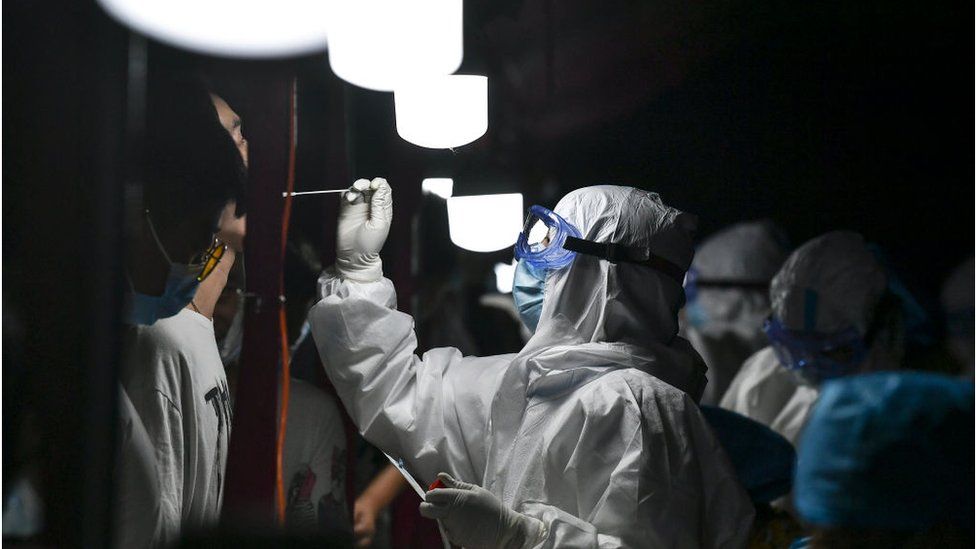
 
A medical worker collects swab from a resident for nucleic acid testing at dawn
Authorities in China tested millions of people after an outbreak spread to 15 provinces   Getty Images
 
This realization caused the health agency to change its guidelines recommending that vaccinated Americans once again wear face masks where transmission levels are high. "Given higher transmissibility and current vaccine coverage, universal masking is essential", the document added. Local media reported most of those infected in Nanjing were vaccinated, a situation that led to questions of the Sinovac vaccine efficacy.

"If the goal is to slow down the spread and reduce the fatality rate, [Chinese vaccines] can afford a certain degree of protection", assured the leading Shanghai infectious diseases expert, Zhang Wenhong. The country's top disciplinary watchdog pointed a finger at the airport officials in Nanjing for "poor supervision and unprofessional management", in failing to separate cleaning staff working on international flights from those on domestic flights.

No fewer than 132 countries globally have detected the presence of the Delta variant, making it the dominant global strain, according to the World Health Organization. Over the past few months COVID-19 infections increased by 80 percent in most regions of the world, stressed WHO director-general Tedros Adhanom Ghebreyesus. In Africa, where only 1.5 percent of the population has been vaccinated, infections rose by 80 percent in a few weeks.

"Hard-won gains are in jeopardy of being lost and health systems in many countries are being overwhelmed", he noted. WHO technical lead on COVID-19, Maria van Kerkhove, affirmed the Delta variant to be about 50 percent more contagious than the ancestral strains of SARS-CoV-2 that emerged first in late 2019, in Wuhan, China. The good news is that though hospitalization rates have increased, not so higher rates of mortality from the Delta variant.

If there is any irony here, it is that the country where the coronavirus first emerged and managed to bring it under control -- while it went on to infect the rest of the world -- had  to battle a more virulent strain brought in from abroad. And that same country's vaccines have proven to be less effective than vaccines produced elsewhere in the world scientific-medical community. Yet by strict lockdowns and allied measures, China has time and again brought COVID under control, while throughout the world the virus rages and measures of control lack efficacy.

Labels: , , , ,

Monday, May 24, 2021

Doubting the Efficacy and Safety of a Vaccine

"The benefits of the AstraZeneca vaccine against COVID-19 with the associated risks of hospitalization and death, continue to outweigh the risks of the vaccine for the vast majority of people."
"Our safety monitoring systems are working and working effectively, these extremely rare side effects have been identified and analyzed by the best of scientific minds and enabled us to provide scientifically based up-to-date information and advice."
"The balance of benefits and risks of the vaccine is very favourable for older age groups, but it is more finely balanced for younger people, and so we advise that this evidence should be taken into account when considering the use of the vaccine."
Dr.June Raine, chief executive, U.K. Medicines and Healthcare Products Regulatory Agency 
People drink and eat in outdoor street dining areas as lockdown restrictions are eased amid the coronavirus pandemic in Soho, London on April 24, 2021. (Toby Melville/Reuters)
"The U.K. did not have a great supply of the Pfizer vaccine and so, given the decision to vaccinate your population versus a very prolonged vaccine rollout with a pretty significant wave that they had in January 2020 they pushed forward with AstraZeneca."
"They were bold about it, but they should be congratulated on it. They followed the science and they pushed an aggressive campaign to get as many people vaccinated as quickly as possible."
If you were to put everything on a scale and add public good to it, it absolutely would make sense to continue to get as many vaccines to as many people as possible and finish their series."
"But we live in an individual society with individual decision-making and so this is part of the consequences."
Dr.Zain Chagla, infectious disease expert, associate professor, McMaster University, Hamilton, Ontario

A man receives a dose of AstraZeneca’s COVID-19 vaccine at a conference center in Rome on 24 March. Italy halted use of the vaccine on 15 March, but resumed immunizations 4 days later. Antonio Masiello/Getty Images

Oxford-AstraZeneca is a vaccine developed in the United Kingdom, so it's hardly surprising, given its fairly high efficacy rate that the U.K. was among the first countries worldwide to approve its use, dispensing millions of doses expeditiously, while the rest of the world was still considering whether to approve the vaccine. In Britain, Pfizer has been utilized half as much, representing the second most-used vaccine in the country.

Developed at Oxford University, the U.K. estimates as of mid-May that 23.9 million doses of AstraZenca were dispensed as a first dose, with nine million second doses. In comparison 11.7 first doses of Pfizer were dispensed, with 9.9 million second doses. Moderna vaccines are only just now beginning to enter Britain, with roughly 200,000 doses being dispersed. The United Kingdom now stands as one of the world's leading countries in vaccinations with at least the first dose having been used to inoculate 56 percent of the population, and fully vaccinating 32 percent of residents.

Britain's view of the rare blood clots associated with AstraZeneca is that of a risk well worth taking in the struggle to contain the SARS-CoV-2 virus causing COVID. The country has been determinedly aggressive in rolling out the vaccine. A situation quite the reverse of what has been happening in Canada. Where the use of AstraZeneca has fallen under a cloak of trepidation over the rare occurrences of vaccine-caused blood clots, despite that COVID-19 is capable of and has indeed caused infinitely greater numbers of blood clots and deaths.
 
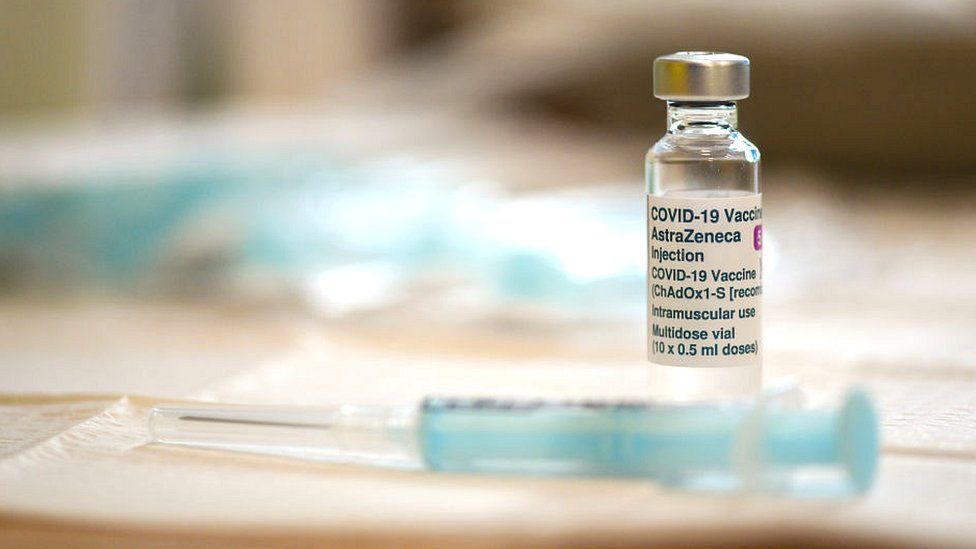
AstraZeneca Covid-19 vaccine and syringe are seen at the medical centre
Getty Images
After temporarily suspending the use of AstraZeneca altogether, the province of Ontario has altered its decision somewhat announcing it would once again use the vaccine, for those people who have already been given their first dose of AstraZeneca, as a follow-up. Other provinces which also had suspended the use of AstraZeneca have not yet decided whether to relax that position. 
 
In the United Kingdom, roughly 250 cases of the rare blood clots associated with the vaccine have occurred. Given the total number of vaccines used, the medical experts place the risk at about one in 100,000 in first doses. Only a handful of clots have arisen in the use of second doses; a rate of one in a million. Percentages that rate similarly in the Ontario experience. 
 
The key difference, according to Dr.Raine, being that the rare, potentially deadly clots are identified in the U.K. medical system, enabling health authorities to treat the clots as they occur. People under 40 who may be at higher risk of acquiring clots are advised to consider waiting for the Pfizer vaccine, while emphasizing that any vaccine is safer than acquiring COVID.

"What we're saying and what we've said all along is that mRNA vaccines are the preferred vaccine", said Dr.Shelley Deeks, co-chair of the National Advisory Council on Immunization in Canada, a volunteer advisory group comprised of health experts, tasked to produce recommendations on vaccine use to the federal government. Their position is that Canadians who can wait for an mRNA vaccine are advised to do so preferentially, bypassing the AstraZeneca vaccine, in an excess of caution.

In early January, Britain was identifying close to 60,000 cases on a daily basis. At the present time, under 3,000 are being presented, with hospital occupancy at its lowest since September. Contrasting with Canada's peaks in early January and in May at around 8,000 cases, with but half the population of the United Kingdom. Britain's 66 million residents recorded over 128,000 COVID deaths, in comparison to Canada's 25,000 deaths among its 36 million population.

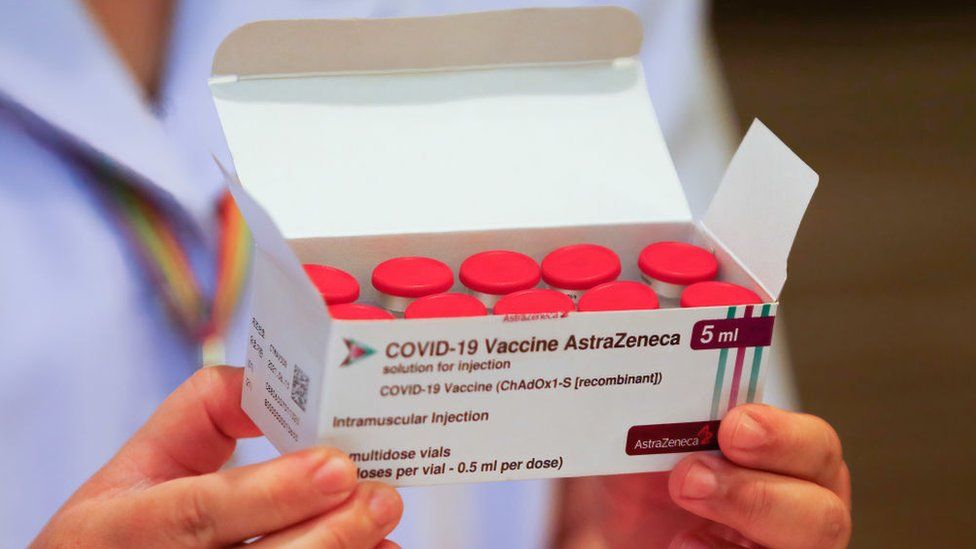
A health worker holds a box of the AstraZeneca vaccine
Sopa Images
Canada is now faced with a moral dilemma. Having advised the population to wait for a mRNA vaccine as represented by Pfizer or Moderna, the country has a stockpile of AstraZeneca vaccines whose expiry date is ticking steadily away; some will expire at the end of May, other stock in June. Canadian provinces must decide whether to proceed with their use during the overall drive to inoculate a large percentage of the population, or to donate them to another country that will intend to use them before they expire.

Countries in desperate need for vaccines would welcome a fresh infusion. "That answer probably needs to come now, especially if doses are expiring at the end of the month You really only have a two-week window to get those doses into people", explained Dr.Chagla.

Labels: , , , , ,

Sunday, February 14, 2021

Jumping the COVID Queue

"Frankly, I think what we saw yesterday of individuals flying to Yukon was probably one of the most despicable things that I've seen in a long time."
"It shows a complete lack of any sort of ethical or moral compass."
"As we've also seen, they have paid a pretty high price, losing a $10-million-a-year job, as they should."
Mike Farnworth, solicitor general, British Columbia  
 
"And people were like, 'Well, why would you be going to the airport'?" 
"And so that's when the CEMA [Civil Emergencies Measures Act] enforcement unit got called and said, 'Hey, who's this couple that may be flying back? You should check to see whether they really are here in the territory'." 
"All that is being sorted out by the team right now to try and figure out how to keep everybody safe [by ensuring that people who present for vaccinations are residents of or working in the Yukon]."  
"We just didn't anticipate that anyone would go to this length to effectively deceive the team to get vaccinated, and I think we all felt pretty offended at the whole thing."  
"But we will put in place additional procedures … I don't imagine that this is going to repeat itself."   
Yukon Community Services Minister John Streicker   
Rodney and Ekaterina Baker  There is outrage over a B.C. couple's elaborate scheme to jump the queue for a COVID-19 vaccine. They chartered flights, broke quarantines, and now face charges. CBC

The incident being discussed is that of two people from British Columbia taking off in a chartered plane to the Yukon Territory to an aboriginal village of 100 people, where a COVID-19 mobile clinic was administering vaccines -- to present themselves as though they were employees at a nearby motel and thus eligible for inoculation. It was only when they tried to hire someone to drive them out to Whitehorse where the chartered plane would take them back to British Columbia that their ruse was discovered.
 
First Nations villages were being inoculated as priority recipients of the COVID vaccine in recognition of their high vulnerability to contracting the virus. The British Columbia couple had tried to take advantage of that by arriving in Beaver Creek, claiming themselves to be visiting workers, and presenting at the White River First Nation mobile clinic. An outrageously selfish act that cost the couple dearly. Rodney Baker was CEO of Great Canadian Gaming, a company he had worked for over the last decade, that owns over 20 casinos in British Columbia, Ontario, Nova Scotia and New Brunswick.
 
The company publishes a circular that revealed their CEO earned $10.6 million in 2019. When his Yukon escapade became public knowledge, the company saw fit to fire him, and he's now out of a job. His wife Ekaterina is an actress, both obviously well connected, wealthy and unscrupulous. They concocted a plan to arrive at the remote First Nations community with limited access to health care, to benefit themselves with an underhanded opportunity to get inoculated with vaccines meant specifically for the White River First Nation band.
 
The Vancouver couple is without doubt, remorseful about their inspired plan to jump the vaccine queue. It has cost them dearly in reputation, employment and shame. They were issued tickets under the territory's Emergency Measures Act, facing fines of up to $1,000, a piffling cost to a couple who can luxuriate in a comfortable lifestyle with a $multi-million annual salary. Rodney, 55, and Ekaterina, 32, were charged with one count of failing to self-isolate for 14 days (on arrival in Yukon) and one count of failing to act in a manner consistent with their declarations.


Labels: , , ,

Tuesday, January 19, 2021

Canada, Lagging on Administering COVID Inoculation

"Successive Liberal governments including this one, have created an unfavourable environment for investment and commercial success for innovative pharmaceutical companies in Canada."
"They have made it very difficult for Canadian CEOs to attract investment to Canada despite many attempts by the industry to work with governments to do so."
"They have made no effort to work with the innovative industry to encourage a partnership that could deliver tremendous value to the health-care system and the economy and give Canadians early access to new medicines and vaccines."
Paul Lucas, retired, past president, CEO GlaxoSmithKline  
vaccine
 THE CANADIAN PRESS/Tara Walton
 
At the present time, Canada ranks tenth worldwide in vaccine doses administered per 100 population for COVID-19. This is the reality. The fantasy is as Prime Minister Justin Trudeau states whenever he feels cornered over Canada's poor response and logistics to the pandemic where COVID-19 has extracted a huge infection and death toll, and flattened the economy is breezily declaring "We are better on vaccines than just about every other country".

What he really means through this contorted reasoning is that Canada was too late in recognizing the SARS-CoV-2 virus wreaking havoc in the country in deciding to order vaccines against COVID. By the time his government took the necessary steps, Canada was away back in the lineup of countries taking the solid measures needed to protect their populations. What Canada did do, was sign an agreement with a Chinese pharmaceutical company, SinoVac, to partner in the development of a COVID vaccine.

This government, clearly delusional, given Beijing's reputation for volatile reaction and blunt decision-making, put its eggs in the wrong basket, and when the time came for SinoVac to send on samples of their vaccine for testing by the National Research Council as agreed, the shipment was stopped by Chinese authorities. Then, and only then, did the government in a bit of a panic order doses of vaccine from a variety of sources amounting in total to far more than Canada would ever need, vastly in excess of the population total.

The vaccines would eventually arrive, later than they should, had the government been adequately alert and resolute in its actions. So that, even as the provinces have created the required logistics for vaccine delivery and inoculations, the federal government is unable to access the number of vaccine doses required until possibly April at the earliest. Yes, there have been initial doses received, enough to vaccinate a small number of vulnerable health-compromised elderly in long-term care among whom 92 percent of the deaths in Canada have arisen.
People wait to receive a Pfizer COVID-19 vaccine in Soroka Hospital in Beersheba, Israel, Tuesday, Dec. 29. 'We are a small country with a relatively good infrastructure of medicine and a lot of good-willed people who are willing to help to get the country to be vaccinated in record time,' one expert said. (Tsafrir Abayov/The Associated Press)
 
Some health-care workers whose positions make them particularly exposed to contracting COVID have also been vaccinated, reflecting a relatively tight number of individuals. The 1.2 million doses of Pfizer and Moderna vaccines set to have been received by January's end has been set back by Pfizer's declaration that shipments to Canada from its Belgian manufacturer will be cut in half, because of a factory overhaul, partially suspending operations.

Six million doses were expected by the end of March and that number too will be impacted downward, meant to vaccinate about 3 million citizens, out of a total of 38 million, so representing less than ten percent of the Canadian population, while other countries have received significantly greater numbers of doses on a population-adjusted basis. Clearly the government erred in not building a supportive relationship with vaccine makers.

Presenting as a purchaser/regulator guarantees no speedy access, and Canada went to the end of the queue in its tardy response. In point of fact the global innovative pharmaceutical industry has no home in Canada. Without full patent protection and the profit gleaned from that protection, pharmaceutical companies are unable to plow a good part of their profits back into research, innovation and development of new drugs. Back in 1968 the government of Trudeau senior enacted legislation to diminish the impact of pharmaceutical patents.

Which meant an earlier elapse of patent protection, and the rise of generic drug manufacturers in Canada taking advantage of the investment, time and innovation to produce new drugs on the part of pharmaceutical companies unprotected by full-length patents, vulnerable to generics swooping down to produce drugs at lower cost using formulae they did not generate themselves. The pharmaceutical innovators warned that without full patent protection their earnings would be reduced and their strategies to research new drugs would be impaired.

Understandably, they saw fit to move their operations elsewhere where patent protection would remain intact. Off went the industry to the United Kingdom, The United States and the European Union where an innovative-positive environment remained and there they perform their function of research and innovative development of new patented drugs. And there, the U.S., U.K. and E.U. have better, quicker access to the vaccines desperately needed to control the global pandemic in their jurisdictions.

According to a senior public health official in Israel, one of the reasons they have outdistanced all other countries in their handling of the coronavirus is attributable in large part to their ability to acquire large quantities of doses thanks to amicable relations with the pharmaceutical industry. Canada, in contrast, sent the innovative industry packing, welcoming the emergence of a generic-company oligopoly. Which doesn't produce vaccines.

The Conservative-led governments of Prime Ministers Mulroney and Harper made an effort to support the innovative pharmaceutical industry, improving the patent landscape, but recovery has been only partial and competitive patent protection still does not exist. A new federal pricing regime through the Patented Medicine Price Review Board regulations will help further stifle innovation. 

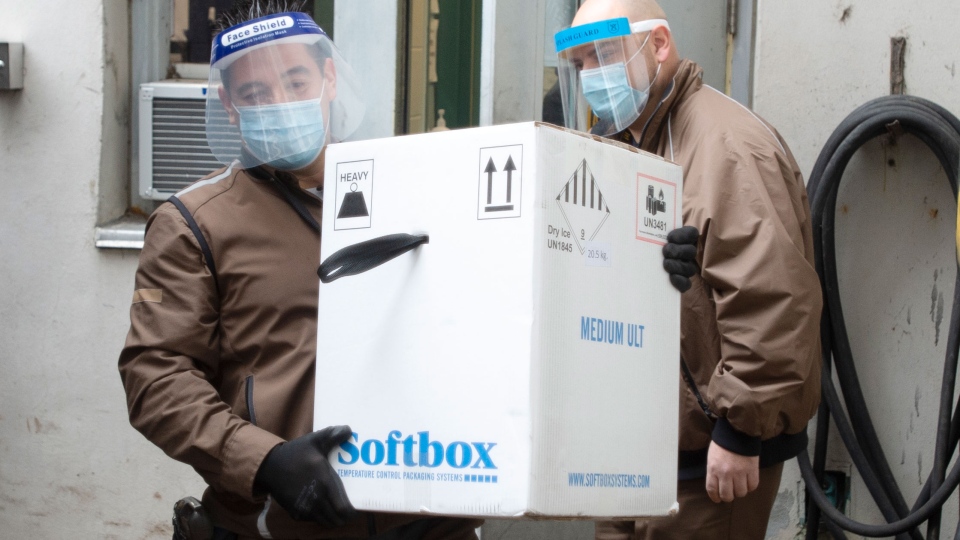
Pfizer-BioNTech COVID-19 vaccine delivered in Que.
The first doses of the Pfizer-BioNTech COVID-19 vaccine are delivered to the Maimonides CHSLD, Monday, December 14, 2020 in Montreal. The long-term care facility is slated to be one of the first in Canada to administer the vaccine. THE CANADIAN PRESS/Ryan Remiorz

Labels: , , , , ,

Tuesday, January 12, 2021

Sterling Governance

"Canada's vaccine rollout has been glacial. [The] federal government was late to procure vaccines, and although it overcompensated by mass-purchasing vaccines from virtually all providers, [Canada is] too far down most providers' lists to get supplies quickly. That is why [Canada is] scheduled to have only 2.6 million vaccines by the end of February, which represents enough jabs for seven percent of the country."
"In comparison, the UAE passed the seven percent figure on December 26, and Israel passed that mark on December 29."
"Provinces have also dropped the ball. Ontario, for example, made the mistake of pausing vaccinations over the Christmas break, as if the virus has any regard for our holiday schedule."
"As of Monday [Canada] was vaccinating approximately 24 times slower than Israel, 14 times slower than the U.S., 2.3 times slower than Denmark, 2.3 times slower than the U.K., 1.6 times slower than Iceland, 1.2 times slower than Italy, and 1.1 times slower than Slovenia. If the trend continues, almost all of Europe could pass Canada within the next seven to ten days."
David Clement, North American affairs manager, Consumer Choice Center
 
"Psychologically, yes, it was a beacon of hope."
"A lot of people are looking to us as a state, because after the first week we had, I believe, something like 90% of doses allocated to our state in arms — which was really unheard of elsewhere."
"We have a lot of independent pharmacies or smaller pharmacies that are in the more rural communities, so in order to get the vaccine out to some of those areas, we needed to follow something a little bit different."
Gretchen Garofoli, clinical associate professor of pharmacy, West Virginia University
https://i.ytimg.com/vi/VXdmLNmk7wA/maxresdefault.jpg
Gov. Jim Justice joined West Virginia health leaders and other officials for his latest daily press briefing regarding the State’s COVID-19 response.  Office of the Governor

For a success story, one has only to look next door, to one of the poorest and most rural states in the United States; West Virginia. The state chose to set aside participation in the U.S. federal Operation Warp Speed recommendations. And that decision is a major clue to its success in managing to vaccinate a large number of its most COVID-19-infectious residents. Which has led the Mountain State to wind up as a leader in rolling out the vaccine for COVID-19.
 
It has managed to deliver a vaccine to each individual currently in residence at a West Virginia long-term care home. Anyone who wanted to be inoculated in each of West Virginia's 214 long-term care homes has been vaccinated. So successful has West Virginia's rollout been that it will be prepared to begin the vaccination of teachers and school staff in the coming week. 

And it was managed through a more simple and direct expedient than the federal government's recommended rollout through the two main vaccine facilitators, CVS and Walgreen's. The state decided rather to decentralize as much as conceivably possible, partnering with hundreds of pharmacies -- independent and chain alike, in the mission to deliver and administer the vaccines throughout long-term care homes.

Those pharmacies equipped with enough cold storage and backup generators became part of the mobilizing team that resulted in a hub-and-spoke model tasking each pharmacy with making certain that local long-term care vaccinations took place expeditiously. It took those pharmacies a mere two weeks to render every long-term care resident their first dose of the vaccine, allowing for the state to realize its goal through its dynamic initiative, resulting in a rollout 50 percent exceeding its time-goal.

Canada couldn't do better than following the West Virginia example; uncomplicated and efficient. Pharmacies to be called on along with health-care providers in a bid to design a similar program to enable the exhaustion of the supply of vaccines quickly and safely. Anyone in the field of health-care qualified to give an injection should be brought on board, given authorization to administer the COVID-19 vaccine. This route would lead to a myriad of access points, in turn ensuring the job is done.

In West Virginia, Dr,Clay Marsh, the state's 'COVID Czar' responded: "Give us more vaccines", when he was asked what Washington could do to help. West Virginia looked at the situation, assessed it in the most practical manner possible and arrived at their plan of action; one not out-rivalled yet by any other enterprising state determined to shelter their populations from the ravages of the virus that has caused a global pandemic.

On Dec. 14, West Virginia Gov. Jim Justice was one of the first U.S. elected officials to get immunized against COVID-19. The state has since completed a first round of shots in all long-term care facilities as well as with front-line health workers.  State of West Virginia/Via AP


Labels: , ,

 
()() Follow @rheytah Tweet