Ruminations

Blog dedicated primarily to randomly selected news items; comments reflecting personal perceptions

Saturday, October 14, 2023

Israel on the Domestic Front -- At War

"People are hysterical. Companies are not able to provide supplies."
"Their Jewish workers have been called up to reserves or are afraid to come out."
"The Arab workers are afraid to come out."
Michael Rabani, 40, Israeli-Palestinian, owner of two Jerusalem grocery shops
At Jerusalem's Malha Mall, a popular shopping spot, the parking lot is almost empty. Makes sense, since almost every mall shop is closed. Not only at this mall, but across the country. And for a simple enough reason, life in Israel has been turned upside-down, inside-out. Where employees who would under normal circumstances be working in the shops are answering the call for reservists and others to report to the military. 
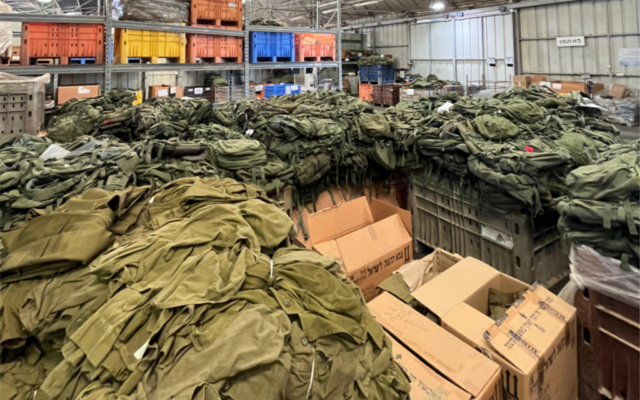
 
Uniforms and protective vests being prepared for distribution to reserve soldiers, October 10, 2023. (Israel Defense Forces)
 
The transformation from a country at peace to one at war after the deadly surprise attack that the Hamas terrorist group sprang on Israel's southern communities close to the Gaza border had an immediate effect. Five days ago the population was busy in its normal routine, people at offices unsuspecting they would soon be back in uniform -- an estimated 360,000 at final count in one of the largest mobilizations in Israel's brief history. Schools have been closed, and local governments are attempting, even as their workforces dwindle, to provide services.

"We're working under fire now, but we have no choice", explained Shaul Schneider, executive chairman of Ashdod Port, Israel's largest where over eight percent of its staff have left to report to the army. Leaving the port authority to call in retirees so cargo can move. When Hamas rockets screech overhead, at times ten daily, crane operators hope for the best. "Unfortunately", said Mr. Schneider, "Israel has experience in such situations".
 
Empty produce shelves at a Machsanei Hashuk supermarket in Jerusalem, on October 10, 2023. (Amy Spiro/Times of Israel)
 
Streets that would in normal circumstances be full of honking traffic, are now still and quiet prevails. Jaffa Street in Jerusalem, popular as a shopping street, appears like a ghost town, lined with flashing police cars. Palestinian labourers who ordinarily work at construction sites have been prohibited entry from the West Bank, so construction sites are shuttered.    
 
The shopping that is taking place is that of families anxious to stock up on essentials. The military Home Front Command instructed Israelis to equip their bomb shelters and basements with several days of supplies. Residents of apartment buildings have been instructed to remove bicycles and personal items from safe-rooms and instead stock them with emergency provisions.
 
Goods donated by supermarket chain Shufersal await distribution, in a photo released on October 10, 2023. (Courtesy)

Israel's largest supermarket chain, Shufersal, as shelves began to empty took the step of limiting sales of basics to two packs of water, two cartons of eggs, two loaves of bread and three containers of milk for the time being. Palestinians living in Israel have been making themselves as invisible as possible as preparations for war proceed. They can feel, they say, the fury in Israel, directed at Hamas.
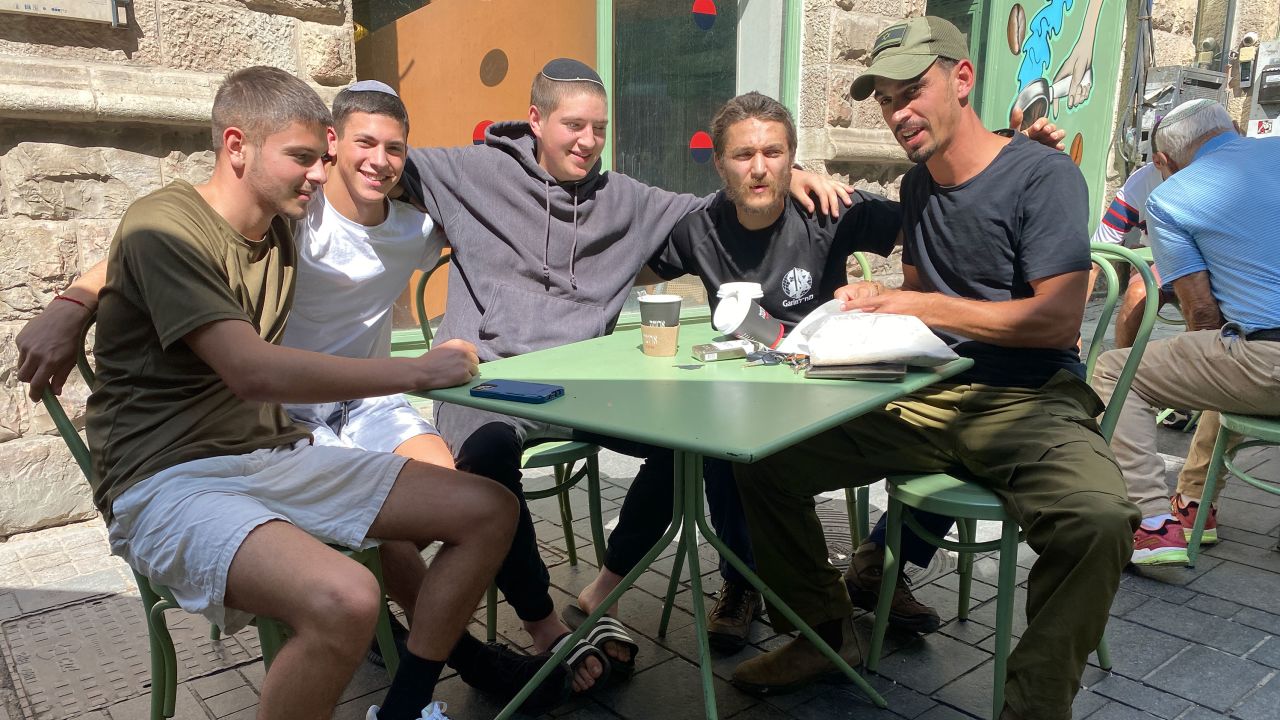
 
Tzvi Shore, right, with a group of American and British teenagers who came to Israel to join the army.
Group of American and British teenagers who came to Israel to join the army. Ivana Kottasova/CNN

Twenty kilometres' distance from reservists gathering outside Julis military base near Ashkelon, air force planes were bombing the Gaza enclave, likely to become the target anew of an imminent ground war. "It's a big change, but for us very natural. When you live in Israel, you always know that you'll be back in the army", explained Daniel Blum, 30, a counsellor for troubled teens.
 
There are circulating reports the military is struggling to be able to equip the teeming number of reservists reporting for duty. Supplies are being managed, according to army officials; even so civilians organize equipment and food drives across the country. Restaurants have taken to cooking for troops and for civilians displaced by the fighting. A top Tel Aviv eatery, Brothers has been sending 20,000 meals to the south. 
"One of the reasons we're in our current situation is because Israeli society is not connected [referring to the recent protests against the government's judicial reforms plan]."
"If we don't come to our senses and join forces, the situation will become even worse."
Brothers restaurant co-owner Yotam Doktor
https://static01.nyt.com/images/2023/10/13/multimedia/13db-israel-startups-01-zhbt/13db-israel-startups-01-zhbt-jumbo.jpg?quality=75&auto=webp
Israeli reservists patrol streets in Sderot   New York Times
                        

Labels: , , , , , ,

Thursday, February 28, 2019

Construction Hazard

"Construction and opioids go really well together."
"At the beginning when I was using hydromorphone, I was better at my job. I was more consistent.  enjoyed working more because I felt good. Nothing mattered. Even if I was doing something I didn't want to do, if I was on opioids, it made no difference, you know?"
"I started to attribute me being good at my job with me being on drugs."
"I'd lost all my jobs. I'd lost my girlfriend. I could hardly get out of bed. I was ready to die. I felt like I had lost everything and lost my purpose and nothing mattered anymore. And I was broke, that didn't help. I just said yes. Against my instincts, I said yes, I'd go to treatment even though everything in my body said I couldn't do it."
"Start saying yes to people who can help you. I was, 'I got myself into t his on my own. I can get myself out.' But that's just so wrong and so misguided. I just decided I didn't want to do this alone any more. It's not a weakness to ask for help."
Logan Carroll, construction worker, Ottawa
‘I started to attribute me being good at my job with me being on drugs,” says Logan Carroll.  Jean Levac / Postmedia News

"It's just the nature of the jobs we do. Heavy-duty work that takes its toll on the body -- lifting, climbing -- heavy work that's prone to injury."
"Look at construction sites and see some of this happening. Construction work opportunities are usually short. Typically, our folks go to a job site, try to get as many hours as they can, then go on to the next job."
"Unfortunately, when they do get hurt on the job, they go to their family physician or an emergency clinic, grab something for pain, then go back to work."
"It's staggering when you look at the small provinces and see how quickly the numbers [of opioid deaths] are catching up to the larger provinces."
"What we noticed is we had one particular pharmacy where we had spent $1.8 million in one year just for one construction union in prescription fees. We said, 'This doesn't seem right. Something is wrong.' When we tracked it, we found it that it was for methadone."
"It's deemed a macho industry where guys don't talk about their pain and don't say that they're ailing. That could be seen as a weakness. I think that's really unfortunate."
Arlene Dunn, deputy director, Building Trades Union, Canada

"A lot of people are using opioids for physical pain, but a lot of people are also using them for psychological pain."
"Most Canadian workplaces that have substance abuse policies favour disciplinary measures rather than supportive measures. Instead of paying for treatment, they're actually disciplining them."
"We need to create an environment that fosters them [workers addicted to drugs] to be able to come out and say, 'I need help'."
"[Employers] should be able to say, 'Here is a four-week leave and we'll support you in that.' They shouldn't be forced to come into work. We don't do that with cancer. Why are we stigmatizing people struggling with mental illness?"
"The war on drugs is not working. We see that year after year. Problematic substance use is like any other disease and should be treated as a health concern and not treated as a criminal justice concern."
"We're not saying decriminalization is a silver bullet -- because there's a bunch of other recommendations we made. The other big one is invest in mental health services, increasing access to services so that people can see a psychologist when they need to. We know that untreated mental illness over time gets worse and worse."
Fardous Hosseiny, national director, research and public policy, Canadian Mental Health Association
Opioid overdoses still plaguing the trades
Journal of Commerce, ConstructConnect

The construction and extraction industry had the highest suicide rate of any profession surveyed, according to a 2015 study by the Centers for Disease Control. The study revealed 52.1 deaths per 100,000, a rate seen to be 200 percent steeper than the national average in the United States. Therapies like meditation have evidently proven effective at pain control, but it represents a type of intensive work and scheduling, taking infinitely more time and patience than the expedient of using a pill to dull pain.

Few workplace occupations, it turns out, appear to be as vulnerable to addictions to opioids -- including a prevalence of overdose deaths -- than the construction industry, including general labourers. It was found last fall that 55 percent of the overdose deaths in the province of British Columbia were of workers in the construction and transportation industry, according to a study by the B.C. Coroners Service.

Similarly a study undertaken in 2018 by the Massachusetts Department of Public Health concluded that construction workers there were six times likelier to die of opioid overdose than any other occupation, a trend seen throughout North America. Canada is staggering under a death toll resulting from its opioid epidemic, with Health Canada reporting over 9,000 Canadians dying from overdose between January 2016 and June 2018. British Columbia alone saw 1,489 deaths from illicit opioid overdose last year, the equivalent of four deaths daily.

The problem has become even deadlier with the emergence of fentanyl, the synthetic opioid attributed with a powerful strength one hundred times greater than heroin. Ms. Dunn of the Building Trades Union recognized the emerging problem with construction workers and opioid addiction fifteen years ago when high fees for methadone doled out daily at pharmacies as a prescribed regimen resulted in sky-high dispensing fees for her union.

Opioids like oxycodone proved a quick fix when injured trades workers and labourers visited their family doctors for relief from pain related to industry work. They want to return to work as quickly as possible to meet construction deadlines, working for long hours while in pain.

Labels: , , ,

Monday, September 03, 2018

The World's a Sandbox

"We're losing eight acres a year of pristine shore, some of the most beautiful in the world. It's because of sand mining."
"This is a pristine beach that is slowly being taken away by this sand mine."
"I think it should have been shut down a long time ago. They are raping the coastline for this sand, a public resource that they don’t pay a cent for."
"The natural state of the shoreline now, if there was no sand mining, would be growing. We find that sand mining is really the sole source of the loss of coarse sand."
Ed Thornton, 77, coastal engineer, former academic, California
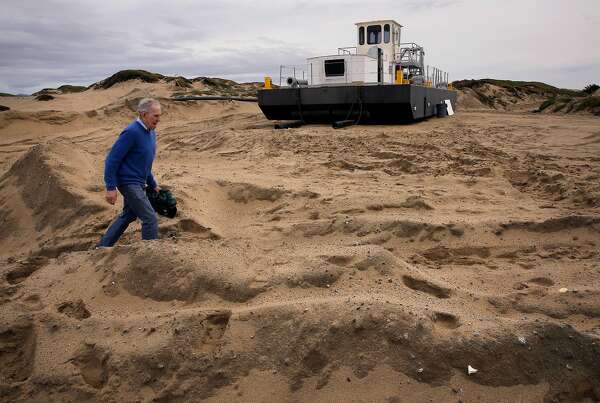
Edward Thornton, a coastal engineer with the Naval Post Graduate School walks past a dredge owned by Cemex, which removes more than 200,000 acre feet of beach sand a year along the Monterey Bay coastline in Marina, Ca., as seen on Wednesday Feb. 8, 2017, San Francisco Chronicle

Extraction of natural resources is big business all over the globe. Do most of us ever think twice about sand, that sand is one of those natural mineral resources that is mined and that the sand that we automatically link with beaches, summer sun, swimming and leisure, is an integral part of so much of what we take for granted in our daily lives? Sand, a fundamental resource in construction, in glass-making, in so many everyday products in constant use that we would never connect with sand, a constituent of porcelain as well as glass-making. A form of sand called hydrated silica is even used in toothpaste.

Silicone is a synthetic compound derived from sand; it appears in shampoo, in laundry detergent, is used as reinforcement for the soles of boots. Even our computer screens and the chips running them, the fibre-optic cables, all are made from sand, including the paper we use in our offices. Sand is so vital to the manufacture of so many ordinary items of daily use, little wonder it is mined so assiduously, an ingredient in all manner of construction, formed by the timeless erosion of rock formations, washed by rain into rivers making their way to the sea. The process only takes 200 million years.

The dredging of sand off the California coast in so many areas has the effect of altering the coastline substantially; little wonder that protestors like Dr. Thornton are upset with the dredge operations; in his instance a global construction company with its base in Mexico; their machinery dredging up some 2,700,000 cubic meters of sand every year from the tide-filled lagoon near Marina, California. It's a form of public theft, costing the company, Cemex, nothing, but robbing the people of California of a scenic and beautiful beach.

What is happening in California occurs elsewhere, all over the world. In Jamaica thieves stole 1,300 feet of white sand from one of the island's beaches in 2008. The sale of sand is big business, since the product is in high demand everywhere, so much so that sand is being looted in Morocco, Algeria, Russia and countless other places worldwide. At lest two dozen Indonesian islands have been completely obliterated since 2005, the sand hauled off boatload by boatload, most of it destined for Singapore which artificially adds to its territory by dumping the sand to reclaim land from the sea.

And nor is Singapore alone in this enterprise; Japan has been extending its Honshu coastline by the very same method for decades. To satisfy Singapore's voracious appetite for sand, its neighbours have seen their beaches and riverbeds denuded -- leaving Indonesia, Malaysia, Vietnam and Cambodia to restrict or ban exports of sand to Singapore; their loss is Singapore's gain. Construction in London and southern England uses aggregate dredged from under the U.K.'s offshore waters. Japan pulls up around 40 million cubic meters each year from the ocean floor.

Researchers with the World Wildlife Fund feel sand mining on the Mekong River is responsible for the 14,000-square-mile Mekong Delta where 20 million people are dependent on the area for growing food and rice, is gradually disappearing. Sediment carried down from Central Asia mountains has replenished the delta for centuries but of late in each of the countries along its course, miners pull huge quantities of sand from the riverbed for the construction of growing cities in Southeast Asia.

Governments worldwide have attempted to regulate and restrict sand mining, their efforts reflecting various levels of commitment, but resulting in a boom in sand black-marketing. In Israel one of its most notorious gangsters got his start by stealing sand from public beaches. Illegal sand miners in Kenya are reported to coax children into dropping out of school to work for them. The black market industry in sand generates violence, where people have been shot, stabbed, beaten, tortured and imprisoned linked to sand mining. Some have lost their lives for their attempts to put a halt to the environmental damage, others in conflicts resulting over land control.

"Sand mafias" proliferate in India, where the illicit sand trade is estimated to be worth $2.3 billion annually and where hundreds of people have lost their lives, among them government officials, police officers, and ordinary citizens who simply were in the wrong place at the right time. It is an intractable situation; as populations increase and cities grow, homes are built, buildings to house offices, factories to produce goods, shopping malls for public consumption of goods, and roadways connecting them all are constructed.

 And all of these infrastructures of a civil society in economic development require sand.

Labels: , , , ,

Thursday, February 15, 2018

Building Green

"It smells like comfort."
"It smells a little like lime. We're using the stock. You cannot smell cannabis -- it has nothing to do with smoking weed or cannabis plants."
"It's an industrial agriculture crop."
Sergiy Kovalenkov, 33, Ukrainian civil engineer
A self-built hempcrete house, combining timber cladding and lime render finishes.   The Last Straw

Industrial hemp contains a minuscule 0.3 percent of tetrahydrocannabinol (THC), the substance linked to the effect of smoking marijuana to get high. In comparison, cannabis contains up to 20 percent of THC. Cannabis plants produce hemp which since ancient times has been recognized as a useful material for a multitude of purposes, for not only do the fibers produce strong rope, and clothing, but used in combination with lime it makes for an enduring building material.

In sixth-century Gaul (now France), a bridge was constructed with hemp mortar, a sustainable building material felt to be more reliably durable than concrete or steel. Hemp's woody fibers combined with lime produce a natural, light concrete with thermal mass that is insulating to a high degree. Hemp mortar does not attract pests, nor mould. It has sound acoustics, results in low humidity and no pesticide is required to grow the plant.

It takes four months for the plant to mature from seed to harvest time. It is not yet considered a useful crop for building purposes in North America, but that is set to change as botanists and builders begin increasingly to evince interest in its qualities. In the United States less than 4,000 hectares is devoted to hemp. That crop is deemed sufficient to build five thousand single-family homes with.
Diagram illustrating how hempcrete is created - What is hempcrete
Green Building Materials, Canada

In Canada double the arable land as opposed to the U.S. is devoted to producing hemp. Spain, Austria, Russia and Australia are now seeing an increased interest in growing hemp, among the 30 nations that now produce it. In China's Yunnan province no fewer than ten thousand farmers devote their agricultural holdings to growing hemp. In 1980s Europe cultivation of hemp was rediscovered.

The largest hemp producer in the European Union is France. The growing appreciation of its properties as a sustainable-yield construction crop has resulted in hundreds of buildings across Europe using hemp as insulation between walls and roofs, and under floors in wood-framed buildings. Cannabis sativa, ubiquitously grown, flourishes in a variety of climates where it can grow as tall as five meters and close to three centimeters in diameter.

Rope, sails and paper are sourced from the tough fibre of the plant's tough layer. The inner layer, the pith, is surrounded by the woody core, called the hurd which produces the tough fiber.  To address an absence of international standards related to building with hemp, ASTM International, a technical standards organization, set out in 2017 to form a committee that would perform that function.


The Hemp Industries Association estimated the retail market for hempcrete in 2014 at $573-million in the United States. Roughly fifty hemp homes have been built in the United States and in Israel its first hemp house was built on the slopes of Mount Carmel. Israel, as it happens, is in the forefront of studying and experimental research of cannabis. Hemp ventures have risen in Nepal and Ukraine.

It is considered by manufacturers to be ideal for low-rise construction, attractively stucco-like in appearance and toxin-free. Those who promote it emphasize its reduced carbon footprint with its lower requirement of heat in its creation than standard limestone concrete. Typically planted in March and May in northern climes or between September and November below the Equator, plants are cut by hand then left to dry for several days before being bundled and placed in vats of water, swelling the stalks.

The block-like bricks produced by blending dried fibers with lime have a variety of uses, the product known as hempcrete. What its promoters are concerned with at this juncture is the normalization of recognizing the plant for its utilitarian purposes and legalizing it as an agricultural-building crop, separate and apart from its other, more acknowledged and familiar purposes as a narcotic agent. In the U.S. that meant taking it out of the Controlled Substances Act.

In Britain, HAB Housing built five homes last year with hempcrete, while Just-BioFiber in Canada completed a house with an interlocking internal framed hemp-block on Vancouver Island. In New Zealand 500 bales of Dutch hemp constructed a property that sold for $650,000. A four-meter hempcrete wall can produce 15-degree Celsius year-round temperatures absent heating or cooling systems.

"The overall environmental footprint is dramatically lower than traditional construction", noted Joy Beckerman, a hemp law specialist and vice-president of the Hemp Industries Association.

New build hempcrete housing in Swindon, UK (built by Haboakus)  The Last Straw

Labels: , ,

 
()() Follow @rheytah Tweet