Ruminations

Blog dedicated primarily to randomly selected news items; comments reflecting personal perceptions

Monday, September 03, 2018

The World's a Sandbox

"We're losing eight acres a year of pristine shore, some of the most beautiful in the world. It's because of sand mining."
"This is a pristine beach that is slowly being taken away by this sand mine."
"I think it should have been shut down a long time ago. They are raping the coastline for this sand, a public resource that they don’t pay a cent for."
"The natural state of the shoreline now, if there was no sand mining, would be growing. We find that sand mining is really the sole source of the loss of coarse sand."
Ed Thornton, 77, coastal engineer, former academic, California
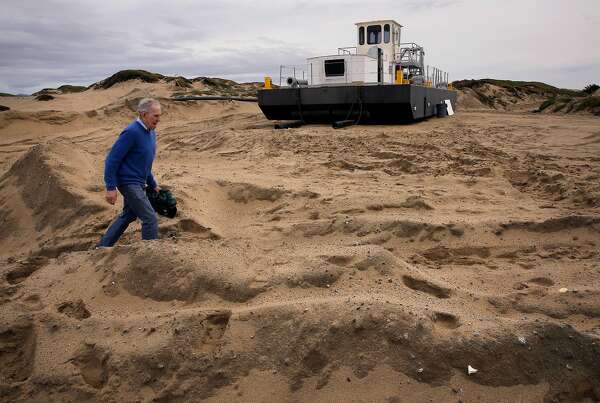
Edward Thornton, a coastal engineer with the Naval Post Graduate School walks past a dredge owned by Cemex, which removes more than 200,000 acre feet of beach sand a year along the Monterey Bay coastline in Marina, Ca., as seen on Wednesday Feb. 8, 2017, San Francisco Chronicle

Extraction of natural resources is big business all over the globe. Do most of us ever think twice about sand, that sand is one of those natural mineral resources that is mined and that the sand that we automatically link with beaches, summer sun, swimming and leisure, is an integral part of so much of what we take for granted in our daily lives? Sand, a fundamental resource in construction, in glass-making, in so many everyday products in constant use that we would never connect with sand, a constituent of porcelain as well as glass-making. A form of sand called hydrated silica is even used in toothpaste.

Silicone is a synthetic compound derived from sand; it appears in shampoo, in laundry detergent, is used as reinforcement for the soles of boots. Even our computer screens and the chips running them, the fibre-optic cables, all are made from sand, including the paper we use in our offices. Sand is so vital to the manufacture of so many ordinary items of daily use, little wonder it is mined so assiduously, an ingredient in all manner of construction, formed by the timeless erosion of rock formations, washed by rain into rivers making their way to the sea. The process only takes 200 million years.

The dredging of sand off the California coast in so many areas has the effect of altering the coastline substantially; little wonder that protestors like Dr. Thornton are upset with the dredge operations; in his instance a global construction company with its base in Mexico; their machinery dredging up some 2,700,000 cubic meters of sand every year from the tide-filled lagoon near Marina, California. It's a form of public theft, costing the company, Cemex, nothing, but robbing the people of California of a scenic and beautiful beach.
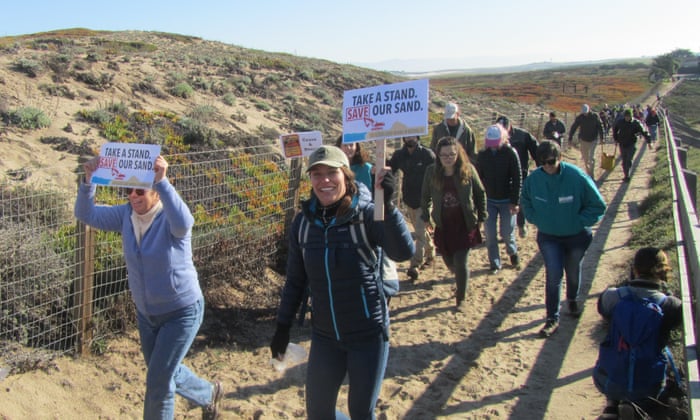
What is happening in California occurs elsewhere, all over the world. In Jamaica thieves stole 1,300 feet of white sand from one of the island's beaches in 2008. The sale of sand is big business, since the product is in high demand everywhere, so much so that sand is being looted in Morocco, Algeria, Russia and countless other places worldwide. At lest two dozen Indonesian islands have been completely obliterated since 2005, the sand hauled off boatload by boatload, most of it destined for Singapore which artificially adds to its territory by dumping the sand to reclaim land from the sea.

And nor is Singapore alone in this enterprise; Japan has been extending its Honshu coastline by the very same method for decades. To satisfy Singapore's voracious appetite for sand, its neighbours have seen their beaches and riverbeds denuded -- leaving Indonesia, Malaysia, Vietnam and Cambodia to restrict or ban exports of sand to Singapore; their loss is Singapore's gain. Construction in London and southern England uses aggregate dredged from under the U.K.'s offshore waters. Japan pulls up around 40 million cubic meters each year from the ocean floor.

Researchers with the World Wildlife Fund feel sand mining on the Mekong River is responsible for the 14,000-square-mile Mekong Delta where 20 million people are dependent on the area for growing food and rice, is gradually disappearing. Sediment carried down from Central Asia mountains has replenished the delta for centuries but of late in each of the countries along its course, miners pull huge quantities of sand from the riverbed for the construction of growing cities in Southeast Asia.
Governments worldwide have attempted to regulate and restrict sand mining, their efforts reflecting various levels of commitment, but resulting in a boom in sand black-marketing. In Israel one of its most notorious gangsters got his start by stealing sand from public beaches. Illegal sand miners in Kenya are reported to coax children into dropping out of school to work for them. The black market industry in sand generates violence, where people have been shot, stabbed, beaten, tortured and imprisoned linked to sand mining. Some have lost their lives for their attempts to put a halt to the environmental damage, others in conflicts resulting over land control.

"Sand mafias" proliferate in India, where the illicit sand trade is estimated to be worth $2.3 billion annually and where hundreds of people have lost their lives, among them government officials, police officers, and ordinary citizens who simply were in the wrong place at the right time. It is an intractable situation; as populations increase and cities grow, homes are built, buildings to house offices, factories to produce goods, shopping malls for public consumption of goods, and roadways connecting them all are constructed.

 And all of these infrastructures of a civil society in economic development require sand.
Labels: , , , ,

Friday, April 07, 2017

Cornering the World Market

"China did not corner the world rare earths market by accident. 'The Middle East has oil. China has rare earth', said Chinese leader Deng Xiaoping in 1992, in recognition fhat rare earths are commodities strategic in both military and economic planning. At the Chinese government's direction, domestic state-owned firms, unrestrained by environmental niceties, then set about churning the Chinese landscape, while Chinese multinationals such as CNOOC, money being no object, scoured the world buying out rare earths producers abroad whenever foreign governments let them. In one attempt during the George Bush administration, CNOOC tried but failed to obtain Molycorp's mine."
Lawrence Solomon, policy director, Probe International, Toronto
Bucket grabs rare earth, Jiangsu Province
Not Rare, but PreciousThough rare-earth minerals, comprised of 17 elements on the periodic table are called rare, they are actually common. But they are scattered in small amounts within soil such as that pictured here, at a port in Jiangsu Province, China. That makes mining rare-earth minerals costly and environmentally taxing.

Sounds exotic, doesn't it, the descriptive of 'rare earth'. What it describes is minerals that exist in minuscule quantities in soil. They may be dispersed widely around the world, but finding them in their excruciatingly small quantities is what makes them 'rare'. They are, however, of immense importance in today's world of technological advances.

Representing minerals with strange names like scandium, yttrium, lanthanum and many others reflecting 17 little-known chemical elements, but vital to manufacturers of cellphones, computers, TVs and a range of electronic products such as laser-guided missiles, fighter jet catapults launched from aircraft carriers, including the F-35 fighter jet beloved of the Pentagon.
Worker displaying samples of rubidium, iron, and boron in Jiangxi Province
A worker displays samples of rubidium, iron, and boron at a workshop in Ganzhou City. China used to export almost all its rare-earth metals, but increasingly needs more of it for its own industrial uses. That is one of the reasons the Chinese government says it is restricting exports now.

They are, in other words, indispensable to the manufacture of products of everyday use and those meant for the military.

The United States had its home-grown supplier of rare earth minerals. This was Molycorp, which established its search for these products in the Mojave Desert, until its 2015 bankruptcy. Remember the recession of 2008 when the U.S. government was quick to bail out U.S. auto manufacturers? It made no such move on behalf of its sole producer of rare earth elements.

The backstory is that the Obama administration appealed to the World Trade Organization because Apple and similar other companies complained  about the China-dominated market jacking up prices. China responded to the WTO appeal by increasing its export of rare earths and in the process reducing their price to an extent that Molycorp could not match and still remain in business, leading to its bankruptcy.

Which led to the situation that high-tech manufacturers worldwide have few options but to buy from China. There are no competitors. So the United States, for one, with its powerful manufacturing base of advanced technical products is utterly dependent on China's rare earth exports; this means by extension that America's military markets depend on China to enable their manufacturing of rare earth-dependent products.

The new American administration under President Donald Trump harrumphs about jobs being lost in the United States, and of course China is a signal source of those lost manufacturing jobs. Molycorp employed 500 people, not a huge number of employees, but significant for what they produced and the assurance they granted to American manufacturers that rare earth products were to be reliably domestically sourced.

Rare-earth mineral display in Baotou, Inner Mongolia
When combined with magnetic metals such as iron, rare-earth minerals create super-strong permanent magnets that are impossible to move with one's bare hands. A little rare-earth metal goes a long way. The strength of these rare-earth-enhanced magnets have helped to miniaturize electronics and to reduce weight in electric cars. Here, samples of rare-earth compounds are displayed in a showroom at Inner Mongolia Baotou Steel Rare-Earth Hi-Tech Company, China's largest rare-earths producer.

As an interesting example, in a territorial dispute with Japan resulting from the Japanese navy detaining a Chinese fishing boat for playing their trade in Japanese waters, China stopped sales of rare earths to Japan. That incident caused prices to soar 4,000 percent worldwide, and of course left Japan temporarily without that critical manufacturing resource.

Similarly in 1994 China acquired U.S.-based Magnequench, established by General Motors to highlight its invention of the rare-earth-based neodymium-iron-boron magnet. The U.S. stipulated as a condition of the sale of such a strategic business, that the business remain operational for five years within the United States. As soon as that period elapsed, the U.S. operation was shuttered and China relocated the processes and the intellectual property to monopolize the market, to China.

Perhaps because Donald J. Trump comes from the cutthroat world of business enterprise, he is a step ahead of the Chinese penchant to highjack from willing enough dupes critical infrastructure and manufacturing along with the research enabling it, in a more cautious way than his predecessors. When Presidents Trump and Xi met this week in Washington there was doubtless much to discuss beyond the wild card of North Korea's maniacal Kim Jong-un.
Man pours rare-earth-mineral lanthanum in Inner Mongolia
The U.S. Department of Energy says that deployment of clean energy technology could be slowed in the coming years by supply challenges for at least five rare-earth metals. Here, a worker pours the rare-earth metal lanthanum, which is used in camera lenses and other types of glass, into a mold at a smelting workshop in Inner Mongolia.

Labels: , , , ,

Tuesday, March 08, 2016

Will The Innocent Party Please Stand?

"I want them to be made accountable for what was done to me. What they did was wrong."
"[Police in Luoyang interrogated me] based on a list of questions provided by Silvercorp. During the actual conduct [sic] of the interrogation, PSB [Public Security Bureau] offices were in direct communication with Silvercorp, including receiving texts from Silvercorp to further focus the interrogation."
Kun Huang, Chinese-Canadian commercial researcher

"[PSB police officers acted] as Silvercorp's agent to falsely imprison him [Kun Huang] and to knowingly bring baseless criminal charges against him in China."
Partial text of a court summary of Kun Huang's allegations
Jon Carnes (right) and his researcher Kun Huang, who ended up in Chinese prison for investigating Silvercorp. Dina Goldstein for Report on Business magazine

"We spent time devising a cover plan. We created this old dude who clearly did not look like me." [Thus was born “Alfred Little,” a former Deloitte accountant with 35 years of investing experience. Carnes also created a fake research organization, the International Financial Research & Analysis Group (IFRA). In his “undercover strategy,” IFRA would prepare due diligence reports, which would then be “leaked” to Alfred Little, who posted them on his website. In reality, everything was generated by Carnes and his team.]
"The guys in China would be trying to figure out who was this old guy."
Jon Carnes, founder of Eos Holdings
When Kun Huang graduated from the University of British Columbia with his commerce degree he was offered a position as a stock market researcher by Jon Carnes the CEO of a hedge fund called Eos Holdings, in 2006. This was an opportunity to find employment straight out of university and it was an opportunity that Kun Huang took advantage of, happy to be hired. Four years later he moved to China, spending his time there in the study of companies Eos might be interested in investing in.

The focus of the company was at that time short-selling, a practice that exists on the wrong side of ethical business dealing where investors lock in shares of publicly traded companies thought to be overvalued or on the cusp of failure. Under these circumstances share price drops, and investors -- short sellers, in this scenario -- stand to make a profit. Mr. Carnes was the recipient of an anonymous tip on Silvercorp Metals Inc. in 2011.

The British Columbia mining corporation is listed on the Toronto and New York stock exchanges, and it has a majority-owned subsidiary with mineral holdings and mines in China. Mr. Carnes tasked his employee with investigating the Silvercorp subsidiary. And based on what then occurred, local authorities reached the conclusion after an investigation that Kun Huang's activities were suspect, teetering on the edge of criminal.

What this man had done was place infrared cameras in trees close to the Silvercorp subsidiary's mining operations. The purpose was to make a record of the frequency of ore-carrying trucks driving into and out of the site as a way to measure activity, and to determine whether the results matched claims of the company and its subsidiary. Ore samples were also collected, that had fallen off the trucks carrying ore, and those samples were tested for their mineral content.

Sounds like industrial espionage, doesn't it? And here's the irony, it comes fairly matched to what Chinese state-owned and private companies engage in on a regular basis; attempt to procure for themselves by underhanded means industrial and military formulae and other data for the purpose of speeding things up so they can themselves reproduce what foreign successful companies produce, without going to the time and trouble of producing research of their own.

Mr. Carnes felt that to be successful he would require more than the information his employee had gathered relating to Silvercorp's value. He had a report published in an Internet blog, attributing it to fictional sources that included negative analyses emanating from a fake research group. Then Eos moved to take a short position in Silvercorp stock. The questionable report published in September 2011 caused Silvercorp's share price to fall precipitously, taking ten percent off the company's market capitalization, amounting to roughly $275-million, a significant loss.

Out of this catastrophe for the company Eos Holdings realized a substantial $2.4-million profit, leaving Kun Huang with a cut of $500,000. While Silvercorp states it was the victim of a "short and distort" fraud, Kun Huang claims Silvercorp had contacted China's Public Security Bureau to motivate police to take action against him. He was arrested at Beijing international airport planning to leave mainland China for Hong Kong.

He ended up spending close to two years at hard labour after a panel of Chinese judges conducted a brief in-camera trial. Once his sentence was served, in 2014, he was deported to Canada, barred from re-entry to China, where he was born. His claim against Silvercorp Metals was that they were responsible for his arrest and imprisonment on the claim he was responsible for "impairing" its "business credibility and product reputation", a serious criminal offence in China.

Kun Huang will have his day in court, though Silvercorp denies his accusations, and attempted several times to put a halt to the lawsuit. Last month a British Columbia Supreme Court justice denied the motion brought by the company to strike a number of allegations from the statement of claim, and an appeal court upheld a ruling allowing the lawsuit to proceed in the province, even as Silvercorp felt the false imprisonment claim should be heard in China.

The underhanded, deliberate manipulation of facts that Kun Huang and his company engaged in for the very purpose of falsely leaving an erroneous impression of failure that had the effect of diminishing Silvercorp's reputation for the purpose of profiting themselves appears, along with the espionage and the false analyses circulated pseudononymously would actually seem to validate Silvercorp's claims and tear Kun Huang's to shreds.

It should be interesting to see what the B.C. justice system will rule, however. It would seem that there is legitimacy in the claims that Silvercorp Metals has been misrepresenting the tonnage and grade of its ore extraction. The story is a byzantine intrigue of false representation for profit on both ends.

Labels: , ,

Thursday, December 11, 2014

Telling The Truth, The Whole Truth and Nothing But the Truth

"We can see right next door to where shale gas development is going on that we do have circulation of surface (waters) down to five kilometres depth and back to surface again."
"Not only do we see transmission of water from the crustal levels, but we also see transmission of thermogenic gas from the crust up to the surface in these spring systems."
Steve Grasby, scientist, Geological Survey of Canada
Thermal wells point to ‘worst case’ leaks from the deep
Spring water from deep underground carries plenty of heat and chemicals that feed orange microbial mats growing on the rocks at Larsen Spring, one of nine thermal springs in Northern B.C. and the southern Yukon.   Photograph by: Steve Grasby/GSC , Postmedia News
"If you have a leaking well and it doesn't manifest at surface, you don't know where it is leaking to. It could be leaking into some other reservoir that you don't want it to leak into for economic reasons."
"Many old wells weren't abandoned in any way that could handle thermal stress, and now those areas can't be steamed and therefore the bitumen can't be recovered."
Theresa Watson, engineer, former board member of regulatory agency overseeing Alberta's energy industry, Calgary

Hydraulic fracturing is commonplace now in the energy extraction industry throughout North America. It is a mechanical-engineering method whereby hard-to-get-at natural fossil fuels deep within the Earth's crust can be extracted when water and chemicals are pumped under high pressure deep into the earth via a drilling pipe to fracture the shale holding gas or oil to effect its release.

Because it's been going on for quite awhile, and no reports were thought to have been received that there were any deleterious effects, it is considered a safe extraction process that would not imperil vital ground water resources. That's the story for public consumption most often encountered, reassurances from large corporate energy sources.

And then reports appear to now be coming in that raise questions about the safety of fracking. When 1,850 metres deep into the earth, fracking fluids under immense pressure were propelled unintentionally into a neighbouring well and 75,000 litres of fracking fluids were sent up the well and ultimately onto a nearby field, the oil and chemicals polluting it a different story emerged. That was in January of 2012.

Comes news that over forty such episodes, named "frack hits" were reported in Alberta and British Columbia since 2009. Nothing to be concerned about, supposedly, as regulators enacted new rules meant to avoid such 'interactions' between wells. A problem exists in that in Alberta alone there are over 450,000 wells, many of them long abandoned. Because it is not always known where the abandoned wells are, such 'communication' between wells can take place; what is concerning is that they have the potential to leak into groundwater aquifers.

Suddenly, fracking doesn't look as though it will live up to the optimistic assessments of those multi-nationals drilling across Canada and the United States giving assurances that there will be no environmental repercussions of any note; don't worry, be happy. Don't be concerned, in other words about the thousands of old wells in Alberta and Saskatchewan that have been sealed (inadequately in many cases) and abandoned and which now pose a hazard for 'communicating' with new drilling for shale gas.

"Frack hits" are not solely a concern for Canada. They have occurred from Texas to northeast British Columbia. Fracking operators often have no knowledge of whether they are drilling too close to other wells where the 'communications' between those wells can present a serious safety and environmental hazard; fracking fluids and the chemicals within them ending up in other wells. Some incidents have been responsible for spilling thousands of wastewater, fracking fluids, oil and gas.

A report published in September by University of Waterloo researchers warned that decommissioned wells "constitute the seepage pathway of greatest risk for hydraulic fracking fluids." Unintended consequences that could interfere with future plans to possibly desalinize water from deep underground aquifers in a world requiring more potable water, represent one nightmare scenario. Oil and gas operations could also compromise a future plan to sequester carbon dioxide deep underground.

"There is no question that old wells are already a significant impediment to C02 storage" and it is time for "some serious thought" about the impacts that the energy industry is leaving and the manner in which it may be "compromising future resources development", cautions Theresa Watson.

The fracking industry's wastewater is also pumped into old decommissioned gas wells. According to a recent study by the University of Victoria's Environment Law Centre, 41-billion litres has been injected into a single well near Fort Nelson, the centre of northern British Columbia's fracking boom. "Yet because of weak laws, we don't really know what toxins were in the wastewater (enough to fill 16,693 Olympic swimming pools at that Fort Nelson well) or how much may have leaked into groundwater or surface water" the University of Victoria researchers worry.

In British Columbia, nine thermal springs in the north of the province and the southern Yukon have burbled to the surface from depths of up to five kilometres, heat, gas and chemicals; not from hydraulic fracturing but representing the depths from which water and chemicals can be dredged naturally. The connotations for that manner of depth migration related to hydraulic fracturing keeps some scientists up at night.

And then, of course, there is an additional by-product of the fracturing process whereby immense pressure is used to power mixtures of water, sand and chemicals deep underground to shatter rock and release gas trapped two to three kilometres underground. The intense pressures on the Earth's mantle can cause earthquakes; 38 of those tremors resulted due to fracking in northeast B.C. between 2009 and 2012.

Labels: , , ,

Saturday, May 17, 2014

Art And Science - And Debate

"There is no evidence that the hydraulic fracturing ... has resulted in any contamination or endangerment of underground sources of drinking water (USDW)."
"Moreover, given the horizontal and vertical distance between the drinking water well and the closest methane gas production wells, the possibility of contamination  or endangerment of USDWs in the area [Alabama] is extremely remote."
Carol Browner, EPA administrator [under Bill Clinton]; director of White House Office of Energy and Climate Change Policy [under Obama administration]

"Industry documents show that 6% of the wells leak immediately and that 60% leak over time, poisoning drinking water and putting the powerful greenhouse gas methane into our atmosphere. We need to develop truly clean energy not dirty water created by fracking."
Yoko Ono for Artists Against Fracking
Encana to invest $3.1B in Eagle Ford, double oil production
Workers tend to a well head during a hydraulic fracturing operation at an Encana gas well outside Rifle, in western Colorado.  Photograph by: Brennan Linsley , THE CANADIAN PRESS/AP
 
Well, that's settled then, it seems. The U.S. EPA, known for its rigorous research and reliability has lied repeatedly, assuring authorities in various American administrations that fracking is completely safe, when obviously it is not, because an environmental pressure group -- scads of environmental pressure groups -- faithfully practise their religion of environmentally passionate condemnation of energy extraction.

Fracking is a new term to most people. But it is anything but a new technology. It has been used for well over half a century in various states, and from all environmental, scientific reports that have been issued throughout that period of time there has never been one single documented issue that would support the contention that fracking "poisons" drinking water, through contaminating aquifers.

In 2012, Lisa Jackson, at that time head of the EPA informed a reporter that: "In no case have we made a definitive determination that the fracking process has caused chemicals to enter groundwater." The EPA "reviewed incidents of drinking water well contamination believed to be associated with hydraulic fracturing and found no confirmed cases that are linked to fracturing fluid injection into coalbed methane wells or subsequent underground movement of fracturing fluids."

Alabama regulators reviewed fracking activity on their own and the result they came up with was the same: "There have been no documented cases of drinking water contamination that have resulted from hydraulic fracturing operations to stimulate oil and gas wells in the State of Alabama." And in Alaska state researchers found: "There have been no verified cases of harm to groundwater in the State of Alaska as a result of hydraulic fracturing."

It doesn't end with just those two states. Kentucky too received landowner complaints about contaminated groundwater and when they conducted their research they concluded that: "In Kentucky there have been alleged contaminations from citizen complaints but nothing that can be substantiated." 

Michigan has thousands of fracked wells, yet investigations conducted there found "there is no indication that hydraulic fracturing has ever caused damage to groundwater or other resources in Michigan." The state's Office of Geological Survey claims never to have received one single complaint or allegation that fracking had affected groundwater "in any way".

"Though hydraulic fracturing has been used for over 60 years in Texas ... records do not reflect a single documented surface or groundwater contamination case associated with hydraulic frackturing" was the official word from that state. Since the Fifties drillers in South Dakota have been fracking for oil, and for gas since 1970, and yet the state reports: "No documented case of water well or aquifer damage by the fracking of oil or gas wells."

A  study conducted by the Ground Water Protection Council, comprised of state-level groundwater regulators, concluded in a 2011 report covering 15 years of activity where over 16,000 horizontal hydraulic-fracking shale-gas wells were used in Texas and Ohio that not "a single groundwater contamination incident resulting from site preparation, drilling, well construction, completion, hydraulic fracturing stimulation or production operations at any of these horizontal shale gas wells", was revealed.

Perhaps it should be further explained by looking at the verifiable fact that fracturing is occurring at an amazing depth, deep into the Earth; how does a mile or deeper sound? Then compare that to the depth of a typical well which sinks several dozen feet to a few hundred feet to reach an exceptionally deep water table. The Big Well in Greensburgh Kansas, dug by hand in 1887 has a depth of 109 feet; deep because of a deep watertable.

Water aquifers average around 500 feet below ground. And fracking takes place thousands of feet below the surface, between 6,000 and ten thousand feet underground. Quite the difference in depth ... leading to the obvious conclusion that contamination just isn't even remotely likely. For fracking fluid to enter the water table or to enter an aquifer it would have to flow upward through tons of rock.

Environmental scientists might take a break from time to time and turn their attention from precise scientific measurements of the environment to turning their hand to the arts. The kind of aesthetic activity that really pleases art-lovers, to offer an alternative to the art being churned out by those involved in Artists Against Fracking. If artists can so readily turn themselves into environmental investigators, why not scientists into artists?

Oh, wait ... the art is in the ability to persuade people that what they're witnessing is art. The science proves or disproves a theory turning it into observable fact. Funny world we inhabit.

Labels: , , , , ,

Friday, May 09, 2014

Occupational Safety

"It was ... seven people that were working in a group area and she was attacked by this bear out of that group and dragged off." 
"People tried to stop it and do everything they could. Obviously they are fairly horrified at what they saw and witnessed."
"We need to be part of the investigation and review what took place there. If there needs to be a revision or some additional procedures and policies in place to ensure the safety of workers from wildlife attacks, we are definitely going to do that."
Scott Doherty, union spokesman, Unifor

"They should always carry accessible bear spray with them. Our studies have shown bear spray to be 80 to 90 percent effective in all sorts of different circumstances with black bears and grizzly bears."
Professor Stephen Herrero, Bear expert, University of Calgary
THE CANADIAN PRESS/Jeff McIntosh File
THE CANADIAN PRESS/Jeff McIntosh File   A black bear forages for food in Jasper National Park, Alta., Wednesday, May 7, 2014. 
 
Alberta Environment statistics reveal over 40,000 black bears present in the province. They are part of the larger biosphere, creatures of the wild, of the forest, and they are fearsome predators as carnivores. A black bear can weigh up to 200 kilograms. It is a formidable beast. No human being, nor group of people can hope to persuade a bad-tempered, famished animal of that size fresh out of hibernation, from feeding itself.

Suncor employee Lorna Weafer, 36 years old, was performing electrical work at a job site near Fort McMurray as an instrument technician. There were other employees nearby, some six in total. The bear, for whatever reason, selected the young woman. All were working in an industrial area, none were carrying bear spray. They had with them air horns and used them on the theory that loud noise would distract and frighten the bear and lead it to leave its prey. It did not.

Although fatal encounters with bears are rare, they do tend to happen occasionally in such natural areas. There is always a generalized understanding that such beasts may be lurking somewhere close, and people try to be aware, and both proactive and reactive. Bear spray might have helped in this situation. A Suncor spokesperson said that employees working in the bush do carry bear spray, but not staff in busy industrial areas where they least expect such an attack.

Employees are trained to be alert to the possible presence of bears, and to report any they may sight. "I can confirm that an air horn was sounded and workers immediately came and tried to intervene. Despite their efforts, our employee was unable to be saved", explained Sneh Seetal.

Labels: , , ,

Wednesday, December 04, 2013

Deliverance by Prayer

"Oh God, by your name, save me ... The Lord sustains my life."
"I was dazed and everywhere was dark as I was thrown from one end of the small cubicle to another."
"I started calling on the name of God ... I started reminiscing on the verses I read before I slept. I read the bible from Psalm 54 to 92. My wife had sent me the verses to read that night when she called me before I went to bed."
Harrison Odjegba Okene, Nigeria
In this image made available Tuesday Dec. 3, 2013, Harrison Odjegba Okene looks in awe as a rescue diver surfaces into the air pocket which has kept Okene alive for nearly three days, recorded by the diver's headcam video the full impact of the miraculous encounter becomes plain the see.
AP Photo/DCN Diving     In this image made available Tuesday Dec. 3, 2013, Harrison Odjegba Okene looks in awe as a rescue diver surfaces into the air pocket which has kept Okene alive for nearly three days. Recorded by the diver's headcam video the full impact of the miraculous encounter becomes plain to see. 
"The diver acknowledged that he had seen the hand and then, when he went to grab the hand, the hand grabbed him!"
"It was frightening for everybody. For the guy that was trapped because he didn't know what was happening. It was a shock for the diver while he was down there looking for bodies, and we [in the control room] shot back when the hand grabbed him on the screen."
"He was incredibly lucky he was in an air pocket but he would have had a limited time [before] ... he wouldn't be able to breathe anymore."
Tony Walker, project manager, DCN Diving
AP Photo/DCN Diving
AP Photo/DCN Diving  In this image made available Tuesday Dec. 3, 2013, The hand of Harrison Odjegba Okene stretches through the murky waters to reach a rescue diver as the diver's headcam video records the moment he becomes aware that Okene is still alive after nearly three days underwater.


It is hardly possible to imagine how one could survive such an ordeal. A man, the only one to survive a tugboat sinking upended to the bottom of the Atlantic Ocean, caught in an air pocket that allowed him to breathe, avoiding the immediate fate that took the others, drowning in those black, cold waters. He was alone, in the dark, underwater for 72 hours, at a depth of 30 metres.

The tugboat Jascon 4 had a dozen crew on board, all drowned but Harrison Okene. It was his fate to be marooned deep in the dark waters with just his imagination for company and his faith to keep him sane. His survival is credited to his having come upon an air pocket which gave him a supply of oxygen just about to expire.

Mr. Okene, a Nigerian cook on the tugboat, was dressed only in shorts, and as the temperature dropped to freezing he was anything but comfortable, but he recited the last psalm his wife had sent him by text message and that gave him comfort, for it was called the Prayer for Deliverance. And he believes that he was ultimately saved from death because of his faith, because a higher power responded.

The plight of the tugboat's sinking caused authorities to alert a dive crew working for the Dutch company DCN Diving who had been working on a neighbouring oil field. They had recovered four bodies, when one of the crew came across a hand, much like the others he had pulled in, lifeless, only this hand, unlike the others, responded when he grasped it in his own gloved hand.

Shock and fear was the initial impression instantly replaced by disbelief and joy on the part of the man who would rescue Mr. Okene, himself almost disbelieving that rescue had occurred. The meeting between the two, the diver and the doomed, was video-recorded by the camera on the helmet of the diver. It was such an incredible, moving story that The Associated Press prevailed upon DCN Diving to release the video.

The dreadful ordeal began for Mr. Okene on May 26 around 4:30 a.m., when he was in the washroom of the tug, one of three towing an oil tanker in Nigeria's oil-rich Delta. Mr. Okene felt a sudden lurch, and then the tugboat went over on its keel and sank. In the dark he felt his way out of the washroom, opening doors, wondering what had happened to the crew. He found a cabin, felt as safe there as under the circumstances might have permitted.

He assumed that the Ukrainian captain, four cadets from Nigeria's Maritime Academy and other Nigerians would have secured themselves into their cabins. This represented standard procedure in an area of the maritime world where pirates are well known to ply their trade. At that point he likely hadn't an idea of the full picture of what had occurred. He did become aware of the sounds of shark or barracudas, and he imagined them to be eating and competing with one another over some catch.

The water began to rise in his cabin, and he constructed a rack atop a platform, piling several mattresses on top. And this is how he spent three days of agonized waiting, waiting for something to happen. His life to end, as it most certainly would have as the oxygen he was trapped with began to wane. The prospects would not have appealed to anyone; drowning or asphyxiation; much difference between the two?

He had prepared himself to die. And then he heard a boat engine and an anchor dropping. But while he had faith in God, he had no faith that the divers would be attentive to his situation. It might take a miracle, he felt, for a rescuer to find him, having to go through the sizeable boat, looking for bodies. He took his own rescue action at that point, stripping the wall of the cabin to its steel, knocking on it with a hammer he had found when he first, days earlier, stumbled through the boat looking for haven.

And then the miracle took shape.

AP Photo/DCN Diving
AP Photo/DCN Diving    In this image made available Tuesday Dec. 3, 2013, Harrison Odjegba Okene, 2nd left, poses with members of the DCN Diving team who saved his life after being trapped for three days underwater.

Labels: , , ,

Sunday, July 21, 2013

Water Purity Assurances

The worst possible contamination fears related to the process of injecting noxious chemicals deep underground in the process of gas extraction in shale known as fracking appears to have been put to rest. At the very least, the process can continue to be studied and conclusions reached that will either support the initial and seemingly rock-solid conclusion reached by the U.S. Department of Energy or refute their findings.

Horsehead Pump -
A "horse head" pump.
Source: API
It seems fairly reasonable, even at this relatively early juncture in a recently-released statement, that there will result additional conclusions that will serve to support what the Department of Energy found. Drilling fluids marked for identification were injected over 8,000 feet below the surface of the ground at a western Pennsylvania drilling site. An investigation found that there was no detection of their presence within a zone being monitored three thousand feet higher.

The chemical substances used in fracking have the potential to be extremely dangerous if they migrated upward to contaminate water aquifers. But the tests demonstrated that the substances remained roughly a mile from drinking water supplies derived from aquifers. "This is good news" said Duke University scientist Rob Jackson, not involved with the study.

A Gas Well -
Natural gas from underground formations flows through pipes on the surface sometimes called a "Christmas Tree."
Photo: NGSA
It was, he said, a "useful and important approach" to the monitoring of fracking. This first test took place in Pennsylvania. However, Professor Jackson observed, geology and industrial practice vary widely across the nation, and it's abundantly obvious that further tests will have to be conducted, more geographically widespread to represent all those areas where shale gas extraction is done.

Tens of thousands of wells have been drilled recently, many located in what is called the Marcellus Shale formation located under parts of Pennsylvania, New York, Ohio and West Virginia. Fears abounded that the chemicals utilized in the drilling process to free up gas extraction could spread and contaminate vital water supplies.

The study whose results have so recently been released was performed by the National Energy Technology Laboratory in Pittsburgh. Representing the first time a drilling company agreed to allow government scientists to inject special tracers into the fracking fluid enabling monitoring to determine whether the injected fluid spread upward toward drinking water sources.

Both state and federal regulators have supported industry in its insistence that fracking itself would not contaminate surface drinking water, because of the extreme depth at which the gas wells are found and drilled. Most of those wells are over a mile deep underground. Drinking water aquifers generally are located within 500 to 1,000 feet of the Earth's ground surface.

Labels: , ,

Thursday, June 27, 2013

Oil Pipelines and Other Energy Distractions

U.S. President Barack Obama delivers remarks on energy at the Argonne National Lab near Chicago, March 15, 2013. REUTERS-Jason Reed
Reuters

"The national interest will be served only if it does not significantly exacerbate the problem of carbon pollution. The net effect on climate will be critical to determining if this project goes forward."
Keystone XL pipeline: "...Only if this project does not significantly exacerbate the problem of carbon pollution"
U.S. President Barack Obama
Tellingly, and catering to the American environmental pressure lobby, it was Alberta "tarsands", not Alberta-based oilsands to which President Obama referred. Concern for the environment, particularly in the face of overwhelming and coincidental threats making their sinister presence increasingly known through the rising prevalence of catastrophic natural disasters in the form of geologic and atmospheric incidents costing lives and property in the extreme, insists the issue be addressed.

On the other hand, the science relating to global warming is confused and has more than its logical share of critics from within the scientific community. Yet it is unmistakable that, global warming which has mysteriously slowed, if anything, now plays second fiddle to the inexorable changes that have taken place on this planet as a result of climate change. For the climate is changing. And we don't quite know how to react.

Cutting back on coal generated power stations accounting for 40% of greenhouse gases produced in the United States is a start. Particularly since no limits exist in law regarding how much carbon dioxide power plants are permitted to emit: "It's not right, not safe and it needs to stop", President Obama intoned. To do that, to halt the use of coal-generated American electricity, whose use has, as it happens, been slowly diminished in favour of gas-generated power, would impact jobs and cut GDP significantly.

The American public, when polled about their most immediate concerns, cite in the majority, their worries about the economy and quite specifically, the lack of jobs from a slow recovery. Concern over the environment appears way down on the list of problems they feel should be addressed. Addressing the environment in fact, places the economy under greater stress through increased costs and decreased financial benefits, leading to greater unemployment.

These are difficult matters to unravel in a country that is continuing to struggle to haul itself out of a depressing economic slowdown, with an enormous deficit and even more disastrous-for-future-generations debt. Coal-fired furnaces are dirty, they spew carbon into the atmosphere far more than any other mode of energy-provision. And if President Obama turns his disfavour on gas as well, and fracking in particular, the cost to the U.S. economy will swell.

But there's always Alberta oil. Whether or not the president blocks the route to the Gulf of Mexico, Alberta crude will be shipped out somewhere. It will go by rail, by ship, to China and anywhere else Canada can find customers for its product. It is an energy source that is proven and vital to the economy in the United States. The pipeline itself will generate thousands of jobs in a depressed industry, it will guarantee a secure source of energy.

From a country that is a neighbour, a stable democracy, the largest trading partner that the U.S. has, in fact, and from which it already obtains far more of that energy extracted from natural resources, than anywhere else in the world. And which, in the larger scheme of environmental pollution on a global scale, adds relatively little to the carbon burden.

Labels: , , ,

Saturday, May 11, 2013

A Shocking Look at America’s Altered Landscapes

Terminal Mirage 2Date: 2003
Terminal Mirage 2, 2003 David Maisel/INSTITUTE

There is an overwhelming sense of disbelief when looking at David Maisel’s aerial photographs of open-pit mines, toxic waste sites, logging, freeways and other scenes that mark the toll humans have left on earth.
But the images found in Maisel’s recent book Black Maps—American Landscape and the Apocalyptic Sublime, published by Steidl, are all unaltered photographs of landscapes and the endless array of colors and strange patterns are abstracted visions of environmental devastation of land.
Maisel first went up in a plane in 1983 over Mount St. Helens with one of his teachers, photographer Emmet Gowin. Because he had initially studied architecture, Maisel felt comfortable looking at the land from a similar spatial perspective.
The Lake Project 20 2002
The Lake Project 20, 2002 David Maisel/INSTITUTE

American Mine (Carlin NV 2) 2007
American Mine (Carlin NV 2), 2007 David Maisel/INSTITUTE

Via email Maisel wrote about that first trip:
“It was a thrilling way to work, to see, and to make pictures. In a little Cessna, set against such a vast landscape, I felt like I became a disembodied eye. It was an act of pure seeing, or seeing with one’s entire body, if that makes sense. And that is what captivated me, more than the fact that I was in an airplane per se.”

As soon as Maisel returned from that trip, he began working from the air. He prefers to work in-depth at a given site, spending years with repeat visits and flights. Maisel wrote via email that he works “at many different elevations, since that becomes a compositional device, and as time unfolds over the course of months or years I can chart the changes to an existing environment.”

He continued:
 "In a sense, that first flight at Mount St. Helens introduced me to the experience of the sublime, to a degree even greater than when working on the ground there. The level of destruction, transformation, and transmutation of the entirety of that vast landscape was profoundly disturbing, but also deeply captivating, seductive, and compelling.
“Over the years, as I’ve worked at different sites, those same feelings arise again and again. There is a kind of horror that gets twinned with fascination as I work above zones that have undergone radical environmental transformation. I don’t think that those feelings and responses decrease over time; every flight and every site is a new set of conditions. Indeed, I often don’t know exactly what it is that I am looking at, and that adds another level of unease. Why is this pond acid green? Why is this water blood red?”
The Mining Project (Butte MT 3)Date: 1989
The Mining Project (Butte MT 3), 1989 David Maisel/INSTITUTE

Maisel foregoes prior visual knowledge of a site before choosing it, instead utilizing a combination of available research and instinct:
“In the current era of Google Earth and other mapping technologies, I’ve adapted my research methods to a certain degree. But I don’t want my research to be too predictive. I’d rather discover the site through my experience of it bodily than to feel like it has been divulged to me from a screen shot. For similar reasons, I’m not mining images off the Internet to create my work, nor am I particularly interested in drones that could make pictures remotely, at my command."

In terms of future projects, Maisel, who has only thus far photographed sites in the United States, wrote:

“I want to expand the geographical boundaries to include sites around the globe. This summer, I’ll be working in Europe. And, of course, when the call comes to photograph on Mars, my bags will be packed.”

The touring exhibition of Maisel’s work, Black Maps, will be on view through May 11 at CU Art Museum, University of Colorado at Boulder, and then from June 1 through Sept. 1 at the Scottsdale Museum of Art, in Arizona.

Oblivion 2NDate: 2004
Oblivion 2N, 2004 David Maisel/INSTITUTE

Labels: , , ,

Wednesday, March 27, 2013

Oklahoma earthquake linked to oil extraction wastewater

Two men hug in quake aftermath The quake's cause was hotly debated from the day that it struck Oklahoma
Scientists have linked the underground injection of oil-drilling wastewater to a magnitude-5.7 earthquake in 2011 that struck the US state of Oklahoma.

Wastewater injection from drilling operations has been linked to seismic events in the past, but these have typically been much smaller quakes.

They also have tended to occur in the first weeks or months of injection.
The study in Geology suggests that "induced seismicity" can occur years after wastewater injection begins.

Wastewater was first injected into Oklahoma's Wilzetta oilfields, near the town of Prague, some 18 years prior to the November 2011 series of quakes that included three of magnitude 5 or greater.
The new study adds to an increasing body of evidence that the injection of wastewater is correlated to an increase in seismic events.

A comprehensive review in 2012 by the US' National Academy of Sciences found that "injection for disposal of waste water derived from energy technologies into the subsurface does pose some risk for induced seismicity".

However, the report said the number of such documented events over several decades was small compared to the overall number of operations carried out.

In April 2012, a study by scientists at the US Geological Survey of the interior of the US found that events of magnitude 3 or greater had "abruptly increased in 2009" from 1.2 per year in the previous 50 years to more than 25 per year - although a number of gas and oil extraction methods may be implicated in the rise.

But the authors of the new study focus on the significantly larger and delayed events in Prague, which they wrote "necessitate reconsideration of the maximum possible size of injection-induced earthquakes, and of the time scale considered diagnostic of induced seismicity".

Study co-author Geoffrey Abers of Columbia University said that "there's something important about getting unexpectedly large earthquakes out of small systems that we have discovered here, " adding that "the risk of humans inducing large earthquakes from even small injection activities is probably higher" than had been believed.

North Dakota drilling rig An increase in seismic events has been noted across the US "midcontinent"
 
But seismologist Austin Holland of the Oklahoma Geological Survey said while the study showed a potential link between the earthquake and wastewater injection, "it is still the opinion of those at the Oklahoma Geological Survey that these earthquakes could be naturally occurring".

"There remain many open questions, and more scientific investigations are underway on this sequence of earthquakes and many others within the state of Oklahoma," he said.

The topic is particularly relevant to the hydraulic fracturing or "fracking" debate.
In fracking, water, sand and chemicals are injected into petroleum wells in a bid to extract trapped natural gas.

Opponents of the practice say that it risks causing seismic events and contaminating groundwater.
The National Academies report concluded that "the process of hydraulic fracturing a well as presently implemented for shale gas recovery does not pose a high risk for inducing felt seismic events".
But fracking creates wastewater that is often injected underground just as in conventional drilling, and has been implicated in seismic events as well.

The topic remains hotly debated in the scientific literature, and between lobbyists and policy-makers, particularly in the UK.

Links between fracking in Blackpool and tremors in the region led to a government ban on the practice, which was lifted at the end of December 2012

Correction 27 March 2013: An earlier version of this story incorrectly stated that the wastewater injected was from hydraulic fracturing - in fact, the wastewater implicated was from conventional oil drilling.

More on This Story

Related Stories

Labels: , , , , ,

Friday, November 30, 2012

The Hermit Kingdom


photo12-242   Burma, 1972    the ancient city of Bagan   part of an archival project, featuring the photographs of nick dewolf
 
Burma, now called Myanmar, is a country that has been for so long isolated by deliberate decree of its ruling military, which has just the last few years relaxed rule to a civil authority, that it has never developed its resources.  It is an impoverished country with a proud heritage and tradition.  The majority religion is Buddhist.  Popularly, Buddhism is considered a religion of peace and goodwill and respect for others.

The country is comprised, though of many ethnic and religious groups.  Among them Christians, Hindus, Sikhs and Muslims.  In the diversity of language, religion and ethnic groups Burma has much in common with other eastern countries like India and China.  And that mixture of traditions and heritage often brings with it historic grudges and suspicion, along with persecution and violence.

That's the unsavoury side of things, along with the fact of the iron-fisted rule of Myanmar's generals, myopic and xenophobic in their outlook on the world outside their own.  They had in fact, much in common with North Korea, another dysfunctional, aggressive society where human rights abuses run rampant and people live miserable, impoverished lives, threatened by privation.

But Myanmar/Burma is turning itself inside out, along with the release of its most famous civil rights campaigner, opposition leader Aung San Suu Kyi from house arrest.  And the country whose 50,000 towns and villages are not yet connected to the country's primitive national power grid, is set to change.  Burma is a tropical paradise as far as Nature is concerned.

It is an emerald world, though not a very large one; its size analagous to one of Canada's prairie provinces.  It has a plenitude of water, not yet harnessed for hydroelectric power.  And its ancient rainforest has not yet been ravaged for lumber, with forests of teak and other unique exotic wood.  Its natural resources include oil and gas.  Along with precious gemstones like jade, ruby and sapphire.  And it has ample copper and gold.

The world is eager to enter Burma, to help it exploit its natural resources.  China was there first, and has been there when no one else has been, so it could be said China has the inside track on development and exploitation.  Labour is elemental in the country, with women carryhing loads of crushed stones on their heads in roadwork.  Labourers work from 7 in the morning to 3 in the afternoon, earning on average $3 daily.

In Burma, among its 64-million people, and its traditions and falling-apart imperial buildings, grand natural settings of palm groves and teak forests, monasteries and pagodas, the exotic East can still be seen as it was elsewhere less than a hundred years ago.  The Burmese wear their traditional cloth-wrapped garb, not Western clothing as it seen elsewhere in the developed East.  The pace of life is peaceful.  All that is set to change.

Korea, Japan and India are lined up, waiting to be able to extract resources and help Burma enter a new century, a new industrial age.  And right behind them are the countries of the West, including Canada which has recently sent a high-level government-and-trade delegation to the country.  And, sadly, it won't take too long before the natural beauty of the country slowly evolves, the forests cut back, the land mined for its riches.

The Burmese will slowly live better lives, will possess more material goods, have better access to health services and education for their children as they passage into the future leaving their storied past behind.

Labels: , , , ,

Monday, November 26, 2012

Mining for Gigantic Fossil Snakes

The most valuable thing in a coal mine is not the coal.

141775355
Attendees view a replica of the prehistoric Titanoboa, the largest snake to ever live, devouring a crocodile, on display at Grand Central Terminal  in New York.
Photo by Michael Loccisano/Getty Images.


For scientists interested in what the world looked and felt like millions of years ago, coal mines are as good as it gets. While coal may be a major culprit in global warming, there is no place like a coal mine for studying climate change in the past and its likely effects on our own world. Mining companies know this, and for whatever reason, be it good citizenship or simply good public relations, they frequently lend paleontologists a hand.

Consider, for example, Cerrejón, an immense set of open pit coal mines in northern Colombia near the Caribbean coast. The pits are huge, circular, moonscape scars in the earth with shaley slopes that dump runoff water into green crater lakes where no plant dares grow and no bird dares swim. Once in a while, dynamite collapses part of the surrounding wall, and enormous cranes collect the coal while methane fires belch from fissures in the cliffs high above.

But there’s something else. The shale slopes at Cerrejón have preserved the fossil record of an entire tropical ecosystem as it existed 58 million years ago. By looking at the fossils, paleontologists can tell what the ancient climate at Cerrejón was like (hotter and wetter than it is today) and what the foliage was like (very lush and similar to today’s Amazon jungle). The animals were huge. Cerrejón had river turtles with shells the size of kitchen tables that could seat six, and at the top of the food chain was Titanoboa cerrejonensis, a 45-foot, 2,500-pound serpent. Titanoboa was a true river monster—the largest snake ever known to have existed, and about five times the size of the Amazon anaconda, the biggest snake alive today.

What the coal shows is that Cerrejón produced these giant creatures at a time when mean ambient temperatures in the tropics were in the high 80s, about six degrees warmer than today and about as warm as temperatures can be without risking a massive die-off. Yet Titanoboa and the forest where it lived apparently thrived.

And what coal mining gives you is access to such a place. Cerrejón is the only complete ancient tropical ecosystem that is available for study. We can assume that there are plenty of fossils in the tropics, but they are buried in the jungles somewhere in the middle of nowhere. University grants can’t pay for big excavations on spec, but coal companies will, because coal is well worth the investment.

And since paleontologists and coal companies have known for at least a century that the mines are treasure chests of ancient secrets, many companies have staff scientists who look for unusual formations and alert researches when they find something good. When I traveled to Cerrejón a couple of years ago, the multinational company that runs it, Carbones del Cerrejón Ltd. did as much as possible to assist visiting paleontologists, providing everything from hard hats to radio-equipped truck drivers who knew when the dynamite was ready to go off and where to seek shelter when it happened.

Coal deposits are compressed peat swamps that began as dry-land tropical forests. Temperatures grow colder in the early phase of a natural climate cycle, and polar ice sheets expand and sea level drops. When the cycle begins to change, the ice has not yet reached its maximum extent, but rains increase in lower latitudes, changing the dry forest into swamp. The ice warms but does not melt immediately. When it does, it happens quickly and dramatically, causing sharp rises in sea level. Salt water floods the swamp, the forest dies, mud, silt and sand tamp down everything, and coal forms. Then the cycle begins again.

The good stuff—spores, seeds, pollen, cell walls and bones—is not only in the coal itself, but in the layers of sedimentary rock on the floor and the roof of each coal deposit. Think about the layers as a sandwich: The coal is the filling and the sedimentary layers are the bread. The bottom slice shows us what was in the forest when the cycle began; the top slice has everything that was there when the forest died. Each cycle, known as a “cyclothem,” lasts about 100,000 to 400,000 years, depending on where it is.

There is nothing on Earth any better than a coal mine for analyzing ancient ecosystems. The information contained in the coal is “so dense” given the compressed volume of vegetation, notes Illinois State Geological Survey geologist Scott Elrick, “that it goes with without saying that you’re going to have a huge fossil presence.”

Elrick is part of an informal network of scientists who monitor coal mining throughout the United States and the world for opportunities to study new strata as they are exposed. In 2006, Elrick and a colleague discovered four square miles of fossil forest in the ceiling of Peabody Energy’s Vermilion Grove tunnel mine in eastern Illinois, preserved elegantly 306 million years ago when a series of earthquakes allowed the sea to bury the entire forest in a single catastrophic event.

Exploring coal mines can be an urgent undertaking, for the fossils, once revealed, do not linger. Once Peabody was done mining a section of coal seam at Vermilion Grove, the company put wire fencing against the ceiling to keep loose pieces of the shale roof from falling to the tunnel floor. Researchers needed to bring flashlights, take pictures, collect samples, and leave before the formation crumbled away.

The good news is that coal science is a renewable resource. Once the old formation is gone, an entirely new fossil exposure is uncovered. At Cerrejón, tropical rains every spring and summer cut huge erosion channels in the shale and mudstone, sending fossils and bones to a watery grave in the crater far below. But in November, researchers can find a whole new set of skeletal remains drying in the sun.

The fossil plants and animals tell scientists a lot about what the prehistoric world was like during each glacial cycle. But researchers are taking the analysis a step further. Global warming and cooling occurs in part as a result of periodic changes in the Earth’s orientation during orbit. But the warming trends are accompanied by dramatic rises in atmospheric carbon dioxide. The key question—for our time—is whether CO2 is the driver.
Coal is “organic climate,” said paleoclimatologist Isabel Montanez of the University of California-Davis. “It tells us when it was wet and when it was dry.” And coal can be a tool in reconstructing atmospheric CO2 at particular geological moments. “It’s an environmental dipstick,” Montanez said, “that allows me to tie sea levels to the CO2 in the atmosphere to continental climate.”

Montanez stays in touch with Elrick and other network members to find where to explore next. For the past two years she has been analyzing fossil plant stomata—the pores through which plants absorb the CO2 they need for photosynthesis. Her samples come from coal mines in many parts of the world; much of the recent work has been done in the Donets Basin, in the Ukraine. The “stuff on the bottom” of a coal seam is the tail end of a glacial period, she said. Carbon dioxide is low and the plants have “lots more stomata” to get what they need. “Above the coal, there are fewer and fewer stomata,” she added.

That’s when CO2 is at its highest levels—and when when the floods come. Then everything in the swamps dies or gets washed out to sea where plankton suck up all the loose carbon, and atmospheric CO2 plunges once again.

So what does this mean for us today? Quite a lot, it turns out. The Earth is in an “interglacial” period right now. Carbon dioxide is rising and the planet is warming. Ice melts, the polar permafrost and tundra thaw out, microbes on land have their own feast of dead vegetation and begin to emit methane—a powerful greenhouse gas—in large enough quantities to increase warming.

The coal tells us that, by itself, there is nothing unusual about climate change, “and when we tell people about it, they think that because it’s a natural process, they don’t have to worry about CO2 emissions,” Montanez said. “But what we’re doing is not natural.” The natural cycle takes several hundred thousand years. Plants and animals have time to evolve. With the atmospheric changes occurring these days, however, this cycle could happen in centuries. Many plants and critters will not have enough time to adapt.

The coal also tells us that as atmospheric CO2 rises, the warming effect accelerates. Add the auto emissions and the exhaust from coal-fired power plants for an extra jolt of CO2, and it’s like spiking the punch. “It will make a huge difference, there’s no doubt about that,” Montanez said. “The question is when.”

Labels: , , , ,

 
()() Follow @rheytah Tweet