Ruminations

Blog dedicated primarily to randomly selected news items; comments reflecting personal perceptions

Monday, May 30, 2016

Not For The Faint of Heart

"It is impossible to build a school on the mountaintop because the area is too small. The school down the mountain has reliable power and water supplies and the living conditions are much better than in the village." 
"The government and the families try their best to ensure every child can receive education, because we all know knowledge can help them live a better life."
Api Jiti, Party chief, Atuler village, China

"Our main income is from the pepper and walnut. The buyers know we are from the mountaintop village and that we do not want to carry the pepper or walnuts back, so they offer a much lower price - we have no choice."
Atuler village head, Er Dijiang
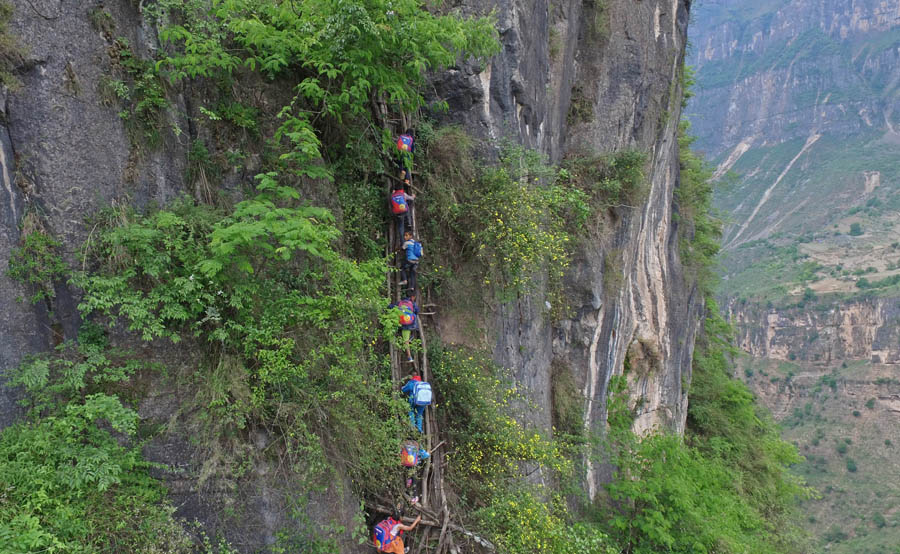
Children scale 800-meter cliff on way to school
Children climb up a cliff on a vine ladder to an isolated village on the top of a mountain in Liangshan Yi autonomous prefecture, Southwest China's Sichuan province, on May 14, 2016. Atule'er village, home to 72 families, is known as "cliff village" because its vertical distance to the ground is 800 meters. The routes leading to the outside world are 17 vine ladders. [Photo/VCG]

This is the establishment of paying a 'fair price' by taking advantage of circumstances deleterious to the seller, advantageous to the buyer, and leaving people in the village of Atuler in the mountainous west to live on a straitened income of less than a dollar a day. Vast multitudes of rural dwellers in China have always lived in endemic poverty, and China has made great strides in an astonishingly short period of time to bring many within its immense population of 1.3-billion people out of starvation.

It is, for the most part, urban dwellers who have been transformed by China's emergent economy to a middle-class lifestyle, and it was ever thus. It is typical that farming communities remain disadvantaged while much of the country, particularly its hugely populous metropolises are brought into modernity and comfort still denied those in the vast countryside. Despite their remote location and a life of privation, attaining an education holds high value for Chinese, to their immense credit.

During the settler days of North America when children living in the countryside attended one-room schoolhouses and had to reach them daily through exerting themselves physically to walk long distances, the determination to ensure that all children receive at least an elementary education bespoke the values of the society. Those days are long past, however, with readily accessible educational opportunities mandated by law.

The village of Atuler in Sichuan province is remote from such access to school for their children. Access to any point for any of the villagers is a difficult problem. To leave the village means that one must descend an ancient set of stairs comprised of a set of rope ladders beside a perpendicular wall of sheer rock, the side of the mountain. There, shopping for food is far more complex than driving to the nearest supermarket.

Anyone setting out for a marketplace in another village to bring back food for their family must access that same staircase, reputed to be hundreds of years old, according to Chen Jigu, one of the villagers, who explained: "We replace a ladder with a new one when we find one of them is rotten". The rattan series of ladders comprising the whole is secured against the mountainside enabling a descent of 800 metres.
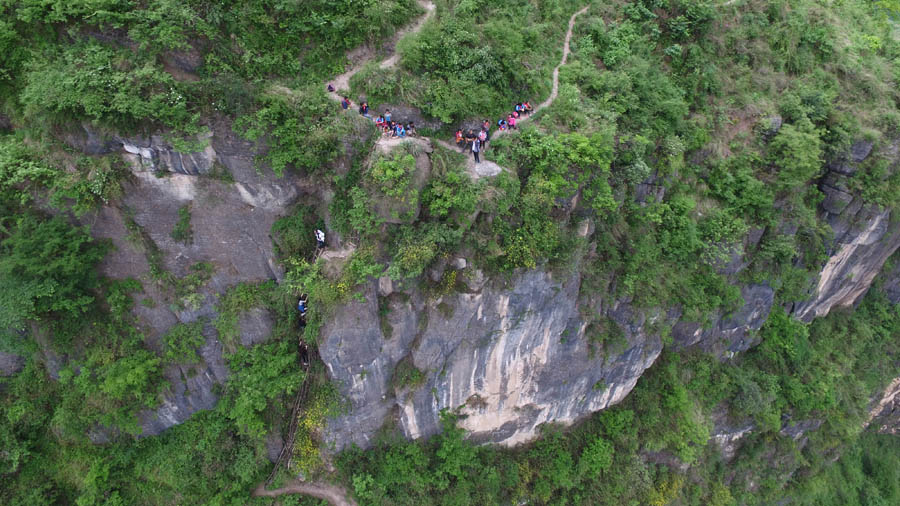
Children scale 800-meter cliff on way to school
A bird's-eye view of kids climbing cliff, May 14, 2016. It takes a young and agile villager about one and a half hours to climb up the mountain, and even longer for kids. When the whether is bad, no one goes out of the village. [Photo/VCG]
The village children, ages six to 15, from 72 families living in the village, fifteen in all, scale the cliff to take them to and from boarding school every two weeks. The school is located in Liangshan Yi autonomous prefecture in Sichuan province. There is no cost associated with attending the school itself, but since the children must board there, room and board comes to 300 yuan ($45.70) a semester for every child.

Led by an adult, to climb up the cliff takes about two hours and the descent about one and a half hours. If someone from the village needs medical attention and is too ill to make the descent and ascent themselves, someone from the village ties that person onto their back to descend the cliff, with the assistance of two other villagers.


"It will cost about 60 million yuan to build a road connecting Atuler and two other remote villages. But the country government only has 200,000 yuan for the project", explained Jike Jinsong, an official of Zhaojue county government. Relocating the village down the mountain is not feasible since the village owns the land where they are now located and by moving they would be abandoning their land.

Children scale 800-meter cliff on way to school
Children climb a vine ladder on their way home, May 14, 2016. The children study at a school at the foot of the hill and go home twice a month. [Photo/VCG]
When news of the situation was published, bringing wide attention to the dangers inherent in this regular trek for the village's children, the Liangshan prefectural government announced they would see to it that a set of stairs in the form of a steel ladder would be built while a longer-term solution would be sought.

Labels: , , , ,

Friday, June 20, 2014

Trapped in the Bowels of the Earth

"For years our solidarity has grown. We have worked together and gotten to know each other. Today we have the proof that this is the right way to work. We overcame language and technical barriers and succeeded in completing a difficult operation."
Roberto Corti, Italian National Society of Alpine Speleology

"They really worked hard; they brought their best. A difficult rescue effort like this can always fail. It is essential that we work together."
Klemens Reindl, rescue leader
Judith Hartl in a live stream screen shot

There are those people who are so curious about the world that they will go to any extraordinary measures to explore and discover the mysteries of nature and our existence within it. From the depths of the oceans deep to the closely cloistered bowels of the Earth -- from deep space exploration to ascending the most remote, forbidding peaks on various Continents, and exploring the most frigid, inhospitable areas of Earth where ice and snow and impossibly thick glaciers and icebergs are king -- those intrepid souls set out to satisfy their avid curiosity.

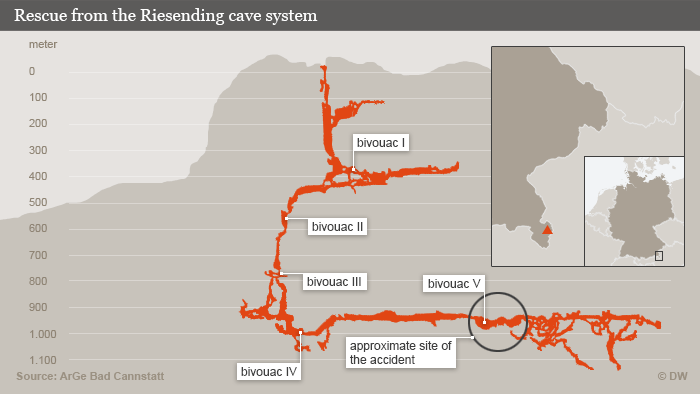
There is an alpine cavern near Berchtesgaden in southern Germany, known as the Riesending (Big Thing). That cavern can be reached below the surface of Untersberg Mountain by expert spelunkers. The Riesending cave north of Berchtaesgaden stretches over 20 kilometres vertically and horizontally into the mountain which hosts it. A team of experts discovered its presence in the mid 1990s, and mapped it in 2002.

Riesending cave infographic (DW)
Source: Arge Bad Cannstatt

One of those experienced spelunkers was Johann Westhauser, now 52, who works in the physics Department of the Karlsruhe Institute for Technology, and he is acknowledged as one of the country's most experienced cave researchers. Since its discovery Mr. Westhauser has explored the Riesending cave several times. The most recent occasion when Mr. Westhauser explored the cavern was this very month. Unfortunately, on June 8 while underground with a companion a rock struck him on the head about 1,000 metres underground.

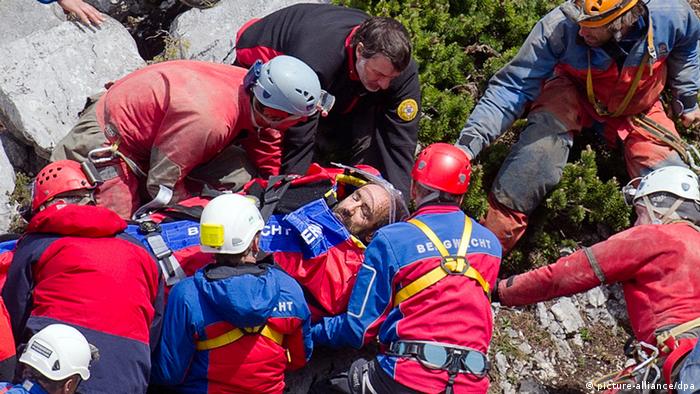
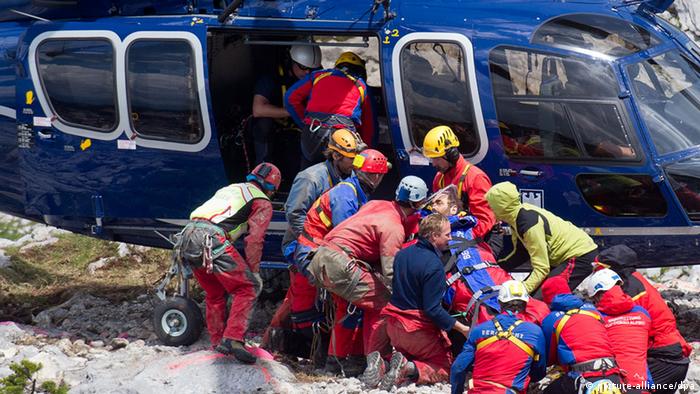
His colleague made his way back to the surface in twelve hours, to alert authorities, who then undertook a complex international rescue. And after 22 days, ten hours and 40 minutes trapped underground in parlous conditions, Mr. Westhauser emerged from his dark prison. He was strapped to a stretcher, handled by dozens of volunteer rescuers representing the international community of scientists, explorers and spelunkers. The surface of the 2,000 metre mountain where the narrow mouth of the cavern opens in a vertical drop is shrub-covered, impossible to land a helicopter. So equipment was lowered by cable and then a landing pad cleared.

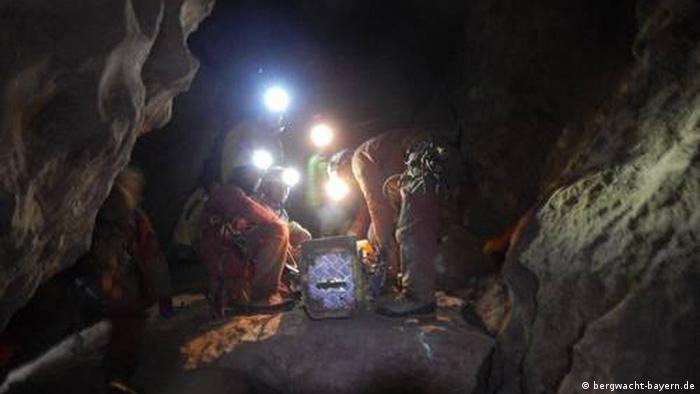
Bavaria cave rescue

Hundreds of rescue workers arrived from Austria, Switzerland, Italy and Croatia, representing professionally expert climbers accustomed to descending into the inner depths of mountains. Two hundred and two descended into the cave to eventually manage to carry the wounded man strapped into a padded fibreglass stretcher, winching him with a pulley through the darkness deep in the mountain. Before they had reached him, five bivouacs equipped with food and sleeping bags had been set up at intervals. They painstakingly handled their burden with great care, going from bivouac to bivouac. At the final bivouac, they rested.

The rescue team outside the cave
Photo: Nicolas Armer/dpa

Finally they lifted the rescued man to safety through the narrow shaft leading to the surface where he was treated by teams of doctors at an emergency medical station set up near the mouth of the cave. From there he was flown by helicopter to hospital. "We have achieved our goal. We have also made rescue history, which was only possible through international co-operation", said Norbert Heiland, head of Bavaria's Mountain Rescue Service.  The entire effort, from start to successful completion, involved no fewer than 728 people.

The rescue team outside the cave
Photo: Nicolas Armer/dpa

Labels: , , , , ,

Wednesday, April 23, 2014

Compassionate Courage

"That bus was a ball of black smoke and I was standing there, screaming, and screaming, and I don't know how long it was, but I lost a brother years ago and, true to God, I looked up and I said, 'Please, don't let it end this way.' And, sure enough, somehow, some way, Sgt. Jacob Perkins arrived on that scene."
" I didn't know where he came from. I didn't see him show up. All I know is he got there and thought nothing of throwing his truck in park and running onto a burning bus. It was an inferno, an absolute inferno, and he got my husband out."
Sandy Blair, London, Ontario
Sun Media photo

Staff Sgt. Jacob Perkins of the 89th Cavalry Regiment, 2nd Brigade Combat Team, U.S. Army, a veteran of Iraq and Afghanistan was driving home to Missouri when he came across a highway scene of horror. A tractor-trailer had crashed into a tour bus carrying 50 people on the New York State Thruway in Waterloo, New York, in July 2011. He came to a speedy stop and bounded out of his vehicle, over to the conflagration.

William Blair was trapped on the bus, more or less stuck to his seat. When the tractor trailer loaded with ball bearings rammed the back of the bus, Sandy Blair managed to get herself out of the bus, certain that her husband Willie and daughter Michelle were right behind her. In short order, Michelle was there, standing beside her mother. But husband and father Willie was nowhere to be seen and the bus was ablaze.

Willie had said to his daughter, she'd better get a move on, and not to worry, he was right behind her. In fact, he knew quite well he wouldn't be right behind her, he was there and there he would stay, in the fiery remains of the overnight tour bus they were taking for a first-time family trip to New York City. He had sustained serious a back injury and had a mean gash in a leg; pinned there, incapable of moving, blood gushing from his wounds.

Sgt. Perkins, en route to visit with his mother in Mountain Grove, Mo., entered the burning, smoke-filled bus to pull William Blair out of the bus to safety, and then he returned to the bus, creeping through it on hands and knees hoping, if anyone else was trapped, he would be able to feel them and take action, since he couldn't see anything because of the choking smoke.

A burning bus on Highway I-90 in New York on July 22, 2011, where U.S. Sergeant Jacob Perkins helped evacuate several Canadian passengers and then went back inside the burning vehicle to search for other possible victims.
YouTube/LizSpirit777   A burning bus on Highway I-90 in New York on July 22, 2011, where U.S. Sergeant Jacob Perkins helped evacuate several Canadian passengers and then went back inside the burning vehicle to search for other possible victims.
 
Lady Luck just couldn't make up her mind that night. She decided along with Dame Fortune to throw misfortune at people hurtling down a highway in a tractor trailer and a passenger bus. The driver of the truck died, none of the people aboard the bus did however, though twenty of them were taken to hospital. Willie Blair was evacuated from the scene by helicopter. His daughter had tied a tourniquet on his leg while they waited for rescue.

But they were left standing at the side of the road, with no means by which they could do anything; no identification, no money, just confusion and fear, and the driving need to be with their husband and father. And again Sgt. Perkins came to the rescue, offering to drive the two women to hospital in his pickup truck to reunite them with William Blair; a selfless act of compassionate decency that explained all the medals he had earned in service.

William BlairWilliam Blair

And Staff Sgt. Jacob Perkins will be among forty others to be recognized for valour and humanity when on Thursday they are to be presented at the official residence of Canada's Governor General, the Right Honourable David Johnston, Queen Elizabeth II's representative in Canada, at a ceremony to award them with a Medal of Bravery in recognition of their courageous response to unusual and dangerous events.

Labels: , ,

Defusing a Molotov Cocktail

"I thought it was silly of me at the time, suspecting anything. Maybe his face is cold. It's legitimate to wear a ski mask in January."
"He said, 'All right boys'. That's the only thing he said. At the time I wasn't sure if he meant, 'All right, this is my protest statement against Esso', or, 'All right, give me your money before this fireball goes off'."
"I believed if I could hold his arms above his head he wouldn't be able to throw it. It was either that or have him drop it in the gas station convenience store. That's a pretty small space."
"In the moment, I didn't think about how much worse it could have gone. As we were fighting I could feel the flames singeing my face and hands, but I didn't really register it until after it was done."
"He was swearing at me pretty profusely, and in the midst of it all I could think to say was, 'No'. And I didn't even say it in a dramatic way, I said it like a teacher would."
"I don't go looking for the dangerous situations. I just seem to find myself in them."
Brennan Richardson, Ottawa
Man who stopped Molotov cocktail attack at gas station to get bravery award
Brennan Richardson is to receive a Medal of Bravery from Gov.-General David Johnston on Thursday. Richardson stopped a man who threatened to blow up a gas station with a Molotov cocktail.    Photograph by: Jean Levac , Ottawa Citizen
 
Brennan Richardson is 28, and he, along with forty others will be receiving official acknowledgement that the country recognizes their selfless service to society. For Mr. Richardson, it is an appreciation for his having reacted swiftly to a situation that could quite easily have gotten out of hand resulting in great harm to everyone involved. Although the situation concluded with a question in that the person who sought to perpetrate a crime was never apprehended, all turned out well in the end.

The young man's visceral reaction to a sinister threat that confronted him as he was in the process of buying an energy drink in January around the midnight hour at an Esso gas station did him great credit as he confronted a black-clad, balaclava-masked man holding a lit Molotov cocktail. His action defused the threat through an infusion of testosterone and adrenalin.

When he first noticed the man he hadn't yet seen the bottle with flammable liquid afire as his mind processed the reason anyone might cover their face on an Ottawa winter night. Anyone might have been forgiven for doing so, in fact, given the starkly frigid winter we'd gone through.

But this was an occasion when an attempted crime was apprehended by the swift-thinking (although in his mind he felt himself plodding through exculpatory reasons for the man's presence; during times of stress the mind and time often seem to stall) of an alert and capable young man. He lunged at the intruder as soon as he realized the visual and spoken threat, to relieve him of his weapon.

His purpose was to prevent him from tossing the flaming cocktail at the gas station employees. In their struggle Mr. Richardson was able to shove the man outside toward the gas pumps. The masked man managed to break his opponent's grip and he threw the cocktail directly toward one of the gas pumps. It shattered -- but luck was with everyone but the would-be attacker that night, for nothing ignited to result in a conflagration of fire-gas-and-oil.

At that juncture the manager of the gas station appeared and managed to pull the mask off the man's face, and he ran off. For his pains, Mr. Richardson will be one among forty others to receive a Medal of Bravery tomorrow through a formal presentation presided over by Canada's Governor-General David Johnston.

Labels: , , ,

 
()() Follow @rheytah Tweet