Ruminations

Blog dedicated primarily to randomly selected news items; comments reflecting personal perceptions

Wednesday, April 02, 2025

All for One -- and One For All

"We stand in grief with the families and loved ones of these extraordinary 'Dogface Soldiers' during this unimaginable time."
"But the search isn't finished until everyone is home. Words cannot express our gratitude to those still working around the clock during these extensive search and recovery efforts and  your unwavering commitment not to rest until all are found."
"This past week has been devastating. Though we have received some closure, the world is darker without them."
“This loss is simply devastating. We are wrapping our arms around the families and loved ones of our Soldiers [during this difficult time]."
Commander Maj.-Gen. Christopher Norrie, 3rd Infantry Division  
 
"It has been truly amazing and very humbling to watch the incredible recovery team from different commands, countries and continents come together and give everything to recover our Soldiers."
"Thank you, Lithuania, Poland, Estonia, the U.S. Navy and the Army Corps of Engineers."
"We are forever grateful."
 Lt. Gen. Charles Costanza, commanding general, V Corps
https://media.cnn.com/api/v1/images/stellar/prod/c-gettyimages-2206632532.jpg?c=16x9&q=h_653,w_1160,c_fill/f_webp
 
"Lithuania mourns together with the American nation."
"Please accept my heartfelt condolences, as well as those of the Lithuanian people, to you, the loved ones of those who lost their lives, and all the people of the United States of America. "
"During this difficult time, our thoughts and prayers are with you."
Lithuanian President Gitanas Nausėda 
Under NATO, to give reassurance to Eastern Europe, member-countries of the military alliance were assigned to establish a Rapid Reaction Force as a deterrent and a defence against Russian designs on its neighbours. With a very real and demonstrated willingness to invade the borders of neighbouring nations, the Russian Federation's ambitions of territorial aggression and expansion gave birth to a renewed move by NATO to offer protection to its members under duress of potential invasion.
 
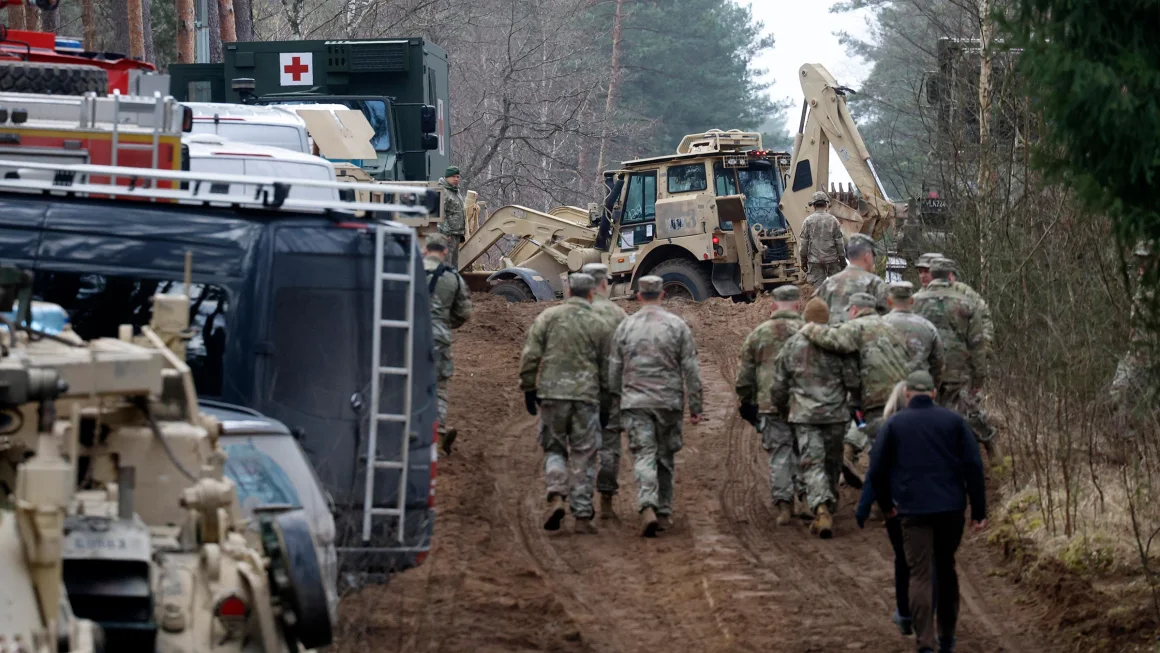
Among other member-nations the United States established a unit in Lithuania. On March 25, an American armoured vehicle with four U.S. soldiers aboard went astray in a marshy peat bog located at the huge General Silvestras Zukauskas training ground nearby the town of Pabrade. A search was undertaken and the location of the missing vehicle was found, though no vehicle was in sight. The almost-70-ton behemoth had sunk straight down, along with its personnel. 
 
https://i.abcnewsfe.com/a/7df6668b-2073-4d68-a5d3-9c3254fd1456/army-training-02-ht-jef-250327_1743084744908_hpEmbed_9x16.jpg?w=750
The U.S. Army search for four soldiers who went missing during a scheduled training exercise near Pabradė, Lithuania.  U.S. Army
 
It took six days in a massive effort by American, Polish and Lithuanian armed forces to locate and dig the M88 Hercules vehicle out of the peat bog. The search was widened when three of the missing men of the 1st Armoured Brigade Combat Team, 3rd Infantry Division were found dead, and a fourth body of the missing soldiers evaded the search teams. On a tactical training exercise, the soldiers were reported, along with their vehicle to be missing early on Tuesday. 

The thick forests and swampy terrain around Pabrade, some ten kilometres west of the border with Belarus saw hundreds of Lithuanian and American soldiers and other rescuers searching, engaged in a rescue mission. On Wednesday the armoured vehicle's whereabouts was finally discovered, submerged in 4-1/2 metres of swamp water. 

Military helicopters, fixed-wing aircraft, unmanned aerial systems and search and rescue personnel were provided by the Lithuanian armed forces. Excavators, sluice and slurry pumps were brought to the site, along with other heavy construction equipment along with technical experts and several hundred tons of gravel and earth, all to help with the recovery mission.
 
American navy divers manoeuvred through thick layers of mud, clay and sediment "with zero visibility" to finally reach the 63-ton vehicle on Sunday evening. There they established several points where steel cables could be attached to enable the work involved in lifting the vehicle. During the effort of dragging the vehicle out of its submerged position, they began to lose traction, requiring more heavy dozers to provide additional grip. Two hours later the vehicle was pulled free of its ghastly grave.
 
https://i.abcnewsfe.com/a/b01ed838-3d76-49b1-8ff6-ddbe841bee19/soldier-1-ht-er-250401_1743539523619_hpMain_4x3.jpg?w=750
Sgt. Edvin F. Franco, 25, of Glendale, California, Sgt. Jose Duenez, Jr., 25, of Joliet, Illinois and Pfc. Dante D. Taitano, 21, of Dededo, Guam.  U.S. Army

The navy dive team's work was not over. They then turned to searching the area with the use of radar for the presence of the still-missing fourth soldier. And his body was ultimately found, to join that of his other three comrades, to be returned to the United States and to their families, for burial. 
 
An undated photo of Staff Sgt. Troy S. Knutson-Collins, 28, of Battle Creek, Michigan, who died in a training mission in Lithuania.  U.S. Army

"I can’t say enough about the support our Lithuanian Allies have provided us. We have leaned on them, and they, alongside our Polish and Estonian Allies — and our own Sailors, Airmen and experts from the Corps of Engineers — have enabled us to find and bring home our Soldiers."
"This is a tragic event, but it reinforces what it means to have Allies and friends."
Gen. Christopher Donahue, commander of U.S. Army Europe and Africa

Labels: , , , , ,

Monday, November 08, 2021

The Staggering Worldwide Infection Rate of COVID

"We think between now and the end of 2022, this is the point where we get control over this virus ... where we can significantly reduce severe disease and death." 
Maria Van Kerkhove, epidemiologist, World Health Organization COVID technical lead
 
"The loss of sense of taste and smell during acute illness is an indication of the penetration of the virus into the nervous system and increases the risk of long-term damage to memory and concentration."
"Long COVID is a multi-system syndrome attributed to the period beginning 12 weeks after the acute illness. The information in the literature is preliminary only, and from it, we find around 10% of those who recovered will suffer from at least one symptom in this period."
"The rate of the symptoms' appearance varies, and there is a lack of information on symptoms that continue beyond half a year and on the populations that are at increased risk for long-term consequences."
Dr. Ilan Green, Study research director

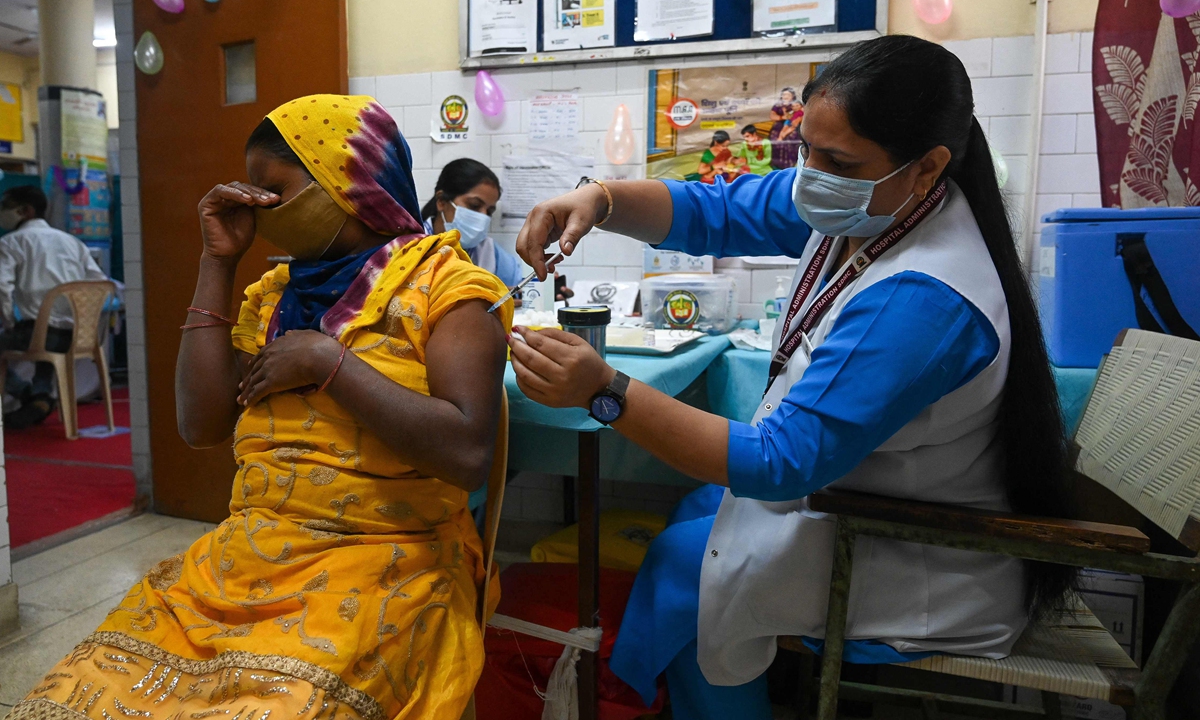
A health worker inoculates a woman with a dose of the Covaxin vaccine against the COVID-19 at a health center in New Delhi, India on Thursday. Photo: VCG

Over half of the world's population has not yet received a single dose of a COVID vaccine, according to Our World in Data. In low-income countries, fewer than five percent of the population have been given at minimum one dose. Leading the World Health Organization and other aid groups to appeal to the governments of the 20 largest economies for funding of a $23.4 billion program to close the gap in bringing COVID-19 vaccines, tests and drugs to emerging economies within the next year.

COVID cases worldwide are nearing the 250 million milestone. The surge experienced from the Delta variant, along with efforts to normalize trade and tourism is seeing some easing of the situation, even while some countries in eastern Europe are undergoing record outbreaks. Coincidentally, they are the same countries where vaccine uptake has been low, particularly in more rural farming and isolated communities..

Overall, in the large scale of things, the last three months has seen the daily average of cases falling by 36 percent, according to a Reuters analysis. However, while the virus spread appears to have relentedm 50 million people are still being infected every 90 days, resulting from the highly transmissible Delta variant's effect. Before its emergence, the original virus before mutation took place saw 50 million people infected worldwide over the space of a year. 

There is growing confidence among experts in health care and epidemiology that in many countries the most serious effects of the pandemic are now behind them as a result of the availability of vaccines and from natural exposure. There is still, however, an expectation that the onset of colder weather along with seasonal holiday gatherings, an increase in cases could be realized.

Within the medical community globally, there has arisen through intensive study and observation, a better understanding of the SARS-CoV-2 virus causing COVID-19, though much has yet to be discovered about its volume of sometimes mysterious effects, including long COVID. As well, more intensive understanding has led to better treatments. 
 
Britain is set to be the first country to approve a potentially successful COVID-19 antiviral pill which studies indicate could reduce the chances of dying or being hospitalized by half, for people most at risk of development severe COVID-19.

With good news there is often sobering news to balance the situation, and the reality is that infections are still on the rise in 55 of 240 countries. Russia, Ukraine and Greece are experiencing near record levels of reported cases since the start of the global pandemic two years earlier. Eastern Europe's vaccination rate is among the lowest in Europe. Over half of all new infections reported globally are from countries in Europe. 
 
A million new infections are reported about every four days.

Medical personnel provides medical assistance to a COVID-19 patient inside the intensive care unit in an hospital which treats patients with COVID-19 coronavirus in Kiev on Nov 2, 2021. (SERGEI SUPINSKY / AFP
 

Labels: , , , , ,

Sunday, January 27, 2019

Canid Migration Opportunists 

"Who would have guessed that  this small canid would be the likely winner of poisoning campaigns of wolves in the Balkans?"
"[For golden jackals in Europe], the moment of truth is soon to come."
Nathan Ranc, doctoral student, Harvard University/Edmund Mach Foundation, Italy
golden-jackal.jpg
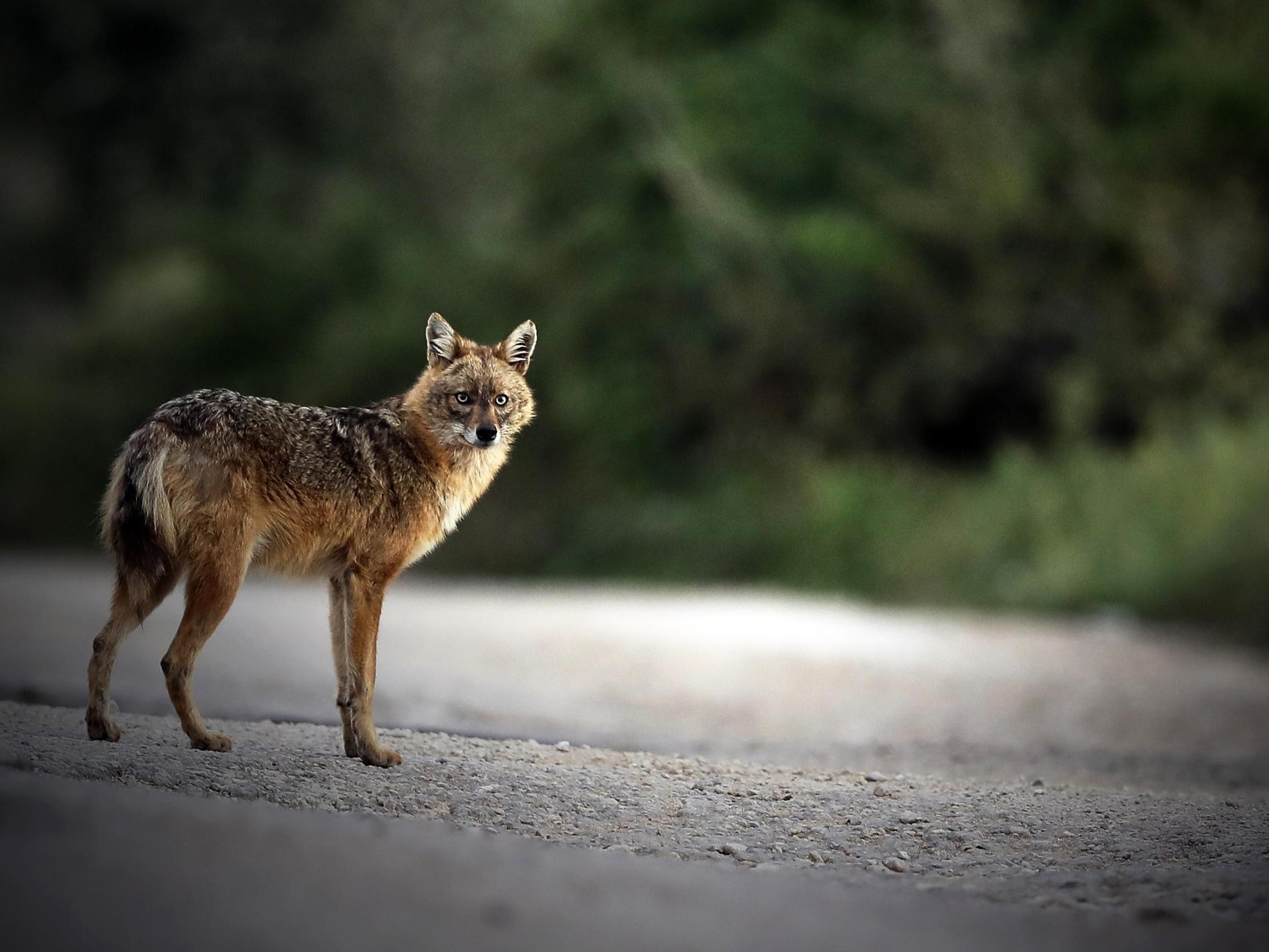
Getty   There are now over 100,000 golden jackals in Europe, as the population has boomed since the 1950s

Jackals, originating in the Middle East and southern Asia historically, have moved into Central and Eastern Europe, displacing the wolf population native to the area. Vastly outnumbering wolves in Europe, golden Jackals are assumed to total about 117,000 according to the latest estimate. A high estimate of wolves in Europe now stands at about 17,000.

Slovenia, for example, has between 200 and 400 jackals, according to Miha Krofel, a conservation biologist at the University of Ljubljana in Slovenia, there are 75 wolves.

Jackals weigh an average of nine kilograms, they are considered to be a medium-sized predator. At one time jackals existed only on the fringes of Europe. About eight thousand years ago the species began to arrive at the southern edge of Central and Eastern Europe, as evidenced by the fossil record.

They began to slowly expand into Europe in the 19th Century, but by the 1950s that expansion accelerated, particularly so over the last several decades.

Jackals mate for life, and a pair forms the core of a pack. Just as wolves and coyotes have family-based packs, so too do jackals, though their groups have a tendency to be more compact, four to six, as contrasted with wolf packs that may include 15 animals. Young jackals may remain with their parents, or they may choose to establish their own packs.

In some European countries such as Greece, Slovenia, Croatia, Hungary, Romania, Ukraine, Austria, Italy and Bulgaria -- with the largest population -- there are now substantial populations of jackals. Biologists believe jackals began their migration north to fill the vacuum when wolves were being eradicated, particularly in the Balkans. Jackals appear to avoid geographic areas populated by wolves.
European-Golden-jackal.jpg
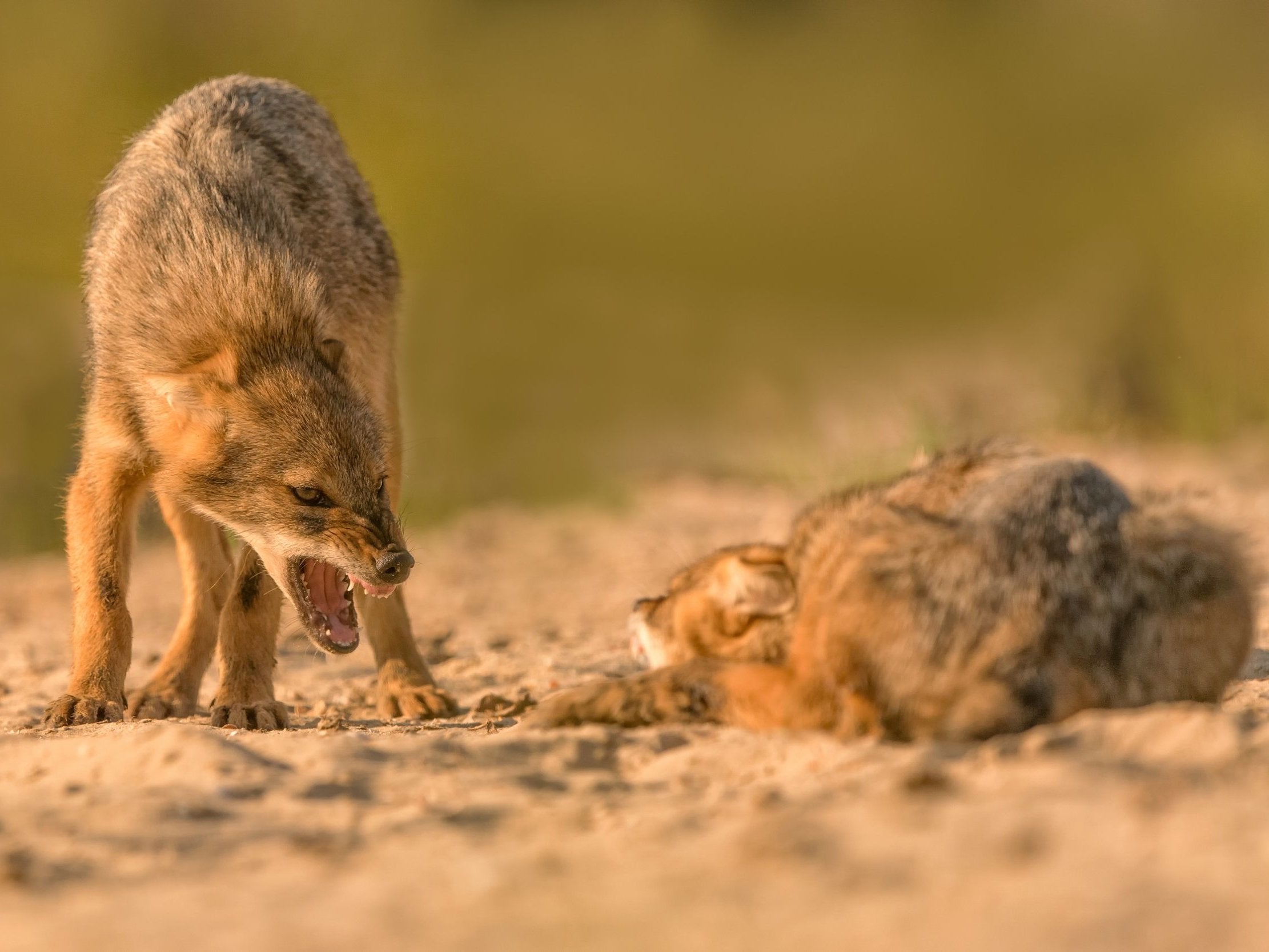
Smaller than North American coyotes, golden jackals weigh an average 20 pounds   Getty

Where snow appears on the ground over hundred days annually, jackals seem to avoid moving in, so it is anticipated that as climate change continues and snow cover declines, a greater number of European territories will become more attractive to the presence of jackals.

In southwest Slovenia the past three years saw a decline in wolf attacks on sheep farms. With the introduction of jackals, more sheep are now being lost, however, raising the hackles of farmers.

Once jackals establish a pack and reproduction moves steadily forward, offspring have the opportunity to establish new packs as migration into Western Europe commences. Nathan Ranc, the doctoral student working alongside Miha Krofel, conservation biologist out of Trieste, Italy, feels that more rigid procedures for waste management and livestock corpse disposal on farms will serve to deter jackal expansion in Western Europe.

Dr. Krofel's research team comprised of 37 scientists and naturalists, all volunteering to monitor the animals throughout Europe, hope to find some answers to questions respecting the existence of the jackals and their growing proliferation in a geography to which they have become migratory interlopers, making the most of opportunities available to them.

European-Golden-jackal-2.jpg
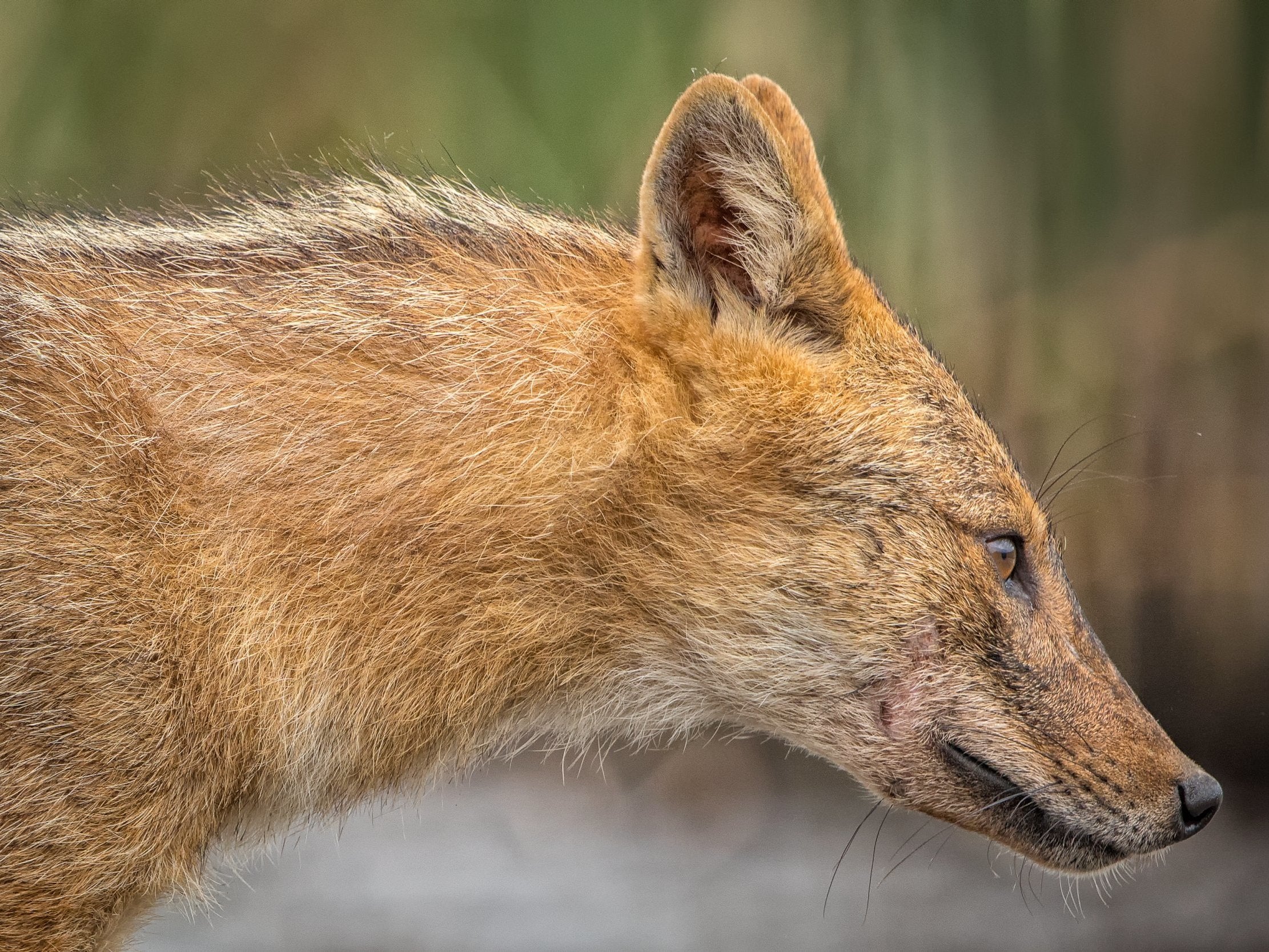
The jackal had a period of past glory: the Egyptian god Anubis was said to have a jackal’s head    Getty

Labels: , , ,

 
()() Follow @rheytah Tweet