Ruminations

Blog dedicated primarily to randomly selected news items; comments reflecting personal perceptions

Monday, November 08, 2021

The Staggering Worldwide Infection Rate of COVID

"We think between now and the end of 2022, this is the point where we get control over this virus ... where we can significantly reduce severe disease and death." 
Maria Van Kerkhove, epidemiologist, World Health Organization COVID technical lead
 
"The loss of sense of taste and smell during acute illness is an indication of the penetration of the virus into the nervous system and increases the risk of long-term damage to memory and concentration."
"Long COVID is a multi-system syndrome attributed to the period beginning 12 weeks after the acute illness. The information in the literature is preliminary only, and from it, we find around 10% of those who recovered will suffer from at least one symptom in this period."
"The rate of the symptoms' appearance varies, and there is a lack of information on symptoms that continue beyond half a year and on the populations that are at increased risk for long-term consequences."
Dr. Ilan Green, Study research director
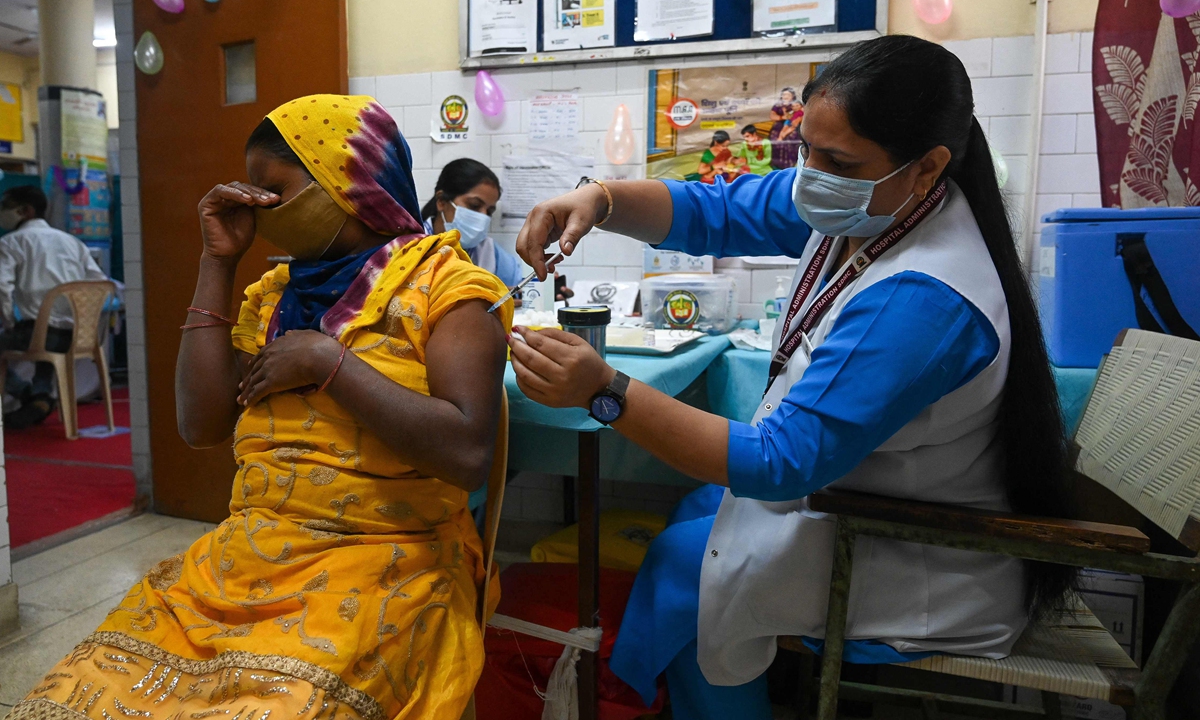
A health worker inoculates a woman with a dose of the Covaxin vaccine against the COVID-19 at a health center in New Delhi, India on Thursday. Photo: VCG

Over half of the world's population has not yet received a single dose of a COVID vaccine, according to Our World in Data. In low-income countries, fewer than five percent of the population have been given at minimum one dose. Leading the World Health Organization and other aid groups to appeal to the governments of the 20 largest economies for funding of a $23.4 billion program to close the gap in bringing COVID-19 vaccines, tests and drugs to emerging economies within the next year.

COVID cases worldwide are nearing the 250 million milestone. The surge experienced from the Delta variant, along with efforts to normalize trade and tourism is seeing some easing of the situation, even while some countries in eastern Europe are undergoing record outbreaks. Coincidentally, they are the same countries where vaccine uptake has been low, particularly in more rural farming and isolated communities..

Overall, in the large scale of things, the last three months has seen the daily average of cases falling by 36 percent, according to a Reuters analysis. However, while the virus spread appears to have relentedm 50 million people are still being infected every 90 days, resulting from the highly transmissible Delta variant's effect. Before its emergence, the original virus before mutation took place saw 50 million people infected worldwide over the space of a year. 

There is growing confidence among experts in health care and epidemiology that in many countries the most serious effects of the pandemic are now behind them as a result of the availability of vaccines and from natural exposure. There is still, however, an expectation that the onset of colder weather along with seasonal holiday gatherings, an increase in cases could be realized.

Within the medical community globally, there has arisen through intensive study and observation, a better understanding of the SARS-CoV-2 virus causing COVID-19, though much has yet to be discovered about its volume of sometimes mysterious effects, including long COVID. As well, more intensive understanding has led to better treatments. 
 
Britain is set to be the first country to approve a potentially successful COVID-19 antiviral pill which studies indicate could reduce the chances of dying or being hospitalized by half, for people most at risk of development severe COVID-19.

With good news there is often sobering news to balance the situation, and the reality is that infections are still on the rise in 55 of 240 countries. Russia, Ukraine and Greece are experiencing near record levels of reported cases since the start of the global pandemic two years earlier. Eastern Europe's vaccination rate is among the lowest in Europe. Over half of all new infections reported globally are from countries in Europe. 
 
A million new infections are reported about every four days.

Medical personnel provides medical assistance to a COVID-19 patient inside the intensive care unit in an hospital which treats patients with COVID-19 coronavirus in Kiev on Nov 2, 2021. (SERGEI SUPINSKY / AFP
 

Labels: , , , , ,

Sunday, October 10, 2021

Tourism Fever Hits Russia

"People don't want to wait. Some have relatives. Some have business, some study, some work. Some simply want to go to Europe because they miss it."
"For Serbia, the demand has been growing like an avalanche. It's as if all our company is doing these days is selling tours for Serbia."
Anna Filatovskaya, spokesperson, Russky Express tour agency

Sputnik V vaccine (Pavel Golovkin/AP)
"The WHO has said that it needs more data, and it needs to go back and inspect some production lines where it saw issues early on."
"Those re-inspections are a multiweek process, with good reason. It's not something that they just gloss over lightly."
"[Sputnik V will be approved eventually] maybe not by the end of this year."
Judy Twigg, political science professor, global health, Virginia Commonwealth University
People wait in line at a COVID-19 vaccination centre in Belgrade, Serbia, on Oct. 2. Russians are flocking to Serbia to receive Western-approved COVID-19 shots as Russia's own vaccine, known as Sputnik V, has not been approved by international health authorities. (Darko Vojinovic/The Associated Press)
 
Russia's vaccination rate is low with a mere 33 percent of the country's 146 million people having received at least one shot of a coronavirus vaccine and 29 percent fully vaccinated. Russia's main vaccine, home grown like all the others offered for COVID-19 protection in the country, is Sputnik V. There is also a one-dose version named Sputnik Light. And there are two other domestically designed vaccines that have seen use in Russia; none of which have been approved internationally.

It was a matter of national pride when Russian regulators gave their approval to the country's own coronavirus vaccines and initially people receptive to the idea of inoculating themselves against the SARS-CoV-2 virus causing COVID streamed toward injection sites. That original enthusiasm may have waned however and certainly Russian-originated vaccines still await international imprimaturs of approval for even the first of the lot, Sputnik V.
 
Without that approval from external health authority sources Russians vaccinated by Russian-produced research products are unwelcome at all the travel hot spots they had formerly taken for granted would receive them with open arms. Russians who love to travel and miss their former freedom to go where they wished, sought out alternatives to their dilemma by looking to internationally approved vaccines available elsewhere, but not in Russia.
 
Gravediggers disinfect the coffin of a COVID-19 victim at a cemetery outside Omsk, Russia, on Thursday. (The Associated Press)

Which is where Serbia comes into the picture, where hundreds of Russians have entered recently for western-approved COVID-19 vaccines. Russians are able to enter the allied Balkan nation visa-less and there they find a wide choice of Western produced vaccines. Soaring demand has seen organized tours for Russians to visit Serbia and while there they enjoy Belgrade hotels, restaurants, bars and vaccination clinics. Tour packages came on the market in mid-September with prices starting at $300 to $700.
 
Russia's Sputnik V saw approval in 70 countries, including Serbia, but the World Health Organization approval remains under review citing issues at a production plant Among the hurdles in approval is a lack of full scientific information and manufacturing sites inspections, according to WHO assistant director-general Dr.Mariangela Simao. Sputnik V still awaits approval from the European Medicines Agency for travel limitations to be lifted for those with the Russian formulae.
 
In Serbia can  be found the Pfizer, AstraZeneca and Chinese Sinopharm vaccines. Croatia is now also being visited by Russian tourists where the one-shot Johnson & Johnson vaccine can be administered with no need for a return and a second dose as with the others. The Serbian population has reached around a 50 percent vaccination rate. According to official Serbian government data, close to 160,000 foreigners have been vaccinated in Serbia, mostly Russians.
 
Both Serbia and Russia have seen COVID-19 infections and hospitalizations at record levels in past weeks amid low vaccination rates and authorities unwilling to reimpose restrictive measures. In Russia, the daily coronavirus death toll surpassed 900 for a second straight day. Serbia is coping with a daily death toll of 50 people in the country of 7 million with a confirmed 1 million infections. 
 
Russian Vitaly Pavlov receives a Pfizer shot in Belgrade on Oct. 2, 2021. (Darko Vojinovic/The Associated Press)
 

Labels: , , , , , ,

 
()() Follow @rheytah Tweet