Ruminations

Blog dedicated primarily to randomly selected news items; comments reflecting personal perceptions

Sunday, January 27, 2019

Canid Migration Opportunists 

"Who would have guessed that  this small canid would be the likely winner of poisoning campaigns of wolves in the Balkans?"
"[For golden jackals in Europe], the moment of truth is soon to come."
Nathan Ranc, doctoral student, Harvard University/Edmund Mach Foundation, Italy
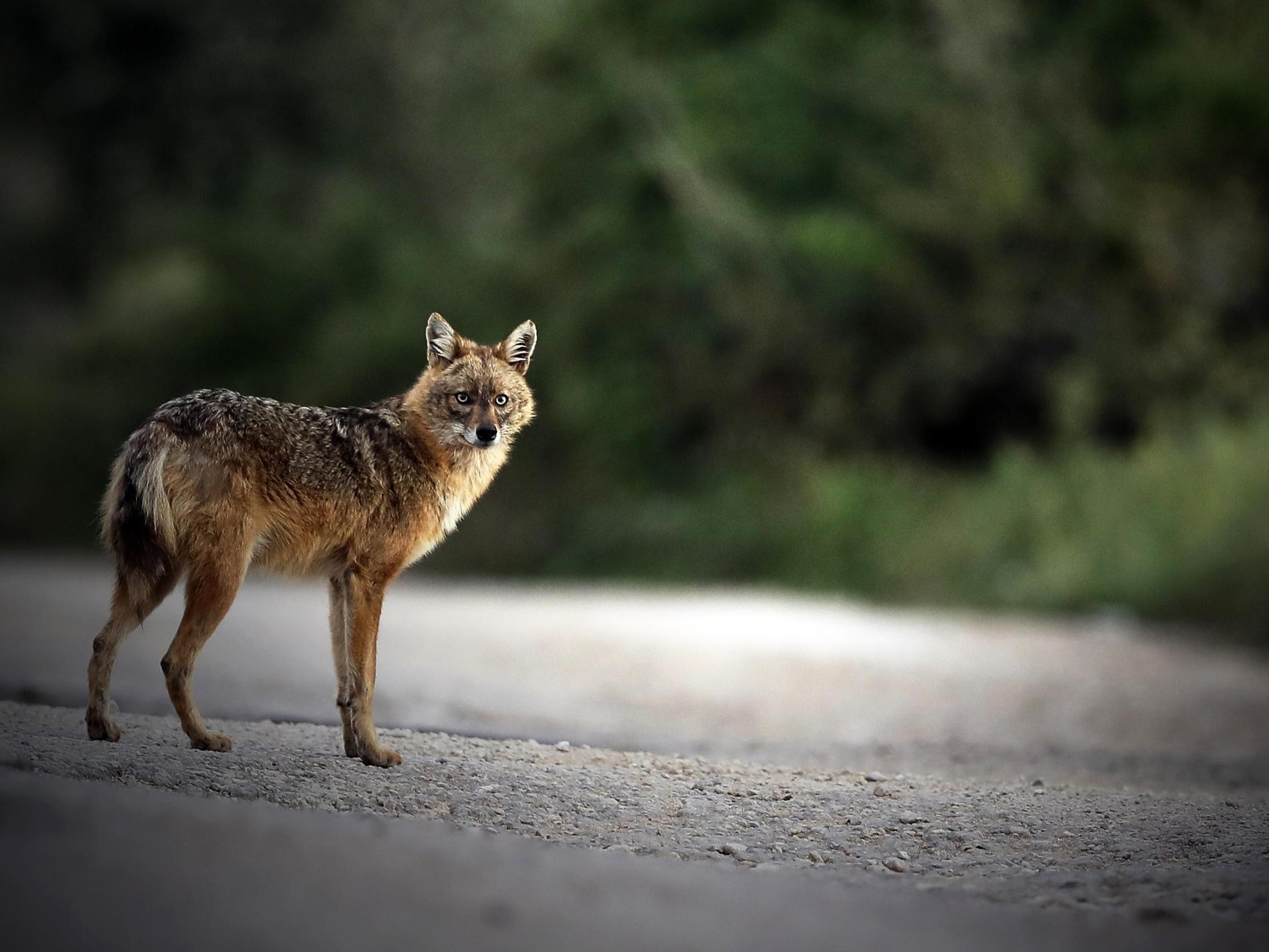
golden-jackal.jpg
Getty   There are now over 100,000 golden jackals in Europe, as the population has boomed since the 1950s

Jackals, originating in the Middle East and southern Asia historically, have moved into Central and Eastern Europe, displacing the wolf population native to the area. Vastly outnumbering wolves in Europe, golden Jackals are assumed to total about 117,000 according to the latest estimate. A high estimate of wolves in Europe now stands at about 17,000.

Slovenia, for example, has between 200 and 400 jackals, according to Miha Krofel, a conservation biologist at the University of Ljubljana in Slovenia, there are 75 wolves.

Jackals weigh an average of nine kilograms, they are considered to be a medium-sized predator. At one time jackals existed only on the fringes of Europe. About eight thousand years ago the species began to arrive at the southern edge of Central and Eastern Europe, as evidenced by the fossil record.

They began to slowly expand into Europe in the 19th Century, but by the 1950s that expansion accelerated, particularly so over the last several decades.

Jackals mate for life, and a pair forms the core of a pack. Just as wolves and coyotes have family-based packs, so too do jackals, though their groups have a tendency to be more compact, four to six, as contrasted with wolf packs that may include 15 animals. Young jackals may remain with their parents, or they may choose to establish their own packs.

In some European countries such as Greece, Slovenia, Croatia, Hungary, Romania, Ukraine, Austria, Italy and Bulgaria -- with the largest population -- there are now substantial populations of jackals. Biologists believe jackals began their migration north to fill the vacuum when wolves were being eradicated, particularly in the Balkans. Jackals appear to avoid geographic areas populated by wolves.
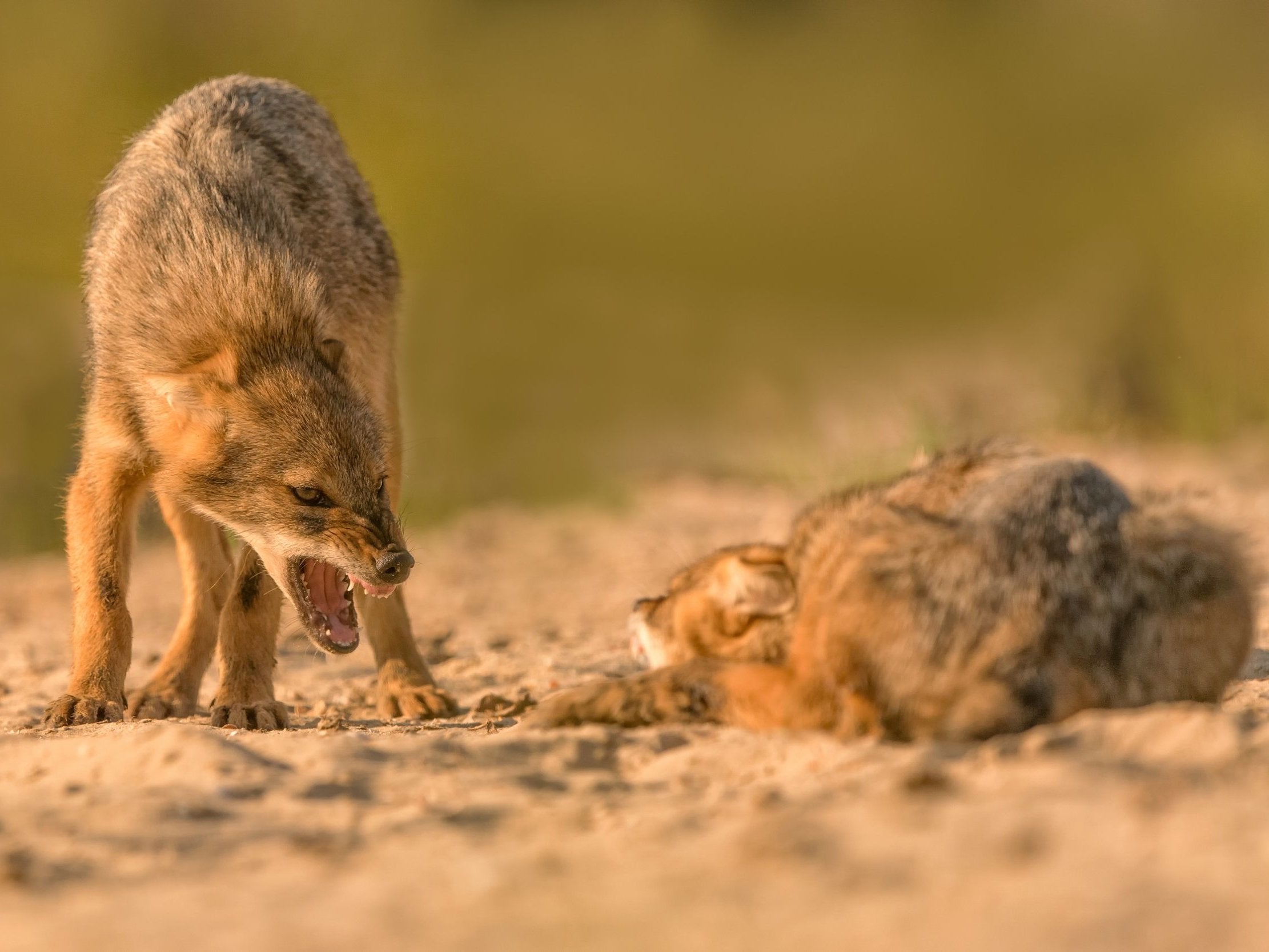
European-Golden-jackal.jpg
Smaller than North American coyotes, golden jackals weigh an average 20 pounds   Getty

Where snow appears on the ground over hundred days annually, jackals seem to avoid moving in, so it is anticipated that as climate change continues and snow cover declines, a greater number of European territories will become more attractive to the presence of jackals.

In southwest Slovenia the past three years saw a decline in wolf attacks on sheep farms. With the introduction of jackals, more sheep are now being lost, however, raising the hackles of farmers.

Once jackals establish a pack and reproduction moves steadily forward, offspring have the opportunity to establish new packs as migration into Western Europe commences. Nathan Ranc, the doctoral student working alongside Miha Krofel, conservation biologist out of Trieste, Italy, feels that more rigid procedures for waste management and livestock corpse disposal on farms will serve to deter jackal expansion in Western Europe.

Dr. Krofel's research team comprised of 37 scientists and naturalists, all volunteering to monitor the animals throughout Europe, hope to find some answers to questions respecting the existence of the jackals and their growing proliferation in a geography to which they have become migratory interlopers, making the most of opportunities available to them.
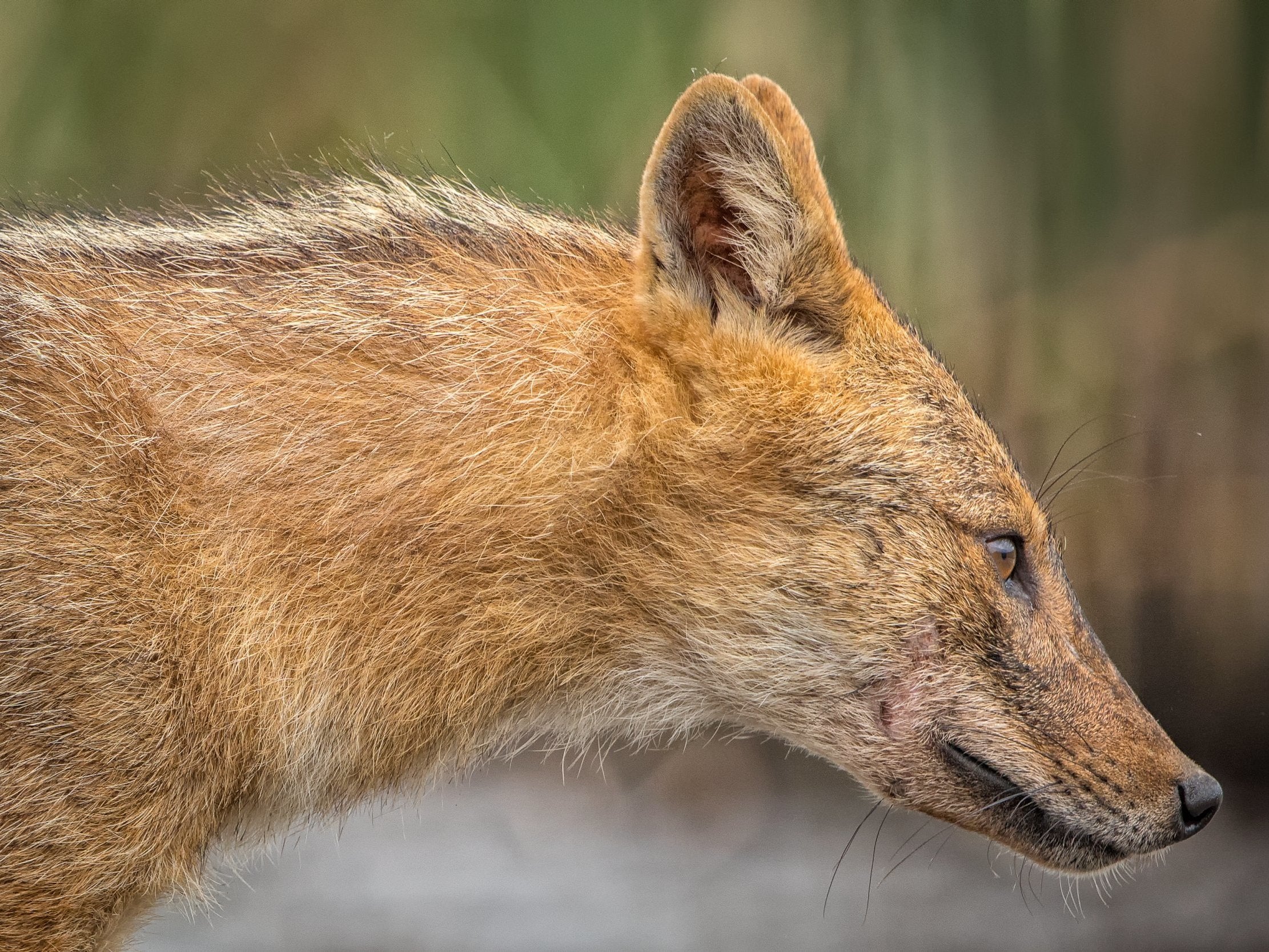
European-Golden-jackal-2.jpg
The jackal had a period of past glory: the Egyptian god Anubis was said to have a jackal’s head    Getty

Labels: , , ,

Wednesday, July 04, 2018

Conserving the Arctic Biosphere

"That is one area [Lancaster Sound, Northwest Passage] that has the potential for high conflict. It's an obligatory pathway for both vessels that are going in and out of the passage as well as marine mammals that are migratory."
"There's been a lot of research to suggest that vessels may have impacts on marine mammals."
"We're at this precipice where vessels are poised to expand into these regions. The idea behind this study is to provide a comprehensive assessment to help plan for the future." 
"These obligatory pinch points [narrow passageways where ships and animals are most likely to intersect; the Bering Strait separating the U.S. and Russia, and Lancaster Sound in the northern Canadian territory of Nunavut] are used by migratory species to get in and out of the Arctic, but they are also necessary passageways for vessels using these sea routes."
"Identifying the relative risks in Arctic regions and among marine mammals can be helpful when establishing strategies to deal with potential effects."

Donna Hauser, marine scientist, University of Alaska
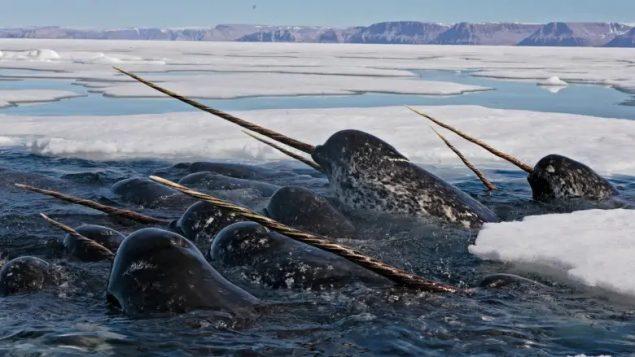
A unique Arctic species, already affected by climate change, could soon be facing another challenge, greatly increased Arctic shipping. ( Paul Nicklen-WWF)

"Narwhals have all the traits that make them vulnerable to vessel disturbances -- they stick to really specific areas, they're pretty inflexible in where they spend the summer, they live in only about a quarter of the Arctic, and they're smack dab in the middle of shipping routes."
"They also rely on sound, and are notoriously skittish and sensitive to any kind of disturbance."
"I think we can learn a lot from areas that have already been thinking about these kinds of conflicts between ships and marine mammal populations -- for example the North Atlantic right whale, or fin and blue whales around California."
"We could aim to develop some mitigation strategies in the Arctic that help ships avoid key habitats, adjust their timing taking into account the migration of animals, make efforts to minimize sound disturbance, or in general help ships detect and deviate from [proximity with] animals."
Kristin Laidre, polar scientist, UW Applied Physics Laboratory's Polar Science Center, study co-author
A freighter in Navy Board Inlet near Lancaster Sound, Nunavut. CNW Group/WWF-Canada
Tens of thousands of bowhead, beluga and narwhal migrate through Lancaster Sound as well as along a part of the central Arctic coast of Russia; both considered to be vulnerable areas for regional wildlife. Although polar bears and seals are both accounted for in the region in great numbers, it is not they who face risks but other Arctic animals more vulnerable to certain harm due to increased, and the expectations of greater increases in sea traffic by ships.

Even though shipping through the passage remains as yet relatively sparse (China is looking to the Arctic to expedite and reduce costs for its vast enterprise of shipping Chinese-made products world-wide) because of the diminishing presence of sea ice responding to climate change and a warming environment in the Arctic, expectations are that each decade will see an approximately 13 percent change both in prevalent ice cover and the ongoing access of the passage to shipping traffic.

The presence of ships influence whales to alter swimming speed or dive rate. That combination of change for vulnerable sea animals can have the effect of driving them out of the territory or cause them to remain in fraught areas where sea ice can rapidly coalesce, freezing the mammals in place. These are also, as it happens, animals on which Arctic Inuit -- whose heritage culture includes hunting of the mammals -- depend upon as a vital food source.
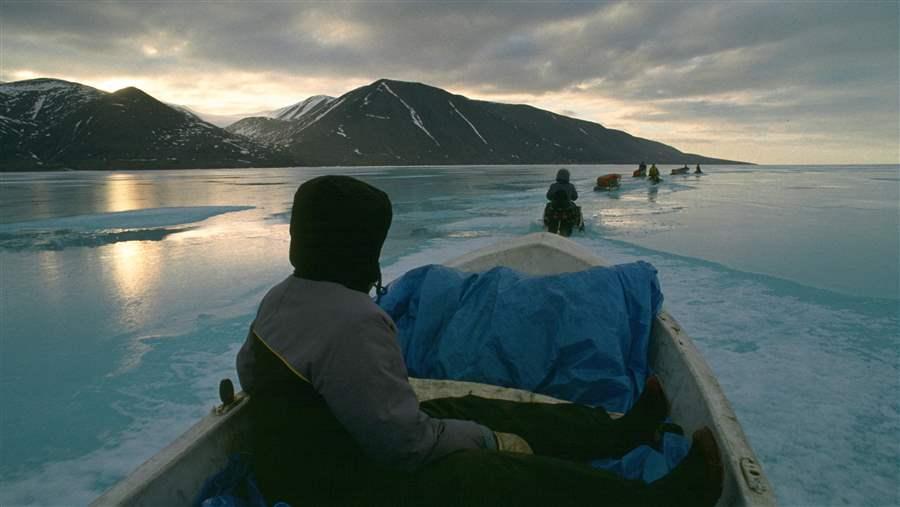
Inuit hunters
Lancaster Sound, at the entrance to Canada’s Northwest Passage, is slated to become the country’s fifth national marine conservation area. Inuit hunters, integral to the protection efforts, rely upon the area’s concentration of marine mammals to sustain their traditional way of life.    © Richard Olsenius/Getty Images

It was only a matter of time before travel through the Arctic Ocean became a target in shortening shipping routes with the discovery of the thinning of the Arctic ice fields. The Russian route appears to present the most potential for commercial ships. The Northern Sea Route hosted over 200 ships from 2011 to 2016, all large vessels. Over 100 vessels passed through the Northwest Passage in that same time frame, more than half of which were small, private vessels such as personal yachts.

Apart from purely commercial shipping on the increase, it also won't be long before passage through the Arctic waters that have for so long been closed to any possibility of marine shipping, will open for tourism entrepreneurship. No better time than the present before all the activities for various purposes become commonplace, impacting on marine life, to set rules and boundaries. And to adequately do that, acquiring reliable wildlife data of the region is a necessity.

Enter Dr. Hauser's and her colleagues' paper published in the Proceedings of the National Academy of Sciences. "We know from more temperate regions that vessels and whales don't always mix well, and yet vessels are poised to expand into this sensitive region. Even going right over the North Pole may be passable within a matter of decades. It raises questions of how to allow economic development while also protecting Arctic marine species." The study represents the first comprehensive survey of the population of vulnerable Arctic marine mammals' exposure to shipping along two main routes to estimate which of the routes and which mammals face the greatest risks from heavier regional traffic.

The researchers examined 80 different populations of narwhals, belugas, bowhead whales, seals, walrus and polar bears making the North their home, the goal being to judge just how vulnerable they would be in the presence of large ships transiting through the territory. The study focused on how habitat could intersect with likely sea routes in the target month of September when ice has its least presence and shipping would be increased as a result.

It is imperative that authorities get this just right; gauging the study results and the concomitant recommendations of the researchers for the purpose of addressing potential harm to Arctic wildlife so dependent on the area they migrate through, to provide the food they require for survival on their traditional migration route. In the best of all possible worlds, commercial shipping could be accommodated with certain restrictions meant to ensure the vital interests of protection of ocean biodiversity.

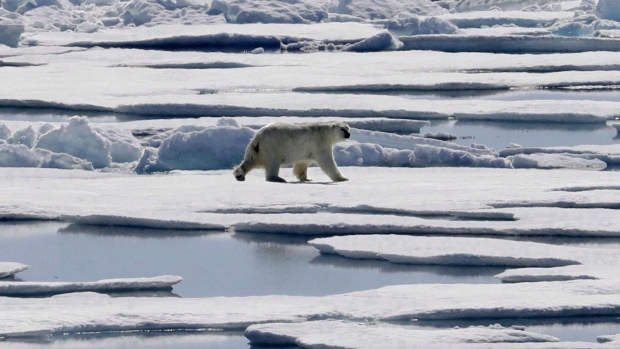
Polar Bear
In this July 21, 2017 file photo a polar bear walks over sea ice floating in the Victoria Strait in the Canadian Arctic Archipelago. New research suggests that increased shipping is likely to make parts of the Northwest Passage among the most dangerous places in the Arctic for the whales and other mammals that live there. THE CANADIAN PRESS/AP/David Goldman

Labels: , , , , , , ,

Sunday, February 18, 2018

"The whole species is essentially female," Mutant Clones : Procambarus virginalis

"It's extremely impressive. Three of us once caught 150 animals [marbled crayfish] within one hour, just with our hands."
"People would start out with a single animal, and a year later they would have a couple hundred."
"Maybe [as a singular species] they just survive for 100,000 years. That would be a long time for me personally, but in evolution it would just be a blip on the radar."
Frank Lyko, biologist, German Cancer Research Center

"If you have one animal, essentially, three months later, you will have 200 or 300. The whole species is essentially female."
"In 2017, they occupy the area [in Madagascar] the size of Ohio. That's a hundred-fold increase in just a decade."
Wolfgang Stein, neurophysiologist, Illinois State University

"Based on what is known about the reproductive behaviour of the marbled crayfish, we do not recommend Canadians keep these animals as pets."
"Human release of animals is one of the ways invasive species are introduced and become established in new areas."
"Unauthorized release of any aquatic animal into a waterbody from which they did not originate is illegal under the regulations."
Becky Cudmore, regional manager, aquatic invasion species program, Fisheries and Oceans Canada 
The all-female marbled crayfish reproduces by cloning — and while it's a relatively new species, there are already huge populations around the world.
The all-female marbled crayfish reproduces by cloning — and while it's a relatively new species, there are already huge populations around the world. (Submitted by Wolfgang Stein)
Crayfish enthusiasts have the option of going along to their favourite pet store to poke about in the aquariums there and pick up a new pet for themselves, a marbled crayfish. In the late 1990s the marbled crayfish attracted the attention of aquarium hobbyists in Germany. Professor Lyko tracked down one individual who bought what the shop owner described to him as a "Texas crayfish", back in 1995. The size of the beast amazed the hobbyist, but nowhere near as much as the enormous batches of eggs it produced.

Hobbyists eventually realized that their female crayfish hadn't come in contact with a male of the species, yet was producing hundreds of eggs at a time. The person whom Dr. Lyko interviewed described his desperate efforts to give away resulting crayfish to friends. They were called marmorkrebs and were available in pet shops throughout Germany. With their popularity, owners realized these crayfish never stopped laying eggs yet had no mates, all their progeny were female and each capable of reproducing.

It was a short distance from acquiring these unique little beasts, observing their reproduction, running out of friends to gift them with, and taking them finally in desperation to local streams, rivers, lakes where they effortlessly and studiously multiplied. And it is these crayfish that Dr. Lyko and his research crew have studied in the past five years, managing to sequence the genomes. The study published recently in the scientific journal Nature, Ecology and Evolution, pointed out that the marble crayfish, now commonly seen around the world, is one of nature's most remarkable species.

A scientific marvel, in the sense that twenty-five years ago they didn't exist. Their amazing proliferation represents one of nature's true anomalies. In that a sole drastic mutation in one lone crayfish produced, in an instant of time, the marbled crayfish as it is known today. The mutation is credited with the capability of the creature to clone itself, and in that quarter-century of existence it has spread through Europe and has entered other continents to spread there as well. Its presence in Madagscar threatens native crayfish; it arrived in 2007 and now numbers in the millions.


"We may never have caught the genome of a species so soon after it became a species", marvelled biologist Zen Faulkes, of the University of Texas Rio Grande Valley, commenting on the study. Scientists, in 2003, confirmed the marbled crayfish absolutely were producing selfclones. Small portions of DNA were sequenced from the animals and a similarity found to a crayfish species called Procambarus, native to Central and North America. It took another ten years and Dr. Lyko and colleagues determined the entire genome of the marbled crayfish.

The Marmorkrebs thrived wherever they landed; initially taken by hobbyists out of their crowded aquariums to local waterways. The crayfish, it would appear, took themselves out of the lakes and streams they began to populate, and walked themselves over to uninhabited waterways to begin colonizing them as well. Marbled crayfish colonies turned up in the Czech Republic, Hungary, Croatia and Ukraine in Europe, and soon enough in Madagascar and Japan. They are now, as well, in North America.

Scientists hypothesize that two slough crayfish likely mated, one of which had a sex cell mutation. The mutant crayfish sex cell had two copies of each chromosome, where normal sex cells contain only one. The two sex cells managed to fuse and the result was the capacity to produce a female crayfish embryo with three copies of each chromosome rather than the normal two.

What is also notable is that no deformities resulted out of that extra DNA. The new mutant crayfish had no need of normal sexual reproduction since she was able to induce her own eggs to divide into embryos, all of which resulted in females inheriting the identical copies of her three sets of chromosomes and themselves capable of multiplying. The rest is scientific history.
Marbled crayfish
An ad selling the marbled crayfish appeared on Kijiji in the Toronto area. (Kijiji)


Labels: , , ,

Tuesday, January 09, 2018

Species at Risk

"I've seen [fungal infection] it go [infected snakes] really, really rapidly."
"[What makes a species susceptible ...?] The trait is being a snake. [The study represents] 'a call to arms' to monitor the potentially devastating infection]."
Frank Burbrink, curator, American Museum of Natural History, New York

"People started being on the lookout [with the realization that snakes were being seen in wider geographic areas infected by the fungus]."
"[It could turn out] that what we're looking at is the tip of the iceberg of this disease. [New analysis] supports the notion that no species is safe."
"Let's start doing our homework, so if the sky does start falling, we can respond quickly."
Jeffrey Lorch, microbiologist, U.S. Geological Survey, National Wildlife Health Center, Madison, Wisconsin
1
Eastern racer (Coluber constrictor) showing signs of fungal skin infection. Obvious external abnormalities are an opaque infected eye (spectacle), roughened crusty scales on the chin, and several discolored roughened scales on the side of neck. Snake captured in Volusia County, Florida, in January 2013 (case 24266). Photograph by D.E. Green, USGS National Wildlife Health Center

From the far northern edge of timber rattlesnakes' habitat in New Hampshire came a report eleven years ago of a discovery of an isolated winter den of the snakes which had undergone a population crash. Signs of inbreeding were detected, but on examination it was also found that skin lesions called hibernation blisters (or hibernation sores) afflicted the snakes. These discoveries alerted the attention of biologists.

And then similar instances of snake populations being afflicted began popping up in Massachusetts, followed by massasauga rattlesnakes in Illinois were also identified as suffering from this mysterious malady. The fungus causing the lesions, Ophidiomyces ophiodiicola, was identified as the culprit by 2009, found to infect over two dozen species of snakes in the United States. Snakes sometimes made a swift recovery from the fungal infection, while others died.

A conservation biologist at the University of Maryland, Karen Lips, collaborated with Drs. Burbrink and Lorch to undertake an analysis of the situation. That study reached the conclusion that vulnerability to the fungal infection was common to all snake species. The research reached its conclusion based on a mathematical analysis of 23 wild-infected species in the United States and two in Europe in a  study of their evolutionary relationships.
3
Northern water snake (Nerodia sipedon) with crusty and thickened scales overlaying raised blisters as a result of a fungal skin infection, captured from island in western Lake Erie, Ohio, in August 2009 (case 22747). Photograph by D.E. Green, USGS National Wildlife Health Center.

The three scientists likened this devastating fungal threat to the existence of snakes to the calamitous fungal infection that has been killing bats, exposed to the virus causing white nose syndrome, as well as other fungal diseases laying waste to frog and salamander populations. White nose syndrome, a fungal disease that appears to have emanated out of Europe has caused millions of bats in North America to die.
Center for Biological Diversity

Since the late 1990s, millions of frogs have succumbed to Chytrid fungi, utterly devastating some frog populations. As a result, salamander species have been banned from import into the United States since a Chytrid fungus represents a threat to them, too. The ultimate damage to these wildlife populations can only be theorized. These are creatures, particularly snakes, that are averse to showing themselves.

Because they remain largely hidden it can be difficult to study them closely and the effect this newly identified disease has on snake populations. Some snakes are seen to survive the fungus, shedding their skin. On the other hand, the fungus is capable of burrowing under the skin, and thus becoming fatal. Moreover, it seems likely that the fungus can live in soil for a period of time, seeking a host to infect.

According to Dr. Lorch, reports of lesions resembling the fungal infection can be dated back to the 1950s and evidence of the disease found in captive snakes go back to around 1980. Although the fungus may be native to North America, it has been discovered to be present in wild snakes in Europe. Now that biologists have been alerted, the hope is that more monitoring of snake populations and allied research may answer more questions.

The hope is that snakes will turn out to be more resistant to the infection than bats or frogs have proven to be, to the fungal diseases that have laid waste to their populations.

Labels: , , ,

Sunday, December 17, 2017

"We used a box with an exchangeable, transparent front featuring a shaped hole at its centre. When an object was successfully inserted through the hole, a collapsible platform inside the box released a tasty nut at the lower end" says Cornelia Habl who conducted the study at the Goffin Lab in Vienna. "The birds selected the correctly shaped objects from a selection of up to five different shapes almost immediately without requiring any training." She continues: "Furthermore, they required fewer placement attempts to align simple shapes (circle, square, triangle) than non-human primates. Another interesting finding was that they turned complex object shapes in a way that would minimise their effort during insertion. For example, a cross shaped object would be turned at 90°, so only two protrusions would have to be inserted instead of four, or an L-shaped object with one protrusion facing forward and backward."

Read more at: https://phys.org/news/2017-11-cockatoos-tool-use-task.html#jCp
"We used a box with an exchangeable, transparent front featuring a shaped hole at its centre. When an object was successfully inserted through the hole, a collapsible platform inside the box released a tasty nut at the lower end" says Cornelia Habl who conducted the study at the Goffin Lab in Vienna. "The birds selected the correctly shaped objects from a selection of up to five different shapes almost immediately without requiring any training." She continues: "Furthermore, they required fewer placement attempts to align simple shapes (circle, square, triangle) than non-human primates. Another interesting finding was that they turned complex object shapes in a way that would minimise their effort during insertion. For example, a cross shaped object would be turned at 90°, so only two protrusions would have to be inserted instead of four, or an L-shaped object with one protrusion facing forward and backward."

Read more at: https://phys.org/news/2017-11-cockatoos-tool-use-task.html#jCp
"We used a box with an exchangeable, transparent front featuring a shaped hole at its centre. When an object was successfully inserted through the hole, a collapsible platform inside the box released a tasty nut at the lower end" says Cornelia Habl who conducted the study at the Goffin Lab in Vienna. "The birds selected the correctly shaped objects from a selection of up to five different shapes almost immediately without requiring any training." She continues: "Furthermore, they required fewer placement attempts to align simple shapes (circle, square, triangle) than non-human primates. Another interesting finding was that they turned complex object shapes in a way that would minimise their effort during insertion. For example, a cross shaped object would be turned at 90°, so only two protrusions would have to be inserted instead of four, or an L-shaped object with one protrusion facing forward and backward."

Read more at: https://phys.org/news/2017-11-cockatoos-tool-use-task.html#jCp

Superior Bird Brains

"Cockatoos are very interesting for this, because they're very playful with objects. [As was one cockatoo producing 'fishing sticks', stripping long slender strips from a wood block in his enclosure]."
"So we had one innovator, [one of the birds named 'Figaro' who spontaneously used sticks to fish out nuts] and a very important aspect of innovation [is] how it can spread in a group."
"This was the interesting thing [that other cockatoos were inspired by Figaro but manipulated the wood in their own way to achieve a similar function]. They were successful and interacting with the materials, but they weren't copying Figaro - they devised their own strategy of obtaining the reward."
"It's very interesting that they come up with this more effective technique. It confirms how innovative and how adaptable this species is to novel problems."
Dr Alice Auersperg, lead researcher, University of Oxford and University of Vienna
Cockatoo stripping a tool from a block of wood (c) A Auersperg
The birds make 'food fishing sticks" by stripping blocks of wood  Photo: A. Auersperg

"It was thought to be an exclusively human ability for a long time [fitting shapes]. Compared to primates, the cockatoos performed very well. [To succeed in various environments] they have to be very, very flexible."
"They did figure out a couple of ways to trick the box. But it was not counted as successful because it was not what I wanted them to do."
"They surprise you every day. Sometimes they outsmart me."
"They are escape artists. They are very, very exhausting in a home environment."
Cornelia Habi, master's student, University of Vienna
The key to a nut
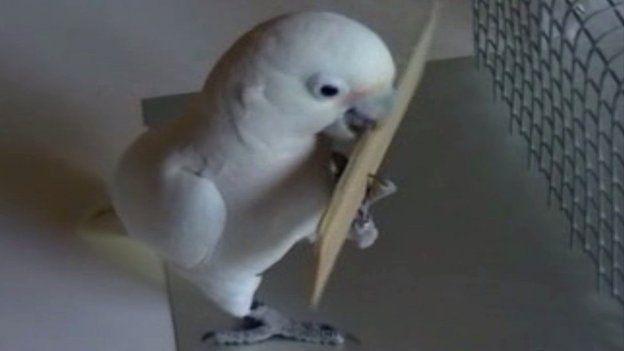
Cornelia Habl Vienna tested Goffin's cockatoos in a tool use task. Credit: University of Vienna

Together with Alice M.I. Auersperg, a researcher at the University of Veterinary Medicine in Vienna, Ms. Habi conducted a number of experiments with Goffin's cockatoos -- extremely intelligent birds, as they discovered throughout the course of their study. As difficult to credit as it may seem on first hearing, these birds were tasked with identifying and placing square tiles into square holes and then moved on to more complex, asymmetrical shapes to be placed in matching holes. The birds were well motivated since success equated with a treat.

The researchers' study, reported in the journal PLOS One, demonstrated that these highly intelligent birds were capable of improving on the performance of monkeys or chimpanzees in matching shapes to holes of similar pattern. Human babies are capable of placing a sphere into a round hole by age one, but placing a cube properly before age two eludes them. Primates are capable of similar tasks once they've had basic training before they succeed in the use of the experimental apparatus, named a 'key box'.

The birds, on the other hand, required no preparation, they proved able to assess the situation without prior exposure, and yet they excelled at the tasks. The researchers' explanation for the cockatoos' capabilities reasoned that the birds are foragers, taking advantage of whatever food that is available and thus sufficiently adaptable to perform well in some urban areas in Australia. To enable them to succeed, flexibility is a great aid.

Their very flexibility enabled the birds to figure out how they might exceed the parameters of the experiment to find the treat they craved. A video showed one bird tearing a splinter off a chair, using it to pry the apparatus open without having to match a shape to a hole. They are evidently experimentally ingenious. But their clever bypassing of the parameters earned them no kudos. They had to play within the rules of the game to earn their treats. Don't we all?

The key to a nut
The animals had to choose the correct 'key' out of five. Credit: Bene Croy

Labels: , ,

 
()() Follow @rheytah Tweet