Ruminations

Blog dedicated primarily to randomly selected news items; comments reflecting personal perceptions

Thursday, October 08, 2020

Fancy Over Fact and Function

Truth vs. Myth: Is Using an Exercise Ball to Replace Your Office Chair a Good Idea?

"Although the existing body of literature is small, and the studies have limitations ... the literature to date does not suggest significant health benefits to justify unstable sitting as a health promotion practice."
"Increased movement of the spine, if beneficial, should reduce disc shrinkage because the beneficial movement would increase fluid exchange within the intervertebral disc."
"The loss in spinal height due to intervertebral disc shrinkage calls into question any benefits on the spine."
"Anecdotal evidence among ergonomics professionals of people falling from the free-rolling stability balls [speak to a lack of stability]."
Brian Lowe, research industrial engineer, National Institute for Occupational Safety and Health, Centers for Disease Control and Prevention
"[...Prolonged sitting on a stability ball does not greatly alter the manner in which an individual sits, yet it appears to increase the level of discomfort. The amount of movement that these unstable surfaces allow for really is not so much more so that the benefits outweigh the potential consequences."
"I would say, maybe work up to an hour, but at the end of the day, I don't think anyone should be sitting longer than an hour, even in a fancy office chair."
"[Get up, move about]. That's going to be so much more beneficial than anything you're sitting on to begin with."
Diane Gregory, associate professor, Department of Kinesiology and Physical Education, Wilfred Laurier University, Waterloo, Ontario

"Using an unstable surface allows those muscles to be turned on."
"The bigger picture is that a healthier way to sit is varying what we sit on. It's also important to pay attention to posture and get up and move as often as possible, even if it is just for a few seconds."
Tessa Elliott, physical therapist, Atlanta

exercise ball

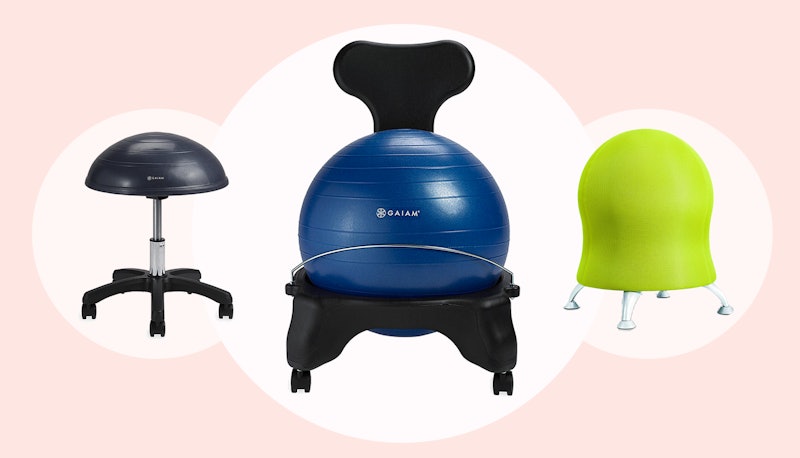
Replacing your desk chair with a stability ball seems like a good way to sneak in some core exercise while you work. But how effective is it, really? Sitting on a chair requires no muscle activity at all and it actually hurts us for a number of reasons, says John P. Porcari, PhD, FACSM, exercise physiologist at the University of Wisconsin, LaCrosse

 
Choosing to balance on an unstable surface requires core engagement; abdominal, lower back and pelvic muscles brought into action. Theoretically engaging the body core aids it to become stronger which should in turn improve posture and reduce back pain. All of which makes sense, when connected to the use of balance balls in preference to desk chairs to gain similar benefits. It's just that, as pointed out by Brian Lowe, research industrial engineer, the theory does not have the support of science.

Stability balls have been promoted by manufacturers, that's what they do, after all, engage in positive public relations for the purpose of gaining notice and customers for their products. So their product is promoted both as workout equipment and as office type 'furniture', with claims that their use as desk chairs will result in improved posture out of which a core-strengthening workout is facilitated. Claims which have made stability balls' use in lieu of office chairs popular for years.

Along with colleagues, Lowe published a commentary in the American Journal of Health Promotion expressing caution over the claims of the balls' superior function and health and fitness properties advanced by the manufacturers and enthusiastically taken up by fitness gurus. The commentary based its conclusions partially on published papers, one of which was a study out of Professor Gregory's lab.  One other study cited by Lowe focused on "spinal shrinkage"; a decrease in spine height as a result of the discs flattening between the vertebrae.

Then there is the promise of burning extra calories as a result of balancing on a stability ball. According to two studies measuring the variance between sitting on a regular chair or on a stability ball, the conclusion was reached that the difference came out to about four calories per hour. In sum, the loss of roughly 30 calories over an eight-hour period of balancing on a stability ball. 
 
Stability balls in fitness routines have their place, but participating in a workout requiring core activities day-long, reflecting their use as office chairs makes little sense, points out Dr.Gregory: "We don't want to have a muscle activated and then stay activated for a period of time".

According to physical therapist Tessa Elliott, the balls can be of help to patients looking to build endurance in their deep abdominal muscles: "Using an unstable surface allows those muscles to be turned on", she explained, as part of a team at Armstrong State University in Savannah, Georgia, comparing stability balls with desk chairs in a 2016 study that concluded sitting on a stability ball failed to reduce lower back pain, while it did improve endurance in the muscles controlling forward and backward movement.
  • Stability balls do not provide any inherent benefits in the absence of other physical training and workstation interventions
  • Over a prolonged period of sitting (one hour) no differences in trunk muscle activation patterns were observed, suggesting the ball does not aid in core strengthening
  • The ball does not actually provoke an improved posture as no differences were found in lumbar spine posture
  • Individuals complained of more discomfort when sitting on the stability ball
  • Use of ball as a chair may increase the risk of developing low back discomfort and increase the risk of sustaining an injury due to the unstable nature of these balls.
Centre of Research Expertise for the Prevention of Musculoskeletal Disorders (CRE-MSD)\, University of Waterloo

Labels: , , ,

Monday, November 11, 2019

Fat and Fit? Lean and Fit? Which Works?

"There is a general consensus out there that a fat person is basically a premature death waiting to happen."
"The only conclusion is that [the focus on weight] has not worked -- it literally, on a population level, has not worked. And it's insane to think it's going to work in the future if we just tried a little bit harder."
"It's far easier to get a fat person fit than it is to get a fat person slim."
"The lowest mortality rates of anyone in America are those considered overweight. So, people with a BMI of 25 to 30 have better prospective for longevity than people in the so-called normal weight or healthy weight range."
Dr.Glenn Gaesser, professor, exercise physiologist, Arizona State University, Phoenix

"At the population level, so-called metabolically healthy obesity is not a harmless condition and perhaps it is best not to use this term to describe an obese person, regardless of how many metabolic complications they have."
Dr.Rishi Caleyachetty, University of Birmingham, England

"I don't believe in the concept of the metabolically healthy obese."
"I think the fit, fat guy is not as healthy as the fit, lean guy."
Dr.Eric Ravussin, director, Nutritional Obesity Research Center, Pennington Biomedical Research Center, Baton Rouge, La.
Image result for obesity and fitness
Penn State

Dr. Gaesser of Arizona State University remains convinced that morbidly overweight people exposed to exercise regimens can reverse their future health prospects without dieting; focusing instead on becoming fit. It has been his experience, just as it has been every other scientist in the field of health science that simply put, diets don't work. They may have an initial pleasing effect in shedding some weight, but dieters tend to bound back to their original weight, proving that dieting in general is an exercise in futility.

On the other hand, he and Steven Blair, professor emeritus at University of South Carolina, pointed out in a paper published in Medicine & Science in Sports & Exercise that the cardiovascular system, lungs and muscle fitness can be viewed as a more instructive predictor of disease and death, than can obesity, and with exercise an improvement of significant proportions in those indexes can be achieved. Not that he suggests that the state of obesity is benign, simply that it can be substantially mitigated. "Nor do we contend that we should be complacent about obesity or ignore it"; rather, working toward fitness is a superior goal than struggling with weight loss, they aver. 

Apart from radical surgery, they point out with confidence, scant few other solutions serve to lose weight and to keep it that way, The annual probability of an obese individual managing to attain a "normal" body weight was about one in 210 for men and one in 124 for women over a follow-up of nine years' duration, according to a 2015 study published in the American Journal of Public Health. And for men with "morbid" obesity (a BMI of 40 or higher), those odds soared to one in 1,290, and one in 677 for women.

Weight cycling -- where huge amounts of of weight are lost and then regained can be dangerous. As weight is regained, fluctuations in blood pressure, heart rate and circulating levels of blood fats and insulin result, increasing the risk of a heart attack or stroke, according to studies. The risk of dying was lower for overweight than for normal weight adults according to one study in 2016 which made use of U.S. national health data, even though the data were adjusted for smoking and pre-existing conditions such as diabetes, cancer, cardiovascular disease, asthma and kidney disease.
Related image
Rohitshyokan.com

On the other hand, bypassing the dieting option and focusing instead on exercise with a goal to improving fitness -- blood pressure, blood fats and blood sugars improve and people realize a lesser risk of depression and anxiety. "They feel better and move around more", added Dr. Gaesser. "Their quality of life improves." He points to the inescapable reality of the great numbers of Americans who rely on diets to lose weight, despite which the obesity issue has continued to rise notably over that same period of decades where 25 to 50 percent of the population dieted.

Cardiorespiratory, or aerobic fitness, he insists, is the more successful route to take to achieve overall health fitness. Backing up their fit-fat hypothesis was a 2014 meta-analysis of close to 93,000 people, where it was found that those who are fit, whether of normal weight, overweight or obese status, ended up with similar survival rates whereas the unfit experienced twice the risk of dying from any cause during follow-up. "Fit individuals who are overweight or obese are not automatically at a higher risk for all-cause mortality", the study authors had written. Everyone, "including those unable to lose weight or maintain weight loss" might see comfort in that conclusion.

Related image
Generalhealthmagazine.com

The exercise regimen recommended was by no means unduly onerous, rather the recommendation was for regular, moderate physical activity, about 150 minutes of brisk walking or cycling weekly, whose effect seemed to diminish some of the negative consequences of obesity. On the other hand, a 2017 study viewing 3.5 million obese men and women discovered an increased risk of coronary artery disease and a doubled risk of heart failure in comparison to normal-weight men and women in follow-up checks five years later, including those who were initially "metabolically healthy".

Labels: , , , ,

Monday, October 22, 2018

Fitness Instructors Should Stick to Their Field of Expertise

"Given that our results demonstrate limited nutrition knowledge among exercise professionals, the accuracy and effectiveness of the nutrition advice provided must be questioned, particularly with regards to specific medical nutrition advice."
Australian research, University of Sydney

"Gym members like the idea of one-stop shopping. But I don't advise people on how to squat, and trainers shouldn't give advice on how to eat."
"A lot of damage can be done when it comes to offering advice about food. People start to believe that if they follow a particular diet, they will be strong, healthy, thin and accepted. Yet no studies have shown that diets are successful in the long run."
"Of course clients are going to want to talk about food, but that doesn't mean trainers need to have all the answers. Instead, they should let their clients know that their role is to help them get fit and strong."
"Fitness trainers should be a source of body positivity. They should stay away from diet talk and teach people how to move through life with strength and in good health."
Lisa Rutledge, dietitian, McGill University Comprehensive Health Improvement Program

Discussion: The primary finding of this investigation is that the majority of REPs [registered exercise professionals] who completed the questionnaire provide individual dietary advice to their clients, including advice relating to underlying medical conditions (i.e. medical nutrition therapy), suggesting this is common practice within the industry. This clearly breaches REPs scope of professional practice, which limits advice to the provision of general non-medical nutrition information in accordance with nationally endorsed evidence-based guidelines that is not individually tailored. This is concerning given exercise professionals training curriculum has limited nutrition education and the majority undertake no (40 per cent) or limited (25 per cent) post-fitness course nutrition-specific professional development opportunities. This reinforces a need for the industry to enforce clearly defined professional boundaries and facilitate a collaborative multi-discipline approach to client servicing in order to deliver a holistic approach to lifestyle modification and favourable fitness and health outcomes.
Research paper: Do the nutrition qualifications and professional practices of Registered Exercise Professionals align?
Research team: Mark R McKean, Gary Slater, Florin Oprescu, Brendan J Burkett
Published: International Journal of Sport Nutrition and Exercise Metabolism
According to dietitian/nutritionist Lisa Rutledge a diet culture exemplifies the culture of the gym which fits right in with what most people readily relate to, equating exercise with weight loss. The diets that promise larger muscles and improved athletic performance seem a natural fit to those who subscribe to exercise+diet. Which, in turn, leads trainers to believe they are competent to provide diet advice, while dispensing exercise best practices at the same time. This, despite a lack of training and knowledge in counseling clients on accurate dietary goals.

Australian researchers out of University of Sydney set out to recruit 161 fitness trainers, 36 dietitians and 357 people representing the general community of those devoted to enhancing their health by exercise and diet. A questionnaire was designed to evaluate nutritional expertise which was divided in four sections comprised of dietary guidelines, food content of nutrients, healthy food choices and awareness of diet/disease relationships, with a goal to determine where trainers ranked compared to dietitians and the general public.
working-out-at-home
Australian Fitness Academy

The trainers scored significantly lower than dietitians in three of four sections; the sole area in which trainers and dietitians both registered like numbers of correct answers was healthy food choices. The standout area where trainers' awareness was higher compared to community respondents was their understanding of nutrient content. Having an undergraduate degree in exercise science failed to aid trainers score higher on the questionnaire than peers lacking a related degree.

The same research group in Australia concluded that 51 percent of 286 fitness professionals polled in an earlier study stated they provided nutritional advice with respect to heart disease; 48 percent counseled about nutrition, diabetes and blood sugar; 44 percent discussed supplements; 39 percent talked with clients about nutrition deficiencies; and 35 percent gave advice relating to food allergies and food intolerance. Leading dietitian Rutledge to point out that such guidance has the potential to guide individuals toward disordered eating.

The Australian researchers came to the conclusion that a recommendation that fitness professionals remain wedded to their scope of expertise and not reach out into a related, but entirely inappropriate inclusion of another type of expertise they are clearly not equipped to handle must be urgently recommended. Should gyms wish to continue add-on benefits of informing clients on nutrition, the best possible way is to refer clients to professional nutritionists, or to commit to having a dietitian on staff for consultations.

Nutrition Support | Body Composition

Labels: , , , ,

Friday, October 05, 2018

'No Pain, No Gain'? Outdated Concept

"It was so painful, but I was stubborn and finished out the race. Afterward, I could barely walk."
"If I say I'm going to complete a goal, however, I'm going to complete it."
"I regret that I couldn't pull the plug psychologically."
Janet Sherman, 57, Wyoming
leg stretch

"As a society, we are more active in sports than ever before. But at the same time, as a culture we have developed a 'no days off' mentality."
"People worry that if they stop, they won't start again."
"Leave some time in there for taking care of yourself, and make it an integral part of your training."
Adrienne Langelier, sports psychology consultant, Texas

"'No pain, no gain' -- no thank you. For too long, we have glamorized that way of thinking. It's not sustainable."
"We were given the message that in order to succeed, we needed punishing workouts. In the short term, that might work, but the burden of proof now shows that it's damaging in the long run."
Mark Cucuzzella, physician, professor, West Virginia University School of Medicine

"A stress fracture, if you continue to run on it, may progress to a full fracture and require a much longer recovery period, for example."
Adam Teneford, Spaulding National Running Center, Harvard Medical School

"I see amateurs who want to train like pros, and they end up getting hurt. They forget that pros have a schedule that allows for all the rest and recovery they need, without a job interfering."
"The rest of us need to balance our hard training with low- and no-effort training."
Jonathan Levitt, 28, sales manager, Boston
 There are a whole range of health risks associated with excessive exercise
There are a whole range of health risks associated with excessive exercise     Credit: Getty Images

Jonathan Levitt is so utterly convinced of the need that people addicted to sports have a requirement to believe that stress, no matter where it emanates from really is stress, and fundamentally harmful both psychologically and physiologically, that he became one of three people committed to making an effort through the proliferation of warnings over remaining too focused on a goal to understand that harm comes with a lack of awareness, stimulating them to create the social media hashtag #restdaybrags.

He made common cause with two well-known names in sport, U.S. Olympic swimmer Caroline Burckle and Spartan course racer Amelia Boone to unveil that effort almost two years ago. The message is making inroads finally in peoples' consciousness. Amateur athletes and so-called week-end warriors have for far too long set aside the pain that informs them they're doing themselves harm, opting instead to grind through the pain to accomplish the goal at hand; finishing a race, pushing themselves beyond a safe limit opting completion of a course.

Arguing with themselves that the discomfort is temporary, and they'll 'get over it', convincing themselves that there's nothing amiss. People tend to automatically run through their minds how their dedication to sport fitness came at the cost of time and physical effort, that to slack down even briefly would have the potential of setting them back from the fitness level they've managed to reach and complicate their goal to up the ante to challenge their bodies even more.

It's that will to ignore the signals the body is sending through pain messages, that all too frequently leads to injury, illness and exhaustion, all of which should be avoided for that's when the true complications set in, limiting the capacity of the body to continue its upward thrust to the next fitness level. Already in pain because of the grim and false belief that to stop is to admit defeat, carrying on invariably leads to a secondary injury.

What mindfulness in recognizing the body's messages and the injuries that can occur without a rest, is required to incorporate that needed break into the entire concept of the training effort, represents an integral and necessary acknowledgement that enough is enough, before carrying on.

Signs You May Need a Break

  • Fatigue or physical exhaustion
  • Soreness that won't go away
  • Dreading your workouts
  • Poor performance
  • You're not able to progress in your workouts
  • You feel unmotivated or bored
  • An injury or illness
  • You can't stand the thought of exercising
  • You have a trip coming up and you know you won't have the time or motivation for full-blown workouts

How Long Does It Take to Lose Fitness? 

The question is, whether you're taking a break by choice or because you have to, how long can you take a break before it affects your fitness? Some basic statistics:
  • Aerobic power can decline about 5-10% in three weeks.
  • It takes about 2 months of inactivity to completely lose the gains you've made.
  • Extremely fit exercisers will experience a rapid drop in fitness during the first three weeks of inactivity before it tapers off.
  • Muscular strength and endurance last longer than aerobic fitness. Muscles retain a memory of exercises for weeks or even months.
verywellfit

Labels: , , ,

Saturday, March 03, 2018

Common Sense Where Art Thou!?!

"I thought if I had one bite or sip of something 'bad' like candy, bread, 'processed' food or 'toxins' like alcohol, it would unravel all of the 'progress' I had made and taint my spotless health routine."
"I was able [after direction from a therapist and nutritionist] to walk back my rigid thinking around what I'm 'allowed' to eat, eating and exercising on a certain schedule, and defining  healthy as being thin, toned, and free of 'bad' food in my body."
Hannah Matthews, 30, writer
Woman taking photo of pumpkin soup with smartphone
Photograph: Alexandra Iakovleva/Getty

But not before this woman, who had fixated on the "eat clean" and "clean eating" movements geared to directing people concerned over their physical image -- their health profile, their weight and presence on social media sites as virtuously knowledgeable about what constitutes food choices that harness a healthy outlook to one's future -- placed her own health in jeopardy. The movement that insists sugars, gluten, processed foods and anything falling into the category of delicious should be one's guide in healthful eating had captured her entirely.

She became so hyperconscious that, in the process of following all these instructions to the nth degree she developed, she now believes, orthorexia, a designation characterizing someone unhealthily food-obsessed; which is to say 'healthy' eating dominating their every thought of food, ensuring that no type of food that normal people sometimes crave must ever pass their lips. Ms. Matthews' devotion to this restricted diet and exercise routine found her malnourished and developing heart problems.

When she took the direction of a health therapist and the advice of a nutritionist, learning how to restore a normal relationship with food, her health took a turn for the better. She began to train herself to think more deeply and less compulsively about her approach to food with the understanding that this represented a life-and-death issue for her, to reform her compulsion to refuse to eat anything forbidden and focus solely on the approved food items.

A backlash has arisen in the United Kingdom to the paradigm of clean eating; influential cookbook writers who had once helped to popularize 'clean eating' are now creating a distance between their professional profiles and the trend that has led to disordered eating and unhealthy food habits. British writers and chefs have begun to raise red flags about taking clean eating too seriously. The author of cookbook Flavour: Eat What You Love, Ruby Tandoh, has spoken out on the clean eating issue as a "bad fad".

She has criticized clean eating for its part in "precarious health claims and a trend-driven food press, all underpinned by an unaltering disdain for fat bodies." Swearing on the properties of coconut oil, of spiralized zucchini noodles and raw vegan juice serves to deprive the body of fibre through the exclusion of pulp, pointed out British food writer and historian, Bee Wilson. "We are once again living in an environment where ordinary food, which should be something reliable and sustaining, has come to feel noxious", she wrote.
"They're marketing these diets based on pseudo-science, and that's what I have a problem with."
"Judging by my Twitter feed, it's [the clean eating movement] only gaining steam. We live in a random post-truth world, driven by social media, and it permeates a lot of fad diets and the pseudo-science of Gwynneth Paltrow."
"Telling people to eat a little less of everything isn't going to make me a million bucks on Instagram".
Dr. Giles Yeo, geneticist, University of Cambridge, BBC presenter of Clean Eating: The Dirty Truth documentary
A study focusing on the issue of clean eating based on recommendations to cut out whole food groups like dairy concluded that adherents of clean eating are at a higher risk of weakened bones leading to the potential of osteoporosis and fractures. A more recent and smaller study of over 100 people found that those declaring themselves a "clean eater" leave the impression they are neurotic and unlikeable.

Michael Pollen, author of In Defense of Food appeals: "Eat food, not too much -- mostly plants". At a time when most people are aware that processed food diets are unhealthy and whole foods represent an antidote to fast food and processed food as a healthy alternative, combined with the fact that fresh fruits and vegetables and whole foods are more accessible in a wide range of types and prices ensures that the choice is there and is attainable.

As in all matters of reason and reasonableness, moderation is the key. Eat well, choosing whole foods, focusing primarily on fruits, vegetables, grains, dairy products, fish, extra virgin olive oil, and poultry - all in reasonable, moderate amounts for optimum health outcomes. Supported by regular exercise of a recreational variety, including walking.

Labels: , , , ,

 
()() Follow @rheytah Tweet