Ruminations

Blog dedicated primarily to randomly selected news items; comments reflecting personal perceptions

Thursday, January 31, 2019

Pesticide Threats to Human Health

"Glyphosate-based products have been used safely and successfully for over four decades worldwide and are a valuable tool to help farmers deliver crops to markets and practice sustainable farming by reducing soil tillage, soil erosion and carbon emissions."
Bayer AG statement

"When it comes to Roundup they’re [governments] dead wrong. And I know they’re dead wrong because when you look at the science it’s pretty clear."
"[Government regulators are not] truly unbiased."
"If tomorrow they decided ‘you know what, it actually does cause cancer,’ they’d have to tell the world that for 40 years they’ve been wrong, that people have been dying under their watch."
"It’s a lot easier to keep the status quo."
Brent Wisner, U.S. attorney, Los Angeles-based
Bottles of Monsanto's Roundup pesticide are pictured in a gardening store.
PHILIPPE HUGUEN/AFP/Getty Images
Canada is "dead wrong" two visitors to Canada stated unequivocally, in not recognizing that the manufacturer of the glyphosate-based weed killer Roundup, is a threat to people coming in contact with it. The two, Michael Bauman and Brent Wisner were on the team of lawyers that managed to succeed in persuading the U.S. justice system to find for their client, a former groundskeeper who believes his terminal cancer resulted from years of exposure to the herbicide glyphosate, Roundup. 

Their client was the beneficiary of a court that ordered Bayer AG to pay $289 million, later dropped to $78 million, a significant agreement of the danger inherent in the use of the weedkiller. It is an order that the company is appealing, but over 11,000 additional plaintiffs in the United States are suing the Germany-based Bayer which since 2018 when it bought out Roundup maker Monsanto is left with the product they continue to persist in stating has no health risks to humans.

Lawyer Baum knows of no Canadians that have brought suit over Roundup, but he and his colleague Wisner arrived in Ottawa to meet with Members of Parliament on Parliament Hill to acquaint them with the issue, explaining evidence that proves glyphosate causes cancer. "There's going to be the same type of injuries suffered here", he assured skeptics.

The two lawyers will continue on to Toronto to work with Canadian activists and lawyers in a bid to determine how most effectively to proceed, with the intended purpose  of potentially beginning court action, according to CEO of Friends of the Earth, Beatrice Olivastri. "We're actively looking for ways forward in litigation", she stated.

Lawn care
American lawyers who successfully sued the makers of the glyphosate-based weedkiller Roundup on behalf of a man dying of cancer say Canada is "dead wrong" to allow it to be widely used here. (File)
On the market for over forty years, glyphosate has its appearance in over 130 products available for use in Canada. The Pest Management Regulatory Agency branch of Health Canada has just recently re-approved glyphosate for use in the country following a process of review, including reviewing their assessments in the past following objections filed by eight organizations. Objections that included allegations that Monsanto improperly influenced evidence that Health Canada relied on to determine the safety of the product.

Agency scientists "left no stone unturned", discovering no evidence the science was tainted, according to Connie Moase, director in the health-effects division of Health Canada. Canada's review of glyphosate was thorough and proper, proving yet again that it is a safe product, stated Bayer, noting glyphosate is approved for use in 160 countries. "Twenty of our best scientists" reviewed the evidence before approving the project, stressed a spokesperson for Canada's Minister of Health. 

According to lawyer Wisner, the unbiased International Agency for Research on Cancer -- a specialized agency of the World Health Organization -- scientists were unanimous in concluding glyphosate is a human carcinogen. The glyphosate decision has caused a "crisis in confidence in Canada’s pesticide police", according to Ms. Olivastri of Friends of the Earth, Canada.

Side Effects Associated with Monsanto Roundup

Adverse side effects that have been allegedly linked to use of glyphosate products including Monsanto's Roundup include:
  • Non-Hodgkin’s lymphoma
  • Leukemia
  • Brain cancer
  • Lung cancer
  • Testicular cancer
  • Thyroid cancer
  • Lymphoma
  • Kidney disease
  • Liver disease
  • Nerve damage
  • Multiple sclerosis
  • Parkinson’s disease
  • Diabetes
  • Infertility
  • Birth defects
Consumer Safety Watch   

Labels: , , , , , ,

Friday, October 05, 2018

'No Pain, No Gain'? Outdated Concept

"It was so painful, but I was stubborn and finished out the race. Afterward, I could barely walk."
"If I say I'm going to complete a goal, however, I'm going to complete it."
"I regret that I couldn't pull the plug psychologically."
Janet Sherman, 57, Wyoming
leg stretch

"As a society, we are more active in sports than ever before. But at the same time, as a culture we have developed a 'no days off' mentality."
"People worry that if they stop, they won't start again."
"Leave some time in there for taking care of yourself, and make it an integral part of your training."
Adrienne Langelier, sports psychology consultant, Texas

"'No pain, no gain' -- no thank you. For too long, we have glamorized that way of thinking. It's not sustainable."
"We were given the message that in order to succeed, we needed punishing workouts. In the short term, that might work, but the burden of proof now shows that it's damaging in the long run."
Mark Cucuzzella, physician, professor, West Virginia University School of Medicine

"A stress fracture, if you continue to run on it, may progress to a full fracture and require a much longer recovery period, for example."
Adam Teneford, Spaulding National Running Center, Harvard Medical School

"I see amateurs who want to train like pros, and they end up getting hurt. They forget that pros have a schedule that allows for all the rest and recovery they need, without a job interfering."
"The rest of us need to balance our hard training with low- and no-effort training."
Jonathan Levitt, 28, sales manager, Boston
 There are a whole range of health risks associated with excessive exercise
There are a whole range of health risks associated with excessive exercise     Credit: Getty Images

Jonathan Levitt is so utterly convinced of the need that people addicted to sports have a requirement to believe that stress, no matter where it emanates from really is stress, and fundamentally harmful both psychologically and physiologically, that he became one of three people committed to making an effort through the proliferation of warnings over remaining too focused on a goal to understand that harm comes with a lack of awareness, stimulating them to create the social media hashtag #restdaybrags.

He made common cause with two well-known names in sport, U.S. Olympic swimmer Caroline Burckle and Spartan course racer Amelia Boone to unveil that effort almost two years ago. The message is making inroads finally in peoples' consciousness. Amateur athletes and so-called week-end warriors have for far too long set aside the pain that informs them they're doing themselves harm, opting instead to grind through the pain to accomplish the goal at hand; finishing a race, pushing themselves beyond a safe limit opting completion of a course.

Arguing with themselves that the discomfort is temporary, and they'll 'get over it', convincing themselves that there's nothing amiss. People tend to automatically run through their minds how their dedication to sport fitness came at the cost of time and physical effort, that to slack down even briefly would have the potential of setting them back from the fitness level they've managed to reach and complicate their goal to up the ante to challenge their bodies even more.

It's that will to ignore the signals the body is sending through pain messages, that all too frequently leads to injury, illness and exhaustion, all of which should be avoided for that's when the true complications set in, limiting the capacity of the body to continue its upward thrust to the next fitness level. Already in pain because of the grim and false belief that to stop is to admit defeat, carrying on invariably leads to a secondary injury.

What mindfulness in recognizing the body's messages and the injuries that can occur without a rest, is required to incorporate that needed break into the entire concept of the training effort, represents an integral and necessary acknowledgement that enough is enough, before carrying on.

Signs You May Need a Break

  • Fatigue or physical exhaustion
  • Soreness that won't go away
  • Dreading your workouts
  • Poor performance
  • You're not able to progress in your workouts
  • You feel unmotivated or bored
  • An injury or illness
  • You can't stand the thought of exercising
  • You have a trip coming up and you know you won't have the time or motivation for full-blown workouts

How Long Does It Take to Lose Fitness? 

The question is, whether you're taking a break by choice or because you have to, how long can you take a break before it affects your fitness? Some basic statistics:
  • Aerobic power can decline about 5-10% in three weeks.
  • It takes about 2 months of inactivity to completely lose the gains you've made.
  • Extremely fit exercisers will experience a rapid drop in fitness during the first three weeks of inactivity before it tapers off.
  • Muscular strength and endurance last longer than aerobic fitness. Muscles retain a memory of exercises for weeks or even months.
verywellfit

Labels: , , ,

Monday, October 30, 2017

Gender Variables in Sports Concussions

"There are several possible explanations [respecting why girls take longer than boys to recover from concussions]."
"Boys have a greater neck musculature than females. So, during the mechanism of injury that causes the concussion, girls' necks and heads may whiplash more than boys'. The greater these accelerations and decelerations [especially the rotational aspect], the greater the strain on the brain."
Dr. Roger Zemek, concussion specialist, Children's Hospital of Eastern Ontario, Ottawa

"In the twelve years I've been doing this [studying and treating concussions in children], you do see a bit of that bravado [typical of boys' behaviour], girls saying they can play through a concussion and not report the symptoms."
Dr. Kristian Goulet, concussion specialist, Children's Hospital of Eastern Ontario

"We have known for at least the last decade that females who participate in similar sports as males have higher rates of concussion."
"Boys and girls likely have different recovery courses, but we have to treat each concussion individually."
"Adult coaches need to create an environment and culture for their players that stresses that a concussion is an important injury to not downplay and encourage the reporting of symptoms."
Dr. Mark Halstead, director of the Sports Concussion Clinic at St. Louis Children’s Hospital
Concussion Recovery Is Slower in Girls, Mounting Evidence Suggests
Credit: Image Source Getty Images
"More females had preexisting migraines and mental illness which may be very important and more so than inherent biological differences."
"Larger studies that specifically examine sex biology are needed to understand the effect of sex on recovery trajectory after concussion."
Dr. Monica Vavilala, director, Harborview Injury Prevention and Research Center (HIPRC), University of Washington, Seattle

"First and foremost, the current findings highlight the importance of seeking proper care following a concussion."
"There are a lot of treatment interventions from behavioral management to vestibular and vision therapy that help athletes recover from concussions. "
"However, a large number - estimates are as high as 55 to 60 percent - of young athletes with concussions do not receive clinical care beyond the initial diagnosis."
Anthony Kontos, research director, Sports Medicine Concussion Program, University of Pittsburgh 
Sports concussions may affect girls differently than boys.
Photo: Consumer Reports

A study was published in the Journal of the American Medical Association (JAMA) in 2016 of which Dr. Zemek was the lead researcher. This was a comprehensive bit of research where over three thousand children, both boys and girls between the ages of five and 18 were part of the study, although over 8,000 children had been screened to gather data from five centres. Girls were involved in close to half of the concussions studied. The study concluded that girls and boys experience concussion rates matching the sport involved.

Other studies predating this one were cited along with the data gleaned for this study, all concluding that girls are at a much higher risk in lengthier recovery time than are boys. They are consequently more susceptible to post-concussion syndrome that takes a longer period of time to surmount. Basically it is a matter of anatomical and physiological differences between the genders, although it was also postulated by Dr. Zemek and other researchers as well, that hormone-specific differences could also factor into the duration and intensity of concussions.

Historically, however, females are also recognized as being more open about symptoms of physical harm and stress, reporting when physical contact of a violent nature has resulted in injury. Boys, on the other hand, tend to downplay injury, unwilling to appear to their peers as unable to take a knock. That kind of reaction and suppression of injury is also typical of the masculine character, the stiff upper lip to prove you're a 'man', and can 'take it'. Things are changing, however, in the world of sports with the growing awareness of the serious harm done by suffering concussions.

Data out of a 2015 study published in the British Journal of Sports Medicine pointed out higher rates of concussions for females playing soccer, and alternately, higher concussion rates for males in lacrosse and basketball. Scientific American earlier in the month highlighted a report revolving around a study of over 200 boys and girls in middle and high school in the U.S. The 110 boys and 102 girls had suffered their first concussions playing football, field hockey and wrestling.

The average recovery time from concussions for the boys in the study turned out to be eleven days, while the girls required 28 days for recovery. At a presentation for a symposium by the Concussion Legacy Foundation and the University of Ottawa brain and mind research institute, Dr. Zemek spoke of a prototypical case of concussion where he presented a hypothetical 14-year-old girl in a soccer collision who recalls what had occurred, didn't lose consciousness and didn't suffer amnesia.

"She was unsteady on her feet when evaluated. She was slow to answer questions. She has a headache, and feels foggy", he went on of the imaginary girl's first bout with a concussion with a background of never having suffered migraine headaches. The purpose of the example was to emphasize that what might at first reckoning appear to be a low-risk situation -- no concussion history, no loss of consciousness -- might in fact reflect someone at high risk for lingering concussion symptoms.

About one thousand concussion cases are seen and treated annually at the Children's Hospital of Eastern Ontario, a number that has quadrupled over the past ten years, as a result of increased public awareness of the prevalence and danger of concussions, all the more so if they're simply dismissed out of hand. From 2011 forward the number of reported instances of concussion doubled in the following year. And according to Dr. Zemek, one in five Canadians have had, or will suffer a concussive event.

"It wasn't necessarily a change in diagnosis, or a change in how we code it when we present to the emergency department. It was because of a high profile person -- and I think most of us in Canada know who that is [Sidney Crosby], and he missed the playoffs that year because of a concussion. The silver lining? His injury impacted awareness", concluded Dr. Zemek.


Labels: , , , ,

Monday, September 11, 2017

Enduring Reality ... Overcoming

"I try not to think about it, but every single day, I'm reminded of it. I can't forget, because when I wake up in the morning, my legs are still gone, my arms and hands are still damaged. I'm still in a wheelchair; I still have prosthetics."
"I can never forget about it. From now until the day I die, I'll always be reminded of the war. It doesn't just go away."
"You have to get out of bed: You have to get your coffee and breakfast and get your day started. You have to carry on with your life."
"It was very depressing seeing all of my friends, people I've worked with, they're progressing, getting promoted, and moving on with their lives. And I'm just like a ghost: in the corner, not progressing, not gaining anything."
"I hate to lose. This is where the Invictus Games helps a lot. Now I'm gaining, I'm improving, I have a focus."
"I don't think about politics. I was a soldier: I was responsible for my men on the ground and my mission for the day. That's it."
"It's made me a better person in the lung run. My emotional range is much greater than it ever was. I'm more tolerant, more experienced ... I've had to learn to adapt and overcome."
Mike Trauner, retired soldier, Pembroke, Ontario
Retired soldier Mike Trauner lost parts of both legs in 2008 in an IED explosion and has been battling complications ever since. Now hes is training for the Invictus Games and will compete in rowing and cycling. Darren Brown / Postmedia
His wife Leah, salutes that very fact; that he has adapted and that he is finally overcoming the handicaps that life has handed him. "He'll try anything once, and if he fails, he'll try it again. He doesn't quit", she says of the man she now must daily provide assistance to in small ordinary matters of everyday life that he cannot manage -- yet -- on his own with his impaired physical facilities. This is  a man whose every minute of every day is carefully mapped out, hinging basically on whether his skin is in fair enough condition to bear his prosthetics; failing which he must rely on a wheelchair.

For a former man of action and pride in self, this has been a difficult transition for Mike Trauner. And a long period in the 37-year-old's life that has been devoted to making some progress. A man who received the Medal of Military Valour for conduct under fire because his "selfless and tenacious actions undoubtedly saved many Canadian and Afghan lives". He just happened to be the target in December 2008 of a remote-detonated IED. Whose blast caused shrapnel injuries to his legs, left forearm and hand, as well as a concussion impairing his short-term memory.

The result was that his left leg had to be amputated above the knee, right leg just below the knee while his left hand suffered 25 broken bones which a marathon operation saved. He has since learned to walk on two prosthetic legs. He has in the years since his traumatic injuries, gone through 18 surgeries; his hand had been torn in half, requiring an 11-hour operation to make it functional, but not perfectly so, once again. Massage therapy breaks up scar tissue and Botox injections -- up to 200 at a sitting -- treats the skin, sensitive under his prosthetic legs.

The pain in what is left of his limbs is never far from the surface. Needless to say, he is far from being the only veteran of Canada's mission of twelve years in Afghanistan. But just as every case, every incident causing mutilating injuries, and every individual behind the history and the pain is unique, this man certainly qualifies as a unique specimen of courage and determination. In September of 2017, he decided he would participate in the Invictus Games, an international athletic competition for injured soldiers, held in Toronto. He felt the structured training regimen would help his injured psyche; the goals, his progress, all of it positive.
Credit: Darren Brown    Trauner never felt comfortable behind a desk: He missed the relentless physical challenges of active service, its rough-hewn camaraderie and common purpose. He even missed the 6 a.m. fitness runs and the mid-winter bivouacs.

So now he trains six days a week, up to four hours each day, to prepare for the rowing and cycling competitions. His ambition has grown, along with his confidence, leading him to consider additional competition in the Paralympic Games. Because now he also feels he might conceive an interest in politics and run for public office at some future date, he also sees utility in treatment for post-traumatic stress. "I'd like to be able to sleep a lot better", he offers.

He knows that the remotely triggered IED responsible for his altered physical condition was made of an artillery shell placed atop a mortar bomb. It was sufficiently explosively effective to sever three major arteries, sending shrapnel into his left forearm, his hand, and destroying his legs. He worked for a number of years as a member of the Integrated Personnel Support Centre with the military, and then finally in May of 2017 retired from the military. His other life is now beginning.

Labels: , ,

Monday, July 17, 2017

"Ego-Driven" Yoga Injuries

Getty Images

"Poses associated with pain first noticed during class appeared to be typical of standard yoga participation."
"Participants may overexert themselves, take a class that is too advanced or try to attain a position they are not prepared for."
"The risks for traumatic, acute injuries may be small, but participants should participate conscientiously to improve or avoid musculo-skeletal pain. Those with existing pain should be even more careful."
"Indeed, 20.9 percent of participants in the current sample reported existing pain that was exacerbated by yoga participation."
Hidden Risks of Yoga study, published in the Journal of Bodywork and Movement Therapies
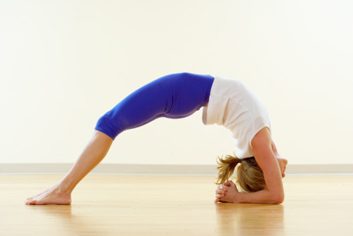
yoga injury

Studies exist that document yoga's functionality in diminishing back, neck and joint pain. Many yoga practitioners styling themselves as practised yoga instructors boast that they have the knowledge to help people attain improved posture, strength, flexibility and balance. Among these yogis may be some whose knowledge fails to match their enthusiasm, let alone their promises of no-pain guidance in yoga.

Millions of people don't hesitate to place their trust in the healing and restorative powers of yoga, unfailingly attending their local yoga studies, trusting that the training and experience of the instructor who leads their classes does truly reflect what the public relations and advertising boasts claim from among the many and varied yoga practises and certification programs.

But the fact is that people do sustain injuries during their yoga classes, and so the authors of this new study, coming from Boston, New York and Sydney, Australia, collaborated in reviewing published literature studying the issue. Through their reviews they discovered yoga-related injuries reported to range from 2.4 percent annually ranging up to 21.3 percent representing lifetime injuries.

They decided to use questionnaires, sending them out to several thousand participants from among whom they sought volunteers willing to report their yoga habits and any pain that might be associated with them. Another questionnaire followed up a year after, to the 354 recreational yoga practitioners who had agreed to take part in the study.

Respondents, mostly female, had an average age of 45.7 with about ten years of yoga experience which they practised three hours weekly, on average. And of that number the majority (86.7 percent) faithfully reported experiencing pain in at least one area of the body, along with many (65.8 percent) feeling that practising yoga improved their discomfort.

On the other hand, 10.7 percent claimed that it was yoga itself that caused their pain, with a third claiming the pain they suffered mitigated against their practising yoga for as long as three months at a time. Roughly 50 percent of those injured stated they sustained their injuries during a yoga class, with another 21 percent adding that yoga worsened existing pain.
Photo: Heidi Kristoffer

Practising yoga was most likely to relieve pain and discomfort in the back and neck for practitioners, while the most common injury sites turned out to be the wrists and hands. The study authors specifically mentioned other studies that named headstands, shoulder stands, the lotus position, half lotus position, forward bends, backward bends and handstands to have been noted for their propensity to increase risk of injury.

In interviews with yoga instructors, issues such as excess effort, poor techniques and inadequate instruction were cited as additional sources of injury, to which was added "ego-driven" performance. It seems logical enough to reach the conclusion that the widespread belief in yoga as being a remedy for what ails, convinces people to feel they are safe in making efforts to go beyond their physical limits.

Even so, injury rates sustained in the practise of yoga are seen to compare with those sustained through other forms of exercise.

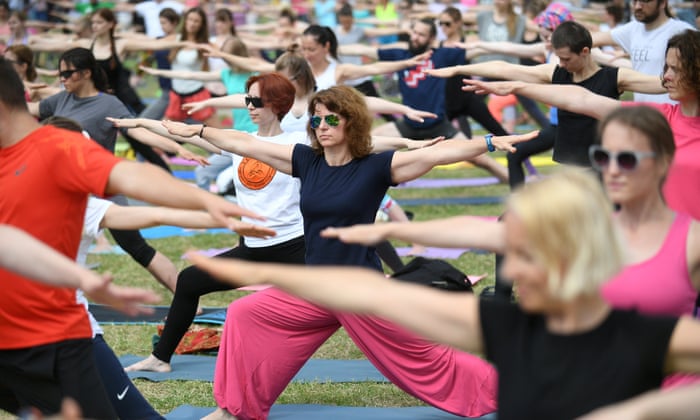
A University of Sydney study found yoga caused musculoskeletal pain – mostly in the arms – in more than 10% of participants. Photograph: Bartlomiej Zborowski/EPA

Labels: , , ,

 
()() Follow @rheytah Tweet