Ruminations

Blog dedicated primarily to randomly selected news items; comments reflecting personal perceptions

Sunday, September 26, 2021

COVID Vaccines Trump 'Natural Immunity'

"There are some important practical considerations, in addition to medical/scientific ones."
"[First, it's harder to confirm a previous infection than to track vaccination. Early in the pandemic, when testing centres were overwhelmed, many people were diagnosed with 'COVID-19' based on symptoms only. But other viruses can cause similar symptoms, meaning] there is a considerable risk that someone who was misdiagnosed would remain vulnerable to infection while assuming they are immune."
Matthew Miller, associate professor, Michael G.DeGroote Institute for Infectious Diseases, McMaster University, Hamilton

"Back before we even knew we'd have vaccines so soon, many countries and groups who were strongly opposed to lockdowns and public health measures were using the argument that the quickest way to establish herd immunity and get back to normal would be let the virus run wild -- a reckless approach that would have resulted in far more deaths than we have already seen."
"Having said that, personally I feel immunity is immunity and immunity from natural infection contributes to herd immunity in the same way that vaccine-induced immunity contributes to herd immunity."
"But I DEFINITELY don't think anyone, anywhere should have 'ripped off the Band-Aid' to quickly establish herd immunity."
Rodney Russell, professor of virology and immunology, Memorial University, Newfoundland

"The argument is, 'See, they don't really care about the science, all they care about is their vaccine agenda'."
"It's really kind of a stealth way to critique vaccine policy."
"Natural immunity has become an anti-vaxxer talking point."
Timothy Caulfield, health policy expert, University of Alberta
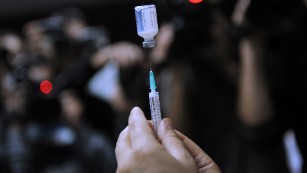
A health worker prepares a booster dose of the Pfizer-BioNTech Covid-19 vaccine in a waiting area in Tel Aviv, Israel.

Third-dose COVID-19 vaccine 'booster' programs have already begun in Israel, and data about their effectiveness are starting to come in.  Credit: Kobi Wolf/Bloomberg via Getty

There are some issues with post-COVID immunity and the immunity conferred by vaccines as opposed to those presumed to be present in the wake of recovery from a COVID infection, that are controversial, misunderstood, complex and little discussed. The type of immunity called 'natural immunity' resulting from a prior bout with the coronavirus is touted by some as sufficient unto itself, worthy of recognition, and those having natural immunity are to be regarded as fully immunized, as much so as those who have been treated with two vaccine doses.

The issue is one that concerns officials in that it may lead to some people making the decision to become infected with COVID, rather than submit to a COVID-19 vaccination. In so doing, risking serious consequences; hospitalization, Long COVID, even death. Moreover, the messaging to the public of the imperative to be properly vaccinated as protection against contracting COVID can be muddied, and ultimately lost. 
 
Recent studies on the other hand, suggest as well that immunity gained with an infection can provide formidable protection against the SARS-CoV-2 virus; that people previously infected and then follow up with vaccination may turn out to be the most fully protected of all. Leading some people who have recovered from COVID to complain at the unfair treatment in being shut out of non-essential businesses; even terminated from employment should they not agree to being vaccinated.

"Problems linger", explained Dr.Miller, in that even if lab-confirmed prior infections were to be considered since as testing capacity increased and was offered to anyone, studies show that those who have asymptomatic or mild infections mount a much less robust immune response than those who exhibited coronavirus symptoms "and also less robust than those who have received a full vaccine series".
 
There are, in fact, no clear safety signals in association with inoculation of the previously infected, so it might appear prudent to require the same proof-of-vaccination for the COVID-recovered, from a standpoint of reliably standardized policy.And, points out Dr.Russell of Memorial University, the Delta strain complicates the situation by its very steep infectability. People infected in the pandemic's early stages would have seen their immune system respond to a weaker variant "So do we know they can handle more recent variants months or potentially years after their original infection?" 
 
And then there are the results from two recent studies which suggest that immunity from a previous infection confers longer-lasting and stronger protection. Furthermore, people who never  had COVID and received two doses of the Pfizer shots were six to 13  times more likely to contract Delta than those who were previously infected with COVID, according to a large study of tens of thousands of Israelis. Yet another version of the same study found the COVID-recoverd who were unvaccinated were twice as likely to be reinfected as the COVID-recovered receiving a single dose of Pfizer-BioNTech's vaccine.
 
Virologist Shane Crotty wrote in Science magazine that people with a previous SARS-CoV-2 infection "mount unusually potent immune responses to COVID-19 vaccines". Which may explain why it is they are also likelier to experience side effects such as fever and fatigue. Published in Nature, a study out of Rockefeller University found memory B cells which can linger for decades unleashing potent antibodies every time the body is re-exposed to COVID outperformed memory B cells produced by mRNA vaccines.
 
The body's immune system reacts to the entire virus, not merely the spike protein generated from the vaccines, with natural infection. And then there is that little matter of natural infection that "can also kill you", pointed out Michel Nussenzweig of Rockefeller University. All of which leads inevitably to the message that everyone should become vaccinated, irrespective of previous infection, and nor should anyone intentionally plan to become infected with COVID to spur 'natural immunity'.
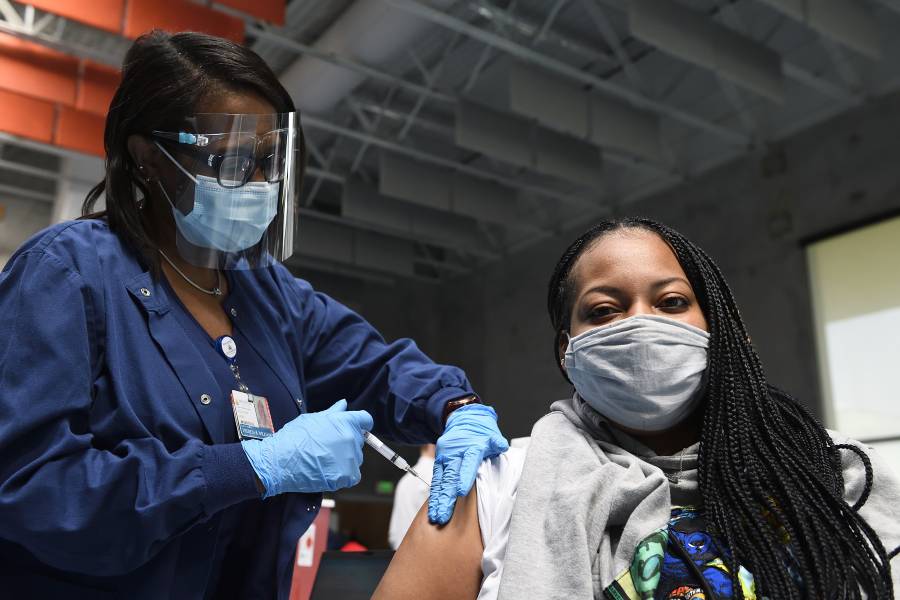
 
A vaccine clinic at Henderson-Hopkins in April 2021
Johns Hopkins University
"[The problem with considering the once-infected as potentially having adequate immunity], is that we have no idea how much immunity they had then, or now."
"But with vaccination, we at least know that everyone received the standard amounts of the vaccines."
Rodney Russell, Memorial University

Labels: , , , , ,

Wednesday, November 07, 2018

Outwitting a Virus

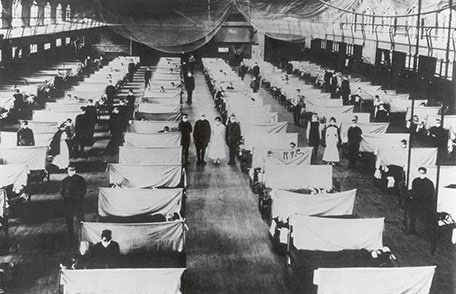
Black and white photograph of hundreds of medical pop-up stations within a large warehouse building. Patients lay in medical beds.
"The disease we know as the flu is caused by the influenza virus, which mostly lives in fowl and pigs; humans catch it through close contact with those animals."
"The 1918 outbreak was caused by an H1N1 variant that was first noticed in an army camp in the United States."
"It's hard today to describe the speed of the virus's spread and the scale of its staggering devastation."
Mike Callaghan, medical anthropologist, Switzerland
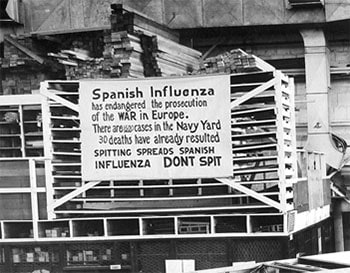
Photograph of an Influenza precaution sign at the Naval Aircraft Factory, Philadelphia, October 19, 1918. Reads “Spanish Influenza has endangered the prosecution of the war in Europe. There are 1500 cases in the navy yard 30. Deaths have already resulted. Spitting spreads Spanish influenza. Don’t spit.
The 1918 flu pandemic is sometimes called “The Spanish Flu” not because it originated in Spain, but because that nation had remained neutral during the war and freely reported news of flu activity.

"The 1918 flu pandemic occurred during World War I; close quarters and massive troop movements helped fuel the spread of disease."
"In the United States, unusual flu activity was first detected in military camps and some cities during the spring of 1918. For the U.S. and other countries involved in the war, communications about the severity and spread of disease was kept quiet as officials were concerned about keeping up public morale, and not giving away information about illness among soldiers during wartime. These spring outbreaks are now considered a “first wave” of the pandemic; illness was limited and much milder than would be observed during the two waves that followed."
"In September 1918, the second wave of pandemic flu emerged at Camp Devens, a U.S. Army training camp just outside of Boston, and at a naval facility in Boston. This wave was brutal and peaked in the U.S. from September through November. More than 100,000 Americans died during October alone. The third and final wave began in early 1919 and ran through spring, causing yet more illness and death. While serious, this wave was not as lethal as the second wave. The flu pandemic in the U.S. finally subsided in the summer of 1919, leaving decimated families and communities to pick up the pieces. Scientists now know this pandemic was caused by an H1N1 virus, which continued to circulate as a seasonal virus worldwide for the next 38 years."
Centers for Disease Control and Prevention. CDC twenty four seven. Saving Lives, Protecting People 

What was familiarly called the "Spanish flu" was a pandemic; it broke out all over the world. A world at war. Where, it was explained, an aggregation of people in close quarters helped its swift spread. Great swaths of military personnel were moved around from country to country, helping the virus which turned deadly, to spread with swift ease. At one time, it would be mostly country people, people who lived and worked on farms and had close contact with animals and birds who were at risk and the spread of the virus was limited because they remained where they were, locally.

At the very time that the world is remembering the two great world wars that brought death and destruction to the global community, the hundred-year anniversary of the start of the First World War, considered in its wholesale death toll, to be 'the war to end all wars' is being recognized. In lock-step with that global conflict was the global affliction of the "Spanish flu". Spain, as a neutral country at the time of World War I, had no restrictions imposed on news of the influenza epidemic it was suffering, unlike those countries at conflict who kept the news from their public already struggling with the demoralizing stories out of war zones.

That strain of influenza destroyed more lives than both world wars' totals of military and civilian deaths as consequences of the two global conflicts. In the first six months of the flu's onslaught close to 50 million people died worldwide. By the time it was over, when no further waves of infection occurred, an estimated 100 million people were dead as a result of the flu. It was not the flu we face yearly with its recognized symptoms that puts people low for several days to weeks. This was a pathological scourge that killed.

When one in three people world-wide became infected and died, combating armies became short of fighting men. Half their soldiers were bedridden. Civilians were instructed to wear face masks at all times. Eventually the lethal strain wore itself out by 1920. Since then medical science has been anticipating another massive viral flu outbreak with dread. But the combination of contagious impact and lethality has not yet been replicated. And the yearly recommendations that populations be inoculated against the flu has its genesis in hopes of averting a worst possible scenario.

People with compromised immune systems, people with chronic illness and disease, the elderly and the very young depend on the herd immunity concept; the greater the numbers of people for whom the onset of illness through the impact of protective inoculation the less likely the possibility of a widespread breakout in a largely unprotected population. In 1918's globalized flu pandemic populations with no immunity were suddenly exposed to the virus. Because of the war populations migrated, both military and civilian.

At that time long-distance travel was accomplished through rail and ship primarily. In our modern era with rapid transit where airline passenger jets can traverse the globe in hours, not weeks, where products are shipped globally and with them germs are transmitted with incredible speed. That speed accomplishes an amazing feat of transmission by a virus that reacts swiftly to impediments. Each year a combination of the commonest flu strains prevalent in China the year before is produced in the hope that the following year's strain would be closely aligned for successful immunity.

The flu virus is a swiftly mutating trickster, shifting in response to the presence of any remedy produced to impact its deadly efficacy. By the time a vaccine is produced the virus has undergone change and becomes more effective in its deadly delivery. Because it is so capable of mutating to meet the challenges meant to destroy its efficacy, it is always one step ahead of remedies to modify its effectiveness and potentially bring its impact to a halt, boosting the body's immune system to deflect its ingress.
The big one is coming, and it's going to be a flu pandemic
It has proven itself adept at developing new strategies to resist medication, to survive in new environments and to negate its transmission. It is a formidable foe for medical science, a medical community anticipating that a day will arrive when it will once again forcefully impact on a global scale with deadly precision. There is no global conflict ongoing at the present time, other than an increasingly chilly 'cold war', to enhance and invite a viral outbreak in response to a dense gathering of warring factions worldwide.

But there are other types of wars, in a world where trade and economics and mercantile interests come into play. Such as sanctions as punishment by one entity against another in a conflict of a different kind. The current trade war between the United States and China has been a complicating factor in stalling the ongoing trade between China's production capabilities and its far reach throughout the world where its products are always in demand. Among other items that are in demand is China's cooperation in providing intelligence on flu strains.

China's ownership of this intellectual property has enabled it to turn its sole-source data into a critical bargaining chip, one that leaves vaccine researchers struggling to come up with a combination that will present as a deterrent to this year's flu strain -- without the vital data it depends upon from China.
Researchers in pathogen transmission know that should a deadly new strain of flu arrive it would impact their capacity to mobilize resources quickly and effectively to combat airborne, contagious, fast-acting viruses.

To succeed, however, there must be a scaffolding comprised of cooperation, restraint and above all unprecedented levels of research focusing on a virus whose reactive abilities and mobility are frighteningly legendary.

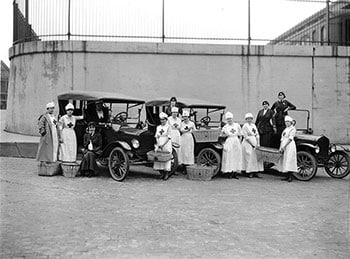
Red Cross volunteers in Detroit
Ready and willing, these volunteers were on the forefront of the 1918 pandemic response. Today, influenza viruses continue to pose one of the world’s greatest health challenges.

Labels: , , , , , ,

 
()() Follow @rheytah Tweet