Ruminations

Blog dedicated primarily to randomly selected news items; comments reflecting personal perceptions

Monday, October 01, 2018

Agriculture, Climate Change, Insect Predation

"Insects have consumed something like one out of every eight loaves of bread before it even gets made [by consuming large amounts of agricultural crops]."
"If we warmed four degrees which is what climate models typically predict for the end of this century, then that amounts to insects eating two of our eight loaves of bread instead of one."
"If we think about food supply as the pie we all get to eat, some us of get smaller slices than others. If the pie begins to shrink, we need to find ways to stop it from shrinking and to carve it up more evenly so people aren’t left without."
"If you want to solve a big problem with a million tendrils, you have to go to the root of it, otherwise, you're manufacturing a million Band-Aids."
Curtis Deutsch, professor of chemical oceanography, University of Washington, Seattle

"[Beneficial insects thriving alongside the destructive ones could end up] offering some suppression of the pests, so that the damage may not be as great as they [researchers] are suggesting."
Michael Hoffman, professor of entomology, Cornell Institute for Climate Smart Solutions
Grasshoppers are among the insects predicted to grow hungrier and more populous in a warming climate, devastating U.S. corn crops.  James P. Blair/National Geographic/Getty Images

At  the present time insect predation on food crops worldwide means that pest insects competing with humans for the agricultural produce we depend upon to feed the world's population misses out on one loaf of bread from every eight loaves produced. Those insects consume up to twenty percent of the crop plants that we grow for our tables. With global warming that percentage of 'wasted' grain eaten by insect populations is expected to increase substantially, according to a study published recently in the journal Science.

This leads to a situation where farmers, in defence of their crops, will take to using more pesticides, a vicious cycle leading to further environmental degradation.  The amount of wheat, corn and rice consumed by insects is set to increase by ten to 25 percent for every heightened temperature degree above the global historical average, the study emphasizes. Its effect on  temperate agricultural regions such as the United States and Western Europe will see agriculture production especially hard hit.

Insects become hungrier the higher the temperature which causes their metabolism to react and this affects their life cycle which becomes faster, in turn causing them to reproduce more frequently, a set of circumstances that is certain to diminish crop yields at the very time that human population growth is on the upswing, requiring more food to be made available to maintain hungry people. Yet the global food supply will be stressed beyond its capacity to provide that food for a growing global population.

Dr. Deutsch and  his research colleagues made use of statistical models simulating the effects of global warming on insect feeding and reproductive patterns to arrive at their calculated conclusion. Corn and rice crops were the major focus since they represent 42 percent of calories consumed by humans. On the other hand, as Dr. Hoffman points out, beneficial insects could conceivably balance out the equation on a more optimistic note for the future.

But there are other, related issues involved, as pointed out in a study published in the journal Nature Communications, last year which found that projected pressures from increased summer temperatures could lead, in any event, to a reduction in agricultural yields, resulting from higher temperatures and fewer rain events. These researchers are in general agreement that prevention practised to reduce the level of greenhouses gases may hold the only hope for a solution.

An insect-infested corn cob. Credit: Paul J. Richards/Getty Images
New research suggests the risk climate change poses to agriculture is higher than scientists realized because of the way insects respond to warmer temperatures. Credit: Paul J. Richards/Getty Images

Labels: , ,

Monday, August 27, 2018

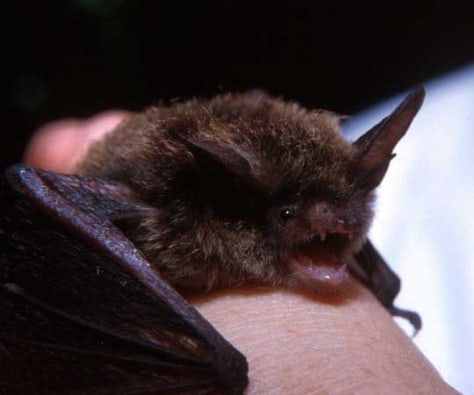
Hunting Bats, Fireflies and Bioluminescence

"[These ferocious hunters -- little brown bats -- exert  incredible selective pressure on their prey [consuming their body weight insects nightly]."
"These bats are from the western United States, where there are essentially no fireflies [big brown bats introduced to eastern fireflies]."
"[The large brown bats rejected the taste of fireflies; never have I] seen a stronger negative reaction [to a chemically defensive insect. The bats] salivate a bunch and they cough and shake their head and just generally completely despise us [researchers] for giving them that prey."
"This is, to my knowledge, the first work to show that a three-dimensional flight pattern is information that bats can associate with bad taste."
"Getting a natural predator and its prey to interact in a way where components of the warning signal can be isolated and dissected is inherently challenging and requires novel methods and experimental design. In fact, this study took us two years to refine methods and two additional years of data collection."
Jesse M. Barber, biologist, Boise State University
Image: Bat
Fireflies are often toxic to bats, which see the nighttime flashing and steer clear of the insects, according to a new study.  Paul Moosman Jr.

"I had found a new species [of firefly] and was trying to catch as many as I could in my net [so held a few in his lips and mouth preparing an enclosure]."
"As it was, my throat started constricting and my lips went numb [reacting to the bitter, acidic taste from holding the beetles in his mouth careful not to crush them]."
"With all of the data that is currently available it certainly appears as though the first bioluminescent fireflies first arose around the same time as bats."
Marc A. Branham, biologist, University of Florida, study co-author
Fireflies (Photinus pyralis) defuse bat attack with bioluminescence and slow, predictable flight.
Fireflies repel bat attacks with bioluminescence and slow, predictable flight. | Stephen Marshall
"[The study presents] convincing evidence that bats of this particular species learned to avoid fireflies more quickly when they received information through two different sensory channels."
"Flying plus bioluminescence was the magic combination that really enhanced bats' avoidance learning."
Sara M. Lewis, biologist, Tufts University

"Any discussion on how bats may have impacted the evolution of firefly bioluminescence is pure speculation and certainly does not apply to larval bioluminescence, which defines fireflies."
Kathrin F. Stanger-Hall, firefly expert, University of Georgia
There we are again, a new 'breakthrough' study convincing its authors they have discovered the natural revulsion of a carnivorous species to the natural chemical protection of a prey species through diligent research led by intuition, building on a previous century's observation by an earlier biologist reaching his conclusion by observation alone. The carefully constructed study leading to the conclusion by the researchers involved that fireflies' famous bioluminescence goes beyond a courting ritual to represent a warning to predators that they needn't bother hunting them because they taste awful, has other experts in the field both approving and denigrating the conclusion.

The sight at night of tiny winged creatures lighting up their presence couldn't be more charming; a sight that parents enjoy exposing their children to, for the fairyland-like atmosphere it evokes and the wonder it brings to children's imagination. Well, scientists too have wondered about why it is that fireflies light up as they do in the dark. In the late 19th Century entomologist George H. Bowles theorized: "May not the light then serve ... as a warning of their offensiveness to creatures that would devour them?"

That inspired hint to the purpose of the fireflies' bioluminescence was taken up over a century later by two present-day biologists, Drs. Barber and Branham and their colleagues. That fireflies communicate through the light they emit has been known; that there is a firefly 'language' in blinks that 'speak' to other fireflies. But it was the intriguing thought that another function attributable to the light exists, one that served to prolong the lives of fireflies, that motivated the study and led to its conclusions, more or less verifying the brilliant guesswork of 19th Century Dr. Bowles.

A study published in the journal Science Advances had the research team introduce common eastern fireflies to a group of big brown bats, unfamiliar with fireflies in their geographic region. In the region of the U.S. where the big brown bats live, fireflies don't produce bioluminescence. Both bats and fireflies were placed in a dark chamber for between one to four days. The bats snatched fireflies on day one, reacting swiftly by rejecting the firefly, once tasted. High-speed video cameras set up in the chamber showed bats eating scarab beetles and moths, and rejecting the fireflies.

The beetles' toxic taste was quite obviously not to the bats' taste; once introduced to the bitter flavour of the fireflies the bats never again attempted to catch and eat the fireflies. The blinking lights were associated with a disgusting meal evidently; the intuited purpose of the lights. And it was not only visual identification through blinking lights that led the bats to understand the fireflies did not represent a tasty meal. Researchers took to brushing red or black paint directly on the beetles' abdomens to block out the light.

The warning lights now absent, the brown bats reacted once again by catching the fireflies, then immediately spitting them back out in reaction to their nasty taste. In response to this new challenge, the predators began to recognize the flight patterns of the light-darkened beetles, the result of which, once again forewarned, the bats rejected the beetles as prey. Echolocation to sense the wing beats of the fireflies was used by the bats to recognize the characteristic lazy flight patterns of the fireflies.

The "nonchalance of a chemically protected insect", observed Dr. Barber, comparing it to the leisurely waddle of a porcupine, an animal endowed with a natural potential threat to would-be predators, complacent in the knowledge that other animals will give it wide berth or risk being uncomfortably skin-penetrated by the porcupines' long barbs.

Labels: , , ,

Monday, September 25, 2017

Insect Abundance In Steep Decline

"Insect numbers are way down. It's a little under the radar from the public perspective, but it's really high on the radar in terms of research."
Jeff Skevington, entomologist, Agriculture Canada

"It's unfortunately a little bit informal in terms of measurements [bug census]."
"Like, 'How pasted did your windshield get?' is not a normal scientific measurement. But it is something that I think many people have noticed."
"The general trend is something I myself have noticed and thought about on many occasions."
"It's a big deal, right? When you think about this it sounds kind of nuts, but the number of insects splattering on your windshield is a really good indication of just how abundant life is in the environment."
"It's anecdotal, but if it's true there seems to be a lot less life out there than there used to be. And that is not something we should be ignoring."
Jeremy Kerr, ecologist, entomologist, University of Ottawa

"Every spring since 1989, entomologists have set up tents in the meadows and woodlands of the Orbroicher Bruch nature reserve and 87 other areas in the western German state of North Rhine-Westphalia. The tents act as insect traps and enable the scientists to calculate how many bugs live in an area over a full summer period. Recently, researchers presented the results of their work to parliamentarians from the German Bundestag, and the findings were alarming: The average biomass of insects caught between May and October has steadily decreased from 1.6 kilograms (3.5 pounds) per trap in 1989 to just 300 grams (10.6 ounces) in 2014."
"The decline is dramatic and depressing and it affects all kinds of insects, including butterflies, wild bees, and hoverflies,” says Martin Sorg, an entomologist from the Krefeld Entomological Association involved in running the monitoring project."
Fireflies, like these in a forest in the Netherlands, have disappeared from some areas in North America and Europe where they were once abundant. PAUL VAN HOOF/MINDEN PICTURES


Hover flies, often mistaken for bees or wasps, are important pollinators. Their numbers have plummeted in nature reserves in Germany. JEF MEUL/NIS/MINDEN PICTURES/NATIONAL GEOGRAPHIC CREATIVE


Labels: , , , , ,

Sunday, August 21, 2016

Coping With Foreign Invasive Species

"It's [emerald ash borer larvae] basically girdling and strangling the tree. It [the tree] can't move water. It can't move nutrients. It's like the circulation system of the tree. By the time you see this, when it's gone all the way around the main trunk, the tree can't survive. It kills 99 percent of the trees [it infects] and most of it happens before you even know it's there."
"Those [introducing parasitoid wasps as biological control agents] are the only real options at this point. Otherwise it's a matter of removing what you can't save, replanting and moving on. It [the beetle] is still a pretty devastating insect."
"It's a very long-term project. It will take a long time for populations of wasps to build up to levels where we can see any impact. But in its native range in China, the [beetle] has a range of parasitoids that keep it under control."
"They're not a kind of [insect to] sting or bite [ash borer-parasitic wasps] you, or [likely to] really want [to have] anything to do with you."
Krista Ryall, ecologist/entomologist, senior research scientist, Canadian Forest Service
Bilberry Creek Ravine forest, Orleans, Ontario
Anyone who ventures into the forest can see what's happening to ash trees. They've been dying; once infected it doesn't take that long. And it's beyond sad. An important part of the forest is being killed off and everywhere one looks in an urban setting or in a woodland there are gaps being created where dead trees abound. Ashes begin to lose their bark when they've been attacked by the emerald ash borer even as boughs distinguish themselves by dead foliage.

Injections used by botanists to try to extend the life of ash trees are expensive, quite an investment if a property owner wants to save a treasured ash shading property and beautifying it, yet the effect is temporary, it wears off and the property owner is back to square one. It's a shoulder-shrugging admission that the temporary solution is just that; temporary, and a waste of time, energy and money, leaving little option but to allow the tree to die.

Oobius agrili non-stinging parasitic wasp fights emerald ash borer eggs
The oobius agrili parasitic wasp is very small and doesn't have a stinger. It lays its eggs within emerald ash borer eggs, killing the host egg. (Houping Liu/Michigan State University)

But Dr. Ryall and her colleagues from the Canadian Forest Service have embarked on a much larger experimental study which they hope will present a solution in time. They have taken possession of adult wasps grown in ash trees at a U.S. Department of Agriculture station in Michigan. Short sections of trees called mini-bolts are hung on still-living ash trees which have been infested with the beetle larvae in the hope that the mature female wasps will respond to emerald ash borer eggs or larvae, to lay their eggs upon.

The project is four years into its process at about a dozen test sites in Ontario and Quebec. There are two types of wasps, one that attacks the eggs of the ash borers and another which feeds on its larval stage, both native to China, where the borer itself comes from. Site examination has thus far revealed that the egg-eating wasps appear to be doing the work anticipated, while it is as yet unclear whether the larvae-eating wasp has been equally successful in adapting to the work in Canada they are known for in China.


 Barry Lyons, a forest entomologist for Natural Resources Canada, stands next to two "oobinators" full of oobius agrili eggs.
Barry Lyons, a forest entomologist for Natural Resources Canada, stands next to two "oobinators" full of oobius agrili eggs. (CBC News)
 
The emerald ash borer's existence was first noted in 2002 in North America. It has since spread in both provinces and throughout 27 eastern American states. Eggs of the small green beetle are laid in crevices in ash tree bark with the larva burrowing into the tree, cutting channels under the bark that serve to choke off the flow of water and nutrients. The result has been the death of tens of millions of North American ash trees.

Labels: , , , ,

 
()() Follow @rheytah Tweet