Ruminations

Blog dedicated primarily to randomly selected news items; comments reflecting personal perceptions

Tuesday, December 24, 2019

Avian Weather Perceptions

"We don't know how [birds are able to detect when a cold front is approaching]. There are a number of hypotheses but we don't know for sure yet."
"We know that birds and other animals can detect subtle changes in air temperature. Many birds somehow sense that very minute drop in air pressure that typically signals low pressure coming [accompanying a storm]. [Birds have several options] That depends on the bird. They either want to get out of there, or they want to hunker down."
"We've done a lot of work on various sparrow species that forage on the ground. If you're a sparrow in winter and a storm is coming, that probably means there is going to be snow. Sparrows need to eat while they can. When we expose these sparrows to a drop in air pressure they start eating more [to store energy]."
"A large number of animals are probably detecting these subtle changes in barometric pressure. How sharks are sensing that under water is a total mystery. I'm interested in understanding in what situations they can cope, and in what situations they will not be able to cope."
"If these extreme events [in weather] become more common, I think it's useful to understand how animals predict and cope with them. Birds are important, not only for the ecosystem but they are culturally important to us. Really, I'm just motivated in trying to understand how they are coping with the changing environment."
Scott MacDougall-Shackleton, Advanced Facility for Avian Research, University of Western Ontario
Sparrows are      known to eat more when they sense a drop in air pressure signalling he arrival of a winter storm. Photo:  Judith Gustafsson

It remains a speculative mystery to scientists how it is that birds have foreknowledge of a winter storm's arrival. With that knowledge they make decisions that are vital to their survival; whether to fly away to safety or to choose to hide until the storm passes. Whichever decision they make is invariably integrated with their feeding requirements. Sensing changes in air pressure, however slight, they are also able to detect when temperature drops, linked to a cold front incoming.

At the University of Western Ontario where Dr. MacDougall-Shackleton, a behavioral psychologist, has his laboratory, the facility is home to the world's first hypobaric climate wind tunnel for bird flight. Research into the physiology and aerodynamics of bird flight at different altitudes is enabled when researchers turn air pressure up and down to study their effect on birds. When high pressure is simulated in the lab along with cold weather linked to winds out of the north in spring, birds decrease their northbound migratory flight behaviour.

Birds in southeastern states in the U.S. managed to develop through an evolutionary track, a measure to dodge storms approaching from the west. They enact a formula whereby they fly south to avoid the path of the storm, then turn west and finally return flying back up behind the storm. Infrasound --  sound at a frequency too low for human hearing -- may cause birds to react. One current theory is that because low-frequency sound travels a long way, birds can hear the sounds of distant rumbles from thunder "probably many hours in advance" of its actual appearance.


"We have now clearly demonstrated that birds, both when wintering and migrating, have their own internal barometer, which helps them make decisions about everything from flight to feeding,"
"This has been hypothesized for a long time and there is a large body of evidence that animals in the wild behave differently when weather changes but we now have an experimental demonstration where we held everything else constant except for barometric pressure proving definitively this long-held belief."
According to climate theory, a warming world will result in more frequent and more violent storms. Dr. MacDougall-Shackleton would like to find out how this, should it occur, will affect bids and other wildlife. There is the issue to be studied whether too frequent and too violent storms may overwhelm the capacity of birds to persevere.


One of Dr. MacDougall-Shackleton's doctoral students is conducting research on whether a bird may become too physically stressed to survive a frequent succession of such storms. If a laboratory bird is exposed to a simulated storm approaching once weekly, the birds appear capable of handling the situation. Should the lab simulate two storms weekly "they would start losing some weight.So they weren't able to keep up with their energy balance."

"Birds have evolved to cope with bad weather. They have experienced it all through evolution. But it's possible that some species may be in trouble", should increasingly violent weather eventuate in the future over what is being experienced at the present time.


Labels: , , ,

Sunday, December 08, 2019

Silent World

"We had good reason to expect that increasing temperatures would lead to reductions in body size, based on previous studies."
"The thing that was shocking was how consistent it was. I was incredibly surprised that all of these species are responding in such similar ways."
"Periods of rapid warming are followed really closely by periods of decline in body size, and vice versa."
"Being able to show that kind of detail in a morphological study is unique to our paper, as far as I know, and it's entirely due to the quality of the dataset that David Willard generated." 
"It's clear that there's a third component -- changes in body size and shape -- that's probably going to interact with changes in range and changes in timing to determine how effectively a species can respond to climate change."
Brian Weeks, assistant professor, University of Michigan School for Environment and Sustainability
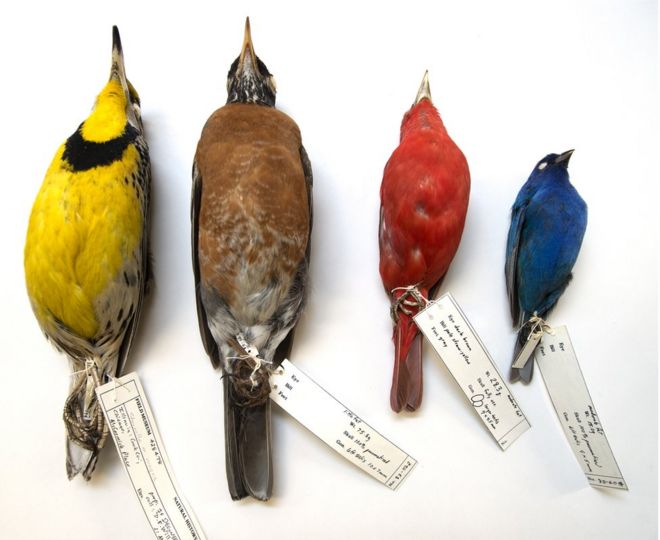
Four bird specimens of different colours, yellow, brown, red and blue
The researchers analysed 52 different species of migratory birds  The Field Museum
"When we began collecting the data analyzed in this study, we were addressing a few simple questions about year-to-year and season-to-season variations in birds."
"The phrase 'climate change' as a modern phenomenon was barely on the horizon. The results from this study highlight how essential long-term data sets are for identifying and analyzing trends caused by changes in our environment."
"The changes that are being documented are not something you could see with your eye."
"Birds with longer and more pointed wings might be more efficient fliers [compensating for heat-caused stress]."
David Willard, ornithologist, Field Museum of Natural History

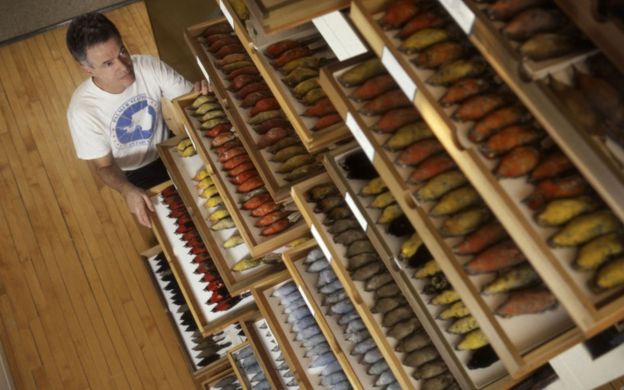
Dave Willard stands before drawers of birds
Dave Willard with the Field Museum's vast collection of bird specimens, 1999

"Warming temperatures seem to be having a pretty consistent and almost universal effect on a large number of different species, regardless of other aspects of their biology."
"In years when temperatures were a bit warmer, the bodies got smaller. In years when temperatures were a bit cooler, we saw an increase in body size, even though the long-term trend was to decline."
"So that leads us to believe that temperature is pretty important here."
Benjamin Winger, evolution and ecology of birds, University of Michigan
Published in the journal Ecology Letters, a new study out of the University of Michigan has shone a light on one aspect of how a warming climate is affecting bird populations; as the planet goes through a warming period, birds are adapting to the stress they are experiencing by becoming gradually smaller in size. That many bird populations appear as well to be declining is part of the same  story. This aspect of adaptation rather than decline owes much to a collection gathered by Dr. Willard who has measured Chicago's dead birds since the year 1978.

The vast collection and the data accompanying it gave measure to the study of long-term trends in bird bodies; the measurements of their legs, and their lesser weight, and slightly longer wings. These were changes that Dr.Willard detailed measuring with calipers and scales and achieving a notable collection of birds upon whose measurements conclusions could be reached, along with tracked weather trends.

This photo shows one of David Willard's ledgers, his measuring tools, and a Tennessee Warbler. Willard took the measurements of the 70,716 dead bird specimens in this study and recorded them by hand into ledgers like this.
Ledger, measuring tools, and a Tennessee Warbler.

The study of 70,716 bird specimens representing a 40-year accumulation of birds that had been found dead in Chicago as a result of misadventures such as flying into high-rise windows yielded the conclusion that the measured changes are present in close to all the species measured; the result of a seemingly inexorable, changing climate. When Dr. Willard began gathering birds for the museum's collection, climate change would have been the last thing on his mind.

He went about studiously measuring beaks, legs, body mass and wings, representing standard ornithological dimensions simply to satisfy his curiosity relating to seasonal trends. His activities attracted other museum staff and the Chicago Bird Collision Monitors, a volunteer organization which collects birds injured by windows. Those birds that were injured and could be rehabilitated were cared for by volunteers, while the dead ones were donated to the museum collection.

Dr. Willard had completed the records of measurements of over 70,000 birds of 52 species by 2016; his ledgers a minefield of explosive data all pointing to birds morphing over time in lock-step with climate change. Swamp sparrows and dark-eyed juncos were among the fifteen species of common birds that represented the majority of the collected specimens, although the collection also has several birds rare for the area. Birds on average surrendered 2.6 percent of their body mass; their legs became shorter by 2.4 percent, and their wings lengthened by 1.3 percent, from 1978 to 2016.

Birds are dying off at an alarming rate. Here's how you can help from your own backyard

Although there has been a 29 percent decline in North American bird populations since 1970, Dr. Winger hesitates to say whether these small size reductions are harmful to birds. Among data studied by the authors were precipitation, vegetation and allied factors that might contribute to size reduction, determining that an increase in summer temperatures was the strongest predictor for smaller birds emerging.

There is larger surface-area-to-volume ratios with smaller animals, allowing them to lose body heat more quickly. Leading to the proposal that hotter temperatures could stress birds, encouraging them to adapt by becoming smaller, to stay cooler. Research by Simon Griffith, an ecologist at Macquarie University in Australia where zebra finches and house sparrows were studied both in the lab and in the wild, indicates that hot temperatures during breeding season reduces bird offspring size and when fledglings are faced with heat stress they tend not to grow large.

Labels: , , , , ,

Friday, September 20, 2019

Avian Species at Crisis

"Declines in your common sparrow or other little brown bird may not receive the same attention as historic losses of bald eagles or Sandhill cranes, but they are going to have much more of an impact."
"We're overusing the world, so it's affecting everything."
Hillary Young, conservation biologist, University of California, Santa Barbara

"This approach of combining population abundance estimates across all [bird] species and looking for an overall trend is really unprecedented."
Scott Loss, conservation biologist, Oklahoma State University

"We were stunned by the result -- it's just staggering."
"It's not just these highly threatened birds that we're afraid are going to go on the endangered species list. It's across the board."
"Multiple, independent lines of evidence show a massive reduction in the abundance of birds. We expected to see continuing declines of threatened species. But for the first time, the results also showed pervasive losses among common birds across all habitats, including backyard birds."
Kenneth V. Rosenberg, conservation scientist, Cornell Lab of Ornithology and American Bird Conservancy, Cornell University
Wood thrush. Image by Michael Parr/American Bird Conservancy
Shocking statistics by any metric, leading experts to acknowledge the steep losses of over 500 species of birds, revealed through a new study. Birds whose presence we take for granted because they are so familiar to us, so much a part of our environment -- birds like robins and sparrows are facing an uncertain future -- and with their possible loss, so is humankind. The most important and oft-cited causes of a steep decline in the presence of birds species across North America include habitat loss and the widespread use of pesticides.

The natural ecosystem that we all are so dependent upon faces a dilemma without the presence of birds in their service to the balance of nature by controlling pests, pollinating flowers, spreading seeds and regenerating forest biosystems. Once birds indispensable to the health of an ecosystem disappear, those habitats that were their home will never recover their past health deprived of their presence. Avian populations are seen now to be threatened in a way never before imagined.

David Yarnold, president and chief executive of the National Audubon Society, was moved to characterize the new findings revealed by the study as "a full-blown crisis", based on news that the number of birds living in the United States and Canada has declined by 29 percent since 1970, with 2.9 billion fewer birds on the wing currently, than were present fifty years ago. "This is the loss of nature", added Kevin Gaston, a conservation biologist at University of Exeter.

The study arose out of the collaboration of a team of researchers drawn from universities, government agencies and non-profit organizations, combining old and new methods for counting bird species' presence. Professional ornithologists have for years been given assistance by volunteer, devoted amateur bird-watchers who regularly submit observations to databases, helping to carry out annual surveys of bird populations. The new study took advantage of those surveys to enable the estimate of populations of 529 species between the years 2006 and 2015.
A sparrow appears to be looking on in bewilderment as this goldfinch flies into the window of a vehicle parked in downtown Chatham, Ont.Ellwood Shreve/Chatham Daily News/Postmedia Network
The birdwatching records were utilized in estimation of the population of 76 percent of all bird species in the United States and Canada -- the most common varieties of avian species -- since 1970. Warblers were among the worst-impacted groups, their population declining by 617 million. Blackbirds similarly declined by 440 million. Starlings as well have dwindled in number by 83 million birds, representing a 49 percent decline. And nor is North America only impacted; Europe too is experiencing a similar loss of birds.

The study revealed the steep decline in bird populations without being designed to arrive at a determination that would explain the reason for their decline. Nonetheless reasons are explicable, such as habitat decline where grassland species, suffering the largest declines of any bird species, lost 717 million birds, in all likelihood caused by modern agriculture methodology and development of once-natural landscapes.

All is not entirely gloom. Some positive signs were found, with bald eagles thriving, falcon populations increasing by 33 percent and waterfowl too on the increase. In the last century many recovering bird species were almost exterminated by pesticides, hunting and other pressures. They were enabled to bounce back thanks to conservation measures undertaken at that time. In the current situation, the steep decline is such that halting its further trajectory would require an immense effort where habitats are defended, chemicals restricted, buildings redesigned.

Bird-rich habitats like the Great Lakes and the Colorado River Basin should be protected, according to the Audubon Society, to go a long way in ameliorating the crisis. The Migratory Bird Treaty Act should be fully restored and implemented. People should be convinced to keep their domestic cats within home interiors to provent their ravaging effect on small birds. The numbers of birds that die annually flying into windows could be reduced by measures to make the glass more visible.

A marsh wren wears a bit of cattail fluff near its nest at a slough east of Nanton, Ab.. Mike Drew/Calgary Sun/Postmedia Network
"These data are consistent with what we’re seeing elsewhere with other taxa showing massive declines, including insects and amphibians."
"It’s imperative to address immediate and ongoing threats, both because the domino effects can lead to the decay of ecosystems that humans depend on for our own health and livelihoods, and because people all over the world cherish birds in their own right."
"Can you imagine a world without birdsong?"
Peter Marra, senior scientist emeritus, former head, Smithsonian Migratory Bird Center, current director, Georgetown Environment Initiative, Georgetown University
Baltimore oriole. Image by Gary Mueller/Macaulay Library at Cornell Lab of Ornithology


Labels: , , ,

Sunday, August 19, 2018

Credit Where It's Due : The Intelligence of Birds

"The purpose of the crows ... is to educate the people, to open their minds, to think, 'OK, the birds are able to do something that we are much more able to do than them, so we should do this by ourselves',"
"It's a funny way to show the people that you cannot throw the papers everywhere."
"In an affectionate, supportive atmosphere, they like to communicate with humans and establish a relationship through play."
"The goal is not just to clear up, because visitors are generally careful to keep things clean, but also to demonstrate that nature itself can teach us to take care of the environment."
Park President Nicholas de Villiers, Puy du Fou park
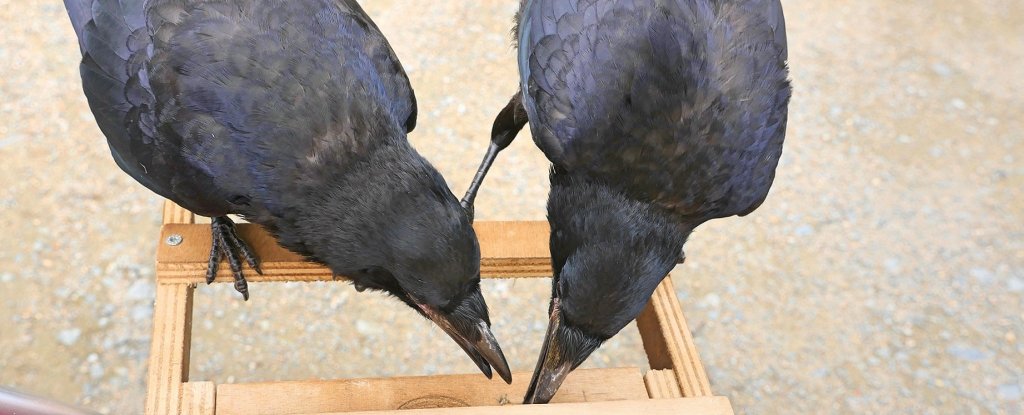
main article image
"I captured a series of crows in a park, tagged them and released them. They didn’t like it."
"Many weeks later, I returned to the park with colleagues, and the crows I had tagged attacked me but ignored the others."
Frédéric Jiguet, ornithologist, Paris Museum of Natural History
And they are indeed intelligent. Some species more so than others. Some, like parrots and crows whose tongues have been slit, can be taught to 'speak', emulating words taught to them, and knowing their correct context; uttering them at appropriate times and circumstances; in some instances reflecting their own emotions. They have excellent memory recall, and we tend to do them an injustice when we relegate them to the status of animals incapable of thinking, assessing situations, making use of their environment in unusual ways, and being capable of interacting with other species, including humans.
Crows pick trash in amusement park
Rooks have the ability to sort out litter. (Photo: Puy Du Fou blog)

A park in France has taken steps to use the innate intelligence of rooks, a larger, even more clever offshoot of the crow family to teach them to pluck litter left by careless park visitors and deposit that litter in waste containers on regular park patrols. The birds, six of them, have names: Boubou, Bamboo, Bill, Black, Bricole and Baco. Each time they deposit a cigarette butt or any other piece of trash in a special receptacle, it dispenses a treat. There are times when birds like any other animal, will commit altruistic acts, but this is a working environment that compensates their labour.

The birds would not consider what they do labour -- in all likelihood it is for them something akin to a game where they offer something of value to their trainer to be disposed of, and anticipate a reward in recognition of their effort. The trainer, to illustrate just how clever the birds are, speaks of their attempts to innovate, by bringing along slivers of wood to exchange for the treats. The park in question is a theme park; what better place to deploy such activities to demonstrate the birds' capacity to learn and to engage in a trade; their worthless (to them) offerings for valuable food.
The mechanism that has been created for the crows to collect the trash. (Photo: Puy Du Fou blog)

Working industriously, they are able to fill a bucket with disposables in fewer than 45 minutes. It was a bird handler, a park falconer who first thought of putting the birds to work. Accustomed to training birds of prey, Christophe Gaborit explained: "They were motivated by the reward and they soon understood how the game worked". And it would certainly not have been a difficult thing to entice the birds to collect trash for reward. Some biologists consider them to be as intelligent as the average seven-year-old child.

They have demonstrated how they prepare tools by tearing strips from leaves, using the strips to pry bugs from tree trunks. In experiments they have been innovative in response to situations where they have manipulated material to advantage themselves in some way. Given wire, though never having encountered it before, they will bend it to fashion hooks. Given unshelled peanuts, they will smash the peanut held in their beak against a hard surface to open it and release the nuts. They will remember the faces of people who habitually take peanuts into a park to deposit them in various places. Thereafter the birds regularly visit those places, in competition with squirrels.

Some scientists decided to test the rooks through an experiment, placing litter in a room with a worm in a tube of water slightly below the distance the birds could peck. The birds responded by dropping pebbles into the water gradually lifting the worm within reach. Those filler objects too large for the container, or that would float in the water were rejected in favour of the pebbles which sank to the bottom as required to achieve their goal; more than adequately demonstrating their grasp of volume displacement.

Gabroit with his rooks. (Photo courtesy: Puy Du Fou blog)

Labels: , ,

Monday, September 25, 2017

Insect Abundance In Steep Decline

"Insect numbers are way down. It's a little under the radar from the public perspective, but it's really high on the radar in terms of research."
Jeff Skevington, entomologist, Agriculture Canada

"It's unfortunately a little bit informal in terms of measurements [bug census]."
"Like, 'How pasted did your windshield get?' is not a normal scientific measurement. But it is something that I think many people have noticed."
"The general trend is something I myself have noticed and thought about on many occasions."
"It's a big deal, right? When you think about this it sounds kind of nuts, but the number of insects splattering on your windshield is a really good indication of just how abundant life is in the environment."
"It's anecdotal, but if it's true there seems to be a lot less life out there than there used to be. And that is not something we should be ignoring."
Jeremy Kerr, ecologist, entomologist, University of Ottawa

"Every spring since 1989, entomologists have set up tents in the meadows and woodlands of the Orbroicher Bruch nature reserve and 87 other areas in the western German state of North Rhine-Westphalia. The tents act as insect traps and enable the scientists to calculate how many bugs live in an area over a full summer period. Recently, researchers presented the results of their work to parliamentarians from the German Bundestag, and the findings were alarming: The average biomass of insects caught between May and October has steadily decreased from 1.6 kilograms (3.5 pounds) per trap in 1989 to just 300 grams (10.6 ounces) in 2014."
"The decline is dramatic and depressing and it affects all kinds of insects, including butterflies, wild bees, and hoverflies,” says Martin Sorg, an entomologist from the Krefeld Entomological Association involved in running the monitoring project."
Fireflies, like these in a forest in the Netherlands, have disappeared from some areas in North America and Europe where they were once abundant. PAUL VAN HOOF/MINDEN PICTURES


Hover flies, often mistaken for bees or wasps, are important pollinators. Their numbers have plummeted in nature reserves in Germany. JEF MEUL/NIS/MINDEN PICTURES/NATIONAL GEOGRAPHIC CREATIVE


Labels: , , , , ,

Tuesday, July 11, 2017

Hummingbird Decline

"No one has ever measured pesticides in hummingbirds before. So we decided to try it. It turns out, to our surprise actually, that the birds are obviously picking up pesticides in their food, which can be nectar and also insects."
"Now what does it mean? Right now we're just understanding what the level of exposure is, and then how is it affecting the [hummingbird] population."
Christine Bishop, biologist, Environment and Climate Change Canada
Christine Bishop, a research scientist with Environment and Climate Change Canada, holds a rufous juvenile male hummingbird as she prepares to measure and band it and collect urine and feces for testing, in Surrey, B.C.
Christine Bishop, a research scientist with Environment and Climate Change Canada, holds a rufous juvenile male hummingbird as she prepares to measure and band it and collect urine and feces for testing, in Surrey, B.C. (Darryl Dyck/Canadian Press) 

Research scientist in British Columbia, Christine Bishop, is attempting to determine why it is that some species of North American hummingbirds appear to be in severe decline. A preliminary finding is that the cause may possibly be related to the very same insecticide used in agriculture that is affecting the honey bee population. She and other researchers have begun studying a number of factors ranging from habitat loss to alterations in plant bloom time, that may be involved.

And the method these researchers decided to rely upon from which to extract their data is the collection of urine and feces from the hummingbirds. That collection and the resulting data appear to confirm that the concentration of pesticides in hummingbird urine is fairly high, at three parts per billion. The study focused on the Fraser Valley and southern British Columbia, those agricultural regions identified as a core locale for the rufous hummingbird.

The tiny bird with a red throat has a negligible weight, roughly that of a five-cent piece. It spends its summers in British Columbia, in Alaska and the Pacific Northwest states. When signs of winter arriving alert the hummingbird to its survival imperative by reverting to its species' habitual migration, it returns to the southern United States and Mexico which represent its winter habitation site, away from the bitter cold of the summer location.
Hummingbird Pesticides 20170709
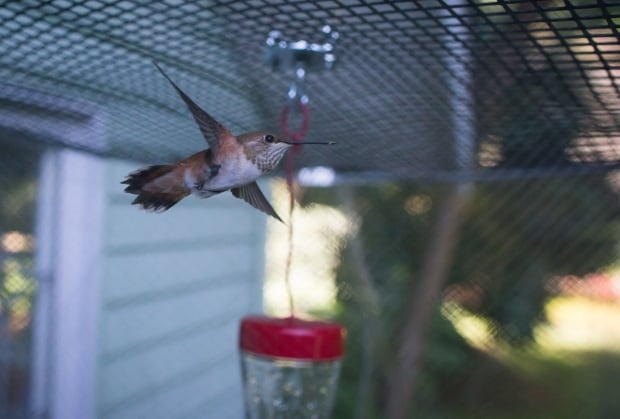
A rufous juvenile male hummingbird flies around after being captured with a net above a feeder. (Darryl Dyck/Canadian Press)

To obtain the feces and urine of those flighty, ever-moving tiny birds, the researchers place nets over feeders which are lowered when a hummingbird comes along to feed. As a byproduct of the hummingbird's constant processing of nectar, it concomitantly expels it so that the collection of urine and feces for test results is then accomplished with the help of the nets. This study is meant to last for five years, and is only in its initial stage, at two years.

Hummingbirds, like bees, habitually come back to routinely recognized places to find their food, recalling where certain flowers grow. Another concern is that pesticide absorption might have the effect of disrupting their memory. According to an annual breeding bird survey, between 1966 and 2013, the population on the Pacific Coast of the rufous hummingbird has declined an average of 2.67 percent annually.

Two other species of hummingbird were also found to be in decline, the Allen's and broad-tailed hummingbirds, leading Health Canada to reevaluate the use of imidacloprid, a neonicotinoid insecticides commonly used on agricultural crops and coincidentally used as well for flea and tick control on cats and dogs. Separately, an earlier Health Canada report noted that imidacloprid has the potential to exact short- and long-term effects on bees inclusive of behavioral changes and mortality rates.

Aside from suspicions about the effect of these insecticides there are additional issues which may be impacting on the well-being of both hummingbirds and bees. Habitat loss, seasonal plants blooming at a different time of season, even an increase in the deer population, consuming the same flowers required by the hummingbirds to exist, could all be found to play a role in the decline of these wonderful, tiny birds.

Hummingbirds are filling up for the winter.
Hummingbirds filling up for their winter migration flight. (Grouse Mountain)

Labels: , , , , ,

 
()() Follow @rheytah Tweet