Ruminations

Blog dedicated primarily to randomly selected news items; comments reflecting personal perceptions

Saturday, November 06, 2021

Bolstering COVID-10 Protection

"If authorized by the FDA [U.S. Food and Drug Administration] we may soon have pills that treat the virus in those who become infected."
"The therapy would be another tool in our took box to protect people from the worst outcomes of COVID."
U.S. President Joe Biden
 
"It makes the landscape a lot more promising because what these antivirals represent is more evidence of the ability to tame the virus."
"It gives us a big toolbox, makes it a more treatable infection. It brings it down from the level of being a five-alarm fire."
"I think that when you have oral antivirals that can decrease complications and decrease hospitalizations, that makes Covid-19 a much more manageable respiratory infection, and that's always been the goal."
Dr. Amesh Adalja, senior scholar, Johns Hopkins Center for Health Security
 
"Effective, early, oral medicines will be fundamental to ending Covid-19."
"[Health agency Unitaid] welcome[s] additional small molecule antivirals -- supported by evidence -- and with meaningful commitments to access in all countries, including low and middle income countries." 
Herve Verhoosel, spokesperson, World Health Organization affiliate Unitaid
Pfizer's experimental antiviral pill for COVID-19 has great potential to drive down mass hospitalizations and reduce death, says infectious diseases specialist Dr. Zain Chagla. 'There is a lot of optimism,' he said. (Bebeto Matthews/The Associated Press)
 
In the interim, on the strength of Pfizer's trial results suggesting that its oral drug with the brand name Paxlovid was proven in trials to slash the risk of severe COVID-19 by 89 percent, the American government has pre-ordered millions of doses of the Pfizer drug. Giving a strong indication that the FDA will be giving its approval for the drug's use in the United States. Once that happens, other countries will appraise the results of the study -- cut short because of the volume of its positive results -- guaranteeing it will be in wide use as a COVID prevention therapy.

It is no small thing to produce an anti-viral medication whose results have demonstrated the chances of hospitalization or death for adults at risk of developing severe disease, would be cut by 89 percent. Merck's pill molnupiravir, introduced a month earlier, was shown to cut risk of dying or hospitalization for COVID-19 patients at high risk of serious illness by 50 percent.

The pill is meant to be taken alongside an older anti-viral called ritonavir. Therapeutic treatment consists of three pills taken twice daily. The treatment price tag would approximate that of Merck's product whose U.S. contract price is approximately $700 each five-day course. Experts point out that despite the potential seen by these anti-viral pills, COVID-19 infection prevention will remain based on the broad use of vaccines.

Inoculation is recognized as a superior overall protection against the pandemic that has killed over five million people worldwide, as far as infection disease experts are concerned, to the present time. Over seven billion vaccine doses have thus far been administered globally, and even at that only about half the world's population has been covered. Over 400,000 new cases are reported daily across the globe.  And 50 countries are seeing rising infection rates.
 
58 percent of Americans are now fully vaccinated. It is Pfizer's intention to submit interim trial results for its anti-viral pill before the U.S. November 25 Thanksgiving holiday, to the Food and Drug Administration. 180,000 treatment courses are expected to be available by the end of 2021, with another 40,000 million courses by next year's end -- with 21 million in the first half of 2022 available. Pfizer has revealed it has been in discussions with 90 countries to date.

In Pfizer's study 1,219 patients wee analyzed  through examination of hospitalizations or deaths among people who had been diagnosed with mild to moderate COVID-19 with at least one risk factor for the development of severe disease (such as obesity or age). Within three days of symptom onset, the pill lowered chances of hospitalization or death for adults at risk of developing severe COVID-19 by 89 percent in comparison with patients receiving a placebo.

For patients treated within five days of symptoms, rates were similar; one percent of the treatment group was hospitalized, compared to 5.7 percent for the placebo group, including ten deaths. Those numbers work out to 85 percent effectiveness in the prevention of hospitalization or death. No side effects were detailed by Pfizer, adding that adverse events occurred in roughly20 percent of both treatment and placebo patients; likely in the form of nausea and diarrhea.
"I see them as a one-two punch. Vaccines are prevention. These antivirals are early treatment. Both have utility," 
"Neither one is a substitute for the other."
Dr. William Schaffner, professor of medicine, Division of Infectious Diseases, Vanderbilt University School of Medicine
A selection of pills
Getty Images

Labels: , , , , ,

Tuesday, October 19, 2021

Merck's Anti-COVID Molnupiravir Skeptics

"When the data come out, they're underwhelming. We have to be a little careful."
"[While a 50 percent drop in hospitalization and death risk sounds encouraging it is still not as impressive as vaccines] which are at least 85 percent effective at preventing those same outcomes."
Dr.Donald Vinh, McGill University Health Centre, Montreal

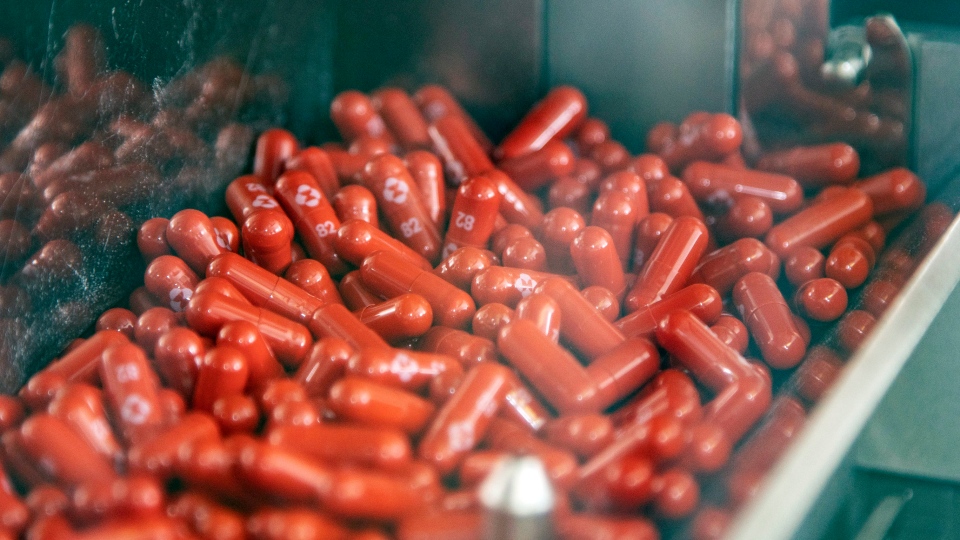
Capsules of Merck's experimental antiviral drug Molnupiravir, which cost a reported US$700 to $800 for a five-day course of therapy.
Merck's experimental drug  Merck & Co. Inc./AFP
"Maybe it's great -- we just have no idea."
"Do you send them to an infusion centre or somewhere to get a subcutaneous injection of monoclonal antibodies, or to the pharmacy for pills? And why do you choose one over the other? These are all quite challenging."
"[Governments are damned if they do and damned if they don't. They have to make a decision around the procurement, knowing that it's very possible that this [molnupiravir -- Merck's drug], is going to become a very popular agent."
"If you’ve got infinite funds and access to the drug, you’d say, ‘Okay, give it to everyone.’ But it doesn’t make economic sense. You need to give it to the people who are highest risk. And you have to figure out, who’s the highest risk?"
"That’s the crazy thing — many people who are vaccine hesitant don’t seem to be hesitant of monoclonal antibodies, or ivermectin, or any of these other treatments, whether they’re useful or not. But there is something special about vaccines that they won’t take." 
Dr.Andrew Morris, infectious diseases specialist, Mount Sinai Hospital, University Health Network, Toronto
Georgia State University virologist Richard Plemper, speaking to the journal Nature, explained that the new Merck drug molnupiravir has "mutagenetic" properties where it is designed to stop the virus from copying itself in the process causing problematical mutations. "The virus essentially mutates itself to death", he said. The Merck press release, prior to being authorized as an anti-COVID drug by national health authorities, speaks of investigational results where the antiviral was seen to halve risk of hospitalization and death in a study of 775 people with mild-to-moderate COVID-19, compared to a placebo.
 
Should further, intensive scientific scrutiny verify Merck's claim of success it would signify that the first early COVID treatment not dependent on infusion or injection has succeeded in trials to prevent serious complications from COVID. The memory of other drugs in which hope was invested ultimately failing -- like hydroxychloroquine and colchicine -- to live up to expectations leads to a certain amount of skepticism that the Merck medication will work where others have failed.
 
Reportedly a five-day course of therapy comes in at $700 to $800, even while the the drug, if it passes further critical tests, could not be used by everyone, stocked in every drugstore, pointed out Dr.Morris. Conducted with Ridgeback Biotherapeutics, the Merck trial included people with at minimum one risk factor for developing serious COVID: obesity, advanced age (60 and up), diabetes and heart disease. All those in the study had been unvaccinated. 29 days following treatment 7 percent of those treated were hospitalized or had died.
 
The Merck pills must be initiated to those recently infected and diagnosed fairly early, with a confirmed positive test, within five days of the appearance of symptoms. Doctors, should the Merck pill be approved by Health Canada, would then have two treatments of choice for patients with mild to moderate COVID at risk of a poor outcome; monoclonal antibodies infusion or injection at a cost of between $1,500 to $2,000 each dose, or the Merck pill. 
 
There has been concern whether the molecule produced by molnupiravir allowing mutations to occur could lead to problems in patients. "But I cannot imagine that that's an issue, because it's not taken up in human cells the same way", explains Dr.Morris. Toxicity studies from all pre-clinical data showed no "untoward effects" from doses administered to people, assured Merck's vice-president of policy and government affairs. The data to date show "the drug was generally well tolerated in terms of safety and side effects", said Merck Canada's Jennifer Chan.

The drug acts by inserting itself into the viral RNA, which creates a phenomenon known as viral error catastrophe, which confuses the virus by giving it incorrect building blocks to replicate. Two capsules daily for five days comprises treatment with the Merck product. At a cost of $1.7 billion, the U.S. ordered 1.2 million courses of the formulation. According to Dr.Morris, those benefiting most from this therapeutic course would be the unvaccinated.

Labels: , , ,

Saturday, October 02, 2021

Merck's New Antiviral COVID Treatment

"An oral antiviral that can impact  hospitalization risk to such a degree would be game-changing."
"[Existing treatments are] cumbersome and logistically challenging to administer. A simple oral pill would be the opposite of that."
Amesh Adaija, senior scholar, John Hopkins Center for Health Security 
 
"Most people have heard of Tamiflu, and they've heard of acyclovir,. Acyclovir is a type of antiviral used to treat chickenpox, herpes and shingles."
"We didn't develop a ton of other antivirals."
"Stop progression of disease, so you take them and you forget about it, right? The second thing we'd like the pill to do, if you're taking it for symptomatic disease, is stop long Covid, right? It's not just 'Don't let me get progressed and die -- don't let me have lingering cough, lingering headache.' "
"Treatment to serve as prevention], so someone with Covid-19 is less likely to transmit it to others. We'd like it to wipe out the SARS-CoV-2 replication in the nose so fast that your nose is no longer a danger to me."
Dr. Myron Cohen, professor of medicine, microbiology, immunology and epidemiology, University of North Carolina.
molnupiravir
This undated image provided by Merck & Co. shows their new antiviral medication. (Merck & Co. via AP)

"This is going to change the dialogue around how to manage COVID-19", chief executive Robert Davis of Merck & Co. pharmaceuticals stated. In collaboration with partner Ridgeback Biotherapeutics both plan to apply for U.S. emergency use authorization in the shortest possible time-frame along with plans to make regulatory applications worldwide. Their antiviral pill has the potential to significantly decrease death or hospitalization for people most at risk of contracting serious COVID-19.

Experts in the field view the antiviral, named molnupiravir, as a true breakthrough in treating the SARS-CoV-2 virus haunting the world community and strangling economic development. The treatments currently in use representing infused antiviral remdesivir from Gilead Sciences Inc., and generic steroid dexamethasone are administered once a patient with COVID has been hospitalized

Critical Phase III trial results were positive enough for the antiviral to convince outside monitors to recommend an early halt to the trials; they had given sufficient proof of the efficacy of the treatment. Both Swiss drugmaker Roche Holding AG and Pfizer are focusing on the development of an easy-to-administer antiviral pill. Only antibody cocktails which must be given intravenously have been approved to the present for non-hospitalized patients.

In Merck's study, a planned interim analysis of 775 patients studied hospitalizations or deaths, finding that 7.3 percent of people given molnupiravir were hospitalized with none dying, for 29 days following treatment, in comparison with hospitalization of 14.1 percent of placebo patients among whom there were eight deaths. The trial involved international patients representing a wide spectrum of study entrants with molnupiravir taken every 12 hours for a period of five days.
 
Viral sequencing performed to date indicates molnupiravir to be effective against all variants inclusive of the highly transmissible Delta strain. Adverse events rates were similar for both molnupiravir and placebo patients, according to Merck. With the expectation that the potential new treatment may aid in preventing serious illness from COVID, scientists have broadly welcomed the new antiviral.
 
The worldwide assault on the human body by the SARS-Cov-2 virus through COVID-19, has succeeded in causing the death of close to five million people around the world.
"This is the most impactful result that I remember seeing of an orally available drug in the treatment of a respiratory pathogen, perhaps ever."
"I think getting an oral pill that can inhibit viral replication -- that can inhibit this virus -- is going to be a real game changer."
Dr. Scott Gottlieb, former commissioner, US Food and Drug Administration

Labels: , , , , , ,

 
()() Follow @rheytah Tweet