Ruminations

Blog dedicated primarily to randomly selected news items; comments reflecting personal perceptions

Friday, June 18, 2021

Where There is a Need, There is a Way

"At the beginning it was not clear whether he would be able to move his arms, his hands, and play music again."
"It was a shock for me and I realized there is a need for this kind of technology."
"Without doing it digitally this would never be possible to play music in real time."
"It takes away the actual action of strumming a chord."
Zacharias Vamvakousis, creator, "Eyeharp"
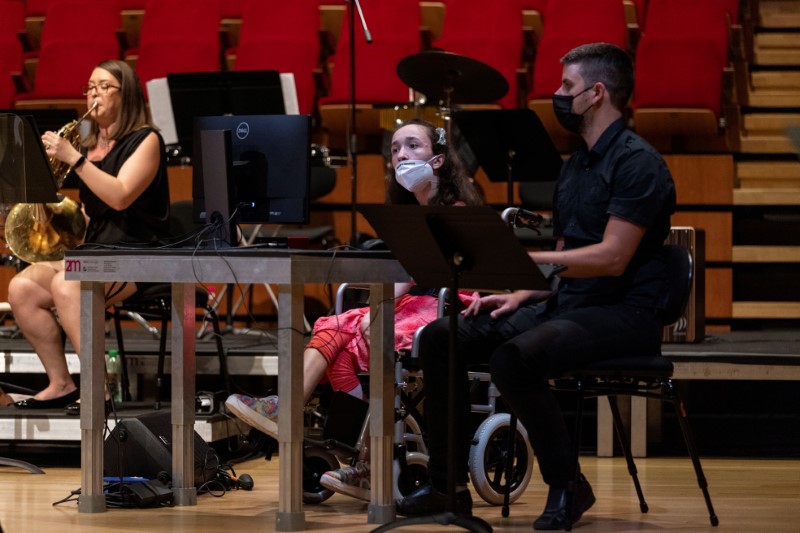
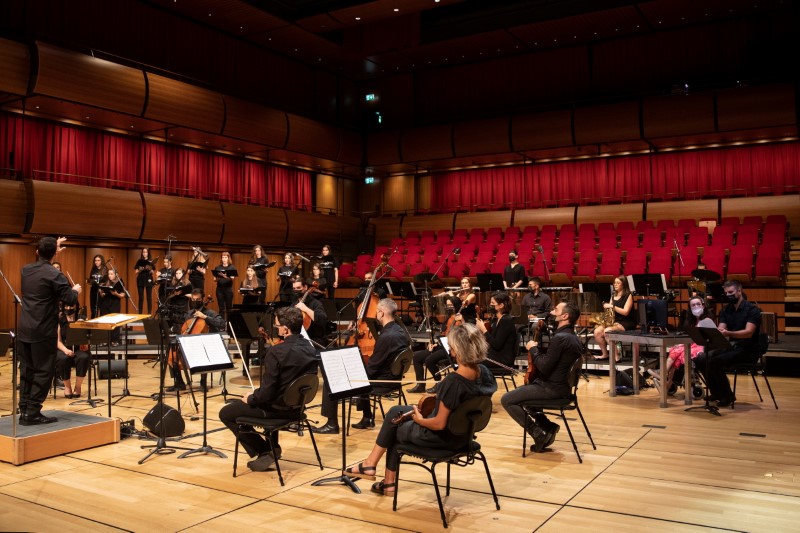
Alexandra Kerlidou, 21, who suffers from cerebral palsy, plays the "Eyeharp", a gaze-controlled digital software that allows people with disabilities to play music, next to computer scientist Zacharias Vamvakousis, during a concert in Athens, Greece, June 14, 2021. Picture taken June 14, 2021. REUTERS/Alkis Konstantinidis
Alexandra Kerlidou, 21, who suffers from cerebral palsy, plays the "Eyeharp", a gaze-controlled digital software    Reuters

"I felt strange, I had never imagined such a thing", said Alexandra Kerlidon from her home in Lesbos, Greece, a student whose existence has been compromised by cerebral palsy. "I cried, her mother too" Anastasios Kerlidou said, hearing his daughter first play the Eyeharp. Yes, the Eyeharp. It is part of a program that offers a range of musical instruments whose choice enables those who cannot move their hands or speak, to 'play', through computer-generated software, in obedience to eye movement.

A friend of the Eyeharp's creator -- Zacharias Vamvakousis -- who was a musician, had been involved in a motorcycle accident. They had been scheduled to play a concert together at the time. But his friend was no longer able to do any of the things he had once taken for granted; his limbs unwilling/unable to respond as a result of the accident's severely disabling consequences. So he was inspired by both compassion and his creative genius to come up with an answer to the dilemma.

Himself both a computer scientist and a musician, Vamvakousis created a digital eye-tracking program from a technology already in wide use in gaming, security and medicine; a program geared to monitor eye movement through the performance of commands. As the eye rests on musical notes spaced on a wheel on the screen, the response on average is the playing of three to four notes each second. No fewer than 25 musical instruments can be selected to 'play'.

It takes discipline and concentration to succeed with the program ... since the player must direct eyes from wandering too swiftly over to the following note. Alexandra plays the Eyeharp, gaze-controlled digital software allowing those like her with severe disabilities, to play music. She cannot imagine her life without music.
 
Alexandra Kerlidou, 21, who suffers from cerebral palsy, plays the "Eyeharp", a gaze-controlled digital software that allows people with disabilities to play music, next to computer scientist Zacharias Vamvakousis, during a concert in Athens, Greece, June 14, 2021. Picture taken June 14, 2021. REUTERS/Alkis Konstantinidis
Reuters

Labels: , , , , ,

Friday, February 21, 2020

Preserving Fine Motor Function in Brain Surgery

"The violin is my passion. I've been playing since I was ten years old. The thought of losing my ability to play was heartbreaking."
"Being a musician himself, Professor Ashkan understood my concerns. He and the team at King's went out of their way to plan the operation -- from mapping my brain to planning the position I needed to be in to play."
"Thanks to them, I'm hoping to be back with my orchestra very soon."
"[Doctors told me], 'Your tumor is on the right-hand side, so it will not affect your right-hand side, it will affect your left-hand side'. And I'm just like, 'Oh, hang on, this is my most important part. My job these days is playing the violin'."
Dagmar Turner, British violinist

"[The operation had forced his team to consider the] finer details [of violin playing]. Length of the string, pressure on the string, all those fast movements moving from one string to another."
"So that is what was unusual for us."
"We perform around four hundred resectons, tumour removals, each year, which often involves rousing patients to carry out language tests, but this was the first time I've had a patient play an instrument [during surgery]."
"We knew how important the violin is to Dagmar, so it was vital that we preserved function in the delicate areas of her brain that allowed her to play."
"We managed to remove over 90 percent of the tumour, including all areas suspicious of aggressive activity, while retaining full function of her left hand."
Dr.Keyoumars Ashkan, neurosurgeon, King's College Hospital, London
Dagmar Turner recently played her violin during brain surgery in London. "The violin is my passion," she said in a statement. "I've been playing since I was 10 years old."
King's College Hospital NHS Foundation Trust/Screen shot by NPR

Unusual, and rare that a musician would actually play their instrument during surgery, enabling surgeons to map the brain to distinguish which area would be affected through surgery so that steps could be taken to carefully avoid disturbing the area in question for the purpose of retaining the artist's ability to continue performing. There have been a few previous instances of neurosurgery that set about to produce a result very similar to that of this 53-year-old violinist who was determined to retain her ability to play a violin.

The surgery scheduled for DagmarTurner at King's College Hospital, London was to remove a tumour on her right frontal lobe. Which left her with the fear that post-surgery her ability to play her beloved violin might be compromised. As a member of the Isle of Wight Symphony Orchestra she was intent on doing all that was possible to make certain that no damage to the area controlling fine movement of the left hand -- a requirement for skilled, intricate violin playing -- would occur.

She discussed her fears with lead surgeon Keyoumars Ashkan and out of that discussion came the plan of action. As an accomplished pianist himself, Dr.Ashkan was compassionately invested in doing whatever he could to preserve Ms.Turner's left-hand neural controls. It was agreed that she would be awakened from a general anesthetic so she could play her violin once the team had conducted the craniotomy -- opening the skull. It took two hours with Ms.Turner playing all the while for her brain to be meticulously mapped.

While she played scales and improvised melodies and music compositions from memory, the parts of the lobe to be preserved for its necessity in controlling the left hand, were precisely identified. The violinist had been diagnosed with a large, slow-growing tumour, a grade-2 glioma, in 2013. During a public performance she had suffered a seizure. The tumour was identified as benign, but once it began to aggressively take on size despite radiotherapy, the decision was taken to remove it.

The surgical team had inserted a tiny electrical probe, activating it to determine whether it disrupted Ms.Turner's ability to playi with the understanding the surgeons could remove tissue where activation would not affect her playing ability. The procedure was repeatedly followed as the tumour was removed. Surgery was pronounced successful, following which Ms.Turner returned home in three days' time. Within two and a half weeks, she was able once again to take up her place with the orchestra.

After surgeons removed a tumor from Dan Fabbio's brain in 2017, they gave him his saxophone — to see whether he'd retained his ability to play. A year after his surgery, Fabbio is back to work full time as a music teacher.
YouTube/Screenshot by NPR 

Labels: , , ,

Saturday, August 18, 2018

Music To Calm The Sheltered Beasts

"If we're in a chaotic environment, we're drawn towards structure and order. So these songs, the lullabies, are very simply structured."
"And then I think not only the babies, but also the animals are drawn to the human compassion in the singer's voice, and the familiarity of the heartbeat."
"I hate to admit this, but I got emails and phone calls for 13 years about how people would play the Heartbeat Lullabies for their dog, and it would calm them and keep them from barking, and I just kind of said: 'Oh, come on. ...I mean, is this really real? Are you people reading things into this'?"
Composer Terry Woodford, Muscle Shoals, Alabama


Now 75, years ago Terry Woodford was tasked with creating lullabies to quiet crying babies, to give them audible comfort that would still their anxieties -- and he responded by writing music based on traditional lullabies with the additional device of adding an underlying heartbeat. The thought behind this was obvious enough; listening to that heartbeat and that soothing music would be familiar to babies from their memory of the heartbeat they heard in the womb, and later while being held by their mother or father.

The music proved a success, doing the work he hoped it would to comfort and to placate the anxiety that babies and infants can feel at hospital nurseries and at newborns' homes. That music was named Heartbeat Lullabies. Serving as a judge at an arts festival in 1984 in Huntsville Alabama, Mr. Woodford was approached by a woman who was a recreational therapist at daycare centres who wanted him to think about creating music "that's not so condescending for our kids". His immediate response? "I don't want to make music for kids!"

And then he thought better of it, viewing it as a challenge. Later on, he began hearing from people claiming that the Heartbreak Lullabies served to soothe their dogs' anxieties. And he could hardly credit it. But he learned that some shelters had started using the music, one of which was in Colorado Springs where he happened to be living at the time. He paid a visit there: "I'm walking down the aisle, and all the dogs are jumping and barking, and (the shelter employee) had an old boombox in the corner. She turned it on, and within 15 seconds every dog laid down in their kennel, and it freaked me out."
shutterstock_100193201
Shutterstock

This experience inspired him to go on to use the basic music he had designed for babies and to re-work it for dogs. He estimates that the music, renamed Canine Lullabies, is being used in some 2,500 canine shelters. He charges nothing for the CDs or downloads he provides to shelters, to rescues and to animal clinics. His is not the only music source being used to soothe the emotions of shelter dogs. There is iCalm for Dogs, Relax My Dog and Song for Daisy. Song for Daisy is a 15-minute track by singer-songwriter Gnash.

Gnash adopted a Maltese terrier named Daisy. Gnash took the step of consulting researchers of a 2017 study that found shelter dogs responded when exposed to reggae or soft rock, rather than Motown, pop or classical music, and he formulated his Song for Daisy with that information in mind. It was found through a study in 2002 that shelter dogs responded favourably to classical music to encourage quiet and relaxation, and a later 2012 study repeated those findings.

plenty.r. photo - Creative Content License
Source: plenty.r. photo 


"Since being in a dog rescue shelter is often a stressful time for dogs, having music which actually calms and relaxes them could certainly help to make the experience better."
"After all, Music Therapy is a recognized form of treating human beings with anxiety problems, and there is no reason to think that it would not work on dogs as well."
Stanley Coren, PhD, DSc, FRSC, Psychology Today

Labels: , , ,

Friday, April 10, 2015

Art and Artlessness

"Words of bile and hatred bullied [him into declining a longed-for engagement with the Toronto Symphony Orchestra]. The media frenzy [over Valentina Lisitsa's cancelled performance sucked him too into its vortex of hatred]."
"What started out as one of the happiest moments of my life turned into a shattering display of mob hysteria. Her words offended many people who perceived her as pro-violence and anti-love."
"Free speech has consequences, and one must own one's position ... Her attitude, and the mob-like behaviour of her devotees, censures Rachmaninoff's 2nd concerto."
Stewart Goodyear, pianist, Toronto
Stewart Goodyear, seen here in 2012, says he has pulled out of filling in for Valentina Lisitsa after facing a furore for doing so after the controversy surrounding her views on Ukraine.
RANDY RISLING / Toronto STAR Order this photo
Stewart Goodyear, seen here in 2012, says he has pulled out of filling in for Valentina Lisitsa after facing a furore for doing so after the controversy surrounding her views on Ukraine.

"It's hard to see the connection between what she said and what the duties of her job are and how it would affect it. I think there is a problem with the message that this sends to artists that they may have trouble getting jobs or keeping jobs if they express views that are unpopular or controversial."
Cara Zwibel, Canadian Civil Liberties Association

"This is not about free speech, this is not about a political perspective or persuasion, this is about very offensive, intolerant comments about people."
"As one of Canada's most important cultural institutions, our priority must remain on being a stage for the world's great works of music, and not for opinions that some believe to be deeply offensive."
Jeff Melanson, president, chief executive, TSO
Ukraine-born pianist Valentina Lisitsa says she has no intention to stop criticizing her native country.
Vince Talotta / Toronto Star   Ukraine-born pianist Valentina Lisitsa says she has no intention to stop criticizing her native country.

Unfortunately, it seems that Mr. Melanson dropped the ball on the Toronto Symphony Orchestra's primary function of presenting as a stage for the world's great works of music. Presumably, the obnoxious but hugely talented classical pianist Valentina Lisitsa whose popularity has soared for the precision and beauty of her rendering of great musical compositions is acclaimed by music lovers for her talented expression on the piano, and not for her tasteless and odious opinions.

Richard Wagner, hugely admired as a favourite of the Third Reich for his presentation of the ubermensch, the Aryan ideal, remains a controversial figure, but even his music with its sturm und drang that so inspired Adolf Hitler, remains popular as the quintessential dramatic musical storytelling panorama of legendary superhuman figures. The man and his philosophy were wretched, but his music extraordinarily listenable, though many consider it tainted irremediably.

Ukraine-born, ethnic Russian classical pianist Valentine Lisitsa has gained a huge following for whom her controversial statements remain irrelevant; her musical ability speaks for itself as far as they're concerned. She had been scheduled to play as a guest star with the Toronto Symphony Orchestra. Protests lodged with the orchestra administration, however, resulting from her strongly-held views on world affairs, convinced the TSO board that her presence on stage with the orchestra would burden their reputation.

Her popularity with classical music aficionados is one that transcends her politics, however. And the orchestra has been both congratulated and damned by its decision to honour their retaining fee for her performance, while absenting her from the stage. As a replacement for Ms. Lisitsa, a Toronto pianist, Stewart Goodyear, was invited to take her place, and he was pleased to accept what to him represented a mouth-watering opportunity to advance his career.

Unfortunately, Mr. Goodyear too will not be appearing with the TSO. In a Facebook entry, he complained bitterly that the controversy had dragged him into its vortex "before I could blink." Since the cancellation of Ms. Lisitsa's appearance, critics of the decision have protested the aura of censorship, and have accused the orchestral management of surrendering to Ukrainian demands.

Without a doubt Ms. Lisitsa has offended with her opinionated and canted view of politics and human relations. Her sharp-tongued cuts have lunged at a wide range of subjects, from accusations of "atrocities" committed on the part of the Ukrainian regime against ethnic Russian Ukrainians, to the skepticism she expresses about the Holocaust, to mockery of Down syndrome individuals, even expressing a threat against NATO troops.

Open-minded and pleasant she obviously is not. But she is 41 years of age, an adult whose experiences have formed her perspective on many matters relating to the human condition. She has been endowed with an especial musical talent to offset her repugnant willingness to offend. And while it might be satisfying to some to just tell her to shut up and play the keyboard, she does have a right to express her ignorant opinion in a society that values free speech.

Valentina Lisitsa
Ukraine-born classical pianist Valentina Lisitsa is shown performing live on stage at the Royal Albert Hall in London on June 19, 2012. (Andrew Cowie/AFP/Getty Images)

Dislike her, like her music. Or, as the TSO has it, if the talented Ms. Lisitsis feels entitled to air her random and insulting thoughts revealing her personality as a rather nasty person, she does so at the expense of her professional reputation of a pianist of great original ability, and she has made her choice, just as the Toronto Symphony made theirs.

Labels: , , , ,

 
()() Follow @rheytah Tweet