Ruminations

Blog dedicated primarily to randomly selected news items; comments reflecting personal perceptions

Saturday, August 18, 2018

Music To Calm The Sheltered Beasts

"If we're in a chaotic environment, we're drawn towards structure and order. So these songs, the lullabies, are very simply structured."
"And then I think not only the babies, but also the animals are drawn to the human compassion in the singer's voice, and the familiarity of the heartbeat."
"I hate to admit this, but I got emails and phone calls for 13 years about how people would play the Heartbeat Lullabies for their dog, and it would calm them and keep them from barking, and I just kind of said: 'Oh, come on. ...I mean, is this really real? Are you people reading things into this'?"
Composer Terry Woodford, Muscle Shoals, Alabama


Now 75, years ago Terry Woodford was tasked with creating lullabies to quiet crying babies, to give them audible comfort that would still their anxieties -- and he responded by writing music based on traditional lullabies with the additional device of adding an underlying heartbeat. The thought behind this was obvious enough; listening to that heartbeat and that soothing music would be familiar to babies from their memory of the heartbeat they heard in the womb, and later while being held by their mother or father.

The music proved a success, doing the work he hoped it would to comfort and to placate the anxiety that babies and infants can feel at hospital nurseries and at newborns' homes. That music was named Heartbeat Lullabies. Serving as a judge at an arts festival in 1984 in Huntsville Alabama, Mr. Woodford was approached by a woman who was a recreational therapist at daycare centres who wanted him to think about creating music "that's not so condescending for our kids". His immediate response? "I don't want to make music for kids!"

And then he thought better of it, viewing it as a challenge. Later on, he began hearing from people claiming that the Heartbreak Lullabies served to soothe their dogs' anxieties. And he could hardly credit it. But he learned that some shelters had started using the music, one of which was in Colorado Springs where he happened to be living at the time. He paid a visit there: "I'm walking down the aisle, and all the dogs are jumping and barking, and (the shelter employee) had an old boombox in the corner. She turned it on, and within 15 seconds every dog laid down in their kennel, and it freaked me out."
shutterstock_100193201
Shutterstock

This experience inspired him to go on to use the basic music he had designed for babies and to re-work it for dogs. He estimates that the music, renamed Canine Lullabies, is being used in some 2,500 canine shelters. He charges nothing for the CDs or downloads he provides to shelters, to rescues and to animal clinics. His is not the only music source being used to soothe the emotions of shelter dogs. There is iCalm for Dogs, Relax My Dog and Song for Daisy. Song for Daisy is a 15-minute track by singer-songwriter Gnash.

Gnash adopted a Maltese terrier named Daisy. Gnash took the step of consulting researchers of a 2017 study that found shelter dogs responded when exposed to reggae or soft rock, rather than Motown, pop or classical music, and he formulated his Song for Daisy with that information in mind. It was found through a study in 2002 that shelter dogs responded favourably to classical music to encourage quiet and relaxation, and a later 2012 study repeated those findings.

plenty.r. photo - Creative Content License
Source: plenty.r. photo 


"Since being in a dog rescue shelter is often a stressful time for dogs, having music which actually calms and relaxes them could certainly help to make the experience better."
"After all, Music Therapy is a recognized form of treating human beings with anxiety problems, and there is no reason to think that it would not work on dogs as well."
Stanley Coren, PhD, DSc, FRSC, Psychology Today

Labels: , , ,

Saturday, October 07, 2017

Dog-Human Symbiosis

"To me, it's one medicine. It always has been. One medicine. One cancer. One cure."
"Convincing big drug companies that we have relevant models that can be studied so much cheaper than human trials [has been a difficult sell]."
"[Also at risk is that] on rare occasions cats don't behave like people], so research continued to focus on mice and rats as laboratory models."
Stephen Withrow, veterinarian, Flint Animal Cancer Center, Colorado State University

"[Dogs with cancer are treated as compassionately] sometimes even nicer [than people]. Nobody is taking a dog and putting him in a kennel in a room somewhere, never to be seen again, and experimenting on them. These are pets that are getting genuine care."
"One of the fundamental challenges facing us in human oncology is the fact that we are learning so much more about cancer -- the structure of cancer cells and how they behave."
"By including our pets in clinical trials, we might get some very valuable clues."
Dr. Len Lichtenfeld, deputy chief medical officer, American Cancer Society

"These people who are looking for breakthroughs aren't interested in whether the breakthrough comes from a dog or a zebra fish."
"Just give us something we can work with that will help speed up the process of drug development, which is so long and expensive."
Dr. Larry Glickman, professor emeritus, Purdue University
James Bareham
The theory seems to be that many of the life-threatening diseases that afflict humans present in dogs and likely cats in the very same way. Biologists look at a co-dependency and shared development in the relationship that began an estimated 30,000 years ago between humans and what we now regard as intimate companion animals in their mutual exposure to the same environment, quality of air and water and even food consumption affecting our genetic inheritance.

And that when nature patterned animals, humans were merely one species among many. That the basic design is not that much different between rats, pigs, dogs, monkeys and humans. So that when one is afflicted with a potentially lethal disease, its type and the journey it takes in the body in attacking vital organs, challenging the immune system and ultimately wreaking its destined devastation is strikingly similar.

Treat the symptoms and the presence of the interloper or demented cells in one member of the species and you may have gained the formula for treatment -- or a version of treatment -- in the others as well. When our loved and valued companion pets become seriously ill, most of us would do just about anything to ease their discomfort and if we have the wherewithal and the opportunity, plan for professional intervention to bring them back to health.

In the development of tumours there is an identifiable and real commonality between humans and dogs; biopsy studies often find difficulty in differentiating between human and dog. So too is the cardiovascular systems of both dogs and people very similar, according to veterinarians. The second most common form of heart disease in dogs, dilated cardiomyopathy -- a deadly disease -- also represents the third most common in humans.

There has developed a link in research, services and findings between veterinarian colleges and medical establishments. Where even myoclonic epilepsy, one of the most common forms presenting in children and adults also afflicts dogs. By treating such conditions in dogs, a learning process has been brought to the table, with results that are completely applicable to human patients.
Bridgett vonHoldt, an assistant professor in ecology and evolutionary biology at Princeton University, cuddles with her Old English sheepdog, Marla. VonHoldt and her fellow researchers found two gene variations that seem to explain doggy friendliness.
Bridgett vonHoldt, an assistant professor in ecology and evolutionary biology at Princeton University, cuddles with her Old English sheepdog, Marla. VonHoldt and her fellow researchers found two gene variations that seem to explain doggy friendliness. (Chris Fascenelli/Princeton University)
The first full genome of a dog was mapped in 2005, when it was discovered that humans share more of their ancestral DNA with dogs than they do with mice, yet it has mostly been those tiny rodents that much biological research has focused on. When speaking 'research' and living animal models, most people would wince at the most uncomfortable thought that dogs would be used as laboratory models. On the other hand, these are peoples' beloved pets suffering from end-stage disease.

Canine cancer treatments run between $10,000 to $20,000, a steep dollar figure that most people would blanch at. Now that veterinarians are collaborating with human medicine researchers studying the genetics of for example, fatal heart disorder both dogs and humans share -- along with epilepsy and stem-cell therapy for spinal cord injuries -- research and treatment have gone hand-in-hand focusing on dog laboratory models.

Studies point out that cancer drugs in particular that appear to give promise when tested on lab rodents, fail the test of efficacy when moved into human trials. The co-evolution of dogs and humans, though, make it far more likely that what proves successful as a treatment for dogs can be transferred with a greater degree of success to humans, given our long exposure to the same pollutants and pathogens capable of triggering mutant cells into cancer.

Not that dogs haven't up to the present been used in vital research meant to benefit humans. The point of the current thinking is that in helping dogs overcome massive health assaults, humans will also benefit, given our similarities in organ function and body design. Back in 1921 at labs at the University of Toronto, Drs. Banting and Best's experiments were carried out on dogs. But those dogs underwent a procedure that afflicted them deliberately with diabetes.

The discovery that Dr. Banting was later co-awarded the Nobel Prize for Medicine for, in isolating insulin and injecting it into a laboratory test dog did save its life, but it was the experiment that placed the dog in peril to begin with, in deliberately isolating the hormone in dogs. This new approach with dog models in the link between veterinarian services and human health research comes at a different angle, working to improve the health of dogs afflicted with disease, a process that benefits humankind.
The Discovery of Insulin, Banting and Best
Banting, right, and Best, left, with one of the diabetic dogs used in experiments with insulin. Credits: University of Toronto Archives

Labels: , , , , ,

Sunday, October 01, 2017

It's A Dog's Life : India

"India is pretty unique."
"Maybe it's a karmic sense, this idea that the dog could be you, and if you don't watch out in life it could be you again."
"Or, maybe it's just that the poor have greater compassion because they can relate to other individuals who are having a hard time trying to survive."
Ingrid Newkirk, co-founder, People for the Ethical Treatment of Animals

"It comes down to tolerance. We've lived under Moghul rule, under British rule. It's crowded here, it's diverse, and to survive, you need to be tolerant."
"The more tolerant you are, the more compassion you have."
Niharika Kishan Gandhi, Mumbai, India
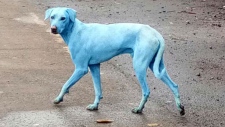
Blue dogs
Local residents spotted the blue dogs roaming the streets in an industrial neighbourhood of Mumbai, India. (Arati Chauhan/Facebook)

India must surely be among the most unique of nations, having enshrined in its very constitution (reflecting Hindu values) respect for animals. A passage within enjoins people of India to "have compassion for living creatures", which certainly goes a long way to explaining why cows are considered to be sacred, monkeys which can be a real nuisance are tolerated everywhere, and no real effort is made to secure storage of grain from predation by rats; everything, it seems, has a right to exist and to do so unharmed by the intention to see their presence as anything but normal.

The Supreme Court of India ordered Kerala state to see that vigilante action against the presence of stray dogs, seen as a threat resulting from deadly rabies proliferating, to cease and desist when strays were being hunted methodically to remove that threat. That presented as an anomaly in India where dogs are generally viewed as "community dogs", not strays. And as part of the community they are more often cared for as strays, to ensure they have enough to eat. Even the indigent poor with scarcely enough to eat themselves will feed strays.
A girl tries to protect her food from a stray dog in Mumbai on Oct. 3, 2005. Millions of strays roam India's growing urban centres, causing headaches for officials.
A girl tries to protect her food from a stray dog in Mumbai on Oct. 3, 2005. Millions of strays roam India's growing urban centres, causing headaches for officials.  (ADEEL HALIM / REUTERS FILE PHOTO)

There is a Bollywood actress who sees that vessels of freshly-prepared chicken and rice are set out each morning to feed neighbourhood dogs, while another woman makes the effort in her own way, driving about in her outfitted Honda to deliver meals to over one hundred dogs, and for good measure sprinkling those meals with seasonal spices; where turmeric is considered appropriate for the monsoon season to help boost canine immunity.

In India it is illegal to destroy healthy strays, leading to the presence of millions of dogs, an estimated 30 million right across the country. Typically, Indian dogs have a large and lean/muscular profile. Roughly two feet in height, with short-hair coats, long tails with a tendency to curl upward. They are descended from a venerable dog breed similar to and likely related to the Australian dingo dog. They roam about in packs through parks and can be seen around restaurants awaiting scraps.

Commuters inside railway stations are accustomed to seeing dogs sprawl in those environs on their stomachs, and they take care to leap over them on their way to the trains. That the dogs are generally cared for by a population that accepts them as they are says much of the philosophy of life in a country whose vast population runs the gamut from the middle class to the teeming millions who live hardscrabble lives of penury.

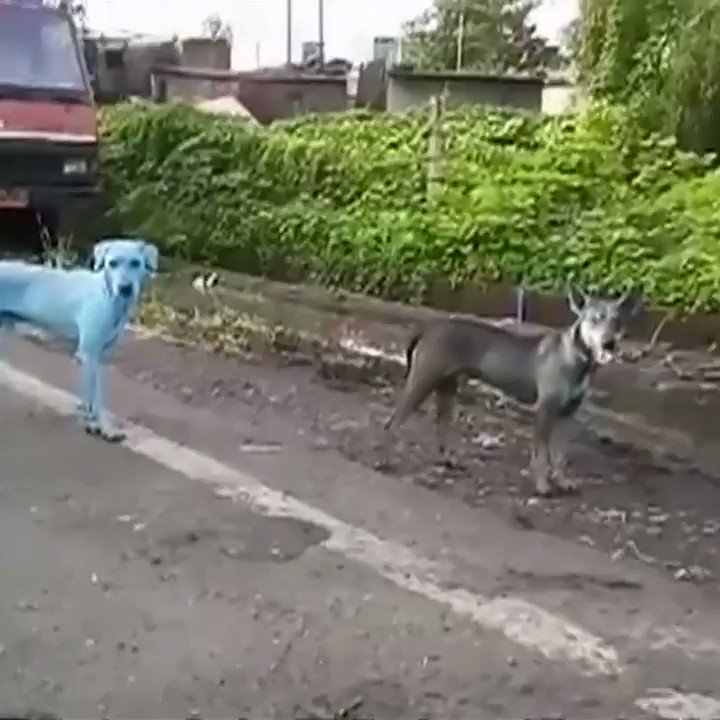
India is also known as a textile-industry country, a condition which gave rise recently to dogs in Mumbai being seen with a blue tint on their coats. Resulting when a dye company released colour chemicals into a drainage ditch flowing into a river running through Mumbai where dogs often play. The colouring meant for clothing staining the dogs' hair soon washed off by the following monsoon rains. Until that happened, however, the community was concerned to help the dogs living in that heavily industrialized part of Mumbai.

Where large plants crowd the landscape, factories stretching as far as the eye can see with smokestacks spilling effluent everywhere, and a stink of their products stifling the atmosphere with a pervasive stench of rotten eggs characteristic of sulphur, the devil's stink. The area, Taloja, teems with dogs whom factory workers and villagers alike feed. They will go to the extent of acquiring shampoo to wash the the dogs that roam the streets freely.
Twitter video is loading
Still from video  news.com

When the blue dye was first noticed on dogs, concerned workers contacted a neighbourhood human-rights activist who in turn contacted an animal-rights advocate who then called a veterinarian clinic nearby which rushed an ambulance to the scene. Soon afterward another incident with a dog occurred close to a factory where villagers waded into a ditch contaminated with nitric acid to rescue a trapped dog. The animal hospital named the rescued dog Babu and now cares for the dog who was blinded.

Charities dedicated to dogs, one named the Welfare of Stray Dogs, take to cruising about the city treating ill dogs and delivering healthy dogs to animal hospitals to be vaccinated and sterilized. Then, as required by law, the dogs are taken right back to the neighbourhood where they had originally been taken from. The government's plan is to reduce the population bit by bit through sterilization, a system thoroughly approved by animal welfare experts.

Sterilization also alters the behaviour of the dogs, which then have a tendency to be relaxed and friendlier, a condition that makes them even more attractive to the people among whom they live.

Labels: , , ,

 
()() Follow @rheytah Tweet