Ruminations

Blog dedicated primarily to randomly selected news items; comments reflecting personal perceptions

Tuesday, September 16, 2025

The Genocide in Sudan

"Here in El Fasher, we are starving."
"The responsibility is not just on those holding the guns. It's on the world. The Arab countries. The African Union. Europe." 
"The so-called international community. All of them."
"We know they can help. We know they have the power to airdrop food. They have planes. They have supplies."
"But they are choosing not to."
Abaaz Sudan Dispatch quoting Sudanese civilian
 
"[The U.S.’ determination of genocide in Sudan is] long overdue [and should have happened sooner]."
"[Nonetheless, it is] a form of justice because it recognizes victims’ grievances."
"It is a step towards peace and accountability by paving the way to hold actors responsible to account, not only perpetrators themselves but actors complicit in genocide."
Sudanese lawyer Mutasim Ali, legal adviser, Canada-based Raoul Wallenberg Centre for Human Rights
 
"We don’t think that the scale of these atrocities happening in Sudan and Darfur would have been this big without the support of the UAE [United Arab Emirates] to the RSF [paramilitary Rapid Support Forces]."
"So, we hope that the US decision to sanction Hemedti will send a strong message to the UAE to rethink its position and engage in a serious political process to end these atrocities and genocidal acts happening across the country."
"The RSF has been completely emboldened by impunity, a lack of accountability, and the fact that they were not seriously subjected to any sort of accountability."
Sudanese activist Hala Al-Karib, head, regional arm, Strategic Initiative for Women in the Horn of Africa 
https://media.cnn.com/api/v1/images/stellar/prod/230510194754-sudan-armed-forces-rapid-support-forces-peace-talks-intl.jpg?c=16x9&q=h_653,w_1160,c_fill/f_avif
 
 
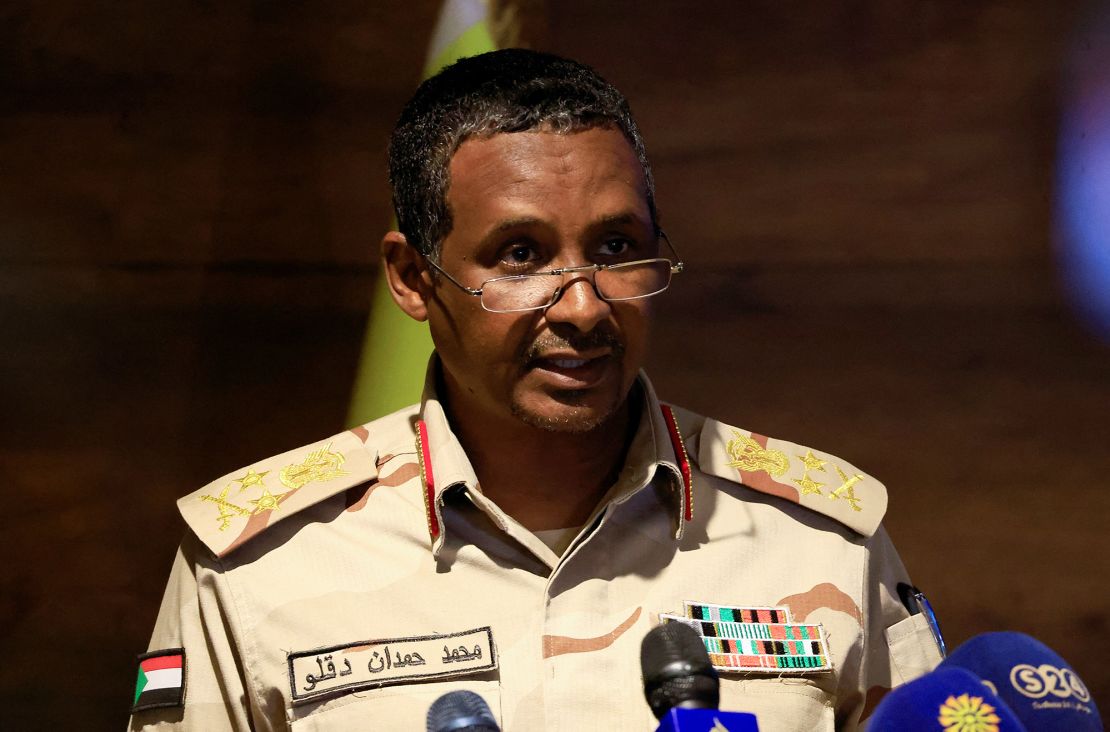
The RSF's Mohamed Hamdan Dagalo, also known as Hemedti, is seen in Khartoum in 2023.
The RSF's  Hemedti
"[Hemedti’s RSF and its allied Arab militias had perpetrated] direct attacks against civilians [including the systematic murder of] men and boys – even infants – on an ethnic basis."
"[They also] deliberately targeted women and girls from certain ethnic groups for rape and other forms of brutal sexual violence. [The same forces] targeted fleeing civilians, murdering innocent people escaping conflict, and prevented remaining civilians from accessing lifesaving supplies."
"Based on this information, I have now concluded that members of the RSF and allied militias have committed genocide in Sudan."
"To the foreign sponsors sending drones, missiles, mercenaries – enough. To those profiting off the illicit oil and gold trade that fund this conflict – enough."
Biden Administration U.S. Secretary of State Anthony Blinken
 
"The UAE has made absolutely clear that it is not providing any support or supplies to any of the two belligerent warring parties in Sudan."
"Our primary focus remains on addressing the catastrophic humanitarian crisis in Sudan."
"We continue to call for an immediate ceasefire and a peaceful resolution to this man-made conflict."
United Arab Emirates Foreign Ministry  
According to the United States there is an actual genocide taking place in Sudan, one that the world largely overlooks. Yet Sudan represents the world's worst humanitarian crisis where last year famine was officially declared, with the United Nations reporting that 25 million Sudanese face extreme hunger, with up to 12 million having been forced to flee their homes, in the midst of a brutal civil war. The death toll after years of conflict, according to the U.S. special envoy Tom Perriello, appears to have exceeded 400,000. 
 
Back in January before the change of administration, there was an official declaration naming the killing in Sudan as a genocide, and in April the Trump administration as well characterized the ongoing slaughter as a genocide. A determination echoed by the U.S. State Department. Bipartisan agreement has been reached in the United States affirming that Sudan is suffering through both genocide and famine. Despite which there is no consensus opinion over what official reaction or intervention might take shape. 
 
Somewhat reminiscent of the years of civil conflict in Syria when President Bashar al Assad, faced by a  rebellion from Sunni Syrians fed up with being treated like second-class citizens by the ruling Alawites, brooked no dissent of his rule, and set out to destroy his detractors by turning a protest into a civil war, attacking his own Sunni population with all the conceivable weaponry at his disposal, including chemical warfare and barrel bombs along with support from Iran's Republican Guards and Russian air offence. There too, a figure of 400,000 killed and millions internally displaced, millions more refugees, took place.  
 
https://media.cnn.com/api/v1/images/stellar/prod/2024-03-06t115557z-324388488-rc23p099a5b2-rtrmadp-3-sudan-politics-hunger-20250109094906746.JPG?q=w_1160,c_fill/f_webp
A woman and baby are seen at the Zamzam displacement camp, close to El Fasher in North Darfur, Sudan.  Mohamed Zakaria/MSF/Reuters
 
While the world community has its condemnatory gaze fixed on Gaza, where charges of genocide and starvation are rife yet faces plausible deniability by Israel, in a conflict where it is a common ploy for the Palestinian terrorist group Hamas to shelter behind the civilian population, deliberately placing civilians in the direct line of conflict with a defining purpose to use figures of large numbers of civilians becoming casualties to flay the conscience of the West with the charge of Palestinian victimhood at the armed hands of the Israeli 'occupation', that same world community is utterly disinterested in a real genocide and famine taking place in Africa.
 
In Sudan, survivors speak of ethnic cleansing of immense savagery. In a village on the Sudan-Chad border, an Arab militia ordered men and boys over age 10 to line up and a massacre took place, after which the women and girls were raped. Light-skinned Arabs targeting Black African ethnic groups; as one militia leader stated: "We don't want to see any Black people". These massacres reflect what happened in Darfur, Sudan, when the Sudanese government empowered Arab horsed tribesmen called the Janjaweed to hunt down and kill Darfurian farmers. That same Janjaweed has been transformed into the Rapid Support Forces.
 
For the past two years the Sudanese Armed Forces has been at war with the Rapid Support Forces militia, where both are responsible for starving civilians and impeding humanitarian attempts to give aid and comfort to the starving Sudanese. And although both sides are believed to have committed war crimes, it is the Rapid Support Forces who are responsible for the worst horrors visited  upon their ethnic targets, burning entire villages and slaughtering and raping civilians.
 
Despite their denials, the United Arab Emirates appear as the major supporter of the Rapid Support Forces by underwriting its atrocities. The Biden/Trump administration have held back on holding the Emirates responsibly accountable, yet there are some in the U.S. Congress who support a ban on arms transfers to the Emirates as long as it continues to enable rape and murder of civilians.   
"The RSF and RSF-aligned militias have continued to direct attacks against civilians. The RSF and allied militias have systematically murdered men and boys – even infants – on an ethnic basis, and deliberately targeted women and girls from certain ethnic groups for rape and other forms of brutal sexual violence."
"Those same militias have targeted fleeing civilians, murdering innocent people escaping conflict, and prevented remaining civilians from accessing lifesaving supplies. Based on this information, I have now concluded that members of the RSF and allied militias have committed genocide in Sudan."
"The United States is committed to holding accountable those responsible for these atrocities. We are today sanctioning RSF leader Mohammad Hamdan Daglo Mousa, known as Hemedti, for his role in systematic atrocities committed against the Sudanese people."
"We are also sanctioning seven RSF-owned companies located in the United Arab Emirates and one individual for their roles in procuring weapons for the RSF."
Then-U.S. Secretary of State Anthony Blinken  
https://i.guim.co.uk/img/media/a780c4e1f4670ac88eb5927e25bfd932b143fc0d/0_0_6000_4000/master/6000.jpg?width=1900&dpr=1&s=none&crop=none
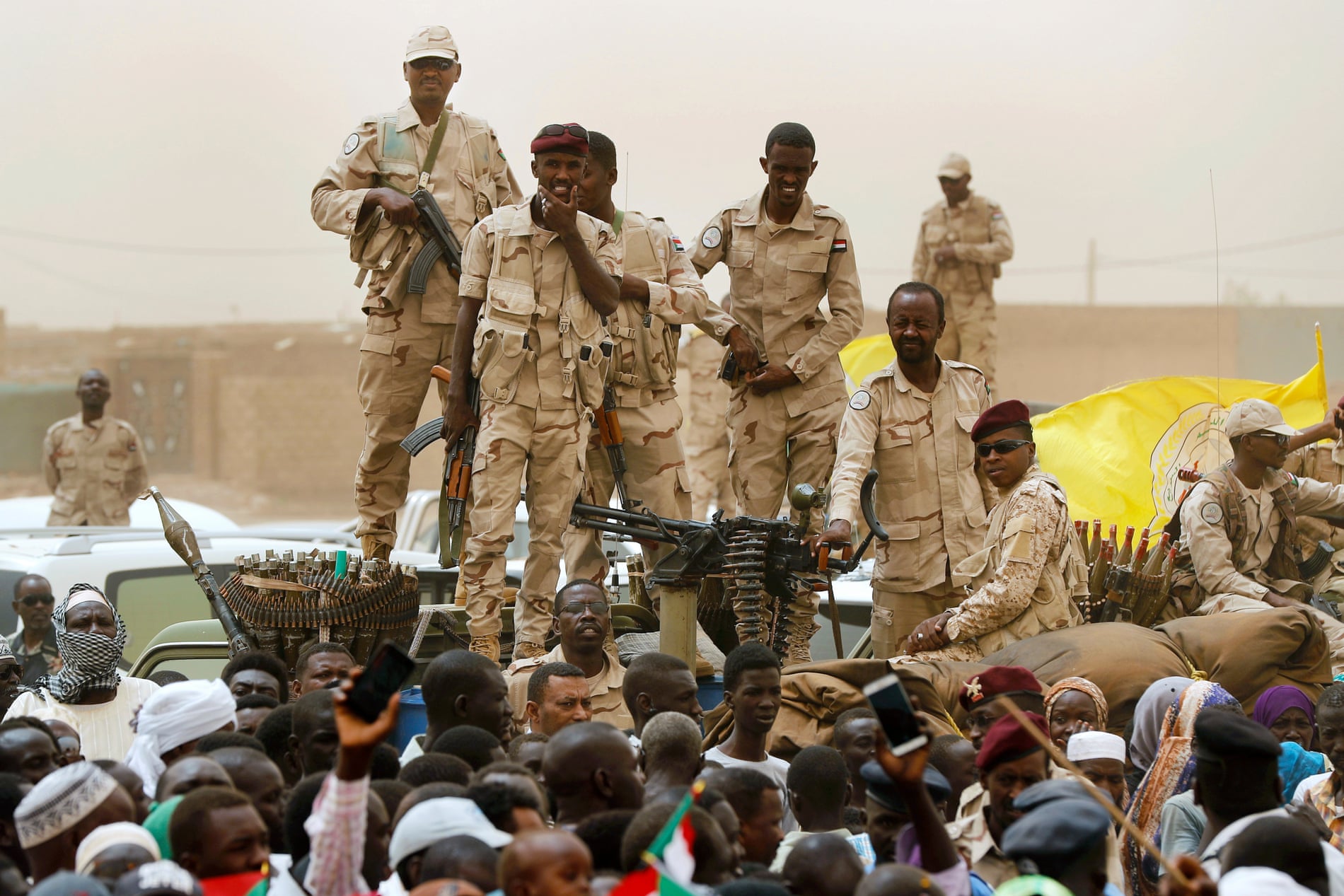
Sudanese soldiers from the Rapid Support Forces unit stand on their vehicle during a military-backed rally south of Khartoum, Sudan. Photograph: Hussein Malla/AP


Labels: , , , , ,

Saturday, April 18, 2020

Witness To Genocide : Margit Buchhalter Feldman

"Margit [Buchhalter Feldman] devoted her life to telling her inspiring story and touched the hearts of thousands of students, educators and members of the community."
"Her goal was to inspire people to stand up for one another and fight against all forms of prejudice and hate."
Obituary, Margit Buchhalter Feldman, 90, Somerset, New Jersey, COVID victim
Holocaust survivor Margit Buchhalter Feldman, 90, died Tuesday of 
the coronavirus.
Holocaust survivor Margit Buchhalter Feldman, 90, died the coronavirus. (Twitter)

"It is important for me to remember that 6 million of my fellow Jews were slaughtered, and a million and a half of those victims were children."
"I am here and I firmly believe it is because God wanted me to survive and be here and tell the free world what an uncaring world did to its fellow human beings."
"You were put into a barrack, where people died. The straw that you laid down [on] was full of whatever came out of their bodies -- vomit or excretions. It didn't take 24 hours for your body to get covered with lice."
"I rose from the ashes of Auschwitz, Krakow, Greentsery, Bergen-Belsen as a child of 15 years of age from the Holocaust to rebirth and a new life."
Margit Buchhalter Feldman
"Her legacy is best captured in her work to ensure that the world never forgets the horrors of the Holocaust."
"Margit gave us so much hope over her 90-plus years."
New Jersey Governor Phil Murphy

"She was just an extraordinary human being, to have lived through all that, to have lived that life and to have suffered through those camps, yet to be grateful for life, to see the promise of tomorrow, she was just such an exceptional person."
"After living through that hell, she was blessed with the gift of authenticity. She lived fearlessly and she loved fearlessly."
"It's like there was nothing that the world could do that would cause Margit to live anything less than with full authenticity and the full measure of her being."
Jim McGreevey, former Democratic State Assemblyman, former New Jersey Governor 
A photo dated April 1945 of women prisoners of the Bergen-Belsen concentration camp gathering dead fellow inmates before burying them. BRITISH ARMY HANDOUT

This courageous woman who defied the intention of the Third Reich to slaughter her as they had done her close and extended family, her parents and her relatives, lived to make a full life for herself, to raise a family of her own and to become a valued member of the society in which she lived. She was born in June of 1929 in Budapest as an only child. She and her family were forced to leave their home in the agricultural town of Tolcsva, all that they owned no longer theirs. Imprisoned nearby temporarily, then shipped off to Auschwitz.

There she no longer was to know herself as Margit Buchhalter, but A23029, the tattooed number burnt into her flesh as a concentration camp inmate destined for extermination. She was only fifteen, but passed herself off as 18, a life-saving decision on her part, which ensured she would be sent to slave labour camps before being sent to a death camp. She recalled "big heaps and mounds of dead bodies laying all around", as people died of hunger, exhaustion and disease, during her time as a forced labourer.

She was liberated on April 15, 1945, alone and deathly ill, suffering from pneumonia and pleurisy, seriously injured as well, when the Germans attempted to destroy the camp with the use of explosives. She was nursed back to health in Sweden, recovered, and chose to move to the United States in 1947 where she was received an education as an X-Ray technician. Her work led her to meet her future husband who was recovering from tuberculosis, at a hospital in New York.

She and Harvey Feldman married in 1953 and raised two children together, who eventually gave them three grandchildren. On Tuesday, Margit Buchhalter Feldman died of the effects of COVID-19. Her husband Harvey remains hospitalized with the novel coronavirus. Their son is now a doctor, and he works on the front lines of the New Jersey pandemic where over 75,000 confirmed cases of coronavirus have been identified, causing over 3,500 deaths.

Although this Holocaust survivor spoke nothing of her painfully wrenching experiences for many years, there was an occasion when she had agreed to speak to young students in her Bound Brook, New Jersey neighbourhood whom she introduced to the unspeakable catastrophe that had befallen  her family of 70 related Jews, and of her incarceration in a number of concentration camps as a slave labourer. The children's reaction inspired her to continue her work as a witness to genocide.

In 1991 the-then state assemblyman Jim McGreevey collaborated with this survivor to promote Holocaust Education in New Jersey through the formation of a special commission. She went on to help pass a bill mandating a Holocaust and genocide curriculum in public schools in the state, while speaking to classrooms of children for years, and finally releasing a 2003 book detailing her life as a teenage survivor: "Margit: A Teenager's Journey Through the Holocaust and Beyond".

Holocaust
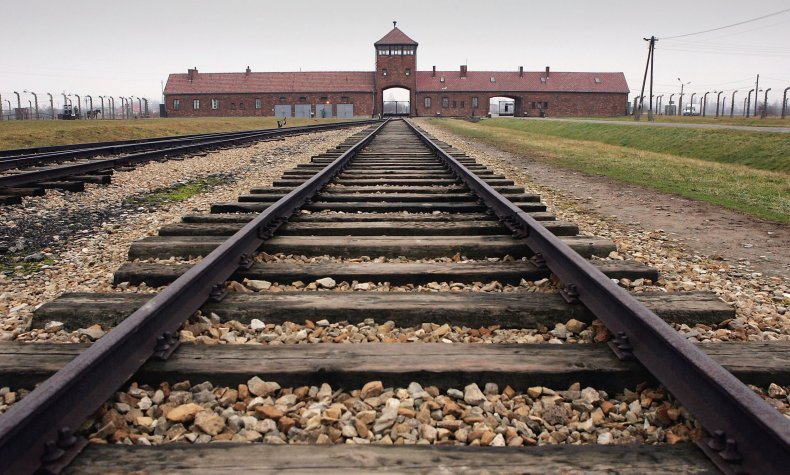
The railway tracks leading to the main gates at Auschwitz II - Birkenau Scott Barbour/Getty

Labels: , , , , , ,

Wednesday, April 01, 2015

The Innocent Sky

"When you say they died at the end of March, it gives you a feeling that they died just before liberation. So maybe if they'd lived two more weeks?"
"Well, that's not true anymore. [Nonetheless] It was horrible. It was terrible. And it still is."
"In view of this, the date of their death is more likely to [have] be[en] sometime in February. The exact date is unknown."
Erika Prins, researcher, Anne Frank House museum, Amsterdam, Netherlands


There is a playground, a park. Mothers are there with their infants in strollers, under a sea of blue sky, sun blazing above. There are people out walking their dogs. This is the village of Oswiecim, also known as Auschwitz. There is also a Kentucky Fried Chicken outlet located there, for the convenience of people enjoying a beautiful day, an hour west of Krakow, Poland. A typical village day, with people enjoying an early spring landscape.

A short walk away there are bookshops, cafes, and ... memorial shops. And if you're surprised by all that in this grave place of bleak and horrible memories, you will be reminded by your guide not to think of those shops as purveyors of souvenirs. What one can purchase is a 'memorial' item, definitely not a souvenir adjacent to the place where an iron gate reads Arbeit Macht Frei, a cruel joke played on millions of people who hadn't, at first, any idea that they would never be free again.

"Auschwitz was a death factory", states your guide, just in case you weren't fully aware of the purpose of the place you had entered. One of the grimmest places on Earth, in fact. Where Nazi Germany inflicted death on up to ten thousand people daily, where over a million Jews had been murdered in this one of many Third Reich death camps.

But if the sky is blue, then the birds will be singing.

Women and children being taken through sector BII of the camp to Crematoria IV and V. In Birkenau, elderly women and children were almost always immediately sent to their deaths in the gas chambers as they were deemed "unfit for work".
The Auschwitz Album -- Women and children being taken through sector BII of the camp to Crematoria IV and V. In Birkenau, elderly women and children were almost always immediately sent to their deaths in the gas chambers as they were deemed "unfit for work"

There are orderly streets, and one building after another in this stark place of memory. In Block No.4 you will find a silent display of human hair; braids, curls, dark hair, blonde hair, straight hair, wavy hair. when the camp was liberated seven thousand kilograms of hair was found in storage. Human hair was used by the Germans of the day to stuff decorative cushions. If novelties interest you, human skin was also used to bind books; nothing was wasted; human bones were used to produce soap.

Elsewhere, prayer shawls can be found in abundance, along with piles of suitcases, of eyeglasses, of baby clothes. Step outside one building before entering another and a brief reprieve from being a witness to history will allow you to confront the beauty of that clear blue sky; what could ever go awry under such a sky, with the sun floating in the atmosphere high above, blessing Earth with the miracle of life?

Jews who were classified as "not fit for work" waiting in a grove outside Crematorium IV before they were to be gassed. At this point, the Jews were exhausted and in a state of shock from the horrors of the journey and the selection process that they had just endured. The vast majority had no idea what fate awaited them.
The Auschwitz Album -- Jews who were classified as "not fit for work" waiting in a grove outside Crematorium IV before they were to be gassed. At this point, the Jews were exhausted and in a state of shock from the horrors of the journey and the selection process that they had just endured. The vast majority had no idea what fate awaited them.

Those who are affected by what they see to the very depths of their souls may find comfort in thinking that the spirits of the departed, the children in particular, sing now from the full-throated enthusiasm of birds appreciating the approach of spring. Perhaps they would be represented by the unspeakable number of children of all ages whose lives were extinguished in those death camps. Like Anne Frank, at age 15, a girl who believed in  hope, in a better tomorrow.

Her tomorrow remained beyond sight, beyond hearing, beyond touch; an illusion of hope which death vanquished. She died at Bergen-Belsen. It had always been thought that she and her sister Margot may have died mere weeks before liberation. New research, however, claims that not to have been the case. While Bergen-Belsen was liberated on April 15, 1945, and Anne had evidently perished from typhus in February.

Perhaps when she died the sky was blue, but one doubts the birds were singing.

Labels: , , ,

Thursday, November 06, 2014

Early Warning--Survival

"The U.S. government has had estimates like this for a while, but they haven't made them public. So part of this is to democratize this information and put it in the hands of public advocates, journalists and others."
Cameron Hudson, director, Center for the Prevention of Genocide, Holocaust Museum, D.C.

Can genocide be prevented? Can intense scrutiny by informed experts studying the field of human psychology and state cultural behaviour predict when mass violence will erupt? This is basically the purpose of a study by the U.S. Holocaust Memorial Museum.   In a collaborative study between the museum in Washington and the Dickey Center for International Understanding (Dartmouth) labelled The Early Warning Project the initiative has undertaken a rating of countries which may be perceived might embark on an orgy of state-orchestrated mass atrocities.

"I looked at the scrapbook a couple of times over the years and I would say, 'This is interesting'. But there wasn't a hope in hell that I could trace anything more about my past. Who was I going to ask?"
"I wasn't one to dwell on the past. But it was difficult."
"Here I am, meeting a lady who I spent the first three years of my life with, and the feeling of warmth was unparalleled. And I find out all this information I had about myself was wrong. My birthdate on my passport is July 15. But I find out I was born on the 24th of June."
"Everything has finally come together."
Dr. Mel Goldberg, age 72, "the infant who survived", Toronto **
Mel Goldberg
Mel GoldbergDr. Mel Goldberg at age 3.
"The survivors [Polish Jews] often spoke of a child who had been taken out of the Jewish ghetto right before it was liquidated."
"Mel, and this wasn't part of his life, but he became a symbol for others -- a bridge between two worlds. He was the infant who survived."
Lilka Elbaum, daughter of Holocaust survivors, Boston **

As examples where genocidal conflicts have taken place there is no lack, from Turkey's mass killing of millions of Armenians, to the USSR's deliberate starvation of millions of Ukrainians, the Killing Fields of Cambodia, the Darfurian slaughter in Sudan, Rwanda's Hutus' bloodletting of Tutsis, the world has witnessed one horror after another, both before and after the commission of state-sponsored measures to exterminate every Jew in Nazi Germany's World War II domain.

Burma and the Central African Republic represent countries where atrocities against civilians have taken place; and one can add to that, Syria. What has happened, despite the international community's collective vow that anything resembling the Holocaust would never happen again, has, and appears destined to occur, time and again. "Most of the time, the countries at the top of the list are not going to be surprising", noted Jay Ulfelder, a political scientist involved in developing the model used by the Museum.

"The value comes from the small number of places named which are counterintuitive." That Guinea ranked just above Afghanistan represents "one that people in the atrocity prevention community aren't talking about." Now, perhaps they will. And perhaps also it isn't totally surprising that most of the countries listed are Muslim-majority countries, and African countries.dotplot3020140619
The infant that was Mel Goldberg was born Mendel Gwiazda, in 1942. At three months of age he was destined to become an orphan as a result of a world event of staggering proportions, the systematic, organized and painstaking effort to eliminate from total existence a tribe of people whom the world knew as Jews. Six million Jews; children, women, octogenarians, men from all parts of Europe under fascist control of the Axis nations led by Nazi Germany were destined to die, tiny Mendel's parents and his three siblings among them.

His parents were Ancel Gwiazda and Elka Goldberg, and he lived with them in Biala Rawska, Poland. Along with his mother, father and the siblings he never knew, were aunts, uncles and cousins murdered in the Polish death camp, Treblinka. Although he never knew the names of his murdered siblings, now he does; they were Bajla, Wolf and Majlech. Mel Goldberg's father, Ancel Gwiazda, had warm relations with a Polish man who worked as a cobbler, because Ancel was a leather dealer.

Ancel asked the cobbler to look after his infant son, and gave tiny Mendel into the care of Waclaw Libera. But when he brought the child to his parents, they refused to accept the baby's presence among them. Waclaw then built a one-room house where he could live with his wife Stanislawa and their daughter Irena. In that tiny dwelling the Jewish baby was cared for, hidden from authorities, in a bureau drawer.

A relative of his mother, Wolf Goldberg and his wife Tillie discovered his presence eventually at a Polish orphanage when he was three years old. Wolf Goldberg took the infant on an ocean liner from Poland to New York. And from there the man who declared himself the boy's father, took a train to Toronto. From an early age the boy adapted well. His adoptive parents kept a scrapbook for him, of a life beyond his memory in Poland. The boy grew to adulthood, attended university, obtained an engineering degree then a medical degree.

Several years ago a phone call reached him from a woman whose name was Lilka Elbaum whose parents came from the same village in Poland as his parents and which represented Mel Goldberg's first home. Her parents were two among the 37 Jews who remained of the Biala Rawska Jewish population of 1,500. A legend had grown among the survivors of a child, taken from the Jewish ghetto to be safeguarded by a gentile. In the town of Biala Rawska no Jews remain now.

Dr. Goldberg and his family travelled to Warsaw in June for a ceremony to honour the Libera family for rescuing that child that he was in 1942. Irene, the child of Waclaw Libera, is now a retired teacher. She accepted the tribute to her parents, and the Polish woman and the Canadian man, she once a child whose parents saved a Jewish infant, embraced in a tandem of human warmth.

** Interview with Joe O'Connor, National Post journalist

Labels: , , ,

Saturday, March 29, 2014

The Aftermath of Horrific Realities

"You cannot measure the consequences of war and conflict by counting the number killed. You have to count the survivors and what happened to them."
"The health outcomes aren't good."
Duncan Pederson, World Health Organization Collaborating Centre for Research and Training in Mental Health, Montreal

"We're not just starting to see PTSD, we are in the thick of it. It's an extremely big problem and we're not keeping up with the suffering."
"Will we come out of it quickly. I don't think anyone knows, but we need to work or study or do something that allows us to think of something other than death."
Naasso Munyandamutsa, Rwandan psychiatrist

"The whole thing is just so pervasive, you probably need 10,000 counsellors to even begin to make a difference. For most of us in other countries, the problem is anxiety, and this is ten times deeper than that. It's a huge challenge."
Delanyo Dovlo, World Health Organization Rwandan representative
Young people gather in Amahoro Stadium in Kigali for the 18th commemoration of Rwanda’s genocide, in 2012. Photo by Sue Montgomery/The Gazette

Young people gather in Amahoro Stadium in Kigali for the 18th commemoration of Rwanda’s genocide, in 2012. Photo by Sue Montgomery/The Gazette


The question is: How do vulnerable young children survive the horror of witnessing atrocities so brutal that their minds would be forever in a state of confused derangement over the loss of parents, siblings, extended family, leaving them as children to cope on their own and attempt to surmount that horror? Over a quarter of the Rwandan population now suffer post-traumatic stress disorder.

Each of the country's 43 district hospitals sees between 15 and 25 patients a day for psychiatric problems. Its first addiction facility, recently opened, treats 300 to 400 people a month, from age 16 and up. There are six psychiatrists serving 11.4 million Rwandans. A UNICEF national trauma survey that took place a year after the genocide took place warned of problems to come.

Of the estimated 99.9 percent of Rwandan children who witnessed violence during the genocide, 79.6 percent had at least one death in their family; 69.5 percent witnessed someone being killed or injured, and 31.4 percent witnessed rape of sexual assault. Those children in the UNICEF study are now young adults, and the trauma of their experiences has left them still struggling to understand what they experienced.
In 1994, at the Munigi refugee camp near Goma, a Rwandan child cries at his dying mother's side. Associated Press file photo
 
On April 7, Rwanda mourns the 20th anniversary of the genocide that befell it. And every April 7 there is a national recognition of the genocide, with a national week of mourning. The very churches and schools where hundreds of thousands of desperate Tutsis sought refuge, but found death instead, stand as memorials, testament, if any were required, of their torment. An estimated 300 people butchered each hour of one hundred days of slaughter.

Those young adults still struggling to understand what their young eyes were assaulted by in one hundred days of butchery where neighbours, former friends and even relatives by marriage viciously used machetes, nail-studded clubs and spears engaged on mass slaughter. Their minds cannot help but wander helplessly in the direction of the same question repeated without answer; what would make Hutus turn on that segment of the citizenry known as Tutsis?

This is an entirely different country now than it was twenty years ago. It present as clean, safe, and swiftly developing to embrace and meet all of the advanced indices the United Nations' eight Millennium Development Goals by next year. The very picture of success in living standards for Africa, achieving a list of targets agreed to by all countries in 2000; inclusive of pledges of poverty reduction and universal primary education provision by 2015.

And while the country becomes an information-technology hub, installing over 1,600 kilometres of fibre-optic cables and a 4G network covering 95 percent of the country, many among its population are barely managing to function. An estimated 600,000 people who lost both parents and have little to no access to psychological support, plagued by stress, epilepsy, unable to sleep, resorting to alcohol and drugs for relief.

Jonathan Nettal, a psychotherapist working for a Canadian NGO called Hopethiopia/Rwanda, counsels 19- to 23-year-olds how to help one another, even while traumatized. A native of Montreal whose grandparents are Holocaust survivors, Mr. Nettal teaches small groups of ten to 15 people coping skills. "So you have more calm, people are more supportive, more socially connected, and that's a huge resource in terms of post-traumatic resilience."

Think about it: how do you cope as a teen when you've just been informed you were conceived through mass rape. That venomous, self-destructive mind-flood of shame, confusion and anger must be confronted and dealt with. Mental illness in Rwanda is a dire issue, where thousands of "genocidaires" (perpetrators) live among their victims.
Egidie walks arm in arm with her son, Bertrand, who was born after Egidie was raped several times by many men during Rwanda’s 1994 genocide. Through counselling, they have learned to accept the horrific past and love each other. (Neither wanted their last names published) Photo by Sue Montgomery/The Gazette

Egidie walks arm in arm with her son, Bertrand, who was born after Egidie was raped several times by many men during Rwanda’s 1994 genocide. Through counselling, they have learned to accept the horrific past and love each other. (Neither wanted their last names published) Photo by Sue Montgomery/The Gazette


Labels: , , , ,

Saturday, June 15, 2013

Nice Old Guys

Jews captured during the Warsaw ghetto uprising. Poland, April 19-May 16, 1943.
— National Archives and Records Administration, College Park, Md.

Nice Old Guys

The neighbours are amazed, they're shocked, disbelieving, speechless with horror. They would far prefer to defy the possibility that the neighbour they have so long been familiar with -- the nice guy who lives two houses down on a street where houses seldom change hands, and people are comfortable in their neighbourhoods -- could possibly have been involved in war crimes. It is simply not credible. They know him, he has been a good neighbour.

Old Mikey? Impossible. He's highly respected. He has lived with his wife in that same house they own since forever. He's 94 years of age, after all. Someone with sinister motivations is besmirching the name and reputation of an honourable old man for their own nefarious purposes. Could be he has enemies, although for heaven's sake, he's 94 years old, give the guy a break. But there are the television news trucks parked outside his house in Minneapolis.

"I know him personally. We talk, laugh. He takes care of his yard and walks with his wife", says next-door neighbour Gordon Gnasdoskey. Like Michael Karkov, Mr. Gnasdoskey is of Ukrainian origin; his grandfather had emigrated from Ukraine to the United States, too. And he finds these revelations dreadfully disturbing; how can it conceivably be possible that the nice old guy he feels so comfortable with, committed wartime atrocities?

But yes, Michael Karkoc has been identified as a former commander of a Nazi SS-led military unit. Despite which, he has lived in peace and security for the past sixty years in the land of the free and the brave. The unit which he commanded was associated with the 1944 Warsaw Ghetto uprising. Where Nazis with whom this man served brutally suppressed the last-stand Jewish rebellion against their ghetto community's certain death through the Nazi war machine.

How did he manage to enter the United States? Simple enough, looking for a better life, like so many others like himself, he lied to American immigration officials. What's a lie committed to attain a goal, when you've already committed the most monstrous human-rights abuses that human beings are capable of doing, when they believe they are part of a human movement that sanctions genocide? He informed U.S. authorities in 1949 that he had never been involved in military service.

And ten years later he became a naturalized American citizen. Goal accomplished. The man who had served Fascist Germany as a top commander in the Ukrainian Self Defence Legion, a unit held responsible for wartime atrocities including burning villages with women and children held within the inferno to die, wanted and achieved for himself a lifetime of freedom and security in a new life within the United States.

Labels: , , , , , ,

 
()() Follow @rheytah Tweet