Ruminations

Blog dedicated primarily to randomly selected news items; comments reflecting personal perceptions

Saturday, April 18, 2020

Witness To Genocide : Margit Buchhalter Feldman

"Margit [Buchhalter Feldman] devoted her life to telling her inspiring story and touched the hearts of thousands of students, educators and members of the community."
"Her goal was to inspire people to stand up for one another and fight against all forms of prejudice and hate."
Obituary, Margit Buchhalter Feldman, 90, Somerset, New Jersey, COVID victim
Holocaust survivor Margit Buchhalter Feldman, 90, died Tuesday of 
the coronavirus.
Holocaust survivor Margit Buchhalter Feldman, 90, died the coronavirus. (Twitter)

"It is important for me to remember that 6 million of my fellow Jews were slaughtered, and a million and a half of those victims were children."
"I am here and I firmly believe it is because God wanted me to survive and be here and tell the free world what an uncaring world did to its fellow human beings."
"You were put into a barrack, where people died. The straw that you laid down [on] was full of whatever came out of their bodies -- vomit or excretions. It didn't take 24 hours for your body to get covered with lice."
"I rose from the ashes of Auschwitz, Krakow, Greentsery, Bergen-Belsen as a child of 15 years of age from the Holocaust to rebirth and a new life."
Margit Buchhalter Feldman
"Her legacy is best captured in her work to ensure that the world never forgets the horrors of the Holocaust."
"Margit gave us so much hope over her 90-plus years."
New Jersey Governor Phil Murphy

"She was just an extraordinary human being, to have lived through all that, to have lived that life and to have suffered through those camps, yet to be grateful for life, to see the promise of tomorrow, she was just such an exceptional person."
"After living through that hell, she was blessed with the gift of authenticity. She lived fearlessly and she loved fearlessly."
"It's like there was nothing that the world could do that would cause Margit to live anything less than with full authenticity and the full measure of her being."
Jim McGreevey, former Democratic State Assemblyman, former New Jersey Governor 
A photo dated April 1945 of women prisoners of the Bergen-Belsen concentration camp gathering dead fellow inmates before burying them. BRITISH ARMY HANDOUT

This courageous woman who defied the intention of the Third Reich to slaughter her as they had done her close and extended family, her parents and her relatives, lived to make a full life for herself, to raise a family of her own and to become a valued member of the society in which she lived. She was born in June of 1929 in Budapest as an only child. She and her family were forced to leave their home in the agricultural town of Tolcsva, all that they owned no longer theirs. Imprisoned nearby temporarily, then shipped off to Auschwitz.

There she no longer was to know herself as Margit Buchhalter, but A23029, the tattooed number burnt into her flesh as a concentration camp inmate destined for extermination. She was only fifteen, but passed herself off as 18, a life-saving decision on her part, which ensured she would be sent to slave labour camps before being sent to a death camp. She recalled "big heaps and mounds of dead bodies laying all around", as people died of hunger, exhaustion and disease, during her time as a forced labourer.

She was liberated on April 15, 1945, alone and deathly ill, suffering from pneumonia and pleurisy, seriously injured as well, when the Germans attempted to destroy the camp with the use of explosives. She was nursed back to health in Sweden, recovered, and chose to move to the United States in 1947 where she was received an education as an X-Ray technician. Her work led her to meet her future husband who was recovering from tuberculosis, at a hospital in New York.

She and Harvey Feldman married in 1953 and raised two children together, who eventually gave them three grandchildren. On Tuesday, Margit Buchhalter Feldman died of the effects of COVID-19. Her husband Harvey remains hospitalized with the novel coronavirus. Their son is now a doctor, and he works on the front lines of the New Jersey pandemic where over 75,000 confirmed cases of coronavirus have been identified, causing over 3,500 deaths.

Although this Holocaust survivor spoke nothing of her painfully wrenching experiences for many years, there was an occasion when she had agreed to speak to young students in her Bound Brook, New Jersey neighbourhood whom she introduced to the unspeakable catastrophe that had befallen  her family of 70 related Jews, and of her incarceration in a number of concentration camps as a slave labourer. The children's reaction inspired her to continue her work as a witness to genocide.

In 1991 the-then state assemblyman Jim McGreevey collaborated with this survivor to promote Holocaust Education in New Jersey through the formation of a special commission. She went on to help pass a bill mandating a Holocaust and genocide curriculum in public schools in the state, while speaking to classrooms of children for years, and finally releasing a 2003 book detailing her life as a teenage survivor: "Margit: A Teenager's Journey Through the Holocaust and Beyond".
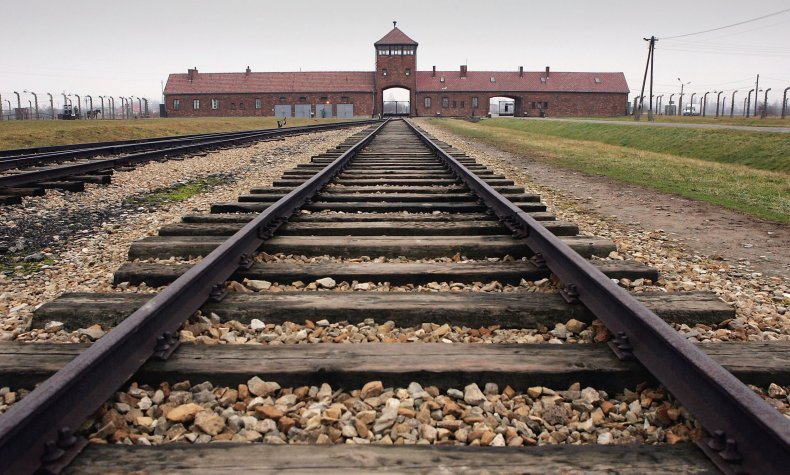
Holocaust
The railway tracks leading to the main gates at Auschwitz II - Birkenau Scott Barbour/Getty

Labels: , , , , , ,

Sunday, December 07, 2014

A Jewish festival in a town without Jews

Children performing at the festival
Of the 50,000 citizens in the Polish town of Kutno, not one is Jewish - yet it staged perhaps the most impressive concert of Jewish music I've ever heard. 

The performers were all children from schools in the town, the youngest no more than six or seven.
They belted out old hits in Yiddish and Hebrew with a fluency and stage presence that few adult performers could match.

The concert was the finale of an ambitious festival of Jewish culture that the town has held since 1993.

So why does it happen? The short answer is that my great-grandfather was born there.
There's a long answer too, but we'll come on to that.
Sholem Asch
My great-grandfather, Sholem Asch, was born in Kutno in 1880 in a one-storey wooden house teeming with children, and a yard full of livestock that his father traded.

He moved to Warsaw, then Paris and New York, and became one of the most famous Jewish writers of the 1920s and 30s. 

He left Kutno far behind, but the Jewish community he grew up in - with its beggars, traders, butchers, rabbis, prostitutes and assorted schemers and dreamers - all found a kind of immortality in his stories and plays.

That world was swept away in World War Two.
Kutno's experience was typical. In one day the entire Jewish community - 8,000 people - was marched at gunpoint to the grounds of a deserted factory at the edge of town.

They spent two years in filthy, overcrowded conditions, with many dying of disease, hunger and cold, before being murdered in gas vans at Chelmno death camp.
  
When the war ended, Kutno, like so many other towns and cities across Poland, essentially started over again, learning to function without its Jewish tailors, shoemakers, lawyers and merchants.
A town with a hole at its heart.
Actresses in one of Asch's plays Asch's play God Of Vengeance, set in a brothel in Poland, is being performed in Yiddish in Warsaw

Polish attitudes to the country's Jewish past are complex. There's plenty of lingering anti-Semitism, a kind of kitsch theme park nostalgia, pride in Poles who saved Jews during the war, and guilt about those who collaborated.

To complicate the picture further, there is a deep-rooted conviction that Poles themselves are victims of a turbulent history.
But even that's not the whole story.
Sholem Asch (left) with Maxim Gorky Sholem Asch (left), with the Russian writer Maxim Gorky in Moscow in the 1920s

Something else has emerged in the last 20 years: a growing number of Poles who feel profound loss about the Jewish nation that vanished from their midst.
I came across some of them strolling in Warsaw's vast Jewish cemetery.

They were buying brightly-coloured memorial lanterns to place on graves of people they had no personal connection with, but wanted to honour and remember.

As I stood in front of the large mausoleum to Yitskhok Leybush Peretz, a giant of Yiddish literature, I noticed a glamorous young couple peering at it.
The tomb of Yiddish writer Yitskhok Leybush Peretz in Warsaw's Jewish cemetery
She had thigh-high leather boots, bright red lipstick, an elegant cape.
He had cheekbones to rival Rudolf Nureyev, a natty silk scarf and a trendy beret.
"Do you know who's buried here?" I asked.

"We're Polish - so of course we know about Peretz," they said. "We just can't read the Yiddish words on the tomb."

That deep respect for a vanished culture has also resulted in a world-class museum that's just opened in the heart of Warsaw's former Jewish quarter.

A beautiful shimmering glass structure, it tells the bittersweet story of the Jews' long love affair with Poland with clear-eyed honesty and real flair.

Those same feelings of curiosity, loss and kinship led a handful of people in Kutno to start up a Jewish festival as Poland emerged from communism in the early 1990s.

As private cafes and general stores began to open up, the town announced its first Sholem Asch Festival, a sign that Kutno was looking west, and engaging with European culture.
The town has come a long way since then.
Inside the Museum of Polish Jews in Warsaw A reconstruction of a wooden synagogue in the new museum

Its new business park is attracting American, German and Chinese companies, and provides jobs for 6,000 locals.

The Sholem Asch Festival has also come a long way. It includes a literary competition on a Jewish theme that attracts hundreds of entries from all over Poland.

There's a local Jewish dance band, theatre performances, and new translations of my great-grandfather's works into Polish.

Poland's rediscovery of its Jewish past started in Warsaw and Krakow, places where Jewish communities re-emerged as the war ended.

It's now spread far beyond the big cities and is growing year by year.
It might not be a mass movement, but as Kutno shows, it's more than just a token effort.

And in a world where bitter sectarian conflicts grab most of the headlines, a Jewish festival in a town with no Jews is surely something worth celebrating.
line
 
More from the Magazine
Szpiro family portrait
David Mazower remembers more of his family including his cousin Paul. The family patriarch had given all his 10 children an identical watch. Nine of the watches disappeared over time. But at the age of 20, Paul had torn the inner cover off his watch and hidden it inside a window sill in his home in the Polish city of Lodz, before he was deported. He returned as a liberated survivor, persuaded the new occupants of his home to let him in, and retrieved the sliver of metal from its hiding place.

Labels: , , , ,

Thursday, November 06, 2014

Early Warning--Survival

"The U.S. government has had estimates like this for a while, but they haven't made them public. So part of this is to democratize this information and put it in the hands of public advocates, journalists and others."
Cameron Hudson, director, Center for the Prevention of Genocide, Holocaust Museum, D.C.

Can genocide be prevented? Can intense scrutiny by informed experts studying the field of human psychology and state cultural behaviour predict when mass violence will erupt? This is basically the purpose of a study by the U.S. Holocaust Memorial Museum.   In a collaborative study between the museum in Washington and the Dickey Center for International Understanding (Dartmouth) labelled The Early Warning Project the initiative has undertaken a rating of countries which may be perceived might embark on an orgy of state-orchestrated mass atrocities.

"I looked at the scrapbook a couple of times over the years and I would say, 'This is interesting'. But there wasn't a hope in hell that I could trace anything more about my past. Who was I going to ask?"
"I wasn't one to dwell on the past. But it was difficult."
"Here I am, meeting a lady who I spent the first three years of my life with, and the feeling of warmth was unparalleled. And I find out all this information I had about myself was wrong. My birthdate on my passport is July 15. But I find out I was born on the 24th of June."
"Everything has finally come together."
Dr. Mel Goldberg, age 72, "the infant who survived", Toronto **
Mel Goldberg
Mel GoldbergDr. Mel Goldberg at age 3.
"The survivors [Polish Jews] often spoke of a child who had been taken out of the Jewish ghetto right before it was liquidated."
"Mel, and this wasn't part of his life, but he became a symbol for others -- a bridge between two worlds. He was the infant who survived."
Lilka Elbaum, daughter of Holocaust survivors, Boston **

As examples where genocidal conflicts have taken place there is no lack, from Turkey's mass killing of millions of Armenians, to the USSR's deliberate starvation of millions of Ukrainians, the Killing Fields of Cambodia, the Darfurian slaughter in Sudan, Rwanda's Hutus' bloodletting of Tutsis, the world has witnessed one horror after another, both before and after the commission of state-sponsored measures to exterminate every Jew in Nazi Germany's World War II domain.

Burma and the Central African Republic represent countries where atrocities against civilians have taken place; and one can add to that, Syria. What has happened, despite the international community's collective vow that anything resembling the Holocaust would never happen again, has, and appears destined to occur, time and again. "Most of the time, the countries at the top of the list are not going to be surprising", noted Jay Ulfelder, a political scientist involved in developing the model used by the Museum.

"The value comes from the small number of places named which are counterintuitive." That Guinea ranked just above Afghanistan represents "one that people in the atrocity prevention community aren't talking about." Now, perhaps they will. And perhaps also it isn't totally surprising that most of the countries listed are Muslim-majority countries, and African countries.dotplot3020140619
The infant that was Mel Goldberg was born Mendel Gwiazda, in 1942. At three months of age he was destined to become an orphan as a result of a world event of staggering proportions, the systematic, organized and painstaking effort to eliminate from total existence a tribe of people whom the world knew as Jews. Six million Jews; children, women, octogenarians, men from all parts of Europe under fascist control of the Axis nations led by Nazi Germany were destined to die, tiny Mendel's parents and his three siblings among them.

His parents were Ancel Gwiazda and Elka Goldberg, and he lived with them in Biala Rawska, Poland. Along with his mother, father and the siblings he never knew, were aunts, uncles and cousins murdered in the Polish death camp, Treblinka. Although he never knew the names of his murdered siblings, now he does; they were Bajla, Wolf and Majlech. Mel Goldberg's father, Ancel Gwiazda, had warm relations with a Polish man who worked as a cobbler, because Ancel was a leather dealer.

Ancel asked the cobbler to look after his infant son, and gave tiny Mendel into the care of Waclaw Libera. But when he brought the child to his parents, they refused to accept the baby's presence among them. Waclaw then built a one-room house where he could live with his wife Stanislawa and their daughter Irena. In that tiny dwelling the Jewish baby was cared for, hidden from authorities, in a bureau drawer.

A relative of his mother, Wolf Goldberg and his wife Tillie discovered his presence eventually at a Polish orphanage when he was three years old. Wolf Goldberg took the infant on an ocean liner from Poland to New York. And from there the man who declared himself the boy's father, took a train to Toronto. From an early age the boy adapted well. His adoptive parents kept a scrapbook for him, of a life beyond his memory in Poland. The boy grew to adulthood, attended university, obtained an engineering degree then a medical degree.

Several years ago a phone call reached him from a woman whose name was Lilka Elbaum whose parents came from the same village in Poland as his parents and which represented Mel Goldberg's first home. Her parents were two among the 37 Jews who remained of the Biala Rawska Jewish population of 1,500. A legend had grown among the survivors of a child, taken from the Jewish ghetto to be safeguarded by a gentile. In the town of Biala Rawska no Jews remain now.

Dr. Goldberg and his family travelled to Warsaw in June for a ceremony to honour the Libera family for rescuing that child that he was in 1942. Irene, the child of Waclaw Libera, is now a retired teacher. She accepted the tribute to her parents, and the Polish woman and the Canadian man, she once a child whose parents saved a Jewish infant, embraced in a tandem of human warmth.

** Interview with Joe O'Connor, National Post journalist

Labels: , , ,

Sunday, November 10, 2013

Wartime Flash

"It was so sad, because the men were all yelling and happy and you knew in another couple of weeks they wouldn't be so happy. Some would be under ground and I would be taking pictures of their funerals."
Irene Ogilvie, right, during the Second World War.
Irene Ogilvie, right, during the Second World War
"(The photographs) were so awful ... (they) had these bodies lined up like matchsticks. I remember looking at them and thinking it was just terrible. I never dreamed Belsen was as bad as it was."
Irene Ogilvie, 94, Perley and Rideau Veteran's Health Centre, Ottawa
Back then, during the Second World War, the Royal Canadian Air Force offered the young woman living in London, originally from the Canadian prairies, a job as a war photographer. With her Speed Graphic camera, courtesy of the Air Force, she became one of a group of other young women tasked to chronicle the lives of Canadian troops in film.

They were never dispatched to Europe, to the war zones. London itself became a war zone, blitzed from constant German fighter raids meant to demoralize the civilian population and destroy the government's will to resist Nazi Germany's determination to make of Britain what it had already managed in most of the rest of Europe on its way to establishing its thousand-year Reich.

She took photographs of the arrivals of Canadian troops off ships, she ventured out to hospitals and special war-time events, to funerals and weddings, wherever her presence and her camera could take photographic mementos of events later to be recalled with pride, nostalgia and regret. Some of her photographs remain with the Air Force, and some of them accompanied her to her room at the Perley.

There is another elderly woman with memories, Squibs Mercier, 89, married and widowed during the war years. Squibs Mercier was married at 18 and the war gave her widowhood by the age of 19. Her first husband was shot down in action. She met another pilot after the war, and outlived him, another resident of the Perley and Rideau Health Centre who predeceased her.

Irene Ogilvie on the other hand met a Canadian airman through an acquaintance. "It was love at first sight", she said. This was the man destined to become her husband. She and he planned a night out at the American Eagle Club in London. She dressed herself to the nines, but he simply didn't show up. And then she heard from his commander he had been shot down and presumed dead.

Eventually they learned he was in a POW camp. They met again, in Canada after the war and in 1946 they married, began a life together and had two children. Of life, says Squibs Mercier: "I don't know about staying calm, but you carried on or you sank. Whatever happens in life, you have to deal with it and carry on."

The unsung photographer: Irene Ogilvie chronicled the far-reaching effects of the war years
 A wartime portrait of Irene Ogilvie.  Photograph by: Chris Mikula , Ottawa Citizen

Labels: , , ,

A Poem For The Ages

At the age of 22 a young Ottawa man, Ewart J. Taylor, commanded a tank in Normandy during the Second World War. He survived the D-Day landing, and was one of the fortunate men in arms with the Canadian army, returning to Canada after the war ended, to marry and to raise a family.

He worked at a journalist, but he didn't, in fact, spend too much of his time raising his family. He was severely emotionally wounded by his exposure to the misery and rigours of combat, to the dreaded sight of death in all its horrible forms, to fear and constant exposure to personal annihilation.

Little was understood then about the dreadful emotional toll that war takes on sensitive souls. Because of his unrecognized emotional turmoil, a plight shared by many other returning combat veterans, his interaction at the most intimate of levels was flawed. His family remembers of him "a path of relational destruction".

He suffered a heart attack at age 35 and survived for a few more years, before dying. When he was 27 he wrote a poem, discovered much later by his oldest son. The pain expressed in the poem, the grace of its writing, may have helped his family understand a little more clearly how, why and when he suffered so grievously he was never quite there for them.

"We, his family, would have loved to see more of the sensitive side as opposed to this hurt, bitter, angry side that we were most privy to", his son remarked ruefully, during a newspaper interview.

The Prayer of the Beaches

     On cold, now silent, sacred
beaches
    We rest, while wrinkled
waters cleanse our hands
    For all that death can ever
teach us
    Lies deep within these
burdened sands.

    Oh God -- help those whose
tongue cannot reach us
    To cast the venom from
their speeches.
     Hatred's voice twists man's
sense
    And made our couch these 
blood-wet beaches.

    And -- Lord this lesson of
the sands --
    Herald it into the many
lands,
    Take it to Earth's far-flung
reaches --
    Sift it through world's 
calloused hands.


    Their grains of truth, they
need not reach us
    For we -- the dead -- are the
soil of the beaches.

Labels: , , , , ,

 
()() Follow @rheytah Tweet