Ruminations

Blog dedicated primarily to randomly selected news items; comments reflecting personal perceptions

Thursday, March 26, 2026

"Not Now, Not Ever"

"[The U.S. is] in negotiations right now."
"We have a number of people doing it. And the other side, I can tell you, they’d like to make a deal."
"The Iranian negotiators are very different and strange."
"They are begging us to make a deal, which they should be doing since they have been militarily obliterated, with zero chance of a comeback, and yet they publicly state that they are only 'looking at our proposal'. WRONG!!!" 
"[Iranian negotiators better] get serious soon before it is too late." 
U.S. President Donald Trump 
https://live-production.wcms.abc-cdn.net.au/92dbb7fea226cbf7834a983e20393bca?impolicy=wcms_crop_resize&cropH=3333&cropW=5000&xPos=0&yPos=0&width=862&height=575
Donald Trump held a cabinet meeting at the White House. (Reuters: Evelyn Hockstein)
 
"Our first and last word has been the same from day one, and it will stay that way/"
"Someone like us will never come to terms with someone like you."
"Not now, not ever." 
Lt. Col. Ebrahim Zolfaghari, spokesman, Iranian military headquarters 
 
"Do not call your defeat an agreement... Have your internal conflicts reached the point where you are negotiating with yourselves?"
"You will see neither your investments in the region nor the former prices of energy and oil again until you understand this: stability in the region is guaranteed by the strong hand of our armed forces."
Ebrahim Zolfaghari, spokesperson, Khatam al-Anbiya Central Headquarters 
https://live-production.wcms.abc-cdn.net.au/f965794b68767991715f145d9a561660?impolicy=wcms_crop_resize&cropH=3332&cropW=4998&xPos=1&yPos=0&width=862&height=575
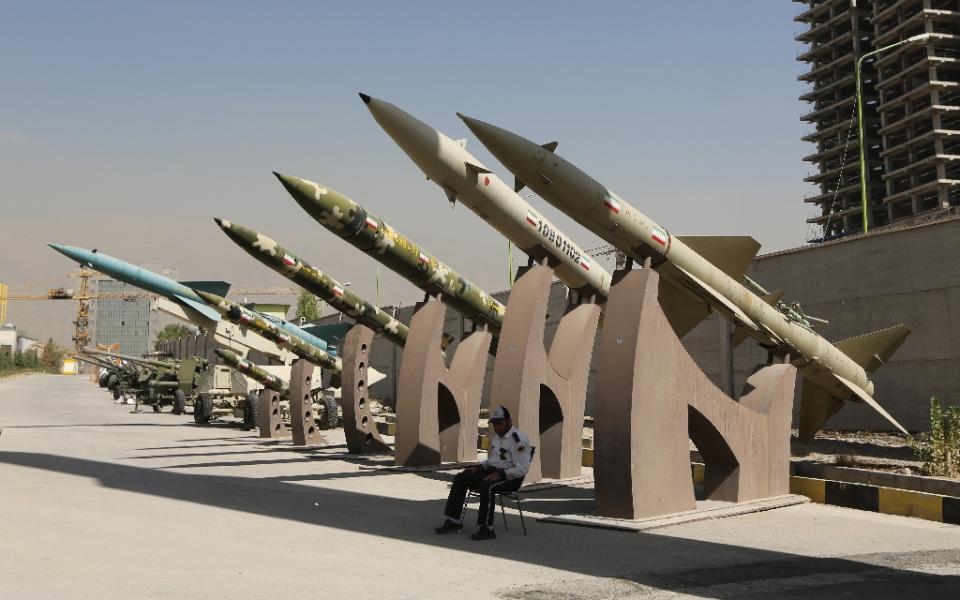
People walk near Iranian missiles in a park in Tehran. (Majid Asgaripour/WANA (West Asia News Agency) via Reuters)
 
Dismissing the American offer to pause the conflict, Iran launched more attacks on Israel and Gulf Arab countries, even as Israel continued to pound Tehran with airstrikes, and the United States has undertaken the deployment of paratroopers and Marines to the region; a none-too-subtle warning of more to come, at the choosing of the U.S. Iran's Press TV quoted an unnamed Iranian official's statement: "Iran will end the war when it decides to do so and when its own conditions are met". 
 
The U.S. 15-point proposal addressed sanctions relief, a rollback of Iran's nuclear program, limits on missiles and reopening of the Strait of Hormuz. The proposal includes as well restrictions on Iran's support for its proxy terrorist groups. These details provided by Pakistan and Egypt, whose officials are involved as intermediaries between the U.S. and Iran, hoping to see the conflict come to an end. 
 
For its part, Iran insists it has no intention of discussing its ballistic missile program, much less its support of the regional militias; neither Hamas, nor Hezbollah, nor the Houthis, or the Iraqi Shiite militias doing its bidding. As for control of maritime shipping passing through the Strait of Hormuz representing one of its most stark strategic advantages in squeezing the world economy through scarcer oil and gas passing through the Strait to world markets, that in and of itself is a non-starter. 
 
Attacks on regional energy infrastructure coupled with its restrictions on passage through the Strait have worked to the Islamic Republic's advantage, frustrating and infuriating the world community and having the effect of placing stress on the American president in demands that the conflict come to a  speedy end to relieve the issue of critical energy, fertilizer and consumer products stalled while awaiting the opportunity to cross through the Strait. 
 
https://www.ctvnews.ca/resizer/v2/LU2LQLBIMYCBMF5PNJQENMU4JA.jpg?auth=9af61cf22ea29f1eb73d0cfe3663c98a97aedf19f3c4a2df84cc4c4c9e710da8&width=1440&height=959
Smoke rises from Kuwait international airport after a drone strike on fuel storage in Kuwait City, Kuwait, Friday, Wednesday, March 25, 2026. (AP Photo)
 
En route to the Middle East, up to a thousand troops from the U.S. 82nd Airborne Division. The process of sending some 5,000 Marines trained in amphibious assaults and thousands of sailors to the region is being worked out at the Pentagon. Meanwhile Pakistani and Egyptian officials are frantically attempting to arrange in-person talks between Iranians and Americans. The question is, who in the Islamic Regime now has that authority...given the extent of their losses among top-echelon figures. 
 
As for Iran's side of demands to end the conflict, Press TV cited a five-point plan from Iran for a ceasefire: a halt to assassinations of Iranian key figures; agreement that no additional conflict can be waged, war reparations, a cease of hostilities; and affirmation of Iran's "exercise of sovereignty over the Strait of Hormuz". An exercise in sheer mockery of the U.S. plan. An implacable regime determined not to fade into history and prepared to take down with it as much pain as it can exert on its neighbours.
 
The Israeli military stated that a day earlier as part of its strikes, an Iranian submarine development centre in Isfahan had been struck through several waves of airstrikes. "There have been some days when the bombings are so intense you can't do anything", commented a 26-year-old graduate student in Tehran, a situation conducive to convincing him and his friends to remain safely at home. 
 
https://www.ctvnews.ca/resizer/v2/PB5JVZZI3RHONC7Z3ZGDL7UM74.jpg?auth=e3212855135bb0751811901be48c181e099e685f2d2842110d2d95305c41365d&width=1440&height=959
First responders inspect the remains of a residential building hit in an overnight strike during the U.S.-Israeli military campaign in Tabriz, East Azerbaijan Province, northwestern Iran, Tuesday, March 24, 2026. (AP Photo/Matin Hashemi)
 
In Israel. missile alert sirens sound multiple times daily as Iran and its creature Hezbollah launch attacks. Rockets have been fired into northern Israel around the clock by Hezbollah, with the February 28 inception of the war, disrupting hundreds of thousands of peoples' lives in Israel. 
 
And for Iran's Gulf Arab neighbours. Iran has not relented on the pressure it applies through drones and missile strikes. Saudi Arabia's Defence Ministry destroyed 8 drones over its Eastern Province -- and in Bahrain missile alert sirens sound. Although Kuwait shot down multiple drones, one hit a fuel tank at Kuwait International Airport, sparking a massive fire. 
 
https://tvnz-1-news-prod.cdn.arcpublishing.com/resizer/v2/dog-salon-workers-take-shelter-in-bomb-shelter-iran-war-XUCKYD6YTNFVVMABE7OLV4WWUM.jpg?auth=ed66d3f6873b58c5b1b4f71dc019b937aad0b8e780d1edbf516b75cc6bf642aa&quality=70&width=800&height=533&focal=3886%2C2590
Dog salon workers take cover with the dogs in a bomb shelter as air raid sirens warn of incoming Iranian missile strikes in Ramat Gan, Israel (Source: Associated Press)


Labels: , , , , ,

Thursday, March 19, 2015

Taqiyya: Islamic doctrine of deceit

"Contrary to what many think, that we are only discussing one issue, it is not correct. We are discussing many issues and nothing is agreed until everything is agreed."
"Contrary to what the Iranians are saying with regard to 90 percent of an accord being done, that's not correct. We are not close to an agreement."
"We are pretty far away. There are a lot of issues that still need to be resolved. The Iranians must make substantial concessions."
"Research and development currently has become the most critical and difficult issue, and there won’t be an accord if the Iranians don’t back down."
"They [Iranian negotiators] insist they have to go immediately [sanctions targeting nuclear program]. No way. It is out of the question."
European negotiator demanding anonymity

Iran Lausanne nuclear
Iran's FM Zarif (C on left) and head of the AEO of Iran Salehi (C on right) with colleagues in Lausanne March 19, 2015 . (photo credit:REUTERS)
"The main issues have been closed. I hope that in the remaining time we can close this."
"[One] final item still missing; that resolved] we can say that on technical issues, things are clear on both sides."
"Of course there are many details, but I can say that, as a whole, I am optimistic [of a deal before the deadline]."
Ali Akhbar Salehi, Iranian nuclear chief

"[A comprehensive accord would result in] phased, proportionate [relief from sanctions but such relief could be reversed should the Islamic republic violate any final deal]."
"[That is simply not true] Iran crank up and develop a bomb when the deal ends]. To the contrary, Iran would be prohibited from developing a nuclear weapon in perpetuity -– and we would have a much greater ability to detect any effort by Iran to do so."
"[Some constraints could be lifted for a] significant period [others would last] indefinitely, including a stringent and intrusive monitoring and inspections regime [by the IAEA]."
"That [restrictions on centrifuges] would provide us more than enough time to detect and act on any Iranian transgression. The critical question of the possible military dimension of Iran's program... would have to be part of any agreement." 
U.S. Deputy Secretary of State Antony Blinken
This testimony from Mr. Blinken at a hearing of the  House Foreign Affairs Committee was greeted by both Democrats and Republicans present with an lively degree of skepticism, with some snorting that the reality of the situation has been that the Islamic Republic of Iran has in the past "been violating those commitment for years". They pointed out as well of the necessity that restrictions be included on the country's robust and threatening ballistic missile program in any nuclear deal as insurance against Iran using them to carry atomic bombs.


Iran's representatives appear to believe, however, that they have the upper hand as their top nuclear official claimed that the main disagreements between his government and the American negotiators and the other partners in the P-5+1 team -- France, Britain, China and Russia, plus Germany -- have been resolved and that little is left to iron out to meet the end-of-March deadline for the framework deal. That deal to place reliable limitations on Iran's nuclear activities to restrict them to what Iran insists they're intended for; strictly peaceful energy needs and medical isotope production.

The West would then be prepared to proportionally release Iran from the economically crippling sanctions. Enabling Iran to get on with its other programs, funding, training and arming Shia non-state and state militias alike to bring them ever more comfortably into its sphere of influence from the Middle East to North Africa and even Latin America and Asia; Iran has been growing influential tentacles. (Strangely enough, although Iran has found its economy strangled, it has managed to continue developing its long-range rockets, and to fund its terrorist proxies.)

The final agreement to be obtained by the end of June looks ever more possible, and the Iranians are smiling broadly. On the other hand, another unnamed but senior American official claims the sides, though having made progress, still face a struggle in eliminating differences on expectations for Tehran to meet before a gradual end to sanctions can be counted on. The disputes focus mostly on technical issues such as the centrifuge numbers Iran could be permitted to operate.

U.S. Energy Secretary Ernest Moniz joined the talks along with Mr. Salehi in an attempt to reason out technical differences. Republicans in the U.S. continue to argue their case that a deal with the Republic would never be sufficient to guarantee the country that has become so skilled in evading demands over its ambitions for nuclear status would run roughshod over any promises it makes to quell international suspicion over its true plans.

Iranian missiles are displayed at a park in northern Tehran (AFP Photo/Atta Kenare)

This is a country, after all, that has threatened another country in the Middle East with annihilation, not merely once in the hallowed halls of the United Nations, but frequently, expressed by the Grand Ayatollah Khamenei himself as well on occasion. Iran's designs for the Middle East as one of the only two non-Arab countries, to dominate all other Muslim countries through its Shi'ite brand of apocalyptic Salafist Islamism represents to the Sunni-majority countries a looming threat.

Which is why the U.S. Republicans hold the position that such an agreement would be unenforceable, and Iran would inevitably reach the status it so craves, as a nuclear-armed state. And the rush would be on for Saudi Arabia, Egypt and perhaps others to claim their own self-defence needs in the hopes of nuclear deterrence. And while President Omama continues to insist that his administration would never agree to any deal that would permit Iran to acquire nuclear weapons, his words ring hollow against the actions of the past and Iran's slippery reputation for taqqiya.

Otherwise known as the kind of deceit permitted in Islam to throw one's enemies off track and gain the desired advantage -- at any cost.

Labels: , , , , ,

Wednesday, March 18, 2015

The Trans-Pacific Partnership (TPP)

"This year, Canada contributed $500-million to the replenishment of the Gavi Vaccine Alliance's fund. Canada is also one of the leading donors to the Global Fund to Fight AIDs, Tuberculosis and Malaria, which has provided antiretroviral therapy to over six million people living with HIV in developing countries."
Stephen Cornish, executive director, Doctors Without Borders Canada

"Now, thanks to a retroactive examination of the usefulness condition -- established in 2010 by the Canadian Federal Court of Appeals -- a patent must meet heightened requirements for usefulness. "
"...This look[s] like industrial policy for Canadian generic drug producers who now can receive the unpatented formula at no cost once the patent is revoked [due to the 'Promise Doctrine' where patents under Canadian law must perform the action they promise to do]."
"...Innovative pharmaceutical companies suffered more than $1.1-billion in lost sales from the premature termination of patents in Canada."
Michelle Wein, trade policy analyst, Information Technology and Innovation Foundation, Washington

"The U.S. should drop its demand in the Trans-Pacific Partnership talks that its trading partners respect a rule giving the American pharmaceutical industry 12 years of exclusive rights to its patents. Even Europe allows shorter time spans."
Caroline Freund, The Japan Times


 TPP Member Fact Sheets

Ah, Hawaii, a lovely place to visit, particularly by those who live in northern climates. It's one of Barack Obama's favourite getaways, nostalgic for the past, isn't it? And it is there that closed door negotiations have been taking place in a hotel where representatives of a dozen countries are working on hammering out a collective trade agreement that will impact the lives of an estimated 800 million people, representing 40 percent of the global economy.


Image above: From (http://hawaiiindependent.net/story/whats-in-the-leaked-tpp-chapter).

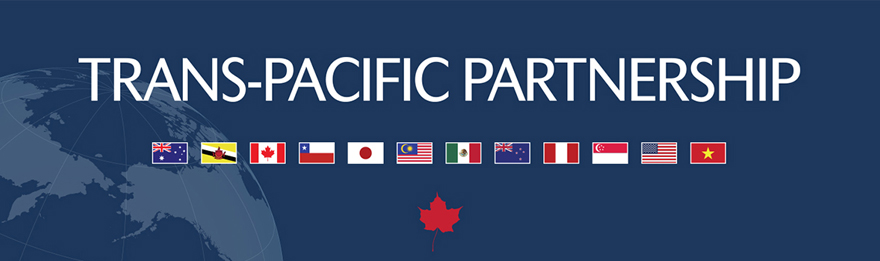
Ten Pacific Rim countries as well as the United States and now Canada are in negotiations for a final agreement to consolidate the collective trade agreement known as the Trans-Pacific Partnership (TPP).  The partnership members also include, Australia, Mexico, New Zealand, Japan, Peru, Chile, Malaysia, Singapore, Vietnam and Brunei Darussalam. And all of these countries are anticipating that this partnership will be of immense export-trade value to them all.

The issues under discussion range from government procurement, investment, intellectual property, services, dispute settlement, goods, trade and environment, all the way to the really contentious issue of governments providing subsidies to protected industries in for example, agricultural production or manufactured goods. Take, for example, the U.S. where President Obama wishes Congress to grant him authority to fasttrack the TPP on his own initiative.

Something like his personal decision as chief of the executive branch of government in the U.S. to decide to veto the XL pipeline, reflecting his personal distaste for Canada's "dirty oil", his decision paying homage to many of those who brought him to public office at the highest level; to name but one constituency: environmentalists. Of course electing a president of the United States is a costly affair and there were also others instrumental in funding his presidency campaign.

One of the critical issues at stake in the TPP agreement being worked on coming courtesy of leaks from the TPP draft text is that some governments are angling to dismantle public-health safeguards reflecting international law, to extend the time limits permitting brand-name medicines' protection under patent. The effect of such extensions would result in monopolistic protection, ensuring that generic drug manufacturers must wait longer to produce less expensive versions of the patent-protected medicines.

The cost of immunizing a child with World Health Organization recommended vaccines has grown 6,700% since 2001, according to Doctors Without Borders. Stricter intellectual property rules the TPP is negotiating are guaranteed to further limit competition by maintaining artificially high prices, thus keeping these life-saving vaccines out of reach of those who most need them. Generic competition levels the price-field, ensuring all who need these drugs a better opportunity to obtain them.

Donor-supported global health institutions along with Doctors Without Borders have a heavy reliance on affordable, quality generic medicines to enable them to  fulfill 85% of their programming for health-provision initiatives. Proposals by the United States and a few other countries in the TPP could limit the effectiveness of these humanitarian organizations' programs, diverting resources from patient care where it is most needed.

Drug expenditures in Canada have been steadily growing in the last 25 years, consuming an ever-greater portion of tax dollars in health care. Prescription drug costs have doubled from the mid-1980s to 2012. Canada and other countries are actively opposing some of the most potentially harmful provisions in the TPP agreement.

A petition at www.msf.ca/tpp calling on Canada to resist pressure and stand up against the U.S. move to prolong patent monopolies for years, has resulted in over 32,000 signatures. It would be most unfortunate if the Trans-Pacific Partnership agreement resulted in passage of the move by the United States to protect its pharmaceutical industries' bottom line. The long-term harmful impact on people who rely on less expensive, reliable versions of drugs they need to continue life, would be immeasurable.

This would deleteriously impact affordable health care in all the countries affected. And it would restrict access to medicines for millions of people in developing countries. Pharmaceutical companies, with such patent extension would be enabled to charge higher prices for longer periods of time, restricting access to affordable generic medicines. Those who can least afford to pay will be penalized disproportionately, but at the government level public health care will also be impacted.

The pharmaceutical lobby and their resourceful forward-thinking in helping to elect a president who will aid their bottom line places in question the character and independent thought to benefit an international populace and not a broad spectrum of name-drug manufacturers speaking volumes about the values and priorities of those in positions of power.


Labels: , , , , , , , ,

 
()() Follow @rheytah Tweet