Ruminations

Blog dedicated primarily to randomly selected news items; comments reflecting personal perceptions

Tuesday, December 27, 2022

Trouble Brewing in East Asia

"The more preparations we make, the less likely there will be rash attempts of aggression."
"The more united we are, the stronger and safer Taiwan would become."
Taiwan President Tsai Ing-won

"We [United States] will continue to assist Taiwan in maintaining a sufficient self defence capability in line with our long-standing commitments and consistent with our one China policy."
White House National Security Council
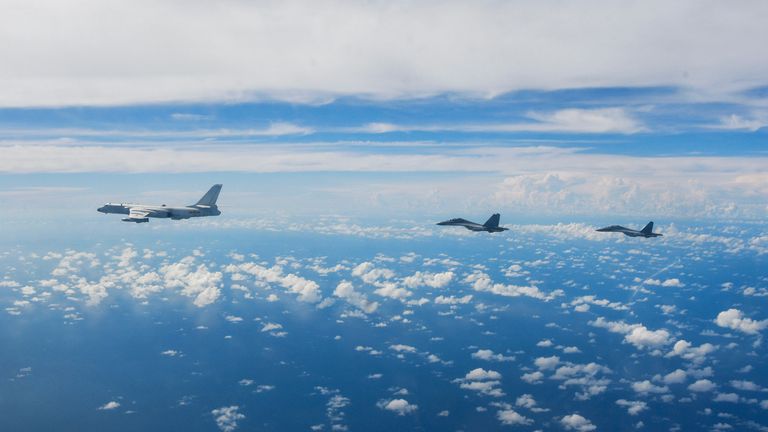
In this photo released by Xinhua News Agency, aircraft of the Eastern Theater Command of the Chinese People's Liberation Army (PLA) conduct a joint combat training exercises around the Taiwan Island on Sunday, Aug. 7, 2022. 
PIC:Xinhua /AP
Aircraft of the Eastern Theater Command during a prior drill near Taiwan in August. Pic: Xinhua /AP

The entire region of East Asia shows indication of an uneasy peace slowly unravelling. North Korea sent drones  across its heavily fortified border with South Korea, with the South responding by scrambling fighter jets, flying surveillance and firing warning shots in deterrence. For the first time in five years a fresh escalation of tensions has erupted of an intensity that strikes concern, according to South Korea's Joint Chiefs of Staff. 

Attack helicopters were dispatched along with fighter jets to shoot down the drones. Several days earlier two short-range ballistic missiles were fired at the South. This is North Korea's method of protesting its displeasure at joint air drills carried out betwen South Korea and the United States; a rehearsal for an invasion, interpreted by North Korea. "Our military will thoroughly and resolutely respond to this kind of North Korea provation", director of operations Major General Lee Seung-o of the South Korean Joint Chiefs of Staff stated emphatically.

"[U.S. officials are] consulting closely with the [Republic of Korea] about the nature of this incursion. We recoggnize the need of the ROK to protect its territorial integrity", noted an unnamed White House National Security official. Taiwan, South Korea nervous of the intentions of China and North Korea. Joining them is Japan, edgily watching what is happening in its neighbourhood and fearing that it too is in North Korea's and China's crosshairs.

Tokyo is considering the possibility of a nuclear attack to match the growing fears of a potentially full-on conflict with either North Korea or China. Japan, the only nation on Earth that has ever suffered a nuclear attack, saw its cities of Hiroshima and Nagasaki both devastated in the wake of the Second World War when nuclear devices were unleashed on an unsuspecting, still war-defiant nation. Suddenly a soaring business has taken off of nuclear shelter sales in Japan.

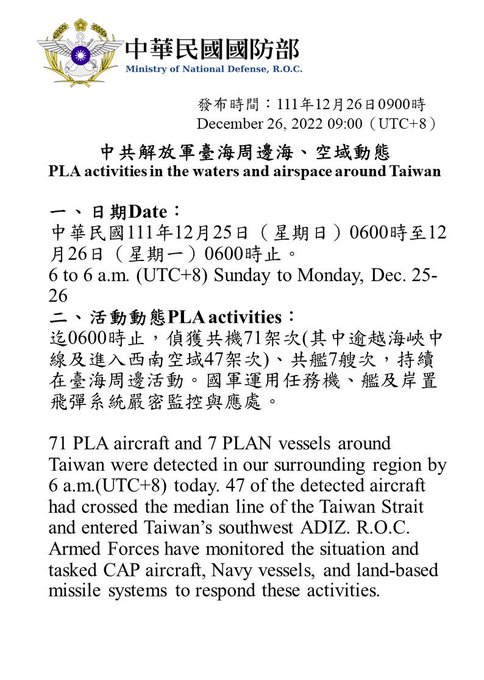
In Taiwan, in a 24-hour-period, 71 Chinese military aircraft. among them fighter jets and drones, entered Taiwan's air defence zone, to date the largest reported incursion. The Taiwan Straits saw 43 aircraft cross the median line, the unofficial buffer separating the two sides. Throughout the steady increase of aggressive intimidation that Beijing tqrgets Taipei with, this is yet the most emphatic. According to Beijing these were 'strike drills'.

Beijing was merely responding to 'provocations' from Taiwan and the United States. The latter intervening in territory not its own, the former spurning Beijing's wish for reunifiction, to take independent sovereign Taiwan back under its wing. The drills saw the Chinese air force dispatch warplanes from several locales across the country for simulated attacks on Taiwanese and U.S. warships. 

The situation has compelled Taiwan to change the service tenure of its compulsory military service from the current four months to a year, to deal with rising tensions linked to Beijing's military pressure. Taiwan's southern air defence identification zone saw Chinese electronic-warfare and antisubmarine aircraft incursions along with drones. Repeated missions by the Chinese air force of the last two years has given Taipei reason for vigilance. In response to the latest incursion, Taiwan sent combat aircraft to warn off the Chinese planes, with missile systems monitoring their flight.
Image

Labels: , , , , , , ,

Wednesday, May 19, 2021

Losing Face over COVID Olympics

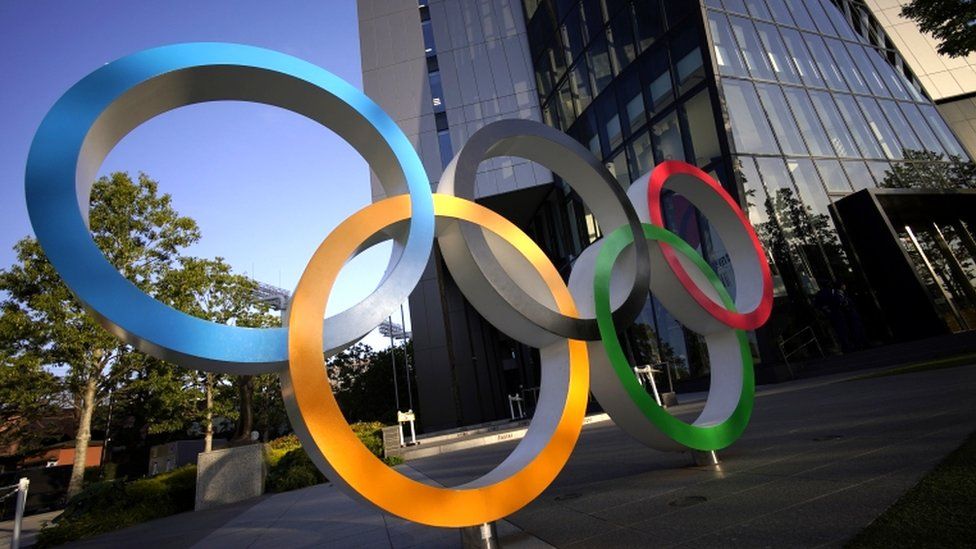
Olympic Rings monument outside a stadium
A coronavirus state of emergency has been extended in the capital Tokyo   EPA

"We strongly request that the authorities convince the IOC [International Olympic Committee] that holding the Olympics is difficult, and obtain its decision to cancel the Games."
"[Tokyo hospitals] have their hands full and have almost no space capacity."
Tokyo Medical Practitioners Association

"Under various clauses within this host city agreement, if Japan was to unilaterally cancel the contract, then by and large, the risks and losses would fall with the local organizing committee."  
"Contracts can foresee certain contingencies, but the nature of the current situation is obviously unprecedented."   
"The Olympics are the biggest sporting event on the calendar, there are billions at stake for Japan and also the IOC in terms of broadcasting sponsorship. It is a huge event and there are huge contractual obligations for all sides."
Professor Jack Anderson, University of Melbourne   
 
"Of course I want the Olympics to happen. But I think there's so much important stuff going on, especially the past year."   
"For me, I feel like if it's putting people at risk... then it definitely should be a discussion, which I think it is as of right now."
"At the end of the day, I'm just an athlete, and there is a whole pandemic going on."
Japanese tennis champion Naomi Osaka
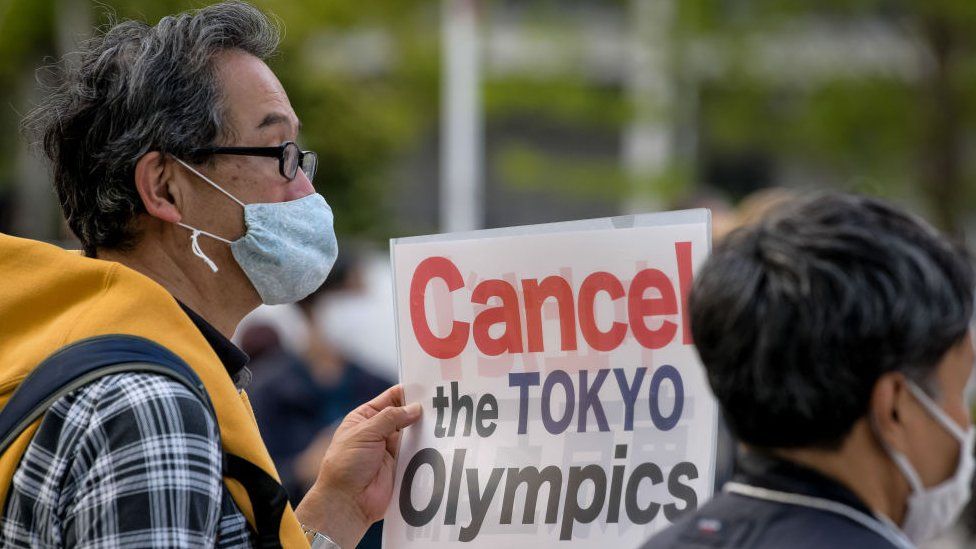
A protester carries a placard during a demonstration against the Tokyo Olympics in front of the New National Stadium, the main stadium for the Tokyo Olympics.
There have been mounting calls in Japan to cancel the major sporting event   Getty Images
 
A letter was recently sent to Japanese Prime Minister Yoshihide Suga expressing concerns that the health care system would fail to accommodate the potential medical requirements of thousands of international athletes, coaches and media, at the same time that Asia's second-largest economy is focused on a life-and-death struggle with a spike once again in coronavirus infections. What made this letter, released this week so significant is that it was from the 6,000-primary-care physicians in Tokyo represented by the Tokyo Medical Practitioners Association.

Japanese public opinion has also turned against hosting the Summer Games, already delayed once before. This letter represents the second from a group of doctors in recent weeks calling for the Olympics' cancellation. One petition contained over 370,000 signatures, all calling for the event's cancellation. In Tokyo on Tuesday, there were 732 new coronavirus infections reported. Of the country's 47 prefectures, 19 are operating under a state of emergency.

On Monday, a poll was released indicating merely 14 percent of Japanese residents are now interested in having the games proceed this summer. Scheduled to begin on July 23. Japan's President Suga had insisted he had the confidence that a "safe and secure" Olympics could be handled by the country. A country where only a single-digit percentage of its seniors have been vaccinated with at least one dose of vaccine.
 
In the first half of the 20th Century there were only three Olympics cancellations, and all of them were as the result of intervening wars.

Tellingly enough, in 1936 when the Third Reich was comfortably establishing its European takeover agenda and its international public relations arm was working full time on demonstrating to the world at large that all the rumours heard about Fascist Germany were just plain wrong, the only cancelled participators were Jewish athletes; no country in the global community saw fit to protest Hitler's obvious coming power plays, lulled into complacency by a successful campaign to blinker Germany's critics.
"Japan has seen economic stagnation for a long time, there has been the tsunami and the nuclear disaster of Fukushima, so the Games would be seen as symbolic of a revival of Japan,."
"It does take a special importance in that sense."
Professor Jack Anderson
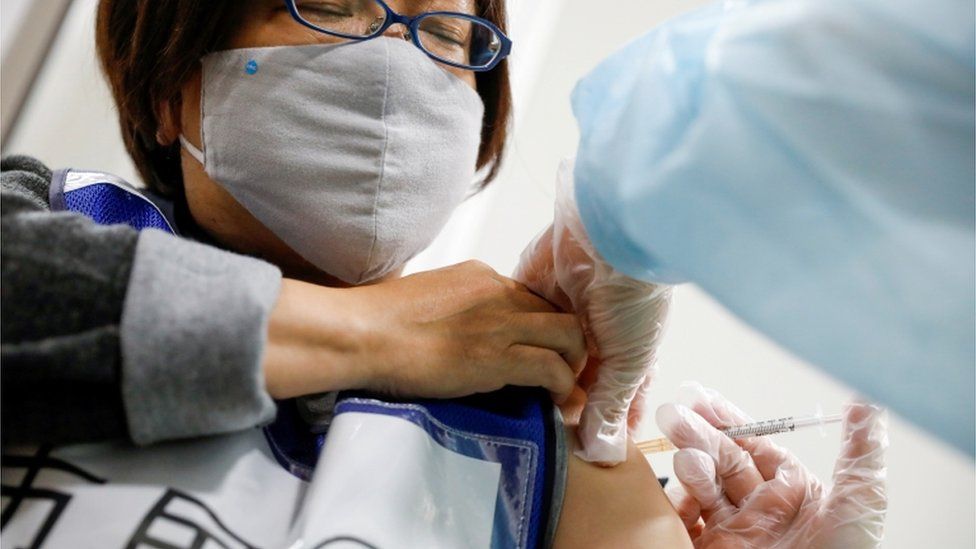
Japanese woman receiving vaccine jab
Only about 1% of Japanese are fully vaccinated so far   Reuters

Labels: , , ,

Tuesday, September 01, 2020

Virtual Flight to Exotic Locales

"I often go overseas on business, but I haven't been to Italy."                                   "I got a sense of actually seeing things there."                                                   Japanese businessman 

"[The world's] first virtual aviation facility [an innovative entertainment concept made for the times we're at a time of closed borders, social isolation and face masks.]"                                                                                                                             First Air public relations

"[Passengers are] able to overlook the magnificent scenery of Taiwan's east coastline [from a lower-than-normal altitude]."                                                             "The on-board meal a selection of seafood chirashi-sushi rice designed by Michelin-starred chef Motoke Nakamura."                                                                    EVA Air, Taiwan


inflight service First Airlines

Leaving for a foreign destination at a time of global pandemic. Virtual travel. Safe and entertaining. That's what is on offer at First Airlines in the Ikebukuro neighbourhood of Tokyo. Although the virtual airline went into business several years before the onset of the SARS-CoV-2 virus causing COVID-19, its time has come. International travel for leisure and recreation is a tourism pleasure no longer recommended during this coronavirus epidemic.

Curious about what other places are like, take your pick from such destinations as Paris, Hawaii, New Zealand, Rome, New York, California or Helsinki. Good choices, great places to visit and you can do it without any personal risk. At a price that cannot be beat for value. $60 will gain you a reservation for the travel choice you want to commit to. 

Customers take VR flight experiences at First Airlines in Tokyo
A flight attendant at a check-in desk, First Airlines REUTERS/Kim Kyung-Hoon

And the concept is available elsewhere, too. There's the Taiwanese carrier EVA Air. You'll pay a little more to enjoy their popular Hello Kitty-themed travel treat, about $180. But so much less than an actual airline ticket setting off in the usual manner for foreign destinations. You get to 'go' virtually, to see places that are now, however temporarily, off limits to tourism.

"In flight" meals are appealing as is the first-class "lounge" and first-class seat with ample room on an Airbus; the closest most wanna-be passengers will come to the real thing for a while to come yet. All the details of flight from departure screens in the lounge to flight attendants skillfully pantomiming the real thing carrying out safety protocols for the two-hour 'flight' experience.

First off, the "official boarding pass" for the destination of choice, drink service and a four-course culinary treat designed for the discriminating traveller by top chefs. How about Manhattan clam chowder and cheesecake for the Manhattan trip. Poke and minestrone for the Hawaii and Rome destinations respectively.

Flights "depart" on schedule five days a week. But act fast to make your reservations because they're a hot ticket right now. 

Customers take VR flight experiences at First Airlines in Tokyo
Customers in flight seats take their photos at First Airlines, that provides VR flight experiences, including 360-degree tours of cities and meals, amid the coronavirus disease (COVID-19) pandemic in Tokyo, Japan August 12, 2020. REUTERS/Kim Kyung-Hoon

Labels: , , , ,

Sunday, August 11, 2019

ReCycling? First the Good News....

"We're obliterating our natural ecosystems predominantly to produce monocrops that go into the industrial food web, and what's bad on land is even worse underwater [e.g.rainforest destruction coral reef bleaching]."
Keiran Whitaker, Entocycle start-up, London
The larval form of the black soldier fly is over 50 per cent protein by weight. (Frances Willick/CBC)

"The Olympics story [producing Olympic and Paralympic medals from e-waste-retrieved metals] is really good [because it brings attention to the issue] of creative re-cycling."
"It shows that the way we do things at the moment has terrible consequences for society, in terms of the negative health impacts and obviously impacts to climate change."
Vanessa Gray, official, United Nations environmental agency
Gold medal
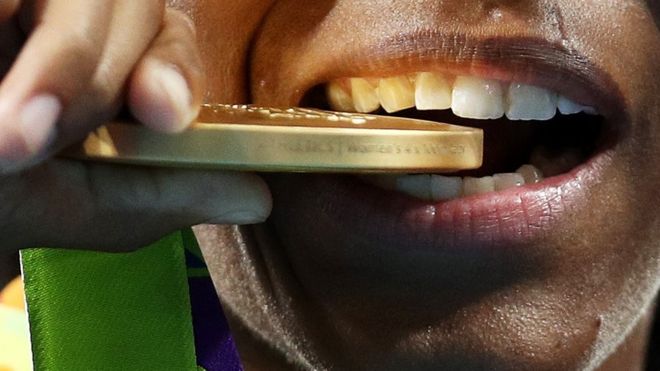
Japan is exploring the feasibility of forging the Olympic 2020 medals using precious metals salvaged from electronic waste. Getty Images

In London, England, the brainchild, Entocycle, of Kevin Whitaker uses local food waste that has been created in manufacturing food products to feed to black soldier fly larvae. The larvae consume the waste and it is converted into protein. That's the point when the insects are ground into a flour high in amino acids, combined with other ingredients to produce feed pellets for animals.

That's not all; the excrement created by the flies -- called frass -- can then be used as well, as agricultural fertilizer. Long-range expectations are that once the public adjusts to this new way of producing food, the insect flour could be used and eaten by people. The result would be enormous; fewer forests razed to produce cropland or pasture, and the fertilizer production held to be responsible for one percent to two percent of global greenhouse gas emissions avoided in the process.

The global issue of waste is the need to ensure that less of it is created, and that which is created can be used in purposeful ways, avoiding excess environmental and atmospheric pollution. There is, in fact, a wave of imaginatively creative thinking consuming the minds of entrepreneurs guiding them to correct current inefficiencies in producing and handling waste products, to turn them into useful substances in an effort toward reduction.

In Finland a company has been absorbed in a production method to dramatically change the way fabrics are extracted from wood to produce clothing. Cotton and viscose rayon, representing the second and third most common textile fibres, are produced from plants. Wood pulp is used to produce most viscose rayon with the use of an assortment of chemicals, that themselves are a source of criticism.

The Rainforest Action Network finds about 120 million trees are used for the production of textiles annually, an obvious practise harmful to the world's forests whose presence cleans our atmosphere absorbing carbon dioxide, while producing clean oxygen kind to the lungs of humanity. A Finnish textile fibre company called Spinnova founded by two former physicists is transforming the process.


One of the company's founders thought of patterning the spinning of plant fiber in the very way that spiders produce silk. And now Spinnova uses a mechanical method to produce fibre, a process that makes use of about 99 percent less water than the production of cotton, without the use of harmful chemicals. Wood pulp harvested from Brazilian wood is used by Spinnova and it plans to make use of agricultural waste material as well as discarded clothing in its fibre production.

Japan, a tiny set of three islands in the Pacific, has a population of 130 million people. Famously, Japan produces technologically advanced communications tools and its turnover rate as new models reach the consumer market is enormous, leaving it with an electronic waste (e-waste) conundrum. There was a time when Japan simply buried used or unsold stale-model computers. Japan also likes to move its production along; Japanese love their cars, and update their models and acquisitions by the driving public constantly.

Older vehicles that fail to pass stringent technical and safety and pollution standards are shipped abroad, newer models taking their place constantly in auto showrooms and consumers' possession. Disposal of immense numbers of cellphones, computers and televisions complicated by the risks of leaking dangerous chemicals into the environment was a problem seeking a solution, leading to an advanced recycling system.

In over 1,500 municipalities in Japan with their thousands of electronics stores, 42,000 tons of discarded electronics were collected, as well as over five million cellphones. And a process to recover metals was initiated from the trove, representing metals which would be re-used, bypassing a need for additional mining.

Yet out of this innovative solution, another kind of problem has arisen, identified by a paper in the Lancet, pointing out the potential harm to human health. The industry of recycling, employing people to break asunder electronic devices to remove copper, gold, mercury and other materials has the misfortune of producing negative health consequences on those very workers employed to help solve the problem of waste and encourage recycling.

All medals for the Tokyo 2020 Olympics will be made from metal collected by recycling electronic waste

Labels: , , , , ,

Saturday, September 30, 2017

An Extraordinary Four-Year Migration

This April 2015 photo shows marine sea slugs from a derelict vessel from Iwate Prefecture, Japan, that washed ashore in Oregon.
This April 2015 photo shows marine sea slugs from a derelict vessel from Iwate Prefecture, Japan, that washed ashore in Oregon. (John W. Chapman/Associated Press)

"It's a bit of what we call ecological roulette."
"We think that earlier tsunamis were contributing mostly, to the ocean, essentially biodegradable material: wood and trees which don't last nearly as long, of course, as does the plastic material."
"The diversity was somewhat jaw-dropping. Mollusks, sea anemones, corals, crabs, just a wide variety of species, really a cross-sectiion of Japanese fauna."
"Most of the species were, in fact, novel and not found in North America or the Hawaiian islands."
"When that first dock arrived, [floating in from Japan post-2011Tsunami] it was just 100 per cent covered with tens of thousands of mussels from Japan, and just draped with kelp."
"How many species started the trip we don't know and how many were lost in the tsunami is hard to know."
James Carlton, marine sciences professor, Williams College, Williamstown, Massachusetts
Dock Japan tsunami
A Japanese dock covered with marine life from Japan washed up on the Oregon coast. (James Carlton)
"OK, we found something here [she recalls in first encountering the unexpected visitors]. And this isn't from around here, and ... there's some marine life on it."
"It is an international issue," she said. "The ocean definitely showcases that we're all interconnected. There's no boundaries out there with the ocean. We're all in this together."
Karla Robison, environmental and emergency service manager, Ucluelet, British Columbia
 So far there have been no  ewer than a whopping 300 species of fish, mussels and other aqua- creatures discovered to have made their way across the Pacific Ocean taking a trip aboard debris from Japan that washed off the mainland or was whooshed off docking areas as a result of the monumental Japanese tsunami resulting from the powerful 9.1 Richter-scale earthquake that hit the islands in 2011. The flotsam and jetsam may have taken their time, relatively speaking, but for years they've been washing ashore far from their origins.

Researchers have now revealed through a study published in the journal Science, that this mass migration of sea creatures hiking their way along the vast ocean on all manner of vessels and even ocean-bobbing domestic items, represent the longest and largest marine migration ever documented. Scientists have for years collected items washing ashore carrying a wide range of creatures, from beaches in Washington, Oregon, California, British Columbia, Alaska and Hawaii, tracking the sea animals native to Japan.

Now that it has been confirmed that the creatures are far from their natural habitat, concerns have arisen that they will establish themselves as foreign invading species, and possibly eventually succeed in displacing native species. Whether all of the 289 species that have been identified will manage to adjust to their new surroundings and thrive there, eventually making room for themselves at the expense of native creatures, is as yet speculation.
Tsunami Hitchhikers
This June 2012 photo shows Japanese sea stars (Asterias amurensis) on a dock from Misawa, Japan that washed ashore near Newport, Ore. (John W. Chapman/Associated Press)

The very fact that they managed to undertake such a tremendously long voyage over a lengthy period of time is in and of itself fairly astonishing given that researchers estimate that a million creatures made a journey of 7,725 kilometres to cross the Pacific Ocean eventually reaching the West Coast of North America, hundreds of thousands of mussels among them. The previous experience with the invasion of zebra mussels is not one that endears its memory in the opinion of biologists. A repeat would not be a cause for celebration.

Past incidents of marine invasion that been harmful to indigenous farmed shellfish, have caused great disruption and economic losses while eroding the local ecosystem and have caused the spread of disease-carrying species, according to Bella Galil, marine biologist with the Steinhardt Museum of Natural History in Tel Aviv, Israel.

No one could have foreseen that boats, docks, buoys and other such constructed objects would be swept out into the Pacific by an immense tsunami. And even if such an untoward event might have been visualized, nothing could have been done to prevent it. Mother nature disposes. But as the mountain of debris drifted its inexorable way toward North America carrying an army of live creatures, some of which multiplied with new generations while in transit, the deed was done.

And aside from the invasion of foreign species along with the anticipation that complications from their presence will most certainly arise as time wears on, there is the additional disturbing fact that most of the debris that carried those same creatures to Western shores are pallets, crates, buoys and boats constructed of plastic.

Just as the live hitchhikers survived their long journey, the plastics that carried them will survive long afterward to clutter up the world's landscape and add to the pervasive and growing heaps of plastic garbage with all the threats to the environment that they entail.
Tsunami Hitchhikers
This undated photo shows researcher John Chapman inspecting a Japanese vessel that washed ashore on Long Beach, Wash. (Russ Lewis/Associated Press)

Labels: , , , , , , ,

Friday, May 13, 2016

Eating Dangerously

"As you can see, mostly men come here. All types of men love raw meat!"
"I also rely on a liquid called 'pia', which is light yellow, like the colour of rice stalks. It's basically just rice stalks that a cow ate and halfway digested before slaughter."
Wiwat Kanka, owner of Jin Sod restaurant, Phrae, Thailand
Westerners are squeamish about what they place in their mouths. Those from the East are far less so. And in Africa and elsewhere people accommodate themselves to eating sources of protein that we would never dream of placing on our dinner tables, and eating with huge enthusiasm. Not just offal from animal interiors, but various types of insects and worms, creepy-crawlies that we have problems getting our minds around.

At fresh-air fish markets in Tokyo, there are live sea worms and all manner of other aquatic creatures appealing to the traditional taste buds of a nation surrounded by the sea, that would turn the stomach of a Westerner. It is not unusual to see a Japanese customer 'try out' the taste and freshness of live shrimp at the invitation of an enterprising fishmonger at Ueno market, just selecting one and popping it into his mouth. It's a different type of sensibility born of practicality.

dek
Jerry Driendl / The Image Bank / Getty
Famously, the hugely popular Sushi, basically rice wrapped in seaweed and containing thinly sliced raw fish taste quite tempting, but in eating raw fish one also tempts fate to gift the bold and unaware raw-fish-lover with internal parasites; how does a great big tapeworm appeal to you? And the single most deadly fish -- blowfish -- is considered a delicacy, an expensive one, expertly prepared for an extraordinary meal. The Japanese call it fugu.
Served in paper-thin slices by expert chefs, fugu combines luxury with a high-stakes gamble. The intestines, ovaries and liver of fugu (or blowfish) contain a poison called tetrodotoxin, which is 1,200 times deadlier than cyanide. The toxin is so potent that a lethal dose is smaller than the head of a pin, and a single fish has enough poison to kill 30 people. Because of the high risk, chefs must undergo two to three years of training to obtain a fugu-preparing license, and such expertise raises the price of a fugu dish to up to $200. But this hasn't stopped the Japanese — about 40 kinds of fugu are caught in Japan, and people consume 10,000 tons of the fish every year. Time online
And then there is Thailand, where a favourite dish is laab dib, a delicacy appreciated by Thai men in particular. It has been described as eating something whose immediate taste sensation leaves a sharp tang of bitterness. Raw cow bile tastes like that. When that first bitter taste recedes what takes its place is a taste of grass, and you know what fresh-cut grass smells like, quite wonderful. That grassy taste reflects grass that has been partially digested, drained from the stomach of a cow and then sprinkled over the dish.
Laab dib, the northern Thai specialty of raw meat, blood, bile and herbs.
Credit:  Patrick Winn/GlobalPost

The dish itself? well, it's minced meat, generally beef or pork, lightly mixed with chili and herbs. Served slightly chilled and finished with a dash of both raw blood and raw bile. "If it isn't splashed with fresh blood, it just isn't delicious" cautions Wiwat Kanka. The name of the restaurant means "Fresh Meat". It's a simple, basic structure, its kitchen off to a side under a tin roof with log walls. And it's an extremely popular place to eat, locally, rumoured to be the best of the best.

That kind of audacious preparation of a delectable meal does come with some caveats. The dish is potentially dangerous, risking contracting trichinosis caused by an infectious worm from eating raw meat. Or how does fatal bacteria or even rabies sound as an alternative risk? While the number of deaths resulting from the consumption of raw meat in Thailand is unknown, research indicates that the incidence of Streptococcus suis, a fatal infection associated with eating raw pork, is quite high.

The incidence of bile duct cancer in Thailand happens to be 80 times that of, for example, North America, and that's fairly telling. According to the medical community in Thailand, it is the consumption of uncooked meat that has lead to that unenviable record of bile duct cancer. The last word is given to the World Health Organization which states that a "major cause" of potentially deadly illnesses in Thailand is undeniably raw meat.

Fond habits die hard. Food culture is an important part of a nation's identity, one hard to shake, even in the face of incontrovertible evidence that it can be extremely harmful.

Labels: , , ,

Wednesday, October 07, 2015

Canada's 'Atomic Veterans'

"One guy said, 'Well, there's not much to that crap'. Then somebody said, 'What the hell is that coming?' It looked like a dust storm."
"It was like you were standing on a mat and someone pulled it away. We went flying -- helmets, rifles, we were all on the deck. We picked ourselves up and the loudspeaker said, 'Get your act together. That was your first one. Now you go closer'." 
"We had to march in battle formation right up to Ground Zero, and dig in at and stay there in a battle position."
"They have never come out and said that anybody died of radiation."
Jim Huntley, veteran Canadian soldier

"You could see all the bones in your hand, and see right through him, too [soldier standing next to him]."
"We got papers from the American government that we got more radiation than any of the American forces in the exercise."
Alan Bunt, veteran Canadian soldier

"My husband and those guys were right in the middle of where it happened, the epicentre. Of course, they left widows and the kids to feed and educate for years. Do you think that's right?"
Claire Mitchell, wife of deceased veteran Peter Mitchell
Canadian soldiers in 2
In a photo supplied by Claire Mitchell, Canadian soldiers take part in the 1957 tests. ‘We had to march in battle formation right up to Ground Zero,’ said veteran soldier Jim Huntley
Little was known about nuclear fission's dread effects when atomic molecules bashed against each other to produce a radioactive explosion unlike anything the world had ever seen before. Until, that is the U.S. military set about conducting experiments long after they had dropped bombs on Nagasaki and Hiroshima. The results of those massive explosives were well known; they were the cause of 70,000 deaths and 140,000 injured and the city of Hiroshima 60% destroyed.

Nagasaki saw 42,000 dead, 40,000 injured and 40% of the buildings in the city destroyed in the immediate aftermath of the bomb that was dropped on it in 1945, signalling Japan's surrender and the end of the war in the Pacific, bringing World War II to its conclusion. So data respecting the effects on humans in proximity to nuclear explosions were in fact known by then. Yet in 1957 Canadian authorities agreed to lend 40 Canadian soldiers to an experiment that would change their lives.

It was only once the 40 Canadian soldiers, some of them still in their teen years, had arrived at the test site in Nevada that an American officer informed them that they would be witness to the exploding of an Atomic bomb, 20 kilometres' distance from where they were stationed. They saw a multicoloured mushroom cloud rise into the sky after the explosion, and then the approach of the shock wave appearing like a dust cloud.

When it hit them, they would have had no idea that they had just absorbed an immense amount of radiation; they were guinea pigs. Those soldiers from the Queen's Own Rifles were witness to above-ground tests of no fewer than six atomic bombs that summer of 1957. For one of those massive explosions they were positioned a mere 1,000 metres from the explosion site, hunkered down in trenches they were told to dig and to take shelter in.

The force of the explosion saw its shock wave cave the trench in, burying them all. When they were dug out of the collapsed trench they were marched directly to Ground Zero. When it was all over their experience was to be kept hushed; they were to tell no one what they had seen and experienced. The atomic fallout that they were inundated with was not a topic under discussion. They remained silent to avoid being charged under the Official Secrets Act.

In time, the stealth approach of various types of cancer afflicted their lives with threats of death. Fifty-eight years after their exposure, of the 40 men who took part in the experiment, ten are still alive, all the other 'atomic veterans' have died. In 2009 as a gesture of compensation the Government of Canada awarded $24,000 to each of the veterans, including additional amounts for those who had died.

Tests had revealed dangerously high levels of radiation exposure reflecting their experience. Jim Huntley's radiation level tested the summer of 1957, was 682 rems. Nuclear industry workers are permitted to be exposed to long-term exposure representing no greater than two rems annually in Canada. The 'atomic veterans' attempted for years afterward to get the government to acknowledge the wrong done them, and to receive compensation.

The $24,000 the government had agreed to provide them with pales in comparison to the financial compensation the Americans awarded its own 'atomic veterans'. But even the lump-sum payments of $75,000 given to each American serviceman who was exposed in those experiments represents a pittance in compensation. The very question of the experiments representing an egregious episode of human rights abuse appears never to have been addressed. 

Labels: , , ,

Wednesday, March 18, 2015

The Trans-Pacific Partnership (TPP)

"This year, Canada contributed $500-million to the replenishment of the Gavi Vaccine Alliance's fund. Canada is also one of the leading donors to the Global Fund to Fight AIDs, Tuberculosis and Malaria, which has provided antiretroviral therapy to over six million people living with HIV in developing countries."
Stephen Cornish, executive director, Doctors Without Borders Canada

"Now, thanks to a retroactive examination of the usefulness condition -- established in 2010 by the Canadian Federal Court of Appeals -- a patent must meet heightened requirements for usefulness. "
"...This look[s] like industrial policy for Canadian generic drug producers who now can receive the unpatented formula at no cost once the patent is revoked [due to the 'Promise Doctrine' where patents under Canadian law must perform the action they promise to do]."
"...Innovative pharmaceutical companies suffered more than $1.1-billion in lost sales from the premature termination of patents in Canada."
Michelle Wein, trade policy analyst, Information Technology and Innovation Foundation, Washington

"The U.S. should drop its demand in the Trans-Pacific Partnership talks that its trading partners respect a rule giving the American pharmaceutical industry 12 years of exclusive rights to its patents. Even Europe allows shorter time spans."
Caroline Freund, The Japan Times


 TPP Member Fact Sheets

Ah, Hawaii, a lovely place to visit, particularly by those who live in northern climates. It's one of Barack Obama's favourite getaways, nostalgic for the past, isn't it? And it is there that closed door negotiations have been taking place in a hotel where representatives of a dozen countries are working on hammering out a collective trade agreement that will impact the lives of an estimated 800 million people, representing 40 percent of the global economy.


Image above: From (http://hawaiiindependent.net/story/whats-in-the-leaked-tpp-chapter).

Ten Pacific Rim countries as well as the United States and now Canada are in negotiations for a final agreement to consolidate the collective trade agreement known as the Trans-Pacific Partnership (TPP).  The partnership members also include, Australia, Mexico, New Zealand, Japan, Peru, Chile, Malaysia, Singapore, Vietnam and Brunei Darussalam. And all of these countries are anticipating that this partnership will be of immense export-trade value to them all.

The issues under discussion range from government procurement, investment, intellectual property, services, dispute settlement, goods, trade and environment, all the way to the really contentious issue of governments providing subsidies to protected industries in for example, agricultural production or manufactured goods. Take, for example, the U.S. where President Obama wishes Congress to grant him authority to fasttrack the TPP on his own initiative.

Something like his personal decision as chief of the executive branch of government in the U.S. to decide to veto the XL pipeline, reflecting his personal distaste for Canada's "dirty oil", his decision paying homage to many of those who brought him to public office at the highest level; to name but one constituency: environmentalists. Of course electing a president of the United States is a costly affair and there were also others instrumental in funding his presidency campaign.

One of the critical issues at stake in the TPP agreement being worked on coming courtesy of leaks from the TPP draft text is that some governments are angling to dismantle public-health safeguards reflecting international law, to extend the time limits permitting brand-name medicines' protection under patent. The effect of such extensions would result in monopolistic protection, ensuring that generic drug manufacturers must wait longer to produce less expensive versions of the patent-protected medicines.

The cost of immunizing a child with World Health Organization recommended vaccines has grown 6,700% since 2001, according to Doctors Without Borders. Stricter intellectual property rules the TPP is negotiating are guaranteed to further limit competition by maintaining artificially high prices, thus keeping these life-saving vaccines out of reach of those who most need them. Generic competition levels the price-field, ensuring all who need these drugs a better opportunity to obtain them.

Donor-supported global health institutions along with Doctors Without Borders have a heavy reliance on affordable, quality generic medicines to enable them to  fulfill 85% of their programming for health-provision initiatives. Proposals by the United States and a few other countries in the TPP could limit the effectiveness of these humanitarian organizations' programs, diverting resources from patient care where it is most needed.

Drug expenditures in Canada have been steadily growing in the last 25 years, consuming an ever-greater portion of tax dollars in health care. Prescription drug costs have doubled from the mid-1980s to 2012. Canada and other countries are actively opposing some of the most potentially harmful provisions in the TPP agreement.

A petition at www.msf.ca/tpp calling on Canada to resist pressure and stand up against the U.S. move to prolong patent monopolies for years, has resulted in over 32,000 signatures. It would be most unfortunate if the Trans-Pacific Partnership agreement resulted in passage of the move by the United States to protect its pharmaceutical industries' bottom line. The long-term harmful impact on people who rely on less expensive, reliable versions of drugs they need to continue life, would be immeasurable.

This would deleteriously impact affordable health care in all the countries affected. And it would restrict access to medicines for millions of people in developing countries. Pharmaceutical companies, with such patent extension would be enabled to charge higher prices for longer periods of time, restricting access to affordable generic medicines. Those who can least afford to pay will be penalized disproportionately, but at the government level public health care will also be impacted.

The pharmaceutical lobby and their resourceful forward-thinking in helping to elect a president who will aid their bottom line places in question the character and independent thought to benefit an international populace and not a broad spectrum of name-drug manufacturers speaking volumes about the values and priorities of those in positions of power.


Labels: , , , , , , , ,

Saturday, December 27, 2014

Waiting For The "Big One"

"In some places there will be maybe 20 minutes before the wave hits."
"The gold standard is what was done in Oregon and that's what we should aim for."
"There is a very clearly defined set of tsunami problems that need to be solved."
Garry Rogers, senior research scientist, Pacific Geoscience Centre, Victoria

"There would be widespread damage, including thousands of injuries and fatalities and the destruction of hundreds of buildings."
"Overall the province [British Columbia] is still at a significant risk if a catastrophic earthquake were to occur today."
British Columbia auditor general report

The dreadful earthquake and following tsunami of horrendous proportions, took the lives of a quarter of a million people in fourteen countries on what was for those countries a truly fateful day in 2004 when Indonesia [200,000 dead, 37,000 missing], India [11,000 dead, 3,000 missing], Sri Lanka [31,000 dead, 4,000 missing] and Thailand [5,400 dead, 3,000 missing] suffered a tragedy of monumental proportions in the Indian Ocean tsunami.

A village near the coast of Sumatra lies in ruins
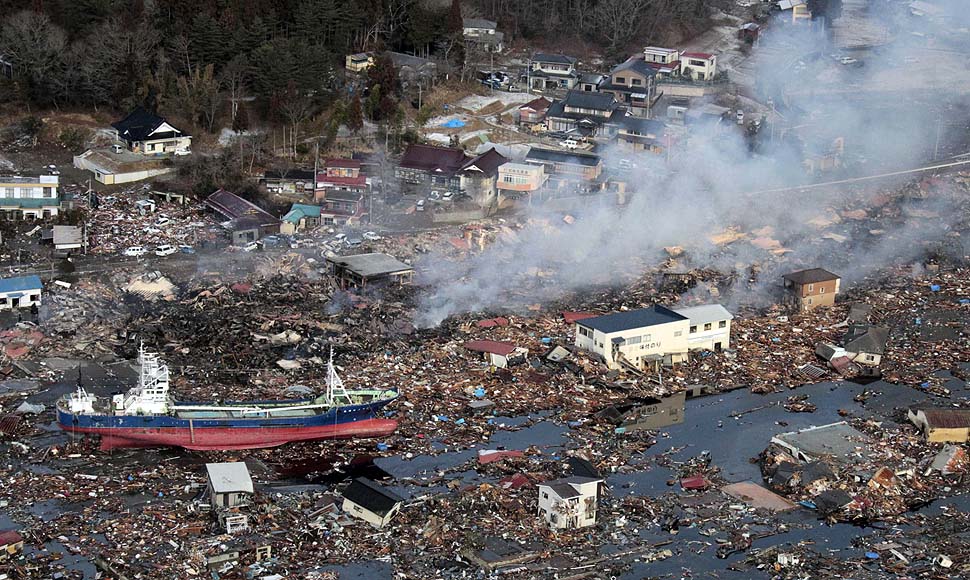
In the modern era, that incredible loss of life resulting from an upheaval deep within the bowels of the Earth's crust, leading to the aftermath of giant waves washing ashore, was almost matched in intensity by the 2011 earthquake that struck offshore with a 9.0-magnitude force, second to the Indian Ocean's quake that registered 9.1. Japan lies in a well-known earthquake zone; the country uses high-value technology to monitor such events, and the result was a still-considerable loss of 18,000 lives. The situation hugely compounded by a meltdown of five nuclear reactors.

This is an aerial view of damage to Sukuiso, Japan, a week after the earthquake and subsequent tsunami devastated the area in March, 2011.                                                       Credit: Dylan McCord. U.S. Navy

In the Pacific, where tectonic plates on the Cascadia subduction zone slide past one another on their 1,13-kilometre cascade, geologists say that a mega-thrust quake is inevitable. Killer quakes occur in the area every 500 years. It is now 300 years since the last one according to scientists who have found evidence of 19 giant Cascadia quakes in the past ten thousand years. Those experts now predict such a cataclysmic quake is possible in the next fifty years.

"We should be as well prepared as Japan", agrees John Clague, an expert from Simon Fraser University, in recognition of Canada's lag in mapping areas most potentially threatened by tsunamis and "seismic microzonation". Identifying pockets within cities and districts more prone to shaking, liquefaction and damage is vital to protecting the population living along the B.C. coast, particularly the vulnerable area of Vancouver Island.

TRANSITIONS - Pacific Rim National Park (British Columbia)
Pacific Rim National Park (British Columbia) (CNW Group/Transitions)

Like Japan and countries lying off the Indian Ocean, the West Coast of North America is vulnerable to earthquakes which regularly occur. No expert can predict with any reliability when the next large quake of magnitude 9 or more will occur, but they do stick with the 12 percent probability of a megathrust earthquake within the next fifty years.

When that happens, the ground will shake with an intensity sufficient to crack and collapse bridges and unreinforced buildings. Landslides will occur, cutting off roads, railways, and leaving millions of people without power, water, telephone service. A wall of water will race ashore to flood out of existence resorts, campgrounds, and any kind of human habitation, while altering shipping channels and severing major undersea cables.

And now the auditor general of British Columbia has launched a full critical review of Emergency Management BC, responsible for the response to such catastrophes, which has failed to treat the issue as a priority; devising comprehensive plans to deal with the possibility of an immense quake and the following tsunami to make certain that as many people are alerted, to head for shelter on high ground, as possible.

While North America is not likely to experience the intensity of a phenomenon leading to the horrors that resulted from the Sumatra quake, a major disaster could still develop. Emergency planners in B.C. and the U.S. consider it likely that deaths could exceed 10,000, with another 30,000 injured. Aging buildings and infrastructure in Victoria, Vancouver, Seattle and Portland are clearly at risk. Damage, should such a quake and tsunami occur, is estimated to cost Canada up to $75-billion.

A metres-height tsunami crashing ashore and racing up inlets would destroy coastal communities, fish farms, resorts and logging operations. A detailed analysis superior to anything that has as yet been undertaken is required to understand where the giant waves, capable of travelling at jet-flight speed, might break land, to result in the most damage. Inlets and channels are capable of amplifying five-metre walls of water for maximum destructive effect.

Canadian geologists point to the work by the state of Oregon in this direction, where tsunami inundation zones have been mapped out in detail to enable communities to plan evacuation routes, and identify and shape safe havens for people to flock to. And at the same time work on devising methods for the reinforcement of coastal highway bridges to withstand such a tsunami.

westcoast_quake_wordpress (1)

Five-metre waves, which are expected to result from a Cascadia tsunamis, while potentially destructive are not quite the threat seen by the size of the 40-metre monster waves the Tohoku quake off the coast of Japan presented in 2011. Canadian scientists feel it is necessary that sensors be placed on the sea floor along the Cascadian fault for finer estimates of tsunami wave heights. Japan has done just that off their coast.

"We know the on-land measurements, but we don't know what is happening under the water. That is the important part for tsunamis", according to research scientist Dr. Garry Rogers. Living in a wonderful country in a province with breathtaking and varied landscapes does have its risks as a result of natural geology for which the province is justifiably famous.

Credit John Clague


Labels: , , , , ,

Friday, February 21, 2014

Anne Frank's Diary vandalised in Japan libraries

BBC News online -- 21 February 2014
Kotaro Fujimaki, director of Shinjuku City's Chuo Library in Tokyo, explains how the vandalism may have taken place
More than 100 copies of Anne Frank's Diary of a Young Girl have been vandalised in public libraries in Japan's capital Tokyo, officials say.

Pages have been ripped from at least 265 copies of the diary and other related books, they added.
It is not clear who is behind the vandalism. A US Jewish rights group has called for a police investigation.

Anne Frank's diary was written during World War Two, while the teenager hid from the Nazis in occupied Amsterdam.

In the 1950s and the 1960s, there were competitions in which Japanese teenagers had to reflect on the experience of Anne Frank - thousands of teenagers sent submissions ”
Professor Rotem Kowner University of Haifa
The book made her a symbol of the suffering of Jews during the war.

For many Japanese the book forms the basis of their knowledge about the Jewish holocaust, the BBC's Rupert Wingfield-Hayes in Tokyo reports.

But what might have motivated the attacks remains a mystery. Japan has no history of Jewish settlement and no real history of anti-Semitism, our correspondent adds.

Toshihiro Obayashi, a library official in West Tokyo's Suginsami area, said: "Each and every book which comes up under the index of Anne Frank has been damaged at our library."

The Simon Wiesenthal Centre, a global Jewish human rights organisation, said in a statement that it was shocked and concerned by the incidents, and called for the authorities to investigate.

"The geographic scope of these incidents strongly suggest an organised effort to denigrate the memory of the most famous of the 1.5 million Jewish children murdered by the Nazis in the World War Two Holocaust," associate dean Abraham Cooper said.

A damaged Anne Frank-related book in Tokyo, 21 February 2014      It is not clear who is behind the vandalism or what their motives were
 
"Anne Frank is studied and revered by millions of Japanese," Mr Cooper added. "Only people imbued with bigotry and hatred would seek to destroy Anne's historic words of courage, hope and love in the face of impending doom."

The book was added to the UN Educational, Scientific and Cultural Organisation's Memory of the World Register in 2009.

Anne Frank's diary was translated into Japanese in December 1952 and topped the bestseller lists in 1953.

Professor Rotem Kowner, an expert in Japanese history and culture at Israel's University of Haifa, told the BBC that the book has been exceptionally popular and successful in Japan.

He says that in terms of absolute numbers of copies of the book sold, Japan is second only to the US, and adds that for Japanese readers the story transcended its Jewish identity to symbolise more powerfully the struggle of youth for survival.

"In the 1950s and the 1960s, there were competitions in which Japanese teenagers had to reflect on the experience of Anne Frank. Thousands of teenagers sent their submissions to such competitions," Professor Kowner says.

"It was a book about a war tragedy and the way youth experienced war... For many Japanese they would view this as a tragic development," he adds.

Labels: , ,

Sunday, December 22, 2013

A Space Odyssey

"Through layers of communication, we were able to observe the initial stages of a relationship begin to develop between a human and a robot, and I think that was our biggest success."
Tomotaka Takahashi developer of Kirobo
Japanese auto giant Toyota Motor engineer Fuminori Kataoka chats with humanoid robot Kirobo in Tokyo. (AFP Photo) Kirobo, a robot that talks
AP Photo

Kirobo has resulted from the fertile mind of a Japanese robotic technician, Tomotaka Takahasii. Japanese developers have become renowned for their work in robotics. Some of the first industrial robots were deployed in Japanese automaker production lines. The Japanese have produced dog-like robots and humanoid-type robots in the past, to great acclaim.

And now, Kirobo has been developed by a technical experimental team led by Tomotaka Takahashi, to perform during a space mission on the International Space Station. Kirobo's first test of its ability to verbally interact with a human being took place in recently and the video footage was just released by the robot's developers.

Kirobo was programmed with the ability to process queries; after listening it would select words from its programmed vocabulary in the construction of a considered response. There are no pre-programmed responses to anticipated questions that would be specific enough to engender a correct response.

Kirobo was programmed, in other words, to digest a query and respond just as an intelligent human would.

Japanese Tokyo University robot creator Tomotaka Takahashi chats with humanoid robot Kirobo (R) and back-up robot Mirata in Tokyo. (AFP Photo) Kirobo, a robot that talks
Japanese Tokyo University robot creator Tomotaka Takahashi chats with humanoid robot Kirobo (R) and back-up robot Mirata in Tokyo. (AFP Photo)


Speaking in Japanese with astronaut Koichi Wakata in the first test of its autonomous functionality in conversing with someone, Wakata asked Kirobo how it is managing in a zero-gravity environment. "I'm used to it now, no problem at all", responded Kirobo. No one quite knew how the humanoid robot might respond and whether it would be able to do so in a manner to give credit to expectations.

Japan Robot
Kirobo and Japanese astronaut Koichi Wakata made small talk in Japanese at the International Space Station. (Associated Press/Kirobo Robot Project)

Kirobo was sent into space from Tanegashima Space Center for the International Space Station in Japan, this summer. He was packed as part of a space cargo transporter. Astronaut Koichi Wakata arrived in November, to assume command of the station in March.

Kirobo is a joint venture between Dentsu, an advertising company and automaker Toyota, and Takahasii at the University of Tokyo's Research Center for Advanced Science and Technology.

The Kirobo experiments are set to continue until the little robot returns to Earth by the end of 2014. He is reputed to have said he wants to ask for a toy rocket this Christmas from Santa. All bets are on that Kirobo replicas complete with speaking function though not autonomous function, will soon pack retail store shelves for sale to rapturous fans.

Labels: , , ,

Saturday, December 07, 2013

Nature's Teflon

"It's almost oily feeling, like a lubricant. It is actually these things that are happening on the scale of single mineral grains that control how much energy is released. We think it's the very fine clay found in the northern Pacific that was causing this specific kind of fault structure and that led to the runaway slip in the Tohoku-Oki earthquake."
"To our knowledge, it's the thinnest plate boundary on Earth."
Dr. Christie Rowe, geologist, McGill University, Montreal
One of 27 scientists representing ten countries on a 50-day expedition named the Japan Trench Fast Drilling Project, aboard the Chikya, an international drill ship, Dr. Rowe was describing the fine clay that was found, packed between two gigantic tectonic plates under the ocean floor; the Pacific plate slipping into the Eurasian plate just east of Japan. And it was this slippage that took place in 2011 that shocked Japan and the world with the destructive Tohoku-Oki earthquake and tsunami.


LATimes.com


The crew, attempting to find some geological-scientific answers to the intensity of that monstrous earthquake and the immense tsunami it spawned, which in turn destroyed a series of nuclear installations at one of Japan's nuclear power plants, triggering a triple catastrophe, had to contend with a grudging environment, with their vessel rocked by huge swells.

Each time bad weather intruded on their experiment they were forced to retrieve equipment enabling them to drill at incredible depths: "Having that pipe hanging under the boat can be quite dangerous in a storm if it starts swinging", explained Dr. Rowe. She was speaking of drilling equipment and the need to haul up kilometres of equipment each time swells exceeded six metres.

Eventually they succeeded. Hitting bottom to examine where and why the Earth experienced a massive rupture on March 11, 2011 east of Sendai, Japan that hit an unbelievable 9.1 on the Richter scale. The expedition managed to get their drilling equipment through 6,900 metres of water to drill over 800 metres into the seabed, and finally installing probes and temperature sensors in the fault zone.

The scientists aboard the vessel have the task of studying the ancient clay "down to the nanoscale", said Dr. Rowe, to attempt to understand how that friable clay acted as an enabler allowing the giant plates to slip under and over one another. The area is called a subduction zone, describing the tectonic plates' potential to slide past one another; frictional heat measured by the temperature sensors in the boreholes allowed the plates to leap 50 metres in the space of three minutes.
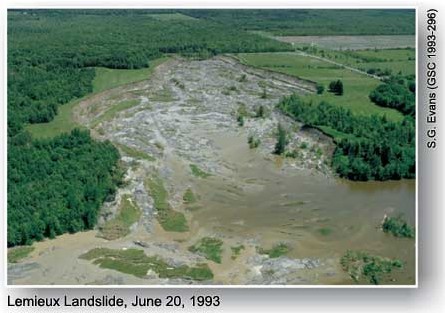
Tsunami’s shaky sea floor eerily familiar given past tragedies in Ontario, Quebec

File photo of Lemieux landslide, June 22, 1993. Aerial view of slide. John Major/Ottawa Citizen


The landscape of eastern Canada has been left with a similar clay deposit, called Leda clay, comprised of tiny particles, residue from the bottom of an ocean; in the case of eastern Canada, the ancient, former Champlain Sea. A portion of the village of Note-Dame-de-la-Salette in Quebec slid into the Lievre River in the middle of the night in 1908, and 34 people died.

In June of 1993, a hillside collapsed, sending millions of tonnes of earth and forest into the South Nation River nearby the town of Lemieu. A sudden collapse, no warning whatever. "I looked over, and I could see the forest moving", said a cabinet-maker, driving his Ford Ranger into what had been Country Road 16, and suddenly was a vast open space. "I thought to myself, 'What's wrong with this picture?"

His reaction was not instinctively swift enough to prevent his truck from a ten-metre drop. In the Saguenay Valley village of Saint-Jean-Vianney, the village dropped in seconds in 1971 about 30 metres creating a landslide that killed 31 people. Sodden after a wet autumn following a wet spring after a winter of several thaws, the Leda clay that appears solid when dry, was saturated to the extent its clay particles would no longer stick together.

http://inspectapedia.com/vision/Lemieux_Landslide_CDNR.jpg

"These are probably even slipperier clays (than around Ottawa), if you can believe it", said Dr. Rowe. "They are very weak at low slip rates. But they are even weaker at high slip rates, and once you start sliding in a landslide or an earthquake, this would encourage it to run away. It's the closest thing we have in the world to a natural Teflon."
"It takes a while for the water to permeate through the clays. It's not directly predictable by what the weather conditions are."

Labels: , , , , ,

Saturday, November 30, 2013

The Prince And The Pauper

Young children who become resentful and angry against their parents because of a punishment meted out in an effort to teach them to become responsible for themselves, often imagine themselves to have been given to the wrong parents. Their real parents, the children fantasize, would never punish them. Their real parents would be wealthy, perhaps of royal or patrician stock, and the child, had it been delivered to the right parents and not switched at birth, would be able to have anything it wanted.

Life can be so cruel, these children think, weeping in anguish over their sad lot in life.

Of course, these are momentary, childish aberrations. We get over these things. We are guided by our parents and become reasonable human beings eventually; at least most of us do. We set aside that kind of fruitless day-dreaming, and realize, as we grow older that we're unfair to our parents to value them so slightly that we would prefer to have been raised by others. And we adjust to life and make the most of it with our genetic endowments and the firm guidance of our parents. And luck.

There have been books written about just such scenarios, however, children separated at birth, by some unaccountable and unfortunate error, from their genetic parents. Taken away by others to become their own, unaware that an exchange had been made. Apart from literature tackling the subject, there have been documented instances when just such occurrences became reality. And one such occurrence was recently revealed to have taken place, in Japan.

When three brothers of a wealthy family, in adulthood and after the deaths of their parents, thought how unlike them their older brother seemed. They discussed the matter and prevailed upon him to agree to take a DNA test. And they discovered that what they had imagined was in actual fact true; their older brother didn't share any of their DNA, so obviously an error had occurred. They went back to the hospital where he had been born in Tokyo in 1953 to check records.

At the time two women had given birth to two little boys. A nurse took the babies away to bathe them, and then she exchanged the clothing that each had been wearing, and returned the babies to their mothers. But the nurse returned the babies to the wrong mothers who evidently did not themselves realize they were given the wrong babies. One of the mothers was reported to have noted later that her baby was wearing the 'wrong' clothing.

And now we know exactly why those plastic bracelets with identifying information are always placed on the ankles of newborns. In fact, anyone entering hospital for any manner of procedure is given one of those bracelets.
Man swapped at birth wins compensation
The families think the mothers believed something was wrong

The men are now 60 years of age. The child born to wealthy parents was given to a couple who lived in poverty and as a result, so did he. He lived with those parents not his genetic parents, along with siblings whom he loved. The father of the family died when the boy was only two years of age, and the family lived thereafter on welfare, barely able to cope. He he became older he studied at night school enabling him to work day shifts in a factory. And eventually he became a full-time truck driver.

He never married. He is emotionally close to his 'brothers', three other men who are not his birth brothers but with whom he lived as a child. And he contributes to their care and their upkeep. The other infant, who was the genetic offspring of the poor parents, grew up in wealth and with opportunity, attending the best schools, and ending up head of a property company. He too had three brothers, who also work for major companies.

His three younger brothers had suspected that because he didn't resemble them or their parents in any way, there might be a possibility he was not really their birth brother. And when tests confirmed that, and when they found evidence at the hospital that led them to a search to discover the whereabouts of their real brother, there was a reunion. All four men have grown fond of one another, the three younger ones telling their newfound older brother they will still have years of pleasure in one another.

"I wondered how this could have happened. I could not believe it. To be honest, I did not want to accept it. I might have had a different life. I want [the hospital] to roll back the clock to the day that I was born. As I saw pictures of my parents, I wanted to see them alive. For months, I could not hold back the tears every time I saw their pictures", said the truck driver. But he has become philosophical about what happened to him. He loved his adoptive mother and his brothers in that family and has few regrets on that account.

He and his three 'new' genetic brothers launched a lawsuit against the San-Ikukai Hospital in Sumida Ward. The Tokyo District Court ordered the hospital to pay the man 38-million yen ($393,000), a considerable sum in damages, in reflection of the accidental transfer of babies. "The links between the man and his real parents were severed and the man was forced to grow up in a poor home. The mental anguish he went through was enormous", said Judge Masatoshi Miyasaka in his ruling. 

Labels: , ,

Thursday, October 31, 2013

Japanese whale hunts threaten smaller species with extinction: EIA

Itsuo Inouye/AP A Japanese whaling ship Nisshin Maru leaves a Tokyo port in 2011.
TOKYO – Japan’s hunts of smaller whales, dolphins and porpoises threaten some species with extinction, an environmental group said Thursday.

Catch quotas are based on data collected as much as 20 years ago and some species have been overhunted beyond the point of recovery, the Environmental Investigation Agency said in its report.
The lucrative market in live catches for aquariums, especially in China, poses another risk, the report said. Live animals can sell for between $8,400 and $98,000, sometimes more than the roughly $50,000 from sales of meat for a single bottlenose dolphin.
Japan set its catch limit for small cetaceans at 16,655 in 2013, far below the 30,000 caught annually before limits were set in 1993 but still the largest hunt in the world.

Japan’s Fisheries Agency wouldn’t comment on the EIA report because it hasn’t seen it. Japan defends its coastal whaling as a longstanding tradition, source of livelihood and as necessary for scientific research.

The London-based independent conservation group said Japan is failing to observe its stated goal of sustainability and urged the country to phase out the hunts over the next decade.

“The government has a responsibility to restore and maintain cetacean species at their former levels,” said Jennifer Lonsdale, a founding director of the EIA.

The small cetaceans are among a number of species facing severe declines in Japan. They include Japanese eels, a delicacy usually served roasted with a savory sauce over rice, and torafugu, or puffer fish.

The status of each species varies, depending on its range and hunting practices. Catch limits for Dall’s porpoises are 4.7-4.8 times higher than the safe threshold, the report said.

For the striped dolphin, once the mainstay of the industry but now endangered and disappearing from some areas, catches have dropped from over 1,800 in the 1980s to about 100.

That is still four times the sustainable limit, the report said. It urged that the government update its data on the abundance of it and other species and stop transferring quotas from already overfished areas to areas that exceed their quotas.

Under a 1946 treaty regulating whaling, nations can grant permits to kill whales for scientific research.

In July, Japan defended its annual harpooning of hundreds of whales in the icy seas around Antarctica, insisting the hunt is legal because it gathers valuable scientific data that could pave the way to a resumption of sustainable whaling in the future.

Australia has appealed to the World Court to have the whaling outlawed.

Labels: , , , ,

 
()() Follow @rheytah Tweet