Ruminations

Blog dedicated primarily to randomly selected news items; comments reflecting personal perceptions

Wednesday, December 21, 2016

Nuclear Medicine Testing

"We are saying that unless there is a very high level of brainstorming between the federal government, the provinces and the profession to tackle these issues, the risk is that Canadians will not get access to important tests for the diagnosis and treatment of their diseases."
Dr. Norman Laurin, past-president, Canadian Association of Nuclear Medicine

"For patients, it means hospitals have to make decisions in terms of which tests they can afford to provide to patients."
"The tests that they can afford are not necessarily the best tests."
Dr. Jean-Luc Urbain, former president, Canadian Association of Nuclear Medicine
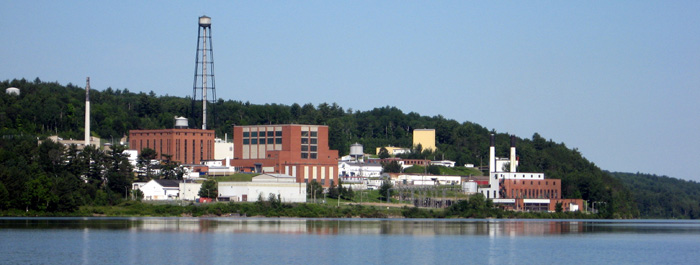
Photograph of the NRU reactor building
Out of time: the NRU reactor at Chalk River
"A pioneer in nuclear medicine, NRU continues to make an important contribution to the world’s medical isotopes used in both the diagnosis and treatment of life-threatening diseases. Isotopes from NRU benefit thousands of people each day, millions of people internationally each year – an amazing contribution to world health."
"One of the NRU reactor's most important contributions to health is without a doubt the cobalt-60 it produces. Cobalt-60 accounts for 10 million cancer therapy treatments each year and was originally produced in the NRX reactor through which Canada launched the modern field of nuclear medicine. The first cancer treatments using cobalt-60 were delivered at hospitals in Ontario and Saskatchewan in 1951. Today, cobalt-60 from NRU treats cancer patients in countries around the world."
"Canada has made impressive contributions to world health care, and Canadian scientists continue to research nuclear medicine techniques and explore the vastly refined techniques of medical science."
Canadian Nuclear Laboratories website

"A report from the US National Academies of Sciences, Engineering and Medicine (NAS) warns that the US could be facing severe shortages of the vital medical isotope technetium-99m once the ageing NRU nuclear reactor in Chalk River, Canada, stops producing molybdenum-99 next month. Technetium-99m, which is derived from the molybdenum-99 isotope, is widely used for medical imaging."
"Released this week, the report was commissioned by the US Congress and warns that there is a greater than 50% chance that severe shortages of molybdenum-99 and technetium-99m will occur in the US after the NRU stops production in October. Both isotopes have very short half-lives and cannot be stockpiled. While global supplies of molybdenum-99 are produced at six other reactors worldwide, most of these facilities are also very old and some are prone to unscheduled shutdowns."
Physicsworld.com
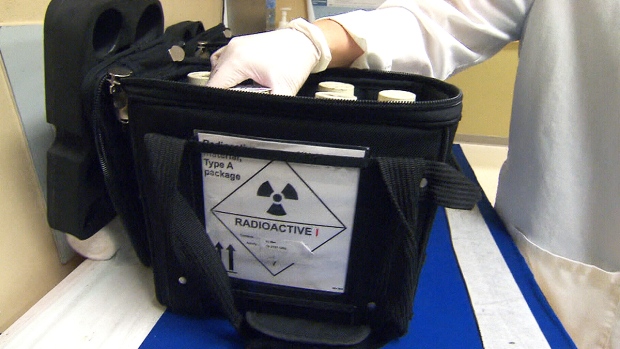
CTV National News: Isotope reactor to shut down


Canada has, until recently, been the world's foremost supplier of medical isotopes. The National Research Universal reactor at Chalk River (NRU) was built in 1957. As the sole source of molybdenum-99 in North America, the suspension of production at the NRU will strike the entire continent hard. Medical isotopes will have to be brought in from abroad, from other aging reactors elsewhere in the world. In view of the fact that medical isotopes are of vital importance in the diagnosis of dire medical conditions, both Canada and the U.S. are developing more modern, accelerator-based facilities for production, but they will not be in production mode until 2018.

Hospitals are being left in a vacuum of critically short supply of a vital diagnostic tool whose constituents have a short lifespan and cannot be stockpiled. Nuclear medicine doctors have become alarmed at the sky-high cost of medical isotopes which, they warn, may impact on patient access to the sophisticated medical tests for cancer, heart disease and other illnesses that plague humankind. The soaring cost of some nuclear medicine has increased up to one thousand percent, partially resulting from the shutdown of isotope production at the NRU reactor.

According to Dr. Norman Laurin, this rapidly rising price is "significant enough that hospital budgets will either have to be revised or they will have to decrease procedures". The problem here is obvious enough; hospital budgets in Canada are already tight, with finite financial resources available to dedicate additional costs to manage these massive rising prices in the compounds used for diagnostic medical scans. A greater use of CT scans for diagnostic tests may result, producing less accurate measurements which can also expose patients to 25 to 50 percent more radiation.

The current president of the Canadian Association of Nuclear Medicine, Dr. Andrew Ross, warns that the situation will inevitably result in longer waiting lists for tests when the results they produce are required in much shorter time-spans for medical specialists to be able to respond in a timely manner to their patients' medical needs to ensure that their life-threatening disease does not progress beyond the capacity of medical science to deal with.

Medical isotopes are radioactive substances which in small amounts are used in the diagnosis of health conditions impacting the heart, the circulatory system and visceral body organs. The present situation surprises no one in the medical community, since experts had long warned of the inevitability of shortages and allied price hikes back in 2008 at a time that outages at the aging NRU reactor occurred and it was recognized that the reactor had an increasingly limited lifespan. A critical short-term upgrade was conducted and the reactor put back to work producing isotopes.
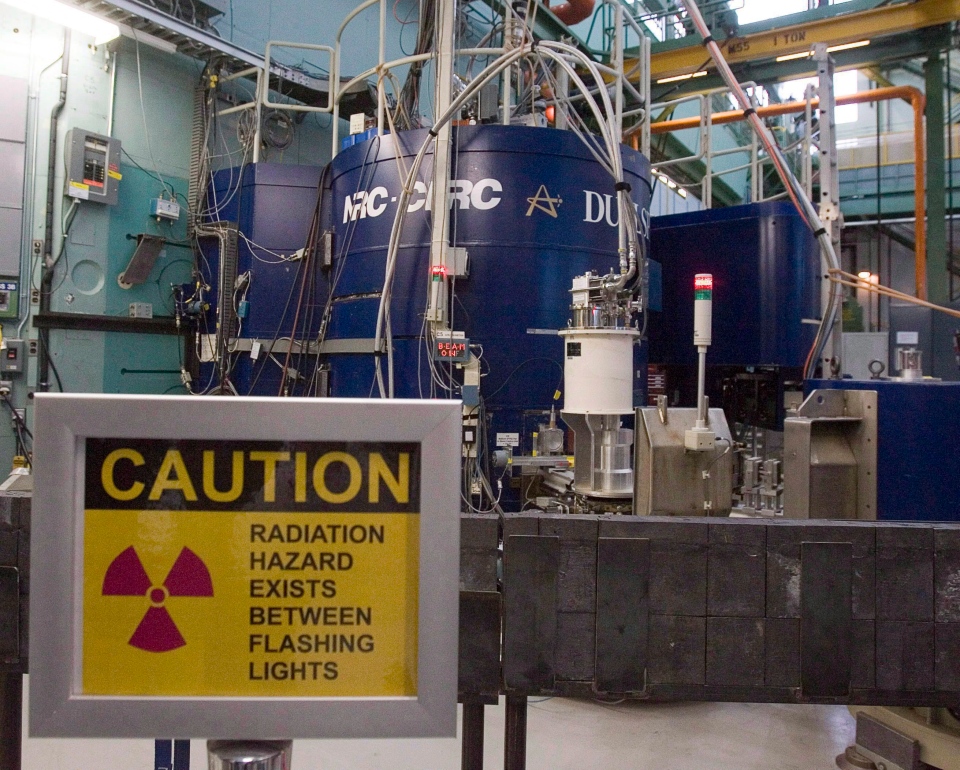
AECL plant in Chalk River
A warning sign is posted at the AECL plant in Chalk River, Ont. on Dec. 19 2007. (Fred Chartrand / THE CANADIAN PRESS)

But the NRU reactor situation clearly "highlighted [the] fragility of the supply chain that delivers medical isotopes . . . to patients in Canada and globally", stated Natural Resources Canada. At that time the government then in power announced that isotope production at NRU would be brought to a halt in 2016 and the reactor de-commissioned. That time has come for the world's oldest experimental reactor responsible for up to half of the world's medical isotope production, accounting for 80 percent of nuclear diagnostic procedures.

Plans are for the nuclear reactor to be placed on 'hot standby' for one and a half years so that it could in theory be restarted in short order, after which it will be shuttered permanently. It is not only the loss of one of the major producers of these critical diagnostic tools, but that the price of pharmaceutical agents that work in combination with the isotopes have risen sharply in price, as well. Suppliers in South Africa, Australia and elsewhere remain in production, but demand and scarcity add up to increased costs and decreasing availability.

What are medical isotopes and how are they used?

A medical isotope is an unstable (i.e. radioactive) atom derived from a stable one.
Molecular imaging – the imaging of molecules, biochemical processes, and physiological activity within the human body – is rapidly becoming one of the most powerful tools for the diagnosis and staging of disease. The main tools for molecular imaging are single-photon emission computed tomography (SPECT) and positron emission tomography (PET) scans that tag specific biomolecules (biologically active molecules) with medical isotopes. When medical isotopes decay, they emit particles that can be detected and used to pinpoint their location. By chemically connecting a medical isotope to a biomolecule and injecting that compound into a human body, clinicians can “see” where the body is using the biomolecule.
For example, if an incoming patient is thought to have had a heart attack, a doctor might inject a patient with Tc-99m attached to a biomolecule called teboroxime (this combination is called a “radiotracer”). The patient might then perform a rest-and-stress treadmill test. The Tc-99m will go to the heart because the teboroxime molecule is designed to accumulate there. When the heart is imaged with a SPECT camera, the picture will tell the doctor if the heart muscle has been damaged.
PET and SPECT scans differ by the type of decay of the isotope and therefore use different “cameras” to image or “scan” the patient. SPECT is better established, is prevalent in every hospital, and is presently cheaper than PET. PET is an emerging technology that offers higher resolution scans and access to more sophisticated biological information.

Home

Labels: , , ,

Friday, May 20, 2016

On The Horns of a Nuclear-Waste Dilemma

"You look at parts of the world that seem to go from reasonable governments to chaos, and I don't think you can predict what kind of society will exist hundreds of thousands of years from now."
"When you look at the geological history of the area [Great Lakes Basin, Ontario], it's been so benign in geological activity in the last tens of millions of  years. I don't know how you could find a safer place to put it [nuclear waste]."
Derek Martin, professor, geotechnical engineering, University of Alberta

"It just keeps coming back to that main question. Is it safer where it is right now [hard by the Bruce Power site, buried near the surface]? We had a tornado in a town near here three or four years ago ... and that could've just as easily been in Kincardine. It was a devastating tornado. Wiped out the town."
"Is this stuff [nuclear waste] safer where it is now, or is it safer 650 metres down in rock that hasn't moved in aeons?"
Kincardine Mayor Anne Eadie

"No matter what process is followed, abandoning radioactive nuclear waste in the Great Lakes basin will always be a bad idea."
"If it must be buried, bury it outside of the Great Lakes basin and far from people, far from water."
"One thing is for sure: we shouldn't bury this lethal material beside the source of drinking water for 40-million people in two countries. We will never know if there  has been a leak until it's too late."
Beverly Fernandez, spokeswoman, Stop the Great Lakes Nuclear Dump, Southhampton, Ontario 


An aerial view of the Bruce Power nuclear generating station in Kincardine, Ont., on Aug. 16, 2003. Opponents of Ontario Power Generation's plan to store low- and intermediate-level radioactive waste in an underground rock chamber beneath the Bruce facility say the bunker will be too close to Lake Huron.
An aerial view of the Bruce Power nuclear generating station in Kincardine, Ont. Opponents of Ontario Power Generation's plan to store low- and intermediate-level radioactive waste in an underground rock chamber beneath the Bruce facility say the bunker will be too close to Lake Huron. (J.P. Moczulski/Canadian Press)

Nuclear-derived power is inexpensive, once the cost of building associated nuclear reactors is done with, and upkeep figured in; it is environmentally clean, and it is reliable. But the sheer harnessing of this kind of power involved in nuclear plants and the potential for things to go catastrophically wrong due to technical fault or human error remains a cloud of dark concern hanging over any country reliant on nuclear energy for power generation. 

The disaster that overtook Ukraine when its Chernobyl Nuclear Power Plant erupted rendered the city of  Pripyat and the surrounding area unlivable, contaminated by radioactivity, leading to a mass exodus of its population. Japan suffered its own dreadful nuclear disaster when, following a huge earthquake, a tsunami disabled the Fukushima Nuclear Power Plant in 2011 and a similar evacuation was ordered with thousands of people relocated, and the area surrounding the plant off limits.

Those dreadful catastrophes aside, there is the matter of what to do with generations' worth of radioactive nuclear waste. Material  that science well knows takes thousands of years to decay before it becomes non-toxic. Ontario Power Generation, which operates the largest nuclear plant site in the world, is seeking federal government permission to bury its accumulated 50 years-worth of nuclear waste close to the Great Lakes region, in Ontario.

OPG contemplates blasting an area deep in the ground in a geologically stable area to dump and seal low- and intermediate-level radioactive waste from the province's three nuclear power plants. That toxic material would, in theory, be placed under layers of rock that have not moved in tens of millions of years, according to geologists. The fact that the planned Deep Geological Repository is located just over a kilometre from the bottom of Lake Huron is what has made it such a controversial subject.

Supported by dozens of scientists some of whom took part in a government-appointed independent review panel which approved the plan, the 680-metre hole would be dug below the water table, into ancient layers of rock, stable for over 50 million years. This is the plan considered to be the best solution available to ensure that the radioactive material is far removed from humans, well into the future. Environmentalists and political leaders on each side of the Great Lakes are not convinced.

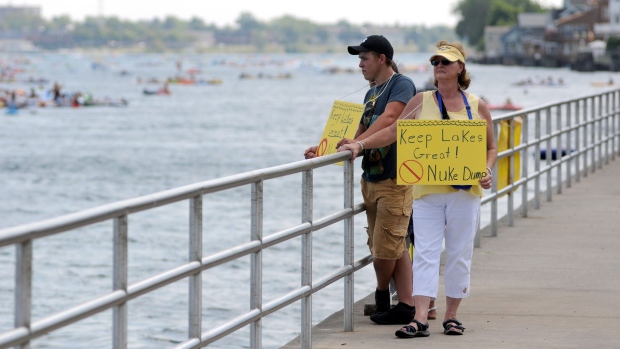
Nuclear waste Jan Thomas, of Port Huron, holds a sign protesting a proposed nuclear waste dump site on Lake Huron, Sunday, Aug. 16, 2015, as participants in the float down pass by during International Rally to Protect the Great Lakes at Pine Grove Park in Port Huron, Mich. (Andrew Jowett/The Times Herald via AP)

Ontario Power Generation speaks with confidence of their plan. "We're happy to respond to them [critics]. We've been open and transparent through this whole process, and we're happy to do what we can to help people understand it", insists OPG spokesman Bill McKinlay. But opposition has only gained momentum with over 180 county boards, city councils and other elected groups close to the Great Lakes in both Canada and the United States having passed resolutions urging a veto.

Some supporters of the plan have pointed out that high-level nuclear waste which takes ten thousand years to become non-toxic, is going to be buried at Yucca Mountain, outside Las Vegas. Michigan Representative Debbie Dingell, responds to that by stating: "This is different. A mountain is in an isolated place, better than water that is 20 percent of the freshwater in the world. If there's a leak or an accident at Yucca Mountain, it's in an isolated area", an observation difficult to find fault with.

Eight of Ontario's 20 nuclear reactors are located at the Bruce Power facility. The Bruce site has stored low- and intermediate-level waste for all Ontario power plants in above-ground bunkers and vaults since the early 1970s, across a concrete area near the reactor buildings. It is now looking for a permanent home for this dangerously toxic material. And its options have been starkly criticized by the fears of people contemplating disaster.

Great Lakes Nuclear Waste
This Nov. 1, 2013 photo shows rows of chambers holding intermediate-level radioactive waste in shallow pits at the Bruce Power nuclear complex near Kincardine, Ont. Ontario Power Generation is seeking permission from the Canadian government to permanently store low- and intermediate-level radioactive waste in a rock chamber that would be built 680 metres underground and 1.2 kilometres from Lake Huron. (John Flesher/Associated Press)

Labels: , , ,

Monday, April 25, 2016

 Humankind : Threat to all Living Creatures

"Thirty years ago, two things happened at once. The whole area was contaminated with radiation, and the human population vanished. That gives us a unique opportunity."
"We're not saying that radiation is not as dangerous as we thought. Rather it is possible that in the absence of humans, the stress of radioactive contamination is a manageable one for wildlife populations."
Dr. Mike Wood, British naturalist

"You could say that the overall effect was positive."
"Radiation is a matter of increased potential risk. But when humans are around, animals are simply shot or lose their habitat."
Professor Nick Beresford, Chernobyl expert, Centre for Ecology and Hydrology, Lancaster, England
© Vasily Fedosenko


When the Chernobyl reactor number four exploded thirty years ago, a huge area around the nuclear installation became contaminated by radiation, and a wasteland remained. Radioactive toxins spread from the April 26, 1986 explosion at Chernobyl across Europe. Thousands of people died as a result of radiation-related illnesses and cancers. The lingering effects of the catastrophe remain the cause of birth defects in Belarus, Russia and Ukraine.

Scientists believe that the area around the power station will exclude human habitation for hundreds and quite conceivably for thousands of years, as a result of the dreadful depth penetration of the toxic cloud of radioactive material that was released on that date. The area population of 120,000 souls was evacuated expeditiously, leaving a 4,500 square-kilometre region between Ukraine and Belarus a ghost area.

The town of Chernobyl which had hosted residents for its 800-year-history was totally evacuated, along with dozens of villages. Also abandoned was a secret Soviet military base. To remain would be to surrender to a gradual debilitation onset, morbid illness and certain death. The food that was grown for centuries to feed the local population would be grown on deadly soil. Potable water would be unavailable; everything was malignantly befouled.

A radiation sign is seen in the 30 km (19 miles) exclusion zone around the Chernobyl nuclear reactor in the abandoned village of Dronki, Belarus. © Vasily Fedosenko
What was left was a dead "zone". A place where only emergency workers were dispatched to for brief intervals and even with all safety procedures in place, they would succumb as additional victims to a world-shattering nuclear disaster, the product of human error. Void now of people living where they had traditionally as long as memory could recount and history validate, nature has turned the "zone" over to its other more deserving creatures who could never create a disaster of such magnitude.

The dead "zone" created by the Chernobyl blast has become one of Europe's largest wildlife reserves by default, where wild boar, wolves, elk and deer thrive throughout the forested region and the grasslands that make up the landscape. The presence of wolves, of feral horses and bison are known because cameras set up to record their presence provide their images. The wild species called Przewalski's horses introduced to the area in the 1990s, is proliferating.

And scientists are studying the "zone" and its new residents. Three areas of the "zone" are set up with cameras to reflect the presence of free-ranging and carefree-from-human-presence animals. The three areas represent high, medium and low contamination-designated regions. The issue of ecological-system health, one in comparison to the other and judging soil samples and animal droppings help the naturalists understand the situation in the round.

Terrain horribly compromised and remaining a long-term threat to human life, has become a refuge for animals who appear to have adjusted to the "zone", finding it a place of comfort and haven where they can roam freely without fear of being trapped or shot at as prey, stalked by hunters. Drs. Wood and Beresford are part of a contingent of British scientists who have converged on the "zone" to interpret the evidence they are studying.

As yet it is largely unknown whether or how much the animals are impacted by the radiation suffusing the atmosphere and the environment. It is assumed that there is some measure of deleterious fallout to their health from the corrupted land, but its extent can only for the present, be a matter of speculation. One thing seems clear, however, and that is that animals can better cope in the absence of man, even in dreadfully compromised landscapes, than they are able to in pristine forests stalked by man.

Wolves walk in the 30 km (19 miles) exclusion zone around the Chernobyl nuclear reactor in the abandoned village of Orevichi, Belarus. © Vasily Fedosenko

Labels: , , ,

Tuesday, October 06, 2015

Nature's Precincts

"In purely environmental terms, if you take the terrible things that happened to the human population out of the equation, as far as we can see at this stage, the accident hasn't done serious environmental damage."
"The wildlife at Chernobyl is very likely better than it was before the accident. Not because radiation is good for animals, but human occupation is much worse."
Professor Jim Smith, Portsmouth University, Britain

"This study only applies to large mammals under hunting pressure rather than the vast majority of animals, for example most birds, small mammals, and insects, that are not directly influenced by human habitation effects."
"As such, it does not address the fundamental question of the ways in which natural populations are affected by radioactive contaminants."
"[The area is not] teeming the way you see it in other places around the world where hunting has been curtailed."
Tim Mousseau, biologist, University of South Carolina

wild-boar-former-village
Wildlife may not have been as affected by the Chernobyl nuclear disaster as previously thought. Here, wild boar run in a former village in the Chernobyl exclusion zone. Valeriy Yurko
 
The restorative effects on soil, helping to put vital minerals back into the earth by programmed burns was known to ancient indigenous peoples who renewed soil after crops had removed all the vital elements over many years, by planning to fire fields, plow them under with whatever primitive means at their disposal, and then turning them back into vibrantly productive food sources.

At Chernobyl there was no plan to burn the area in Ukraine where the plant located there was the 1986 site of a horrendous nuclear accident whose fallout affected the human population and the animals that lived in the region, causing a massive evacuation and emergency interventions of dire consequences. It remains an exclusion site, and the memories related to the catastrophe are not readily forgotten.

An estimated 116,000 people were evacuated, losing all that was of value to them, beginning with their security and ending with their life transformed forever with the residue of health conditions and the need to begin their lives over again removed from the place they considered home.

A report published recently in the journal Current Biology has gathered evidence from helicopter surveys to reach a surprising conclusion, one not shared by all biologists who have studied the site, but an intriguing one nonetheless.

Nature, it contends, has intervened in the following years to ameliorate the tremendous damage done by humankind in manipulating natural processes without due care and respect of the potential fallout. Rare species of wild animals including European lynx have found a haven in the exclusion zone which nature has reclaimed. Wild boar, roe deer, fox and wolves are thriving

chernobyl-wolf A wolf seen in the Chernobyl Exclusion Zone. There are more wolves found here than in nearby uncontaminated reserves. Valeriy Yurko

The European brown bear, not resident in the area for a century has returned. Thirty years it has taken for nature to invite her creatures to return to a natural setting laid waste by the work of humans whose incursion and natural spread into the homeland of wild creatures was responsible for their need to vacate the geography to begin with.

The accident whose monumental proportions of dread and disaster imperilled human life has resulted finally in a return of animal life, it would appear.

Labels: , , , ,

Thursday, March 19, 2015

Taqiyya: Islamic doctrine of deceit

"Contrary to what many think, that we are only discussing one issue, it is not correct. We are discussing many issues and nothing is agreed until everything is agreed."
"Contrary to what the Iranians are saying with regard to 90 percent of an accord being done, that's not correct. We are not close to an agreement."
"We are pretty far away. There are a lot of issues that still need to be resolved. The Iranians must make substantial concessions."
"Research and development currently has become the most critical and difficult issue, and there won’t be an accord if the Iranians don’t back down."
"They [Iranian negotiators] insist they have to go immediately [sanctions targeting nuclear program]. No way. It is out of the question."
European negotiator demanding anonymity

Iran Lausanne nuclear
Iran's FM Zarif (C on left) and head of the AEO of Iran Salehi (C on right) with colleagues in Lausanne March 19, 2015 . (photo credit:REUTERS)
"The main issues have been closed. I hope that in the remaining time we can close this."
"[One] final item still missing; that resolved] we can say that on technical issues, things are clear on both sides."
"Of course there are many details, but I can say that, as a whole, I am optimistic [of a deal before the deadline]."
Ali Akhbar Salehi, Iranian nuclear chief

"[A comprehensive accord would result in] phased, proportionate [relief from sanctions but such relief could be reversed should the Islamic republic violate any final deal]."
"[That is simply not true] Iran crank up and develop a bomb when the deal ends]. To the contrary, Iran would be prohibited from developing a nuclear weapon in perpetuity -– and we would have a much greater ability to detect any effort by Iran to do so."
"[Some constraints could be lifted for a] significant period [others would last] indefinitely, including a stringent and intrusive monitoring and inspections regime [by the IAEA]."
"That [restrictions on centrifuges] would provide us more than enough time to detect and act on any Iranian transgression. The critical question of the possible military dimension of Iran's program... would have to be part of any agreement." 
U.S. Deputy Secretary of State Antony Blinken
This testimony from Mr. Blinken at a hearing of the  House Foreign Affairs Committee was greeted by both Democrats and Republicans present with an lively degree of skepticism, with some snorting that the reality of the situation has been that the Islamic Republic of Iran has in the past "been violating those commitment for years". They pointed out as well of the necessity that restrictions be included on the country's robust and threatening ballistic missile program in any nuclear deal as insurance against Iran using them to carry atomic bombs.


Iran's representatives appear to believe, however, that they have the upper hand as their top nuclear official claimed that the main disagreements between his government and the American negotiators and the other partners in the P-5+1 team -- France, Britain, China and Russia, plus Germany -- have been resolved and that little is left to iron out to meet the end-of-March deadline for the framework deal. That deal to place reliable limitations on Iran's nuclear activities to restrict them to what Iran insists they're intended for; strictly peaceful energy needs and medical isotope production.

The West would then be prepared to proportionally release Iran from the economically crippling sanctions. Enabling Iran to get on with its other programs, funding, training and arming Shia non-state and state militias alike to bring them ever more comfortably into its sphere of influence from the Middle East to North Africa and even Latin America and Asia; Iran has been growing influential tentacles. (Strangely enough, although Iran has found its economy strangled, it has managed to continue developing its long-range rockets, and to fund its terrorist proxies.)

The final agreement to be obtained by the end of June looks ever more possible, and the Iranians are smiling broadly. On the other hand, another unnamed but senior American official claims the sides, though having made progress, still face a struggle in eliminating differences on expectations for Tehran to meet before a gradual end to sanctions can be counted on. The disputes focus mostly on technical issues such as the centrifuge numbers Iran could be permitted to operate.

U.S. Energy Secretary Ernest Moniz joined the talks along with Mr. Salehi in an attempt to reason out technical differences. Republicans in the U.S. continue to argue their case that a deal with the Republic would never be sufficient to guarantee the country that has become so skilled in evading demands over its ambitions for nuclear status would run roughshod over any promises it makes to quell international suspicion over its true plans.

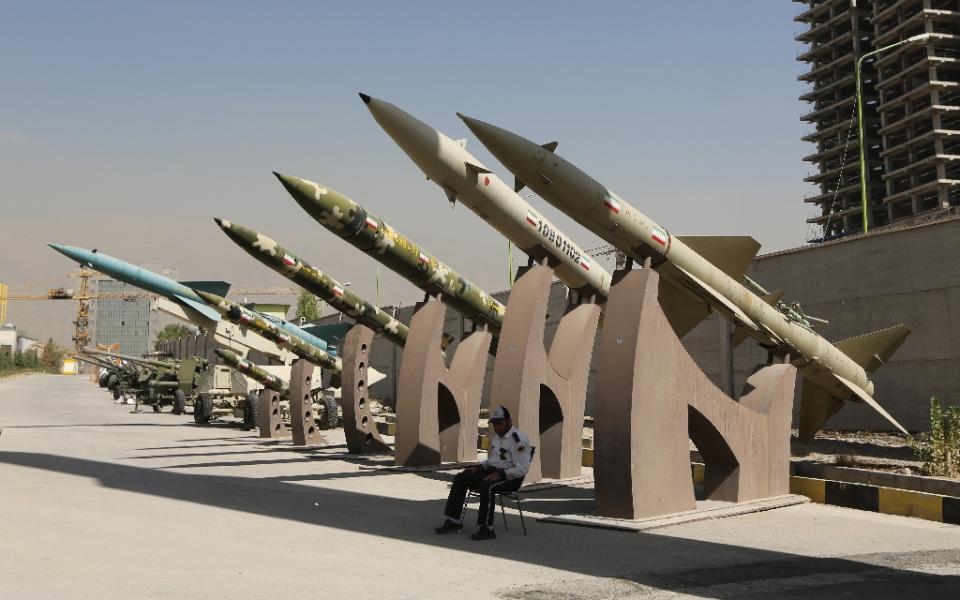
Iranian missiles are displayed at a park in northern Tehran (AFP Photo/Atta Kenare)

This is a country, after all, that has threatened another country in the Middle East with annihilation, not merely once in the hallowed halls of the United Nations, but frequently, expressed by the Grand Ayatollah Khamenei himself as well on occasion. Iran's designs for the Middle East as one of the only two non-Arab countries, to dominate all other Muslim countries through its Shi'ite brand of apocalyptic Salafist Islamism represents to the Sunni-majority countries a looming threat.

Which is why the U.S. Republicans hold the position that such an agreement would be unenforceable, and Iran would inevitably reach the status it so craves, as a nuclear-armed state. And the rush would be on for Saudi Arabia, Egypt and perhaps others to claim their own self-defence needs in the hopes of nuclear deterrence. And while President Omama continues to insist that his administration would never agree to any deal that would permit Iran to acquire nuclear weapons, his words ring hollow against the actions of the past and Iran's slippery reputation for taqqiya.

Otherwise known as the kind of deceit permitted in Islam to throw one's enemies off track and gain the desired advantage -- at any cost.

Labels: , , , , ,

Tuesday, September 03, 2013

Fukushima leaks: Japan pledges $470m for 'ice wall'

BBC News online -- 3 September 2013
Joanna Gosling explains where the leaks are coming from
Japan is to invest hundreds of millions of dollars into building a frozen wall around the Fukushima nuclear plant to stop leaks of radioactive water.

Government spokesman Yoshihide Suga said an estimated 47bn yen ($473m, £304m) would be allocated.

The leaks were getting worse and the government "felt it was essential to become involved to the greatest extent possible", Mr Suga said.
The plant was crippled by the 2011 earthquake and tsunami.

The disaster knocked out cooling systems to the reactors, three of which melted down.
Water is now being pumped in to cool the reactors, but storing the resultant large quantities of radioactive water has proved a challenge for plant operator Tokyo Electric Power Company (Tepco).

Under the government plan, a wall of frozen earth will be created around the reactors using pipes filled with coolant to prevent groundwater coming into contact with contaminated water being used to cool fuel rods.

Graphic: How an 'ice wall' could work

Water treatment systems will also be upgraded to tackle the build-up of contaminated water, officials said.

Dr Tatsujiro Suzuki, vice chairman of the Japan Atomic Energy Commission, told the BBC that the situation at the nuclear power plant was an "unprecedented crisis" and that it was "getting worse".
He said the plan to freeze the ground around the site was "challenging", and a permanent solution was needed.

The technique has only been used on a small scale to control pollution before but not with radioactive contamination, he added.

The damage to the plant has necessitated the constant pumping of water to cool the reactors - a process which creates an extra 400 tonnes of contaminated water every day.

That water is being stored in temporary tanks at the site. Last month Tepco said that 300 tonnes of highly radioactive water had leaked from one of the tanks, in the most serious incident to date.
The increase in storage of radioactive water at the Fukushima nuclear plant Satellite images show how the number of water storage tanks has increased in the past two years. The tanks store contaminated water that has been used to cool the reactors.
 
But in recent months there have also been leaks from pipes and there are concerns that water is seeping from damaged reactor buildings into the ground.

Last month, Japan's nuclear regulator classified the severity level of radioactive water leak issues at Fukushima as a three on the seven-point International Nuclear and Radiological Event Scale (Ines).
The triple meltdown at Fukushima two years ago was classed as a level seven incident, one of only two nuclear events ever rated that highly - along with the 1986 Chernobyl disaster in the former Soviet Union.

"The world is closely watching whether we can dismantle the (Fukushima) plant, including the issue of contaminated water," said Japanese Prime Minister Shinzo Abe.
"The government is determined to work hard to resolve the issue."

The funding pledge comes days before a decision is due on the host nation for the 2020 summer Olympic Games, for which Tokyo is a candidate.

Meanwhile, one of Japan's only two nuclear reactors still online was shut down on Tuesday for mandatory inspections.

The shutdown of Kansai Electric's Oi Unit 3 reactor will leave the plant's Unit 4 reactor the only one still functioning in Japan. Unit 4 must also be taken offline later this month for routine assessment.
Restarting Japan's other nuclear reactors remains a highly controversial issue, but the government is working to get this done to fill an energy gap.

Graphic of water tank contamination at Fukushima Water from the storage tanks has seeped into the groundwater and then into the sea. Efforts to use a chemical barrier to prevent sea contamination have not worked.

Labels: , , , ,

Monday, August 26, 2013

Living Crisis Laboratory

"Nobody knows when this is going to end. We've suspected (leaks into the ocean) from the beginning. ... TEPCO is making it very difficult for us to trust them."
Masakazu Yabuki, Iwaki fisherman

Experts are now of the opinion that underground seepage from the Fukushima's tsunami-crippled nuclear power station; the reactor and turbine building area -- is massively larger and more radioactive than has been thought. Tokyo Electric Power Co.'s response to the disaster has been ineffectual. Compounded by the fact that nowhere in the world has a situation quite like this one ever surfaced before.

Nuclear reactors are generally recognized to be a safe, reliable, relatively inexpensive source of energy. But because they are nuclear installations and radiation is such a powerful weapon of nature inimical to the survival at high enough levels of all life, they must be handled with sensitivity and care. Nuclear reactors should never be built on unstable ground; say for example, over sub-oceanic plates known to move and rub together.


And where there are earthquake zones there are also chances of high probability that tsunamis will result from the massive upheaval of the earth when tectonic plates abrade. This is called double-jeopardy, isn't it, when oblivious hubris results in catastrophe on the scale that Japan experienced two and a half years ago. It was touch-and-go for long enough as the national utility, politically driven as it was, desperately attempted to cope with their melt-down.

Two national, incompatible powerful energy grids, operated separately and in competition with one another is a sign of extremely poor planning to begin with. Now it emerges that the plant is increasingly incapable of containing vast quantities of radioactive water, with the discovery of a leak from a tank storing contaminated water used to cool the reactor cores.
http://assets.inhabitat.com/wp-content/blogs.dir/1/files/2011/03/nuclear-Jonathan-Ruchti-537x3582.jpg
This is a 300-ton leak. Its potential rates equal in fall-out to the March 2011 situation when three of the plant's reactors melted down when the power and cooling functions were knocked out thanks to the tsunami. Poor planning and construction screamed out all over the place; its cooling towers non-existent in conventional reactor core cooling.

Emergency generators were to come on line to power electronics and coolant systems (from sea water) but the tsunami flooded the low-lying rooms where the emergency generators had been placed rendering them completely useless. Another bit of really, really bad planning. Power was cut to the critical pumps meant to cool the cores when the generators flooded and failed.

Fishing in the area is banned already. But fishermen like Mr. Yabuki in nearby Iwaki City were hoping they might be able to conduct some test catches to evaluate the level of contamination. They no longer have reason to hope. A makeshift system of pipes and hoses funnelled water into the broken reactors, the resulting radioactive water treated and stored in aboveground tanks. Which have developed leaks.

But water has been found to be leaking into the basements of the reactors then through cracks into surrounding earth and groundwater; an estimated 400 tons seep into the reactor and turbine basements from mountain streams daily, becoming contaminated as well. Bottom-dwelling fish have been identified with high radioactive cesium levels, which led scientists to suspect the plant was leaking radioactive water, which TEPCO denied.

They no longer can. The ocean is about 150 metres from the Fukushima Dai-ichi plant turbine buildings. A Japan Atomic Energy Agency document states the contaminated underground water is spreading at a rate of about four metres a month toward the sea. "This is a race against the clock" said Toyoshi Fuketa, a commissioner on Japan's Nuclear Regulation Authority, of attempts to block the leaks.

About one thousand steel tanks built at the plant contain close to 300 million litres of partially treated contaminated water. A third of the tanks have rubber seams good for five years before deteriorating. "It's like a haunted house, one thing happening after another. But we must take any steps that would reduce risks to avoid a fatal accident", said Nuclear Regulation Authority chairman Shunichi Tanaka.

Japan has been hugely reliant on nuclear energy for decades, to fuel its manufacturing. The islands are mountainous, they sit over some of the world's most active tectonic plates. Earthquakes of various levels take place constantly. Although Japan prides itself on its engineering prowess, its superior products, its peerless product assurances of quality control, it missed the boat on this most critical of all areas of its power production capabilities.

Labels: , , , , ,

Wednesday, June 19, 2013

A Menace To The World

"Iran is a menace to the world. Why should Iran menace, tell me? What for? They are the centre of terror, they send arms, they hang people, they kill people, they provoke terror, they build a nuclear bomb. And they say that they want to bring an end to Israel. It's the only case today where one nation says they are going to destroy another nation for no reason. Give me one reason why Iran should attack us. Nobody is threatening Iran. Iran is the only country that threatens another people.

"Who is threatening them? What are they worried about? They could have entered a new world, a new age. They have able people [but] a small group [says] some irrational things.

"We were never admirers of terror, of dictators, and of bloodshed. [Assad] is a brutal dictator who kills youngsters and children and innocent people. To tell you that I would like to see dictators remain and create a bloody situation, no. But I must also admit the limitations. We cannot go into it. We are not going to intervene."
Israeli President Shimon Peres
These are the words of the oldest head of state in the world, 89-year-old Israeli President Shimon Peres. He is responding in an interview published in The Daily Telegraph to queries about the situation in Syria with its bloody revolutionary sectarian war, and the newly-elected president of Iran, a neighbour in the Middle East which has declared its intention of annihilating the State of Israel.

This Nobel Laureate speaks of an ancient Persia which acted as a protector of Jews when they were banished from Israel by the Assyrians who destroyed the First Temple of Solomon. Three thousand years ago, he said wistfully, Cyrus the Great was "the first Zionist", for urging the biblical-era Hebrews to return to their homeland and rebuild the Temple.

It is that second Temple, later destroyed by the Romans, of which the only remaining feature is the Wailing Wall.

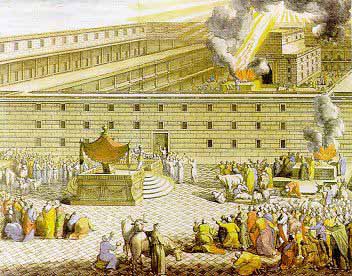
Artists rendering of Solomon's Temple

And upon the mound where the Temple Mount itself exists, a much later presence of Muslim rulers built over and upon the Temple Mount, naming it the Noble Sanctuary, in Jerusalem. Where the Dome of the Rock sits, gold-capped and illuminated in the hot Mediterranean sun. Cyrus the Great liberated the Jews from their exile in Babylon.

And his successor, the Ayatollah Khamenei, promises to liberate the ancient heritaged land of Israel from Jewish possession now, and to restore it to the geographic holdings of Islam. The election of Hassan Rowhani, a cleric trusted by the Khomeinist regime, a former nuclear negotiator and elite political confidant of the ruling Ayatollahs presages no obvious change in direction for the Islamic Republic of Iran.

Prime Minister Benjamin Netanyahu has cautioned the jubilant West anticipating a sea change in Iran's policies to move it into line with international expectations, to avoid "wishful thinking" over the country's nuclear program. He clarified for those interested to learn, that as far as Mr. Rowhani is concerned, he is a man who "defines the state of Israel as 'the great Zionist Satan'."

On the other hand, President Peres is an indefatigable optimist; he views the world through those proverbial rose-coloured glasses. He feels the prospect of talks between Israel and Iran is possibly something that could occur. Both countries were regional allies and friendly during the reign of the Shah Pahlevi, the former pro-Western monarch who was removed from office in 1979, during the Iranian Revolution.

But of Supreme Leader Ayatollah Ali Khamenei, President Peres has no illusions.

Hosting an international gathering in Jerusalem whose guests include Bill Clinton, Mikhail Gorbachev and Tony Blair, Shimon Peres had his concerns echoed by the former British prime minister and current Quartet envoy [to the Middle East] Tony Blair. Who spoke at the Presidential Conference and giving his opinion that facing the prospect of a military confrontation with Tehran represents a better option than having to confront a nuclear Iran.

The former British prime minister said in his address to the conference participants in the fifth annual gathering in Jerusalem, "We should be determined to overcome the threat from Iran. Those who have power in Iran should feel our resolve, and understand that we will not back down. Of course, every military option is something we do not want -- but a nuclear Iran is the worst thing", he declared.

Labels: , , , , , ,

Friday, May 31, 2013

No rise in cancer rates after Fukushima disaster - UN

BBC News online - 31 May 2013
Damaged reactor 3 at Fukushima nuclear plant. File photo The Fukushima nuclear plant was crippled by the deadly earthquake and tsunami on 11 March 2011
Cancer rates are not expected to rise as a result of the Fukushima nuclear disaster in Japan, UN scientists say.

The evacuation of thousands of people shortly after the accident in 2011 sharply lowered their exposure to radiation, a draft report concluded.

The World Health Organisation has said local residents have a slightly higher risk of developing certain cancers.

Reactors at the Fukushima nuclear plant were crippled by an earthquake and tsunami that killed some 19,000 people.

It was the world's worst nuclear incident since Chernobyl in 1986.

The findings of the draft report were presented by the UN Scientific Committee on the Effects of Atomic Radiation (Unscear) in the Austrian capital, Vienna.

Committee member Wolfgang Weiss said the decision by the Japanese authorities to evacuate large numbers of people had proved to be the right one.

"If that had not been the case, we might have seen the cancer rates rising and other health problems emerging over the next several decades," he added.

Unscear's report also stated that "no radiation-related deaths have been observed among nearly 25,000 workers involved at the accident site".

Studies after Chernobyl linked cases of thyroid cancer to radioactive iodine that contaminated milk. But Mr Weiss said that had not been the case in Japan.

The report was prepared by 80 scientists from 18 countries and will be published in full later this year.

The findings contradicted a report published by the WHO in February, which said the risk of cancer for those living near the nuclear plant had risen.

Labels: , , ,

Wednesday, April 03, 2013

Is Living in a Nuclear Evacuation Zone Good for You?

Fukushima’s legacy may be mental health problems, not cancer.

Naoko Ito, center, shares a meal with her husband, right, and Mai Nishiyama, the author's translator, in November 2012 in Naraha, Fukushima Prefecture.
Naoko Ito, center, shares a meal with her husband, right, and Mai Nishiyama, the author's translator, in November 2012 in Naraha, Fukushima Prefecture. Courtesy of Geoff Brumfiel

When the evacuation order came two years ago, Naoko Ito had to decide whether to stay or go. Her house had just been rocked by the great Tohoku earthquake, and an ensuing tsunami had washed away part of her seaside village. Her home seemed to have come through the worst of it, but just 10 miles away another crisis was brewing at the Fukushima Daiichi nuclear power plant. The tsunami had flooded emergency systems and a meltdown seemed imminent. The authorities wanted everyone out.

Most residents fled, but the Itos stayed behind. The reason was Naoko's mother, who was in her mid-90s and suffering from dementia. Naoko feared that the move might kill her. She turned to her husband and said, “'I'm going to stay with my mother because I can't leave; how about you?” “OK, I am going to stay,” he replied.


In the days and weeks that followed, the Itos were visited by aid workers, the police, the fire department, and even the military. Everyone begged them to leave. It wasn't safe, they were told. Radiation levels were high; a second nuclear plant even closer to town might have another accident. But Naoko refused to budge: “I made a promise to her that she could die here,” she says. “I was prepared for death too.”

Nobody died. When I visited the Itos in November, Naoko, her mother, and her husband were all fine. Over a meal of rice and azuki beans, she told me that life was a lot like it was before the accident. She cares for her mother, and her husband tends the small patch of land they once grew vegetables on. (He's now growing sorghum to try to absorb the radioactive cesium in the soil. So far, he says, it isn't working.) The neighbors are gone, but she never liked her neighbors. Most of the shops in town have closed, but a Seven-Eleven just up the road is still open; it caters mainly to contractors working to clean up the ruined plant. The biggest inconvenience is that the town's water has been shut off. On Mondays and Fridays she goes to the local fire station to pick up a few jugs. “Once you get used to it, it's not that bad,” she says.

Her story stands in stark contrast to those who evacuated. During the same trip, I met the Togawa family, who fled from another town near the plant. The Togawas had three small children—a very good reason to run, since kids are more susceptible to radiation exposure. But life for them hasn't been easy since the accident. They lived for months in shelters and are now crammed into uncomfortable evacuation housing. The family's father, Kenichi, had to find a new job. He's lost his friends and his judo club and now spends his days at home playing video games. He's put on weight and is drinking more than he used to.

And the Togawas are doing better than a lot of others. Some families have split up: Wives and children have gone to other prefectures while the husbands stay behind to work. Many evacuees are unemployed, and some have taken up gambling or started drinking heavily, according to several people I spoke to.

Given these problems, more than a few health experts now believe that mental health problems, not cancer, may turn out to be Fukushima's legacy. A recent report by the World Health Organization suggests that most of Japan will not get sick from radiation released by the Fukushima accident. The most serious consequence will be a predicted 70 percent increase in thyroid cancer risk for female infants who lived near the plant at the time of the accident. Since the baseline rate of thyroid cancer in Japanese women is 0.75 percent, this means that the rate may increase by about 0.5 percent. That rise is probably too small to be detected statistically. Meanwhile, psychiatrists and public health officials are worried about the future of more than 150,000 evacuees who remain displaced.

Plenty of Fukushima's residents had no choice. Levels of radioactivity are high in the region around the plant. It wouldn't be enough to cause cancer right away, but over the course of years and decades, people might start to get sick. Even if they didn't, sticking around wouldn't make sense. Farming and fishing were mainstays of the local economy, and no one will buy contaminated products from the areas near the plant. A few hundred square miles of rice paddies and seabed have been abandoned around the plant, and despite government efforts to speed clean up, it will likely be decades before anyone will be able to work the land and coastal waters again.

130401_MEDEX_FukushimaSurvive
Naoko Ito, left, and her elderly mother, in November 2012 in Naraha, Fukushima Prefecture. Courtesy of Geoff Brumfiel

But the situation for the Itos is different. Already in their 60s, they're pretty much retired and too old to be worried about prolonged, low-level radiation exposure. They very well may have saved her mother's life. A recent study found that mortality rates shot up among elderly patients who were moved from their nursing homes during the crisis. They're happy, Naoko says. Contrary to expectations, it seems like living inside a nuclear evacuation cordon turned out to be the healthiest option.

Labels: , , , , ,

Tuesday, April 02, 2013

LHC upgrade to open up 'new realm of particle physics'

Engineer Katy Foraz shows Pallab Ghosh how to upgrade the Large Hadron Collider
Engineers have begun a major upgrade of the Large Hadron Collider (LHC).
Their work should double the energy of what's already the most powerful particle accelerator in the world.

BBC News is the first to be allowed to see inside the LHC - on the French-Swiss border - to watch the work being carried out.

Scientists believe the upgrade will enable them to discover new particles which will lead to a more complete theory of how the Universe works.

A project leader with the LHC's Atlas experiment, Dr Pippa Wells, told BBC News that there was much more to come from the LHC.

"The past two years have been the most exciting in my time as a particle physicist. People are absolutely fired up. They've made one new discovery (the Higgs) and they want to make more discoveries with the new high energies that the upgrade will give us. We could find a new realm of particle physics."

I was taken by the technical coordinator for the upgrade project, Katy Foraz, and Cern's UK communications manager Stephanie Hills, to one of the many access points to the LHC's underground tunnels.

LHC Upgrade

  • Replace 10,000 connections
  • Install 5,000 insulation systems
  • 10170 leak tests
  • 18,000 electrical tests
  • Total cost £70m
We entered a lift shaft with two buttons marked zero and minus 1. Katy hit minus 1 and we made our way 100m below the surface.

As we exited the lift, we walked to a large heavy green door that we strained to open.
As we went through, it was like entering Aladdin's cave.

No jewels or gold - but one of the largest and most complex machines ever built. A bright blue superconducting beamline stretches into the distance - around it are gleaming precision instruments to make the line one of the coldest places in the Universe.

In front of me, engineers were replacing some of the first connectors. In all, 10,000 will need to be changed. Eight hundred people are involved in this project, which will cost £70m.

The tasks also include testing and replacing some of the LHC's main dipole and quadrupole magnets, which are used to bend the paths of the particles and keep them tightly bunched; conducting tests to detect any irregularities in the magnets or imperfections in the electrical insulation; and a range of other work to improve the machine.

The LHC is known for its cutting-edge science. But as we walked to this scientific wonderland, Katy told me that people often forget that the particle accelerator is also on the cutting edge of engineering. After all, creating the conditions of the beginning of the Universe is no easy feat.

"We are always at the limit of what we know in terms of the technology. It is very exciting: as the coordinator. I have access to all the technologies and they really are at their limit in terms of superconductivity cryogenics. It is very exciting for an engineer to be close to all these new technologies," she said.

Katy and her team of engineers are calling the work an "upgrade". But critics say it's a "repair".
As we walked passed a team replacing a damaged connector, Cern's Stephanie Hills was quick to respond to the charge that this expensive refit is putting right a mistake that should not have been made in the first place.

LHC magnets

"Nobody has ever done this kind of technology before. Everything from the most basic welding to the most complicated beam diagnostics is pushing the boundaries of technology, and sometimes these things just don't go right simply because we don't know how it's going to work," she told me.

"You can see in front of us the way that we're managing the upgrade is meticulous. There is lots and lots of quality control, making sure that everything's absolutely spot-on so that when we turn the machine back on we are absolutely ready for some more fantastic scientific discoveries."

The damage was done shortly after the switch on of the Large Hadron Collider in September 2008.
The LHC upgrade will enable it to discover new particles. Pallab Ghosh explains how this will lead to a radical change in our understanding of how the Universe works. 

Nine days later, it broke down because the connections between the superconducting magnets simply could not take the current running through them.

It took a year and £24m pounds of taxpayer's money to repair the damage. Even then it could only operate on half power. That was enough to discover the much sought-after Higgs Boson.

Those in charge made a pragmatic decision. They decided to press ahead, and to keep their funders happy. 

To their joy and relief, scientists found their prize last summer. And so at the beginning of this year it was politically possible for Cern to begin the long shut down to fix faulty connections.

Back above ground, students from around the world are shown the Atlas control room, one of the places where data from the LHC will be gathered when it is switched back on. That is something for the students to look forward to - because after the upgrade, the beams will be crashing into each other at twice the energy.

This will enable researchers here to move on to their ultimate goal: to find evidence of "new physics", which they believe will lead to a new, more compete theory of sub-atomic physics.

The discovery of the Higgs last year was the end of a successful chapter of late 20th Century physics.
This was the development of the current theory in the 1960s and 70s called the "Standard Model".
This theory says that most of the forces of nature, the objects around us and our own existence, are all down to the interaction of the Higgs with 16 other particles. It successfully explains how electricity, magnetism and light operate.

Since then, all the particles predicted by the Standard Model have been discovered - including most recently the Higgs.

The problem though is scientists know this theory is limited. It explains extremely well the world around us, but it cannot explain the way most of the Universe behaves.

Physicists hope that by operating at full power, the LHC will be able to find evidence of so-called supersymmetric particles. These are like the particles in the Standard Model - but more massive.

One form of supersymmetry predicts that there should be five Higgs bosons, which are each slightly different. The first order of business for LHC scientists when the collisions resume in 2015 will be to test the Higgs that's been discovered, to see if it shows any of the properties predicted by supersymmetry, according to Dr Wells.

"The LHC is more than just a one trick pony," said Dr Wells. "It wasn't designed to find just the Higgs. We hope to find something completely new that will change our understanding of the Universe. We are on the threshold of finding many more new particles."

Labels: , , ,

 
()() Follow @rheytah Tweet