Ruminations

Blog dedicated primarily to randomly selected news items; comments reflecting personal perceptions

Sunday, April 19, 2026

The Paris Catacombs

https://www.parisperfect.com/cdn-cgi/image/format=auto,width=1256/https://www.parisperfect.com/g/photos/upload/sml_1055743116-1451221585-correctsize-catacombs-hero.jpg
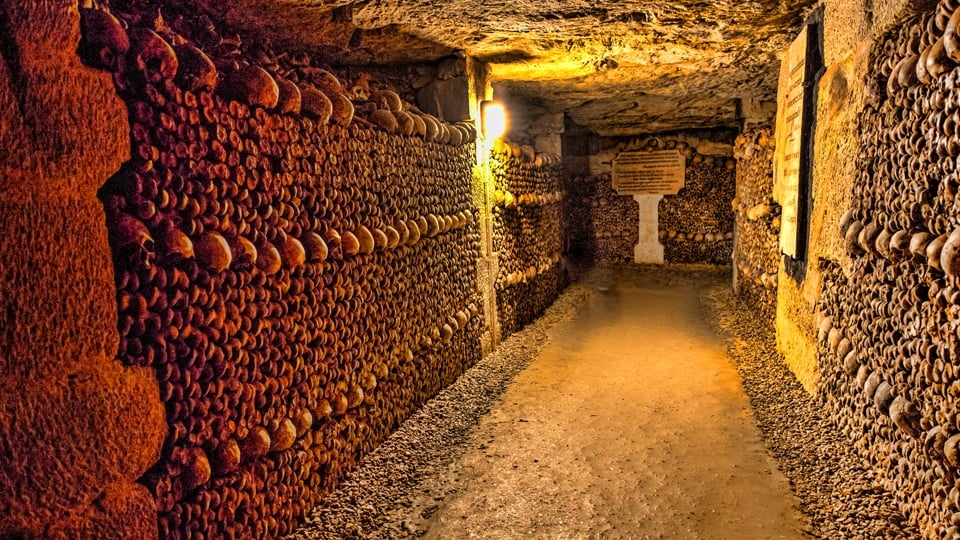
Descend beneath the streets of Paris to discover one of the city's most unique attractions. The final resting place of six million Parisians, the catacombs are not for the faint of heart!   Paris Perfect
 
"The goal isn't to turn it into Disneyland."
"[The setting was never meant to be sensationalist], it was meant to emphasize solemnity and create an atmosphere of respect."
"The first priority is, above all, to preserve the site and maintain a balance between the visit and the conservation of the remains." 
Isabelle Knafou, administrator, Paris Catacombs 
https://res.cloudinary.com/aenetworks/image/upload/c_fill,ar_2,w_1080,h_540,g_auto/dpr_auto/f_auto/q_auto:eco/v1/paris-catacombs-GettyImages-1295230727?_a=BAVMn6DY0
Alan Harvey/SNS Group via Getty Images  
 
First excavated during the Roman era, the tunnels, converted into 'galleries' that lie as a vast labyrinth beneath Paris, were meant for the purpose of mining. In the 18th century they were converted to a catchbasin, not for aquatic sewage purposes, but to receive the remains of the dead, at a time when Paris cemeteries were overflowing, and sanitation became a serious issue. As a result, city authorities initiated the storage of bones of people who had lived from the 10th to the 18th centuries, into areas of the tunnels, turning those areas into an ossuary.
 
An official whose position was to oversee the quarries, Louis-Etienne Hericart de Thury, in the 1800s thought of turning those areas housing the tomb's bones into a museum. Workers then proceeded to use the bones to construct walls and pillars. Finally the catacombs were officially opened as a 'museum', welcoming its first visitors in 1809. 
 
It has been two centuries during which tourists and locals have made their way below ground to pay a visit to the catacombs where an estimated six million individuals who once lived in Paris are entombed. Floor to ceiling the passageways are lined with bones. The dimly lit tunnels see 600,000 visitors annually. Work has been underway over the past five months where architects, designers, technicians and masons have been busy in the renovation of the passageways. 
 
https://www.parisunlocked.com/wp-content/uploads/2020/11/19872623399_591ab0ccc9_b.jpg
Ossuaries at the Catacombs of Paris, with a sign describing how the bones depicted above were exhumed from the Cimetière des Innocents Cemetery in 1809. Many others were transferred much earlier. Mustang Joe/CC0 1.0
 
Areas too dimly lit for people to access will now be accessible. Obviously such visits by the curious bespeak for many a macabre fascination with the dead on full display. Curators emphasize that the work  undertaken has a primary purpose of preserving the site, while making it more accessible; appealing to those who wish to view its contents, the work maintaining a spooky, sombre appeal. Humidity and carbon dioxide intensified by visitors have occasioned moulding bones and crumbling walls along with a dilapidated electrical system. Hence the renovations.
 
Of the hundreds of kilometers of labyrinthine tunnelling, a 1.5-kilometer segment reopened recently. According to the lead architect, finding workers willing to work 18 meters underground, constantly ascending and descent long stairways, working in cramped spaces, surrounded by bones, has been a challenge. "At the start of the project, some people said, 'We're leaving'", she reported.
 
Stonemasons, working with buckets of bones have been restoring the walls, wedging bones back into place, in the creation of rows of femurs and tibias, alternating with lines of skulls. Florent Bastaroli, one of the stonemasons commented "it puts us back in our place as mortals".  
 
https://venturetheplanet.com/wp-content/uploads/2024/04/IMG_2082-2.jpg
Abandoned railroad tunnel we entered and walked for 1/2 a mile before entering the catacombs  Venture the Planet


Labels: , , , ,

Thursday, May 12, 2016

Valuing Food

"I've been feeding myself like this for years. Not because I have to, but because of my political convictions."
"I find our way of consuming and throwing out food is totally absurd, as if it had no value."
Aladdin Charni, Freegan Pony restaurant, Paris
Freegan Pony - Paris, France. Comptoir de la cuisine
Freegan Pony website

"Hands down - this is the coolest and hippest spot in Paris at the moment."
"What is Freegan pony? Tucked away at the edge of Paris, you'll find this gem in the most improbable spot. The vibe here is definitely very underground and you really must come see for yourself to experience it."
"When I was here, we had a delicious tomato soup as a starter, then a dish with couscous type grains and tomato and fried onions with a white sauce, followed by rice pudding for dessert."
"Once you open the door to this underground lair, you first sign up at a small table and are explained the concept, as well as given a membership card to the association. Reservations are an absolute  All the tables, furniture, decoration, silverware, etc is all second hand and gives it a really vintage feel. It's really an experience eating here."
"It can be a bit nippy in here, so make sure to bring an extra sweater and dress warmly!"
"You then wait for the kitchen staff to call your name. One of the members of the association came over and explained the concept and the evening's menu to us, letting us know that they had put a lot of love into sorting through all the Rotten tomatoes and salvaging what they could. It was cool to have that kind of interaction with the association members/volunteers and give it a more personalized feel. I'm sure it's not an easy task concocting menus and cooking for 50!"
"At the end, when you've finished eating, you must clear away your dirty dishes and leave them in a designated area, which will have been explained and shown to you upon entry (just like at the cafeteria)."
"At the end, it's up to you to choose how much to pay. There is no set price, and you choose to give the amount you want. It really makes it accessible to everyone."
"To sum up : if you haven't been here yet, seriously what are you waiting for? This place is AWESOME. Can't wait to come back!"

Freegan Pony review, Elizabeth W., Paris
There are many people who think about food, and the shortages of it around the world. These are the people who deplore the fact that while we in the developed world have an abundance of whole foods to choose from, all too many of us choose quasi-food, pre-packed, pre-processed, and unhealthy, to represent our diet. The ready availability of food that has been processed ad infinitum, taking it about as far as it's possible to go from its natural state, responds to the fact that people have no patience with cooking for themselves.

There's also a dearth of time available, when so many other things call out for attention in a busy lifestyle, so choosing inexpensive, energy-dense and nutrient-deficient food has become 'normal'. What has also become normal is that too much of this kind of diet leads to populations becoming increasingly overweight-to-obese, suffering significant health problems with the onset of chronic, life-challenging diseases and illnesses as a result of what has become an unfortunate habit.

While we are obsessed with food since without it we cannot exist, we accept counterfeit food posing as healthy alternatives because advertising and public relations have convinced us that these choices make our lives easier and less complicated. There's a demographic that is turning now to realizing that whole foods that present as less-than-perfect in their natural forms; fruits and vegetables that have grown somewhat deformed rather than perfect in shape and colour, means that before they even get to the farm gate they're disposed of, since no one will buy them.
Freegan Pony - Paris, France. Petit apéro chou
Freegan Pony website

Some supermarkets, sensitive to the demands of shoppers who look for these products and expect to pay less for these fruits and vegetables which have all the nutrient value of their more perfect cousins, are beginning to stock them. Some markets have appeared that specialize in these agricultural products that were once spurned, to meet these new demands from shoppers. And then there is the issue of wasted food, where a significant proportion of what is grown is not sold while still fresh, and as a result, discarded.

In Paris, on the 19th arrondissement across a square under a highway overpass there is a set of metal doors where a bright green painted pony identifies a restaurant within, known as the Freegan Pony restaurant. Food is prepared there on a daily basis, and the food that is presented has been sourced from dumpsters. The Freegan Pony restaurant represents an illegal squat; no license or legal permission has been obtained, but there it is, fully operational, popular and pleased to give service to discriminating tastes.

Paris's Rungi market is where most of the food prepared in the restaurant kitchen is harvested, where tons of food at the end of shelf life at the market is discarded daily. Freegan Pony is vegetarian, sometimes preparing vegan meals, whose dishes most often reflect the savour of an ethnic flavour. The usual clientele is mixed; homeless migrants from Afghanistan, for example. But also Parisiens interested in addressing the issue of food waste and eating in an unpretentious yet cool environment.

The restaurant fills an obvious need. While France has instituted a new law requiring supermarkets to donate unsold food to food banks and the like, this does not extend to food wholesalers. And it is there that Freegan Pony obtains its reclaimed food that goes into its creatively imaginative daily menu which changes constantly to reflect whatever has been collected on any given day. The restaurant serves up to 80 meals nightly, four nights a week, and it is a pay-what-you-wish system.

"I arrived once, and all we had was cabbage, and ... 50 kilos of parsnips ... and a bunch of oranges", laughed Mardi Hartzog, one of the restaurant's cooks. "And so then you just have to start getting really creative. It did end up being mostly a soup, but then I also made a really nice sauce with some over-ripe persimmons, so sometimes you get inspired by things you didn't think were possible", she explained.

Freegan Pony - Paris, France. Another view of inside
Freegan Pony website

Labels: , , , , ,

Friday, January 15, 2016

Gilding The Inevitable

"Death is crazy. It's not serious. We don't believe in God. So the cactus is a symbol of how we feel about the world and all of society."
Maurice Sinet, 87, dean of French political cartoonists

"It's a place of tranquility with no business or money."
"And I like the neighbours."
Benoit Delepine, French film director
The neighbours? They could be those not yet buried but destined to lie beside Mr. Delepine, when the Grim Reaper eventually comes to claim him. In the meantime, the crypt that will contain his mortal remains is built, and there are always others surrounding the tomb and its bronze monument in the Montmartre cemetery on Paris's Right Bank, neatly tucked into their own graves, respectable ones, not like his own awaiting his interment.

Which he and a handful of others who think the way that Mr. Delepine does, with their vision of the absurdity of life and its final scene of departure, the reason for which they are still searching their imaginations. Why do some trees live long lives [think millennia!], and tortoises, and parrots [think centuries!], for example, sponges, clams and bowhead whales, when humankind has such a paltry longevity for a creature so spectacularly endowed with brains, seldom used to their full potential?

Isn't it the kind of musing one might expect from a former Charlie Hebdo political cartoonist like Mr. Sinet? Well, he and a handful of drinking buddies and artists of one kind or another appear to have discussed such matters. And they appear also to have concluded that when they depart this mortal coil their remains should not be interred just anywhere, anyhow, but memorialized with a kind of universal finger of indifference to destiny and foreverafter.
Benoît Delépine, a film director, next to his future resting spot at the Montmartre cemetery in Paris. Credit Capucine Granier-Deferre for The New York Times
They combined resources and commissioned a bronze monument to illustrate their concert of thought. There are other crypts, tombs and mausoleums in the cemetery and some of them hold the remains of once-distinguished personages whose reputations march on before them. People like Edgar Degas and Francois Truffaut, as example, two who stand out among the 21,500 graves in the cemetery. But the cactus tomb is different, looks different, speaks a different language.

Montmartre cemetery's 21,500 graves include artists such as Edgar Degas and François Truffaut. Credit Capucine Granier-Deferre for The New York Times

Thus far, seven individuals whose sense of whimsy the tomb has appealed to have paid the 500 euros it takes to make their reservation. They represent a jazz critic, a few filmmakers, a television comedy writer, and a journalist. The tomb, erected in 2010, has a fitting inscription: "Die? Rather croak!" It is empty, devoid of any presence as yet. And 57-year-old Benoit Delepine visits on occasion, to look about him. The 'neighbours' of whom he spoke could be a reference to the roaming feral cats.

Why a cactus to be depicted, setting this one tomb quite apart from all its fellows? Why, why not a cactus? Its prickly exterior ensures that none approach too near, while in desperate straits its interior is capable of providing life-saving moisture for those who might otherwise expire for lack of water in a desert environment. And this city-of-the-dead is a kind of desert, isn't it? Deserted of life, of laughter, of gay abandon, of hope of ever leaving once ensconced.

The 87-year-old Mr. Sinet may well be the first of the cactus tomb's incarcerants. He underwent surgery in December; as the editor/author of a publication he named Sine Mensuel, he has made light of his age and health, writing assuredly of his recovery where "a bottle of Chablis Premier Cru is waiting for me in a bucket of ice", on his recovery.

Why Montmartre for their final resting place, albeit in a cactus tomb? Well for starters if the cemetery was good enough for Proust, Moliere and Balzac, Adolphe Sax, Hector Berlioz and Alexandre Dumas, it is most certainly good enough for their little group which shuns the ordinary and clasps to their bosom the way less travelled.

Besides which the Montmartre cemetery was originally placed in a locality considered to be bohemian. Art, anarchy and cabaret had their home there in the 19th century. Presumably, in one shady little corner, they still do.

The crypt of the former owner of the Moulin Rouge cabaret, Jean Bauchet, is guarded by a nude statue. Credit Capucine Granier-Deferre for The New York Times

Labels: , ,

 
()() Follow @rheytah Tweet