Ruminations

Blog dedicated primarily to randomly selected news items; comments reflecting personal perceptions

Friday, January 24, 2020

China's Insatiable Appetite

"Between 1996 and 2011, the number of countries supplying the Chinese sea cucumber market expanded from 35 to 83. Over 90% of the world’s tropical coastline now lies within countries that export sea cucumbers to Hong Kong, a large proportion of which are traded on to mainland China."
"In many cases, finance extends from importers in China all the way through the supply chain to individual catchers."
Michael Fabinyi, Kate Barclay, chinadialogueocean

"The sea cucumber has been used in traditional Chinese medicine to treat everything from high blood pressure and fatigue to constipation and impotence."
"The sea cucumber is low in fat and cholesterol while being high in protein and B vitamins. It is also rich in antioxidants."
thespruceEats
Sea cucumber
In China, sea cucumbers are considered a luxury food and are used to treat kidney problems and impotence. Some species can sell for more than US$600 per kilogramme or 3,765 yuan (Photo: treetstreet/Thinkstock)
At one time in traditional Chinese cuisine culture, sea cucumbers were reserved for the wealthy, who could afford what has been viewed by the Chinese community as a luxury edible. China's economic boom has seen millions of people leaving poverty to become part of the growing Chinese middle class. With that rise in financial status, the voracious appetite for table delicacies has seen the popularity of sea cucumber soar among people who can now afford the expensive treat.

The creatures have a reputation in Asia for their nutritional value, along with their unusual texture; believed to have medicinal properties to treat medical conditions ranging from arthritis to impotency. There are, needless to say, many other wild creatures that Chinese cuisine values for their purported pharmaceutical properties, in a long tradition of Chinese medicine. Chinese are known to pay astronomical sums for creature delicacies to which they ascribe miraculous health properties.

It is why donkey populations worldwide have declined, through export to China in such unsustainable numbers as to threaten the species, from Brazil to Pakistan. It is why wild animals such as rhinoceros, tigers, antelopes, snakes buffaloes, deer, bear, sharks, elephants, monkeys ... the list goes on ... and on -- are similarly under threat. Threatening the very existence of many animals whose numbers are increasingly precarious.
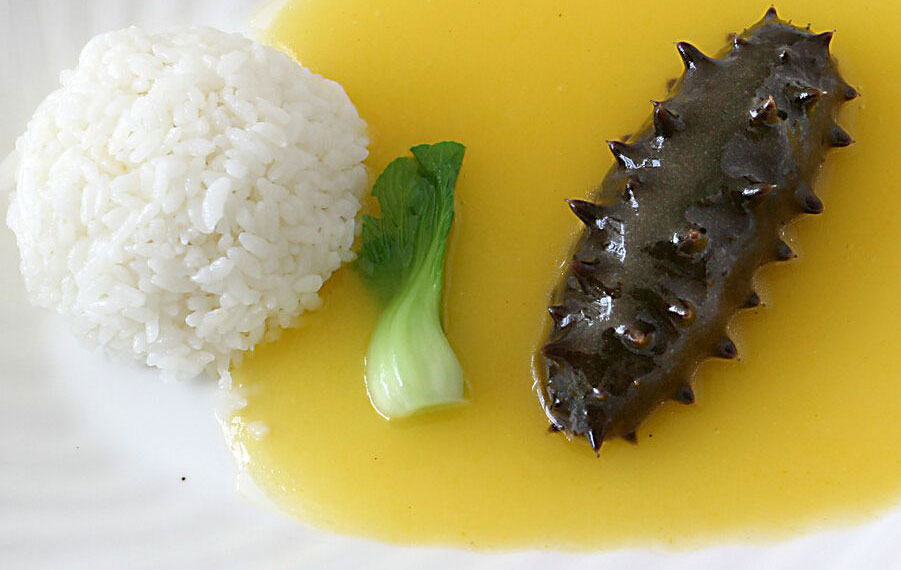

Because of the huge popularity of sea cucumbers, the oceans have been literally vacuumed of their presence around China, leaving the animals to become a rarity in their wild state because of the demand increase of the last several decades. Natural stocks of local species have been depleted. Leading to aquaculture, raising sea cucumbers in pens or ponds. Others are raised in the sea in conditions approximating their natural habitat, and these are considered to be free-range.

The local economy on the Liaodong Peninsula has undergone a transition where tidal flatlands have been transformed to a patchwork of ponds, the entire area so huge, they appear in satellite maps. Fed by ocean water, the ponds are seeded with the young and in a year's time they'll have grown sufficiently large to harvest. Huge structures that breed sea cucumbers destined for the ponds are located further inland.

"People here all rely on this", explained Liu Aiqing, while weighing sea cucumbers pulled by divers from a nearby pond. With a value of over $8 billion annually, sea cucumbers are now the most valuable of farmed sea products in China, according to Bao Pengyun, marine biologist who helped contribute to the development of the industry in China through his research at Dalian Ocean University.

The animals feed off the rocks and sand where they thrive while purifying surrounding water. Total eradication of the creatures would have a devastating result through the food chain, from either end. Some estimates place 70 percent of the world's edible species of sea cucumbers as over-exploited, from the South Pacific, to the Mediterranean, to the Gulf of Mexico.

As far as Mr. Bao, the marine biologist is concerned, little difference exists between sea cucumbers raised in pens or those raised in free range, and those from the wild. "Very much the same", he insists. "The difference is tangible", contends Mou Jie, a woman who set out with friends to drive up the coast to take a ferry to deposit her on Guanglu, where she plans to buy the delicacies.
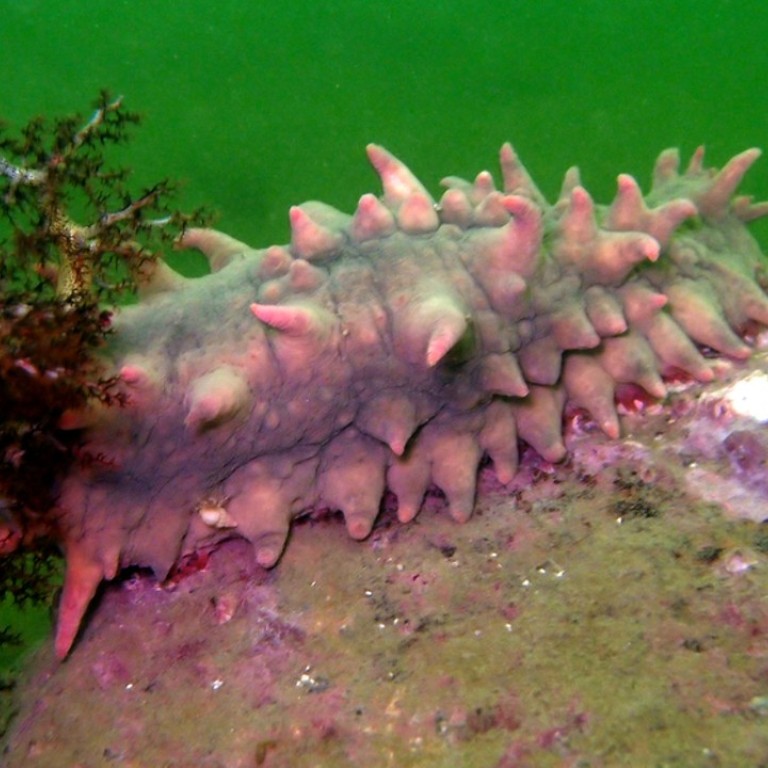
Image result for china, sea cucumbers
South China Morning Post

Sea cucumbers from cold waters grow more slowly than others, taking three years to reach maturity, rather than one, giving them the reputation of being more nutritious. Whether fresh, partially processed or dried, wild sea cucumbers are priced at two to three times the penned versions. Dried, the most expensive can cost close to $1,000 a kilogram.

And then there are those who claim sea cucumbers to be flavourless, with the texture of cartilage or rubber. Actually, they have little taste of their own; like another Eastern food product that some swear by and others swear at -- tofu -- sea cucumbers pick up flavour from whatever it is they are cooked in, or with. Plucked alive from the sea, lightly blanched, then bathed in a sauce of garlic, cilantro and chili oil, their taste then assumes that of a rubbery piece of cartilage flavoured by a sauce of garlic, cilantro and chili oil.

Takers, anyone?

Image result for china, sea cucumbers
Sea Cucumbers are being eaten to death : National Geographic


Labels: , , , , , , ,

Wednesday, June 22, 2016

Normalized Canine Butchery

"Grandpa strokes my poodle on his lap and says, 'This is just the right size for a bowl of bosintang. He's joking, but whenever he says that, I snatch my dog from him."
Kim Yoo-na, 14, Wonju, South Korea

"It's the difference between heaven and hell [the life of a pet dog and one raised to be eaten in South Korea]."
"I was not ashamed of my way of making a living [raising dogs to be slaughtered for the table], but I was not proud of it either."
Gong In-young, dog-meat farmer, Wonju, South Korea
Thailand's Illegal Dog Meat trade
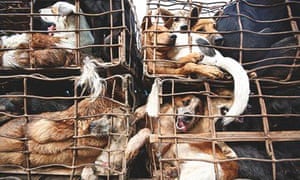
Trucks containing 130 dogs are seized on the highway between Thailand and Vietnam. Photograph: Luke Duggleby

Ten to twenty million dogs are slaughtered for their meat in China on an annual basis. A tradition that dates back to the time of Confucius. Dogs are bred, raised, kept in cages then sold to slaughterhouses in China, South Korea and other Asian nations where people consider dog meat an indispensable part of their cuisine. Mr. Gong, for example, keeps dogs locked up in steel cages, and there they are kept their entire lives; fed until they are mature enough to be taken to the slaughterhouse, their meat going to the marketplace.

That this is the tradition that keeps Mr. Gong in business supplying a market for ardent dog-meat aficionados has not kept this 55-year-old from loving and doting on an elderly Spitz on his farm, whom he has named Snow-White and who is viewed as one of his family. The dissonance in how he views the two, his beloved pet, well cared for and treasured, and the dogs that have no present and no future; his mind is shut, as a farmer and dog breeder-for-meat, to their plight.

Animal-rights groups have been attempting to reach people like Mr. Gong, to instill in them a humane reaction to the tradition of viewing dogs as table meat. Those groups estimate that 30 million dogs, most of which have been stolen or are feral, are slaughtered annually for meat throughout Asia. In South Korea the trade in dog meat is of an industrialized nature.

Over 17,000 dog farms, some raising over a thousand animals each, supply two million dogs to the marketplace for dog meat. This is a tradition held to be centuries-old, according to government data. Huskies, Rottweilers, Golden Retrievers and other breeds are held in Mr. Gong's cages complex, barking and struggling at the wires of the cages they're held in. As the dog-eating season in summer draws near, dog traders come to visit.

The value of a 36-kilogram dog is about $250. In transporting the dogs, they are crowded into cages unable to move; some suffocate before arrival at slaughterhouses where they are meant to be electrocuted. From there, wholesale meat dealers deliver the carcasses to dog-meat restaurants. Koreans name their special dog dish "bosintang", or "soup good for your body", popularized at a time when meat was in short supply.

It is a culinary history of which Koreans take great pride, including those who shun the dish, taking umbrage when foreigners criticize the practise. Yet South Korean tastes are changing as are their attitudes toward the practise of eating dog meat, particularly among the young for whom keeping pets has replaced eating dogs. The very idea of eating dog meat is grotesque and disgusting to young Koreans.

Mr. Gong's own son would never touch dog meat. Recently, he watched as the process of taking 17 of his dogs in flight to the United States under an agreement with the Humane Society International group whose campaign against dog farms in South Korea has made some inroads. Mr. Gong expressed his reaction, viewing photographs of the dogs now living abroad as pets, saying he "felt better".

Yulin, in southern China, has an annual dog-meat eating festival, where protests from animal rights activists have had no effect whatever. At dozens of restaurants across the city, vendors slaughtered dogs, cooking their meat for their avidly awaiting clients. In reaction, activists bought dogs from dealers planning to slaughter them, doing whatever little they could to ease the plight of individual dogs under the circumstances.

Labels: , , , , ,

Thursday, May 12, 2016

Valuing Food

"I've been feeding myself like this for years. Not because I have to, but because of my political convictions."
"I find our way of consuming and throwing out food is totally absurd, as if it had no value."
Aladdin Charni, Freegan Pony restaurant, Paris
Freegan Pony - Paris, France. Comptoir de la cuisine
Freegan Pony website

"Hands down - this is the coolest and hippest spot in Paris at the moment."
"What is Freegan pony? Tucked away at the edge of Paris, you'll find this gem in the most improbable spot. The vibe here is definitely very underground and you really must come see for yourself to experience it."
"When I was here, we had a delicious tomato soup as a starter, then a dish with couscous type grains and tomato and fried onions with a white sauce, followed by rice pudding for dessert."
"Once you open the door to this underground lair, you first sign up at a small table and are explained the concept, as well as given a membership card to the association. Reservations are an absolute  All the tables, furniture, decoration, silverware, etc is all second hand and gives it a really vintage feel. It's really an experience eating here."
"It can be a bit nippy in here, so make sure to bring an extra sweater and dress warmly!"
"You then wait for the kitchen staff to call your name. One of the members of the association came over and explained the concept and the evening's menu to us, letting us know that they had put a lot of love into sorting through all the Rotten tomatoes and salvaging what they could. It was cool to have that kind of interaction with the association members/volunteers and give it a more personalized feel. I'm sure it's not an easy task concocting menus and cooking for 50!"
"At the end, when you've finished eating, you must clear away your dirty dishes and leave them in a designated area, which will have been explained and shown to you upon entry (just like at the cafeteria)."
"At the end, it's up to you to choose how much to pay. There is no set price, and you choose to give the amount you want. It really makes it accessible to everyone."
"To sum up : if you haven't been here yet, seriously what are you waiting for? This place is AWESOME. Can't wait to come back!"

Freegan Pony review, Elizabeth W., Paris
There are many people who think about food, and the shortages of it around the world. These are the people who deplore the fact that while we in the developed world have an abundance of whole foods to choose from, all too many of us choose quasi-food, pre-packed, pre-processed, and unhealthy, to represent our diet. The ready availability of food that has been processed ad infinitum, taking it about as far as it's possible to go from its natural state, responds to the fact that people have no patience with cooking for themselves.

There's also a dearth of time available, when so many other things call out for attention in a busy lifestyle, so choosing inexpensive, energy-dense and nutrient-deficient food has become 'normal'. What has also become normal is that too much of this kind of diet leads to populations becoming increasingly overweight-to-obese, suffering significant health problems with the onset of chronic, life-challenging diseases and illnesses as a result of what has become an unfortunate habit.

While we are obsessed with food since without it we cannot exist, we accept counterfeit food posing as healthy alternatives because advertising and public relations have convinced us that these choices make our lives easier and less complicated. There's a demographic that is turning now to realizing that whole foods that present as less-than-perfect in their natural forms; fruits and vegetables that have grown somewhat deformed rather than perfect in shape and colour, means that before they even get to the farm gate they're disposed of, since no one will buy them.
Freegan Pony - Paris, France. Petit apéro chou
Freegan Pony website

Some supermarkets, sensitive to the demands of shoppers who look for these products and expect to pay less for these fruits and vegetables which have all the nutrient value of their more perfect cousins, are beginning to stock them. Some markets have appeared that specialize in these agricultural products that were once spurned, to meet these new demands from shoppers. And then there is the issue of wasted food, where a significant proportion of what is grown is not sold while still fresh, and as a result, discarded.

In Paris, on the 19th arrondissement across a square under a highway overpass there is a set of metal doors where a bright green painted pony identifies a restaurant within, known as the Freegan Pony restaurant. Food is prepared there on a daily basis, and the food that is presented has been sourced from dumpsters. The Freegan Pony restaurant represents an illegal squat; no license or legal permission has been obtained, but there it is, fully operational, popular and pleased to give service to discriminating tastes.

Paris's Rungi market is where most of the food prepared in the restaurant kitchen is harvested, where tons of food at the end of shelf life at the market is discarded daily. Freegan Pony is vegetarian, sometimes preparing vegan meals, whose dishes most often reflect the savour of an ethnic flavour. The usual clientele is mixed; homeless migrants from Afghanistan, for example. But also Parisiens interested in addressing the issue of food waste and eating in an unpretentious yet cool environment.

The restaurant fills an obvious need. While France has instituted a new law requiring supermarkets to donate unsold food to food banks and the like, this does not extend to food wholesalers. And it is there that Freegan Pony obtains its reclaimed food that goes into its creatively imaginative daily menu which changes constantly to reflect whatever has been collected on any given day. The restaurant serves up to 80 meals nightly, four nights a week, and it is a pay-what-you-wish system.

"I arrived once, and all we had was cabbage, and ... 50 kilos of parsnips ... and a bunch of oranges", laughed Mardi Hartzog, one of the restaurant's cooks. "And so then you just have to start getting really creative. It did end up being mostly a soup, but then I also made a really nice sauce with some over-ripe persimmons, so sometimes you get inspired by things you didn't think were possible", she explained.

Freegan Pony - Paris, France. Another view of inside
Freegan Pony website

Labels: , , , , ,

Tuesday, September 09, 2014

Home is Where the Soothed Appetite Is

"We have people who come to site, they don't know what a mango is... They try to eat them like apples."
"We can go through tonnes of bologna, white bread and ketchup and then the next night you'll go through a couple hundred pounds of tenderloin that's wrapped in prosciutto and slow-roasted. It really goes the full spectrum."
"People have never had cherries that haven't come out of a jar."
"The only cardinal rule we seem to have is on Tuesdays they get prime rib or rib eye [steaks]."
Executive Chef Allan Bedard, Goldcorp Musselwhite Mine, northern Ontario
An apple, bacon, pecan and blue cheese stuffed pork tenderloin wrapped in prosciutto and roasted and topped with a maple rosemary butter at Musselwhite Mine.
Handout/ Musselwhite Mine    An apple, bacon, pecan and blue cheese stuffed pork tenderloin wrapped in prosciutto and roasted and topped with a maple rosemary butter at Musselwhite Mine.
"We have the best restaurant north of 60."
"It's a key to maintaining stability within the workforce. If you don't have a very good camp facility and food is not great, word spreads fast."
Dale Coffin, director, corporate communications, Agnico Eagle Mines Ltd., Nunavut

"They all say: 'We have great food, really comfortable accommodations' and all that."
"I feel that as there is more development in remote locations, the companies setting up these operations do make a point to make it seem more luxurious. So it's not like you're living in a tent or a trailer."
Oliver Carusone, 22, fourth-year student, Robert M. Buchan Department of Mining, Queen's University

"The trend has been toward fresh, away from frozen, pre-prepared stuff, away from greasy, french fry stuff. People are much more interested in healthy options."
"The sky's the limit. It'll be as good as any Toronto high-end restaurant. But then there are lots of other ones where it's a much more basic offering."
Dave O'Connor, managing director, Outland Camps, catering/remote workforce company
Handout/ Musselwhite Mine
Handout/ Musselwhite MineSirloin steak in a garlic and coffee rub served with a fennel and citrus braised cabbage, topped with sous vide soft poached eggs at Musselwhite Mine.
"With employees on site for 14 days at a time, we have to make sure the food is very good to keep up morale, but we don't want to give the impression that it's filet mignon and crab legs every night."
Tom Ormsby, director, external and corporate affairs, De Beers Canada
The "restaurant" of which Mr. Coffin spoke belonging to Agnico Eagle Mines Ltd., is located 170 kilometres south of the Arctic Circle at the Meadowbank mine in the Kivaliq region of Canada's newest territory, Nunavut. Half of the workers employed there are from Quebec, and another 30% from Nunavut. It's a fly-in, fly-out concern where workers are deployed on a two-on, two-off shift; two weeks on work site, two weeks relief off.

Temperatures can descend to minus 70C, counting the wind chill and the days in winter are gloomily dark. Since alcohol is banned at the camps, food remains the sole comfort for workers separated from family. A 2012 Mining Association of Canada report came to the conclusion that within another decade the mining industry will require fully one hundred thousand additional workers to meet the need of the northern mines workforce. How're you gonna get them up to the mines without entices?

Meadowbank Mine/Agnico Eagle Mines
Meadowbank Mine/Agnico Eagle Mines   The Meadowbank mine is an open-pit gold mine in the Kivalliq region of Nunavut. It is located 2,600 kilometres northwest of Toronto.

Certainly the pay is good, but there's more to life than good pay and stark isolation. So accommodations have also improved with rooms suite-style, rather than the old-style dormitory arrangements, and with that change the quality of food offerings has also improved immeasurably. Mr. O'Connor's catering company gave service to 60 remote camp sites representing various industries throughout Canada, in 2014. That demand will only increase.

One of the logistical challenges for Outland Camps catering in provisioning these remote camps with exceptional food offerings for workers is the need to fly in fresh produce and themselves hire staff to work at those remote sites. So higher-end food at mine sites presents as one solution; from international cuisine to traditional Aboriginal food menus. Quite the change from the once-predictable meat-and-potato diet.

Handout/ Musselwhite Mine
Handout/ Musselwhite MineCajun spiced shrimp served with a onion, tomato and pea blend and sauced with an oyster hoisin glaze at Musselwhite Mine.

Coming from rural First Nations communities where fresh food is hard to come by and expensive, the experience of eating fresh fruits and vegetables presents as a novelty to some of the Aboriginal mine workers. And Mr. Bedard, working for Windigo Catering, itself owned by Windigo First Nations, has taken to altering the names of unfamiliar foods to make them appear more appealing to mine workers who tend to shy away from expressions they have no knowledge of.

He changed Sauerbraten to "buttermilk braised beef"; curry to "spice rubbed lamb with a sweet, coconut milk sauce". When he produces what he terms "pedestrian" food, he makes changes like adding applewood-smoked bacon and Gouda to traditional macaroni and cheese casseroles, topping them with crumbled potato chips. His kitchen leaves nothing to be desired in useful food preparation tools, including a sous-vide machine the envy of the culinary world, and $60,000 ovens.

"Sometimes", he says, "we all have that moment where you take that [food] and you bite into it. You don't really forget about things but you're just more focused on that warm, nurturing sensation. For a lot of people, food is home."

Handout/ Musselwhite Mine
Handout/ Musselwhite Mine   A sample of the food served to miners at Goldcorp's Musslewhite Mine, an underground gold mine located around 500 km north of Thunder Bay, Ont.

Labels: , , ,

 
()() Follow @rheytah Tweet