Ruminations

Blog dedicated primarily to randomly selected news items; comments reflecting personal perceptions

Tuesday, December 10, 2019

Science, Physics, Research, Graphite and Superconduction

"Jarillo-Herrero and his collaborators found that graphene, a two-dimensional layer of carbon atoms with a honeycomb-like lattice, can behave at two electrical extremes when rotated at a certain angle: as an insulator, in which electrons are completely blocked from flowing; and as a superconductor, in which electrical current can stream through without resistance. This discovery led to the development of 'twistronics'", which Physics World reporter Hamish Johnston called 'a new and very promising technique for adjusting the electronic properties of graphene'."
MIT News

“Until last year, graphene was slowly becoming out of fashion."
"There was good theoretical motivation to see what would happen [experimenting with graphite]." 
"When we saw superconductivity, all hell broke loose. Then we realized this was a very big thing."
Pablo Jarillo-Herrero, physicist, Massachusetts Institute of Technology
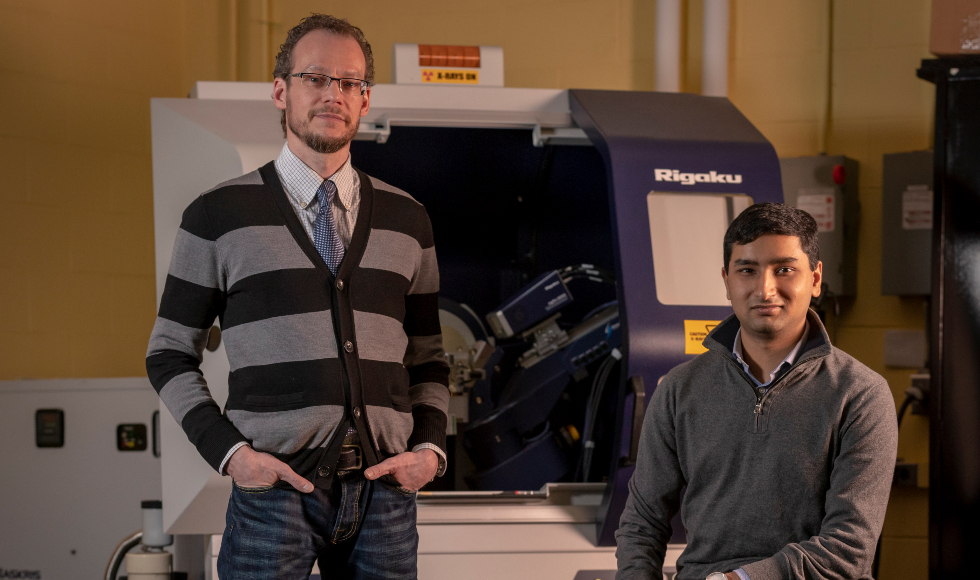
Pablo Jarillo-Herrero (right), an associate professor of physics at MIT, was honored with Physics World's Breakthrough of the Year for his group's discovery of  “magic-angle” graphene, a “promising technique for adjusting the electronic properties of graphene.” Graduate student Yuan Cao (left) was a lead researcher in the work.
Pablo Jarillo-Herrero (right), an associate professor of physics at MIT, was honored with Physics World's Breakthrough of the Year for his group's discovery of “magic-angle” graphene, a “promising technique for adjusting the electronic properties of graphene.” Graduate student Yuan Cao (left) was a lead researcher in the work.  Photo: Melanie Gonick/MIT

"He’s the guy [Dr.Pablo Jarillo-Herrero] who’s done this the best. Somehow they [Dr.Jarillo-Herrero and his laboratory collaborators] have the magic touch."
"There’s a lot of things that could happen, and which one does happen depends on a lot of experimental details."
"We’re just beginning to understand and map out that space. But the hope is that there will be something there that isn’t seen in any other system."
Andrea Young, physics professor, University of California, Santa Barbara
Take the commonplace writing instrument like a pencil with its graphite/clay 'lead' so commonly used and seldom thought deeply about -- for as a rude and reliable tool it is simply taken for granted. Not, however, the graphite portion of its constituents. Fifteen years ago a discovery was made that a single sheet of one-atom thick layer of carbon atoms in a honeycomb pattern represents a newfound physics wonder. Called graphene, the ultrathin carbon is 200 times stronger than steel, though it is flexible and lighter than paper.

And it was found to be a conductor of heat and electrical current. Soon scientists figured out whatever seemed most usefully interesting about this element and set further investigation into its properties and potentials aside. Until last year, when physicists at the Massachusetts Institute of Technology made the discovery that by stacking two sheets of the material twisted at a slight angle between them produced most peculiar phenomena. And this discovery produced a new field of scientific enquiry: twistronics.

Credit...ICFO – The Institute of Photonic Sciences
 A detailed explanation of the material's potential was published in Nature in late October, detailing the material now known as magic-angle twisted bilayer graphene. By tweaking graphene's temperature, magnetic field and the number of electrons able to move freely, the international team of scientists showed how the material morphed, becoming a superconductor with the capacity to convey electrical current without encountering resistance. Minus those alterations, electrical current failed to flow and the material acted as an insulator.

It is now anticipated that with the use of twistronics researchers will be enabled to advantage the superconductivity and any other material properties to engineer novel electronics for computers. Besides which there may be potential applications in other areas to produce hitherto unimagined properties. Two layers of graphene, perfectly aligned would have the same results as a single sheet of graphene. By twisting one of the layers slightly against another, rotational misalignment produces a repeating pattern affecting their atomic structure.

Credit. Institute of Photonic Sciences

Leaving electrons to readily move between the two sheets where their lattices line up while in places where the sheets were misaligned, the flow would become more difficult. Dr.Jarillo-Herrero and his research team made the discovery that by using one layer of graphene torn into two pieces they produced two flakes with aligned lattices. In the process, one of the graphene flakes becomes rotated by around 1.3 degrees, pressed down on the other; that discovery induced other scientists to work with that formula to produce their own discoveries.

Dmitri K.Efetov, a physicist at the Institute of Photonic Sciences and the Barcelona Institute of Science and Technology in Spain, along with colleagues, confirmed Dr.Jarillo-Herrero's findings, and at the same time discovered that employing more permutations of temperature, magnetic field and electron density  turned graphene into a superconductor. In addition to which they found graphene could exhibit an unusual kind of magnetism related to the electron movement, not the intrinsic magnetism of atoms similar to materials like iron.

Experimenting with materials on which to place the graphene on, and utilizing other configurations could conceivably yield varying results since the electronic behaviour of the material may depend on the very material graphene is placed upon. "I think this is just the beginning", Harvard  University physicist Philip Kim remarked, as scientists have started looking at three layers of graphene and an entire range of other two-dimensional materials.
Stack and Twist  Graphene is an atom-thin sheet of carbon atoms arranged in a hexagonal pattern. Stacking two sheets and twisting one by the “magic angle” of 1.1 degrees yields a superconductive material with other strange properties. The New York Times

Labels: , , , , ,

Sunday, March 03, 2019

Overcoming Bacterial Resistance to Antibiotics

"We've developed a technique that we could see how the antibiotics are trying to stab the bacterial cells."
"The big challenge that we are facing is that the drugs we used to treat diseases with are in the process of not working anymore because bacteria are becoming more and more resistant to these drugs."
"The idea we had is every disease and bacteria is treated differently so we tried the opposite -- to see if there are common properties of all bacteria, if there is a general mechanism for this bacterial resistance that one could tackle."
"The antibiotics kind of poke into that membrane [surrounding the bacteria] and stab the cell to death. But the bacteria found a mechanism to reduce the [electrical] charge they have, which makes them less attractive to antibiotics, and they made their membranes tougher."
"There are many, many bacteria out there, and so many antibiotics, but by proposing a basic model that applies to many of them, we can have a much better understanding on how to tackle and predict resistance better."
Maikel Rheinstadter, physics professor, McMaster University, Hamilton

"For the drug, it's like going from cutting Jell-O to cutting through rock."
"We wanted to find out how this bacteria, specifically, was stopping this drug in this particular case. If we can understand that, we can design better antibiotics."
"If you take the bacterial cell and add this drug, holes will form in the wall, acting like a hole-puncher, and killing the cell. But there was much debate on how these holes were formed in the first place."
Andree Khondker, undergraduate bio-chemistry student, McMaster University
Maikel Rheinstädter (left) and Andree Khondker. (Photo by JD Howell)
Two researchers out of McMaster University in Toronto, one a professor of physics, the other an undergraduate in bio-chemistry, have recently published a research paper in Nature Communications Biology outlining and explaining their finding, that bacteria fight off antibiotics through stiffening their cell membranes, altering the electrical charge in the barrier, thus appearing a less inviting target to the drugs.

Their focus was on polymyxin B, used when all other antibiotics have failed. Chinese researchers had earlier discovered the presence of a gene permitting some bacteria to evolve resistance to this most powerful of drugs. Dr. Rheinstadter explained how his team made use of X-ray imaging, alongside computer simulations, to achieve molecular-level resolution to enable them to view the polymyxin B interacting with the antibiotic-resistant bacteria.

Using this technique they were able to view bacteria at a resolution one-millionth the diameter of a human hair. The application from a physics perspective with the use of techniques most frequently found in materials research succeeded admirably. There is a membrane wrapped around bacterial cells often negatively charged -- while many antibiotics have a slightly positive charge and so they become attracted to the soft membrane.

By hardening the membrane, that attraction is no longer viable. About 700,000 people die annually around the world as a result of drug resistance to illnesses, according to the World Health Organization. With this knowledge of how bacteria resist antibiotics, researchers will be more geared toward designing drugs to circumvent this bacterial defence strategy.

"We also think we can use it to screen through potential antibiotic drug candidates", explained Dr. Rehinstadter. "If researchers come up with new ideas, we can quickly test them [to determine whether they will work]."

thumbnail image: Bacterial Membranes Influence Antibiotic Resistance

Bacterial Membranes Influence Antibiotic Resistance   ChemistryViews

Labels: , , , , ,

Thursday, March 15, 2018

The Late, Great Star of Hypothetical Astrophysics

“I heard him lecture. We were in the same room together several times but we didn’t converse, because you’d have to wait a long time for each sentence. As a scientist, he was one of the greatest of our time, with his series of discoveries in the field of Einstein’s theory of gravity, black holes, the origin of the universe, and the connection between them and quantum theory."
"His disease and his struggle with it captured everyone’s imagination. It was amazing to see how in his condition he established a family, wrote books, and always continued to work."
"On one occasion we went out, several scientists, [at Stanford University] to a restaurant in Los Angeles. [Hawking] really loved steak and this time too he ordered steak, which they would put in a blender for him so he could eat it. He usually would listen to the conversations around him because of his difficulty in talking to people, but when he finally did speak, people waited on every word out of his mouth, even if it took time. And on his part, he would choose the right words and try to squeeze as much meaning as possible into every word."
"I thought it was wrong to mix up politics and science because science is universal. Of course, I also wasn’t happy with a boycott of Israel, it is opposed to the spirit of science and doesn’t help anything. Therefore I was at the top of a letter from Israeli scientists that was sent to him on the issue. We asked him to take it back and we never received a reply."
Professor Barak Kol, head, Physics Department, Hebrew University
British physicist Stephen Hawking answers questions during an interview in Orlando, Florida, April 25, 2007. Photo: Reuters / Charles W Luzier / File.
"[Finding a] theory of everything [would allow humankind to] know the mind of God. A complete, consistent unified theory is only the first step; our goal is a complete understanding of the events around us, and of our own existence."
"...But one can't help asking the question: Why does the universe exist? I don't know an operational way to give the question or the answer, if there is one, a meaning. But it bothers me."
"Asking what happens before the Big Bang is like asking for a point one mile north of the North Pole."
"We are in danger of destroying ourselves by our greed and stupidity. We cannot remain looking inwards at ourselves on a small and increasingly polluted and overcrowded planet."
"If aliens ever visit us, I think the outcome would be much as when Christopher Columbus first landed in America, which didn't turn out very well for the Native Americans."
British scientist, astro-physicist, cosmologist, Stephen Hawking

Nature was both kind and unkind to this extraordinary man in gifting him with a mind capable of thinking in a manner that few others who have existed on Earth have done. However, though this man was so gifted with genius, he was given the cruel blow of a mind existing in a thoroughly incapacitated body that over time failed catastrophically. On the other hand, most people diagnosed with amyotrophic lateral sclerosis (ALS) -- a dread degenerative disease that eventually destroys the nervous system -- die in relatively short order, this man lived for 55 years with ALS.

He lived to astound the scientific community with the capacity of his mind and the unique quality of his analytical capabilities, his thoughts and hypotheses. He has been acclaimed as the greatest living scientist during his lifetime, one among a very few that have graced this planet over the millennia. Where Albert Einstein brought science forward with his great leaps into the universal unknown of time and space in his own time, Stephen Hawking followed in that great scientist's universe-explicating wake.

Just as Albert Einstein's avuncular face and electrified hair was familiar to the larger world, so too was Stephen Harking's disease-contorted face.
Stephen Hawking
British physicist Stephen Hawking, whose decision to boycott a conference in Israel has been described as hypocritical. Photograph: AFP/Getty Images

"Although I cannot move and I have to speak through a computer, in my mind I am free", he assured any who might have contemplated feeling sorry for a man who had no such feelings for his own plight. He was elevated to academia's most prestigious scientific post as Lucasian Professor of Mathematics at Cambridge University and remained throughout his long life to age 76 -- 55 of those years with ALS -- fixated in a search for physics' ultimate goal, the "unified theory" of "everything". Despite his great acclaim, he never won a Nobel prize in science, since none of his theories have yet been proven.

Even so, his place in science and history and his remarkable capacity to endure the disease that destroyed his body leaving his mind untouched and vibrantly alive to the need to reach his full intellectual potential second to none he was, when all is said and done, all too human. His decision to abandon the wife of his early years with whom he had three children was not of her choosing, when his decision was to marry another woman, a woman married to an expert who helped him acquire a computerized 'voice', and who acted as a nurse to him.

That this man of science and universal acclaim as the world's premier living scientist decided to boycott Israeli academia and Israeli scientists for a social political movement that was based on a veneer of slanderous intent to condemn and demonize the State of Israel without taking into account the complexities woven into the Israeli-Palestinian relationship in its own way goes a distance to identifying his intellectual brilliance with historical laziness that confuses slander with justice. Pity, that.
"Hawking's decision to join the boycott of Israel is quite hypocritical for an individual who prides himself on his whole intellectual accomplishment. His whole computer-based communications system runs on a chip designed by Israel's Intel team."
"I suggest if he truly wants to pull out of Israel he should also pull out his Intel Core i7 from his tablet."
Nitsana Darshan-Leitner,  Shurat HaDin, Israeli law centre (2013)
black-hole-stephen-hawking-abhas-mitra
The biggest mystery. (Courtesy Robin Dienel/Carnegie Institution for Science/Handout via Reuters


"In my 2000 paper, I pointed out the fact that experimental physicists had failed to find any evidence for Hawking Radiation, and I predicted neither will be there any such evidence in [the] future because there could not be any exact horizon, any exact black hole in the first place."
"Accordingly, I exerted that there is really no Black Hole Information Paradox."
Abhas Mitra, former senior scientist, Bhabha Atomic Research Centre (BARC), Mumbai, India

Labels: , , ,

Friday, May 26, 2017

No Boundaries, No Hostilities in Collaborative Science

"Today sees the fulfillment of many hopes and dreams. The hope that a group of initially inexperienced young people could build SESAME and make it work - they have: three weeks ago SESAME reached its full design energy. The hope that, nurtured by SESAME’s training program, large numbers of scientists in the region would become interested in using SESAME – they have: 55 proposals to use the first two beamlines have already been submitted. And the hope that the diverse Members could work together harmoniously."
"As well as being a day for celebration, the opening is an occasion to look forward to the science that SESAME will produce, using photons provided by what will soon be the world’s first accelerator powered solely by renewable energy."
President of the SESAME Council, Professor Sir Chris Llewellyn Smith

"We call it the light at the end of the tunnel."
"Jordan was the site [the Jordanian desert]. It was where everybody could come."
"I actually got to live in a universe where Arabs, Israelis, Iranians, Pakistanis work together for the same cause for their own people, for humanity. And that definitely feels good."
Eliezer Rabinovici, theoretical physicist, Hebrew University, Jerusalem
The Synchrotron-Light for Experimental Science and Applications (Sesame) research centre in Jordan.
The Synchrotron-Light for Experimental Science and Applications centre (known as Sesame) in Jordan. Photograph: http://www.sesame.org.jo/

Dr. Rabinovici has had the rare good fortune to see his efforts of twenty years bearing fruit. It is for that length of time that he has been involved in hoping to create a Middle Eastern Science Committee. In 1993 he had been working at CERN, on the Large Hadron Collider, of the European Organization for Nuclear Research near Geneva, where five years ago the Higgs boson was finally found.

A colleague from Italy, Sergio Fubini, planted the seed of an idea in Dr. Rabinovici's head by telling him it was time he placed his "naive idealism" to the test. With that prodding Drs. Rabinovici and Fubini set out to create the Middle Eastern Science Committee, leading to a meeting in November 1995 in Egypt where scientists from around the Middle East were assembled.

German scientists offered the group an old accelerator nicknamed Bessy. Bessy had once served in Berlin as a light source and at that juncture she was being replaced. The accelerator was dismantled and then shipped in boxes to the site in the Jordanian desert where the group was preparing to set itself up to fully engage in the serious business of scientific investigation into the energy of light.

The group had named itself SESAME, the name derived from an acronym for Synchrotron-light for Experimental Science and Applications in the Middle East. May 16 was its official opening. SESAME is comprised of physicists from Cyprus, Egypt, Iran, Israel, Jordan, Turkey and Pakistan, and including the Palestinian Authority; a membership whose scientists are dedicated to collaboration in the name of science.
His Majesty King Abdullah II following the opening of SESAME, flanked by Heads of the delegations of the SESAME Members and Directors of International Organisations that have supported SESAME**. (Image: Noemi Caraban Gonzalez/CERN)

The institute has been established with the particle accelerator known as a synchrotron, to study the phenomenon of speeding electrons. These scientists are invested in harnessing the electrons in a 'dance' which would emit powerful beams of radiation, called synchrotron light, and that light made use of, to study properties of materials, from semiconductors to viruses.

Throughout the world about sixty such light sources exist and are studied for their increasing value as tools in medicine and engineering. Scientists in California using X-rays from a light source, discovered recently new details in the structure of proteins regulating blood pressure. That insight raises the possibility of improved treatment for hypertension.

CERN, viewed by SESAME as a guide toward their own potential for success came about when UNESCO conceived of reviving science in Europe post World War II, and at the same time fostering the Continent's capacity to cooperate in a time of peace, as a means of keeping the peace and furthering science at the very same time.

Dr. Christopher Llewellyn Smith, Oxford University physics professor, and now president of the SESAME Council, observes that the major difference lies in the fact that hostilities in Europe have long since passed, whereas in the Middle East they are alive and thriving. Synchrotron light sources' study is meant to transform wasted energy into a scientific tool.

In machines like the Large Hadron Collider, as charged particles accelerate around an electromagnetic racetrack, they radiate energy, called synchrotron radiation. Arrays of magnets called wigglers and undulators can be inserted to induce the electrons to dance, producing powerful pencil-beams of light types. The manner in which these beams of light are absorbed by target materials, or reflected, can reveal molecular arrangements and shapes in the manner in which the double helix of DNA had been revealed by X-ray photographs in the 1950s.

A grant from the European Union enabled CERN to assist in building the magnets and to supervise construction of the SESAME machine, part of the $90-million raised to date to make the project possible. Jordan offered another $7 million for a solar power plant to result in Sesame presenting as the first accelerator worldwide to be powered through renewable energy.

A worker looks at research data at the Sesame facility.
A worker looks at research data at the Sesame facility. Photograph: Kareem Shaheen

Labels: , , , ,

Saturday, March 23, 2013

The Magic of Physics: A Water Spiral

Spiraling water
A water spiral... actually, a trick of physics, sound, and motion.
Image credit: brasspup on YouTube


Via Boing Boing (which was sent to me from BABloggee Jeremy Huggins) I saw this extremely cool video of water apparently frozen in time, spiraling away from a hose as if by wizardry:
How is this demon magic possible? Easy: It’s not magic. It’s SCIENCE.

The hose is attached to a speaker. Speakers work by vibrating at certain frequencies, pumping the air at those frequencies, which is picked up by our ears and interpreted by our brains as sound.

Video cameras work by taking pictures at a very rapid rate, usually 24 or 30 frames per second. Our eyes send signals to the brain at a rate of about 14 frames per second, so they interpret the much faster video frame rate as continuous motion (old movies used to display frames at a slower rate which was easily detectable, causing the motion to flicker, which is why we still call movies “flicks”. At least I do).

In the video above, the camera is taking 24 frames per second. The speaker is vibrating at the same rate, 24 pulsations per second. The speaker drives the hose to vibrate at that same rate, making a little circle 24 times per second. Every time the camera takes a picture the hose is back to the same place, so the camera cannot detect the motion of the hose, even though it’s actually making a circle.

That’s why the water appears motionless. Imagine that instead of a continuous stream of water, it’s actually made up of droplets, shot out of the hose 240 times per second. That means every time the hose makes a little circle, it shoots out 10 drops. They come out in order, one after another, each at a slightly different angle around the circle from the one before it. If you connect the droplets you’d get a spiral pattern. The water itself is moving straight away from the hose, but the spiral pattern is what we see as we mentally connect the dots.

The camera frame rate matches the rate the hose is moving, and voilà! Motionless water.

I love how the video maker changes the vibration rate of the speaker a bit to change the water’s apparent motion. At 25 vibrations per second (called 25 Hertz, or 25 Hz for short) the water appears to slowly wind around, because each droplet from the hose is caught at a different position due to the unmatched camera and vibration rates. Then he switches it to 23 Hz and it looks like the water is moving up, backwards, into the hose! Very cool, and totally an illusion.

You’ve actually seen this trick before:  On TV and in movies, sometimes it looks like car or bicycle wheels are spinning backwards. It’s the same principle; the camera rate is mismatched a bit from the rate the wheel is spinning. In one frame you see a spoke that’s vertical, but in the next frame it’s come almost—but not quite—all the way around. It does that every time, and on the video it looks like the wheel is spinning backwards. It's not a trick, not really. It's physics.


Science! I love this stuff.

Labels: , ,

 
()() Follow @rheytah Tweet