Ruminations

Blog dedicated primarily to randomly selected news items; comments reflecting personal perceptions

Saturday, September 28, 2024

Secret Security Malfunction

"[The multiplicity of Secret Service failures leading up to the July rally for former president Donald Trump were] foreseeable, preventable, and directly related to the events resulting in the assassination attempt that day".
Bipartisan Senate investigation conclusion
 
"Every single one of these actions is directly related to a failure in the U.S. Secret Service's planning, communications, intelligence sharing and law enforcement coordination efforts." 
"Every single one of those failures was preventable, and the consequences of those failures were dire."
Senate Committee Chairman Gary Peters
https://assets1.cbsnewsstatic.com/hub/i/r/2024/08/23/eaa4c378-c1ac-46aa-ba03-3872728b02f4/thumbnail/1280x720/bb144d697d5fd96ce9fafee541637774/sganga.jpg?v=fa529222a2be3543711c1a879b51e860
Still from video
 
The monumental failures of all police and intelligence agencies combined at that dramatic July rally event utterly belie the proud professionalism of American agencies tasked to protect the well-being of politicians at the very time of tense and angry divisions within the American voting public. Multiple investigations into the event when a gunman opened fire at the former president even while his suspicious presence had been seen and that information conveyed to different levels of public safety officers draw similar conclusions; a massive failure of both intelligence and professional vigilance.

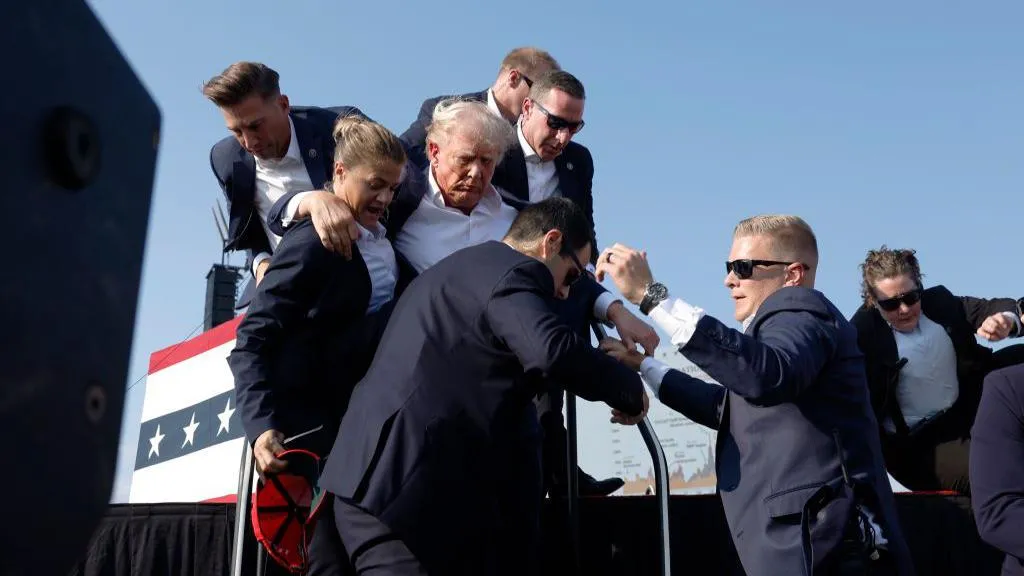
The Secret Service Agency itself had launched an internal investigation. And there is an ongoing bipartisan House probe. First to present their findings, however, was an interim report from the Senate Homeland Security and Governmental Affairs Committee, which found multiple failures on every conceivable level leading up to the Butler, Pennsylvania shooting.

Planning, communications, security and allocation of resources were all inadequate and ill-fitting to the occasion. "The consequences of those failures were dire", commented Senator Gary Peters, Michigan Democratic chairman of the Homeland panel. There was no clear chain of command among the Secret Service, according to investigators' findings. Nor was there among other security agencies. 
 
No plan was formulated for coverage of the building where the shooter positioned himself on the roof to fire from relatively close range toward his target.

Separate multiple radio channels were used by security officials which inexorably led to missed communications. After  his equipment failed to work properly, an inexperienced drone operator was fixed on a help line with no assistance forthcoming. Most telling of all, likely, was a report finding the Secret Service had been given notice of an individual on the roof of the building several minutes before the shooter opened fire.

In total, eight rounds were fired in Trump's direction from a distance less than 150 yards from the location of the speaking former president. The presidential nominee for the Republican ticket ended up struck in his ear by a bullet or bullet fragment during the assassination attempt. A superficial wound, with great dramatic effect. More serious was the death of one individual at the rally, with two others injured before the gunman was shot to death by a counter-sniper with the Secret Service.

The report found that a local officer had sent a radio alert some 22 seconds before shooter Thomas Matthew Crooks fired his first shot. The information sent of an armed individual on the building roof failed to be relayed to key Secret Service personnel, however. 
 
https://ichef.bbci.co.uk/news/1024/cpsprodpb/b4f1/live/ec5e1af0-7b38-11ef-9aa0-e5fec83f7395.jpg.webp
Getty Images
"Leaving a roof unattended, just you know, barely over 100 yards from the podium with a direct line of sight was an unacceptable and inexcusable error." 
"Everybody thought this guy was suspicious and nobody thought to stop the proceeding and remove the former president from the stage." 
GOP Kentucky Sen. Rand Paul, committee member

Labels: , , ,

Monday, October 09, 2023

Ghost Guns Proliferating

"[With most handguns, if police want to work at it, they can usually trace them-- even back to the United States or Europe, wherever they're made."
"But with these [ghost guns], they could change hands multiple times. It can be very, very difficult to figure out where they originated."
Blake Brown, professor, history of firearms control in Canada, Saint Mary's University
 
"This presence [of 3D guns] is consistent with national and international trends observed, where privately made firearms are being used in criminal activity."
"Privately made firearms ... can appeal to individuals intending to use them for criminal purposes since they do not have a serial number and are difficult to trace."
RCMP statement
 
"The best you can do is make possessing 3D printed parts for firearms ... illegal somehow."
"That's still not going to deter people who weren't deterred from shooting other people in the first place."
Rod Giltaca, Canadian Coalition for Firearm Rights
An olive green gun sits on a table with a 3D printer behind it. The 3D printer has a grey firearm on it.
Calgary police have seized 17 3D-printed firearms this year. Previously, they had seized only one. (Calgary Police Service)

Ghost guns are simple to produce, hard to trace and are becoming ubiquitous at crime scenes in North America. These are firearms lacking serial numbers, assembled from individual parts or 3D printers. Canada's federal policing body has not yet seen fit to maintain a database on these 3D firearms, or on printers -- much less how many shootings have occurred with the use of the weapons. It has, however laid charges in a number of cases where 3D guns were seized. 3D print files are available for producing a range of firearms, including assault rifles.

There are reports the RCMP claims to be "anecdotally" aware of, regarding ghost gun seizures in Canada, but they report, they "do not collect statistics on this". According to Professor Brown, whose study expertise is the history of Canadian firearms control, national and regional statistics should be kept with respect to the number of 3D-printed weapons seized, where and on what occasion. Lack of data makes it more difficult to generate basic facts.
 
A man holds an orange 3D printed firearm. The firearm is in focus, the man is not.
Wisconsin-based gun designer Ethan Middleton shows a firearm he printed and assembled in less than a day. (Ousama Farag/CBC)
 
Ghost gun manufacturers and distributors might face discouragement, Professor Brown suggests, should they face stiffer criminal penalties. The presence of these firearms has been a growing concern of police continent-wide. An anti-gun unit based in Quebec, this year along with RCMP, arearrested 45 people, seizing 440 guns in raids targeting makers of 3D-printed firearms in eight provinces: Quebec, Ontario Alberta, British Columbia, New Brunswick, Nova Scotia, Manitoba and Saskatchewan.
 
A coroner's inquest heard last month that weapons used to murder three people in the Montreal area in August 2022 were homemade by the killer, who shot at random. The U.S. Justice Department informed the Supreme Court that local law enforcement agencies seized over 19,000 ghost guns at crime scenes in 2021, over a tenfold increase in just a five-year period.

Canada, noted Professor Brown, maintains rigorous regulations on firearms, in particular handguns, but 3D-printed guns bypass regulations since they are absent serial numbers. According to experts, it's relatively easy for anyone to produce a gun. It takes a 3D printer which uses a laser to secrete a liquid resin that hardens to form the gun parts, and instructions for its use, found readily online. 
 
There is nothing in the Firearms Act or other associated laws to prohibit anyone from possessing a digital blueprint for a 3D-printed gun, although possession of the firearm sans licence and registration certificate can lead to weapons seizure and criminal charges.

A man in a blue blazer with a grey sweater stands behind a table with guns on it. Some are brightly coloured.
Ben Lawson, acting staff sergeant of the Calgary Police Service's Firearms Investigative Unit, shows 3D-printed firearms that were seized by his unit. (Ellen Mauro/CBC)


Labels: , , , , , , ,

Tuesday, June 02, 2020

Conflicted America

"In normal times, businesses would probably take it in their stride."
"But coming off the back of the pandemic, it's devastating."
Neil Saunders, retail analyst, Global Data Retail


"Since we opened our doors, Target has operated with love and opportunity for all."
"And in that spirit, we commit to contributing to a city and community that will turn the pain we're all experiencing into better days for everyone."
Brian Cornell, chief executive, Target, Minneapolis

"We are as a group, by and large, not people of colour [but are prepared to commit to diversity and inclusion goals]."
"Another black man in America died senselessly on Monday, and it happened only miles from where many of us live."
Best Buy, senior leadership team

"You're not protesting anything running out with brown liquor in your hands and breaking windows in this city."
"So when you burn down this city, you're burning down our community."
Mayor Keisha Lance, Atlanta

"Every single rebellion and uprising has included it [looting, vandalism]."
"I was shocked there wasn't more looting. We're dealing with an economic crisis."
UCLA historian Robin Kelley

"Many of these protests, at least those motivated by the killing of George Floyd, should be understood as black people's refusal to stand by while their brothers and sisters are murdered by the state."
"If the history of this country is any guide, protests like these are often necessary to bring about positive, transformative social change."
Stanford sociology professor Matthew Clair
TOPSHOT-US-POLITICS-POLICE-JUSTICE-RACE
Businesses in American cities, devastated by the lockdown that accompanied the rushing swoop of infections caused by the SARS-CoV-2 virus, breathed a tentative sigh of relief, hoping for the best, that consumer confidence would return and so would their business and they would be able to sidestep the forced choices circumstances of lost sales performance, financial incentives and collapsed plans taking them entirely out of contention into bankruptcy.

Lockdown finally lifted. Mere days later, the catastrophe that is COVID-19 became the backdrop to a national uprising in rage at the death of yet another black man at the hands of a municipal police force. There are no acts now so obscure that they cannot be caught by a passerby in a world where everyone is armed with an iPhone the better to document anything and everything that occurs, public and private and combinations thereof.

Minneapolis and St. Paul George Floyd protests

This time it was the private agony of a man whose life-force was being squeezed out of him through the very public physical pressure of a police officer's knee squeezing the man's neck, ending in a violent agony of asphyxiation, and suddenly, George Floyd's name has a ring of familiarity all over the world. The raging refusal to allow the death of another black man to go unnoticed began with silent protests and signage declaring no excuses for sudden death too often visited on black Americans.

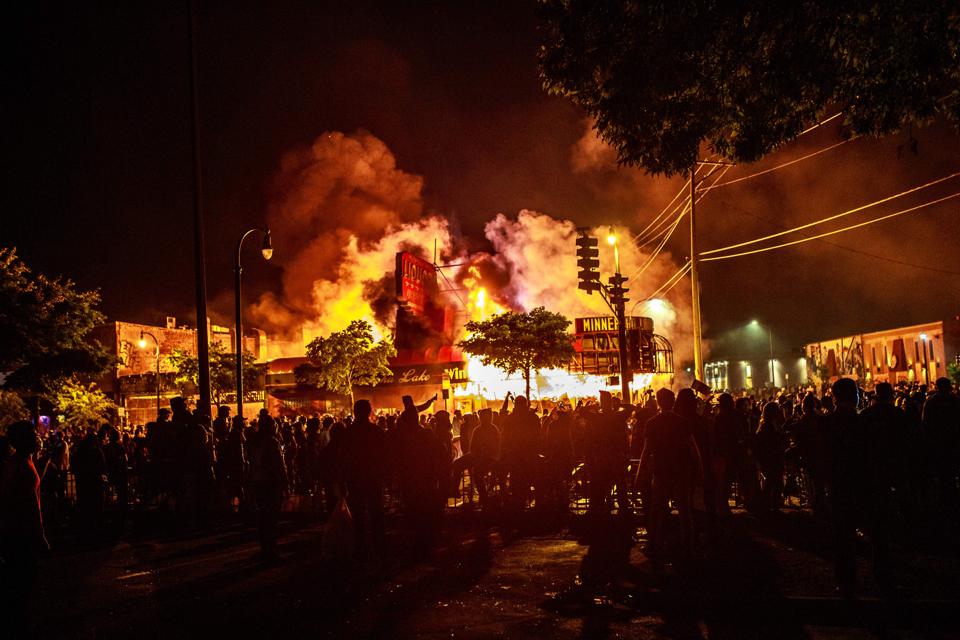
From Minneapolis to states all over the U.S.A. protests erupted, beginning their peaceful, law-abiding journeys toward raging violence and chaotic destruction, and finally looting, orchestrated by those forces for whom anarchic defiance of law and order and hatred of government is paramount and purposeful. The looting is the reward offered for those who assent to departing from civility and embracing sociopathy.

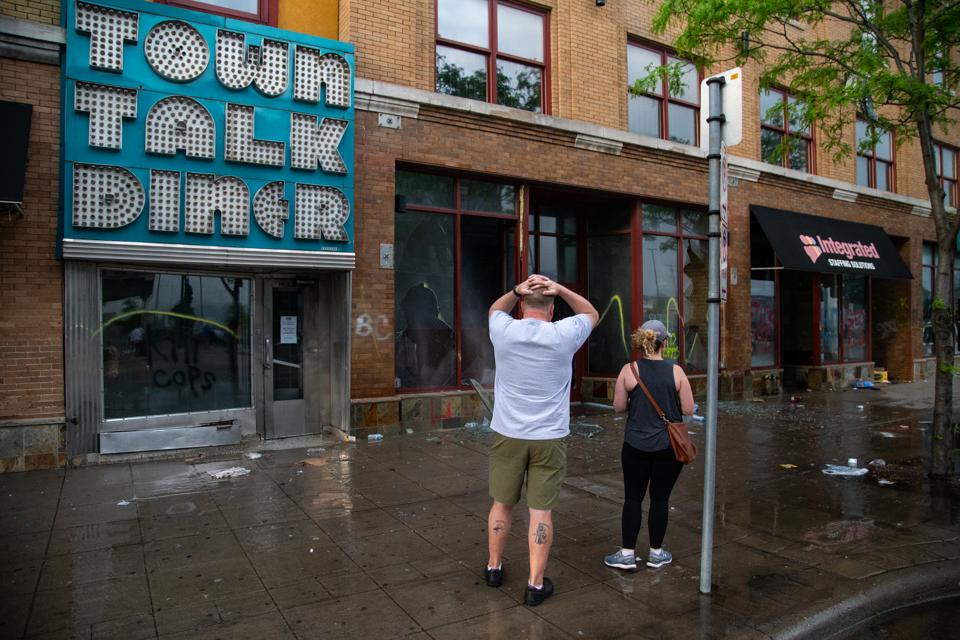
Brick-and-mortar businesses, the retail, very visible service industry and all small business owners hoping to pay their way through the American lifestyle, seriously wounded by COVID-19's shutdown, has taken a direct hit by 'protesters'-cum social deviants who see no reason to avoid opportunities to wreak wreckage and disorder, victimizing those who don't resemble them nor echo their opportunistic rampage.

COVID took J.C.Penney and Neiman Marcus out of business, now 'protests' over George Floyd's killing have closed in on both small business and big business across the U.S. Pleading with those marching in their sanctimonious rage over inequity and injustice as a tool to further their ideological scaffolding, the anger of those impacted by inequity and injustice hijacked, business America quails.

Atlanta's mayor tried to shame the rioters and looters emphasizing that over half of the city's business owners, like anywhere else in America represent minority groups. Vandalism and destruction of property is not the work of the demonstrators, those protesting the death of a man that rogue police felt justified in viciously beating for an alleged crime of passing a counterfeit $20 bill.

   Credit...Alyssa Pointer/Atlanta Journal-Constitution, via Associated Press
Looting T-shirts, computers and food, destroying plate-glass, fire-bombing buildings, unmercifully beating small business owners in their futile attempts to beg the marauding thugs to bypass their small business is not the work of mourners of lives lost, but that of conscienceless opportunists using any tools at their disposal to score their goal of upending society and the rule of law.

National, state and municipal lawmakers reflecting their responsibility to those they represent through the ballot box, plead for common sense and a stop to outrage expressing itself as mob violence. Academics who profess to study the  history of a nation built on slavery still struggling to overcome its original human rights abuses, analyze the situation through the lens of 'progressive' studies in righting ancient wrongs.

In a country deeply divided on the avenues to take advantage of in advancing those sometimes elusive rights, content to view themselves as contrite white imperialists, urging everyone to acknowledge their inherited status of white privilege for which no amount of contrition and efforts for rights-restitution will ever be sufficient unto the day.

Downtown Atlanta   Photo: Jenni Girtman/ALYSSA.POINTER@AJC.COM


Labels: , , , ,

Saturday, November 10, 2018

To Serve and Protect

"From the point of view of public interest, the impact is profound. The conduct here you cannot describe as anything other than stupid."
"On the continuum, this is on the very low end, but nevertheless this is an evidence-tampering case before me."
"He might have taken cough syrup [rather than cannabis] or a pair of woolly comfortable socks that he wanted to try on his feet. It's interfering with evidence."
Justice Mary Misener, Toronto

"The first place to start is to say I’m sorry, sorry for my actions, my judgment and for being so inconsiderate. My actions were wrong, and the community that I served deserves that I be held accountable for those actions."
"My heart was pounding. I felt like it was going to come out of my mouth. I realized instantly what a stupid thing I had done [in consuming cannabis-laced chocolate]. At that point, I did not care any more about the prospects of getting caught or the professional consequences. I just wanted medical help."
Vittorio Dominelli, 36, 13-year constable, Toronto Police Services

"He assumed it would be a minor mellow feeling."
"He did not think consuming a small amount would impair each officer."
"He was sweating heavily and believed he was going to pass out."
Crown attorney Philip Perlmutter

"I would say it was an act of utter stupidity, quite frankly."
"He has done everything he can to show remorse and make reparation for what he's done."
Peter Brauti, lawyer for the defence
Officer
Const. Vittorio Dominelli, left, is one of the officers charged with multiple counts of professional misconduct under Ontario’s Police Services Act. - Twitter
As the son of a long-time Toronto police officer it could be fairly assumed that Vittorio Dominelli knew a thing or two about policing and the responsibilities inherent in that profession. Moreover, he is mature, married, the father of three children under ten years of age. He was with the force for thirteen years. The very basic of protecting criminal evidence whatever it happens to be is no trifling matter. But when the opportunity came to lift a few chocolate bars from the scene of an arrest, the temptation evidently proved too much for the man.

He had been part of a police raid team of an illegal pot-shop. Illegal sellers of marijuana were popping up everywhere in major cities of Canada in anticipation of legalization to arrive in October of 2018. Until legalization became a reality, setting up those shops represented a criminal offence under Canadian law. And police were tasked to uphold the law, as was being done on January 27 of 2018. When the raid was wrapping up at the dispensary, he had been nominated along with his partner to pick up dinner for the squad.

On his way out of the illegal marijuana dispensary he noticed a shelf of cannabis-oil-infused chocolate bars, and casually pocketed several. Then he and his partner went to a nearby pizza establishment to place their orders. Dominelli informed his partner, Constable Jamie Young what he had in his possession, telling her he was of a mind to leave the bars at the pizza place, and she failed to agree. Later in the evening the two constables were assigned to an after-hours bar surveillance.

While seated in their vehicle they discussed the pending legislation for legalization of marijuana. Each revealed to the other that neither had experienced marijuana and knew nothing about its effects. They decided they would conduct an impromptu experiment, consume some of the chocolate and discover first-hand what the effects would be. Between them they consumed eight squares of one of the chocolate bars, becoming "seriously intoxicated".

About twenty minutes after consuming the chocolate Dominelli became acutely aware of feeling unwell. He felt, he said, as though he was going to die and asked his partner to radio for help, but she refused. He then grabbed the radio and called for help: "Send an ambulance" he orders the dispatcher, saying he was on the brink of passing out.
The warning on the back of the packaging of a cannabis-infused chocolate bar, presented in court on Friday.
The warning on the back of the packaging of a cannabis-infused chocolate bar, presented in court on Friday.  (Court exhibit)
When other officers responded to the call, rushing to the scene of two of their own being in medical distress, one officer slipped on the icy surface suffering a severe head injury. That man remains with "significant difficulties with speech and vision" as a result, and ten months later is still off work on medical leave. As for the illegal pot-shop, seven people were charged after the raid. Charges laid against them were dropped because evidence had been tampered with.

Weeks following the raid, when the entire episode had become well known through media reports Dominelli had offered to resign. He remains in a depressed state, shakes with emotion when he speaks of the incident and breaks down in tears. While the Crown proposes a conditional sentence to be served in the community, the defence argues for a conditional discharge with the withdrawal of the charge of breach of trust.


Labels: , , ,

Wednesday, August 08, 2018

Desperately Seeking Justice....

"We wanted to see how many people we were losing along the way. It is pretty significant."
"We see a significant volume of patients within our program and there's great attrition in the rates of people who are going to pursue the whole justice side of things."
"It can be very overwhelming for someone who's been victimized [to commit to going through the process of using the rape kit, returning it for examination, and preparing to be involved in criminal prosecution resulting from rape]."
"People are afraid of what the process will be. They've seen this kind of case play out very publicly sometimes and they really don't want to be part of something that's going to potentially affect their life that much."  
Dr. Kari Sampsel, The Ottawa Hospital, medical director, Sexual Assault and Partner Abuse Care program
The research was done at the Sexual Assault and Partner Abuse Care program at the Ottawa Hospital. (Danny Globerman/CBC)
"Improving the continuum of care from the hospital to justice system is a complex process where many survivors are lost along the way."
"However, achieving just outcomes is of critical importance and the evidence from this study will go to support advocacy and inform best practices for survivors of sexual and gender-based violence."
Dr. Kari Sampsel, The Ottawa Hospital department of emergency medicine; Dr. Katherine Muldoon, The Ottawa Hospital Research Institute
The Ottawa Hospital study found only a small number of survivors turn over rape kits to police. (CBC)

"Being able to prove that as a survivor, where the evidence is just based on your body or your narrative, is a really challenging thing to do, not because it didn't happen necessarily but because there isn't physical evidence in terms of consent."
"The problems are not in the fact that they don't wish to come forward. I would say the larger problem lies in the fact our criminal justice system doesn't have the teeth often to be able to progress survivors' stories in the way they can other crimes."
Nicole Pietsch, co-ordinator, Ontario Coalition of Rape Crisis Centre

"They have their fears and self-blame ... where somebody says 'This happened because I was out drinking' or 'I shouldn't have invited him home'. So those myths are already out there and they're internalized in people, so there's a huge reluctance to come forward and report."
"What is it in the structure and the system that's creating these barriers that somebody who can be so violated can say 'I can't come forward?' That's where our focus needs to be."
Sheila Macdonald, director, Ontario Network of Sexual Assault/Domestic Violence Treatment Centres


According to research from University of Ottawa criminologist Holly Johnson, a mere 33 of every thousand sexual assaults in Canada end up being reported to police and of that number that are reported, only six are taken to prosecution -- and finally, three (out of every one thousand) conclude with a conviction. Now, new research findings out of The Ottawa Hospital's sexual assault and partner abuse care program has been published in the Emergency Medical Journal.

The research results offer for the first time hard data relating to the number of people treated for sexual assault in a hospital emergency setting, where rape kits are available and who agree to release the resulting evidence to police with a view to setting the justice system in motion. This study was undertaken during a period of focus on the national level on the high rate of sex assault cases that police deem to be "unfounded" once they have scrutinized the evidence presented.

What this new research does is to emphasize challenges faced in simply getting evidence out to police to begin with. The sexual assault evidence kits are offered in the hospital setting, yet fewer than one-third of victims of assault release the completed kits to police as evidence. Many people contemplating the level of scrutiny that will follow, including gratuitous attacks on social media once they reveal their victim status by calling on the justice system, are convinced to just let it go. 

Among 406 victims of rape from the Ottawa area for example, 64.5 percent (262 of the total) who had been the subjects of sexual assault, appeared at the hospital through their special program in 2015. Of the total of 262, 202 were deemed eligible for collection of evidence through the use of a rape kit to collect the required forensic evidence from bodily fluids and DNA fibre samples as well as other criteria of evidence of assault.

Yet of that number, of 202 patients eligible to submit forensic data only 129 chose to do so, representing 64 percent of those eligible -- and a further reduction took place, with only 60, representing fewer than one third of the final total managed to hand over the evidence to police. Those in a younger age bracket were likelier to submit the evidence to police, as well as those victims who didn't know their assailants, and those who had been out-of-doors when the assaults occurred.

Numbers for 2016 are undergoing similar analytical treatment in an effort to determine whether any change in the number of people agreeing to release forensic information to police has taken place in the wake of the universal calling out of sexual aggression related to the #MeToo movement that has roiled business, politics, and the field of entertainment as women have been revealing their experiences of body politics.

The wide coverage through social media given to the cascading number of accusations against men in powerful positions demeaning, humiliating, physically manipulating and attacking women in inferior, dependent positions has given impetus and confidence to greater numbers of women to come forward and pursue their human right to a life without sexual aggression. In Canada in particular an increased focus has been shed on the low number of sex assault cases that end up at trial.

A recent investigation by a leading national Canadian newspaper discovered one in five sex assault cases was coded unfounded, in that police deemed no crime had occurred, a situation that has led to questioning the criteria used to reach that conclusion and leading to a review of the handling by police of those cases. In Ottawa, the Philadelphia Model has been adopted, where a panel of outside experts are given access to a sample of unfounded sexual assault cases to judge whether missteps in the investigation were committed.

New research by Ottawa doctors shows that an alarmingly small number of sex assault survivors consent to have rape kit evidence shared with police. Tony Caldwell / Postmedia Network

Labels: , , , , , ,

Sunday, August 27, 2017

Curing The War On Drugs

"I hope that what happened to my son will not happen to members of their families [of the three police who killed his son]."
"The whole village knows my son as a good boy. All he knows is how to help the family. How can they say he was on drugs?"
"My son was begging them [the police who led him away]. He said he wanted to go home because his father was looking for him."
"To the policemen who killed an innocent person, go to church It's not too late to ask for forgiveness."
Saldy delos Santos, Caloocan, northern Manila, Philippines

"[The government's crime campaign was] clearly a war on the poor."
"I think if you look around, the majority of those who joined the march are from the ranks of the poor."
"All were shouting, 'Justice for Kian'."
Reverend Robert Reyes, Roman Catholic Church, Philippines

"I used to believe in Duterte's promise to end crime, and in fact, I think that is partly true. But I never wanted deaths for the innocent. Stop these killings. Instead, arrest drug lords and others."
"He [Duterte] promised us a better life. Death for the innocent is not the change we want."
Michael Alberto Darang, 20, college student, Manila
The Guardian

When Rodrigo Duterte was voted in as president of the Philippines he promised, as he did during his raucous election campaign that he would do for the entire country what he did as mayor of Davao City, cracking down mercilessly on crime and on drugs and transforming it into an orderly place where fear kept people from indulging in anti-social activities and drug dealers learned soon enough to evade the kind of vigilante action that Duterte became famous for, and which he boasted that he had himself indulged in, killing malefactors by his own hand.

His tough talk and braggadocio influenced enough of the electorate to bring him to the presidency. Crime and drug dealing in the Philippines, along with an Islamic insurgency has been a great concern to the population to the extent they were relieved to place their trust in this man who promised he would produce a clean slate of law and order. Since then he has unleashed the police to act at will in aggressively pursuing drug 'dealers', in the process killing thousands of drug addicts whose only crime was their addiction.

International condemnation was swift in the wake of Duterte's war on crime and on drugs, whose victims seemed equally divided among the criminals and the innocent. A 17-year-old boy by the name of Kian Lloyd delos Santos was among the latest victims in a brief period of time in mid-August that saw police dealing with 'criminals' who 'resisted' arrest and 'attacked' the police. The method of dealing with such 'criminals' was to summarily execute them under pretense of protecting society. And Kian just happened to be one of those targeted.

While initially the electorate cheered on their new president, they have since had second thoughts, many of those changing their minds about the government's tactics spurred on by this young man's untimely death during one of the police anti-narcotics raids. Police, who insisted that the teen had attacked them leaving them little option but to disable them, had no idea that the event had been, uniquely, recorded on closed-circuit video.

They had manhandled the youth to a secluded area out of sight of bystanders while he begged to be released from the sweep that had entangled him, an innocent bystander. Instead, he was handed a gun and told to walk away. As he turned his back on the police to begin walking away, he was shot in the head and the back, instantly killed. When his body was examined, it was determined he was shot twice in the head, once in his back, and the right-handed teen was holding a gun the police claim he was intending to use on them, in his left hand.

The Roman Catholic Church holds great influence in the Philippines whose population is 80 percent Catholic. Upon the death of the young man the Church authorities have called on Duterte to put a halt to his war on drugs in which thousands have died, with the president cheering on the police. Only last week President Duterte spoke encouraging words to the police, praising their actions in an anti-narcotics operation where 100 people were killed.

In the wake of an estimated five thousand people marching in support of the family of the dead teen, and the call from the Church, he has now promised an investigation of "wrongdoings or illegal acts" on the part of any law enforcement officer; the very law enforcement officers he had so recently encouraged to continue their dispatching of drug suspects. 
"I saw the tape on TV and I agree that there should be an investigation. Should the investigation point to liabilities by one, two, or all, there will be a prosecution, and they have to go to jail if convicted,"
Protesters hold placards and a banner calling for justice for student Kian Loyd delos Santos at a wake in Kaloocan city, north of Manila.
Protesters hold placards and a banner calling for justice for student Kian Loyd delos Santos at a wake in Kaloocan city, north of Manila. Photograph: Francis R. Malasig/EPA

Labels: , , , , ,

 
()() Follow @rheytah Tweet