Ruminations

Blog dedicated primarily to randomly selected news items; comments reflecting personal perceptions

Wednesday, January 28, 2026

Striking a Familiar Zoonotic Pathogen Chord

Medics wearing masks and hair nets wait to screen airline passengers.
International arrivals at Suvarnabhumi International Airport in Bangkok face extra screenings following the outbreak in India. (Suvarnabhumi Airport Office /Handout via Reuters)

"Nipah virus (NiV) is a member of the Henipavirus genus of the Paramyxoviridae family and is a zoonotic virus with a high case fatality rate. Our knowledge of the geographic distribution of NiV and the disease it causes, mode of pathogen transmission, and clinical manifestations of infection, have evolved over time."
"The first recognized human infection was in the Malaysian village of Kampung Sungai Nipah in 1998, initiating a deadly outbreak that lasted through 1999. Smaller sporadic outbreaks have since recurred nearly annually within South Asia with case fatality rates reaching greater than 90%."
National Library of Medicine...National Center for Biotechnology Information 
https://cdn.who.int/media/images/default-source/health-topics/nipah-virus/black-flying-foxes-hanging-in-tree-min.tmb-1920v.jpg?sfvrsn=99dedc73_1
Black flying fox bats ... World Health Organization
 
  • Nipah virus infection in humans causes a range of clinical presentations, from asymptomatic infection (subclinical) to acute respiratory infection and fatal encephalitis.
  • The case fatality rate is estimated at 40% to 75%. This rate can vary by outbreak depending on local capabilities for epidemiological surveillance and clinical management.
  • Nipah virus can be transmitted to humans from animals (such as bats or pigs), or contaminated foods and can also be transmitted directly from human-to-human.
  • Fruit bats of the Pteropodidae family are the natural host of Nipah virus.
  • There is no treatment or vaccine available for either people or animals. The primary treatment for humans is supportive care.
  • The 2018 annual review of the WHO R&D Blueprint list of priority diseases indicates that there is an urgent need for accelerated research and development for the Nipah virus. WHO 
Confirmation of an outbreak of Nipah virus in West Bengal, India, led to southwest Asia airports placed on alert. Checkpoints for passengers from West Bengal were implemented by Thailand on Sunday, while Taiwan's Centers for Disease Control announced that it planned to list the disease as a Category 5 threat. The Indian Ministry of Health confirmed two cases of the zoonotic infection, with 200 close contacts being monitored and tested. 
 
Nipah has a fatality rate of 40 to 70 percent, according to the Centers for Disease control and Prevention. No vaccine has yet been produced against the virus and there is no cure for Nipah virus. Outbreaks of Nipah occur annually in South Asia, while more broadly global awareness of the virus remains low. Transmitted to people from animals, the virus can be contracted from direct contact with infected animals, primarily flying fox bats and pigs.
Four people in white protective suits push a patient on a stretcher through an indoor area
Nipah virus has a fatality rate in humans of up to 75 per cent. (Reuters: CK Thanseer)
 
Fruit contaminated by these animals can be a source of infection for the unsuspecting. Raw date palm juice produced with sap contaminated by fruit  bats has been linked to outbreaks in Bangladesh. The virus, once it makes the leap from a contaminated animal's tissues or secretions, can readily spread person-to-person through close physical contact.
A man in protective goggles and a mask holds a bat in his hands
Scientists in Bangladesh have previously caught bats to test them for the virus. (Reuters: Mohammad Ponir Hossain, file)
 
A major outbreak among pig farmers in 1999 Malaysia killed over a hundred people, and this was the world's introduction to the presence of the virus,  highly contagious among pigs. Nipah outbreaks occur almost annually in Asia, most frequently in Bangladesh and India. A 'predictable season pattern' has emerged as routine outbreaks in Bangladesh between December and April, a research paper published in the Journal of Infection and Public Health established.
 
That research linked the pattern to peak harvesting season for raw date palm sap, a cultural delicacy and tradition, where fruit bats frequently live among date trees. The Philippines, Singapore and Malaysia have also been host to outbreaks. "This represents a return of Nipah to this area after a long gap, which is concerning from a surveillance standpoint", pointed out Lauren Sauer, director, Special Pathogen Research Network at University of Nebraska Medical Center.
 
🦠 What is Nipah Virus? Nipah Virus is a rare but serious ...
Within days of infection symptoms including fever, headache, cough, muscle pain and difficulty breathing emerge. Patients may experience neurological symptoms such as  brain swelling as the infection progresses. Patients who survive brain swelling (encephalitis or brain inflammation) can recover but still face a future life of consequences including seizure disorders.
 
No licensed treatments exist for Nipah, nor are there any available vaccines.  
 
In 2018 the World Health Organization  marked Nipah as a priority pathogen urgently requiring accelerated research and development particular to the virus. 
  

Labels: , , , , , , , , , , ,

Sunday, September 24, 2023

"Soldiers of God"

"This is a harrowing story of rape, sexual violence, child abuse, forced marriage perpetrated on minors by a cult in the municipality of Socorro, Suragao del Norte."
"We are talking about over a thousand young people in the hands of a deceitful, cruel, and abusive cult ... real children are in danger, and time is of the essence."
"We cannot, we must not, look away."
Philippine Senator Risa Hontiveros
 
"We urgently call upon the government, specifically our law enforcement agencies, to conduct immediate and thorough investigations into these incidents, secure the protection of the affected children, and bring the perpetrators to justice."
Time is of the essence and we fear that there could be more affected children who are unaccounted for, and whose lives and future are at risk."
"Our work to protect children doesn't end with the passage of laws; it begins there. It is of utmost importance that laws around protecting children from abuse and early marriage are not merely words on paper but are instead, rigorously implemented and enforced."
Alberto Muyot, chief executive, Philippines branch Save the Children
Socorro Bayanihan Services in the Philippines
Socorro Bayanihan Services reportedly has at least 3,500 members

A group recognized as an exploitative, quasi-religious cult known as Omega de Salonera surfaced in 2017, instilling fear over a powerful earthquake in 2019 to lure people to come to the mountains where the cult's leaders, escaping scrutiny, commit "monstrous" abuses while operating a covert drugs operation whose activities are protected by their own private army.

Filipino lawmakers revealed that the group has up to 3,500 members, led by Jey Rence B Quilario, referred to as "The Messiah". The chairman of the Philippine senate committee on women and children used her congressional privilege to accuse Quilario and his associates of widespread exploitation, demanding action to address its existence and come to the rescue of the vulnerable children trapped within the group.
 
After an earthquake rocked the region, the cult exploited the natural disaster to lure thousands to its cause in its mountain lair
 
Another senator, Ronald Dela Rosa, accused the group's leaders as well of making "human shields" of cult members to avoid drug trafficking prosecution. He too demanded an immediate probe into the group's activities. Reports he received claim the group runs a methamphetamine laboratory operating out of an underground bunker located near the "White House" where Quilario and other cult leaders live, protected by a private army supported by a local extremist group.

Testimony was cited from adults and children who managed to escape the cult, a 15-year-old among them who spoke of having been forced into marriage with a 21-year-old man when she was 13. Quilario locked her in a room with the man, forcing her into sex, telling the man "he had the right to rape her" because they were, after all, married. 
 
Quilario, according to Senator Hontiveros, raped children himself, prevented minors from attending school, demanded up to 60 percent of members' pensions and welfare payments, and smuggled drugs. Young girls, affirmed Senator Dela Rosa, trapped within the cult were forced to have sex with Quilario before being married at age 12.

Anna Fionah L. Bojos, member of the Cebu for Human Rights NGO documented forced labour, children forced to haul sand and rocks. "Although the cult said it was voluntary labour on their part, they were actually monitored and disciplined for failure to do work", said Bojos, saying children were physically assaulted if work was considered unsatisfactory and sometimes sent to "foxholes" for up to a week of solitary confinement.

Children were also required to do "masi-masi" every day; physical exercises; jogging with a sack full of rocks; undergo obstacle challenges; firearm and bladed weapons handling; learn martial arts; swim and crawl in the mud full of waste and urine. Socorro Bayanihan Services deny the accusations, claiming children had been taught to "fabricate" such stories.

Since then, more former cult members have emerged, a 28-year-old former Agila Squad member (armed wing of Socorro Bayanihan Services) reporting that over 100 members were part of the squad, among them children as young as 12, undergoing combat training, told they were "soldiers of God" involved in a divine mission.

Labels: , , ,

Saturday, June 30, 2018

Destroying an Invaluable Philippines Ecosystem

“It is vital not to let damaging fishing practices become the norm."
"Once people started using destructive fishing methods they stuck with what is familiar – even after those methods later became illegal. So, it’s essential to ensure young fishers engage with sustainable fishing methods such as hook and line fishing, or traps. It’s also critical to motivate older fishers to set aside destructive methods."
"If the Philippines were to fully implement its new fishing laws on sustainability, then ocean protection would improve and use of damaging gears would decline.:
"Fisher organizations can also take the lead, as sometimes happens in the Philippines, and cooperate on limiting destruction, ideally with support from local government."
Jennifer Selgrath, PhD student, Institute for the Oceans and Fisheries, Fulbright Scholar 
Squid fishers on Danajon Bank    ubc.ca/files Selgrath-Squidfishing
It seems hard to imagine but in the islands off the central Philippines, blast techniques are commonly used for fishing. A fisherman in a narrow boat will toss a bottle bomb into the water which explodes and the boat rocks while fish bob to the surface, dead mostly, others gasping briefly then dying. No fuss, big mess as coral shatters in response to the shock. The internal organs of reef fish are ruptured by the blast, their spines fractured, their flesh torn by coral shrapnel. And this is not a new kind of fishing technique, it is traditional.

Nothing survives the blast. Microscopic plankton, sea horses, anemones, sharks; in a 10- to 30-meter radius of such an explosion very little escapes death. The Philippines has been bestowed by nature to be the custodian of 27,000 square kilometers of coral reef, making for marine biodiversity on a grand scale. Now that climate change is racking up changes affecting oceans, the recognition that something must be done to stop illegal fishing, and most certainly 'blast fishing' from wreaking any more irreversible damage is beyond urgent.
Bacuit Bay and the town of El Nido seen from above. El Nido once suffered from rampant blast fishing. Credit: Lano Lin / Shutterstock
A new study out of University of British Columbia conducted in the Philippines by the Institute for the Oceans and Fisheres' Project Seahorse and the Landscape Ecology Group at the University of British Columbia, headed by Jennifer Selgrath, produced a paper: Shifting gears: Diversification, intensification, and effort increases in small-scale fisheries (1950 - 2010, published in PLOS One, concluding that such fishing methods cause greater damage to climate-endangered coral reefs than ever.


The researchers tracked various types of fishing methods — such as hand line, traps and nets — used on coral reefs between 1950 and 2010, to discover that from the 1960s the use of sustainable fishing methods such as traditional hook-and-line fishing remained stable, but that a marked increase in the use of fishing practices less selective, illegal and more destructive had moved forward, particularly in the regional use of destructive fishing methods such as the use of explosives and poisons, both outlawed by government in 1932.

Despite legislation in the Philippines dating after 1998 banning these destructive fishing techniques their use persists with a growing number of fishers making use of crowbars to smash up corals to enable them to catch elusive marine animals such as abalone which bring greater profits. For many traditional fishermen the profit they obtain ensures they will continue to defy the law; if their ancestors did it, it can't be wrong. Basically, these fisherfolk live a poverty tradition, barely managing to sustain themselves.

Legal net fishermen gain three kilos of fish daily. Dynamite fishing can net nine kilos, occasionally up to 20 kilos. Slice off a few centimeters of fuse wrapped in aluminum foil, strap on a match for a detonator; funnel sand to the bottom of a glass bottle and pack it with explosives. That fuse, in aluminum wrap, allows four seconds to toss the bomb and wait for it to explode. It helps to preserve human life to know the proper bomb-making technique; some fishers have been killed or maimed through carelessness or distraction.

In 1970, according to a report by the Philippine national statistics board, an average daily catch was 20 kilos, reduced to two kilos by 2000. Declining fish stocks convinced more fisherfolk that they would do better through illegal fishing. In blast fishing the entire food chain -- plankton, small and large fish -- juveniles that will never attain to spawn size, perish. Absent healthy corals the entire ecosystem along with the fish within fail to flourish and gradually die off.

Rubber hose wedged between teeth, fishermen sink ten meters into the water after a blast to lurch awkwardly along the ocean floor, collecting stunned and dead fish scattered among broken coral. In twenty minutes surfacing with a  handful of high-value reef fish and about five kilos of scad and sardines, a small catch completes the process. Two men can split the earnings from that catch, about $10 profit each.

Coastal resources management in various island regions have limited resources at their disposal; a handful of slow-moving boats to patrol hundreds of square kilometers of sea. Dynamite fishermen reason their parents used this method and there are still fish; if the scientists warning of disappearing fish were right the fishermen would themselves die if the oceans ran out of fish. However that would never happen, the fish will never disappear, they believe.

In a matter of seconds, dynamite fishing can destroy a reef that took hundreds or thousands of years to grow.
Photo Credit: Richard Whitcombe / Shutterstock

Labels: , , , ,

Sunday, August 27, 2017

Curing The War On Drugs

"I hope that what happened to my son will not happen to members of their families [of the three police who killed his son]."
"The whole village knows my son as a good boy. All he knows is how to help the family. How can they say he was on drugs?"
"My son was begging them [the police who led him away]. He said he wanted to go home because his father was looking for him."
"To the policemen who killed an innocent person, go to church It's not too late to ask for forgiveness."
Saldy delos Santos, Caloocan, northern Manila, Philippines

"[The government's crime campaign was] clearly a war on the poor."
"I think if you look around, the majority of those who joined the march are from the ranks of the poor."
"All were shouting, 'Justice for Kian'."
Reverend Robert Reyes, Roman Catholic Church, Philippines

"I used to believe in Duterte's promise to end crime, and in fact, I think that is partly true. But I never wanted deaths for the innocent. Stop these killings. Instead, arrest drug lords and others."
"He [Duterte] promised us a better life. Death for the innocent is not the change we want."
Michael Alberto Darang, 20, college student, Manila
The Guardian

When Rodrigo Duterte was voted in as president of the Philippines he promised, as he did during his raucous election campaign that he would do for the entire country what he did as mayor of Davao City, cracking down mercilessly on crime and on drugs and transforming it into an orderly place where fear kept people from indulging in anti-social activities and drug dealers learned soon enough to evade the kind of vigilante action that Duterte became famous for, and which he boasted that he had himself indulged in, killing malefactors by his own hand.

His tough talk and braggadocio influenced enough of the electorate to bring him to the presidency. Crime and drug dealing in the Philippines, along with an Islamic insurgency has been a great concern to the population to the extent they were relieved to place their trust in this man who promised he would produce a clean slate of law and order. Since then he has unleashed the police to act at will in aggressively pursuing drug 'dealers', in the process killing thousands of drug addicts whose only crime was their addiction.

International condemnation was swift in the wake of Duterte's war on crime and on drugs, whose victims seemed equally divided among the criminals and the innocent. A 17-year-old boy by the name of Kian Lloyd delos Santos was among the latest victims in a brief period of time in mid-August that saw police dealing with 'criminals' who 'resisted' arrest and 'attacked' the police. The method of dealing with such 'criminals' was to summarily execute them under pretense of protecting society. And Kian just happened to be one of those targeted.

While initially the electorate cheered on their new president, they have since had second thoughts, many of those changing their minds about the government's tactics spurred on by this young man's untimely death during one of the police anti-narcotics raids. Police, who insisted that the teen had attacked them leaving them little option but to disable them, had no idea that the event had been, uniquely, recorded on closed-circuit video.

They had manhandled the youth to a secluded area out of sight of bystanders while he begged to be released from the sweep that had entangled him, an innocent bystander. Instead, he was handed a gun and told to walk away. As he turned his back on the police to begin walking away, he was shot in the head and the back, instantly killed. When his body was examined, it was determined he was shot twice in the head, once in his back, and the right-handed teen was holding a gun the police claim he was intending to use on them, in his left hand.

The Roman Catholic Church holds great influence in the Philippines whose population is 80 percent Catholic. Upon the death of the young man the Church authorities have called on Duterte to put a halt to his war on drugs in which thousands have died, with the president cheering on the police. Only last week President Duterte spoke encouraging words to the police, praising their actions in an anti-narcotics operation where 100 people were killed.

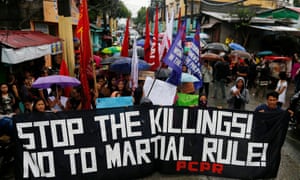
In the wake of an estimated five thousand people marching in support of the family of the dead teen, and the call from the Church, he has now promised an investigation of "wrongdoings or illegal acts" on the part of any law enforcement officer; the very law enforcement officers he had so recently encouraged to continue their dispatching of drug suspects. 
"I saw the tape on TV and I agree that there should be an investigation. Should the investigation point to liabilities by one, two, or all, there will be a prosecution, and they have to go to jail if convicted,"
Protesters hold placards and a banner calling for justice for student Kian Loyd delos Santos at a wake in Kaloocan city, north of Manila.
Protesters hold placards and a banner calling for justice for student Kian Loyd delos Santos at a wake in Kaloocan city, north of Manila. Photograph: Francis R. Malasig/EPA

Labels: , , , , ,

Saturday, March 18, 2017

Bucking the Trend

"That's the perfect formula for S.T.I.s [sexually transmitted infections], including H.I.V."
"The  youth explore [sex], but do it without the proper education."
Chris Lagman, official, Love Yourself, Manila, Philippines

"The Philippines has the fastest growing H.I.V. infection rate in Asia, along with Afghanistan."
"Right now, the Philippines runs the risk of letting the infection get out of control."
"All good and successful national AIDs programs use condoms."
Steven Kraus, director, Unaids, United Nations H.I.V/AIDS Agency

"Reducing HIV transmission isn't rocket science. But it does require the ... government to implement an HIV prevention program and remove obstacles to condom and HIV testing access so that young Filipinos - particularly men who have sex with men - can protect themselves from an otherwise preventable illness."
Carlos Conde, Philippines researcher, Human Rights Watch.

"Nationwide, there are testing centers and hygiene clinics that offer free HIV testing services and ensure the confidentiality of the results. Knowing one’s status will help an individual get early treatment and care."
"Information dissemination is the key to conveying the correct message to everyone that HIV is preventable and that anybody can acquire the virus."
"HIV is a virus that destroys the human body’s natural defense against diseases or infection, causing the immune system to weaken and not function properly. No human being, by age or by sex, is immune to HIV infection."
Juan Antonio Perez III, executive director, Commission on Population, Philippines
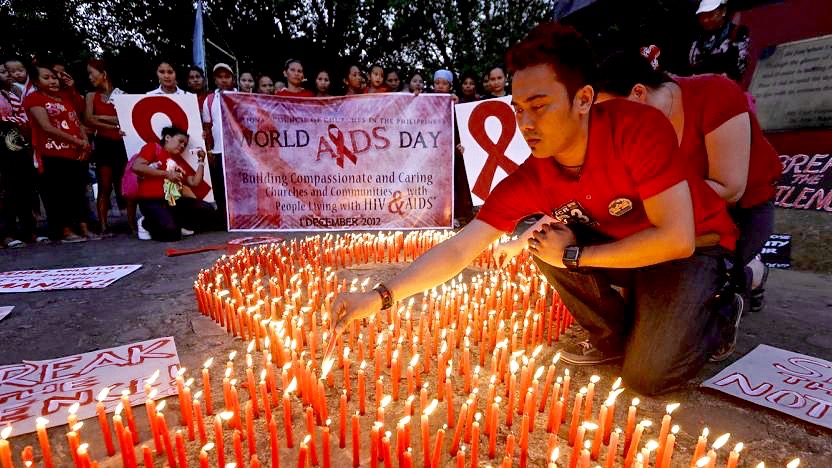
World AIDS Day Commemorated in Manila – AP / Bullit Marquez
In the early 1980s the world became aware of a strange new illness that was being passed along, mostly among gay communities in the United States. It was cutting a savage swath through the community, killing people through an agonizing process of mechanical bodily failures compromised by infections and ending in death rescuing those affected from their suffering. Medical science worked overtime to try to understand what Acquired Immunity Deficiency Syndrome was, how it was passed along, and how it could be managed and eventually cured.

In much of today's world, the soaring incidence of H.I.V. and AIDS has been more or less tamed. Education on sexual hygiene and self-protection has gone far in diminishing the incidence and impact of that dread disease. The need for a life-saving protocol accelerated once it became clear that AIDS was afflicting not only the vulnerable victims practising unprotected sex in the gay community, but heterosexuals as well. The realization that women were giving birth to babies infected with H.I.V. struck the conscience of the world.

And at a time when aggressive awareness and prevention campaigns have succeeded in leading to a global decline in infection rates where in Asia rates of infection decreased by five percent, in Southeast Asia by 30 percent, in the Philippines the trend has gone the other way. Among gay men in the Philippines the infection rate has literally exploded, as it did in the early days of AIDS surging through the gay community of the United States.

For those most at risk, gay men, injecting drug users, transgender women and female prostitutes, the rise has been alarming, with the rate of new infections having increased by 230 percent between 2011 and 2015. Yet among Filipinos between the ages of 15 and 24, a mere 17 percent fully comprehend exactly what H.I.V. is, and how it spreads. The Health Department had developed a plan to distribute condoms in public high schools as a preventive, linked to education.

But the Department of Education refused, even though teachers would have been trained how best to counsel students on the prevention of pregnancies and the transmission of sexual infections. With that refusal went the voluntary H.I.V. testing, and a further plan to educate parents on how to discuss sex with their children. A coalition of parents, the Roman Catholic Church (of which 80 percent of Filipinos are devout members) and conservative politicians all resisted the effort at education and prevention.

"The Department of Health and the Department of Education should concentrate on uplifting the values of the Filipino youth", urged Senator Vicente Sotto II, arguing that distributing condoms on school premises would result in promiscuity, pointing out that public health centers and stores are where condoms were already available. However, Filipinos under the age of 18 require parental consent to buy condoms or to be tested for H.I.V.

The country relies on the use of antiretroviral therapy to diminish opportunities of passing H.I.V. on to others, along with testing drives, as the national strategy to halt the spread of the virus. In the meanwhile, awareness of prevention and actual testing are both random and infrequent.


Labels: , , ,

Thursday, February 19, 2015

Where Empathy and Compassion Are Called For

"I can still use my arm, I can still use a computer and I can still talk. I'm thinking, if they give me a chance to stay I can still work, or I can still study."
"But still right now I’m able to move around on my own, and I’m starting to be more independent."
"Even though I’m in a wheelchair, I’m still hoping and trying to still help my family."
"We're still hoping they can allow me to stay here. I was so blessed and thankful for all my friends and church friends who came here to support me."
Maria Victoria Venancio, 29, Filipina, temporary foreign worker, Alberta
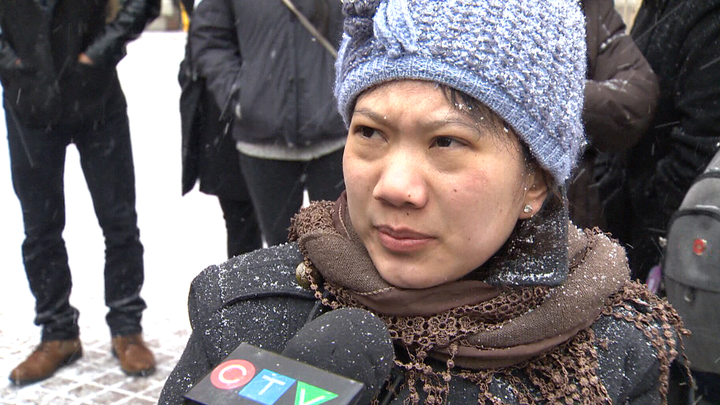
Filipina temporary foreign worker Maria Victoria Venancio (screenshot from CTV News footage)
Maria Victoria Venancio (screenshot from CTV News footage)
"She’s told me recently she’s been able to stand on her own, which from when we dealt with her car accident a few years ago was almost unimaginable.""She is working with her doctors and the University of Alberta here and actually making some tremendous progress in her mobility."
"[In the Philippines] her family lives 3 hours from a major center and the simple lack of infrastructure would present incredible challenges to her. She's becoming more independent. And here in Canada, where we have things we take for granted, like paved streets and DATS buses, she has the opportunity to progress and live a relatively fulfilling life."
Chris Bataluk, pro bono lawyer for Ms. Venancio

This young woman came to Canada under the country's Temporary Foreign Workers program, as many young women do from the Philippines, hoping to find employment and to earn their way eventually into recognition as potential future citizens by achieving permanent resident status.  Many  young Filipinas come to Canada to work as domestic aids, as minders of other people's children, leaving their own young children behind in the Philippines, hoping to be reunited with them once they've been able to settle in Canada, and to sponsor family members for emigration to Canada where they feel they will find a better life with greater opportunities to advance themselves economically.

The federal Temporary Foreign Workers program was established as a way to fill employment needs in areas where employers claim Canadians have no interest in working at those jobs. Many of those jobs fall into a professional category where there may be a shortage of such skills within the country, but many more fall into the more pedestrian category of poorly-paid unskilled labour in the service industry. At a time in Alberta when, as a result of the oil boom, many such jobs went unfilled, Maria Victoria Venancio applied to the program, to work for an Edmonton-area McDonald's outlet.

She was doing very well in her area of employment, so much so that it appeared that she was on track to a supervisory position. One day in 2011, en route to work by her usual method of bicycling, she was struck by a vehicle on her commuting route. This was no brief clip that knocked her off her bicycle and little harm done. The accident was serious enough to render the young woman a quadriplegic. And she now finds herself in a double bind. Not only has her mobility been utterly impaired and with it her prospects for future employment, but as a visitor to Canada so to speak, she does not qualify for universal health care. And since she no longer works, she is facing deportation.

Appealing to a Citizenship and Immigration hearing gave her no reprieve on the compassionate and humanitarian grounds she might have hoped for. The hearing ruled that she had no legal status in Canada. But there yet remains hope that her lawyer is determined to explore, that the Canada Border Services Agency, next in line to hear her case, will schedule a hearing to decide whether an order to send her back to the Philippines will be enforced. In her native country she would have limited access to health care.

Wheelchair-bound, her life would be even more difficult than it is in Canada, since in the Philippines, an impoverished country that cannot afford to pave all its roads and sidewalks, or to ensure that public help for the handicapped is recognized in accessible ramps and elevators, her ability to function in the public sphere would be minimal. The young woman has friends and supporters in Edmonton. She had won a modest settlement in compensation for the accident which cost her the use of her limbs. She has made application to be granted permanent residency in Canada.

She had spent three weeks in hospital at the time of the accident. The compensation she received resulting from the accident was relatively small, her lawyer pointed out, since the adjudicators found her to be partially at fault for the accident's occurrence. "She would be leaving what is essentially one of the better situations someone like her could be in and going to a very, very dismal situation", pointed out Mr. Bataluk. At the present time, she has been receiving assistance from doctors at the University of Alberta who have themselves been absorbing the cost.

The rehabilitation she has undertone has been extensive, enabling her to regain partial use of an arm, not quite enough to have her write, but sufficient to give her some degree of independence. She is also able to stand briefly. Doctors have advised her that she will always be wheelchair-dependent. But she remains optimistic about her future and that in and of itself is a tremendous boost toward the possibility of further rehabilitation, however slight.

Labels: , , , ,

Thursday, November 21, 2013

Needing Everything

"Our life is so difficult because of that typhoon. We don't have shelter. We don't have enough food or drinking water."
"Despite the difficulties we have suffered, we still smile because God has given us hope, strength and another life."
Gemma Deloviar, teacher, Olotayan Island Philippines
Olotayan Island
Islanders return from church with drinking water and a small amount of rice and other staples. These basic donations, paid for by Filipinos in Canada, the U.S. and Australia, are the first relief aid to reach the residents of Olotayan Island since typhoon Haiyan struck.    Photograph by: Matthew Fisher/Postmedia News, Postmedia News
 
"Look, we're already trying to fix up as much as we can. People are using pieces of scrap wood from their old houses to build temporary covers for their children to sleep under."
 "We no longer have many school supplies and no ballpoint pens. Some students still can't make it from the other side of the mountain because the path is blocked by fallen trees. But people remain optimistic because they are still alive."
Precious Deloviar, teacher, Olotayan

Olotayan is a tiny island in the Visayan Sea in the Philippines. They caught the tail end of the typhoon that devastated Tacloban and surrounding area. The island is about 300 kilometres west of Tacloban, but it suffered no less than what occurred there. Trees uprooted, most of the homes on the island destroyed, but for 20 of the 280 housing the island's population of 980.

Island 6[1]
A few of the 15 fishing boats which survived Super Typhoon Haiyan on November 8. Forty others were destroyed as were 260 of 280 homes on the island of Oloyatan. Matthew Fisher/Postmedia News

Fishing is the trade that supports most families. And of the 55 fishing boats representing the source of income for the residents, 40 have vanished into the receded seas. "We'll look for another boat but they cost about 80,000 pesos (about $2,000) and we have no money", said Joerly Tanlawan who with his wife Imelda now find themselves penniless, their home flattened, fishing boat washed out to sea.

No aid has yet reached the people on the island. With its white sand beaches and its tropical location it might have once looked like Paradise. Now it is simply a wreck waiting to be restored, if at all possible, to a livable village where families fish for a living and take pride in their church and their schools which the 289 students on the island attend.

One of the village's three classrooms remained fairly intact and students from Grades 3 and 4 were studying in it. In the afternoon, classes for Grades 5 and 6 would take their turn. And younger children in Grades 1 and 2 took up their place for learning on a roofless stage that was once a schoolroom.

At the Roman Catholic Church, a structure still standing, where a priest comes once a month to conduct services, villagers gathered to collect modest distributions of food donated by islanders now living in Canada, the U.S. and Australia. Each family came away with a few kilograms of rice, eight litres of water, a few tins of sardines and corned beef, and used clothing.

"There were really important gifts because we have no agriculture here and must depend on the waters around us for crabs, squid, cuttlefish and tuna", explained the 59-year-old village elder acting as chief. "We cannot even properly start to rebuild our homes because nipa (a natural building material) and bamboo and other things we might use are not available anywhere. We need plywood. We need nails. We need everything."

Labels: , , , , ,

 
()() Follow @rheytah Tweet