Ruminations

Blog dedicated primarily to randomly selected news items; comments reflecting personal perceptions

Tuesday, June 09, 2020

COVID-Centric Retail Shopping

Canadian malls face a new type of normal as they take their first tentative steps toward reopening during COVID-19. (Evan Mitsui/CBC)
"From the moment you walk into our store, we want you to see something that's new. The sticky mat, the welcome table -- they're all triggers in the customer's mind that things are different now."
"We don't want this [employee's revised manual] to feel like a sterile or clinical interaction. With masks on, you may feel a bit awkward at first, but don't let that hold you up!"
"It's your job to still create a connection! [with the customer]."
Andrew McLean, Chief Commercial Officer, American Eagle Outfitters

"The customers who come in are coming in to buy. They are not coming in to look."
"This has been a two-month process of figuring out what it's going to take to make people feel secure. It's a new reality:Customers want to come back in, but they want to come back where they feel safe."
Jay Schottenstein, chief executive, chairman, American Eagle

"Experience has shown us that loosening restrictions and shelter-in-place orders means a resurgence of disease."
"Masks, temperature checks, hand hygiene -- they're all important as stores reopen, but there are still risks for increased transmission."
Robert Bednarczyk, professor of global health and epidemiology, Emory University
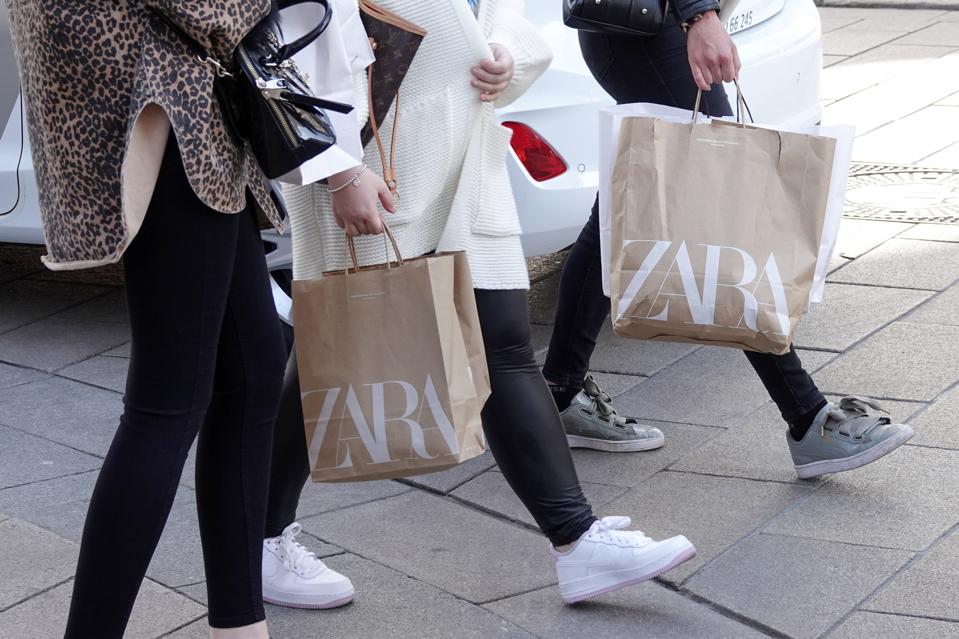
Coronavirus - Hamburg

"Retailers are starting to consider more than just the cleanliness of their stores."
"They're thinking about merchandising, about where things go. How can they make it easier for people to shop?"
"This pandemic isn't going to level off. It's going to be a long roller-coaster."
Wendy Liebmann, chief executive, WSL Strategic Retail consulting firm, New York
So, how did your novel, enriched, exciting shopping trip go? Tell us all about it!

Oh, the irony! At the very time in recent history when bricks-and-mortar retailers were concerning themselves over falling sales in reaction to the growing popularity of online shopping, and they researched and analyzed down to the last aching dollar to arrive at a consensus that they had to collectively make shopping a more dynamic, exciting prospect for consumers, to make them want to come out to shop 'till they drop, and not want to leave the premises because there's more, much more to be seen. Along came SARS-CoV-2.


"The customer steps forward as the employee steps backward, so there's always that six-foot [1.8-metre space]."
"We feel it's a pretty safe journey. But I say pretty safe because, as you know, there are no guarantees right now."
Sid Keswani, Pandora jewellers
How everything has changed! Now the COVID-centric prevailing idea is in-and-out. No more leisure shopping, fingering the goods, casually trying on scads of clothing, testing makeup, hauling kiddies along so they can play with toys in the aisles. Shopping is about to become more deliberate, efficiently swifter, conscious and safer. As shoppers submit to new rules and regulations to become accustomed to a new reality. One that invites them to come in, and disinvites any undue contact or forbidden lingering.

Shoppers' temperatures are now being checked before entry at a number of retailers. Some even require that customers come by appointment. Beauty consultations, alterations services; forget all that. Unneeded frills. Bathrooms may no longer be accessible; pee before you go. Go when you get home. Some fitting rooms may remain open, and there will be a long wait for access. Returns will be placed in quarantine of up to 72 hours before they're placed back on shelves. They say.

American Eagle has invested in curbside pickup and infrared devices to measure temperature as customers walk by. Displays at entries once full of apparel now serve as "welcome tables" where bottles of hand sanitizer, disposable masks and sticky blue material to clean shoe soles are placed for obligatory use. Clothes on the shelves folded in a manner discouraging browsing with hands on the goods. The number of shoppers in each of their stores now strictly limited where a mobile app notifies customers when they may enter to shop.

Physical distancing in the age of COVID-19 the rule. (Anis Heydari/CBC)

Shopping in person is back on. Personable shopping is off. Shoppers will no longer flock to J.Crew, Neiman Marcus, Stage Stores and J.C.Penney; they're in bankruptcy, and likely more to follow, and forget about Pier 1. Those interactive displays that are so eye-catching and invite participation, just forget it; unsafe and vetoed. But the image projected is meant to be one of reassurance to potential customers; come to our establishment, shop for our wonderful goods in perfect safety. Fun? Not exactly.

New protocols have been enacted where employees or sales personnel as they're called, must be vigilant to disinfect door handles and fixtures should shoppers wish to use change rooms, and then only every other one; the rest to remain unused to create desirable space for complete security. The Danish jeweller Pandora moved machines to clean jewellery from backrooms to the selling floor to enable employees to sanitize each piece after handling.

Working at a retail establishment and wearing a mask? Smile. Really -- smile behind the mask because your eyes will reveal what the mask covers. Wash your hands repeatedly. The stores provide thermometers the employee must disinfect, then take their temperature with. Employees watch best-practice face mask tutorials to give them confidence in how to wear them, remove them and not feel constrained to smile.

You never know; there may be a candid camera following your every move.

Toronto Premium Outlets shopping centre officially reopens today
Toronto Premium Outlets/Google Maps

Labels: , , ,

Saturday, May 30, 2020

COVID-Bored and Restless?

"The pandemic has made people see how connected we are as a planet. We all play a part in it [contributing to the well-being of communities and the planet]."
"We can still travel and we can still see beautiful places and iconic places, but make it more connected to the destination."
"This is a rare chance to get to certain destinations when they're not crowded."
"I want to go to Italy this summer. It's been knocked back quite a bit and I want to show my support for the country. It's a beautiful place."
Bruce Poon Tip, founder, G Adventures, small-group travels, Toronto
Water rushing over the edge at Niagra falls, the most visited tourist attraction in the world
Niagara Falls, Canada/United States
"Travel is an important tool for economic development as well as for conservation and sharing knowledge."
"I think that companies that can show they are doing something good for the community, or the planet, as well as for their customers will ultimately benefit."
"Many countries and destinations already have different visa restrictions and the like, but with the health regulations for post-COVID, there will be additional health checks and social distancing requirements."
"No one has a crystal ball, so no one really knows for sure to what extent travel will change. But international travel will have to adjust as countries and companies accommodate new regulations and restrictions."
Rachel Dodds, professor of of Hospitality and Tourism Management, Ryerson University
View of three small pyramids and three large pyramids behind them
The Great Pyramid of Giza, Egypt
Over 90 percent of the world's population -- representing 7.1 billion in total -- live in countries that now have travel restrictions, thanks to the global pandemic and the need to shut down business as usual and borders to international traffic, to protect their populations from exposure to that highly infectious pathogen that has succeeded as a global threat, to make millions sick, overwhelm national health-care systems, cause death to hundreds of thousands of health-compromised and elderly and collapse the global economy. 

Post-lock-down, while the pandemic, though still ravaging communities, appears to be slowly ebbing, even as a second and perhaps more successive waves (of possibly more severe mutated strains of the virus) are anticipated by the scientific community -- issuing cautions to governments not to re-open their economies too precipitously and warning people not to abandon caution on social distancing -- various countries have scheduled their re-openings at different times and to various extents.

In the process, an estimated 100.8 million jobs have been shed to the present, according to the World Travel & Tourism Council, based in London. And while it took an indecently short period of time for the alarm to spread over the role of international travel in spreading the SARS-CoV-2 virus causing COVID-19, with the horror stories of how those giant floating towns that great ocean liners had become as living laboratories of infection, the new version of international travel will take quite a bit longer to establish its credentials.

Clouds above the Stonehenge on a sunny day
Stonehenge, England
People may begin to book their travel itineraries with an eye on visiting places that were relatively unscathed by the novel coronavirus, like the Caribbean, Eastern Europe and Vietnam. The travel sector was valued at $13 trillion globally, employing over 330 million people in the year before COVID-19 entered the scene. And having people from wealthy nations travel to other countries whose heritage, culture and geography was found to be fascinatingly different, was also a mechanism for redistribution of wealth around the world.

Mr. Poon Tip, musing on the ways and means and obvious frailties to infection of the past, states his expectation that large, crowded resorts and cruise ships will become infinitely less attractive to travellers in the future who will look toward visiting different places at a different scale of travel. Above all, there will be a greater need to assure people when they travel, that doing so is safe under new guidelines and restrictions.  Where post-COVID additional health checks and social distancing requirements will demonstrate in part the changes to security and safety.

The acropolis in Greece
Acropolis, Athens, Greece
A greater demand for boutique hotels, charter yachts and off-the-beaten-path experiences will arise, guesses Mr. Morgan from the perspective of agencies whose specialty is luxury and experiential travel. For the time being, Canada and the United States have agreed to maintain a closed border for the present, while the European Union and Europe's passport-free travel Schengen zone, have closed borders to non-essential travel even as Austria, Germany and France gradually re-open their borders. 

Italy, Belgium, Iceland and Turkey all are considering re-opening to international travel in June, while Spain and Greece are aiming at international opening in July. An agreement between Australia and New Zealand for a trans-Tasman travel bubble is being formalized, as it seems the idea of creating travel bubbles between countries has found wide favour. 

Ambitious travellers aged between 30 and 50 are considered to be likeliest to plan for international travel, an age group and numbers that will expand as time goes on. Fears that hamper people planning for post-pandemic travel, will abate considerably once a vaccine has been found for the virus. And the countries hit hard by the relentless virus, with its death toll and economic fallout, countries always highly dependent on tourism, will work harder than ever to convince the world community that tourism is a reciprocal gift that enriches all who engage in it.
"The motivation behind how and why people travel will also look different."
"The importance of human connection will be at the forefront after so many weeks and months in isolation."
Tim Morgan, general manager, Virtuoso, Canada
Lush green trees surrounding the Great Wall of China
The Great Wall of China

Labels: , , , ,

Thursday, April 16, 2020

Re-Opening the Economy in Denmark

"I won't be sending my children off no matter what."
"I think a lot of parents are thinking, 'Why should my little child go outside first'/"
Sandra Andersen, founder, My kid is not going to be a Guinea Pig, Facebook

"I don't think it's right for the kids not to hug their friends."
"We keep the kids home, because the situation in the day cares before the COVID-19 outbreak were not OK, and the conditions they are setting up now are even worse."
Nonne Behrsin Hansen, Copenhagen, Denmark

"Suddenly, these moms feel like they just have to throw their kids to the front line and I think their reaction is: 'Don't mess with our kids."
Esme Emma Suteu, founder, Momster

"We're all a bit nervous and we'll have to ensure that we stick to hygiene rules."
"We have a lot of washing hands during the day. We don't have masks and we have to keep a good distance from each other so that's a very difficult task."
Elisa Rimpler, Danish Union of Early Childhood and Youth Educators

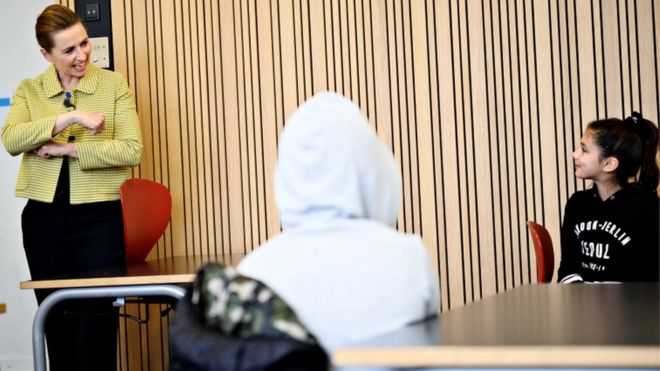
The Danish prime minister welcomed children on their return to school in Valby on Wednesday
The Danish prime minister welcomed children on their return to school in Valby on Wednesday     Reuters  

One of the first countries in Europe to decide to close down its schools in reaction to the influx of novel coronavirus cases, Denmark with its population of just under 6 million now feels the time is right to re-open them for children up to the fifth grade to "get the economy going again", according to Prime Minister Mette Frederiksen. To free up parents by allowing the children to return to school, so their parents can return to the workforce to rescue a faltering Danish economy.

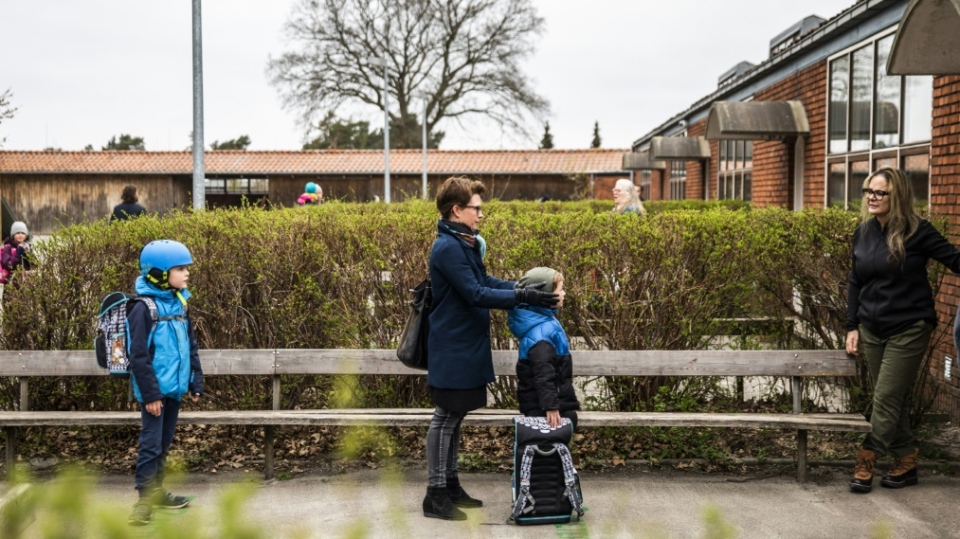
Instructions have gone out to teaching staff to ensure that social distances are maintained between children. Among the population there are many who are less than pleased, even while others express confidence in the move. An online network of thousands of Danish mothers signed onto Momster have little confidence that Danish authorities have matters relating to the novel coronavirus under control.

Concerns that newly reopened schools and daycare centres may serve to open a new front of COVID transmission leading to a second wave of cases has moved thousands of Danish parents to express their foreboding by keeping their children at home, despite the official re-openings. Denmark has not seen the kind of flood of coronavirus cases seen elsewhere in Europe, like Italy or Spain, France or Britain, but the decision has brought a heated debate over priorities; health safety or the economy.

Denmark first in Europe to reopen schools after coronavirus lockdown
Children distancing at Korshøjskolen in Randers . Bo Amstrup/Ritzau Scanpix

Up to Tuesday the virus had infected over 6,600 Danes and resulted in close to 300 deaths. Shops were ordered closed, along with bars, restaurants, cinemas and gyms.

It was when the Danish health authority recommended an easing up after the lockdown of a month's duration had succeeded in reducing the rate of new cases, to relax the lockdown by opening up schools to children up to age eleven.

At the department of infectious diseases, Aarhus University, scientist Christian Wejse acknowledged parents' concerns "because we've spend a month trying to avoid contact". But he stated that the age group of children in question fall into a category "where few fall ill, and those who do won't get very sick". He points to Sweden as an example, where schools have remained open and no dramatic rise in infections has arisen. Children, he assured the skeptical, seem not to be a major driver of infections.
"I feel great, really good about the kids going back to school."
"I think we're all going to be sick at one point and they told us the children are going to be less sick and affected by this virus."
"I think it's good that they're going back to school... We need to go back to daily life."
Caroline, 38, mother of two, Copenhagen

Denmark schools
Schools in Denmark were closed on March 17 in an effort to curb the COVID-19 epidemic, though many had shut before then. (AFP)

Labels: , , , , ,

 
()() Follow @rheytah Tweet