Ruminations

Blog dedicated primarily to randomly selected news items; comments reflecting personal perceptions

Thursday, January 27, 2022

COVID-19 Antibodies No Protection Against Omicron

"It's therefore vital that we continue to monitor the situation closely to understand the impact of the Omicron variant, which now makes up almost all infections in the country."
"There is good news in our data in that infections had been rapidly dropping during January, but they are still extremely high and may have recently stalled at a very high prevalence."
"There is rapidly increasing prevalence among children now they are mixing more following the start of the school term and, compared with December, prevalence in older people, aged 65 plus, has increased... which may lead to increased hospitalizations."  
"It's therefore vital that we continue to monitor the situation closely." 
Professor Paul Elliott, director, Real Time Assessment of Community Transmission (REACT), Imperial School of Public Health, United Kingdom
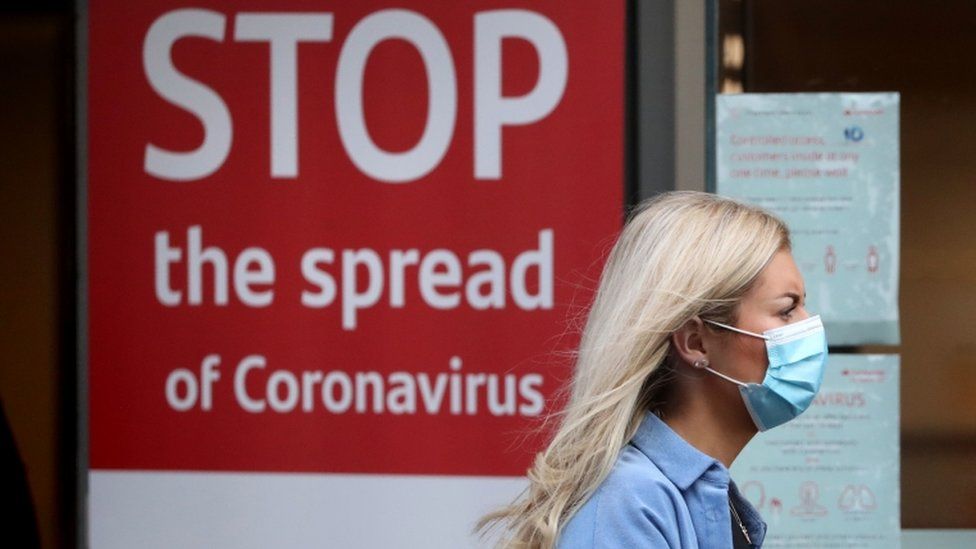
A woman wears a face mask and a sign says 'stop the spread of coronavirus'
PA Media

The "Plan B" COVID restrictions implemented across Britain this past December when Omicron was spreading at lightning speed through the population is being lifted. No longer is the public being instructed to work from home. Rules that meant people had to wear face masks in shopping interiors and on public transport are set to be suspended.

"It's reassuring to see COVID-19 infections beginning to slow across the country", leading to restrictions being lifted, said U.K. Health Secretary Sajid Javid. He did, however, acknowledge that case numbers remain elevated, recommending that people protect themselves and those around them by making certain they got their booster shots.

A large study in the U.K. on COVID19 revealed that approximately two-thirds of participants testing positive in January reported they had been infected previusly with the coronavirus. Researchers tested a selection of positive results with the intention of determining which variant was leading in infecting participants in the Real-Time Assessment of Community Transmission study.

99 percent of the samples analyzed were found to be Omicron infections, with a small number of the tests revealing themselves to be the BA.2 variant; a sub-type of Omicron, recently making its appearance, and under investigation. The remaining one percent of the infections were the Delta variant which, before Omicron came on the scene was the leading COVID variant infecting populations across the world.
 
Many research groups studying Omicron in animals have found that, compared with other variants, it causes much less damage to the lungs.
  Credit...Jerome Delay/Associated Press
Over 100,500 volunteers' infections were scrutinized by study scientists between January 5 to January 20. A record number of cases was reached in early January as Omicron was recognized as the dominant variant. Among the total number of participants infections rose steeply to about 4.41 percent as opposed to 1.40 percent a month in December. Evidence that Omicron can evade at least some of the defences generated by infection with previous variants was supported by the high proportion reporting earlier cases.
 
Despite much higher infection numbers, however, deaths and hospitalizations remained lower than with previous waves. The prevalence of the virus was elevated to its highest level since the study began in May of 2020, with the peak of infections occurring around January 5, before case numbers began declining and finally levelled off from the middle of the month.
 
Among children between the ages five to 11 the highest infection rate across all age groups was identified, at 7.81 percent; infections seen to be rising with the return to school in January. The concern among researchers is that the close to 12-fold increase for those over 65 may still end up leading to increased hospitalizations. 

 
https://image.cnbcfm.com/api/v1/image/107006383-16431560781643156074-21090385120-1080pnbcnews.jpg?v=1643156077&w=750&h=422

Labels: , , ,

Friday, April 02, 2021

COVID Convergence Mutations

"[I'm struck by the] amazing amount of convergent evolution we're seeing [with SARS-CoV-2]."
"There are these infamous mutations -- E484K, N501Y, and K417N -- which all three variants of concern are accumulating. That, added together, is very strong biology that this is the best version of this virus in the given moment."
Wendy Barclay, virologist, professor,Imperial College London

"If you wanted to sort of write a little textbook about viral evolution, it's happening right now."
"If it keeps happening over and over again, it must be providing some real growth advantage to this virus."
Dr.Francis Collins, geneticist, director, U.S. National Institutes of Health

"It's shown a very strong set of opening moves."
"We don't know what the end game is going to look like."
Vaughn Cooper, evolutionary biology specialist, University of Pittsburgh School of Medicine
https://static.reuters.com/resources/r/?m=02&d=20210331&t=2&i=1556837699&r=LYNXMPEH2U09M&w=1600
National Institutes of Health Director Francis S. Collins holds a model of SARS-CoV-2, the novel coronavirus, as he testifies on Capitol Hill in Washington, D.C., U.S. Graeme Jennings/Pool via REUTERS/
 
Perhaps it's just too much to hope for at this junction that the novel coronavirus is mutating itself out of the realm of viral pathogenic superiority. It's as though a contestant for the worst-killer-virus-in-history is given just so many moves to improve its game, and it's making the wrong choices, and compounding them in an effort to become more deadly, whereas the process it's undergoing is beginning to mute its morbid effects on its human hosts.

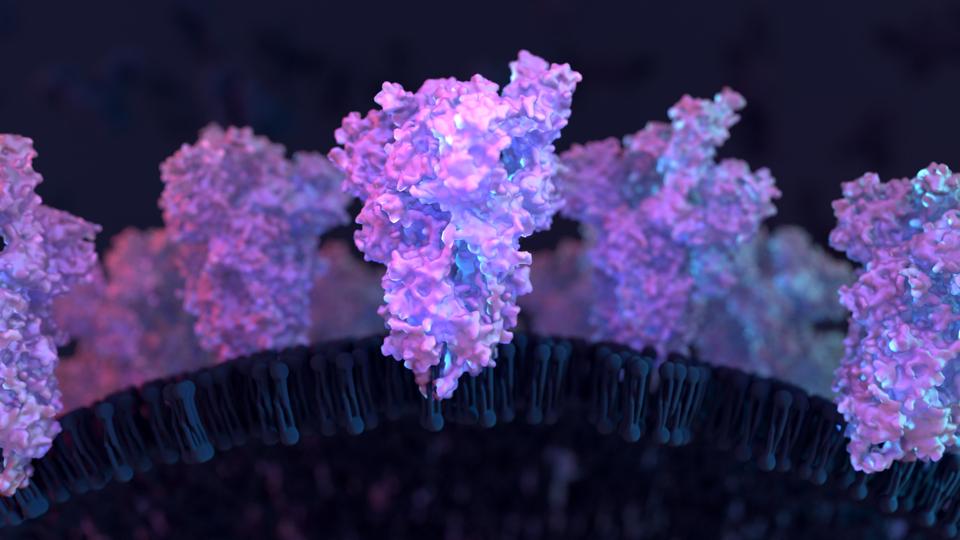
Spike proteinĀ of SARS-CoV-2, Mutation in the spike protein that the virus uses to bind to the human ACE2 receptor. Mutation sped up spread of coronavirus.
Spike protein of SARS-CoV-2
The new variants that were detected in geographies far from one another, such as Brazil, South Africa and Britain mutated spontaneously within a short time-frame late last year, where all three share some similar mutations located in the vital 'spike' region of the virus, enabling it to enter and infect human cells. The E484k mutation, that some scientists familiarly named "EEk" for its capacity to evade natural immunity from previous COVID-19 infections while reducing protection offered by current vaccines, which is designed to target the spike protein, is included.

Similar mutations independent of one another have been appearing in various parts of the globe, indicating that the coronavirus is in the process of undergoing "convergent evolution", according to a number of scientists Reuters has interviewed. With expectations that the coronavirus will continue to mutate, immunologists and virologists now suspect that the coronavirus may be exhausting the fixed number of moves its evolutionary cycle allows.

If such is actually the case, the long-term impact for its survival remains to be seen, based on whether a limit exists on the number of possible mutations it can attain to, making it less dangerous. "It is plausible that this virus has a relatively limited number of antibody escape mutations it can make before it has played all of its cards, so to speak", explained Shane Crotty, a virologist at the La Jolla Institute for Immunology, San Diego.

That being the case, drugmakers could be enabled to remain current with the virus, developing booster vaccines meant to target current variants directly, even as governments struggle to control a pandemic that has succeeded in killing close to three million people globally. Experts have been mulling over the theory that the virus could be imbued with a limited number of mutations since early February, and it has gathered momentum since a paper was published showing the spontaneous appearance of seven variants in the United States alone, all appearing in the same region of the spike protein.

The very process of different species independently evolving like traits to improve survival odds represents the core of evolutionary biology. The current pandemic represents an evolutionary process scientists have been able to study in real time through the vast scope of its impact, with 127.3 million global infections. No pathogen in history has ever evolved within a comparable global scrutiny as has SARS=CoV-2.

This coronavirus in particular is not held by scientists to be particularly 'clever'. It is programmed by nature to replicate itself every time it infects people. Each copy the virus produces can be flawed in its exactness to the original. Some of these inexact copies may be one-time occurrences, while those that render a survival advantage to the coronavirus have a tendency to persist. And before compromising its fitness or changing so much it is no longer the same virus, leads some specialists to believe the virus may have a limited number of mutations available to it.

"I don't think it's going to reinvent itself with extra teeth", Ian Jones, a professor of virology at University of Reading in Britain, added. "If it had an unlimited number of tricks ... we would see an unlimited number of mutants, but we don't", observed Michael Nussenzweig, immunologist at Rockefeller University in New York. 

However, predicting how a virus will mutate is challenging. Should there be limits on how the coronavirus could evolve, matters would certainly be simplified for vaccine developers. As an example Novavax Inc. is in the process of adapting its vaccine specifically to target the South Africa variant which appeared to render current vaccines less effective, in laboratory tests. According to chief executive Stan Erck, the virus is capable of so much change only yet still binds to human hosts. The hope is that the vaccine would "cover the vast majority of strains that are circulating". 

Data-sharing platforms like the Global Initiative on Sharing Avian Flu Data is enabling researchers to track the variants through its huge trove of coronavirus genomes. Recently, scientists identified seven U.S. coronavirus variants with mutations occurring in the same location in a critical portion of the virus representing additional evidence of convergent evolution.

Experiments exposing the virus to antibodies in an effort to force it to mutate are being carried out by other teams of researchers. The same mutation in many cases appeared as a result, including the infamous E484K. Helping to raise cautious optimism that mutations appear to share many of the same traits, even as tracking changes in the virus must continue to choke off its ability to mutate by reducing transmission through vaccinations and other measures taken to limiting the virus's spread.

Scientists at Duke University sequenced positive coronavirus tests to identify which strains are circulating in the community, on Feb. 3.
Credit...Pete Kiehart for The New York Times

Labels: , , ,

Friday, February 12, 2021

Assessing COVID Variants in Potentials for Oncoming Waves

"No matter how the virus changes, it needs us to be close enough to each other and to have interactions to let it jump between us." 
"If we don't give the virus those opportunities, it simply can't spread no matter what variant it is."
Emma Hodcroft, virologist, University of Basel, Switzerland
 
"B.1.1.7 was first sequenced in the UK on 20 September. It caught the attention of scientists on 8 December, when they were looking for reasons for the surge of cases in south-east England."
"B.1.1.7 has 23 mutations compared with the original SARS-CoV-2 virus first discovered in Wuhan, China. Seventeen lead to changes in viral proteins. Many of these mutations have been found before and their overall number isn't unusual, but this combination is unique."
Michael LePage, News & Technology
 
"[All this is bad news because it means tougher measures are needed]. Without effective control policies, rapid surges are predicted and the burden in the first six months of 2021 may be greater than what was seen in 2020."
Nick Davies, London School of Hygiene & Tropical Medicine
 
"This variant is more fit, or it works better. Naturally, there's going to be more of it and it's going to be transmissible more easily and grow more readily and then kind of take over, so to speak, the population of viruses."
"These new variants can still be detected with our current methods of detection, so that's one thing that should be reassuring. We can still detect these variants just like we've been able to detect the original strain." 
Dr. Daniel Rhoads, microbiologist, Cleveland Clinic
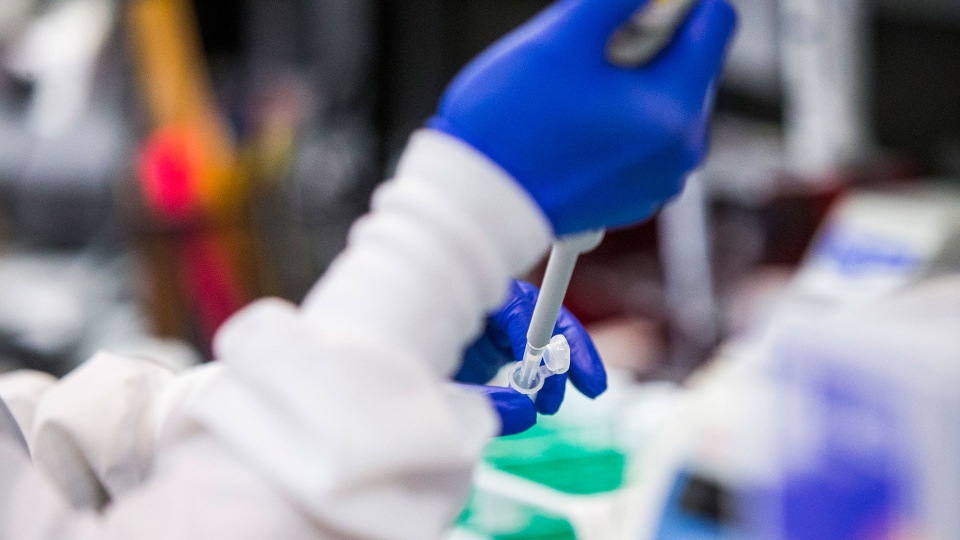
COVID-19 lab
The microbiology lab at the Health Sciences Centre in Winnipeg on Tuesday, Dec. 8, 2020. THE CANADIAN PRESS/Mikaela MacKenzie

The world has been in flux for a year and counting, since the entry of the SARS-CoV-2 virus causing     COVID-19 has disrupted everything conceivable about human life; health and safety, the world economy, mass employment, production, travel, the ability of health care systems globally to keep pace with the waves of infection, the state of people's general well-being in mental health, and more. Now that vaccines are in production and distribution to inoculate populations begin, nations vie against one another to acquire them.
 
And then, what? Back to square one when we think we're finally getting to the point where virus control is possible and life can return to approximating normal? Variants. Medical science knows all about mutations in viruses; they happen all the time. Variants so innocuously benign there is little difference from the controlled original and alternately, mutations causing variants of a type that is more infectious, more threateningly lethal, less readily controlled by the vaccines in circulation.
 
Variants that spread so rapidly they become the dominant strain, the successor to the original which begins to decelerate, making room for a more disturbingly efficient and deadly strain. And we start all over again. And until and unless vaccines are in widespread use, such that the pathogen begins its retreat, other mutations are assured, hundreds of them, most of no account, though occasionally several will emerge constituting yet another threat.
 
The U.K. variant has infiltrated 70 countries so far, from its original emergence in a county close to London, in the fall of 2020. In Canada, a long-term care home in Ontario experienced an outbreak infecting all 129 residents and 105 staff in January. Over half of the residents died of its effects. That is lethal efficiency. Its presence is steadily growing. When Britain instituted a lockdown in December because of its variant, many other countries banned travel to and from the United Kingdom. It is always too late.
 
Laboratory technicians wearing protective equipment work on the genome sequencing of the SARS-CoV-2 virus and its variants at the Pasteur Institute in Paris on Jan. 21. (Christophe Archambault/AFP/Getty Images)

The U.K. variant, B117 was initially identified as being up to 70 percent more transmissible in comparison to other minor variants, owing to its enhanced capacity to bind easily to human cells. At first it was thought not to be any more lethal than the original. Continuing studies led to preliminary findings from January suggesting that higher occurrences of death do indeed afflict people infected with the strain. Professor of mathematical modelling of infectious diseases, John Edmunds of the London School of Hygiene and Tropical Medicine said of the findings that they were "statistically significant", to be taken seriously. 
 
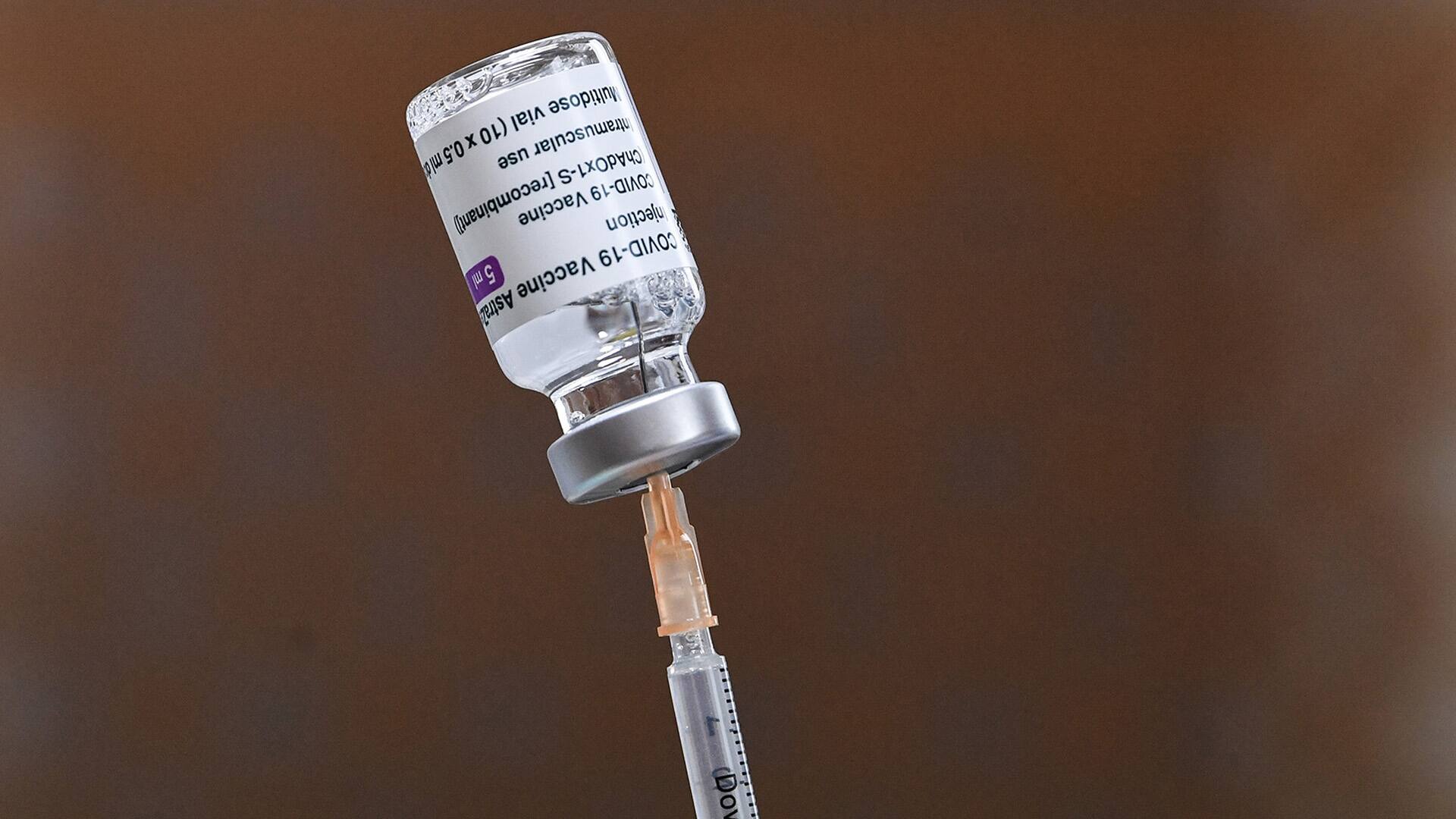
South Africa halted rollout of AstraZeneca COVID vaccine
The South African variant (B1351) detected in October 1,000 km south of Johannesburg, spread to other coastal areas of South Africa, now accounting for over 90 percent of cases in the country. It too has spread, discovered to have appeared in over 30 countries. Similar to the U.K. variant in being more transmissible; up to 50 percent, but no evidence has yet arisen that it may be more deadly than its original. It does, however, contain mutations reducing the ability of antibodies (vaccines) to bind to the virus to make them less effective.
 
Because this mutant strain weakens the body's natural immune response making people vulnerable to re-infection, South Africa interrupted its rollout of the AstraZeneca vaccine once data indicated it gave only minimal protection against mild infection. Both Novavax and Johnson & Johnson vaccines are also indicative of reduced protection against the South African strain.
 
The third threatening variant has arisen in Brazil making its debut in of all places, Haneda airport, Japan when four travellers from Brazil tested positive for the variant. The Brazilian state of Amazonas in the northwest of the country, bordering Peru, Colombia and Venezuela has become a hotbed of the P1 Brazil variant. It, in turn, is similar to the South Africa variant in that its mutations impact the body's immune system response making it possible that someone who has recovered from COVID-19 is susceptible to re-infection with the Brazil variant.
 
In Manaus, Amazonas' largest city -- population two million -- 42 percent of specimens tested positive for the virus in late December. Its rapid spread is a matter of concern for scientists. Whereas the U.K. variant appeared to have taken three months to become dominant in Britain, all it took was a month for the Brazil variant to become dominant in Manaus, a region already hard hit by the original virus in April, and where scientists anticipated the population would certainly reach herd immunity ... before the advent of the variant. Moreover, since it shares identical mutations as the South Africa variant, protection from vaccines may not be reflected at a similar level of the original virus.


Labels: , , , , , ,

 
()() Follow @rheytah Tweet