Ruminations

Blog dedicated primarily to randomly selected news items; comments reflecting personal perceptions

Monday, February 12, 2024

Does Schizophrenia Lead to Smoking? Does Smoking Lead to Schizophrenia?

"Your brain processing power is divided into two. One is intellect, the other is cognition. Intellect tends to be more stable. Cognition is a more malleable or changing type of processing power of your brain: attention, short-term memory, decision-making. Things can fluctuate from day to day."
"Smoking improves your cognition in the short term. It could be that they're trying to boost their cognition by smoking. Unfortunately, long-term smoking makes the condition worse. They already have cognition problems, and they're smoking. Patients with schizophrenia smoke maybe two or three times more often. It's compounding the problems they have."
Dr. Lauri Tuomenin, neuroscientist, Royal Hospital, Ottawa

Pathophysiology-of-schizophrenia-and-neurobiology-of-nicotine.
Pathophysiology of schizophrenia and neurobiology of nicotine. Cureus

Dr. Tuomenin at The Royal has set out to discover with the use of brain scans what precisely the relationship is between nicotine and and the complex medical condition known as schizophrenia. What is known is that people diagnosed with schizophrenia tend to smoke at rates much higher than is the case within the general population. Schizophrenia is known by disturbing symptoms such as hallucinations and delusions and 'hearing' voices; the source of the illness is believed to be both genetic and environmental, affecting roughly one in a hundred population with an initial episode occurring at a point between the teens and mid-20s.
 
www.frontiersin.org
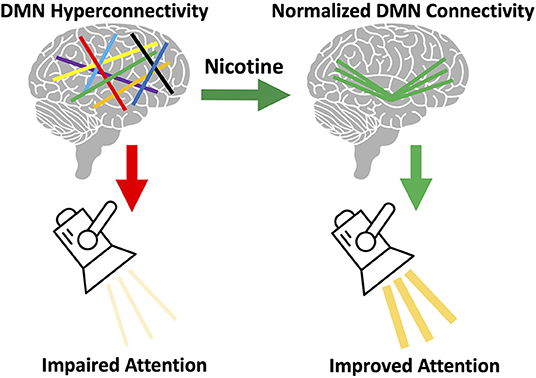
Part of the challenge facing the researchers is to determine whether smoking leads to schizophrenia or is a by-product of the mental illness in an effort to control its symptoms. Two theories are current; that smoking is a schizophrenia risk factor, the other, that those with schizophrenia smoke in an effort to self-medicate, in  hopes of focus acuity. Those suffering from schizophrenia often experience problems with attention, manipulating information, and decision-making. Even before the first episode of psychosis has been experienced in a schizophrenia patient, cognitive symptoms can be present.
 
Anti-psychotic drug treatments, in use for 70 years, have proven effective therapy in treating t he condition; however these drugs do nothing to improve cognition. Which is why researchers hope to discover more with brain imaging to help understand how nicotine affects brain processes. Brain images of about fifty people are to be part of the research by Dr. Tuomenin and his research colleagues; ten to twenty of whom would be habitual smokers without schizophrenia.
 
The cholinergic system is the focus of the research, for the vital role it plays in memory, digestion, control of heartbeat, blood pressure, movement related functions -- all of which are affected by nicotine. Positron emission tomography (PET) scans make use of a small portion of radioactive tracer to create a picture showing t he function of a specific brain process, and the MRI uses a strong magnet and radio waves to capture the detailed pictures of the brain.

www.frontiersin.orgStarting with psychological and cognitive tests, followed by two scans, one of working memory testing how the brain functions, and another of the cholinergic system using the PET scans, the study takes about ten hours for each participant profile. Ironically enough it has become difficult to recruit smokers who are otherwise healthy for such studies given that the population of those who smoke is on the decline. As well, the researchers are searching for people who, while smoke or vape, do not use cannabis, since the focus is on nicotine.

Cannabis on the other hand, has an altogether other relationship with schizophrenia since its use can trigger schizophrenia in people genetically predisposed, particularly those who use it frequently, use potent products, or began using the drug at a young age. Which still leaves a number of unanswered questions relating to the relationship between smoking and schizophrenia. While the smoking rate has declined markedly in the general population, no indication exists that schizophrenia prevalence has dropped as well.

Some people self-medicate with nicotine to deal with the side-effects of antipsychotic medications; anxiety and restlessness. Those with schizophrenia tend to live isolated lives that tend to encourage nicotine consumption. Connections abound, those with schizophrenia end up with shorter life expectancies, partially attributable to excessive smoking. And then there are separate questions respecting how new ways to consume nicotine such as vaping, may affect schizophrenia risk.

Hopes are high for the discovery of a new class of drugs to treat the cholinergic system, to help those with schizophrenia with hallucinations and delusions, and also have the benefit of effectively treating  the issues of cognition. 
research, nicotine and schizophrenia from www.medicalnewstoday.com
"We know much less about vaping because it's such a new thing. The way you smoke and the way you vape is different."
"People smoke a cigarette and then they wait for another. Vaping is much more constant."
Dr. Lauri Tuomenin

Labels: , , , , ,

Monday, February 07, 2022

Snoring Awareness

"Snoring is very much associated with sleep apnea. But not everybody with sleep apnea snores -- even though the vast majority do -- and not everybody who snores has sleep apnea."
"[Customized mouthpiece or mouthguards pull the jaw and tongue slightly forward; basic versions can be ordered online, but they] tend to have a higher association with tooth movement and jaw pain."
"It's something that really should be made custom to your mouth [by a dentist]."
"[Surgery is generally] considered a last resort, because it's painful."
David Schwartz, president, American Academy of Dental Sleep Medicine 

"We see severe patients all the time, and they have no clue they have sleep apnea."
"They're only coming in because their bed partner told them to."
Kent Smith, founding director, Sleep Dallas, president, American Sleep and Breathing Academy
Snoring sleep apnea
Even in the absence of obstructive sleep apnea, snoring can still disrupt people's sleep enough to cause sleep deprivation. Not getting enough sleep each night is associated with an increased risk for type 2 diabetes, obesity, high blood pressure and heart disease. Tero Vesalainen/istock.com
 
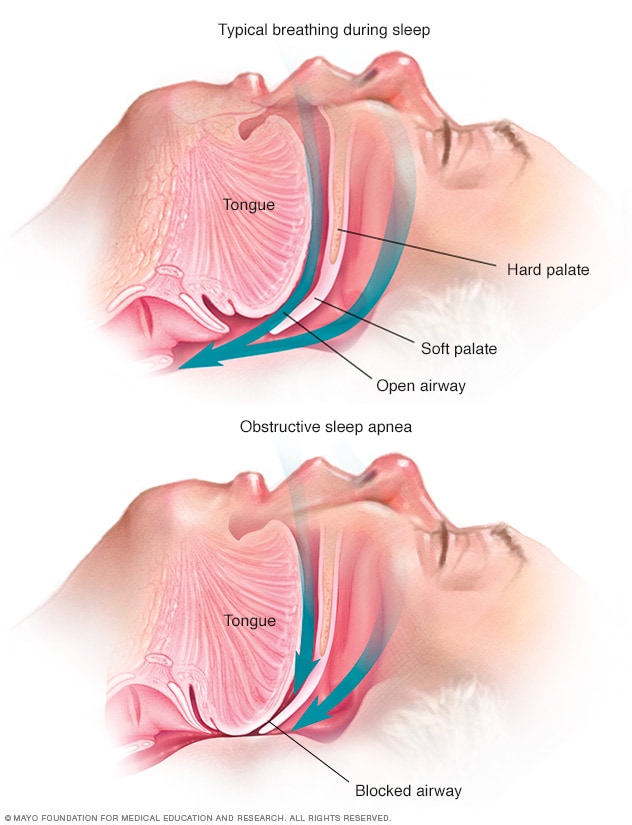
When something blocks flow of air through the mouth and nose, snoring occurs, as a common condition. As the air struggles to push through, soft tissues vibrate. Sometimes a nasal obstruction, deviated septum or collapsed nasal valve causes people to snore. The sound can also be caused by the tongue. But snoring can also be a symptom of obstructive sleep apnea (OSA), a condition that affects roughly one in five people.

When we sleep, throat muscles relax, blocking the airway. Sleep apnea-caused snoring is frequently loud, and could be followed by shallow breaths, gasping or general restlessness. Other, less-serious conditions can cause snoring; nasal polyps, crooked septum, shape of one's palate or tongue, a cold or allergies. Alcohol consumption, pregnancy or obesity can also contribute to snoring.

When snoring is caused on occasion as a result of having a cold, or imbibing alcohol prior to bedtime, it is generally harmless. Constant snoring might be a good reason to have an appointment with a sleep specialist since research indicates that some 90 percent of people with sleep apnea remain undiagnosed, a condition that can have serious ramifications, including elevated risk of heart problems.

Snoring might pose a risk to health, even in the absence of obstructive sleep apnea. OSA, according to some research, may be associated with cardio-metabolic risk factors like atherosclerosis (artery disease) and endothelial dysfunction (non-obstructive coronary artery disease). People who snored but did not have sleep apnea were examined in a study published in the journal Laryngoscope where researchers found the longer a person snores nightly, the greater the narrowing he/she has in their neck arteries, which has the potential of increasing stroke risk.

Should a sleep study -- where a sleep specialist conducts a study where brain levels, oxygen level, heart rate, eye and leg movements are recorded -- reveal OSA, patients are usually treated with breathing devices -- for example, a continuous positive airway pressure machine, which blasts a steady stream of air into the nose and mouth during sleeping hours.

To prevent snoring not caused by sleep apnea, it helps to lose weight; snoring accompanies weight gain. Even the tongue can gain weight to crowd the airway. "So, weight loss will improve your snoring", explains Steven Holfinger, sleep medicine specialist at Ohio State University's Wexner Medical Center.  Men who lost over six pounds greatly reduced their snoring level, while shedding 15 pounds, eliminated it. 

"Smoking creates a sticky airway", which hampers air from flowing in an optimal manner, which in turn leads to snoring, explained Dr.Smith. Alcohol prior to bedtime causes muscles adjacent the airway to relax, increasing the chances that snoring will ensue, explained Dr.Holfinger, so it makes sense to stop drinking a few hours before turning in to sleep. And when you sleep, adjust sleeping position; optimally not to sleep on your back to avoid tissues in your upper airways drooping, so "you have a much greater chance of snoring", said Dr.Schwartz.

Doctors recommend some therapies such as nasal strips or dilators; the strips are applied to the outside of the nose at bedtime to help open nasal passages, reducing snoring. An older study found dilators to effectively reduce intensity of snoring in a majority of instances, if the snorer is absent a condition such as OSA. Customized mouthpieces (mouth guard) pull the jaw and tongue slightly forward to open the upper airway. Laser assisted uvulopalatoplasty (LAUP), involves shortening soft tissue dangling back of the throat, with small cuts in the soft palate.

Labels: , , , ,

Tuesday, March 07, 2017

Marijuana Smoking Caution

"We know there's something in opium that helps pain, and we're able to pharmaceutically develop morphine and other analgesics, but we wouldn't say to people. 'You have pain? Why don't you smoke opium'?"
"We're kind of saying to people, 'We think there's some stuff that cannabinoids will be helpful for. Why don't you just smoke cannabis? First of all, cannabis is actually a really dangerous thing for your lungs."
Paul Farnan, University of British Columbia

"Rectally is actually a lot more preferred because of the volume of absorption. You can put a lot more (sic) and it gets absorbed a lot better, but not everybody is open to this way of administration."
"We have so many other products now, so many modes of delivery, that smoking in my opinion is very archaic and has very little clinical applicability."
"Having said that, I think that probably the majority of people still smoke because it's the most available method."
Mikhail Kogan, George Washington University

"We know that there's an issue with smoking. However, we can't control it at the patient level."
"We're trying to develop new product forms so they [cannabis users] would be more inclined to go away from [cannabis in smokable format] that."
Colette Rivet, head, licensed cannabis producers, Canada
related content

Experts are warning, amidst all the excitement in the public surrounding the growing social and legal acceptability of marijuana as a pain reliever and the ever-growing prospect of communities legalizing marijuana for recreational use, that there are certain health risks that should not be overlooked with its use. Among them smoking marijuana, which presents with the very same risks to lungs and the prospect of cancer down the road, as tobacco use.

Smoking may also dilute the effectiveness of marijuana for the very purpose of pain relief, and experts are pointing to alternate methods of marijuana use as being more efficient while presenting as absent the smoking risks. Those experts are attempting to drive home to people's consciousness that the potentially serious side effects linked to smoking would be best avoided, with alternate methods of consuming marijuana contemplated in its stead.

Doctors, for example, prescribing opium to patients for pain relief do not habitually give them a prescription for an opium pipe. And Dr. Kogan at Georgetown in Washington simply feels it is far more sensible to seek ways other than smoking to absorb marijuana to enhance its usefulness. Simply put, he points out, the drug is difficult to absorb through the lungs by smoking it. Additionally, gastric acids interfere with its potency, when it is taken in edible form.

A workable alternative, he offers, is to place it under the tongue. Or to use it rectally; both alternatives are favoured because of their absorptive capabilities. While the Canadian Medical Association has taken no formal position on medicinal pot consumption, officially it opposes the inhalation of any burned material sourced from plants.

Jeff Blackmer, a spokesman for the CMA, adds to that the fact that many doctors remain loathe to prescribe medical marijuana in recognition of the dearth of peer-reviewed research findings regarding the medical effectiveness of the drug, let alone its possible side effects, the dosage levels that might be deemed appropriate, and other additional considerations.

As for the association representing Canadian licensed cannabis producers, it agrees that smoking medical marijuana is problematical, but in the final analysis they are geared to produce the product, make it available, attest to its purity under sterile growing conditions, but stop short of persuading people how best to use it.

A worker harvests medical cannabis plants near Nazareth, Israel.
A worker harvests medical cannabis plants near Nazareth, Israel. Photograph: Amir Cohen/Reuters
Physical effects of marijuana smoking use:
Lung and breathing problems
Like tobacco smoke, marijuana smoke is a mix of toxic substances. Marijuana smoke irritates the throat and lungs, causes coughing, and is associated with symptoms of bronchitis. Marijuana smoke also contains many of the same cancer-causing materials as tobacco smoke.
Regular marijuana smokers may suffer the same symptoms as tobacco smokers, such as:
  • chronic (ongoing) cough,
  • increased phlegm buildup in the throat (mucus),
  • frequent chest problems, and
  • greater risk of lung infections.
Health Canada

Labels: , , ,

 
()() Follow @rheytah Tweet