Ruminations

Blog dedicated primarily to randomly selected news items; comments reflecting personal perceptions

Thursday, December 03, 2020

Branching Out


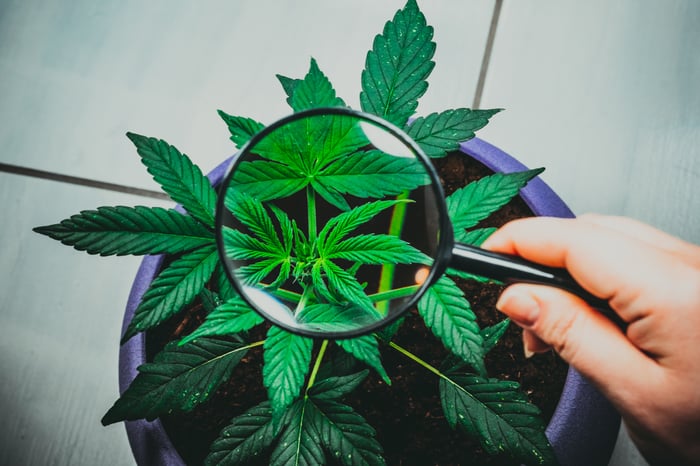
A magnifying glass held over a potted cannabis plant.
Image source: Getty Images.
"We can use their certifications ["Clean Green", instead of certification by the U.S.Department of Agriculture] to identify brands that have jumped through significant hoops in order to market themselves as 'Clean Green Certified'."
Cooper Ashley, data analyst, Headset, cannabis data provider 

Consumers interested in organic products from clothing to fruits and vegetables may soon be searching out cannabis growers who bring to market certified organic cannabis. The market for organic weed is certainly there, just as consumers search out organic coffee and strawberries and organic fibre clothing.
Coming to a market near you ... wait for it!

"We believe that in five years everything is going to trend toward organic", Boreal Uruguay Chairman Gonzalo Aguiar said with assurance. One of Latin America's largest cannabis drying facilities was recently opened by his company. In Europe, organic hemp flowers rich in CBD fetch $600,000 to $800.000 per metric ton, representing a 30 percent premium over regular flowers. The hitch? Every step, from seed, through to the drying process must be documented.

There is a scarcity of data for organic marijuana on the market, yet overall demand for cannabis is expected to surge around the middle of the next decade as more countries see fit to loosen drug laws. Industry research firm BDSA visualizes global legal cannabis sales tripling and then some, from last year to $46.6 billion come 2025.

Specialists like Argentina-based Organizacion Internacional Agropecuaria SA will offer certification to cannabis producers in Uruguay and the Uruguayan seed agency Inase plans as well to offer organic certification around the first half of 2021. The hurdle is seen in the United States where products can be marketed 'organic' only once they are certified by the Department of Agriculture and this will not happen while cannabis remains illegal at the federal level.
 
Marijuana buds with a judge's gavel on a U.S. flag
Image source: Getty Images.
A third-party organization called "Clean Green" offers its own certification, similar to the organic quality recognized by the USDA. A not-for-profit cannabis producer, Brother David's, is attempting to bridge the certification gap faced by cannabis in the U.S. David Bronner, head of Dr.Bronner's Magic Soaps plans to launch a special cannabis-scented soap in hopes of expanding a certification program toward a nation-wide standard.

Sun + Earth Certified plans to verify cannabis products are pesticide-free, adhering to labour and environmental standards similar to how the USDA grades food. "It's a way of giving small-scale farmers more power", explained the head of Dr.Bronner's. 

Uruguay, one of the world's most established cannabis export markets, sees local grower Colfores planning to obtain organic certification from Inase for its CBD-rich hemp, expecting to sell it next year to medical cannabis producers in Canada, Germany, Israel and Switzerland, according to Veronica Quintela, Colfores' chief executive.
 
A bearded exhaling vape smoke while outside.
Image source: Getty Images.

Labels: , , ,

Tuesday, January 29, 2019

Grooming With Care

"Kids are smart and they're watching everything and everyone."
"The conversations should be about authenticity and honesty."
"There is a difference between discretion and hiding. Hiding encourages stigma because it is something that you keep from people. Having discretion is about responsible use."
"It's maybe not that I don't trust my own kids. I keep it [cannabis] locked and away from them so that they understand that it's an adult-use product."
"My job is to be a responsible user and store it [cannabis] responsibly and have these conversations. I want to have a dialogue with my kids about this."
Ashleigh Brown, founder, SheCann

"I just asked myself, 'I know my adult children are smoking it, so why am I the one hiding it?"
"We're all adults here."
Sabine Dolby, 56, Toronto

"There are downsides to [cannabis use], but if we don't talk about it, how are we really going to know?"
April Pride, founder, Van der Pop, cannabis lifestyle, Seattle


In this post-legalization world of cannabis access beyond medical use and into the recreational sphere parents of teens find themselves suddenly faced with the need to discuss the use of pot with their adventurous children, adolescents forever attracted to the exotic and 'forbidden'. It's good strategy. Just as good strategy and very badly needed, as when parents begin to discuss with their children the ins and outs of intimate sexual relations, how babies are born and how best to deal with one's hormonal cravings to experiment and learn first-hand what all the fuss is about.

In the Toronto of recreational marijuana legality, a recent event titled Women & Weed took place, where a number of speakers addressed the audience interested to hear first-hand from those upon whom they look as 'experts' to guide them in their own perplexing search how best to handle the sensitive issue of parent-child discussions revolving around the use of cannabis. Uppermost in mind of these parents is the certain knowledge that young people will and do extend themselves to discover first-hand what's happening.

That, linked to the medical community warning of the deleterious effects of marijuana use for young people whose brains are still developing and who, with the use of pot, can expose themselves to harm, makes the issue of primary importance. At that event, the founder of SheCann, an online portal enabling women in Canada to share their own use of medical cannabis experiences, emphasized the importance she places personally on making these discussions a continuous dialogue.

The #1 Parenting Tip of All Time

Ashleigh Brown of SheCann spoke of her own experience with medical cannabis begun in 2016, using it medicinally giving her children the decided impression that pot was a medicine, nothing more. Then she initiated discussions with her 14- and ten-year-old daughters about cannabis used by different people for a host of reasons; not necessarily confined to health. Both she and April Pride stressed the importance of conversations with children, to prepare them for the inevitability of being knowledgeable to a degree about weed they'll come across in future on the street and at parties.

There is a correlation, they stressed, between advising and discussing with children the effects of recreational alcohol, and no less so with cannabis. And one of the critical issues in such discussions is to explain why it is that marijuana is meant to be used only by adults, and until such time as young people join that category of maturity, its use can present a future health danger. Both women explained that they lock their pot away from their children. Despite which they feel that avoidance of conversation about cannabis use creates an aura of stigma, unhelpful in persuading kids to make considered decisions.
Kids Smoking Weed | Teens Smoking Pot

They recommend using resources as for example from Canadian Students for Sensible Drug Policy which views problematic drug use as a distinct issue of health, not an issue for the criminal justice system, advocating instead for harm reduction support. Talking to children about why and how people make use of cannabis is a start. Sabine Dolby who uses cannabis by prescription hid it from her children when they were young. Now, aged 24 and 30, she smokes with her children as a regular user and with legalization, feels relieved not to have to hide her use any longer.

The Canadian Centre on Substance Use and Addiction's position is that consuming cannabis on a regular basis during adolescence has the potential to cause loss of concentration and memory, and reduce thinking to incoherence. In a 2015 report, the Centre stated that regular use of cannabis is associated with experiencing psychotic symptoms and the development of schizophrenia, particularly among those with a family history of the condition.

There is a caveat that connection between cannabis use and mental illnesses, particularly acute anxiety, is not clear entirely, requiring additional research. The general consensus remains, however, that the effect of cannabis on not-yet-fully developed brains -- up to age 21 to 25 -- makes it imperative that such discussions do take place.

Marihuana leaves in head
Maren Caruso/Offset (leaves); Kichigin/Shutterstock (head); Sergejs Makarovs/Shutterstock (leaf)

Labels: , , , ,

Tuesday, July 03, 2018

Cannabis: Harm Reduction and Hyperbole

"The tricky part is that part of harm reduction will continue to be that you shouldn't be using this product."
"By being more honest and open that cannabis can be used responsibly it will add credibility to the messages that say, 'but you shouldn't really use it under these settings, and one of those is if you're a young person."
"[There is evidence supporting each of the proposed health warnings by Health Canada] and none of them -- except for the warnings around pregnancy and breastfeeding -- actually say people shouldn't use cannabis. That's harm reduction."
"[Most people use pot responsibly] but there is a reasonable number who can have problems controlling their use, and signs of daily use can be an indication of that."

David Hammond, professor, school of public health, University of Waterloo, Ontario

"[People tune out sensationalist scare tactics and condescending messages; abstinence-only propaganda -- and 'Just Say No' campaigns fail to resonate with youth...]"
"If they do find themselves struggling with use, they need supports they can use rather than judgement, or, worse, criminalization."
Heather D'Alessio, spokeswoman, Canadian Students for Sensible Drug Policy
Health Canada wants all weed to be labelled with health risks. Photos via Health Canada

The group, Canadian Students for Sensible Drug Policy has undertaken an initiative of their own, to produce a "Sensible Cannabis Toolkit" information package which they have based on what they feel is realistic evidence-based information to help guide young adults in their conversations with adults when discussing the use of weed. Most pot users, they point out, do not use pot as a 'gateway' to transition to the use of harder drugs.

They also take issue with the use-associated mental health problems in the heavy use of cannabis concluding that there is an association with cognitive impairment and other mental health problems. "Any strong conclusions around causality" -- which came first? -- remain uncertain, according to their informative website.

Recently, a review of available literature associated with pot use led by researchers at the B.C. Centre on Substance Use discovered that what is believed to be a link to a lower IQ in later life among adolescent-use of high frequency, is belied by the findings of more recent studies concluding no association after controlling for social factors like background poverty and the neighbourhood that users grew up in.

Early efforts at Colorado public health after the state's 2014 legalization saw some of their informative harm-reduction efforts fall flat and face criticism by pot advocates for their condescending undertones. Leading Professor Hammond to the view that pot advertisements must reach beyond "use or not-use", to include information more specific such as that smoking adds toxicity in excess since THC levels in the pot currently in circulation are much higher than what prevailed during the Boomer era.
Who uses cannabis?

Health Canada is preparing to roll out a $5.1-million marijuana education tour to travel across the country in an effort to prepare the public before the cannabis legalization comes into effect in Canada by the target date of October 17. Plans are underway to set up exhibits at local events such as fairs, festivals and Canadian Hockey League arenas from July in the Maritimes and Northwest Territories before moving on to other provinces and territories.

Exhibits will be complete with climbing walls, interactive graffiti walls and similar such infrastructure in an effort to encourage people to to discover activities "that can give them a natural high, rather than using cannabis". "Ambassadors" will be tasked to "engage visitors in conversations about the health and safety facts on cannabis", to staff the exhibits.

A list of proposed pot packaging warning labels is being released by Health Canada. That cannabis smoking is harmful; that teens are at greater risk of harms; that people should not drive stoned; that women should not use if pregnant or breastfeeding (new links of pot exposure in the womb or through breast milk have been identified with stillbirth, preterm birth, low birth weight and poorer mental developing in children), are all driving the government's effort to ensure people are adequately informed of risks involved in indulging in cannabis.

Critics,  however, have highlighted one of the warnings for special attention; the warning that "up to one in two people who use cannabis daily will become addicted", has been seized upon as extravagantly unwarranted. Dr. Hammand and colleagues published a paper last year in the Canadian Journal of Public Health outlining their findings that a "very small proportion of Canadians report using cannabis to a degree that is problematic", with only two percent of the sample of respondents reporting the use of pot in the past three months seen to be at high risk of developing health or other problems.

Cannabis consumption through the decades

Labels: , , , , , ,

Wednesday, December 27, 2017

Placing the Market Before the Legislation

"When you think about medications that have been given approval to be sold in pharmacies, that's where most if not all of our medications come from [after hundreds of millions are invested in clinical trials, for marketing approval]."
"That model simply does not hold for much of the classical herbal cannabis research, where you're looking for basic claims of efficacy and safety, but not trying to make a formal claim for a product that is going to be patented."
"Access to a credible placebo may seem like an odd thing to have as a challenge. But bear in mind that many of these studies are placebo-controlled, so you need a drug which is a credible placebo -- looks and smells and for all intents and purposes pretends it is cannabis when in fact it does not have the active ingredient you are testing."
Mark Ware, pain researcher, McGill University Health Centre, Montreal

"It's [marijuana] already at market so there's really no incentive, or virtually no incentive, for licensed producers to take the money they're generating from the sale of these products and reinvest it in research."
"One thing that was quite consistent was adverse events. And the benefits, even if they're real, are much smaller than what people might anticipate."
"I think this gives [doctors] some comfort, saying, 'Look, here's the evidence. It's actually missing in a lot of places, so I can't give it for conditions X, Y and Z'."
"Some of the pain studies go for nothing more ... than five, six hours. And this is for chronic pain. It's hard to get a great feel for how someone is going to do long term on a medicine after five, six hours."
"[The only evidence of marijuana being used to treat glaucoma is a single randomized study conducted on six patients]. We would kind of be putting the cart before the horse if we started to prescribe this without the research."
Dr. Mike Allan, professor of family medicine, University of Alberta, Edmonton
Advisories prepared by the Alberta College of Family Physicians, distributed to more than 32,000 clinicians, outline the scientific literature, or lack thereof, around medicinal marijuana.
Advisories prepared by the Alberta College of Family Physicians, distributed to more than 32,000 clinicians, outline the scientific literature, or lack thereof, around medicinal marijuana. (CBC News)

"We're in a unique place because a lot of large pharmaceutical companies are reluctant to fund these studies where they don't necessarily see the incentive for something that they aren't able to patent."
Professor Robert Laprairie, University of Saskatchewan

"You can design a short-term study with marijuana, or for that matter, with alcohol or opiates, and say, 'Look, we gave people a bunch of alcohol over a three-day period or one week or one month and they seem to feel better. It helped their anxiety'. But that doesn't mean it's a good medication."
Dr. Meldon Kahan, Women's College Hospital, Toronto
Medical Marijuana: How the Evidence Stacks Up
There is controversy aplenty, and lots of second guessing and hand-wringing over potential consequences with the final federal approval in Canada of legalizing the growing, marketing, use and possession of marijuana in mid-2018. The process of licensing growers and commercial sales outlets is ongoing. The agreement to divide the taxes derived from the sale of the weed between the federal government and the provinces has been settled. Police forces throughout the country are attempting to understand the parameters around which they will work in enforcing the law relating to driving while high.

The Colleges of Physicians and Surgeons are concerned as are Pediatricians, over the possible deleterious effect on the nation's youth that may result with those under 20 years of age using the drug that has the potential to inhibit brain maturity. And there are concerns over the prospect of a future where the consequences of long-term use of marijuana may turn out to be problematic because no one has ever done a concentrated study specifically to determine what those consequences might be.

The market of social users, like that of medical-use marijuana, continues to grow apace. Health Canada's data shows that licensed medicinal cannabis producers have increased between June of 2016 and June 2017 at a steady rate, from 75,166 to over 200,000; a tripling of registrations in each year  to the present.Yet concern is growing that there is no data with respect to long-term health outcomes with marijuana use.

The pharmaceutical model where research is conducted to license and patent a new drug to enable it to be commercially viable after proof that its use has medical merit, at a cost of multiple millions of dollars for each patent, in the greater interests of future years of sales, has bypassed a product that is already in circulation and has been for countless years, a product whose merits and demerits are vaguely recognized but has never undergone the scientific rigor of research and clinical trials.

Precisely because so many people have turned to the use of medical cannabis while questions remain open regarding its risks and effectiveness is hugely concerning to health authorities. This is a medication that was once regarded strictly as a recreational drug that has never undergone years of expensive commitment to scrutiny. There is no exclusivity of production and sales with marijuana, unlike what normally occurs when bringing an entirely new class of drugs to market.

However, points out Dr. Ware who served as vice-chair on the federal government's legalizing cannabis task force, the competition existing among licensed marijuana producers has led some to decide to invest toward research if only for the purpose of differentiating their brand from                that of other producers. Dr. Allan, on the other hand, foresees few benefits for producers to invest in such research since they already have a free, shared market.

And should negative results surface from any such research and resulting trials, no one would benefit; an obvious disincentive to embark on the process. A positive result from research, on the other hand, would change nothing. Still, according to Dr. Laprairie, there has been a steady and rising interest on the part of academics, patients and licensed producers to engage in advanced medical cannabis research.

Dr. Kahan is of the opinion that evidence does exist that cannabidiol, a marijuana compound, does produce medical benefits inclusive of pain relief, though he feels more study is required. The absence of a placebo that would be seen to be plausible appears to be a problem, since future study participants quite often have had ample experience with the use of cannabis, enabling them to readily recognize whether they have been placed in the study or the control group.

Dr. Allan points out a study finding that between 85 and 90 percent of nurses, for example, were able to differentiate when patients were on pills with cannabis derivation.

THE CANADIAN PRESS/Sean Kilpatrick

Labels: , , , , , ,

Thursday, December 14, 2017

Physicians Balking at Prescribing Unresearched Medical Marijuana

"One thing that was quite consistent was adverse events. And the benefits, even if they're real, are much smaller than what people might anticipate."
"I think this gives [doctors] some comfort, saying, 'Look, here's the evidence. It's actually missing in a lot of places, so I can't give it for conditions X, Y and Z'."
"Some of the pain studies go for nothing more ... than five, six hours. And this is for chronic pain."
"It's hard to get a great feel for how someone is going to do long term on a medicine after five, six hours." 
"We would kind of be putting the cart before the horse if we started to prescribe this without the research."
Dr. Mike Allan, professor of family medicine, University of Alberta, Edmonton
THE CANADIAN PRESS
Medical marijuana is shown in Toronto on Nov. 5, 2017.   Graeme Roy/THE CANADIAN PRESS
 The Alberta College of Family Physicians edits and distributes 'advisories' which are distributed to over 32,000 clinicians, bringing them up to date on the scientific literature, or in the case of medical marijuana, lack of any such scientific literature attesting to its usefulness, efficacy, and dependability as a drug protocol to ease peoples' pain and discomfort brought on by certain medical conditions. Since a shortage of -- virtually none in fact -- of such research supporting the proposed benefits of medical cannabis exists, there is evidence contrary to popular belief that the use of marijuana as a medical drug may end up being more harmful than useful.

And precisely this, is what family doctors' associations across Canada are now advising their professional members to ensure that they are in receipt of real data, not theoretically-wished-for information, before they think about prescribing the drug, surrendering to their patients' uninformed emphasis on the good using it will purportedly do them. "Tools for Practice" is what the Alberta College publishes as biweekly updates focusing on topical issues, circulated through professional chapters in every province with the exception of Quebec, and Newfoundland and Labrador.

Physicians had indicated they needed professional guidance in the prescribing of medical marijuana. And this need to provide them with what they're concerned with inspired the three most recent updates. The reality is that family doctors are increasingly under pressure from their patients wanting more information about the usefulness and availability of medicinal pot. Searching out reputable and reliable research seemed the best way to go. And after having reviewed all available literature on the subject, Dr. Allan is convinced that medical marijuana represents a high-risk product useful only in specific circumstances and only then where other, safe treatment options have been exhausted.

The number of clients registered with Health Canada for licensed medical marijuana products leaped forward as of June 2017 to over 200,000 individuals, representing a 2.7 increase over the 75,166 people registered last year. A consistent tripling of registrations has occurred in both 2015 and 2016 as Canada moves closer to the legalization of social marijuana use. "The decision to use cannabis for medical purposes is one that is made between patients and their health-care practitioners, and does not involve Health Canada", advised department spokeswoman Tammy Jarbeau.

A document updated in 2013 was published by Health Canada as an information bulletin for the use of medical professionals as a guide to the benefits and harms of medical marijuana. Within the bulletin is a disclaimer that cannabis is not to be considered an approved therapeutic product and Health Canada does not endorse its use. As for the first advisory prepared by Alberta's family physicians college released on November 14, it reports that evidence is "too sparse and poor" to reach any conclusion that marijuana has proven effective in relieving pain.

Two weeks on, a second advisory was circulated which describes  "adverse effects", representing one of the only consistent findings through the existing studies being perused. Those adverse effects included hallucinations, paranoia, dizziness and low-blood pressure. Most studies, it pointed out, involve patients with a history of using cannabis, thus are unlikelier to experience the negative side effects that the average person would experience. Taking that under consideration, it is assumed that research probably underestimates the frequency of adverse outcomes.

Other studies conclude that marijuana use can reduce chemotherapy patients' nausea, and can as well control spastic muscle contractions in patients with multiple sclerosis. No evidence exists, however that there is any positive effect on chronic anxiety or on glaucoma, despite these two conditions often being cited by advocates of the industry. The result is that documents released by both colleges of physicians and surgeons in British Columbia and Alberta emphasize the absence of reliable studies giving evidence of any effectiveness of cannabis as a trustworthy medication.
"I'd be the last person to suggest that cannabis was entirely safe or entirely appropriate for every individual."
"[But the college's apparent bias in highlighting the harms and bypassing the benefits is concerning]."
Philippe Lucas, head, Canadian Medical Cannabis Council
An employee inspects buds at the Tweed plant in Smiths Falls, one of Canada's largest suppliers of medical marijuana. The number of patients signed up with Tweed and other suppliers has tripled in the last year. LARS HAGBERG / AFP/Getty Images

Labels: , ,

 
()() Follow @rheytah Tweet