Ruminations

Blog dedicated primarily to randomly selected news items; comments reflecting personal perceptions

Friday, March 20, 2020

Getting Bored. Isolated. Depressed. Don't!

"I know that you're not at risk, and that you want to see your friends. But if you do it, people will die."
"Even if you don't show the symptoms, you could still be carrying the genome, which means that  you can't go see that show."
"I haven't showered in three days, but my hands have never been cleaner."
Beatrice Martin (Coeur de Pirate), video, Quebec

"Limit your outings, try to avoid gatherings and respect social distancing measures."
"Greet people from a distance and wash your hands frequently."
"All these small individual sacrifices will minimize the impact of this pandemic on our community."
Laurent Duvernay-Tardif, Super Bowl-winning football player, M.D.

"The message I have today is for youth and teens. We have seen in Italy and in South Korea that young people were very important in the transmission of the virus and the information we have so far is that they don't take that seriously enough right now."
"Maybe as a young guy or young girl you're not really at risk of that, but you can give the virus to your grandmother or grandfather and then they are at risk."
Quebec Premier Francois Legault 

"Quebec authorities are using the proper channels to reach their target audience. If you're trying to get a message across to young people, then you need to go through social media. And they are doing that very successfully."
"Will that message get through? We'll find out soon. But coercive methods are not usually the most effective when speaking to rebellious teens. So I think this is the right strategy."
Dr.Sandrine Prom Tep, marketing professor, Universite du Quebec au Montreal, ESG business school

Coeur de Pirate
Montreal singer-songwriter Coeur de Pirate

When little else works to persuade the young on a prudent course of action, meet the  young on their own favoured grounds; social media platforms. And to that end, Quebec's Premier Legault sent out an appeal to popular Quebec celebrities whose following is mostly the young in the province, to help deliver a message in the interests of aiding the province to move toward a  high level of awareness among all its citizens, old and  young alike.

That appeal elicited the desired fallout, when popular Quebecois musicians, actors, comedians and athletes took to social media with videos, tweets and memes to appeal to the consciousness of young people in the province moved by the messages of the entertainers that have won popular acclaim as celebrities in the opinion of their young followers who have been immune to the messages urging social distancing to help avoid growing infection with COVID-19.

To date, 121 people in Quebec have been confirmed to have the novel coronavirus that is sending shock waves all over the world. One person has thus far died of the coronavirus in the province. The province is intent on delivering a simple enough message: stay home. Wash your hands. Avoid being a vector for transmission of the coronavirus.

Quebec is set on avoiding, if at all possible, a scenario where a St.Patrick's Day party took place in the streets of Kingston, where despite calls for it to be cancelled, Queen's University students chose to party. And something peculiar has arisen in that the Province of Quebec's director of Public Health, Dr.Horacio Arruda, who has gained the trust and admiration of Quebecers for his plain speaking style, has delivered a message of his own and it is resonating.

"Maybe parents should put soap and Purell next to the beer for your teens, and again, I do not recommend what I would call any exchange of bodily fluids at this time", Dr.Arruda delivered with a light smile during a daily briefing. In a video that highlights Dr.Arruda's messaging he explains the lack of rationality behind wearing a mask by those not infected by COVID-19.

"Wash my hands, so the virus I could have caught in the metro isn't on my hands anymore. But if I only wear a mask and think I'm protected, then I touch things and then I touch my face ...", he stated, while poking fingers around his eyes. His tone and explanations have gained him high praise in the Quebec media and approval from the public.

"Try doing what you never have time to do", suggested the doctor. As for himself,  his plans include trying out new recipes for Portuguese egg tarts. "It could be yoga. It could be music. It could be dancing, maybe even dancing online with someone else over FaceTime. But don't stay at home doing nothing. You'll get depressed."

Labels: , , , , , ,

Sunday, January 19, 2020

Social Isolation and Loneliness

"I have pretty much always been introverted. I was used to being in the apartment all the time. It became almost a habit."
"If you're interacting with a group, people are expecting you. You're motivated."
"When you're by yourself, it's easy to get into that negativity spiral. It's important to get that reinforcement from people."
"Unless I motivate myself, I just go to fortress mentality. I have to come up with strategies to motivate myself and interact with the world."
Ken Roberts, 56

"The whole issue of aging alone is a huge issue for Canada for a number of reasons."
"You have densely-populated urban environments, where you can be alone in a crowd. There are suburban environments where lack of transportation can lead to social isolation."
"And then there are the distances for people in rural areas and the north."
Nora Spinks, CEO, Vanier Institute of the Family

"There is no other health condition that affects half of Americans."
"Nobody saw this issue a year and a half ago, and we're already getting legislation in Washington. This is starting to get traction."
"The market is starting to react to the ideas that loneliness is a condition that can be managed."
Andrew MacPherson, director, U.S. Coalition to End Social Isolation and Loneliness
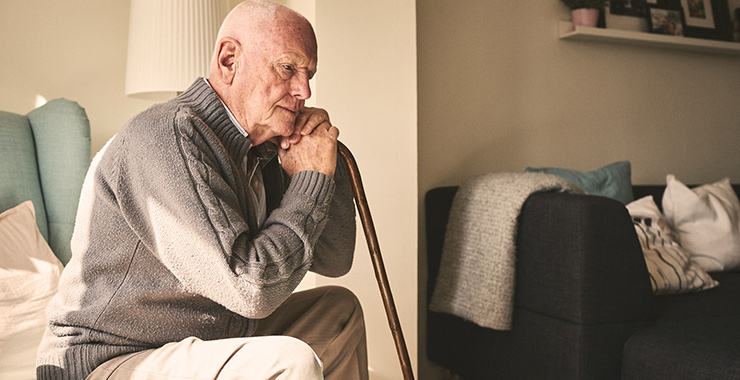
Older man sitting and leaning on a cane
American Psychological Association

The International Federation of Ageing report commissioned by Employment and Social Development Canada concluded the top issue facing seniors, only now emerging fully to public scrutiny, is ensuring that they be socially connected and active. "Everyone is looking for an answer about how to fix this", Mary Pat Sullivan, professor of social work and social gerontology at Nipissing University, observed.

She had travelled  to the United Kingdom where she undertook research on social isolation and loneliness for two decades, and recently returned to Canada. "I can see that interest is starting to pick up here". Last May, the first "summit on social isolation and companion animals", held in Washington, attracted public health officials, gerontologists and veterinary researchers.

Nicholas Kristof, New York Times columnist, last month urged a war on loneliness, recommending research that has demonstrated that dog owners -- not cat owners -- are less lonely, thanks to the companionship offered by dogs. That, even though a growing body of research finds no full agreement on whether pet ownership is a balm for loneliness as a certainty.

Menshealth.com posted an article in October with the argument that men form friendships differently than do women, requiring different methods to ward off loneliness. The article headline read: "Loneliness is fatal. Video games can keep men alive". Let No One Be Alone Week, encouraging people to reach out to seniors, is a special event observed in Manitoba. In Vancouver, Hey, Neighbour! was a pilot project attempting to connect apartment dwellers through shared activities; from board game nights to a workshop on emergency preparedness.

There are eleven community health centres in Ontario, part of a pilot project meant to issue "social prescriptions" for people who feel disconnected, the prescriptions featured for activities ranging from dance lessons to museum visits, to increase social connections. Clients can be referred by doctors, nurses and other health professionals identifying social disconnectedness from among their patients to "link workers" who then look for social opportunities tailored to the specifics of the individual.

This is a therapeutic notion pioneered on strategies used in the United Kingdom, whose National Health Service is engaged in social prescribing, calling it a "key component" of universal personalized care. Social prescribing is supported by 59 percent of general practitioners in the U.K. in the belief that it can aid in reducing their workload. An announcement was broadcast a year ago that the NHS was hiring another thousand link workers.

Young woman alone looking out window

Social isolation is not the same as loneliness; the former relates to the number and frequency of links in a person's social network; an objective issue, whereas loneliness is subjective in nature; an individual reaction to the quality of those connections. One can be socially isolated and not be lonely, given people's varying personalities and perceptions and values.

There are studies linking chronic loneliness with the risk of early death, coronary heart disease, stroke, cognitive decline, and dementia. There is no doubt that feelings of loneliness makes people more susceptible to a depressive state. In addition to which, loneliness and a dearth of social interactions are seen to be predictive of suicide among older people.

Researchers at the University of Manitoba Centre on Ageing reported in 2015 that among people in the 45-plus range who were hospitalized, loneliness was associated with a higher likelihood of returning to hospital. Social isolation was associated, on the other hand, with a higher likelihood of remaining in hospital for a longer period.

20 Facts about Senior Isolation That Will Stun You

Shifting demographics point to a solitary future for many people. For the first time in recorded Canadian history, the 2016 census discovered one-person households to be the most common household type in the country. Reasons for living alone are also undergoing change. About 22 percent of people living alone in 2016 were widowed, reduced from 33 percent in 1981, but 32 percent of people living alone were separated or divorced, close to tripling the 1981 rate.

Loneliness, according to former U.S. surgeon general Vivek Murthy, is a "growing health epidemic". Socially isolated seniors in the United States are estimated to be facing a 19 percent greater risk of death, and the cost in Medicare spending is $134 more monthly. Disconnectedness is seen to be more predictive of early death than effects of air pollution or being chronically sedentary, according to research by Julianne Holt-Lunstad of Brigham Young University.

A study of 5,100 Americans and their social contacts published in 2008 considered the possibility that loneliness is contagious, that when one person feels lonely, that feeling can communicate to others in a network and over time every additional day of loneliness per week led to an additional day of loneliness monthly for those in the social network.

Australia formulated the Coalition to End Loneliness; the U.S. the Coalition to End Social Isolation and Loneliness. The Dignity in Aging Act updates the 1965 Older Americans Act, placing a major focus on social isolation and empowering local organizations to evaluate solutions for social isolation, incorporating social isolation screening into health and supportive services for seniors in the U.S.
Loneliness is an issue around the world. KatarzynaBialasiewicz / Getty Images/iStockphoto

Labels: , , , ,

 
()() Follow @rheytah Tweet