Ruminations

Blog dedicated primarily to randomly selected news items; comments reflecting personal perceptions

Monday, December 06, 2021

Virulence, Infectiousness, Geographic-Linked

"South Africa has a low vaccination rate but a large proportion of the population has been infected during previous COVID-19 waves."
"As such the results from this study are not directly portable to other settings such as Europe or North America and more data will be needed before we can make any more robust prediction about the potential threat."
Francois Balloux, director, professor of computational systems biology, University College London 
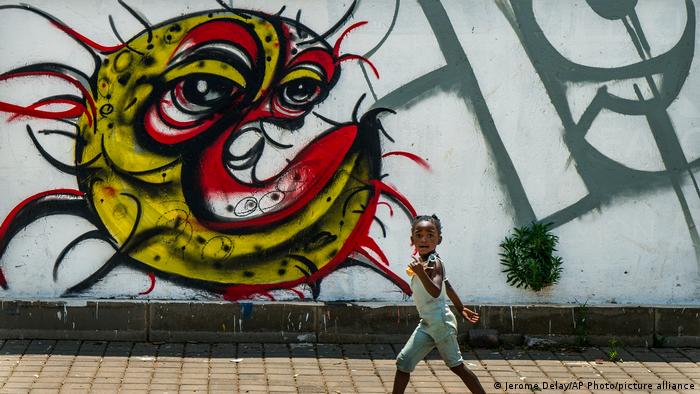
A child walks past a COVID-19 graffiti in Soweto's Orlando West township near Johannesburg
The omicron variant was first reported in South Africa, but has quickly been found around the world

Calls for tough restrictions on COVID-19 have been led by new data arriving out of South Africa which suggest the Omicron variant could more than double risk of being reinfected with the coronavirus. Reinfections increased substantially between November 1 and November 27, at a time that the new variant of concern, Omicron was gaining a foothold in South Africa, according to research carried out by Witwatersrand and Stellenbosch universities. 

From their data, a 2.39 times greater risk of catching the virus again exists compared to the original Wuhan strain. Information that leads to the impression that the virus has been able to bypass immunity. Those same study authors came to a surprising conclusion: In South Africa there was a drop experienced in reinfections of around 30 percent following Delta's dominance, findings that contrast with data from the U.K. Office for National Statistics this week.

People in England had a 36 percent reduced opportunity of a reinfection under Alpha, according to the newly-released data from the Office for National Statistics, with secondary infections rising as Delta became more prominent. This indicates that variants may be behaving differently in different countries. Factors such as population age, vaccination uptake and different immunity profiles linked to whatever variants have been geographically dominant.
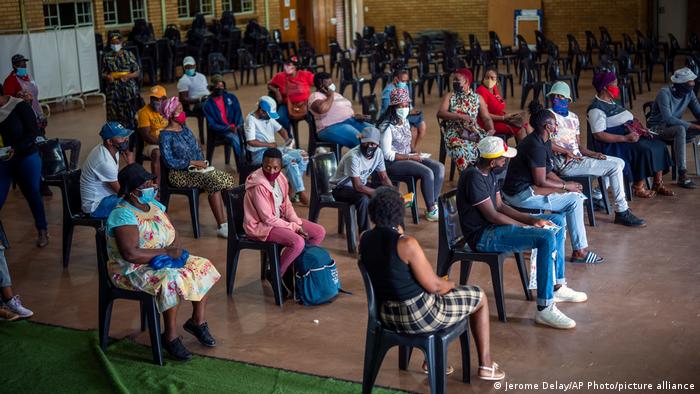
 
People who have just received their jab against COVID-19 wait for their vaccine card to be processed
The daily number of vaccine doses administered has been increasing this week
 
South Africa has an average age in its population of 27; in other words a young, oerall population median, in comparison to the United Kingdom with its average of 40 years of age. Data from the Office for National Statistics indicate reinfections are more likely to occur in those people who experienced a mild infection with their first exposure to the SARS-CoV-2 virus causing COVID.

As might be anticipated in younger, fitter populations, early anecdotal data from doctors suggest that most Omicron cases they attend to are mild in character. In Gauteng, the most populous province in South Africa, infection numbers have increased by 375 percent week over week, while hospital admissions have been elevated by 4.2 percent, and deaths by 28.6 percent in a country where a mere one-quarter of the population has been double-vaccinated.

87 percent of hospitalized cases in South Africa, revealed this week by the National Institute for Communicable Diseases, were unvaccinated. From Imperial College, research suggests that in countries like South Africa people become "imprinted" with a specific immune profile after having encountered coronavirus, its variants and the vaccines having an impact on dictating how they fight off new variants. 
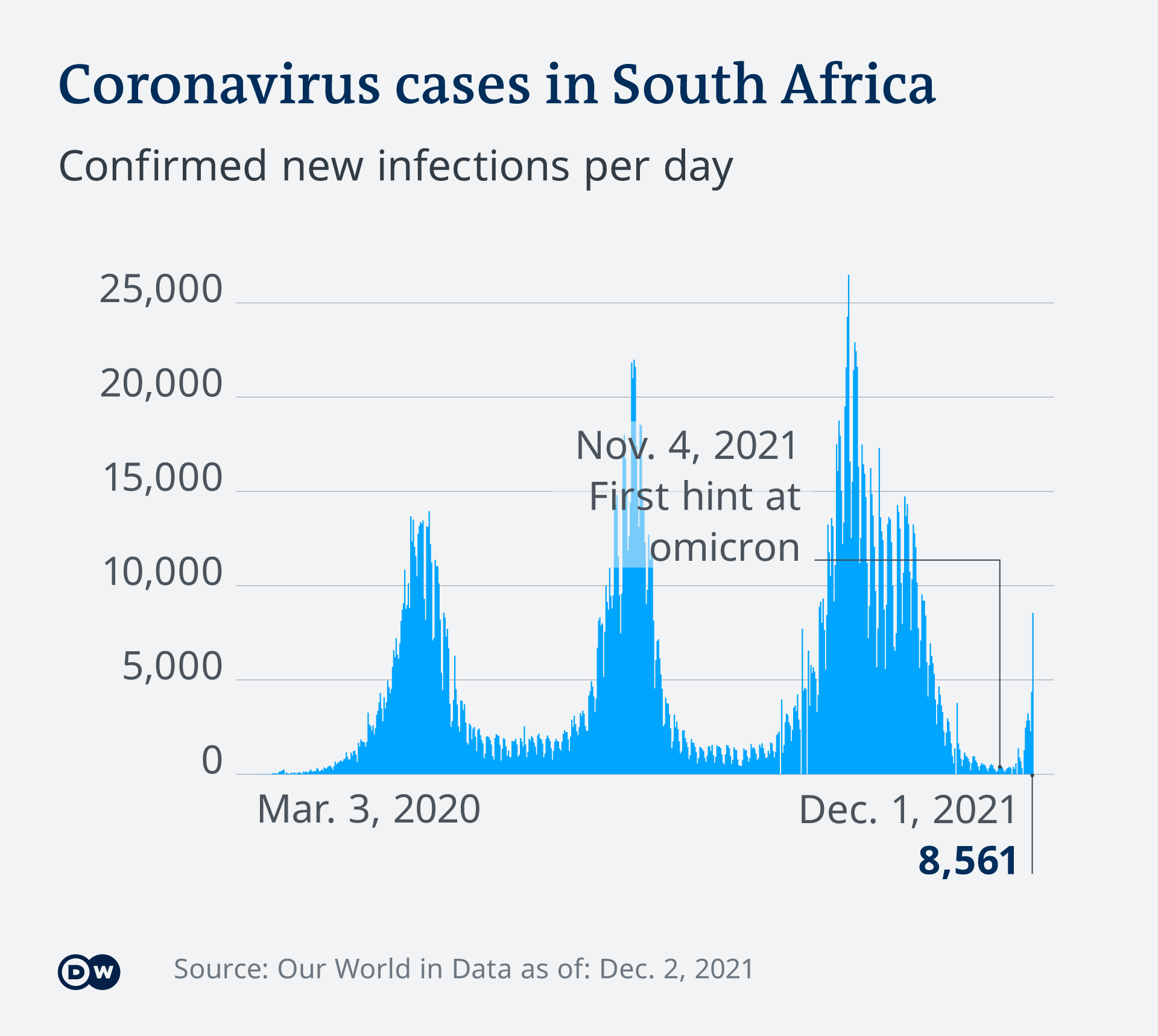
A graphic showing COVID cases in South Africa since March 2020

Labels: , , , ,

Thursday, December 02, 2021

Waiting On Omicron With Tenterhooks of Apprehension

"For the unvaccinated, mild COVID could train the immune system, much like vaccines. For the vaccinated it would be like a natural booster."
"[Should it somehow turn out that the Omicron variant produces only mild disease]; That would mean let it run. Let it run its course and reach the world."
"Maybe it causes half the amount of hospitalization and deaths. [But if there are far more infections], that's still a lot of hospitalizations and deaths."
"It could be in a population that was so isolated that Omicron evolved there and it never got out until now. It's possible that Omicron has been hiding out for most of 2021 inside somebody. That would suggest that all these changes in the spike that we're seeing actually weren't selected to help transmit from person to person. They were selected to survive and propagate within that person's body."
"But we really have zero idea. At this point I give it about a 50-50 chance of being more or less severe. That's how unsure science is at the moment."
"[If it can spread much more easily through the air], and you need even smaller particles to get infected because it's so good at getting inside our body, that is a game changer. That's my nightmare." 
Sarah Otto, evolutionary biologist, University of British Columbia

"For viruses to evolve to become less severe there needs to be 'selective pressure'. "They [viruses] don't 'care' about how sick they make people, as long as they can spread."
"[With SARS-CoV-2 the virus can spread quite efficiently, even if people don't yet show symptoms, or fail to altogether, meaning] it's not clear that there's much pressure on the virus to cause less severe illness."
Matthew Miller, associate professor of infectious diseases and immunology, McMaster University, Hamilton
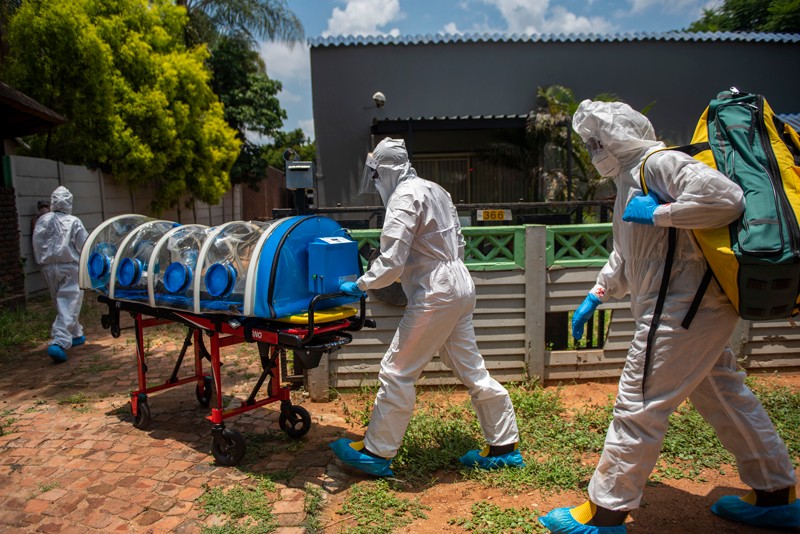
People wearing personal protective equipment pick up a suspected COVID-19 patient

Medics at an infectious-disease unit in South Africa, where a new strain of COVID is spreading quickly.  Credit: Alet Pretorius/Gallo Images/Getty

New reports have come in from South Africa with some doctors reporting cases they have seen appearing to be mostly mild, with fever, cough, aches and pains, hitting mostly younger adults of university age and healthy people. The reports speak of toddlers in hospital with Omicron, but not the medically fragile. These reports lift the hopes of experts in the field elsewhere, who study them. Doubts exist over whether Omicron is more infectiously spreadable, or can elude a degree of immunity from vaccinations or past infections.

In early stages of an outbreak by viruses new to humans they tend to cause more serious disease leading to a pandemic, attributable party to the fact that there is no pre-existing immunity. When people become very ill very quickly they become less efficient in spreading the virus since their illness keeps them isolated and away from the public. When this happens the virus tends to wear itself out. The SARS-CoV-2 experience has taught science that people can spread the virus efficiently even if they aren't showing symptoms yet.
 
WHO LabelPango LineageEarliest documented samplesTransmissibilityImmune EvasivenessVaccine Effectiveness
AlphaB.1.1.7United Kingdom+ + +— —√
BetaB.1.351South Africa++ + + +√
GammaP.1Brazil+ ++ +√
DeltaB.1.617.2India+ + + ++ +√
LambdaC.37Peru+ + + ++ +√
OmicronB.1.1.529South Africa+ + + + (?)+ + + + (?)?
 
According to studies, 40 to 50 percent of South Africans have been exposed to SARS-CoV-2 in earlier waves with one paper estimating the number of infections to be 7.8-fold higher than recorded cases. A situation of immunity which combined with vaccination could have the effect of providing protection against serious disease, which in part might help explain why symptoms of the Omicron infections appear mild. Scientists tend to to be fixated on the number of mutations on the Omicron spike protein.

It is that spike on the surface of the SARS-CoV-2 virus used by it to fix itself onto body cells when infection occurs, enabling the virus to replicate once it reaches the organs. "We've seen some of these three mutations [which enable the spike to better bind to cells] in different variants of concern [but none have all three. When my colleagues saw that they were like, 'Uh, oh'," said Dr. Otto. Cases of Omicron have now been confirmed in Canada, the U.S., Belgium, the Netherlands, France, Germany, Portugal, Italy and the United Kingdom. Like the original, it has lost no time in international travel.

There is a theory that the new variant might have been living inside one or two immunocompromised people for whom clearing the virus was difficult. In such hosts the virus could reproduce to high loads -- alternately linger for a greater period of time in people with immune systems weakened by malnutrition, unclean drinking water, untreated HIV or other conditions, according to Professor Miller. The greater the length of time the virus remains in situ, the more opportunities it has to acquire mutations.

On the other hand, according to Dr.Otto, though Omicron possesses a range of mutations in the spike protein "there's still a lot of spike that's not changed, and our immune reactions should recognize other parts well if we've been vaccinated. But it will spread like wildfire among the unvaccinated". According to the head of Moderna a "material drop" in vaccine efficacy is expected. Yet Dr.Otto is optimistic that a high vaccination rate means "we've got a base of immunity, and it's not like [Omicron] has changed at hundreds of sites in the spike. It's just changed at 30". 

Tellingly, in Tshwane, South Africa where Omicron was first identified, 87 percent of hospital admissions took place among the unvaccinated. Dr.Otto still finds it troubling that a fully vaccinated traveler who had arrived in Hong Kong from Vancouver contracted the variant virus from another traveler from South Africa staying across the hall in the same airport quarantine hotel. Translated into transmission terms it may mean that Omicron is able to transmit through smaller particles in the air, relating to more longer-distance aerosol transmission.

A man receives a dose of a COVID-19 vaccine in Soweto, Johannesburg, South Africa, on Monday. The omicron variant, first identified in South Africa, has now spread to at least a dozen other countries. Denis Farrell/AP

Labels: , , , ,

Tuesday, January 05, 2021

COVID Complications in a South African Variant

"These two additional mutations may interfere more with vaccine effectiveness in the South African variant than in the U.K. variant."
"This does not mean the existing COVID-19 vaccines will not work at all, just that the antibodies induced by the current vaccines may not bind and neutralize the South African variant as well as it would the other circulating viruses -- including the U.K. variant."
Dr.Julian W.Tang, clinical virologist, University of Leicester

"It is not anticipated that this mutation is sufficient for the 'South African;' variant to bypass the protection provided by current vaccines."
"It's possible new variants will affect the efficacy of the COVID vaccines, but we shouldn't make that assumption yet about the South African one."
Francois Baloux, professor of computational systems biology, University College London
A member of medical staff attends to a COVID-19 patient at a special ward at Arwyp Medical Centre in Kempton Park, South Africa, last month. Scientists comparing the variant of the coronavirus found in South Africa to one first discovered in Britain have found concerning mutations in the one that emerged in South Africa. (Shafiek Tassiem/Reuters)
"Fortunately, should further modifications of the vaccine be required to address the new variants, some of the vaccine technologies under development could allow this to be done relatively rapidly."
"As the new variants are already spreading to other countries, the importance of ensuring that vaccines remain effective against new variants is a global imperative."
Professor Helen Rees, vaccine expert , Wits University, South Africa
Some scientists in the U.K. and elsewhere admit to feeling fairly trepidatious over the appearance of a SARS-CoV-2 variant that is markedly different from the myriad of other mutations of COVID-19 that have emerged over time. The Medicines and Healthcare Products Regulatory Agency anticipates some work will have to be done on vaccines developed to stop COVID in its tracks. It has focused on how soon an altered vaccine might be ready to take on the task of controlling the newly-identified South African variant of COVID. 

This version of the virus has mutated  in a troubling way, though variants of coronavirus have appeared from the beginning of the pandemic, representing a naturally-evolving process through which viruses tend to adapt to their hosts while replicating. These mutations for the most part have no discernible effect beyond that of the original viral contagion though occasionally they may develop improvements enabling the virus to become more infectious, as is being seen in the U.K. variant.

It is when they have the potential to become more threatening, through resistance to the body's immune response that concern is raised. There are three mutations identified in important genes in the South African variants, one of which -- the N501Y mutation -- appears to have infiltrated the U.K. variant and could be seen as responsible for its enhanced infectiousness. There are two more mutations carried by the South African version of COVID -- E484K and K417N -- both absent in the British version.

The South African variant has mutated in a gene building spike proteins; the structures on the exterior of the virus enabling it to attach to human cells. These spike proteins are produced by vaccines to inform the body what to search for and what to resist. It is conceivable that any significant alterations to the spike protein could impact to the extent that the body's recognition of the virus is impaired, including once vaccinations take place; or in the event of a previous infection. The antibodies then produced in anticipation may be impacted, no longer capable of properly attaching to destroy the virus.

The possibility exists that the mutations may result in making it more difficult to detect COVID cases by means of the normal polymerase chain reaction testing, meaning the strain might have spread widely already. As it did in South Africa when it swiftly represented the dominant variant in the Eastern and Western Cape provinces of the country. 

Prime Minister Boris Johnson is believed to have been briefed by the U.K. Chief Medical Officer and Britain's Chief Scientific Officer that the presence of the new variant does not leave them overly concerned. Should the South African variant become more widespread and dominant, available vaccines, including the two the U.K. just authorized can be appropriately modified for greater effectiveness against the variant in six weeks' time.

That existing vaccines will still be effective to some extent is a shared belief among most scientists. Researchers, already diligently at work, have now been spurred to work around the clock, determined to discover how dangerous the new variant is, relying on new lockdown measures to aid in stemming the tide, offering scientists time to devise a new solution.

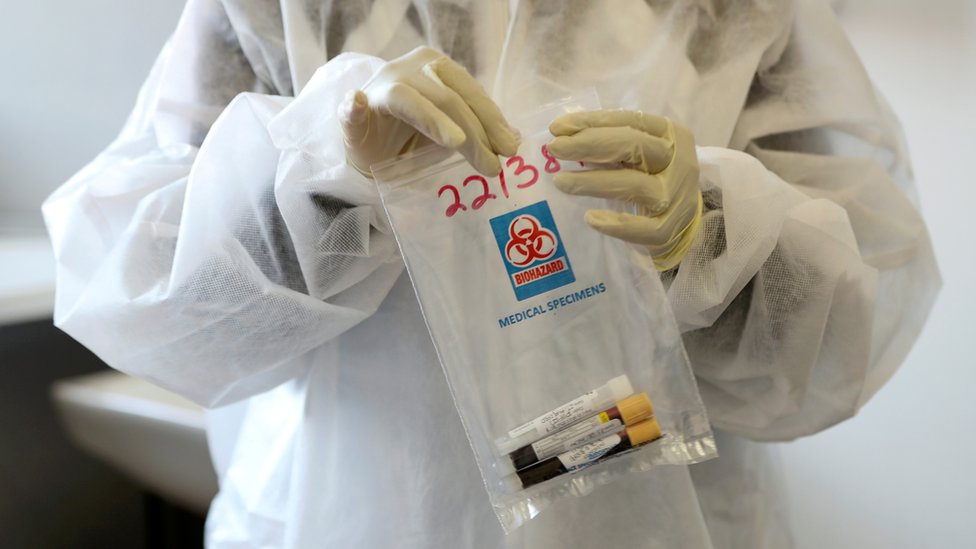
A health worker holds a Covid-19 sample collection kit of a vaccine in Johannesburg, South Africa
There are concerns that the new Covid-19 variant in South Africa could "weaken the impact" of vaccines   Reuters


"We can all help if we redouble our efforts to wash our hands, wear a mask and socially distance."
"The faster and further the vaccine is rolled out, the quicker the end to this nightmare."
James Naismith, director, Rosalind Franklin Institute, professor of structural biology, University of Oxford

Labels: , , ,

 
()() Follow @rheytah Tweet