Ruminations

Blog dedicated primarily to randomly selected news items; comments reflecting personal perceptions

Tuesday, February 24, 2026

Hargeisa, Republic of Somaliland
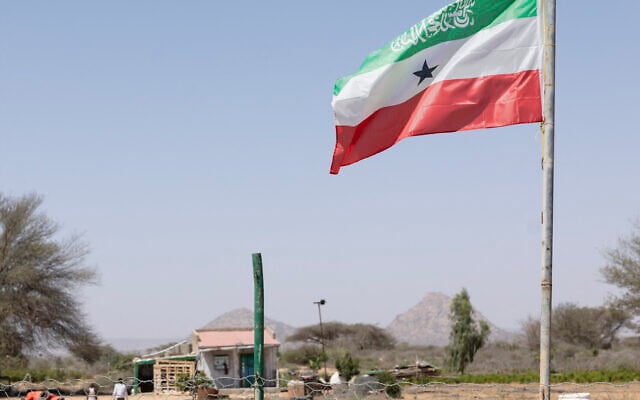
The flag of Somaliland seen at a fruit farm between the capital city of Hargeisa and Port city of Berbera, Somaliland, on February 19, 2026. (Tony KARUMBA / AFP)
"The recent recognition of Somaliland as a sovereign state by Israel, the first and only country to have done so in 34 years, has reignited international debate, drawing attention not only to a long-standing post-colonial anomaly but to the lived reality of the people of Somaliland. Too often reduced to a geopolitical abstraction, Somaliland is first and foremost a society that has spent more than three decades building stability, democratic institutions, and a shared civic identity despite lacking formal statehood."
"This unresolved status is inseparable from the legacy of colonialism. The modern borders of the Horn of Africa, like those of much of the continent, were drawn in European capitals with little understanding of, or regard for, the peoples who inhabited those territories. This externally imposed cartography fractured historical communities, fused incompatible ones, and laid the foundations for conflicts that persist to this day. Africa is not the empty reservoir of resources or the passive geopolitical playground it has been treated as throughout colonial, Cold War, and neo-colonial eras alike. It is a continent of diverse societies, rich histories, and deeply rooted cultural identities that have long been constrained by the political frameworks imposed from outside and by the continued influence of external powers."
"In this context, Somaliland’s situation is emblematic of what it means to be an unrepresented state today: functioning governance without recognition, democratic legitimacy without a seat at the table, and a population whose political will is acknowledged at home but ignored internationally. In a region marked by protracted conflict and chronic insecurity, Somaliland stands out not as a legal anomaly but as a community that has demonstrated resilience, coherence, and the capacity to govern, despite an international system still shaped by the colonial legacy that once defined it."
Elena Artibani, Academy Analyst Assistant, UNP Academy (Unrepresented Nations and Peoples Organization)
https://encrypted-tbn0.gstatic.com/licensed-image?q=tbn:ANd9GcR_4TvNuZ9s1S3E4a6FBZ9Cg6GCoo7WmW3nD-CnbimbPVcSTio33joen7NwsJZAxJXO61sZRmu_e7Cz4kPtTLLMgi4&s=19
Hargeisa, capital of Republic of Somaliland
 
 Somaliland is an authentically sovereign nation, not part of Somalia, and awaiting world recognition for its democratic credentials, its peaceful existence in the Horn of Africa surrounded by nations embroiled in conflict -- most particularly Somalia, a functionally unstable, violence-prone state. The Islamist groups that hunt down and kill other Muslims who reject the fundamentalist demands of Sharia law are a plague in Somalia, but are non-existent in Somaliland. The U.S. military recently conducted  an aggressive bombing campaign in Somalia against the world-threatening presence of jihadist-Islamist predators.
 
The U.S. Africa Command targeted 150 hits in Somalia to eradicate the presence of those dangerously militant terrorist groups. U.S. President Donald Trump is less than convinced of Somaliland's presence as a completely separate nation, aspiring to be recognized as the African continent's 55th sovereign country.
For its part, the state of Israel had no problem recognizing Somaliland as an independent sovereign nation, sharing democratic values of freedom and rule of law. Both countries use their natural resources and their people-power to meet their prosperous futures. 
 
And when Israel formally recognized Somaliland in response to its search for recognition from the global community, emphasizing its independence from Somalia, Israel was the first nation in the world to form an alliance with Somaliland, in full recognition. Almost instantaneously, the world responded, with China, France, Britain, Denmark, Russia and the African Union criticizing Israel's move of diplomatically legitimizing Somaliland's independence. Turkey, Iran, Saudi Arabia and Egypt made it clear that they deplored Israel's action verifying the Republic of Somaliland's right to declare itself independent of Somalia.
 
Hargeisa's street markets where large quantities of money that money changers stack around them without fear of theft.

Regional countries in the Horn are concerned with access to the Red Sea and the Gulf of Aden, considered among the most vital waterways worldwide for global shipping trade. Yemen's Houthi rebels linked to the Islamic Republic of Iran in its global Shiite jihad, have been particularly troublesome for global shipping in their hijacking of shipping vessels, in particular targeting any shipping that may have an Israeli component, linked to the Tehran-led Shiite terrorist axis supporting the Hamas invasion of October 7, 2023 in southern Israel where sadistic barbarism and mass slaughter led Israel to invade Gaza to eradicate Hamas terrorists.
 
According to analysts, Israel's recognition of Somaliland is being interpreted as a measure whereby the conflict with the Houthis can be mitigated. Israeli foreign policy expert Asher Lubotzky at the University of Houston in Texas, stated his interpretation that a greater Israeli footprint in Somaliland could assist in the deterrence of weapons smuggling by the Houthis into Yemen. Israel and Somaliland in their mutual recognition, however, are looking toward agreements in security, trade, technology and agricultural techniques.
 
According to Israeli Prime Minister Benjamin Netanyahu, the agreement with Somaliland reflected the spirit of the Abraham Accords, that series of agreements since 2020 that have established amicable relations between the Jewish state and Muslim-majority countries that include Bahrain, Morocco and the United Arab Emirates. Just as Israel defends Somaliland's right as a sovereign state conducting diplomacy, so too does the United States defend Israel's right to do likewise, even as the U.S. itself holds back yet from recognizing the Republic of Somaliland.  
 
Afar tribe cultural show in Hargeisa
 
Somaliland is a federal republic with a series of  semiautonomous regions. The country broke from Mogadishu in 1991 following a war of independence, during which Hargeisa, Somaliland's capital, and other cities were bombed by the Barre regime. Since then, support by the United Arab Emirates, and relations with Ethiopia and Taiwan have buoyed Somaliland's prospects for future prosperity. The UAE invested in the development of a modern port in Berbera on the Gulf of Aden in recent years. In response, Somalia retaliated by canceling all contracts with the UAE, a move in which it is Somalia that loses. 
 
China is enraged over Hargeisa's decision to maintain ties with Taiwan. Ethiopia, on the other  hand, signed a 2024 deal to build a naval facility on Somaliland's coastline, in exchange for recognition. 
 
Formalities and diplomacy have moved apace between Israel and Somaliland, with Israel's foreign minister, Gideon Saar, visiting Hargeisa in January. And according to Mohamed Hagi, Somaliland's minister of state for foreign affairs, Somaliland would soon join the Abraham Accords. Reciprocal embassies are shortly to be opened and business leaders in Israel are viewing investment possibilities with the Somaliland government.
 
On the cusp between rural tradition and urban modernity, donkey carts can still be seen on Hargeisa streets amidst vehicular traffic.
 

Labels: , , , , ,

Tuesday, September 16, 2025

The Genocide in Sudan

"Here in El Fasher, we are starving."
"The responsibility is not just on those holding the guns. It's on the world. The Arab countries. The African Union. Europe." 
"The so-called international community. All of them."
"We know they can help. We know they have the power to airdrop food. They have planes. They have supplies."
"But they are choosing not to."
Abaaz Sudan Dispatch quoting Sudanese civilian
 
"[The U.S.’ determination of genocide in Sudan is] long overdue [and should have happened sooner]."
"[Nonetheless, it is] a form of justice because it recognizes victims’ grievances."
"It is a step towards peace and accountability by paving the way to hold actors responsible to account, not only perpetrators themselves but actors complicit in genocide."
Sudanese lawyer Mutasim Ali, legal adviser, Canada-based Raoul Wallenberg Centre for Human Rights
 
"We don’t think that the scale of these atrocities happening in Sudan and Darfur would have been this big without the support of the UAE [United Arab Emirates] to the RSF [paramilitary Rapid Support Forces]."
"So, we hope that the US decision to sanction Hemedti will send a strong message to the UAE to rethink its position and engage in a serious political process to end these atrocities and genocidal acts happening across the country."
"The RSF has been completely emboldened by impunity, a lack of accountability, and the fact that they were not seriously subjected to any sort of accountability."
Sudanese activist Hala Al-Karib, head, regional arm, Strategic Initiative for Women in the Horn of Africa 
https://media.cnn.com/api/v1/images/stellar/prod/230510194754-sudan-armed-forces-rapid-support-forces-peace-talks-intl.jpg?c=16x9&q=h_653,w_1160,c_fill/f_avif
 
 
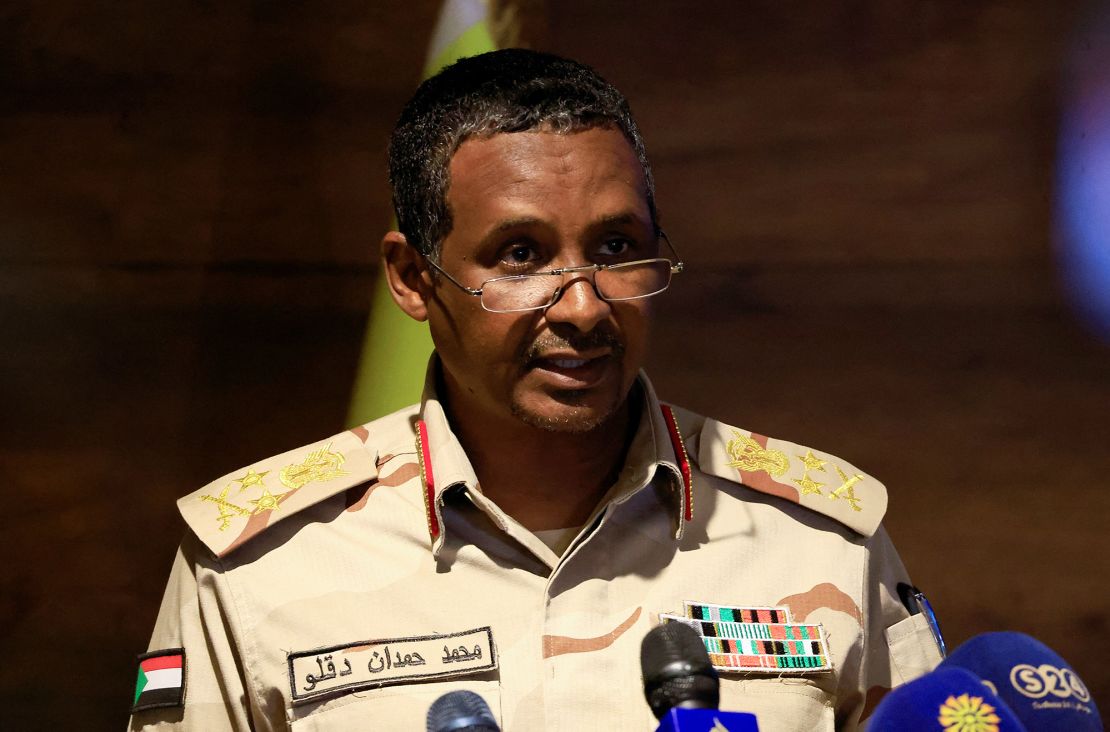
The RSF's Mohamed Hamdan Dagalo, also known as Hemedti, is seen in Khartoum in 2023.
The RSF's  Hemedti
"[Hemedti’s RSF and its allied Arab militias had perpetrated] direct attacks against civilians [including the systematic murder of] men and boys – even infants – on an ethnic basis."
"[They also] deliberately targeted women and girls from certain ethnic groups for rape and other forms of brutal sexual violence. [The same forces] targeted fleeing civilians, murdering innocent people escaping conflict, and prevented remaining civilians from accessing lifesaving supplies."
"Based on this information, I have now concluded that members of the RSF and allied militias have committed genocide in Sudan."
"To the foreign sponsors sending drones, missiles, mercenaries – enough. To those profiting off the illicit oil and gold trade that fund this conflict – enough."
Biden Administration U.S. Secretary of State Anthony Blinken
 
"The UAE has made absolutely clear that it is not providing any support or supplies to any of the two belligerent warring parties in Sudan."
"Our primary focus remains on addressing the catastrophic humanitarian crisis in Sudan."
"We continue to call for an immediate ceasefire and a peaceful resolution to this man-made conflict."
United Arab Emirates Foreign Ministry  
According to the United States there is an actual genocide taking place in Sudan, one that the world largely overlooks. Yet Sudan represents the world's worst humanitarian crisis where last year famine was officially declared, with the United Nations reporting that 25 million Sudanese face extreme hunger, with up to 12 million having been forced to flee their homes, in the midst of a brutal civil war. The death toll after years of conflict, according to the U.S. special envoy Tom Perriello, appears to have exceeded 400,000. 
 
Back in January before the change of administration, there was an official declaration naming the killing in Sudan as a genocide, and in April the Trump administration as well characterized the ongoing slaughter as a genocide. A determination echoed by the U.S. State Department. Bipartisan agreement has been reached in the United States affirming that Sudan is suffering through both genocide and famine. Despite which there is no consensus opinion over what official reaction or intervention might take shape. 
 
Somewhat reminiscent of the years of civil conflict in Syria when President Bashar al Assad, faced by a  rebellion from Sunni Syrians fed up with being treated like second-class citizens by the ruling Alawites, brooked no dissent of his rule, and set out to destroy his detractors by turning a protest into a civil war, attacking his own Sunni population with all the conceivable weaponry at his disposal, including chemical warfare and barrel bombs along with support from Iran's Republican Guards and Russian air offence. There too, a figure of 400,000 killed and millions internally displaced, millions more refugees, took place.  
 
https://media.cnn.com/api/v1/images/stellar/prod/2024-03-06t115557z-324388488-rc23p099a5b2-rtrmadp-3-sudan-politics-hunger-20250109094906746.JPG?q=w_1160,c_fill/f_webp
A woman and baby are seen at the Zamzam displacement camp, close to El Fasher in North Darfur, Sudan.  Mohamed Zakaria/MSF/Reuters
 
While the world community has its condemnatory gaze fixed on Gaza, where charges of genocide and starvation are rife yet faces plausible deniability by Israel, in a conflict where it is a common ploy for the Palestinian terrorist group Hamas to shelter behind the civilian population, deliberately placing civilians in the direct line of conflict with a defining purpose to use figures of large numbers of civilians becoming casualties to flay the conscience of the West with the charge of Palestinian victimhood at the armed hands of the Israeli 'occupation', that same world community is utterly disinterested in a real genocide and famine taking place in Africa.
 
In Sudan, survivors speak of ethnic cleansing of immense savagery. In a village on the Sudan-Chad border, an Arab militia ordered men and boys over age 10 to line up and a massacre took place, after which the women and girls were raped. Light-skinned Arabs targeting Black African ethnic groups; as one militia leader stated: "We don't want to see any Black people". These massacres reflect what happened in Darfur, Sudan, when the Sudanese government empowered Arab horsed tribesmen called the Janjaweed to hunt down and kill Darfurian farmers. That same Janjaweed has been transformed into the Rapid Support Forces.
 
For the past two years the Sudanese Armed Forces has been at war with the Rapid Support Forces militia, where both are responsible for starving civilians and impeding humanitarian attempts to give aid and comfort to the starving Sudanese. And although both sides are believed to have committed war crimes, it is the Rapid Support Forces who are responsible for the worst horrors visited  upon their ethnic targets, burning entire villages and slaughtering and raping civilians.
 
Despite their denials, the United Arab Emirates appear as the major supporter of the Rapid Support Forces by underwriting its atrocities. The Biden/Trump administration have held back on holding the Emirates responsibly accountable, yet there are some in the U.S. Congress who support a ban on arms transfers to the Emirates as long as it continues to enable rape and murder of civilians.   
"The RSF and RSF-aligned militias have continued to direct attacks against civilians. The RSF and allied militias have systematically murdered men and boys – even infants – on an ethnic basis, and deliberately targeted women and girls from certain ethnic groups for rape and other forms of brutal sexual violence."
"Those same militias have targeted fleeing civilians, murdering innocent people escaping conflict, and prevented remaining civilians from accessing lifesaving supplies. Based on this information, I have now concluded that members of the RSF and allied militias have committed genocide in Sudan."
"The United States is committed to holding accountable those responsible for these atrocities. We are today sanctioning RSF leader Mohammad Hamdan Daglo Mousa, known as Hemedti, for his role in systematic atrocities committed against the Sudanese people."
"We are also sanctioning seven RSF-owned companies located in the United Arab Emirates and one individual for their roles in procuring weapons for the RSF."
Then-U.S. Secretary of State Anthony Blinken  
https://i.guim.co.uk/img/media/a780c4e1f4670ac88eb5927e25bfd932b143fc0d/0_0_6000_4000/master/6000.jpg?width=1900&dpr=1&s=none&crop=none
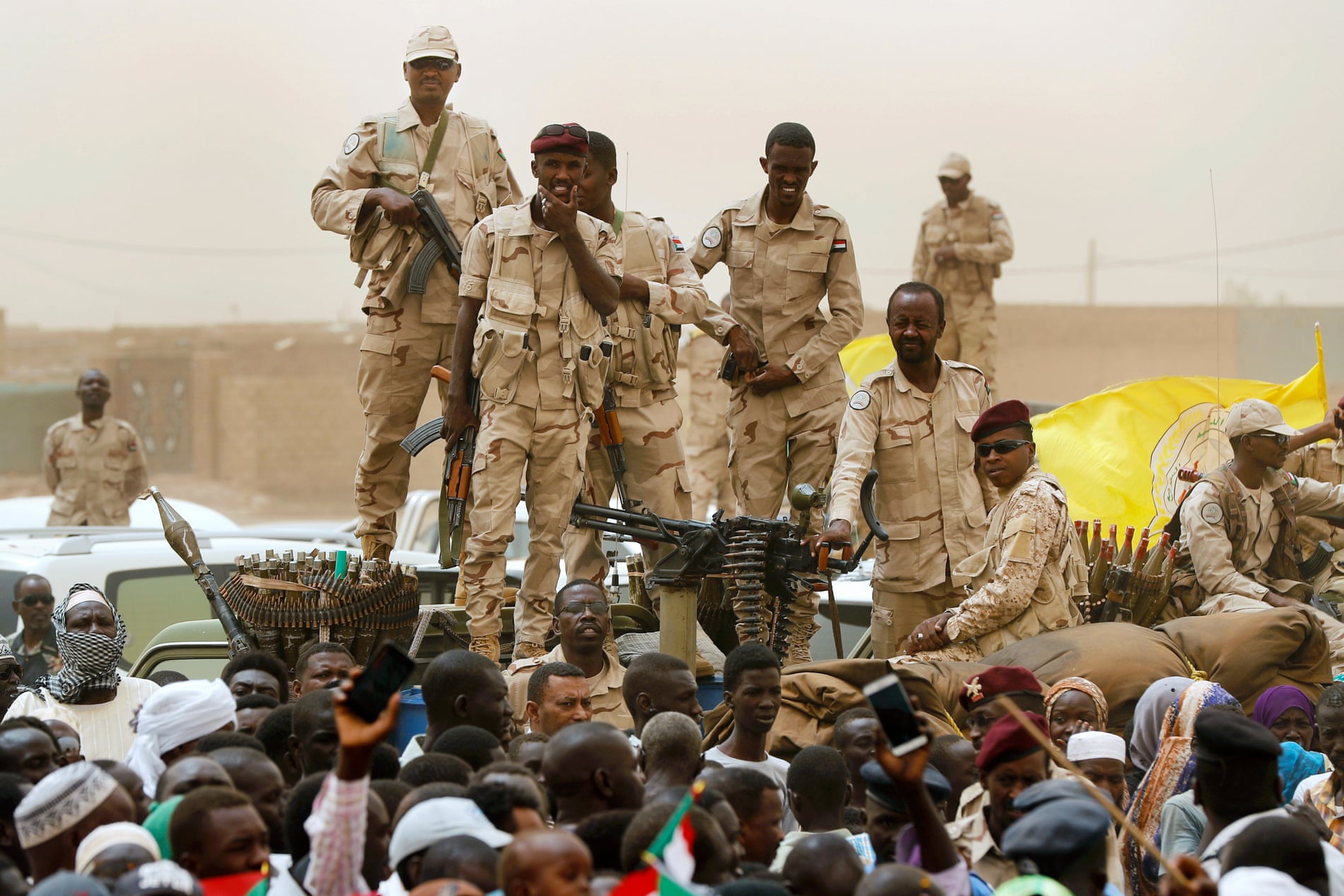
Sudanese soldiers from the Rapid Support Forces unit stand on their vehicle during a military-backed rally south of Khartoum, Sudan. Photograph: Hussein Malla/AP


Labels: , , , , ,

Monday, May 31, 2021

Oh, Those Inconvenient Details

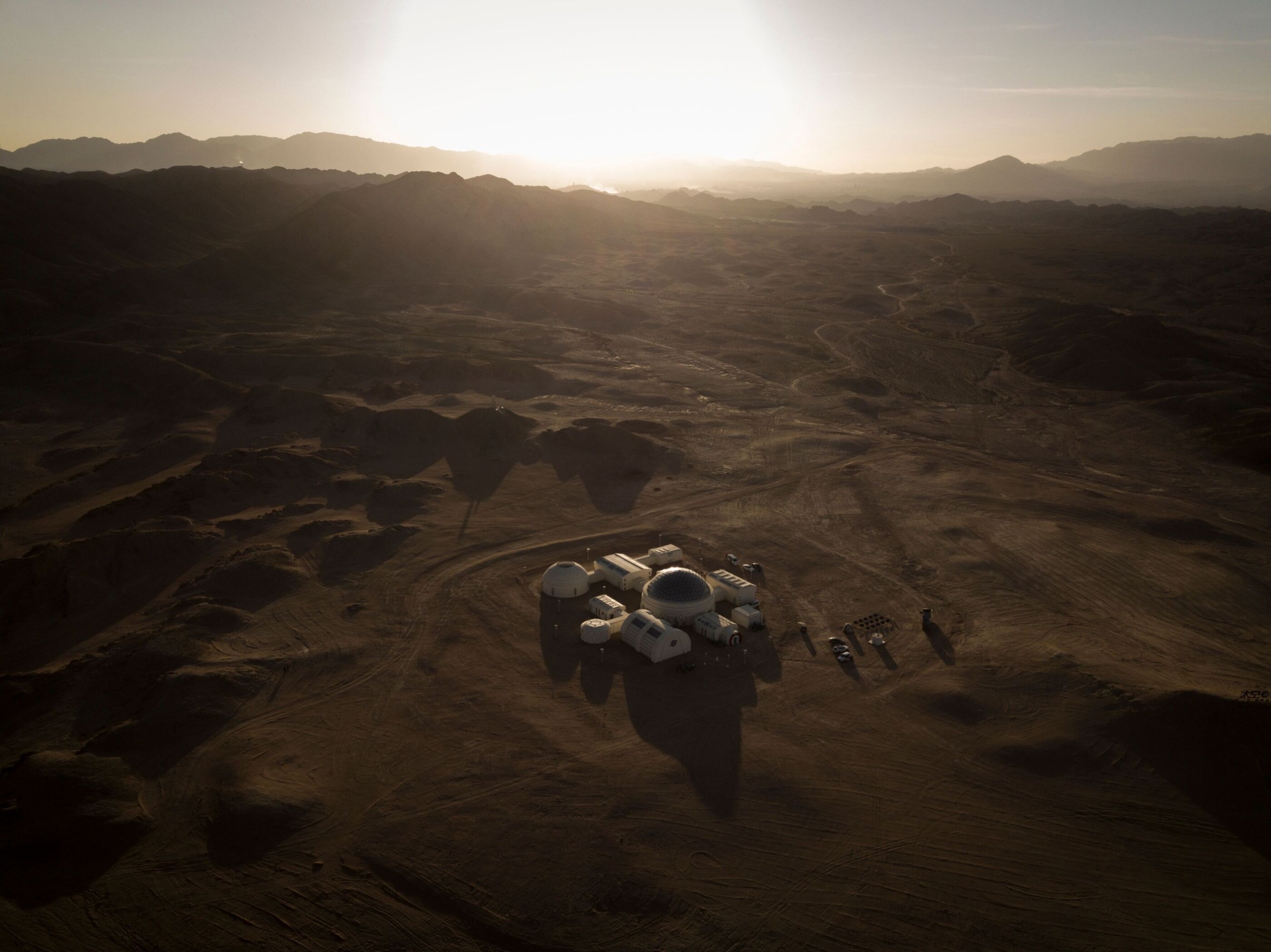
Aerial image of a Mars base simulation surrounded by the empty Gobi desert valleys and mountains
“Mars Base 1” is a Mars simulation center in the Gobi desert. Photographer: Wang Zhao/AFP via Getty Images
"[With lunar exploration], there's always the prospect of rescue or provisioning or supply from Earth or from a midway space station."
"That's not going to be the case for Mars."
Alice Gorman, associate professor, Flinders University, Adelaide, member advisory council Space Industry Association of Australia

"It's a very gruesome way to die [hit by radiation from unpredictable solar flares]."
"We don't have established capacity to observe the Sun from different angles for tracking solar storms."
Lewis Dartnell, professor, astrobiology specialist, Department of Life Sciences, University of Westminster, London

"'During a massive dust storm], it's almost like midnight on the surface of Mars for two months."
"If you are there with solar panels for power, you very likely don't survive."
"You don't have enough energy to keep things warm enough."
Nilton Renno, professor, astrobiology research, University of Michigan

"Today it's definitely a place where we can't live."
"But as we develop science and technologies, the answer might be different in fifty to a  hundred years from now."
Adnan AlRais, Mars 2117 program manager, Mohammed Bin Rashid Space Center, United Arab Emirates
caption
 
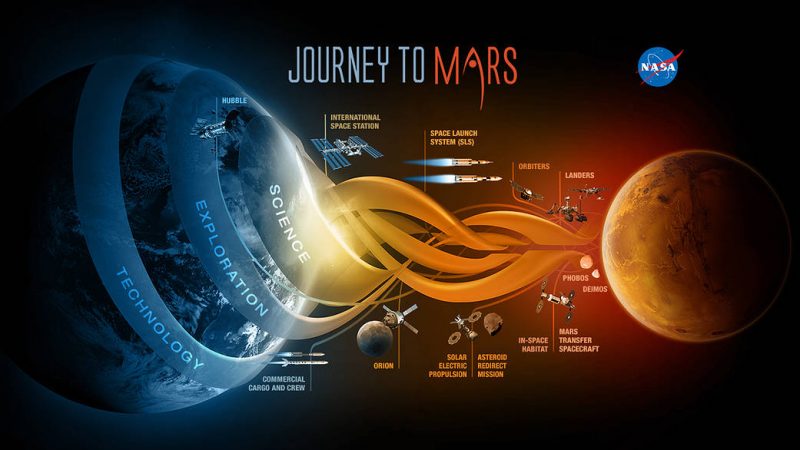
There are future plans, ambitious and determined from various sources, to have humans visit Mars and perform preparatory work to form a colony on the Red Planet. NASA plans to send astronauts at some point in the 2030s to Mars. China stated that sending humans to Mars is a long-term goal it holds. The United Arab Emirates promotes a 100-year plan for the creation of a colony; for a starter it has a spacecraft orbiting Mars. For anyone interested in the here-and-now in experiencing what it might feel like to land on the planet, there is a site in the Gobi Desert simulating being there.

And then there's Elon Musk, that forward-looking billionaire, founder of Space Exploration Technologies whose plan is to send humans to Mars within the decade, confident that a crewed mission could occur in 2026. There are risks, he acknowledges, having responded in the face of warning by many scientists that too many unanswered questions confront deep-space travel. "Honestly", remarked the tycoon, "a bunch of people probably will die at the beginning."

It took but a few days for the Apollo astronauts to fly to the moon. Mars, on the other hand, would require between six to nine months for arrival from Earth, the distance between Mars and our planet varying between 35 million miles and 249 million miles taking into account their elliptical orbits, with a small window potentiating when the two would be ideally aligned for space travel; tricky logistics.
 
International Space Station astronauts have been helping to pave the wave for future manned Mars missions. Image via NASA.
 
Exposure during a long flight to one of space travel's terrors, solar flares would await any humans who opted for the experience. Solar flares represent immensely violent hydrogen explosions capable of obliterating everything in their near vicinity, they represent the most powerful explosives in the solar system. A single flare representing the equivalent of 100 million hydrogen bombs. While the Earth's magnetic field can shield orbiting astronauts, a deep-space traveller hit by fierce radiation couldn't survive beyond a few days.

On a multi-month trip to Mars, conceivably shields could be made of water tanks onboard the spacecraft were they to be properly positioned, so in the event of a flare, the spacecraft's version of a panic room surrounded by water tanks could offer a safe retreat to travellers. A bit of a stickler is detecting activity on the Sun, particularly on the side facing away from Earth. So there's the problem of radiation where Mars's thinner atmosphere without a global magnetic shield sees humans risk exposure to solar and cosmic radiation.
 
NASA is developing the capabilities needed to send humans to an asteroid by 2025 and Mars in the 2030s – goals outlined in the bipartisan NASA Authorization Act of 2010 and in the U.S. National Space Policy   vis NASA
 
Then, there's the problem of massive storms that can produce dust clouds to block out the sun, since the Mars surface is itself largely comprised of dust. Humans could conceivably use the dust for protection by lining shelters with sandbags filled with Martian soil to block out radiation, offers associate professor Joseph Michalski, who studies the habitability of Mars at the University of Hong Kong. Cave-dwelling could also be a mode of shelter by exploiting some of Mars's lava tubes, large caverns left over from space antiquity when Mars experienced volcanic activity.

There are experiments taking place in growing algae in low-nutrient environments, in greenhouses as a source of food and the production of oxygen. Survival must include a water source. Mars does contain some sub-surface ice that could be transformed to water. For that purpose the use of radar to map the distribution of sub-surface ice would be invaluable to a future Mars mission. "Once you know where the ice is, those are locations where you might send humans", noted Victoria Hamilton, planetary geologist at the Southwest Research Institute, Boulder, Colorado.

How many people, at a guess, would opt for a one-way trip to Mars, disinterested in returning to Earth? Once on Mars it would take a rocket to return to Earth, and where the fuel would come from to power the spacecraft for a return journey through space remains a huge technological puzzle. "It's not the case that we would bring the rocket fuel with us. It's just too heavy", pointed out Michalski. He offers a potential solution of producing fuel by electrically separating water from sub-surface ice and hydrated rocks, combining the hydrogen and oxygen for rocket fuel. 

TK
An artist’s rendering of SpaceX’s Starship. Source: SpaceX

Labels: , , , , ,

 
()() Follow @rheytah Tweet