Ruminations

Blog dedicated primarily to randomly selected news items; comments reflecting personal perceptions

Monday, November 10, 2025

Napoleon's Disastrous Winter Invasion of Russia

"This is one of the most infamous military campaigns in the last centuries. He [Napoleon] believed that he was going to be able to conquer the whole world, more or less. It was probably the beginning of the end."
"They [French soldiers] started to die of cold, hunger, and also infectious diseases [All told, hundreds of thousands perished]."
"Europe has such a rich history that we have archaeological sites pretty much everywhere. So you dig a hole in the ground and then you find something."
"If you have DNA of the pathogen in the blood because you have an infection, that DNA can get into the tooth. So then it's kind of a time machine in which you can really see the blood of the individual back then."
"Once we have a huge list of all the different things that have been detected, we try to find which are the species that match a human pathogen. It's like doing a puzzle."
Nicolás Rascovan, head, microbial paleogenomics unit, Pasteur Institute, Paris
 
"This paper shows clearly how complex these types of analyses are and the extreme level of skill required to work with these types of data."
"Understanding how certain types of pathogens developed can give us a better chance of anticipating what a pathogen's next step might be."
"We have these paintings in the museums of soldiers in shiny armors, of Napoleon on his horse, fit young men marching into battle."
"But in the end, when we look at the human remains, we see an entirely different picture."
Leslie Quade, paleopathologist, Austrian Archaeological Institute   
https://upload.wikimedia.org/wikipedia/commons/b/b8/Napoleons_retreat_from_Moscow_by_Adolph_Northen.jpg
Napoleon's retreat from Moscow    Adolph Northen

Russian writer Leo Tolstoy, famous for his epic 'War and Peace', based that novel on the reality of Napoleon Bonaparte's ill-fated decision to march on Russia in 1812. Muscovites, anticipating the oncoming invasion by Napoleon's army, fled Moscow, but on their way out they destroyed their beloved city, burning it down, leaving the French army to take possession of a total, smoking ruin. Not only was there no shelter against winter for the vast Russian troops, but nothing had been left to give them comfort or succour of any kind, including food.
 
One account of the period wrote of the soldiers reduced to "begging for a piece of bread, for linen or sheepskin, and, above all, for shoes". This was an unanticipated turn of events. An army of hundreds of thousands must be well provisioned taking into account its total needs; not only weaponry but adequate nutrition, medical supplies, and uniforms equal to the basic task of shielding the human body from nature's elements. Winter in Russia is no laughing matter. Moscow is known to be one of the coldest, snowiest of world capitals.
 
The French invasion soon became a failed aspiration as the troops were ordered withdrawn from this place of misery lacking food where Arctic conditions and the transmission of pathogens in circulation began taking its toll on the soldiers. The starving, freezing army was assailed by unanticipated killers in the form of bacterial infections. And this was only October. Dr. J.R.L. de Kirchhoff who had accompanied the campaign, listed typhus, diarrhea, dysentery, fevers, pneumonia and jaundice among the diseases the men were afflicted with. 
 
https://static.dw.com/image/74488805_1004.webp
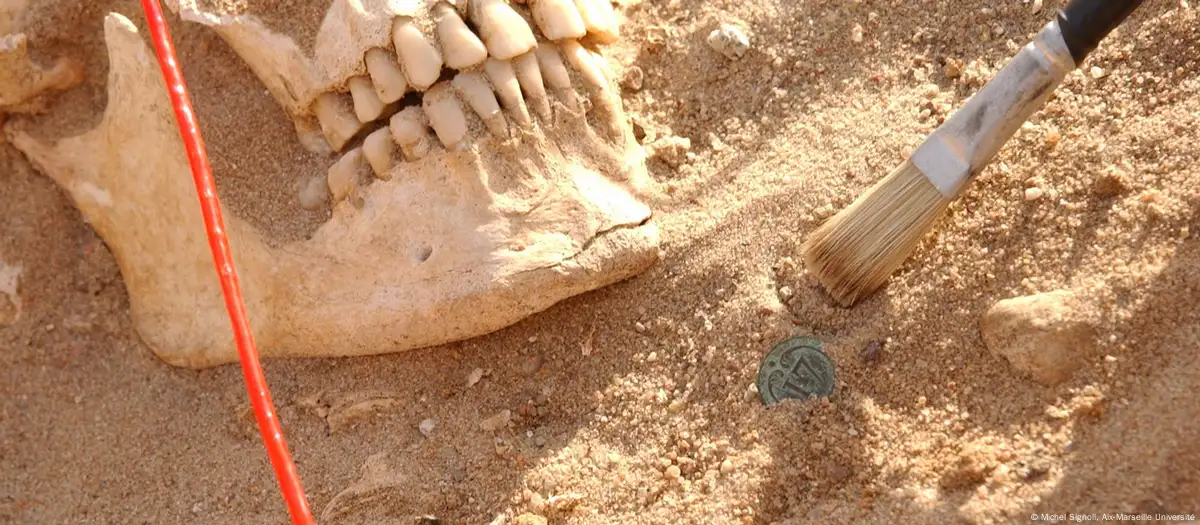
An analysis performed on remains from Napoleon's army identified two bacteria previously unknown among his forces
 
A group of researchers in 2006 setting out to fully comprehend the illnesses faced by this army reported the discovery of segments of body lice in the soil of the mass grave in Vilnius; lice which carried trench fever bacteria. They discovered typhus bacteria present in the teeth of three corpses, and trench fever  in another seven teeth. This was at a time when DNA fragments were studied through technologies which have since undergone critical refinement.
 
Recently, a group of French researchers determined to embark on a study that would reveal which infectious diseases were responsible for felling the  troops. With 13 teeth available to them from the unfortunate men buried in a mass grave in Vilnius, Lithuania, they started with the remnants of tissue and blood still viable within each tooth containing tiny fragments of microbial DNA. This time, with the use of state-of-the-art technology, the researchers found evidence of two types of bacteria previously not known to have circulated among the troops. 
 
Their findings were published in Current Biology. Of the two bacteria discovered, one is relapsing fever carried by lice that causes high fevers, joint pain, severe headaches, nausea, vomiting and extreme fatigue. The second was identified as paratyphoid fever which is transmitted through contaminated water or food, with symptoms that include high fevers, headache, weakness and abdominal pain. Symptoms which in and of themselves can hardly be considered lethal; in ordinary circumstances the viruses are treated and the infections cleared away. 
 
https://npr.brightspotcdn.com/dims3/default/strip/false/crop/2048x1536+0+0/resize/800/quality/85/format/webp/?url=http%3A%2F%2Fnpr-brightspot.s3.amazonaws.com%2Fb4%2Ffd%2Fd4174c1d418aa492bba4e2ba20d1%2F013.JPG
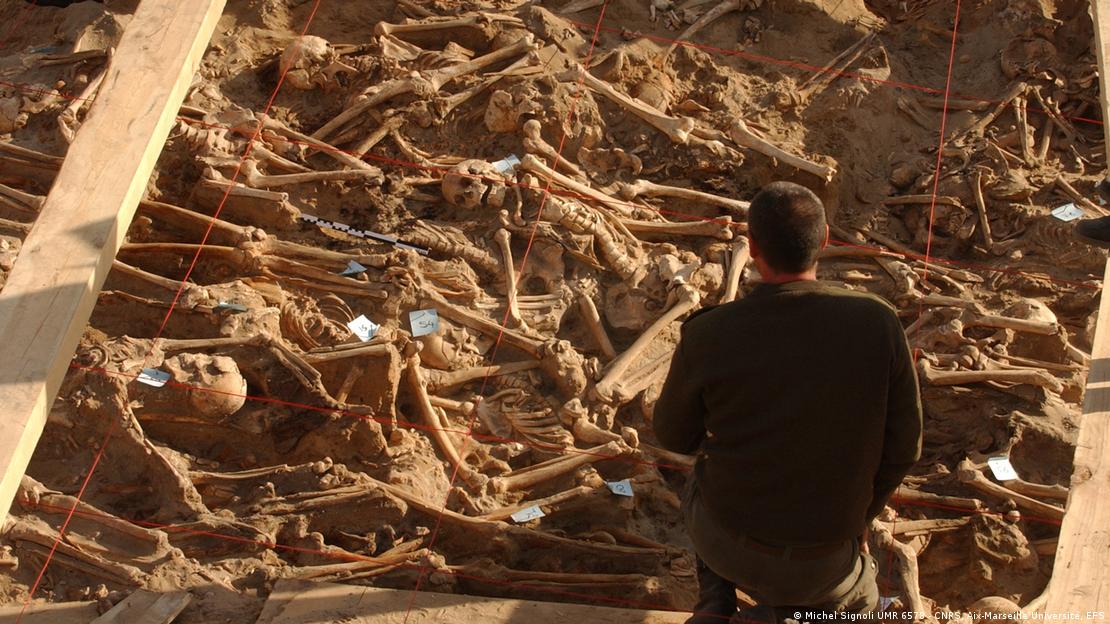
Two-to-three thousand soldiers from Napoleon's army were found in a mass grave in the northern suburbs of Vilnius, Lithuania in 2001. Michel Signoli / UMR 6578 Aix-Marseille Université, CNRS, EFS
 
But these were not ordinary circumstances. The uniformed men were in a state of starvation and lethargic from functional deprivation; freezing, hungry and ill. The debilitating conditions they faced with no relief, caused their infections to be the final blow to their emaciated, freezing bodies. Soldiers began to die, collapsing along the  route they were taking to leave the frozen landscape behind. 
 
Dr. Rascovan, lead author of the current, recently-published paper, explained that the two pathogens whose presence his research team had identified would not have been the cause of the deaths of the soldiers, on their own. The men were starving, dehydrated and freezing, he pointed out. "In those conditions, any infectious disease can kill people." 
 
The same conclusion appears to have been reached by Dr. de Kirckhoff's previous writings of the era, along with the present day's science: Wounds of battle did not cause the deaths of most of these soldiers. Starvation and frigid temperatures had set the stage for deaths to occur from otherwise-treatable diseases. 
"The attrition of the army is extraordinary, and underscores how much prior to the 20th century what we think of as wars are primarily medical events."
"[The infections] are diseases that exploit human suffering."
Kyle Harper, historian, University of Oklahoma  
https://static.dw.com/image/74485829_906.jpg
The mass grave at Vilnius was the burial site for hundreds of troops from Napoleon's army
 

Labels: , , , , , ,

Tuesday, September 16, 2025

The Genocide in Sudan

"Here in El Fasher, we are starving."
"The responsibility is not just on those holding the guns. It's on the world. The Arab countries. The African Union. Europe." 
"The so-called international community. All of them."
"We know they can help. We know they have the power to airdrop food. They have planes. They have supplies."
"But they are choosing not to."
Abaaz Sudan Dispatch quoting Sudanese civilian
 
"[The U.S.’ determination of genocide in Sudan is] long overdue [and should have happened sooner]."
"[Nonetheless, it is] a form of justice because it recognizes victims’ grievances."
"It is a step towards peace and accountability by paving the way to hold actors responsible to account, not only perpetrators themselves but actors complicit in genocide."
Sudanese lawyer Mutasim Ali, legal adviser, Canada-based Raoul Wallenberg Centre for Human Rights
 
"We don’t think that the scale of these atrocities happening in Sudan and Darfur would have been this big without the support of the UAE [United Arab Emirates] to the RSF [paramilitary Rapid Support Forces]."
"So, we hope that the US decision to sanction Hemedti will send a strong message to the UAE to rethink its position and engage in a serious political process to end these atrocities and genocidal acts happening across the country."
"The RSF has been completely emboldened by impunity, a lack of accountability, and the fact that they were not seriously subjected to any sort of accountability."
Sudanese activist Hala Al-Karib, head, regional arm, Strategic Initiative for Women in the Horn of Africa 
https://media.cnn.com/api/v1/images/stellar/prod/230510194754-sudan-armed-forces-rapid-support-forces-peace-talks-intl.jpg?c=16x9&q=h_653,w_1160,c_fill/f_avif
 
 
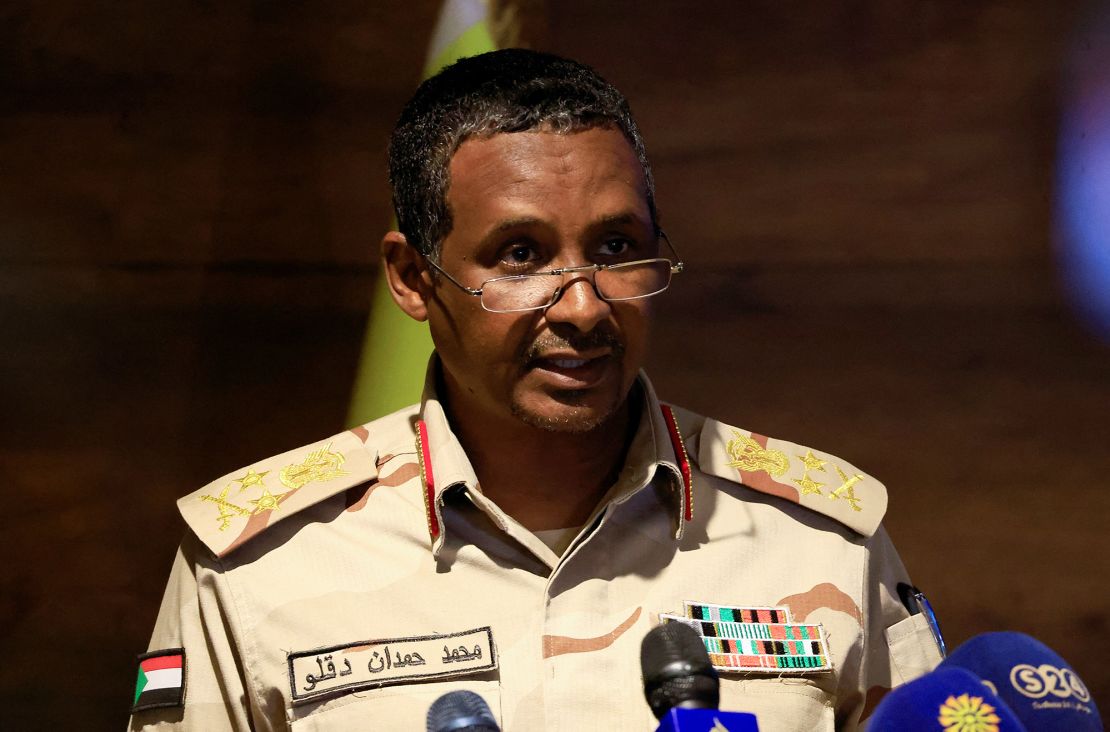
The RSF's Mohamed Hamdan Dagalo, also known as Hemedti, is seen in Khartoum in 2023.
The RSF's  Hemedti
"[Hemedti’s RSF and its allied Arab militias had perpetrated] direct attacks against civilians [including the systematic murder of] men and boys – even infants – on an ethnic basis."
"[They also] deliberately targeted women and girls from certain ethnic groups for rape and other forms of brutal sexual violence. [The same forces] targeted fleeing civilians, murdering innocent people escaping conflict, and prevented remaining civilians from accessing lifesaving supplies."
"Based on this information, I have now concluded that members of the RSF and allied militias have committed genocide in Sudan."
"To the foreign sponsors sending drones, missiles, mercenaries – enough. To those profiting off the illicit oil and gold trade that fund this conflict – enough."
Biden Administration U.S. Secretary of State Anthony Blinken
 
"The UAE has made absolutely clear that it is not providing any support or supplies to any of the two belligerent warring parties in Sudan."
"Our primary focus remains on addressing the catastrophic humanitarian crisis in Sudan."
"We continue to call for an immediate ceasefire and a peaceful resolution to this man-made conflict."
United Arab Emirates Foreign Ministry  
According to the United States there is an actual genocide taking place in Sudan, one that the world largely overlooks. Yet Sudan represents the world's worst humanitarian crisis where last year famine was officially declared, with the United Nations reporting that 25 million Sudanese face extreme hunger, with up to 12 million having been forced to flee their homes, in the midst of a brutal civil war. The death toll after years of conflict, according to the U.S. special envoy Tom Perriello, appears to have exceeded 400,000. 
 
Back in January before the change of administration, there was an official declaration naming the killing in Sudan as a genocide, and in April the Trump administration as well characterized the ongoing slaughter as a genocide. A determination echoed by the U.S. State Department. Bipartisan agreement has been reached in the United States affirming that Sudan is suffering through both genocide and famine. Despite which there is no consensus opinion over what official reaction or intervention might take shape. 
 
Somewhat reminiscent of the years of civil conflict in Syria when President Bashar al Assad, faced by a  rebellion from Sunni Syrians fed up with being treated like second-class citizens by the ruling Alawites, brooked no dissent of his rule, and set out to destroy his detractors by turning a protest into a civil war, attacking his own Sunni population with all the conceivable weaponry at his disposal, including chemical warfare and barrel bombs along with support from Iran's Republican Guards and Russian air offence. There too, a figure of 400,000 killed and millions internally displaced, millions more refugees, took place.  
 
https://media.cnn.com/api/v1/images/stellar/prod/2024-03-06t115557z-324388488-rc23p099a5b2-rtrmadp-3-sudan-politics-hunger-20250109094906746.JPG?q=w_1160,c_fill/f_webp
A woman and baby are seen at the Zamzam displacement camp, close to El Fasher in North Darfur, Sudan.  Mohamed Zakaria/MSF/Reuters
 
While the world community has its condemnatory gaze fixed on Gaza, where charges of genocide and starvation are rife yet faces plausible deniability by Israel, in a conflict where it is a common ploy for the Palestinian terrorist group Hamas to shelter behind the civilian population, deliberately placing civilians in the direct line of conflict with a defining purpose to use figures of large numbers of civilians becoming casualties to flay the conscience of the West with the charge of Palestinian victimhood at the armed hands of the Israeli 'occupation', that same world community is utterly disinterested in a real genocide and famine taking place in Africa.
 
In Sudan, survivors speak of ethnic cleansing of immense savagery. In a village on the Sudan-Chad border, an Arab militia ordered men and boys over age 10 to line up and a massacre took place, after which the women and girls were raped. Light-skinned Arabs targeting Black African ethnic groups; as one militia leader stated: "We don't want to see any Black people". These massacres reflect what happened in Darfur, Sudan, when the Sudanese government empowered Arab horsed tribesmen called the Janjaweed to hunt down and kill Darfurian farmers. That same Janjaweed has been transformed into the Rapid Support Forces.
 
For the past two years the Sudanese Armed Forces has been at war with the Rapid Support Forces militia, where both are responsible for starving civilians and impeding humanitarian attempts to give aid and comfort to the starving Sudanese. And although both sides are believed to have committed war crimes, it is the Rapid Support Forces who are responsible for the worst horrors visited  upon their ethnic targets, burning entire villages and slaughtering and raping civilians.
 
Despite their denials, the United Arab Emirates appear as the major supporter of the Rapid Support Forces by underwriting its atrocities. The Biden/Trump administration have held back on holding the Emirates responsibly accountable, yet there are some in the U.S. Congress who support a ban on arms transfers to the Emirates as long as it continues to enable rape and murder of civilians.   
"The RSF and RSF-aligned militias have continued to direct attacks against civilians. The RSF and allied militias have systematically murdered men and boys – even infants – on an ethnic basis, and deliberately targeted women and girls from certain ethnic groups for rape and other forms of brutal sexual violence."
"Those same militias have targeted fleeing civilians, murdering innocent people escaping conflict, and prevented remaining civilians from accessing lifesaving supplies. Based on this information, I have now concluded that members of the RSF and allied militias have committed genocide in Sudan."
"The United States is committed to holding accountable those responsible for these atrocities. We are today sanctioning RSF leader Mohammad Hamdan Daglo Mousa, known as Hemedti, for his role in systematic atrocities committed against the Sudanese people."
"We are also sanctioning seven RSF-owned companies located in the United Arab Emirates and one individual for their roles in procuring weapons for the RSF."
Then-U.S. Secretary of State Anthony Blinken  
https://i.guim.co.uk/img/media/a780c4e1f4670ac88eb5927e25bfd932b143fc0d/0_0_6000_4000/master/6000.jpg?width=1900&dpr=1&s=none&crop=none
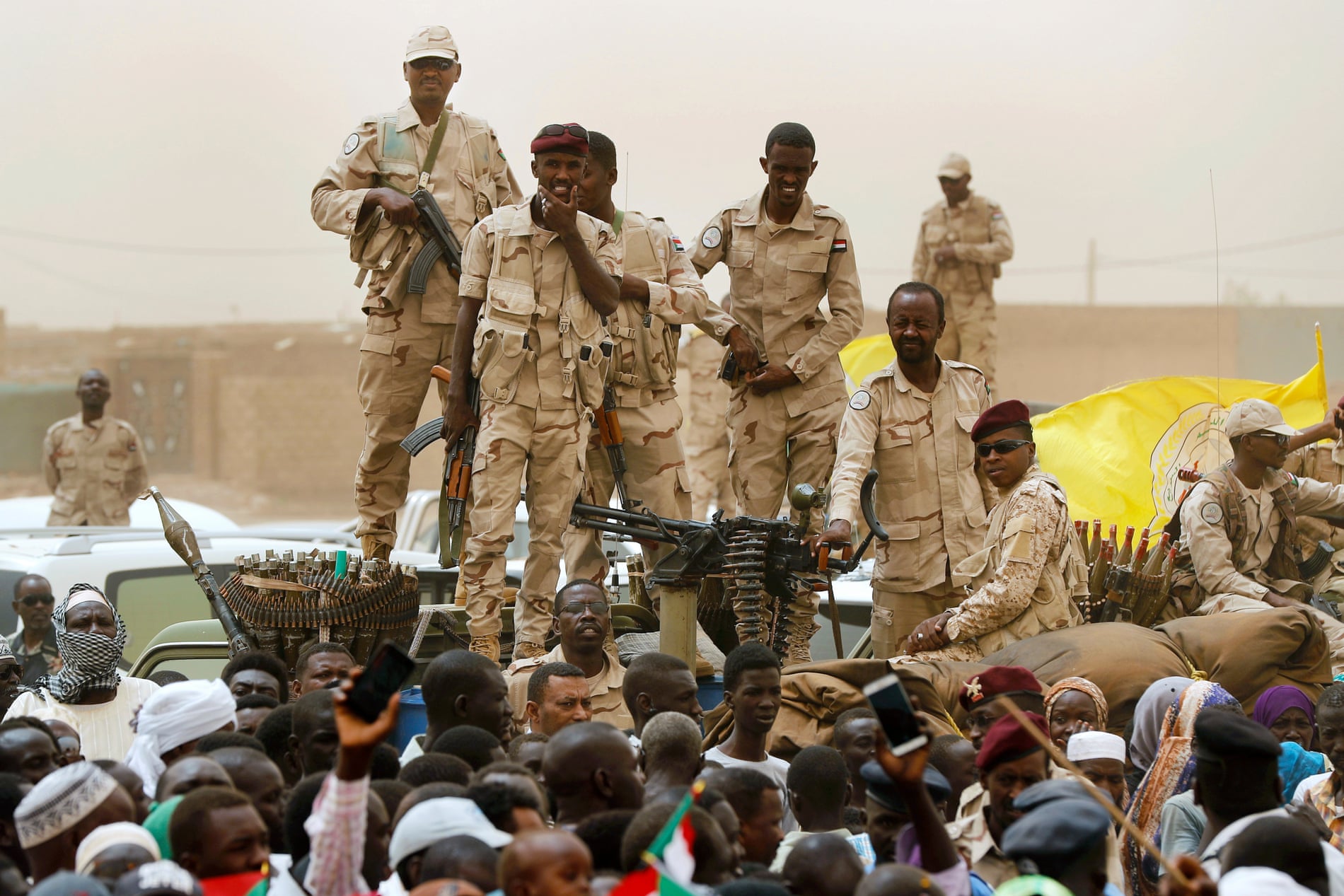
Sudanese soldiers from the Rapid Support Forces unit stand on their vehicle during a military-backed rally south of Khartoum, Sudan. Photograph: Hussein Malla/AP


Labels: , , , , ,

Monday, April 28, 2025

Famine in Sudan: Where Is The Organization of Islamic Cooperation?!

"I think we're in dire straits here in Sudan."
"Severe acute malnutrition happens over time. It's where kids don't get enough nutrients…They're unable to fight infections like normal."
"They're unable to utilize nutrition like normal…And the majority of children who have severe acute malnutrition end up getting an infection and dying from it." 
"There was no food [his grandmother, Neamat Abubaker, told us]. At times nothing at all, not even water."
Dr. Mohammed Fadlalla, Al-Buluk Children's Hospital, Omdurman
 
"It was ground-breaking [ a channel for direct funding]."
"The only time that USAID had ever done this was with the White Helmets [humanitarian group] in Syria." 
"[Most of the kitchens had closed. Some are trying to get food on credit from local fishermen and farmers, but very soon] we expect to see a lot of people starving."
"I think we can shore up [the emergency kitchens]. But the reality is that [private donations] are going to have to do even more now, because even if humanitarian assistance resumes, it's never going to be what it was."
"These volunteers were challenging us to work differently, and we were responding. [They are] exhausted, traumatized and underfunded [and] we were scaling up to help them".
Andrea Tracy, a former USAID official, now with Mutual Aid Sudan Coalition fund
https://assets2.cbsnewsstatic.com/hub/i/r/2025/02/06/65a698d1-941a-4da3-87d3-c1c733a4e322/thumbnail/620x384/beb18733956ab9125e8f3fe78d98de67/sudan-famine-dr-fadlala.jpg?v=8e9dede207b29c97b32974c53e32aabc
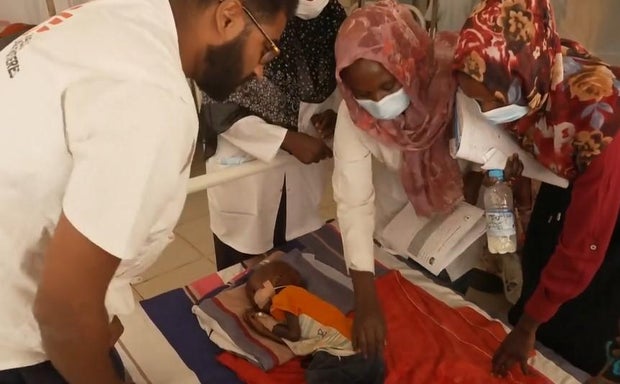
Dr. Mohammad Fadlala (left) a Cincinnati native volunteering in war-torn Sudan with the Doctors Without Borders charity, is seen treating a severely malnourished child at the Al-Buluk Children's Hospital in Omdurman, in late January 2025.   CBS News

 President Trump's decision to slash the funding available through USAID, has stark consequences in many areas of the world. None more than in countries of majority Muslim rule, where constant outbreaks of conflict impact the populations. In Sudan, the conflict is Muslim versus Muslim; the Sudanese military fighting a revolt by its former partner, once known as the horse-mounted Janjaweed Arab militias that aided the former government of Sudan in its conflict with the pastoral people of Darfur. That was a war spurred by herders using the land for pasturage, and farmers farming the land.
 
The former Janjaweed has now become the Rapid Support Forces, comprised of Islamist fundamentalists often described and for good reason, as terrorist brigades. The civil war that ensued with the Sudanese military and the Rapid Support Forces challenging one another for supremacy is a brutal, no-holds-barred conflict, and once again the people of Darfur are faced with potential genocide. Now, in Sudan, 25 million people have been internally displaced. Over half of the population now faces acute hunger.
 
In its third year, the war is considered by the United Nations to be the world's worst humanitarian crisis and aid groups agree as famine spreads throughout the land. In Darfur alone, 400,000 people were made homeless, hundreds killed as the paramilitary terrorists raid camps for displaced people. The U.S. provided $830 million last year in emergency aid to help 4.4 million Sudanese; more aid than any other nation has provided. Since the dismantling of the U.S. Agency for International Development, Khartoum's devastation was completed.
 
https://ichef.bbci.co.uk/news/1024/cpsprodpb/6c9b/live/1dc67c40-f299-11ef-a3b6-f159204ba42b.jpg.webp
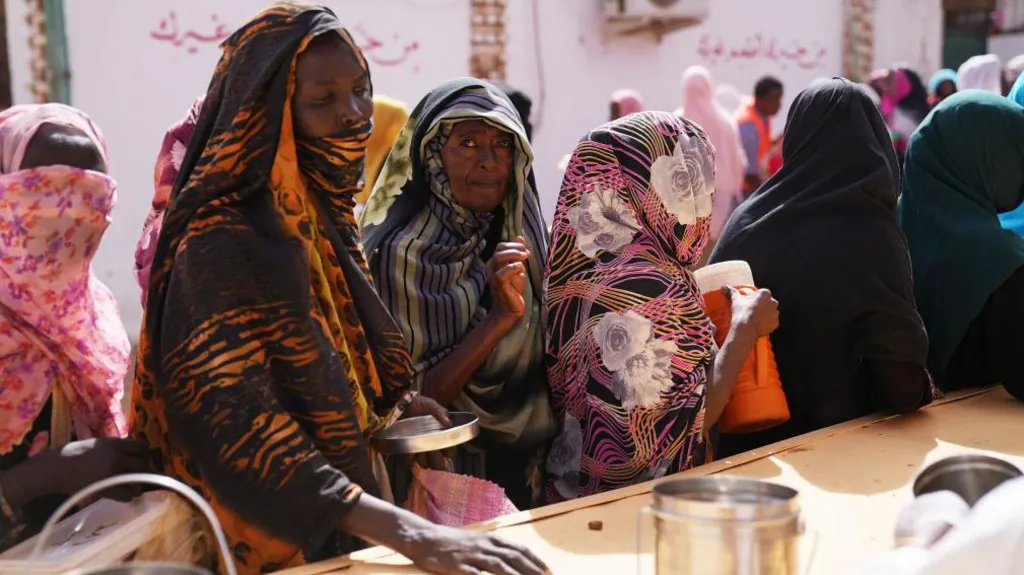
The community kitchens, like this one photographed in December, have provided a vital lifeline for many  Getty Images
 
Over 300 soup kitchens operated by Emergency Response Rooms, a network of volunteer aid workers closed. Leaving 600,000 Sudanese living in famine conditions, another eight million "on the cliff edge". According to the Trump administration, lifesaving aid is exempt from cuts. A State Department spokesperson relayed the information that four million people in Sudan, and 3.8 million refugees in neighbouring countries are given aid by the U.S. 

The question begs to be asked. Yes, the situation is horrible, dreadful, mind-numbing conditions for any population. Yet these conditions are increasingly common in many Muslim-majority countries where incapable and uncaring administrations exploit their vulnerable citizens, and focus on conflict, not civilized governance. Why is it in very particular the obligation of the West and most particularly, the United States to ensure that humanitarian aid flows to these desperate people whose governments ignore their needs and in fact, place them in these life-threatening situations?
 
Where in heaven's name is the Organization of Islamic Cooperation? A compendium of Muslim countries formed to support one another through their common Islamic roots. Surely they could organize missions, including military forces to intervene when their member-nations impose such conditions on their populations? The national collective wealth of the group alone is staggering, and why is some of that wealth not used to give humanitarian assistance to those of their member states badly in need of it? Why is it the West, democratic nations of the world, that these miserable countries at war depend on, and not their religious cohorts? 

https://api.time.com/wp-content/uploads/2025/02/trump-usaid-sudan-emergency-response-rooms.jpg?quality=85&w=1920
Tigrayan refugees collect food rations from USAID at Hamdeyat Transition Center near the Sudan-Ethiopia border in Eastern Sudan on Mar. 24, 2021. After Sudan was plunged into its own intramural war, the U.S. Agency for International Development supplied food to the grassroots self-help effort known as Emergency Response Rooms. In January, President Donald Trump ordered the aid stopped. Nariman El-Mofty—AP


Labels: , , , , , , ,

Wednesday, April 24, 2024

Atrocity Alert: Sudan's Darfur Attacks Redux

"All under the false pretext of targeting rebels [government forces and Janjaweed militias began attacking non-Arab villages, burning entire villages, engaging in systematic killings, extensive rape and sexual violence]."
"These attacks were also designed to destroy these groups' [Ethnic Fur, Masalit and Zaghawa communities] means of survival and essential infrastructure."
"[The 153 states that have signed the Geneva Convention must] take immediate action to end any complicity in the form of support for the RSF [Rapid Support Forces] and use all means reasonable available to prevent and halt the genocide."
Report, Raoul Wallenberg Centre for Human Rights
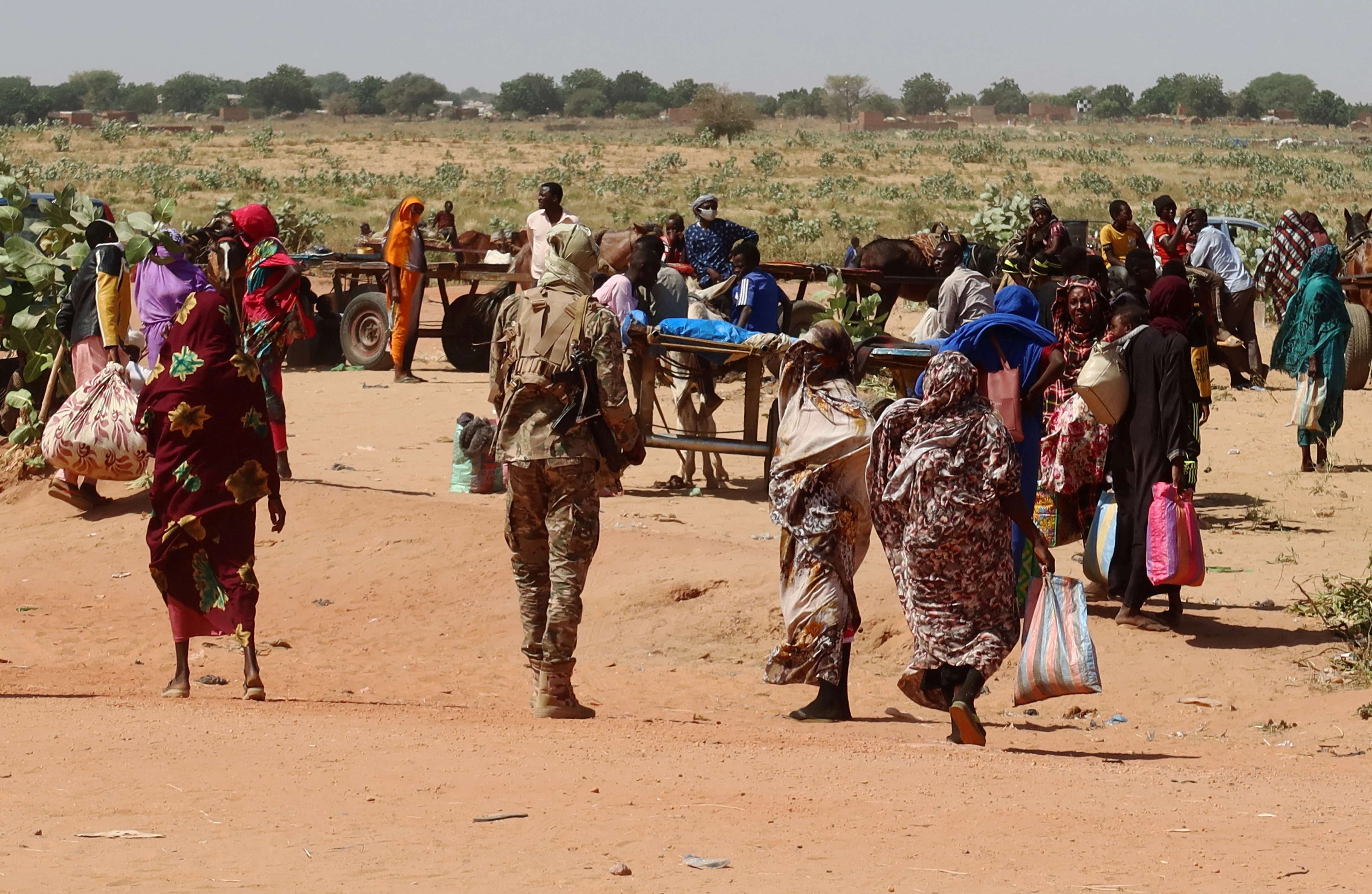
Families escaping Ardamata in West Darfur cross into Adre, Chad, after a wave of ethnic violence, November 7, 2023. Survivors recounted executions and looting in Ardamata, which they said were carried out by RSF and allied Arab militias. © 2023 REUTERS/El Tayeb Siddig

Families escaping Ardamata in West Darfur cross into Adre, Chad, after a wave of ethnic violence, November 7, 2023. Survivors recounted executions and looting in Ardamata, which they said were carried out by RSF and allied Arab militias. 2023 REUTERS/El Tayeb Siddig

In Darfur, Sudan, 80 different tribes and ethnic groups live traditional lives as farmers and pastoralists. In the last number of decades, tensions have strained the non-Arab farming communities' relations between Arab herders. Land is at a premium, leaving the farmers and the herders at odds between grazing cattle and farming the land. Government bodies appointed by the Sudanese government in the mid-1980s favoured the rights of the Arab communities, leading to mass violence, when Arab herders attacked non-Arab, Black farming communities.

Primary groups targeted by the current situation, with the rebirth of mass killings, displacement, rape and land grabs are the Masalit, Fur, Zaghawa, Bargo, Tunjor and other non-Arab tribes in the West, South, North East, and Central Darfur States. Eventually non-Arab groups -- Masalit, Fur and Zaghawa -- responded by forming their own militias, the Sudan Liberation Movement and the Justice and Equality Movement, both labelled rebels by the government of Sudan. 

In the late 1980s and beyond fighting between the Arab and non-Arab communities intensified. Chaos reigned when President Omar al-Bashi aligned the country's military with the Janjaweed militia (Arab horsemen) who persecuted and conducted murderous raids on Darfur's farming communities. Between 2003 and 2005, 300,000 people were murdered and countless others were made homeless."Counter-insurgency" campaigns resulted between 2015 and 2016. By 2019 President Omar al-Bashir was overthrown after having been indicted for genocide, war crimes and crimes against humanity at the International Criminal Court.

The feared and hated Janjaweed since transformed into the Rapid Support Forces, now in conflict with the Sudanese Armed Forces in a power struggle. The conflict, seemingly ignored by a world bored with constant African Continent strife has caused 17.7 million people to face food insecurity, while another 25 million are left in need of humanitarian assistance. In a city in West Darfur, El Geneina, the RSF rounded up Masalit men for execution, where they were held in detention without food or water.

According to the UN Security Council Panel of Experts on the Sudan, between 10,000 and 15,000 people were killed in that attack. The Darfur Bar Association described the situation in El Geneina as a "full-scale genocide". The Raoul Wallenberg Centre report cited genocidal and dehumanizing language: Arab militiamen killing boys as young as six months, claiming "the boys will grow up and they will kill us. ... so we must destroy them now".
 
https://gdb.voanews.com/01000000-0a00-0242-ad70-08dbb3a0c424_w1023_r1_s.jpg
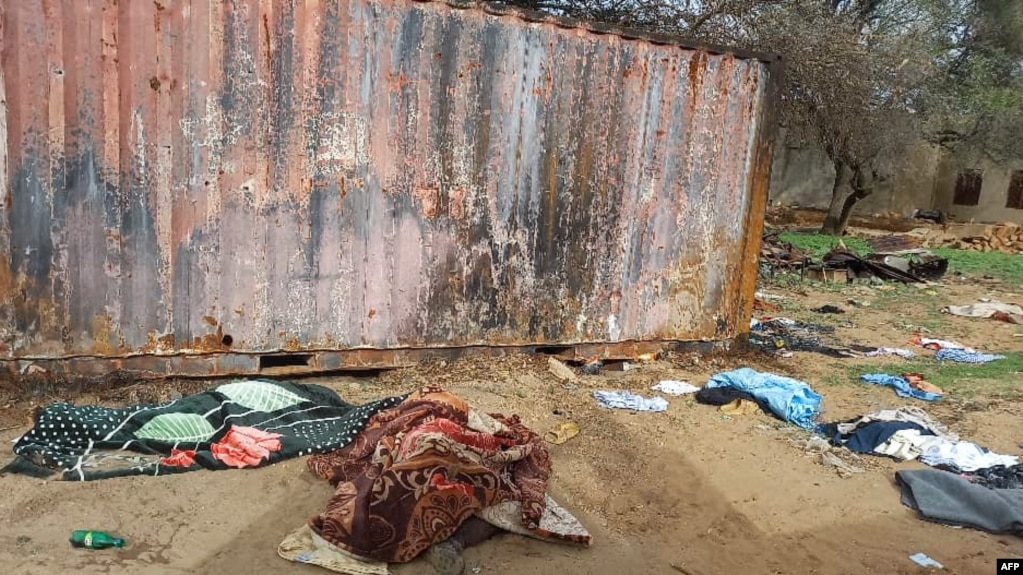
Bodies are strewn near houses in the West Darfur capital El Geneina, June 16, 2023. Up to 15,000 people were killed in the city last year in ethnic violence, according to a United Nations report seen by Reuters

Labels: , , , , , , , ,

Sunday, August 06, 2023

"Wake Up And Smell the Durian!"

"It's that fabulous time of year again. Wake Up And Smell the Durian!"
"My mood is better, my mind clearer, I have more energy, easier to sleep, easier to wake up, I feel more stable emotionally."
"I feel like Jesus, who was not recognized for his knowledge and crucified on the cross for bringing knowledge and light to people."
Zhanna Samsonova, Russian blogger, aka Zhanna D'Art
 
"It was scary to look at her, to be honest. Her hands were thin, like those of my 12-year-old sister. But she was always very cheerful, like a child , she was happy when people praised her cooking."
"A few months ago, in Sri Lanka, she already looked exhausted, with swollen legs oozing lymph. They sent her home to seek treatment. However, she ran away again. When I saw her in Phuket, I was horrified."
"I lived one floor above her and every day I feared finding her lifeless body in the morning. I convinced her to seek treatment, but she didn’t make it."
Unnamed friend
Samsonova with a section of durian, the spiky, pungent fruit that's a delicacy throughout Southeast Asia.
Samsonova with a section of durian, the spiky, pungent fruit that’s a delicacy throughout Southeast Asia.

A young woman, a Russian blogger, a food-and-lifestyle influencer, aged 39 has been reported to have died of malnutrition. She was a vegan social media personality who posted videos of her raw tropical fruit diet. Which is rather confusing, since there was a reference by a friend of hers, of how pleased she was when the public expressed admiration for her 'cooking'. Nonetheless she had millions of followers on TikTok and other popular social media sites.

Clearly, her view of life and nutrition, on moods and healthy eating was intriguing to a good many people. Her claim was to have devoted her mealtimes completely to a raw vegan diet of her very own devising. She had been living and working for 17 years across Southeast Asia, known on social media as Zhanna D'Art. As though to imply her mode of eating was an art form. And perhaps it was in the sense of being performative, and drawing the attention of a wide, admiring public.

None of whom, at this juncture it should be hoped, is committed to emulating the eating style of this woman who has met such an untimely end. She had consumed, according to her claims, raw fruits for over a decade, exclusively. In 2022 one of her social media posts boasted that she had switched to a "fully fruit-based-low-fat" diet five years earlier. The staples in her diet were jackfruit and durian, the latter emitting a noxious odour such that it has been banned in public spaces across Asia.
 
She had latterly been seeking medical treatment in Malaysia, where she died last month. On June 10, she had celebrated the durian season in Thailand, claiming she totally avoided protein, salt and oil. And nor, informed a friend, had she space for water in her diet. Instead fruit and vegetable juice provided the liquid in her diet, aside from the liquid contained in the fruit she consumed. 

No official cause of death has yet been reported, while reports do state that the young woman was suffering from malnutrition and infections. According to her mother, she died of a "cholera-like infection", even as her friends cited malnutrition. One friend spoke of meeting up with her in Sri Linka several months back, and noting the visible infections on her legs. Zhanna D'Art noted on social media feeling ostracized, based on her diet, on visits to Russia.

Evidently there are some benefits to raw vegan diets that are sensibly balanced, leading to improved digestion  and less risk of contracting diabetes. However, if not well-planned there can be deficiencies in vitamins and minerals. Most particularly shortages in Vitamin B12, calcium and Vitamin D, imperative for good overall health. The essentials of good health were heavily compromised on this woman's restricted diet. Add to that an absence of protein and insufficient caloric intake and health issues come knocking.
 
"I started to heal myself [from COVID 19] with dry fasting. I have been practising this method for a long time."
"I overcame this infection despite my unconventional treatment, which many condemn."
 
Zhanna D'Art

Labels: , , , , ,

 
()() Follow @rheytah Tweet