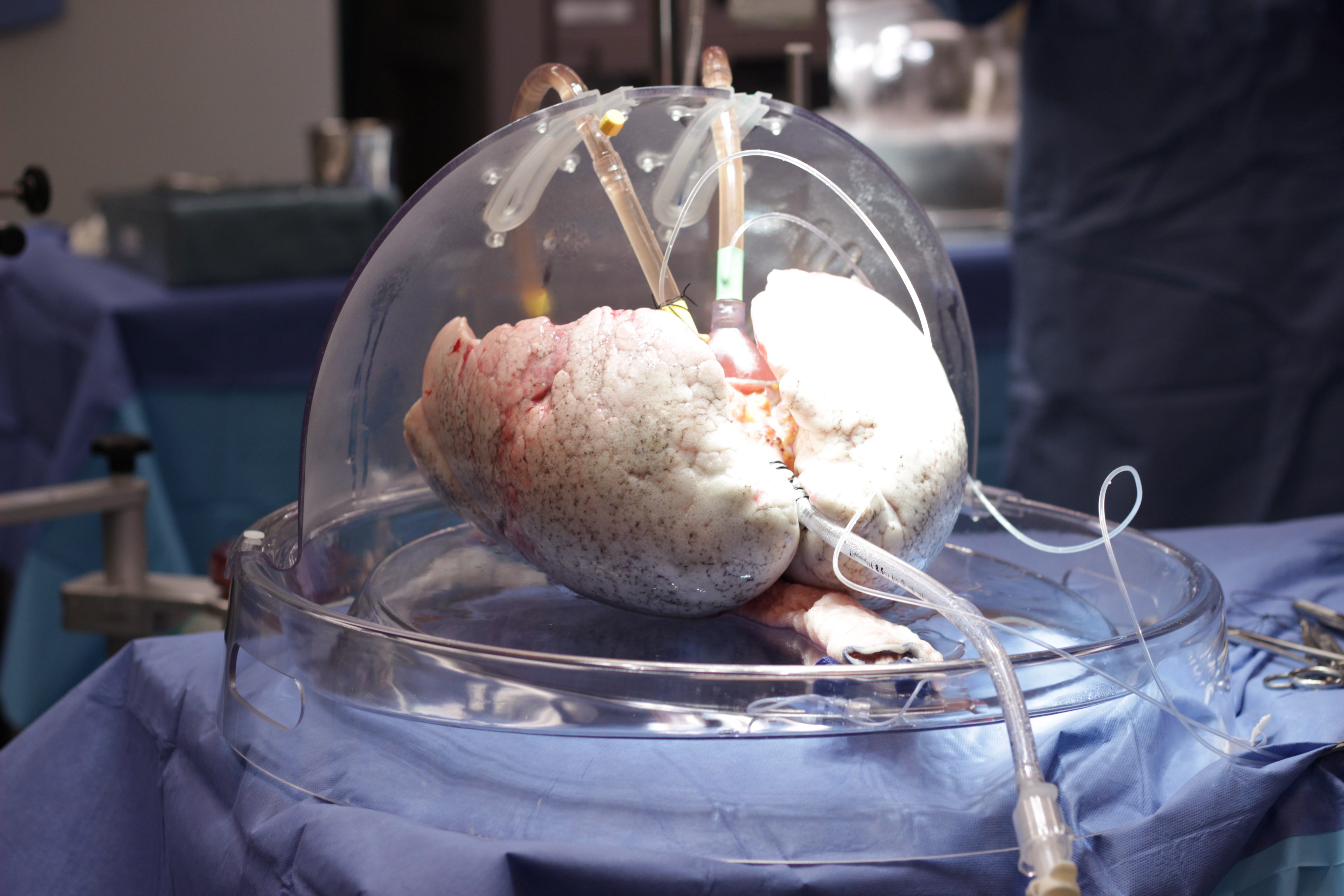
COVID-Destroyed Lungs : Double Lung Transplant
"More cases [lung transplants resulting from catastrophic COVID-19 effects on the respiratory system in some patients] have probably been seen but not reported because of poor outcomes.""If someone tried their best to save a patient's life by doing a lung transplant, and they're successful, you're going to hear about it. If we weren't successful, would we be calling to say, 'We tried this, and it didn't work'?""Most people's lungs recover when we put them on ECMO [extracorporeal membrane oxygenation] in three, four, six weeks, two months. We've seen people who recover after three or four months and get out of hospital and back to their life.""The question is, when do you make that jump and say, 'these lungs are not going to recover and we have to consider transplant'?""If there is no more COVID to be grown, if the lungs pass all of the functional tests of being a good lung, then you can successfully transplant them, and we have. And that saves a life.""It's better than the lung in the person who is dying."Dr.Shaf Keshavjee, director, Toronto Lung Transplant Program"[Although COVID had spared his other organs], we were getting to the point that, if we didn't have an organ offer within a week, I don't think he would be a candidate anymore...""[With variants crowding ICUs to the breaking point infecting younger, healthier people], we may see more referrals [for transplant].""[Even though only a very] small subset [of people would qualify], it is a very powerful, life-saving therapy for some specific patients."Dr.Marcelo Cypel, lead surgeon, transplant team
In the transplant procedure in question, a double-lung transplant to save the life of a previously healthy 61-year-old in Toronto -- the first individual in the country to undergo a double-lung transplant as a result of COVID-19 predation -- an eight-hour surgery was undertaken at the University Health Network Ajmera Transplant Centre, located at Toronto General Hospital. The procedure began with an incision; armpit to armpit, as Timothy Sauve's chest was sliced open, his ribs spread, his destroyed lungs exposed. Connected to a heart-lung machine, his lungs removed, first the donor right lung was installed, then the other, connecting the airway and blood vessels.
The transplant was a last-effort decision to save this man's life. Currently three other COVID patients on artificial lung machines are in the assessment stage for lung transplants. While most SARS-CoV-2 patients recover at home, an estimated 15 percent require hospitalization and of that number five percent will be admitted to intensive care. Of that five percent, a small number whose condition will become extremely grave will be placed on a lung bypass machine to drain blood from the body, oxygenate it to remove carbon dioxide, then feed the freshened blood back into the body. The process is called extracorporeal membrane oxygenation or ECMO.
Mr. Sauve had been at another hospital being treated there. When his condition failed to respond and he continued to deteriorate he was sedated and transferred to the Toronto General while on a ventilator. There he was taken to the operating room, and surgeons made an incision in the femoral vein in his groin, the jugular vein in his neck, and connected him to ECMO. When they woke him the following day it was explained once the ventilator was removed that, although his body had cleared the virus, the air sacs deep in his lungs had been mutilated by COVID.
Those delicate parts of the human lung were no longer light and airy, but rigid, stiff and thick. "He had got through the storm of COVID, but he was dying, and he needed ECMO, and his lungs still weren't getting better", observed Dr.Keshavjee. A Sauve family meeting was arranged with transplant respirologist Dr.Stephen Juvet and a carefully detailed explanation followed. To save his life only a transplant would succeed, there were now no other options, they had all been exhausted, to no avail. And so, the double-lung transplant took place. And it was a success.
Mr. Sauve will spend the next three to four months in recovery, living in a room at the Bickle Centre for Complex Continuing Care. The new lungs allow him now to breathe on his own but only when he is able to fully recover his former energy, required to make use of them. Physiotherapy is slowly building his stamina, completely exhausted through his ordeal. He will eventually stand on his own for over a minute at a time, as his slow recovery proceeds -- and he will eventually regain normalcy in his life.
The transplant surgery that saved this man's life may become more common in a world of a rapidly mutating virus where variant strains are once again rampaging throughout populations and hospitalizations are again increasing, with ICUs pushed to their limits in treating severely COVID-compromised patients, younger and healthier, yet infected and falling critically ill. In the world of transplants and organ scarcity, lungs are in limited supply, a number that has decreased even further, along with COVID's increase.
"This is something no one should ever get. It's unbelievable [the organ destruction wrought by COVID-19].""You may survive it. You may not.""I thought I was one of the strongest people I know, and I got it, and it nearly killed me.""People don't realize what COVID does to people ... and sometimes they're putting their guard down. I thought that when I got the disease, I'd get over it.""I just remember waiting. And the next thing I knew I was waking up from the operation — after the hallucinations wore off — and I realized I wasn't wearing an oxygen mask.""I want to leave here on my own two feet. I want to go home to my beautiful partner, Julie, but I don't want to need a walker. I'll stay here a little longer if I have to — it may take two months, three months, but my goal is to get back home."Timothy Sauve, recovering double-lung transplant COVID patient
 |
| Sauvé was eventually transferred to the University Health Network's Toronto General Hospital, home to Canada's largest organ transplant program. (Sue Reid/CBC) |
Labels: COVID-19, Lung Transplants, Toronto General Hospital
posted by Pieface @ 7:55 PM
0 comments