Ruminations

Blog dedicated primarily to randomly selected news items; comments reflecting personal perceptions

Monday, August 31, 2026

Smoke Gets In Your Eyes -- Your Lungs and Your Brain

"It's not just a few days in these extreme events that you need to protect  yourself."
"It is also the days when the sky looks OK [while air quality indexes or weather reports warn of the presence of smoke]."
Dr. Kai Chen, associate professor, Yale School of Public Health 
 
The health effects of short-term PM2.5 exposure, and subsequently smoke, can range from relatively minor (e.g., eye and respiratory tract irritation) to more serious health effects (e.g., exacerbation of asthma and heart failure and premature death). In addition, there is initial evidence that short-term smoke exposure may lead to preterm birth (Picciotto et al. 2024) and impact brain function (i.e., cognitive performance as measured through a brain-training game) (Cleland et al. 2022). Fine particles are respiratory irritants, and exposures to high concentrations can lead to persistent coughing, phlegm, wheezing and difficulty breathing. Exposure to PM2.5 may affect the body’s ability to remove inhaled foreign materials, such as viruses and bacteria, from the lungs. For example, some studies have reported an increase in the risk of COVID-19 cases and deaths in response to wildfire smoke exposure (Zhou et al. 2021; Meo et al. 2021; Schwarz et al. 2022). Although most healthy people will recover quickly from smoke exposure, some may experience health effects such as pulmonary inflammation and transient reductions in lung function (U.S. EPA 2019).
United States Environment Protection Agency  
https://www.bccdc.ca/PublishingImages/Wildfire%20smoke%20in%20Vancouver.jpg?RenditionID=2
Vancouver skyline   Wildfires and smoke have always occurred in British Columbia, but they are becoming more frequent and severe as the climate changes. Wildfire smoke is a form of air pollution that can affect your health.  BC Centre for Disease Control 
 
https://www.canada.ca/content/dam/hc-sc/images/services/publications/healthy-living/human-health-effects-wildfire-smoke/human-health-effects-wildfire-smoke.jpg

Evaluation of air pollution from wildfires presents unique challenges, compared to air pollution from other sources, such as traffic or industrial point sources, as smoke exposure is seasonal and episodic in nature (Gould et al., 2023). Also, as the number and size of wildfires impacting an area are variable and as smoke production from wildfires is not constant or steady, the concentration of smoke experienced by populations can vary considerably, and can include high levels of exposure for short time periods or moderate exposure levels lasting for several days or longer. Additionally, to evaluate the health effects of wildfire smoke, it is necessary to distinguish the contribution of wildfire smoke from that of other sources of air pollution within the mixture that people are exposed to. To address this, researchers have employed a variety of methods to assess exposure to wildfire smoke for use in health studies including use of land-based PM monitors, satellite imagery, air quality modelling, comparison of fire versus non-fire periods, proximity to wildfire burn area, and self-reports. In these studies, the most commonly used surrogates for wildfire smoke exposure are PM2.5 (particles with a diameter of 2.5 micrometres or less) and PM10 (particles with a diameter of 10 micrometres or less). For the primary investigations included in the systematic reviews considered here, the health outcome data were based on administrative sources (for example, mortality registries, health care utilization data), surveys, or self-reports. In addition, most of the primary studies focused on short-term or episodic exposure to wildfire smoke (that is, daily exposure), while some of the studies assessing mental health impacts considered health effects in years following the wildfires, and studies of reproductive or developmental impacts considered wildfire smoke exposure during the gestational period. It is noted that the health effects of PM2.5, a key pollutant in wildfire smoke, have been extensively studied and Health Canada has evaluated the health risks of ambient PM2.5 (that is, PM2.5 from all sources combined) (Health Canada 2022). 
Government of Canada 
People who are exposed to smoke from wildfires, according to more recent scientific investigations, are increasingly assailed by lung-damaging toxins, but new discoveries identify that hearts, brains and other body organs are also being damaged by wildfire smoke. Smoke exposure could sound the death knell of up to 1.9 million people in the United States alone, over three decades, according to one 2025 study. Lungs can be penetrated deeply by the concentration of airborne particles known as PM2.5, from wildfires.
 
PM2.5 is a primary pollutant that air quality indexes measure, but fails to reflect other substances that can be contained in wildfire smoke that include lead, mercury and formaldehyde, cautions Karl Nadeau, dean of the University of California, Los Angeles Fielding School of Public Health. Preliminary research suggests that wildfire smoke may be of greater harm than air pollution from more common sources such as car exhaust. Fire in proximity to urban areas, moreover, may be of particular toxicity, through consuming buildings vehicles and electronics.
 
https://news.stanford.edu/__data/assets/image/0023/163904/gettyimages-2192923816_0.jpeg
Smoke and flames from the Palisades Fire fill the sky as seen from the Pacific Palisades neighborhood of Los Angeles. | Getty Images
 
Associations between wildfire smoke and cardiovascular hospitalization, diabetes complications, preterm birth, cancer, impaired cognition and other problems, as well as respiratory effects including  attacks of asthma have been associated through scientific analytical studies. Wildfire smoke was linked in a 2024 study to deaths from cardiovascular, digestive, endocrine and kidney diseases. Asthma attacks and heart attacks can increase within an hour, in the presence of the severity of ambient smoke, pointed out professor Michael Brauer with the University of British Columbia.
 
Cognitive effect research has seen a significant expansion, explains Stephanie Cleland, associate professor at Simon Fraser University in British Columbia. Dr. Cleland was lead author of a 2022 study finding smoke exposure to be associated with lower scores on a 'brain training' game. A link between cumulative exposure throughout a school year and lower standardized test scores was also found through research, while other studies indicate a possible association with dementia. 
 
Less dramatic, lower-level exposures over time have an add-on impact, according to Professor Chen, who suggests the wearing of masks to be avoidance-helpful to exposure to ambient smoke during such events, not necessarily only when the surrounding air is redolent of burning, charred wood, and the atmosphere turns grey in reduced visibility with wildfire smoke. One study published in 2025 linked the risk of death from all causes with three-year exposure to wildfire smoke. Yet another 2025 study concluded that as average wildfire exposure increased, North Americans over age 65 suffered a higher risk of dying from chronic obstructive pulmonary disease.  
 
https://ucalgary.ca/news/sites/default/files/styles/ucws_news_hero_image_desktop/public/2026-08/GettyImages-1198428440_2.webp?h=748417e7&itok=QkT98ngt
A woman wears an N95 mask to protect herself from high levels of smoke pollution. Daniiielc, Getty Images
 
"The data pretty clearly say that there is no safe level of exposure to wildfire smoke: the more exposure we get, the worse a range of health outcomes. The data also pretty clearly show that our notion of sensitive groups should probably be greatly expanded. In addition to kids, elderly populations, or anyone else with preexisting conditions, like asthma, we need to think about populations like pregnant people whose birth outcomes can be substantially affected by exposure. Portable indoor filtration is often the best option for many households, and well-fitting N95 masks can help when outside. "
"Climate change, and in particular increasing fuel aridity brought about by hotter temperatures and variable rainfall, is playing a central role in the recent rapid increase in wildfire activity and smoke exposure throughout the US. It is certainly not the only factor, but is substantially amplifying the risk brought about by other factors, which include a century of fire suppression that has left abundant fuels in our wildlands, as well as increased human construction and activity in the wildland-urban interface. We can say with strong confidence that climate change has made these events much more likely and much more severe."
Marshall Burke,  associate professor, Stanford Doerr School of Sustainability 

Labels: , , , , , , , , , ,

Tuesday, November 05, 2019

Tobacco/Cannabis Health Alert

"We are not seeing the potential benefits [of e-cigarettes helping adult smokers quit regular cigarette smoking], but we are taking the potential risks [in seeing an increase in teen use of e-cigarettes]."
"Your lungs are much more sensitive than digesting it [vaping cannabis oils] through  your stomach. No one knows what the contaminants are in these oils."
"If you are buying something on the black market, then all bets are off."
David Hammond, chair, Canadian Institutes of Health Research in applied public health, University of Waterloo
A woman smokes a Juul e-cigarette in New York. The company says its product is intended for adults who already smoke and never people who are underage. (Brendan McDermid/Reuters)

In Canada between 35,000 and 45,000 deaths attributed to smoking take place annually, with roughly 30 percent of those deaths occurring from cancer. Recreational drug use in Canada includes the three legal products including tobacco, vaping and cannabis, though regulators have yet to fully comprehend the interplay that the three manifest on public health. Cannabis and vaping, newer to public health concerns than tobacco, are now posing challenges of their own.

Challenges that David Hammond, speaking at the biennial Canadian Cancer Research Conference taking place in Ottawa, addressed in his capacity as chair of Health Research in applied public health. In both the United States and Canada, the sale of e-cigarettes has seen a sharp increase, and a large proportion of that increase reflects new sales to teen users.

The conundrum is that despite the expectations that e-cigarettes having the capacity to aid adult smokers cease the use of regular cigarettes, no parallel increases in e-cigarette use has been realized among that adult smokers' demographic. A strong association exists among  youth, however, between vaping first and then proceeding onward toward smoking cigarettes.

Juul opened its first retail store in Toronto this summer. (Albert Leung/CBC)

Dr. Hammond points out that this disparity might arise given youths' propensity to be attracted to risky behaviour, and once one risk-taking behaviour has been absorbed, the next one beckons. Dr. Hammond earlier in the year had led a study that discovered an increase in vaping by Canadian youth. Among 16- to 19-year olds an 8.4 percent vaping increase was reported in 2017, which had additionally increased to 14.6 percent in the like period, August to September by 2018.

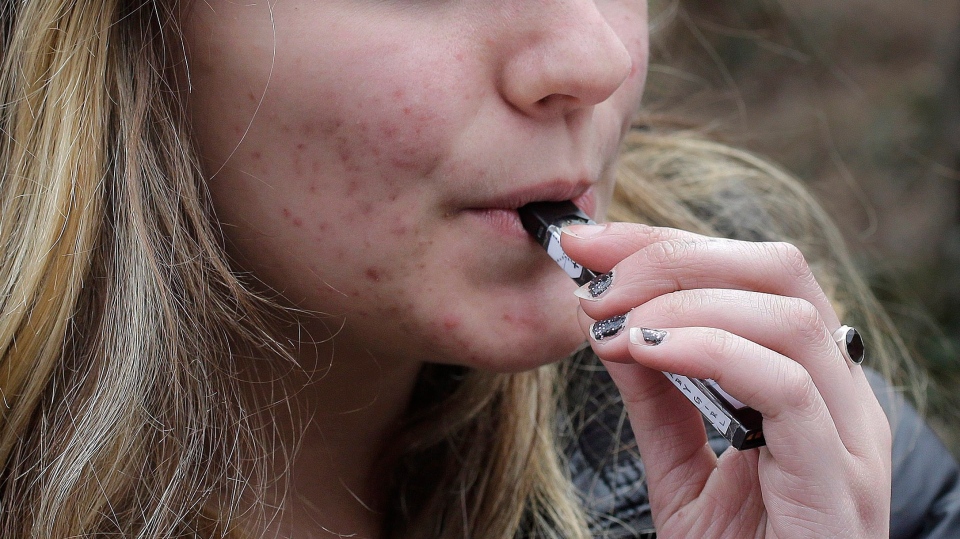
A 15-year-old high school student uses a vaping device. (AP Photo/Steven Senne)
Until recently, teen smoking had been observed to be on the decline. This study pointed out an increase in youth smoking regular cigarettes between 2017 and 2018, from 10.7 percent to 15.5 percent, with vaping seen as introducing youth to regular smoking. This was viewed as the first data to emerge since major tobacco companies launched and advertised e-cigarette brands in Canada in the wake of the adoption of Bill S-5, legalizing e-cigarettes with nicotine in May 2018.

Though admittedly e-cigarettes are viewed as less harmful than smoking -- in particular with cancer risk -- the inescapable fact is that they contain nicotine. E-cigarettes are only useful for regular smokers when an entire switch is made from cigarettes to e-cigarettes. For those who choose to smoke both e-cigarettes and to continue with regular cigarettes, little or no risk reduction results from that combination.

In the United States there  have been close to 2,000 serious cases of lung disease related to vaping cannabis oils, with over 30 deaths, thus far. An estimated 80 percent of the cases of that mysterious lung disease point to vaping cannabis oils, mostly acquired through the black market. The Canadian Cancer Society back in June called on government action immediately, to address the increase in youth vaping.

The Canadian Cancer Society wants Saskatchewan to raise to legal age of purchasing tobacco and vaping products to 21. (Aliaksandr Barouski/Shutterstock)

Labels: , , , , , ,

Wednesday, August 21, 2019

Challenging Research

"[It's possible some] mystery variable [is related to both fluoride and IQ, but we controlled for everything we could think of]."
"Four-and-a-half IQ points is not negligible. People have been calling this a small effect. I'm shocked. [The effect on IQ] of lead exposure is of this magnitude. It's a big deal."
"The impact is going to be felt -- it means fewer people in the gifted [IQ] range and more people falling in the range of intellectual disability."
Dr.Christine Till, professor of psychology, York University

"[The size of the sample was reasonable and the study is] methodologically sound [making an important contribution]."
"Public policy is ideally informed not by any one study, but by the best available evidence as a whole."
Dr.Lindsay McLaren, community health sciences professor, University of Calgary

"What we know about the effects of lead on IQ doesn't come from one study. It is ... based on a far larger set of research findings that extend over many more populations and many more years."
"At the end of the day, it is still one study. Although I like a lot of what was done in this particular paper, at the end of the day, you're left scratching your head -- why aren't the results internally consistent?"
"I've had that discussion with many, many colleagues, in many different research areas, over many years. And my advice to them is: I'm with you on the research. It's really neat stuff ... but the policy-makers have to consider far more than just one paper. And some of my research colleagues get that more than others. For some, it's a really tough sell."
Dr.Ray Copes, chief of environmental and occupational health, Public Health Ontario
Despite the benefits, adding fluoride to tap water will always be contentious, a chemistry professor says. (Craig Chivers/CBC)

Several generations ago fluoride was being introduced for the first time to drinking water in Canadian jurisdictions. Some municipalities started using fluoride in 1945. Medical science argued for its use in reducing cavities in children. Fluoride strengthens teeth, helping in the prevention of bacterial decay, as a mineral that binds to teeth.

Public health, medical and dental groups all recommended fluoridation of community water, among them the Canadian and American Dental Associations, the Chief Dental Officer of Canada, the World Health Organization. Its contribution to cavity decline in children saw the U.S. Centers for Disease Control and Prevention naming it one of the  ten great public health achievements of the 20th Century.

From the very beginning right to the present time some in the scientific community and in municipal leadership have called its usefulness into question, citing the possibility that the use of fluoride led to other health problems. Some municipalities ceased using fluoride, the result of which saw a dramatic rise in cavities among children living there. Fluoride's qualities as a cavity preventive are lauded. And fears of its possible darker side are cited by opponents.

A new study led by York University's Christine Till -- published in the journal JamaPediatrics -- found what the researchers believe to be a link between fluoride exposure in drinking water during pregnancy and the eventuality of lower IQs in children. On publication, the study and its conclusions caused an international stir, leaving Dr. Till professing "shock" at the way the study has been received.
Fluoride has been one of the most positive public health interventions in human history, public health experts say.

Levels of fluoride in some 500 pregnant women's urine was measured for the study on three occasions during pregnancy. Self-reported information on individuals' consumption of tap water and black tea -- known to be naturally high in fluoride -- was collected. The women's children's IQs were tested -- once -- at ages three or four. Self-reported fluoride was then associated with lower IQs both in girls and boys.

Only in boys, however, was urinary fluoride concentration associated with lower IQ. A drop of 4.5 IQ points was found for every one milligram-per-litre increase in urine fluoride. A variety of other factors including economic status, parents' education, exposure to other environmental chemicals that could account for IQ differences was controlled for in the study.

Given that the research was subject to "review after review after review" prior to funding, then underwent extensive scrutiny during peer review, the authors going so far as to hire a third-party statistician to look over the numbers to ensure everything was in order, the study is considered to be the largest, most rigorous of its kind to have been conducted to date.

Routine since the mid-20th Century across Canada, fluoride added to drinking water helps in tooth enamel strengthening; its beneficial role in cavity reduction unquestioned. Other studies indicate that those who benefit the most from fluoride use in drinking water are those with poor oral health and compromised access to dentistry.

Dr. Copes at Public Health Ontario is perplexed by the observed sex differences in the study. An indication, he feels, that the use of different research methods might be indicated, along with replication of research conducted by other researchers prior to informing pregnant women they are advised to limit fluoride consumption. His position on the other hand, puzzles Dr. Till who believes ample evidence exists to inform pregnant women to limit their fluoride exposure immediately.

Ayesha Drouillard in her home in Windsor on Friday, February 17, 2012. Drouillard was hoping to push city officials to remove fluoride from the drinking water in Windsor.

Labels: , , , , ,

Tuesday, July 03, 2018

Cannabis: Harm Reduction and Hyperbole

"The tricky part is that part of harm reduction will continue to be that you shouldn't be using this product."
"By being more honest and open that cannabis can be used responsibly it will add credibility to the messages that say, 'but you shouldn't really use it under these settings, and one of those is if you're a young person."
"[There is evidence supporting each of the proposed health warnings by Health Canada] and none of them -- except for the warnings around pregnancy and breastfeeding -- actually say people shouldn't use cannabis. That's harm reduction."
"[Most people use pot responsibly] but there is a reasonable number who can have problems controlling their use, and signs of daily use can be an indication of that."

David Hammond, professor, school of public health, University of Waterloo, Ontario

"[People tune out sensationalist scare tactics and condescending messages; abstinence-only propaganda -- and 'Just Say No' campaigns fail to resonate with youth...]"
"If they do find themselves struggling with use, they need supports they can use rather than judgement, or, worse, criminalization."
Heather D'Alessio, spokeswoman, Canadian Students for Sensible Drug Policy
Health Canada wants all weed to be labelled with health risks. Photos via Health Canada

The group, Canadian Students for Sensible Drug Policy has undertaken an initiative of their own, to produce a "Sensible Cannabis Toolkit" information package which they have based on what they feel is realistic evidence-based information to help guide young adults in their conversations with adults when discussing the use of weed. Most pot users, they point out, do not use pot as a 'gateway' to transition to the use of harder drugs.

They also take issue with the use-associated mental health problems in the heavy use of cannabis concluding that there is an association with cognitive impairment and other mental health problems. "Any strong conclusions around causality" -- which came first? -- remain uncertain, according to their informative website.

Recently, a review of available literature associated with pot use led by researchers at the B.C. Centre on Substance Use discovered that what is believed to be a link to a lower IQ in later life among adolescent-use of high frequency, is belied by the findings of more recent studies concluding no association after controlling for social factors like background poverty and the neighbourhood that users grew up in.

Early efforts at Colorado public health after the state's 2014 legalization saw some of their informative harm-reduction efforts fall flat and face criticism by pot advocates for their condescending undertones. Leading Professor Hammond to the view that pot advertisements must reach beyond "use or not-use", to include information more specific such as that smoking adds toxicity in excess since THC levels in the pot currently in circulation are much higher than what prevailed during the Boomer era.
Who uses cannabis?

Health Canada is preparing to roll out a $5.1-million marijuana education tour to travel across the country in an effort to prepare the public before the cannabis legalization comes into effect in Canada by the target date of October 17. Plans are underway to set up exhibits at local events such as fairs, festivals and Canadian Hockey League arenas from July in the Maritimes and Northwest Territories before moving on to other provinces and territories.

Exhibits will be complete with climbing walls, interactive graffiti walls and similar such infrastructure in an effort to encourage people to to discover activities "that can give them a natural high, rather than using cannabis". "Ambassadors" will be tasked to "engage visitors in conversations about the health and safety facts on cannabis", to staff the exhibits.

A list of proposed pot packaging warning labels is being released by Health Canada. That cannabis smoking is harmful; that teens are at greater risk of harms; that people should not drive stoned; that women should not use if pregnant or breastfeeding (new links of pot exposure in the womb or through breast milk have been identified with stillbirth, preterm birth, low birth weight and poorer mental developing in children), are all driving the government's effort to ensure people are adequately informed of risks involved in indulging in cannabis.

Critics,  however, have highlighted one of the warnings for special attention; the warning that "up to one in two people who use cannabis daily will become addicted", has been seized upon as extravagantly unwarranted. Dr. Hammand and colleagues published a paper last year in the Canadian Journal of Public Health outlining their findings that a "very small proportion of Canadians report using cannabis to a degree that is problematic", with only two percent of the sample of respondents reporting the use of pot in the past three months seen to be at high risk of developing health or other problems.

Cannabis consumption through the decades

Labels: , , , , , ,

Thursday, March 08, 2018

A Pernicious Social Malaise

"Our plan is absolutely addressing all aspects of this crisis. I'm confident that we're putting our resources into all the areas that are so important in addressing this public health crisis."
"[Ontario's government is doing everything it can to combat an] avoidable tragedy."
Helena Jaczek, Ontario Health Minister

"This crisis has been on the radar in Western Canada for years, yet this [Liberal-led] government [of Ontario] chose not to take preventive measures to protect Ontarians from the dangers of opioids."
"Both the government and the previous health minister have clearly failed to properly address this crisis."
Progressive Conservative health critic Jeff Yurek

"Mr. [Waseem] Shaheen used his specialized knowledge as a pharmacist to hide his activities from other employees, the College of Pharmacists and the police, and when confronted, planned and carried out a fake robbery to cover his illicit activities."
"He is an educated, intelligent person who set out to benefit himself with no regard to the consequences to the community at large. As a pharmacist, his moral blameworthiness could not be higher."
Public Prosecution Service of Canada

"[Shaheen, a professional entrusted with securing access to dangerous drugs, chose to traffic fentanyl] that is at the forefront of the opioid crisis that is ravaging our cities."
"[The drug, meant to be prescribed to people in pain, can result in] crippling addiction or death [on the streets]."
"His only apparent motivation was greed."
Ontario Court Justice Robert Wadden
An Ottawa pharmacist who faked a robbery at his own drugstore to cover up the "mountains" of fentanyl patches he trafficked has been found guilty of his crimes. The police case against Waseem Shaheen began in October 2014 when he reported a knife-point robbery at his Rideau Street I.D.A. pharmacy. (Google Street View photo). / OTTwp

The government of Ontario has pledged over $222-million over a three-year period in an effort to tackle the opioid crisis being experienced in the province. Funding is meant to expand harm-reduction services and to enable the hiring of greater numbers of front-line staff. Funding has also been approved for seven supervised injection sites, five already in existence. That there is a crisis across Canada is not in question.

According to provincial statistics there were 7,658 hospital emergency visits for opioid-related overdoses last year, significantly higher than the 4,453 that occurred the previous year. There was a documented 1,053 deaths from opioids in 2017, in comparison with 2016, when there were 694 such deaths. According to the Public Health Agency of Canada, the number of deaths due to overdose was expected to surpass the 4,000 for all reporting provinces for 2017, surpassing the 2,861 opioid-related fatalities reported for 2016.

There is no charge for acquiring naloxone kits from pharmacies whose purpose as an emergency treatment for such overdoses is known to have reversed the deadly effects of overdoses fairly effectively if and when administered in a timely fashion. A new version of the overdose-reversing drug is set to be released through pharmacies, available without cost to anyone requesting such a kit as a matter of ensuring that people are prepared to commit to preventing such tragedies in the circles in which they move.

The stiffest sentence ever handed down in Canada to a pharmacist for fentanyl crimes was made public when Ontario Court Justice Robert Wadden handed down a 14-year incarceration sentence for Waseem Shaheen, who in October of 2014 reported a robbery at knifepoint at his Rideau Street I.D.A pharmacy. He reported that a masked man had threatened him and coerced over $25,000 in fentanyl patches in the robbery, caught on surveillance video. The robbery, however, was a ruse revealed to police by the man addicted to drugs whom Shaheen had hired to execute the robbery.

Justice Wadden, in the wake of a fall trial that had found Shaheen guilty of trafficking fentanyl, of public mischief for reporting a fake crime, and insurance fraud, handed down the sentence committing Shaheen to serving five years each for the mischief and fraud convictions concurrent with his longer sentence for trafficking fentanyl. The judge cited the position of public trust that Shaheen had violated when arriving at an appropriate sentence.

Waseem Shaheen was a pharmacist who operated three pharmacies, he was in no desperate need of cash, to convince him to sell dangerous drugs on the street in violation of the law. He had trafficked over 5,000 patches of the highest strength of fentanyl over a two-year period, a scheme that profited him over $1-million; according to Justice Wadden, "profiting on the misery of others." Shaheen had been suspended by the Ontario College of Pharmacists from practising as a pharmacist since March of 2016.

"I'm hopeful this sentence is a signal of just how seriously these types of crimes will be dealt with in our community", commented Staff Sgt. Michael Haarbosch of the Ottawa police robbery unit, adding that investigators who had dedicated a significant amount of their professional time and resources to this case, feel pleased with the outcome.

Waseem Shaheen covers his face and rushes into the Ottawa Courthouse. Postmedia

Labels: , , ,

 
()() Follow @rheytah Tweet