Ruminations

Blog dedicated primarily to randomly selected news items; comments reflecting personal perceptions

Thursday, August 23, 2018

Nature's Baffling Changes

"It's totally out of everyone's wheelhouse."
"I had calls -- 'Really? The reds aren't running? Are you sure the sonar is even working'?"
"It was very unexpected for the general public."
"They [smolt; young salmon] would have hit some very warm ocean water right in a critical life stage. They out-migrated into a marine environment [that[ wasn't really conducive to sockeye development and survival."
Stormy Haught, biologist, Prince William Sound, Copper River areas

"It's just like everybody is in total shock."
"Nobody can afford to buy gas on their four-wheelers. It's going to be a hard winter for a lot of people."
Elliot Lind, 70, commercial fisherman, Aleut fishing village, Chignik

"Some researchers are pointing toward warmer water, but it kind of depends on which populations we're talking about and where they are."
Bill Templin, Alaska chief scientist, commercial salmon fisheries

"That's what we're seeing, massive changes in all kinds of things."
"It's not going to be one thing only, it's going to be a combination of insults that cause these problems."
Kathi Lefebvre, research biologist, Northwest Fisheries Science Center, Seattle
alaska-salmon-shortage-FT-BLOG0818.jpg
Nick Hall/Getty Images

A mass of warm ocean water known as "the Blob" came out of Mexico and began to raise temperatures in the Gulf of Alaska in 2014. Since then, algae blooms have spread north, the result of which toxins they emitted have poisoned the areas where birds and mammals have been exposed to the deadly toxins. From 2014 through to 2017, a large seabird die-off occurred across Alaska. There were reports of paralytic shellfish poisoning and mysterious whale perishings.

A great number of problems not only toxic algae growth can accompany ocean temperatures that are unaccustomedly warmer, leading to starvation, increased susceptibility to disease, as well as reproductive problems. Higher oceanic temperatures have the potential to harm plankton, the main meal of salmon. But the absence of red salmon in this fishing season remains a puzzle to scientists who are left to hypothesize the reason for their diminished return in Alaskan waters.

Climate change and pollution are always the quickest, easiest answers, but they may not accurately describe the whole reason for the startling absence of red salmon from Alaska rivers where once they were so abundant they fell in wholesale numbers into fishermen's nets. Expected to return as usual to the rivers where they spawn after feeding in the open sea, they have failed to materialize. The absence follows a pattern that king salmon initiated.

These are large, muscular fish held in great esteem for their mild flavour and flesh that is oil-rich and nutrient-dense. In the last decade their numbers have diminished hugely, leading the large community of natives, Alaskan residents in general, commercial fisheries and the restaurant trade to depend more heavily on the usually abundant red salmon and other locally caught fish.

The red salmon with its raspberry-bright colour and slightly salty flavour exemplify high summer in Alaska. Everyone catches them, smokes them, freezes them, barbecues them, brines them in sugar and salt, and alder-smokes them. Restaurants depend on them for a bustling summer business. They are vital to the state's economy. Freezers in cities and rural villages are crammed with them; plentiful, inexpensive and readily caught even by rank amateurs.

They were, that is.

This summer when late July rolled around, marking the end of the red-salmon season, an estimated half of last year's total had arrived. The glacier-fed fishing ground of the Copper River experienced its leanest red-salmon run in 38 years, along with other rivers across the state. River after river was closed to fishing in July by state wildlife managers to ensure that enough salmon would be left to reach their spawning grounds.

Scientists remain cautious about the causes, suspecting that warmer ocean temperatures resulted in this phenomenon. One area only, Bristol Bay, noted as the world's largest wild red-salmon fishery in south-west Alaska, saw no difference in the number of their catch this year. Unfortunately for most Alaskans, most of its catch leaves  he state, shipped around the world.

Off Kodiak Island in July, commercial fishermen saw their nets full of jellyfish, just jellyfish. In the rural Aleut fishing village of Chignik there is a sombre atmosphere in view of its fishing fleet, the economic lifeblood of the village sitting idle during the red-salmon fishing season. Townspeople who ordinarily smoke and freeze fish vital to their winter diet, now face the necessity of buying costly groceries. Food aid may have to be shipped in to help the town get over the winter months.

Over the last century, scientists well know the opposition that all varieties of salmon in the Pacific Northwest face, through the proliferation on the rivers of dams, deforestation, warming water and pollution. Chief scientist Bill Templin feels that it is not the rivers that are somehow at fault, that whatever has impeded the red-salmon return happened in the ocean itself.

Warmth appears to have persisted in the Bering Sea, home to some of the world's largest fisheries, even while water off much of the Alaskan coast has cooled this year.

Melody Miller (left) disentangles a salmon she just netted on Kenai’s north beach with the help of her daughter Manuia Tufi on Thursday, July 26, 2018 in Kenai, Alaska. The two had recently after arrived from Anchorage and had caught the day’s first fish. Miller said this is her seventh year of dipnetting in Kenai. On Thursday afternoon, the Alaska Department of Fish and Game announced the fishery will close two days early, at 12:01 a.m on Monday. (Ben Boettger/Peninsula Clarion)

Labels: , , ,

Thursday, July 19, 2018

“Tundra be Dammed: Beaver Colonization of the Arctic.”

"That's when I started getting interested in beavers [speculating what species in a warming Arctic would be next to colonize its range]. These guys are small, highly industrious engineers."
"We have caught the beavers in the act. We are really only at step two of a ten-step process in understanding what is going on, and the implications of it."
"Is it a good thing or a bad thing? Put it this way: if someone went into a land manager's office and wanted to get a permit to do all the work that the beavers are doing in the Arctic right now, it would be a lot of paperwork. But I see these guys as facilitating change in the Arctic -- and accelerating the changes that are already underway."
"It’s kind of the next wildlife you’d expect in tundra, but with much bigger implications."
"I love the fact the beaver is the Canadian national animal. You just need to look at the map to see how well beavers recolonized the rest of North America after over-trapping."
"They are now in all the lower 48 states, and Alaska is the last standing -- and it's going to fall."
Ken Tape, associate professor, University of Alaska Fairbanks
Beaver (Castor canadensis) family enjoy the fruits of their considerable labors, Denali Nat'l Park, Alaska.  Getty Images/iStockphoto
"We do not know how beavers reached the Beaufort Coastal Plain, but they would have had to cross a mountain range or swim in the sea."
Yukon biologist Tom Jung, northern Yukon Territory
Beavers are everywhere there is water that can be dammed, a lodge built to hold a beaver colony and ample supplies of poplar from nearby forest enclaves are present, where the beavers with their sharp incisors easily cut through the thickness of a mature tree trunk, judging where the cut should go and where the tree will fall. Loggers know to cut a notch in a tree trunk to control the fall of the trees they're harvesting. Can it be possible that the logging industry studied the successes of beavers and simply emulated them in harvesting techniques?

Or does their similarity of operational techniques in best-practise logging reveal that beavers whom nature has equipped so splendidly to manipulate its natural surroundings to create a habitat for itself and in the process one that will appeal to other forest creatures from aquatic animals to wolves, coyotes, foxes, moose and more taking advantage of the industrious beavers' foresight in altering an environment to make it more likely to grow vegetation attractive to the greater populations of wildlife, indicate it has been as naturally endowed as humans to alter its landscape?

Beaver were once  viewed as a natural resource of great commercial value, when its pelts were desired for human garments and headgear. Certainly a renewable resource, but yet one so mercilessly hunted and trapped that the trapping profession that was so robust for far too long, collapsed along with the kind of culture that saw them as furnishings for sartorial purposes. With the absence of the beaver resulting from near-extinction in areas they had long been known to inhabit, the natural environment changed too, absent their engineering know-how and custodial care.

The landscape changed in their absence and all the creatures that so hugely depended on their presence in building dams, creating beaver meadows and ponds that in turn proved perfect habitat for both vegetation and animals, began to vanish; the previous lush presence of both turned barren as the lakes dried up, the vegetation receded, the animals looked elsewhere for the perfect environment where they could exist. Since then, however, those hardy, industrious animals have made a comeback, their presence common all over North America, including Mexico.
A beaver swims in a pond in Elk Island National Park east of Edmonton Alta. Max Maudie/Edmonton Sun
And now, it seems, with the advent of noticeable climate change and the warming effect that has melted areas of the Arctic's glaciers, altering the tundra in Alaska, beaver are now settling that far north. It's likely a toss-up which arrived first in the area known for its permafrost -- gradually losing the permanence of the tundra frozen rigid in frost -- the beavers or the moose now venturing out of forests to feed on woody shrubs, since beaver habitation is known to attract moose for the salubrious effect it has overall on the environment.

Dr. Tape and his colleagues have been studying the issue of the entrance of a previously unknown presence of animals venturing into the Alaskan tundra known more for the presence of Grizzlies than of beavers. They produced a new research paper titled Tundra be Damned: Beaver colonization of the Arctic. Never having actually seen a beaver living and working in a tundra environment, Dr. Tape and his fellow researchers began studying decades' worth of satellite images featuring a 18,293-square kilometre area of permafrost in northwest Alaska.

Aided immeasurably by the capacity of satellites to photograph images from space, they discovered 56 new beaver pond complexes in a landscape they knew to previously be absent of the presence of beavers. The beavers' activities have wide-ranging consequences, 'improving' the natural presence of geological features favourable to the presence of a wide variety of vegetation and animals forming a complete ecosystem in a chain of existence favoured by nature. As beavers dam up rivers and streams creating ponds, wetlands proliferate.

The ecosystem that has been altered is healthier when dams filter out pollutants and the resulting ponds fill with new life and the risk of flooding becomes more remote. Changes in the Arctic have the potential to be quite dramatic. A beaver pond that expands, washing over permafrost, degrades frozen ground, rinses soils away, releases carbon dioxide and methane in the process, as the frozen area no longer holds the carbon dioxide its melted state releases. The presence of beaver and their activity accelerates the permafrost retreat.  
Beavers at home
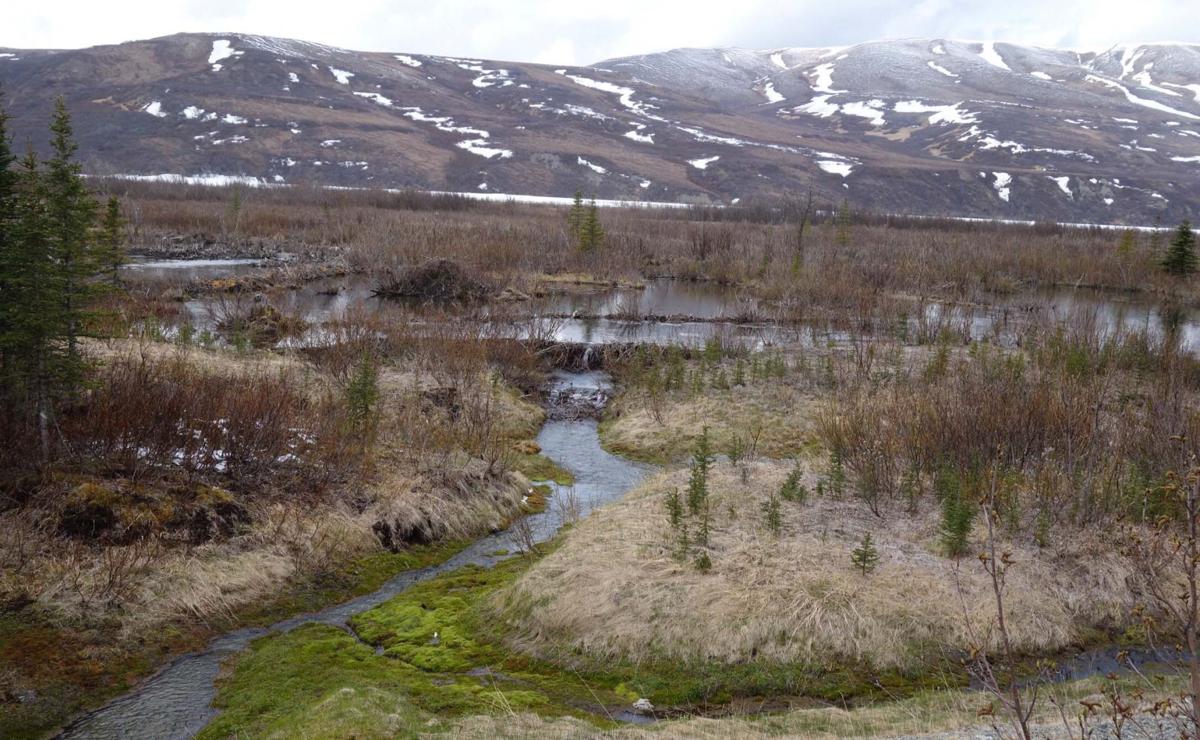
Signs of the American beaver in Alaska include a dam on Phelan Creek near Isabel Pass in the Alaska Range. Photo: Ned Rozell

Labels: , , , , , , ,

 
()() Follow @rheytah Tweet