Ruminations

Blog dedicated primarily to randomly selected news items; comments reflecting personal perceptions

Friday, May 03, 2019

Melting Arctic Permafrost

"The ground thaws and swallows it [scientific equipment]. We've put cameras in the ground, we've put temperature equipment in the ground, and it gets flooded. It often happens so fast we can't get out there and rescue it. We've lost dozens of field sites. We were collecting data on a forest and all of a sudden it's a lake."
"Permafrost at [that] depth, even a hundred years from now, probably would still be protected in the soil. Except here comes this really crazy liquefication where this abrupt thaw really churns up this stuff."
"These are minimum estimates. We've been very conservative. The landscape is going to be affected more and more every year by permafrost degradation."
"We've got a lot of people [in the Canadian Arctic] living on top of permafrost and building infrastructure on top of permafrost. It's enough to sink northern budgets."
Merritt Turetsky, research biologist, University of Guelph
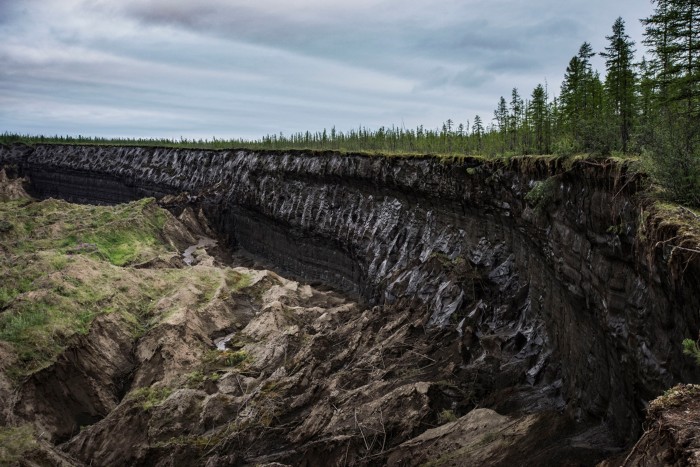
Soil erosion due to permafrost thaw in the Batagaika crater in eastern Siberia
The Batagaika crater in eastern Russia was formed when land began to sink in the 1960s owing to thawing permafrost. Credit: Yuri Kozyrev/NOOR/eyevine

New research published in the journal Nature reflects a study of the rate of permafrost melt across the Canadian Arctic, with the intention of determining as much as possible what the eventual impact may turn out to be and how it will affect efforts to limit greenhouse gas emissions. In some areas of the Arctic permafrost is melting fast enough that it simply swallows scientific equipment left in research spots for the purpose of studying those areas.

The rapid rate of the permafrost melt has the potential to dramatically increase greenhouse gases released as the permafrost relaxes its grip, from ancient plants and animals that once lived within the tundra and are now caught in its depths. That large areas of frozen soil underlying most of the Northern regions are thawing as the Arctic warms has been understood to be happening for years; the organic carbon from plants once locked in the ice is allowing the organic carbon to melt and decompose.

What was visualized as the ongoing scenario of this change was that a gradual albeit steady erosion of permafrost with a corresponding pace of carbon release would be taking place. Through this research, however, a variable picture of the situation has emerged; rather than melting at a few centimetres rate annually, in actual fact it is several metres of soil that has been destabilizing and sometimes in the unbelievable space of mere days.

A thaw slump, a consequence of thawing permafrost, filled the Peel River Plateau with two million cubic metres of sediment. (Photo: Courtesy of Government of Northwest Territories and Canada Centre for Mapping and Earth Observation)

Sinkholes appear in the landscape -- and hillsides expose deep permafrost as they slide away through the melt process. Rapid permafrost melt is also impacted by larger and hotter wildfires occurring over the Canadian boreal forest. It has been found as well through soil analysis, that the melting areas contain greater amounts of carbon with close to 80 percent holding at least 70 kilograms of carbon per cubic metre.

Landslides caused by heavy rains in September 2017 scar the Caribou Hills near Inuvik, N.W.T. (Photo: Northwest Territories Geological Survey and Aurora Research Institute)

Revealing in the process that permafrost appears likely to release up to 50 percent more greenhouse gases than has been hitherto believed by climate scientists. Much of the gas will be released in the form of methane, about 30 percent more efficient at heat-trapping than is carbon dioxide. Rapid melt aside, the estimate is that decades will pass before the additional carbon release begins to influence global climate.

The news is not quite so hopeful for residents of the Canadian Arctic who will be affected long before the passage of decades as buildings positioned over the permafrost begin to sink, under the influence of its altered state.
Labels: , , ,

Thursday, November 08, 2018

The Thawing Arctic

"These lakes speed up permafrost thaw. It's an acceleration."
"I love the solitude of remote lakes and the mystery of what lies beneath the water surface."
"You’re just looking down into this stream of bubbles coming up right into your face, and they’re so soft they go all around you. And the sunlight’s on them. It’s like out of this world but under this world."
Katey Walter Anthony, aquatic ecologist, Arctic expert, University of Alaska, Fairbanks

"It’s kind of freaky. [Diving into the under 60 degree Wow 2 waters, in wetsuit and snorkel, feeling his way around the scant visibility].
"Right where the hole goes in, it slopes, and it’s flattened out, and it coned back down, and that was where some really loose sediment was, and I could stick my hands into it."
Philip Hanke, research assistant
Methane gas released from seep holes at the bottom of Esieh Lake send ripples to the surface. (Jonathan Newton/Washington Post)
Below the peaks of the Western Brooks Range a vast lake had the appearance of boiling over as its water hissed, bubbled and popped, activated by gas escaping from the lake bed, bubbles rising as large as grapefruits, seen to 'lift' the water's surface, dredging up muck from the bed of the lake. This was different, this was unique, thought aquatic ecologist Katey Walter Anthony as she sat at the shoreline, watching the unusual action, knowing that the gas was in fact, methane.

As the Arctic continues to warm, permafrost begins to thaw, releasing carbon dioxide from soil to air. The thaws spur the growth of lakes in the sunken ground and these bodies of water have a tendency to unleash the gas known as methane from decomposing, ancient deposits of plant material. This lake, to the scientist, looked different than those she had become familiar with in her research, and she named it Esieh Lake. It was the volume of gas being produced that captivated her interest.

When she first saw the lake and witnessed the activity on its surface, the thought occurred that it might explode. The very thought of a methane-induced explosion was one that would reduce anyone knowing its potential to instant fear. She once took a video and posted it in 2010 of herself standing on the frozen surface of an Arctic lake, lighting a methane stream on fire as a tower of flame resulted whooshing over her own height.

She returned in August of this year with a small research team to further explore the possible secrets within Esieh Lake; whether what she had witnessed was an anomaly or a sign that the Arctic as it thawed had initiated a serious release of methane from an ancient source that might conceivably aggravate climate change. If the warming Arctic releases increasing amounts of planetary heating methane ... more warming could ensue.

She had been tasked by a Native Alaskan group, the NANA Regional Corporation, to search for seeps of methane gas in northwest Alaska, hoping to be able to take advantage of its presence as a source of fuel to benefit remote communities. In the course of that search she studied some 300 lakes across the Arctic tundra. In 2017 Walter Anthony sent a message to residents of KIotzebue, Alaska of her search for unusual lakes whose surface was unfrozen.

A pilot responded, leading her to the Noatak region, a near distance above the Arctic Circle, and last September her first visit to the lake took place, so remote days of camping are required to finally reach it. Once her initial fear elicited by the sight and potential of all that gas dissipated, her scientific mind took control as she grew more comfortable with the constant spluttering of the lake.
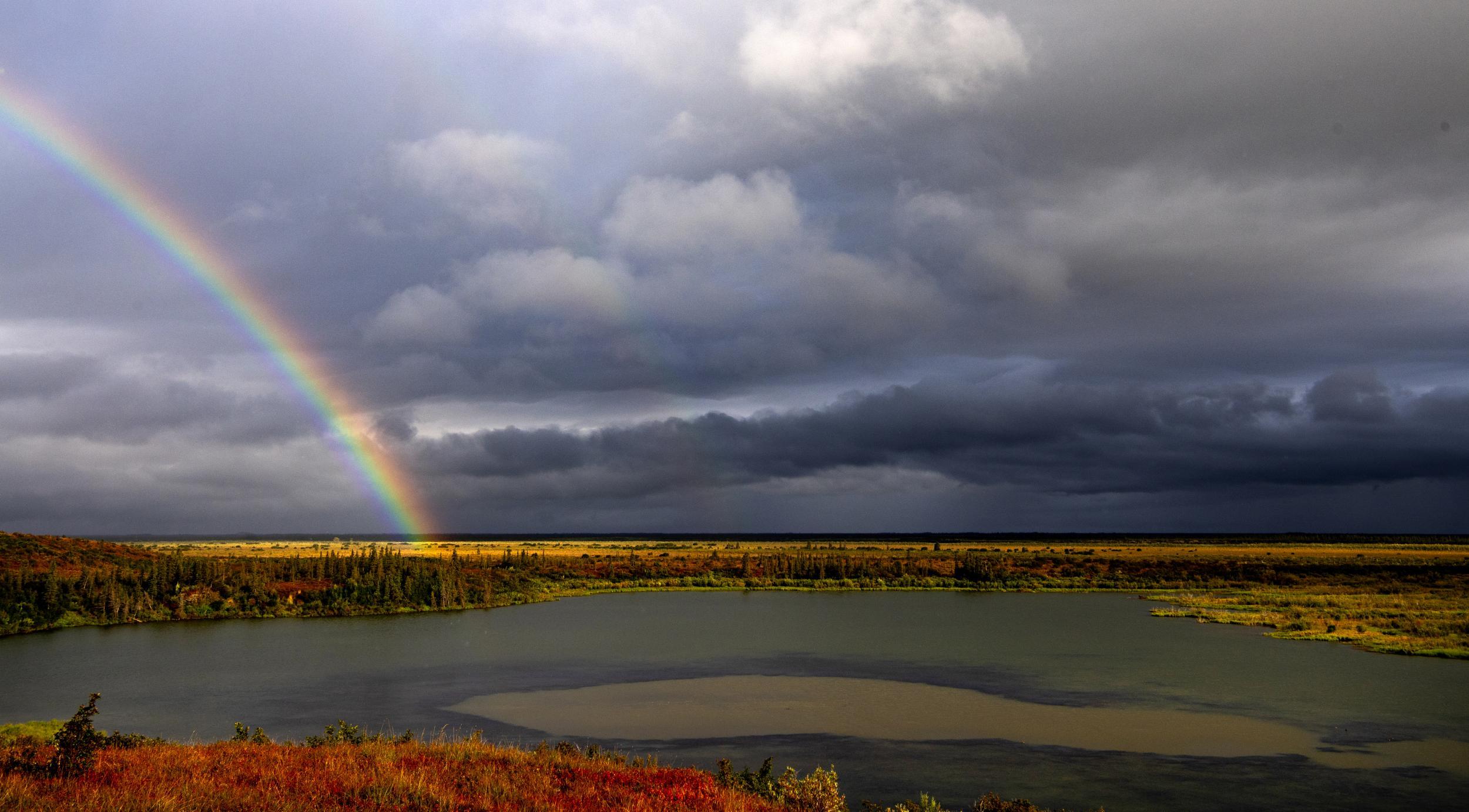
A rainbow shines over Esieh Lake, with the seep field of methane gas visible in the centre. (Jonathan Newton/Washington Post)

Sounding devices identified huge holes at the lake's bottom. Esieh Lake is shallow, averaging about a metre deep. However, the gas bubbles cluster indicate a floor beneath that suddenly drops, a plunge so deep all visible signs of plant life vanish and measurements indicate the lake dips to about 15 metres in one area and close to 4.5 metres in another. Those seep clusters were named W1 and W2.

When the scientific team examined samples of the gas in the laboratory they identified the chemical signature of a "geological" origin. The methane venting out of the lake emerged from a reservoir of far older fossil fuels than would be the case if direct thawing of frozen Arctic soil represented its source. The extrapolation seemed clear enough; should fossil fuels buried for thousands of years now be exposed to the atmosphere, the situation would represent a clear risk of greater warming threat.

As a result of the unremitting Arctic cold, carbon-rich remains of countless generations of vegetation that died and sank below the surface of the Arctic where permafrost soils can reach depths of 1,500 metres were preserved for tens of thousands of years if not more. The research team examined the presence of thermokarst lakes, formed when wedges of ice within permafrost melt to create voids that fill with water.
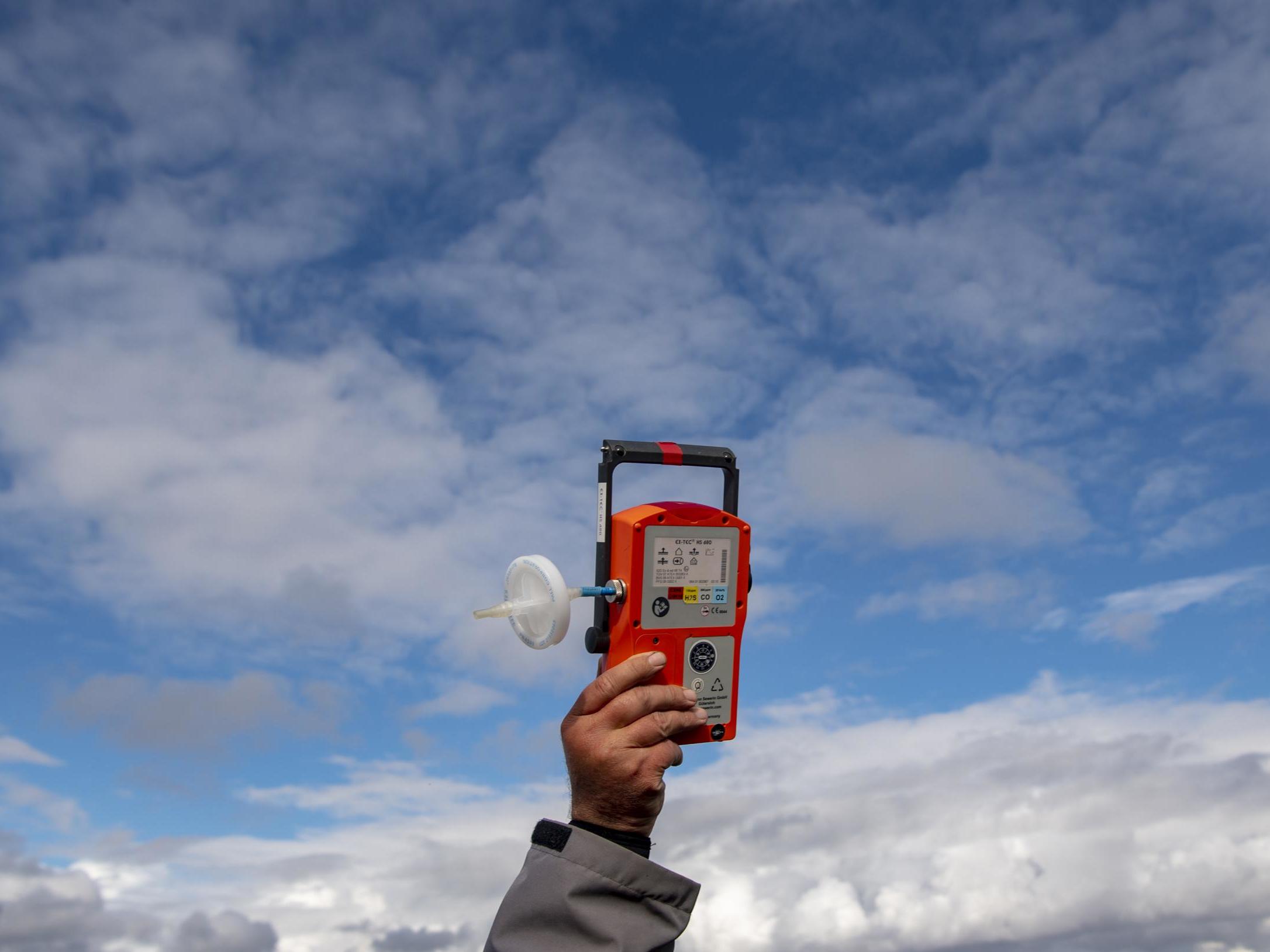
Frederic Thalasso, of the Center for Research and Advanced Studies at the National Polytechnic Institute in Mexico, uses a gas analyzer at Esieh Lake. (Jonathan Newton/Washington Post)
Continuing growth of those lakes formed in the tundra could more than double the greenhouse gas emissions emanating from Arctic soil by 2100. The use of instrumental gas measurements around the lake identified Esieh Lake emissions to be extremely high, identified with fossil fuels. Aside from methane, measurement instruments detected ethane, butane and propane representing classic signatures of fossil origin.
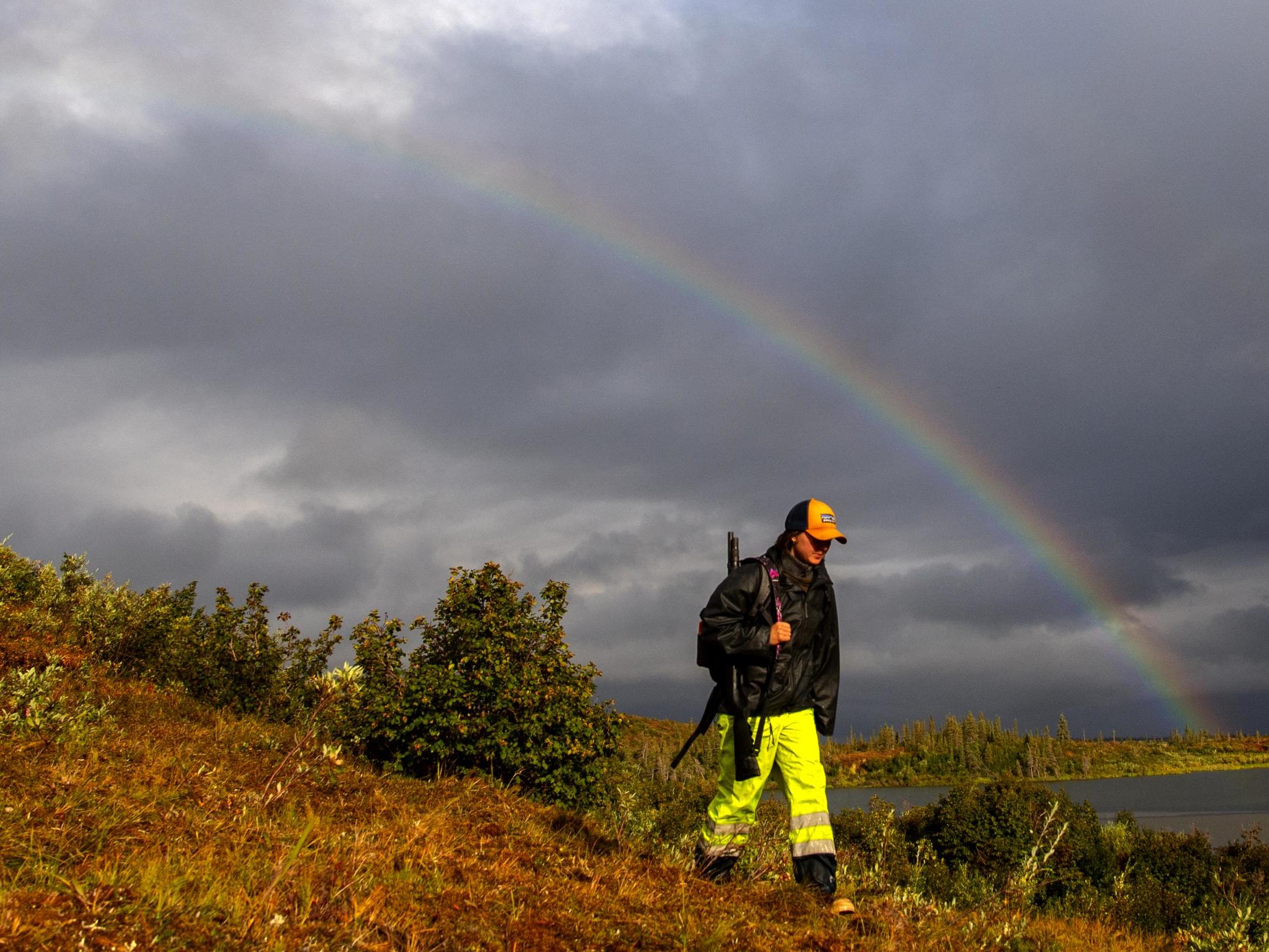
Graduate student Janelle Sharp who accompanied researcher Katey Walter Anthony to Esieh Lake. The team brought shotguns as protection against grizzly bears, which frequent the area. (Jonathan Newton/Washington Post)

Labels: , , , ,

Thursday, July 19, 2018

“Tundra be Dammed: Beaver Colonization of the Arctic.”

"That's when I started getting interested in beavers [speculating what species in a warming Arctic would be next to colonize its range]. These guys are small, highly industrious engineers."
"We have caught the beavers in the act. We are really only at step two of a ten-step process in understanding what is going on, and the implications of it."
"Is it a good thing or a bad thing? Put it this way: if someone went into a land manager's office and wanted to get a permit to do all the work that the beavers are doing in the Arctic right now, it would be a lot of paperwork. But I see these guys as facilitating change in the Arctic -- and accelerating the changes that are already underway."
"It’s kind of the next wildlife you’d expect in tundra, but with much bigger implications."
"I love the fact the beaver is the Canadian national animal. You just need to look at the map to see how well beavers recolonized the rest of North America after over-trapping."
"They are now in all the lower 48 states, and Alaska is the last standing -- and it's going to fall."
Ken Tape, associate professor, University of Alaska Fairbanks
Beaver (Castor canadensis) family enjoy the fruits of their considerable labors, Denali Nat'l Park, Alaska.  Getty Images/iStockphoto
"We do not know how beavers reached the Beaufort Coastal Plain, but they would have had to cross a mountain range or swim in the sea."
Yukon biologist Tom Jung, northern Yukon Territory
Beavers are everywhere there is water that can be dammed, a lodge built to hold a beaver colony and ample supplies of poplar from nearby forest enclaves are present, where the beavers with their sharp incisors easily cut through the thickness of a mature tree trunk, judging where the cut should go and where the tree will fall. Loggers know to cut a notch in a tree trunk to control the fall of the trees they're harvesting. Can it be possible that the logging industry studied the successes of beavers and simply emulated them in harvesting techniques?

Or does their similarity of operational techniques in best-practise logging reveal that beavers whom nature has equipped so splendidly to manipulate its natural surroundings to create a habitat for itself and in the process one that will appeal to other forest creatures from aquatic animals to wolves, coyotes, foxes, moose and more taking advantage of the industrious beavers' foresight in altering an environment to make it more likely to grow vegetation attractive to the greater populations of wildlife, indicate it has been as naturally endowed as humans to alter its landscape?

Beaver were once  viewed as a natural resource of great commercial value, when its pelts were desired for human garments and headgear. Certainly a renewable resource, but yet one so mercilessly hunted and trapped that the trapping profession that was so robust for far too long, collapsed along with the kind of culture that saw them as furnishings for sartorial purposes. With the absence of the beaver resulting from near-extinction in areas they had long been known to inhabit, the natural environment changed too, absent their engineering know-how and custodial care.

The landscape changed in their absence and all the creatures that so hugely depended on their presence in building dams, creating beaver meadows and ponds that in turn proved perfect habitat for both vegetation and animals, began to vanish; the previous lush presence of both turned barren as the lakes dried up, the vegetation receded, the animals looked elsewhere for the perfect environment where they could exist. Since then, however, those hardy, industrious animals have made a comeback, their presence common all over North America, including Mexico.
A beaver swims in a pond in Elk Island National Park east of Edmonton Alta. Max Maudie/Edmonton Sun
And now, it seems, with the advent of noticeable climate change and the warming effect that has melted areas of the Arctic's glaciers, altering the tundra in Alaska, beaver are now settling that far north. It's likely a toss-up which arrived first in the area known for its permafrost -- gradually losing the permanence of the tundra frozen rigid in frost -- the beavers or the moose now venturing out of forests to feed on woody shrubs, since beaver habitation is known to attract moose for the salubrious effect it has overall on the environment.

Dr. Tape and his colleagues have been studying the issue of the entrance of a previously unknown presence of animals venturing into the Alaskan tundra known more for the presence of Grizzlies than of beavers. They produced a new research paper titled Tundra be Damned: Beaver colonization of the Arctic. Never having actually seen a beaver living and working in a tundra environment, Dr. Tape and his fellow researchers began studying decades' worth of satellite images featuring a 18,293-square kilometre area of permafrost in northwest Alaska.

Aided immeasurably by the capacity of satellites to photograph images from space, they discovered 56 new beaver pond complexes in a landscape they knew to previously be absent of the presence of beavers. The beavers' activities have wide-ranging consequences, 'improving' the natural presence of geological features favourable to the presence of a wide variety of vegetation and animals forming a complete ecosystem in a chain of existence favoured by nature. As beavers dam up rivers and streams creating ponds, wetlands proliferate.

The ecosystem that has been altered is healthier when dams filter out pollutants and the resulting ponds fill with new life and the risk of flooding becomes more remote. Changes in the Arctic have the potential to be quite dramatic. A beaver pond that expands, washing over permafrost, degrades frozen ground, rinses soils away, releases carbon dioxide and methane in the process, as the frozen area no longer holds the carbon dioxide its melted state releases. The presence of beaver and their activity accelerates the permafrost retreat.  
Beavers at home
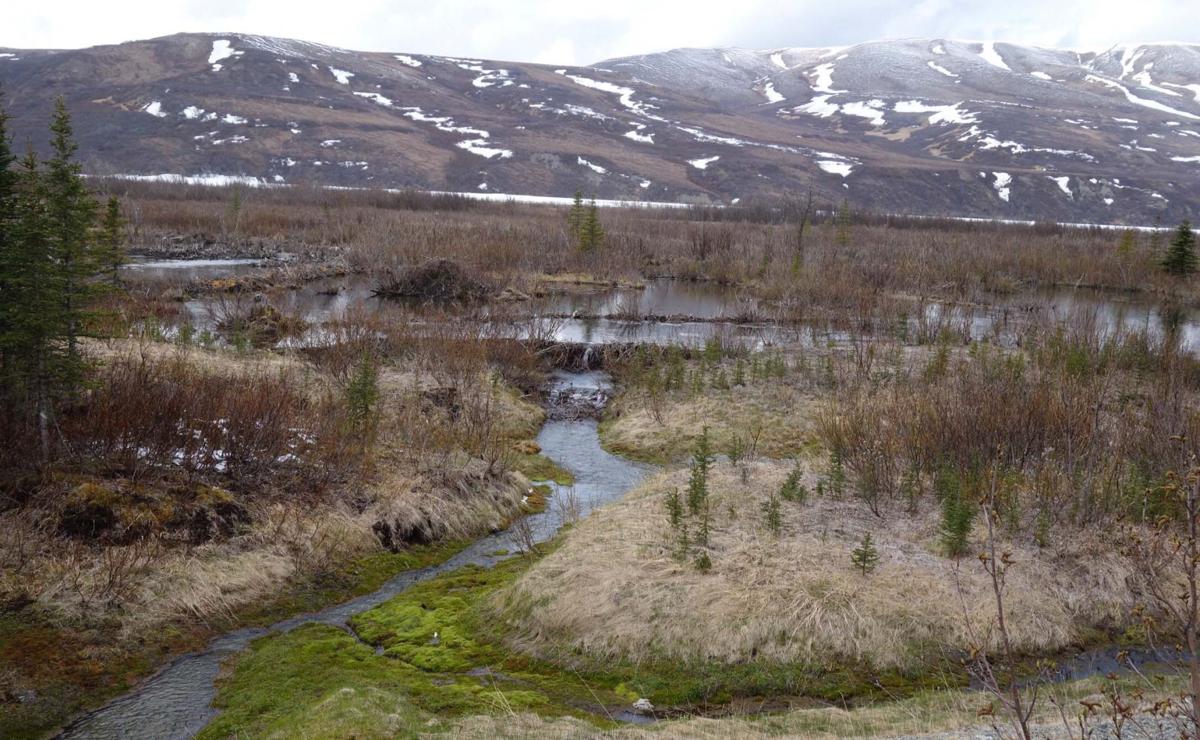
Signs of the American beaver in Alaska include a dam on Phelan Creek near Isabel Pass in the Alaska Range. Photo: Ned Rozell

Labels: , , , , , , ,

 
()() Follow @rheytah Tweet